124 |
P a g e
www.ijarse.com
ASSESSMENT OF THE EFFICIENCY OF
CORRELATION COEFFICIENT FOR FACE
AUTHENTICATION
1Sheela Shankar,
2V.R Udupi
1
Department of Electronics & Communication Engg,
KLE Dr. M. S. Sheshgiri CET, Udyambag, Belgaum, (India)
2
Department of Electronics and Communication Engg,
Gogte Institute of Technology, Belgaum, (India)
ABSTRACT
Face recognition being a robust method of authentication has seen tremendous growth in the recent decades. Face
authentication being an instance of face recognition involves one-to one mapping of probe face images with the
gallery images. The aim of this paper is to test the effectiveness of correlation coefficient for use in face
authentication. The images under test were selected from various standard face databases and the results obtained
were in good agreement with respect to one-to-onematching of faces, although the hypothesis need not be true in
case of one-to-many.
Keywords: Authentication, Correlation coefficient, Face recognition.
I INTRODUCTION
Face recognition is currently gaining wide acceptance as a powerful tool to identify faces uniquely for security
related issues [1]. There are many techniques used to deploy this. However the techniques are well suited for
recognizing faces with considerable amount of variations with respect to illumination, occlusions, skin tone, facial
expressions, poses [2], etc. The techniques used in this regard are artificial neural networks [3,4,5,6,7],principal
component analysis (PCA) [8], eigenface method [9], support vector machines (SVM) [10], etc. Though these
techniques are robust, they are complex in terms of implementation. The proposed technique focusses on the
scenarios of authentication rather than recognition, where one-to-one matching of face image is concerned.
The proposed technique focuses on an easy to use method which can serve as an alternative to the above discussed
methods. It uses correlation coefficient to distinguish between like and unlike images. Also, the effectiveness of
using correlation coefficient in this regard, is assessed.
The rest of the paper is organized as follows. Face recognition and authentication are briefed in Section 2. A detailed
125 |
P a g e
www.ijarse.com
in Section 4. Section 5 deals with the obtained results. Sections 6 and 7 deals with the conclusion and future scope of
the study, respectively.
II FACE RECOGNITION AND AUTHENTICATION
2.1. Face recognition
Face recognition generally refers to different application scenarios. It can be either identification or authentication.
In either case, the images of faces are used in the system. The stored set of faces is usually called the training set or
the galley. The face images used in the later stages are called the testing images or the probes. The latter is matched
against the former. The block diagram of face recognition is shown in Fig.1. The first face deals with detecting the
presence of a face in the given image. If a face is found, then specific features are extracted and later subjected to
classification, which yields in proper recognition of a face.
Fig.1. The basic architecture of the face recognition system
2.2. Classification of authentication
Authentication techniques can be broadly classified into three classes [11]:
1) Something-you-are: deals with the bodily characteristics that are unique identification of a person. Such
techniques are called biometric based and are discussed in detail, throughout the paper.
2) Something-you-know: as the name implies, it is secret information known only to the user. Passwords and PIN
numbers are better examples to substantiate this.
3) Something-you-have: can be objects or items to authenticate, for instance, ATM cards, passport, keys, etc.
2.3. Face authentication v/s recognition
In case of authentication, there is one-to-one matching, i.e. the face under test is matched against the training
database for a claimed identity. The claimed identity is considered to be authenticated if the extent of the match
exceeds some fixed threshold. In other words, if a subject stands in front of a face authentication system and claims
to be a particular user, the system will only check if the subject is the claimed user or not. In recognition scenario,
one-to-many matching is done and the face under test is matched against all the faces in the training dataset to find
the best match. Recognition is more difficult than authentication because the large set of data in the training database
is more prone to incorrect recognition. Secondly, the entire training database is to be parsed on each recognition
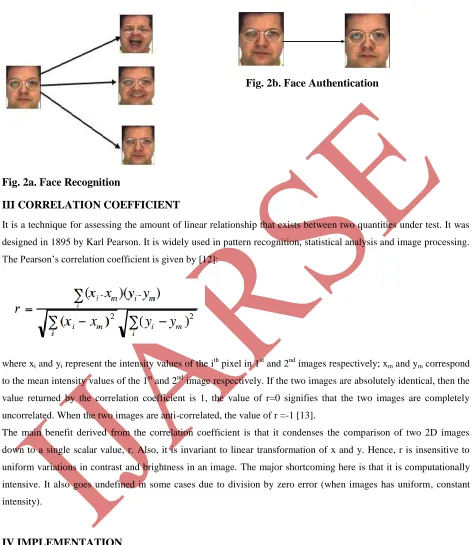
attempt. Fig.2a,b gives a pictorial view of the differences in face recognition and authentication.
Detection Feature
Extraction
126 |
P a g e
www.ijarse.com
Fig. 2b. Face Authentication
Fig. 2a. Face Recognition
III CORRELATION COEFFICIENT
It is a technique for assessing the amount of linear relationship that exists between two quantities under test. It was
designed in 1895 by Karl Pearson. It is widely used in pattern recognition, statistical analysis and image processing.
The Pearson’s correlation coefficient is given by [12]:
where xi and yi represent the intensity values of the i
th
pixel in 1st and 2nd images respectively; xm and ym correspond
to the mean intensity values of the 1st and 2nd image respectively. If the two images are absolutely identical, then the
value returned by the correlation coefficient is 1, the value of r=0 signifies that the two images are completely
uncorrelated. When the two images are anti-correlated, the value of r =-1 [13].
The main benefit derived from the correlation coefficient is that it condenses the comparison of two 2D images
down to a single scalar value, r. Also, it is invariant to linear transformation of x and y. Hence, r is insensitive to
uniform variations in contrast and brightness in an image. The major shortcoming here is that it is computationally
intensive. It also goes undefined in some cases due to division by zero error (when images has uniform, constant
intensity).
IV IMPLEMENTATION
To check the effectiveness of the correlation coefficient, the testing schema involved constructing a database of
faces by selecting 4 faces each from 5 different standard face databases, like AR face database [14], Japanese
127 |
P a g e
www.ijarse.com
face images were of the front view, but a little of side movements were allowed. The first face image from each of
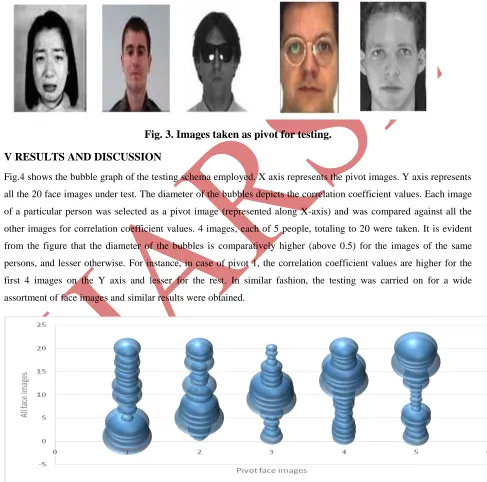
the database was taken as a pivot. Fig. 3 shows a set of pivot images used for the study. Each pivot image was tested
for correlation against all the other images in the database, including itself. Both, one-to-one and one-to-many
matching of face images was undertaken. Before subjecting the images to the test, they were all normalized. The
graphical analysis of the obtained results is given in the results and discussion section.
Fig. 3. Images taken as pivot for testing.
V RESULTS AND DISCUSSION
Fig.4 shows the bubble graph of the testing schema employed. X axis represents the pivot images. Y axis represents
all the 20 face images under test. The diameter of the bubbles depicts the correlation coefficient values. Each image
of a particular person was selected as a pivot image (represented along X-axis) and was compared against all the
other images for correlation coefficient values. 4 images, each of 5 people, totaling to 20 were taken. It is evident
from the figure that the diameter of the bubbles is comparatively higher (above 0.5) for the images of the same
persons, and lesser otherwise. For instance, in case of pivot 1, the correlation coefficient values are higher for the
first 4 images on the Y axis and lesser for the rest. In similar fashion, the testing was carried on for a wide
assortment of face images and similar results were obtained.
128 |
P a g e
www.ijarse.com
VI CONCLUSION
The paper dealt with testing the effectiveness of correlation coefficient for one-to-one and one-to-many matching of
face images for authentication. It was observed that the obtained results were in good agreement of using the
correlation coefficient for authentication specific to one-to-one matching. Hence the proposed technique can be used
in scenarios where the authentication is restricted to one-to-one matching of face images.
VII FUTURE SCOPE
Techniques to enhance the efficiency of correlation coefficient with respect to one-to-many matching should be
undertaken. Major concern should also be laid on optimizing the time complexity of the correlation coefficient.
VIII ACKNOWLEDGEMENTS
The authors are immensely grateful to the valuable suggestions and help provided by the Department of Electronics
and Communication Engineering, KLE Dr. M.S. Sheshagiri College of Engineering and Technology, Udyambag,
Belgaum, Karnataka.
REFERENCES
[1] Zhao, Wenyi, Rama Chellappa, P. Jonathon Phillips, and Azriel Rosenfeld. "Face recognition: A literature
survey." Acm Computing Surveys (CSUR) 35, no. 4 (2003): 399-458.
[2] Xiaozheng Zhang, Yongsheng Gao, “Face recognition across pose: A review”, Pattern Recognition 42 (2009)
2876 – 2896, Elsevier.doi: 10.1016/j.patcog.2009.04.017
[3] Réda, Adjoudj, and Boukelif Aoued. "Artificial neural network-based face recognition." In Control,
Communications and Signal Processing, 2004. First International Symposium on, pp. 439-442. IEEE, 2004.
[4] Zhang ZhenQiu, Zhu Long, S.Z. Li, Zhang Hong Jiang, “Real-time Multi-View Face Detection”, Proceeding of
the Fifth IEEE International Face Conference on Automatic Faceand Gesture Recognition, pp 142-147, 20-21 May
2002.
[5] Rolf F. Molz, Paulo M. Engel, Fernando G. Moraes, Lionel Torres, Michel Robert,”System Prototyping
Dedicated to Neural Network Real-Time Image Processing”, ACM/SIGDA Ninth International Symposium on Field
Programmable Gate Arrays( FPGA 2001).
[6] Gavrila, D.M; Philomin, V., “Real-Time Object detection for Smart Vehicles”. International Conference on
Computer Vision (ICCV99), Vol. 1, 20-25 September 1999.
[7] H. A. Rowley, S. Baluja, T. Kanade, “Neural Network-Based Face Detection”, IEEE Transactiono n Pattern
129 |
P a g e
www.ijarse.com
[8] Yang, Jian, David Zhang, Alejandro F. Frangi, and Jing-yu Yang. "Two-dimensional PCA: a new approach to
appearance-based face representation and recognition." Pattern Analysis and Machine Intelligence, IEEE
Transactions on 26, no. 1 (2004): 131-137.
[9] Turk, Matthew A., and Alex P. Pentland. "Face recognition using eigenfaces." In Computer Vision and Pattern
Recognition, 1991. Proceedings CVPR'91., IEEE Computer Society Conference on, pp. 586-591. IEEE, 1991.
[10] Guo, Guodong, Stan Z. Li, and Kap Luk Chan. "Face recognition by support vector machines." In Automatic
Face and Gesture Recognition, 2000. Proceedings. Fourth IEEE International Conference on, pp. 196-201. IEEE,
2000.
[11] Merkow, M. & Breithaupt, J. 2006. Information Security: Principles and Practices.Pearson Prentice Hall.
[12] J.L.Rodgers, W.A. Nicewander, “Thirteen Ways to Look at the Correlation Coefficient”, The American
Statistician, February 1988, Vol. 42, No. 1, pp.59-66
[13] Eugene K . Jen, Roger G.Johnston, “The Ineffectiveness of Correlation Coefficient for Image Comparisons”,
Research Paper prepared by Vulnerability Assessment Team, Los Alamos National Laboratory, New Mexico
[14] Available at: http://www2.ece.ohio-state.edu/~aleix/ARdatabase.html
[15] Available at: http://kasrl.org/jaffe.html