Available Online at www.ijcsmc.com
International Journal of Computer Science and Mobile Computing
A Monthly Journal of Computer Science and Information Technology
ISSN 2320–088X
IJCSMC, Vol. 4, Issue. 10, October 2015, pg.403 – 412
RESEARCH ARTICLE
OFFLINE HANDWRITTEN
SIGNATURE VERIFICATION
SYSTEM USING NEURAL NETWORK
Hadeel J.Jriash¹, Nada A. Z. Abdullah²
¹Departmentof Computer Science, Baghdad University, Iraq
²Department of Computer Science, Baghdad University, Iraq
¹ [email protected]; ² [email protected]
Abstract— The signature of a person is an important biometric attribute of a human being which can be used to
authenticate human identity. Various complex methodologies in the past have been proposed for signature
verification through feature extraction. This paper presents a new method for off-line handwritten signature
verification that depends on a discrete Radon transform (DRT) as feature extraction, and probabilistic neural
network (PNN) as a verifier. The proposed system discriminates between forgery and original signature. The
proposed system has three main steps; pre-processing to enhance the signature image, feature extraction and
verification using the probabilistic neural network. The system trained using English signatures dataset of 54
persons. Satisfactory results are obtained with 90% Accuracy of system, 10.0% equal error rate (EER), 8.7% false
acceptance rate (FRR), 11.4 false rejection rate (FAR) for skilled forgeries on our independent database.
Keywords— Offline handwritten signature, verification, DRT, PNN.
I. INTRODUCTION
Signature is a special case of handwriting which includes special characters and flourishes. Many signatures can
be unreadable. They are a kind of artistic handwriting objects. However, a signature can be handled as an image,
and hence, it can be recognized using computer vision and artificial neural network techniques [1].
Signature verification is an important research area in the field of personal authentication. The recognition of
human handwriting is important concerning about the improvement of the interface between human beings and
according to the acquisition of the data: On-line and Off-line. Online data record the motion of the stylus while
the signature is produced, and includes location, and possibly velocity, acceleration and pen pressure, as
functions of time. Off-line data is a 2-D image of the signature. Processing Off-line is complex due to the
absence of stable dynamic characteristics. The difficulty also lies in the fact that it is hard to segment signature
strokes due to highly stylish and unconventional writing styles [2]. Both offline and online systems are used to
detect various types of forgeries. Signature forgeries are classified as:
1. Random/simple or zero effort. The forger doesn’t have the shape of the writer's signature, but comes up
with a draw of his own
2. Simple /casual forgery. The forger knows the writers signature shape and tries to imitate it without
much practice.
3. Skilled forgeries. This is where the forger has unrestricted access to genuine signature model and
comes up with a forged sample.
In this paper new offline signature verification is presented. In the first step, pre-processing is initially applied to
the signature, then radon transform is applied to the signature image with a set of angles to obtain feature
vectors, and the results are fed into PPN classifier to verify the tested signature.
II. LITERATURE REVIEW
In [Coe 04] a system was developed to automatically authenticate offline handwritten signatures using the
discrete Radon transform (DRT) and a hidden Markov model (HMM). In this work Used a database of 924
signatures from 22 writers, the proposed system achieved an equal error rate (EER) of 18% when only
high-quality forgeries (skilled forgeries) are considered and an EER of 4.5% in the case of only casual forgeries [3].
[Ala08] presented a method for verifying handwritten signatures by using NN architecture. Various static (e.g.,
Height, slant, etc.) And dynamic (e.g., Velocity, pen tip pressure, etc.) Signature features are extracted and used
to train the NN. The resulting system performed reasonably well with an overall error rate (OER) in 3:3% (2.0%
FAR and 1.3% FRR), it was trained using five genuine signatures and one hundred zero-effort forgeries [4].
[Ooi10] proposed an offline signature verification based on discrete Radon transform (DRT), principle
component analysis (PCA) and probabilistic neural network (PNN). The proposed method was able to achieve
1.51%, 3.23%, and 13.07% equal error rate (EER) for random, casual, and skilled forgeries respectively [5].
[Mar 10] presented a novel off-line signature verification system. An ensemble of HMM-based classifiers was
trained, using both global and local Radon transform-based features. Local features are extracted from circular
retinas, An EER of 8.89% was achieved, which compares favorably to an EER of 12.9% (an improvement of
31.1%) when only global features are considered [6].
[Rad12] proposed a new offline signature recognition system based on Radon Transform, Fractal Dimension
(FD) and Support Vector Machine (SVM). In the first step, projections of original signatures along four
specified directions with angles 0°, 45°, 90° and 135° have been performed using radon transform. Then, FDs of
four obtained vectors are calculated to construct a feature vector for each signature. These vectors are then fed
into SVM classifier for recognition of signatures. The results indicated that the proposed method has a high
[Mad13] introduced a new approach for off-line signature verification and recognition that depends on an
artificial neural network. Which discriminate between two classes (i) forgery and (ii) original signature. The
results showed that the proposed algorithm more efficient than most of the existing techniques [2].
[Push13] presented a Novel technique of Signature Verification by combining Zernike moments with Radon
transform values at different angles of projection from the user's Signature pattern and then forming a statistical
state machine with Hidden Markov Model and PLS Regression. The results showed that the proposed system
verifies signature with an accuracy of 98% with false acceptance rate of 8% [8].
[Adi14] introduced a method of handwritten signature verification using a neural network approach. The method
used features extracted from preprocessed signature images. The extracted features are used to train a neural
network using error back propagation training algorithm. The network could classify all genuine and forged
signatures correctly. The correct classification rate of the system is 82.66% in generalization [9].
[PAL15] introduced a method for signature verification was done by means of image processing, geometric
feature extraction and by using neural network techniques. For training and testing of the system many
signatures are used. This method was able to achieve Accuracy about 86.25% [10].
III. THE PROPOSED VERIFICATION SYSTEM
Generally, an offline handwritten signature verification system includes data acquisition, pre-processing, feature
extraction and encoding, as well as matching as shown in Fig. 1. These processes will be further discussed in the
following sections.
Fig.1 General Overview of Static signature verification system
A. Data Acquisition
In offline signature verification system, images of the signatures are scanned using a digital scanner. Scanned
images are stored digitally for offline processing. [12]. In this work dataset consists of 55 original signatures and
Fig.2 Collection of Database
B. Preprocessing
The purpose of this step is to make signature standard and ready for feature extraction. The pre-processing
stage improves quality of the image and makes it suitable for feature extraction [13] .The preprocessing stage
includes the following steps and Shown in Fig.3:
1)Convert the image into Gray
In present technology, almost all images capturing and scanning devices use color. Therefore, we also used a
color scanning device to scan signature images. A color image consists of a coordinate matrix and three color
matrices. Coordinate matrix contains x, y coordinate values of the image. The color matrices are labeled as red
(R), green (G), and blue (B). Techniques presented in this study are based on gray scale images, and therefore,
scanned or captured color images are initially converted to gray scale [14] using the following equation[15]:
3
y) blue(x, y)
green(x, y)
red(x, y)
gray(x, (1)
2) Contrast Stretching
Contrast stretching aims to improve the contrast in the low-contrast image that occurs due to poor illumination,
lack of dynamic range in the sensor, or wrong lens setting. It operates by stretching the range of pixel intensities
of the input image to occupy the whole dynamic range in the output image. Using the following equation [16]:
255 * min max
min )
, ( ) , (
O O
O y x O y x N
(2)
3) Noise Reduction
Noise reduction (also called “smoothing” or “noise filtering”) is one of the most important processes in image
processing. Median filter is widely used for smoothing and restoring images corrupted by noise. It is a
non-linear process useful especially in reducing impulsive or salt-and-pepper type noise. In a median filter, a
it determines the intensity of the pixel located in the middle of the window. Median Filter is used in this study
due to its edge preserving feature [1].
4) Binarization
There are 256 gray levels of a gray scale image. We need a binaries image having only white and black values.
Each pixel is stored as a single bit (0 or 1). [17] Working in this form is more useful than any other form, since
it is easy to work with 2 bits representation of image. The required time to process colored image is longer than
binary one [18]. We used adaptive thresholding technique for differentiating the signature pixels from the
background pixels by using the following equations:
Min=mean-(Alpha*STD) (3)
Threshold=min (4)
Where the value of Alpha in equation 3 is either 1.4 or 2 based on the contrast of image. If the image is low
contrast, the value of Alpha=2 otherwise the value of Alpha=1.4 that is for better result.
5) Cropping Signature Image
In this stage the Region of Interest (ROI) is determined using auto cropping approach. ROI is the signature
object itself. Using cropping we segment the signature smoothly. Automatic cropping saves more work and
reduces a processing time. The height and width of the first and last pixels in the signature are founded in this
step to cut the signature.
6) Image resizing
After clipping, height and width of signatures vary from person to person and, sometimes, even the same person
may use different size signatures. First, we need to eliminate the size differences and obtain a standard signature
size for all signatures. After this normalization process, all signatures will have the same dimensions. In this
paper, we used a normalized size of 200x200 pixels for all signatures.
(a)
(d) (e)
Fig.3:(a) Original Signature. (b) Gray scale. (c) Denoising . (d) Binarization. (e) Cropping
C. Feature Extraction
Feature Extraction is the key process to achieve high accuracy in signature verification [19]. The features which
we have extracted in the proposed system to generate feature vector that fed to PNN based on discrete Radon
transform (DRT). This stage includes two steps: feature vector extraction using DRT for each signature image
on different directions, then feature reduction.
1) Discrete Radon Transform (DRT)
In recent years the discrete radon transform have received much attention. The Radon Transformation is a
fundamental tool which is used in various applications such as radar imaging, geophysical imaging,
nondestructive testing and medical imaging [20]. DRT is chosen to transform the signature images into a feature
space. The radon transform is projections of an image matrix along specified directions .A projection of a
two-dimensional function f(x, y) is a set of line integrals. The radon transform computes the line integrals from
multiple sources along parallel paths, or beams, in a certain direction. The beams are spaced 1 pixel unit apart.
To represent an image, the radon transform takes multiple, parallel-beam projections of the image from different
angles by rotating the source around the center of the image. Projections can be computed along any angle.[7]as
shown in fig. 4.
Subsequently, the DRT of each signature is calculated, where each column represents a projection or shadow of
the original image at a certain angle. After these projections are processed and normalized, they represent a set
of feature vectors (observation sequence) for the signature.[21] DRT can be expressed as follows[3]:
1
,...,
2
,
1
;
iN
N
j
WijIi
Rj
(6)Where:
Rj= the cumulative intensity of the pixels that lie within the jth beam.
Ψ= total pixels in an image.
wij= the contribution of the ith pixel to the jth beam-sum.
Ii= the intensity of the ith pixel.
Nφ= non-overlapping beams per angle Nθ= number of total angles
The DRT, as a feature extraction technique, has several advantages. Although the DRT is not a shift invariant
representation of a signature image, shift and scale invariance is ensured by the subsequent image processing.
Each signature is a static image and contains no dynamic information. Since the feature vectors are obtained by
calculating projections at different angles, simulated time evolution is created from one feature vector to the
next, where the angle is the dynamic variable.
2) Feature Reduction
Radon transform computes the line integral along parallel paths in a certain direction.
In this work, we computed line integrals of the signature image at 4 different directions. The 4 directions
(orientations) from 0-180 degree with the interval of 45 and 30 degree have been selected empirically. Thus the
feature vector size becomes 637×4 for each image. This approach for feature extraction gives us a long feature
vector with 2548 elements that is inappropriate for classification purpose and take more memory to solve this
problem, we reduction this feature vector by using mean _max method.
When used the interval of 45 the radon transform is applied on the signature image with angles (45°, 90°,
135°and 180°). Then used mean _max method by compute mean for each 10 values in each angle to become the
feature vector size 64×4, then find the max value between four angle to become the size in the end 64×1.
In case of selected interval 30 the radon is perform with angles (45°, 75°, 105°and 135°). The mean-max
method also applied, mean for each 10 values is computed but remove all zero value from each angle vector to
become the length of feature vector 57×4 and find max ,thus 57×1 is the size of feature vector. The main
advantage of this method, it compresses the data without much loss of information. takes less processing time
and less space in memory.
D. Verification
In the verification stage, the system compares the extracted features from tested signature with the features
extracted from the corresponding signature in the database in order to verify the authenticity of the signature and
makes a final decision for verification as genuine or forged signature[10]. As verifier, in this paper the PNN is
structure, guaranteed to converge to an optimal classifier as the size of the representative training set increases
and training samples can be added or removed without extensive retraining.
1) Probabilistic Neural Network:
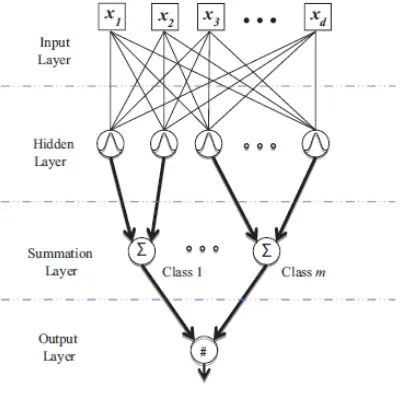
A Probabilistic Neural Network (PNN) is defined as an implementation of statistical algorithm called Kernel
discriminate analysis in which the operations are organized into multilayered feed forward network with four
layers: input layer, pattern layer, summation layer and output layer as shown in fig. 5. PNN learns more quickly
than many neural networks model and have had success on a variety of applications. Based on these facts and
advantages, PNN can be viewed as a supervised neural network that is capable of using it in system
classification and pattern recognition. [22]
Fig. 5 PNN structure
IV. PERFORMANCE EVALUATION
The results provided in this research used a total of 2640 signatures. Those 2640 signatures are comprised of 55
sets (i.e. from 55 different people) and, for each person there are 24 samples of genuine signatures and 24
samples of forgeries. separating data into training and testing sets is an important part. Typically, when separate
a data set into a training set and testing set, most of the data is used for training, and a smaller portion of the data
is used for testing. Analysis Services randomly samples the data to help ensure that the testing and training sets
are similar.
First, to train the system, a subset of this dataset was taken comprising of 14 genuine samples taken from each
of the 55 different individuals and 14 forgeries made by different person for one signature. The features
extracted from 14 genuine signatures and 14 forged signatures for each person were used to train a neural
network. Then to test the system 10 authentic and 10 forged samples for every individual is used. The total
testing set consists of 1100 samples. After training The PNN, the system tested to check the result of each tested
signature to evaluate the performance of the proposed system.
In evaluating the performance of a signature verification system, there are two important factors: the false
rejection rate (FRR) of genuine signatures and the false acceptance rate (FAR) of forgery signatures and these
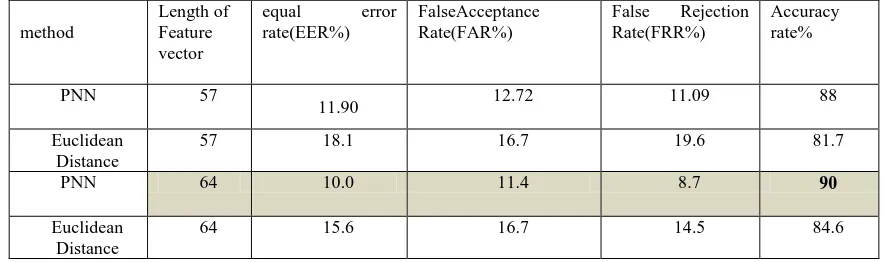
As mentioned above, we use different number of feature vector length (according to the different angles used in
DRT) 57 (when the angles used are (45°, 75°, 105°and 135°))and 64 (when the angles used are(45°, 90°,
135°and 180°)). as shown in Table I. The feature vector of length 64 gives better result than of 57 using PNN.
It is interesting to discover that longer feature length leads to better result.
Table I. Proposed system Performance evaluation using PNN
Length of Feature vector
equal error rate(EER%)
False Acceptance Rate(FAR%)
False Rejection Rate(FRR%)
Accuracy rate%
57
11.90 12.72 11.09 88
64 10.0 11.4 8.7 90
Next, we investigate the performance of DRT by using (Euclidean) distance measure for skilled forgeries
compared with PNN. The results illustrated in Table II for feature vector length 57and 64.
Table II Proposed System performance evaluation using PNN and Euclidean
method
Length of Feature vector
equal error rate(EER%)
FalseAcceptance Rate(FAR%)
False Rejection Rate(FRR%)
Accuracy rate%
PNN 57
11.90 12.72 11.09 88
Euclidean Distance
57 18.1 16.7 19.6 81.7
PNN 64 10.0 11.4 8.7 90
Euclidean Distance
64 15.6 16.7 14.5 84.6
As seen above PNN gives good results values compare to Euclidean distance.
V. CONCLUSIONS
This paper proposed a new method for off-line handwritten signature verification that depends on a discrete
Radon transform (DRT), and probabilistic neural network (PNN).The high accuracy is feasible to filter the
forgery from the genuine signature, especially for skilled forgery; while the speed of the PNN is very favourable
in real-world application. The results are encouraging and thus should motivating the research on skilled forgery
detection especially for offline handwritten signature, and use of additional features improving verification
results and increasing feature dimensionality.
REFERENCES
[1] Cemil OZ, Fikret Ercal, Zafer Demir," Signature Recognition and Verification with ANN",Turkey,2003.
[2] M. D. Malekar,S.Patel," Off-line SignatureVerificationUsingArtificialNeuralNetwork ", International Journal of Emerging Technology and Advanced Engineering, Vol. 3, Issue 9, Sep 2013.
[4] A.McCabe, J. Trevathan and W.Read," Neural Network-based Handwritten Signature Verification ", JOURNAL OF COMPUTERS, VOL. 3, NO. 8, AUGUST 2008.
[5] O.Shih, A. Teoh," Offline Signature Verification through Probabilistic Neural Network",WSCG 2010.
[6] M. Panton, H. Coetzer," Off-line signature verification using ensembles of local Radon transform-based HMMs ", South Africa,2010.
[7] M.Radmehr, S.M.Anisheh, I.Yousefian," Offline Signature Recognition using Radon Transform ", World Academy of Science, Engineering and Technology,Vol:6, No:2, 2012.
[8] K. N. Pushpalatha , A. Kumar Gautham, D. R.Shashikumar," Offline Signature Verification with Random and Skilled Forgery Detection Using Polar Domain Features and Multi Stage Classification-Regression Model ", International Journal of Advanced Science and Technology ,Vol.59, (2013), pp.27-40.
[9] A. Kapil, J. Singh, V. Srivastava," A Hybrid Approach for Offline Signature Verification using Artificial Neural Networks", International Journal of Information & Computation Technology, Vol.4, No. 12 (2014), pp. 1113-1121.
[10] P.V.HATKAR,B.T.SALOKHE,"OFFLINE HANDWRITTEN SIGNATURE VERIFICATION USING NEURAL NETWORK"JOURNAL OF INFORMATION, KNOWLEDGE AND RESEARCH INELECTRICAL
ENGINEERING,NOV 14 TO OCT 15 ,VOL – 03.
[11] S. Garhawal, N.Shukla," A Study on Handwritten Signature Verification Approaches ", International Journal of Advanced Research in Computer Engineering & Technology (IJARCET), Vol 2, August 2013.
[12] P. Kumar, S. Singh ,A. Garg ,N. Prabhat," Hand Written Signature Recognition & Verification using Neural Network ", International Journal of Advanced Research in Computer Science and Software Engineering, Vol 3, March 2013.
[13] Y.Moshtak,"Hand Written Hindi Numerals Recognition System",2011.
[14] M. Jasmine, K.Murugesan,S.R.Inbathini,A.Jabeena,K.S.Tej," Bank Cheque Authentication using Signature ", International Journal of Advanced Research in Computer Science and Software Engineering, Vol. 3, May 2013.
[15] B. Al-Mahadeen and M.S. AlTarawneh," Signature Region of Interest using Auto cropping ", IJCSI International Journal of Computer Science Issues, Vol. 7, No 4, March 2010.
[16] N.Rajpal ,B. Arora," A New Technique for Handwritten Offline Signature Authentication System ", International Journal of Advanced Research in Computer Science and Software Engineering, Vol 4, July 2014.
[17] S. Venturas, I. Flaounas," Study of Radon Transformation and Application of its Inverse to NMR", 4 July, 2005.
[18] A. ABDELRAHMAN, A. ABDALLAH," Signature Verification System Based on Support Vector Machine Classifier", The International Arab Conference on Information Technology , ACIT’2013.