Available Online atwww.ijcsmc.com
International Journal of Computer Science and Mobile Computing
A Monthly Journal of Computer Science and Information Technology
ISSN 2320–088X
IJCSMC, Vol. 4, Issue. 5, May 2015, pg.1101 – 1107
RESEARCH ARTICLE
Mapping of XML to Sparse Table Using Relational
Engine for P2P Databases: Implementation
SAURABH VYAS
*, SHRUTI KOLTE, SONALI BODKHE
PG SCHOLAR, Department of CSE
PROFESSOR, Department of CSE
HOD, Department of CSE
GHRAET, NAGPUR, INDIA
[email protected]@[email protected]
Abstract- In this module, user has to give the query for the further propose and to obtain the optimized query. The wide spread use of the Web has originated several new data management problems, such as extracting data from Web pages and making databases accessible from Web browsers, and has renewed the interest in problems that had appeared before in other contexts, such as querying graphs, semi structured data and structured documents. Several systems and languages have been proposed for solving each of these Web-data management problems, but none of these systems addresses all the problems from a unified perspective. XML is commonly supported by SQL database systems. However, existing mappings of XML to tables can only deliver satisfactory query performance for limited use cases. Most of the existing link analysis algorithms treat a web page as a single node in the web graph. However, in most cases, a web page contains multiple semantics and hence the web page might not be considered as the atomic node. In this paper, the web page is partitioned into blocks using the vision-based page segmentation algorithm. Comparing to other existing techniques, our approach is independent to underlying documentation representation such as HTML and works well even when the HTML structure is far different from layout structure. Genetic Algorithm can be used in this query technique.
Keywords: VIPS, DOM Trees, Rewriter, Data Region Extraction.
I. INTRODUCTION
PROBLEM STATEMENT
This paper focuses on the problem of automatically extracting data records that are encoded in the query result
pages generated by web databases. In general, a query result page contains not only the actual data, but also other
―screen scraping.‖ An ideal data extraction process is able to digest target Web databases that are visible only as HTML
pages, and create a local, identical replica of those databases as a result. What is needed in this process is much more than
a Web crawler and set of Web site wrappers. A comprehensive data extraction process needs to deal with such
roadblocks such as session identifiers, HTML forms, and client-side JavaScript, and data integration problems such as
incompatible datasets and vocabularies, and missing and conflicting data. Proper data extraction also requires a solid data
validation and error recovery service to handle data extraction failures, which are unavoidable [1].
EXISTING SYSTEM
In general, XML query languages contain unconventional constructs that bring more challenges. With XML
schemas, the evaluation of such constructs can be greatly simplified: queries can be pre-evaluated against XML schemas.
For this reason, schemas are even more important for query processing in XML than in RDBMSs, as some XML query
constructs hide schema information and put an additional burden on query processing. Though normalization mappings
provide schema- and normalization-based optimizations, they can only support a Limited number of use cases. In
particular, we identify three use cases that are widely observed in enterprise applications but cannot be supported by
normalization mappings efficiently. Flexible schema. XML’s schema-less property is one of its major advantages over
other schema-first data models. In normalization mappings, schema design of primary-foreign keys requires full
knowledge of the XML schema, and cannot be applied to this use case. While the XML schema can be summarized from
the initial document set , later updates may cause expensive schema evolution and table repartitioning. Many small XML
documents. Enterprise applications often use many small XML documents rather than a few large ones. Normalization
mappings typically shred one XML document over many tables, which causes fragmentation of small XML documents.
As a consequence, the cost of XML reconstruction can be high. Many optional elements/attributes. By data
normalization, XML attributes are stored as additional columns in the tables of their parent elements. This strategy,
however, results in many sparse tables and incurs storage. Schema and normalization have a profound impact on query
processing in database systems. While XML is an ideal model for applications with flexible schemas, conventional query
processing for such XML data loses all schema and normalization-based optimizations. In this paper, we proposed a
novel mapping that resembles normalization for XML with flexible schemas. The key is to retain normalization through
logical sub-tables in one wide sparse table, which is physically represented by interpreted storage. Logical sub-tables are
maintained as metadata—the annotated DG—to reduce the cost of schema evolution. At query compilation time, the
annotated DG is used to eliminate joins. Experimental results demonstrate significant improvements of query
performance under the new mapping.[1][2]
DISADVANTAGES
• Extract method extracts only the actual data not extract other information’s such as navigational panels,
advertisements. Comments and so on.
• Does not remove irrelevant information from the query result page.
• It is not straightforward to determine which index will have the best performance for each query. In fact, index
PROPOSED SYSTEM
Converting an XML encoded dataset associated with each identified hierarchical structure, wherein for each
identified hierarchical structure said converting step includes the further steps of: determining a node element set for said
identified hierarchical structure of said XML encoded dataset, wherein each node element in said node element set is a
discrete level of said identified hierarchical structure of said dataset; determining one or more nodes of said XML
encoded dataset each node being an instance of a node element; allocating to each node a unique node identifier; and
generating an SQL node table containing one or more records, each record corresponding to a respective one of said
allocated node identifiers.[9]
According to a second aspect of the invention, there is provided an apparatus for converting an XML encoded dataset
into a minimal set of SQL tables, the apparatus including: a device for identifying at least one hierarchical structure in the
XML encoded dataset; and a device for converting an XML encoded dataset associated with each identified hierarchical
structure, the device including:
o A device for determining a node element set for the identified hierarchical structure of the XML
encoded dataset, wherein each node element in the node element set is a discrete level of the identified
hierarchical structure of the dataset;
o A device for determining one or more nodes of the XML encoded dataset, each node being an instance
of a node element;
o A device for allocating to each node a unique node identifier; and
o A device for generating an SQL node table containing one or more records, each record corresponding
to a respective one of the allocated node identifiers
According to another aspect of the invention there is provided a computer program product including a computer
readable medium having recorded thereon a computer program for implementing the method described above.
For each round, the DOM tree with its visual information corresponded to the current block (page for the first
round) is obtained from a web browser. Then, from the root node(s) of the DOM tree (e.g. DOM node), the block
extraction process is started to extract blocks from the DOM tree based on visual cues. Every DOM node is checked to
judge whether it forms a single block or not. If not its children will be processed in the same way. Separators among
these blocks are identified and the weight of a separator is set based on properties of its neighbouring blocks. The layout
hierarchy was constructed based on these separators. After constructing the layout hierarchy of the current round, each
leaf node of the content structure is checked to see whether or not it meets the granularity requirement. If not, this leaf
node will be treated as a sub-page and will be further segmented similarly. After all blocks are processed, the final
vision-based content structure for the webpage is out putted. In the above example, we finally obtain a vision-based
content structure tree[6].
ADVANTAGES
Pair wise alignment is proposed for both tag structure similarity and data value similarity. Very Efficient. It is Flexible.
II. ALGORITHM AND DESCRIPTION
A. VIPS
In this paper, we propose VIPS (Vision-based Page Segmentation) algorithm to extract the semantic structure for a
webpage. Such semantic structure is a hierarchical structure in which each node will correspond to a block. Each no
de will be assigned a value (Degree of Coherence) to indicate how co he rent of the content in the block based on
visual perception. The VIPS algorithm makes full use of page layout feature: it first extracts all the suitable blocks
from the html DOM tree, then it tries to find the separators between these extracted blocks. Here, separators denote
the horizontal or vertical lines in a webpage that visually cross with no blocks. Finally, based on these separators, the
semantic structure for the webpage is constructed. VIPS algorithm employs a top-down approach, which is very
effective.[6]
B. Mapping
The Data Region Extraction module identifies all possible data regions, which usually contain dynamically generated
data, top down starting from the root node. [7]We first assume that some child sub trees of the same parent node
form similar data records, which assemble a data region. Many query result pages some additional item that explains
the data records, such as a recommendation or comment, often separates similar data records. Hence, we propose a
new method to handle non-contiguous data regions so that it can be applied to more web databases. Finding the data
segmentation, data region identification.[7][2][1]
III. METHODOLOGIES
Methodologies are the process of retrieving exact information what the user looking for. Here are the modules
and explanation for the modules given for the effective function of the system.
Modules
A. Pre-processing
B. Query Initialization
C. Rewriter
D. DOM Tree Construction
E. Data Region Extraction
Modules Description
A. Pre-processing
Data Preparation and filtering steps can take considerable amount of processing time. Includes cleaning, normalization,
problems can produce misleading results. Thus, the representation and quality of data is first and foremost before
running an analysis.[1][2]
B. Query Initialization
In this module, user has to give the query for the further propose and to obtain the optimized query. Here we consider the
static tables and data’s. The table names and attributes are prefix, name, sex, dob, addr, city, zip, mailid, ph, date, Age,
problem, Height, Weight, BP_Before, BP_After.
C. Rewriter
In this module, have to rewrite the user given query into the representation format based on the selection, project and
joint. Based on this rewrites query only have to prepare the execution plans. The selection is represented by sigma then
the projection is represented by pi then the joint is represented by ><. [4][3]
D. DOM Tree Construction
Get the Input Query Result Page from the User. Given a query result page, the DOM Tree Construction module
first constructs a DOM tree for the page rooted in the <HTML> tag. Each node represents a tag in the HTML page and its
children are tags enclosed inside it. Each internal node n of the tag tree has a tag string tsn, which includes the tags of n
and all tags of n’s descendants, and a tag path tpn, which includes the tags from the root to n.[5][6]
E. Data Region Extraction
The Data Region Extraction module identifies all possible data regions, which usually contain dynamically
generated data, top down starting from the root node. We first assume that some child sub trees of the same parent node
form similar data records, which assemble a data region. Many query result pages some additional item that explains the
data records, such as a recommendation or comment, often separates similar data records. Hence, we propose a new
method to handle non-contiguous data regions so that it can be applied to more web databases. The data region
Extraction algorithm discovers data regions in a top-down manner. Starting from the root of the query result page DOM
tree, the data region identification algorithm is applied to a node n and recursively to its children ni, i =1 . . .m. Compute
the similarity simij of each pair of nodes ni and nj, i , j = 1 . . .m and i # j, using the node similarity calculation method.
The data region identification algorithm is recursively applied to the children of ni only if it does not have any similar
siblings. Segment the data region into data records using the record segmentation algorithm.[7]
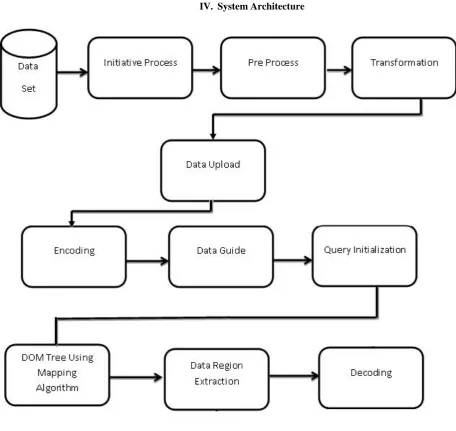
IV. System Architecture
Fig. 1 Implementation Flow of the system.
V. Conclusion
In this paper a new approach for extracting web content structure based on visual representation was proposed. The
produced web content structure is very helpful for applications such as web adaptation, information retrieval and
information extraction. By identifying the logic relationship of web content based on visually out information, web
content structure can effectively represent the semantic structure of the webpage. An automatic top- down, tag-tree
independent and scalable algorithm to detect web content structure was presented. It simulates how a user understands
the layout structure of a web page based on its visual representation. Compared with traditional DOM based
segmentation method, our scheme utilizes useful visual cues to obtain a better partition of a page at the semantic level. It
is also independent of physical realization and works well even when the physical structure is far different from visual
presentation. The algorithm is evaluated manually on a large dataset, and also used for selecting good expansion terms in
it would be useful to study for which combinations of documents and workload this mapping is and is not well suited.
Even more useful would be a system that automatically selects a mapping and translate queries with minimum user input
(sample documents, sample query workload). The sparse mapping can have many variations. For example, instead of
mapping an entire XML document, the system could map only parts of the document that are queried.
REFERENCES
[1] L. J. Chen et al. ―Mapping XML to a wide sparse table,‖ in IEEE 28th ICDE, Washington, DC, USA, 2012.
[2] Saurabh Vyas et al. ―A revierw paper for mapping of XML Data to Relational Table‖ in International Journal of Computer Science and mobile Computing, vol. 3 Issue. 12 December 2014.
[3] H. Georgiadis and V. Vassalos, ―XPath on steroids: Exploiting relational engines for XPath performance,‖ in Proc. SIGMOD, Beijing, China, 2007.
[4] M. J. Carey, L. Ling, M. Nicola, and L. Shao, ―EXRT: Towards a simple benchmark for XML readiness testing,‖ in
Proc. 2ndTPCTC, Singapore, 2010.
[5] Z. Chen, H. V. Jagadish, L. V. S. Lakshmanan, and S. Paparizos, ―From tree patterns to generalized tree patterns: On
efficient evaluation of XQuery,‖ in Proc. 29th Int. Conf. VLDB, Berlin, Germany, 2003.
[6] P. YESURAJU* et al, ―A LANGUAGE INDEPENDENT WEB DATA EXTRACTION USING VISION BASED
PAGE SEGMENTATION ALGORITHM,‖ IJRET., Volume: 2 Issue: 4, pp. 635–639, 2012103.
[7] G. H. L. Fletcher, D. V. Gucht, Y. Wu, M. Gyssens, S. Brenes, and J. Paredaens, ―A methodology for coupling
fragments of XPath with structural indexes for XML documents,‖ Inf. Syst., vol. 34, no. 7, pp. 657–670, Nov. 2009.
[8] P. A. Boncz et al ―MonetDB/XQuery: A fast XQuery processor powered by a relational engine,‖ in Proc. SIGMOD, Chicago, IL, USA, 2006.
[9] S. Acharya, et al., ―Relational support for flexible schema scenarios,‖ Proc. VLDB, vol. 1, no. 2, pp. 1289–1300, Aug. 2008.
[10] Amjad Qtaish, Kamsuriah Ahmad, ―Model-Mapping Approaches for Storing and Querying XML Documents in Relational Database.
[11] A. Arion, A. Bonifati, et al, ―Efficient query evaluation over compressed XML data,‖ in Proc. EDBT, Heraklion, Greece, 2004.
[12] K. S. Beyer et al. ―System RX: One part relational, one part XML,‖ in Proc. SIGMOD, Baltimore, MD, USA, 2005.
[13] P. Bohannon, J. Freire, P. Roy, and J. Sim´eon. From XML schema to relations: A cost-based approach to XML storage. In Proceedings of the International Conference on Data Engineering (ICDE), pages 64–75, 2002.
[14] P. Bohannon, J. Freire, P. Roy, and J. Siméon, ―From XML schema to relations: A cost-based approach to XML storage,‖ in Proc. 18th
ICDE, San Jose, CA, USA, 2002.
[15] S. Amer-Yahia, F. Du, and J. Freire. A generic and flexible framework for mapping XML documents into relations.
[16] Technical report, OGI/OHSU, 2004 [15] Z. Chen, H. V. Jagadish, L. V. S. Lakshmanan, and S. Paparizos, ―From tree patterns to generalized tree patterns: On efficient evaluation of XQuery,‖ in Proc. 29th Int. Conf. VLDB, Berlin, Germany, 2003. 1414 IEEE TRANSACTIONS ON KNOWLEDGE AND DATA ENGINEERING, VOL. 26, NO. 6, JUNE 2014