Available Online atwww.ijcsmc.com
International Journal of Computer Science and Mobile Computing
A Monthly Journal of Computer Science and Information Technology
ISSN 2320–088X
IMPACT FACTOR: 5.258
IJCSMC, Vol. 5, Issue. 7, July 2016, pg.204 – 209
PERFORMANCE ANALYSIS OF
DSR, SEA-DSR AND MODIFIED
DSR ROUTING PROTOCOLS
1A. R. Khalifa,
2R. A. Sadek,
3M. A. Al-Shora
1
Systems & Computers department, Al-Azhar University, Cairo, Egypt 2
Computer Engineering Department, Arab Academy for Science Technology and Maritime Transport, Cairo, Egypt 3
Systems & Computers department, Al-Azhar University, Cairo, Egypt 1,2,3
Cairo, Egypt 1
[email protected]; [email protected]; [email protected]
Abstract— Routing in Mobile Ad Hoc Network (MANET) is complex due to the fact that the network graph is episodically connected, and nodes get only intermittently connected because of nodes mobility, terrain, weather, and jamming that change topology rapidly. This paper compare between a new Cross-Layer Design (CLD) routing protocols and original one to achieve a reliable data transmission in MANET. A key challenge is to provide a mechanism that can provide good delivery performance and high quality of service in intermittent networks. The key components of Modified DSR and SEA-DSR approach include a Cross-Layer Design (CLD) to improve information sharing between different protocol layers. In order to improve the end-to-end performance of MANET, they present a mechanism that allows the network layer to adjust its routing protocol dynamically, based on signal strength along the end-to-end routing path for each transmission link. However, there is study done over the DSR routing protocol to enhance its performance. In this study, way of a comparison and performance evaluation of DSR, SEA-DSR and Modified DSR routing protocols, this is done using NS2 Simulator to identify the protocol enhancement for MANET’s.
Keywords— MANET, Routing Protocols, DSR, SEA-DSR, Modified DSR.
I. INTRODUCTION
Source Routing (DSR) [4], and Destination Sequenced Distance Vector (DSDV) [5]. However, the routes selected based on hop count alone may be of bad quality, since the routing protocols do not ignore weak quality links, which are typically used to connect to remote nodes. These links usually havepoor signal strength, hence higher frame error rates and lower throughput [6], [7]. The wireless channel quality among mobile nodes is time varying due to fading, Doppler Effect and path loss. Known that the shortest-path metric does not take into account the physical channel variations of the wireless medium, it is desirable to choose the route with minimum cost based on some other metrics which are aware of the wireless nature of the underlying physical channel. In MANET, there are many other metrics to be considered: signal strength, Signal to Noise Ratio (SNR), Packet Loss, Maximum available bandwidth etc. These metrics should come from a cross-layer approach in order to make the routing layer aware of the local issues of the underling layers [8]. The ability of MANET to provide acceptable quality of service (QoS) is restricted by the ability of the underlying routing protocol to provide consistent behavior despite the inherent dynamics of a mobile computing environment [9], [10]. Cross-Layer Design has enormous potential in wireless communication systems. By using Cross Layer Design (CLD) these protocols try to enhance QoS for DSR routing protocol. In this paper we select DSR as one of the common MANET protocols that uses minimal hop count to select rout, and SEA-DSR and Modified DSR that uses Signal strength, to enhance the quality of service of the DSR. We evaluate how the protocols differ in the methods it uses to select paths, detect broken links, and buffer messages during periods of link outage. We computed the differences in terms of packet delivery ratio, end-to-end delay, goodput and Routing load. We show that the performance of DSR protocol is improved using the SEA-DSR and Modified DSR.
The rest of this paper is organized as follows: In Section 2, DSR and its advantage and its disadvantages are presented. Section 3 discusses the signal strength and energy aware DSR routing protocol. Section 4 presents Modified DSR routing protocol. The simulation environment setup and simulation results are presented in section 5. Section 6 concludes the paper
II. DYNAMIC SOURCE ROUTING (DSR)
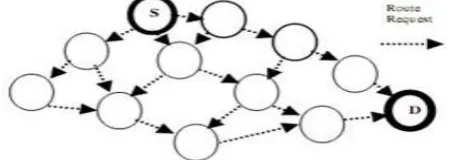
In DSR source node generates a route request packet when it has a new route to a destination. The route request is flooded through the network until it reaches some nodes with a route to that destination. See fig 1 and 2
Each route request packet holds the information of the route it has propagated [4]. When the route request packet arrives at the destination or an intermediate node with a route to the destination, a route reply packet will be generated. This reply packet is then sent back to the source node following the reverse route contained in the route request packet. While transmitting the data traffic, the complete path is added to each data packet according to the routing table of the source node[11]. The intermediate nodes forward packets according to the path provided in the packet. More clearly, in DSR routing protocol to send route reply packet, when current route breaks, destination seeks a new route.
This paper provides a change to the route selection mechanism that is used in DSR. DSR is modified by adding the signal strength parameter beside DSR hop count metric as new metrics in which this values are added to the route reply packet [12]. Given those features, source node can select the best and more stable route out of various available routes based on Signal strength. Therefore, the Quality of service (QoS) and the performance of the routing protocols in MANET environment can be improved.
III.SIGNAL STRENGTH AND ENERGY AWARE DSRROUTING (SEA-DSR)
In this section, we discuss the working procedure of SEA-DSR. The goal of this work is to improve the reliability of route discovery in MANET by using signal strength and energy metrics through cross- layer information sharing. The main features of this protocol is
Selecting stable routes by accounting signal strength and residual energy level of the intermediate routes[13].
Protect against link breakages due to weak link and energy depletion at the intermediate nodes.
The above specified feature ensures that SEA-DSR protocol select routes that endures longer with respect to communication link, where the link with greater signal strength is given preference over the link with weak signal strength and in case of residual energy, where the nodes with greater energy is given preference over the low energy nodes. These results in less path breakage, packet loss, reroute discoveries and routing control overhead. We also go for route maintenance, with the help of signal strength, if it is getting below certain threshold value [13].
When a node needs to send packets to some destination, it search for route in its route cache. It is not possible to maintain the route cache for long duration, as network topology is not consistent. If route to the destination is not available, it starts broadcasting route request packet to its entire neighbor. The RREQ packet of DSR is extended in this protocol. An extra field called reliability count (RELCOUNT) is added to the RREQ packet. This field contains reliability count of the path it comes across. Destination node selects the most reliable route among all the routes based on this value and the hop count value[13].
If an intermediate node receives a RREQ packet from its neighbor, it measures the strength at which it received the packet and energy level of the node. If the signal strength is above the threshold value SThr1, then reliability count is incremented by HSRCNT otherwise it is incremented by MSCNT. If the energy of the receiving is above the threshold value EThr1 (30% battery) then reliability count is incremented by HECNT otherwise it is incremented by MECNT. After this the RREQ packet is broadcasted. Intermediate nodes are not allowed to reply for the RREQ it received. If node energy is below EThr2 or signal strength is less than SThr2, the RREQ is dropped[13].
When the destination node receives the first RREQ, it starts the timer ∆t for t sec. It stores all the RREQ details in the route cache. After the timer expires, it find the path with maximum reliability factor and send the RREP to it. All the route request that arrives after timer expires, will be dropped [13]. The reliability factor for the received path is calculated by the following formula.
Reliability Factor = Reliability Count / No. of Hops
IV.MODIFIED DYNAMIC SOURCE ROUTING
count. In case of two or more equal routes strengths, the one with the minimal hop count will be chosen[14].
In technicality, information from the transmission links, such as signal strength, can give valuable information to the source node about the transmission paths as far as routing is concerned. Each wireless node can communicate with any other node within its transmission range, which depends on signal strength at the receiver node. We modified the route reply packet format and added one extra field in the packet format to store the worst value of signal strength (received power strength) along the route from destination to source. See figure 3
Figure 3: Modified Route Reply packet format of DSR including metric of signal strength.
Part2 illustrates how original DSR works. We modified also the mechanism of DSR process to include our signal strength model. The new mechanism will work as follows:
Modified DSR at destination node.
When the route request packet arrives at the destination, with a route to the destination, a route reply packet is generated. This reply packet is then sent back to the source node, following the reverse route contained in the route request packet[14].
Modified DSR at intermediate node.
Each intermediate node updates the signal strength values if its link value of signal strength is lower than the existing recorded value in signal strength field in the route reply packet. If the signal strength values of its link are greater than the recorded value, the node does not update the value. The process continues until the route reply packet reaches the source node[14].
Modified DSR at Source node.
Now, at the source node there are many of available routes with different values of signal strength. The Source node selects the route based on the value of best of worse available values of signal strength, and put other routes in cache. If there are many routes with the same value of signal strength the protocol choose one of them with minimal hop count, and arrange others in cache[14].
V. EXPERIMENTAL RESULTS (SIMULATION)
Case 1: 10 Nodes Network.
The first simulation case considers 10 nodes as the density in the assumed area.
TABLE 1
10 NODES NETWORK SIMULATION RESULTS
motion speed transmit rate Parameter DSR SEA-DSR MODIFIED DSR
5 m/s 2 p/s
packet delivery ratio 96.9 96.9 100 average delay 0.007 0.01 0.03
Goodput 140.6 140.3 160
Routing load 2.81 0.44 0.158
5 m/s 10 p/s
packet delivery ratio 96.7 97.84 100 average delay 0.079 0.07 0.0118
goodput 28.22 29.13 31.5
Routing load 13.77 2.12 0.853
10 m/s 2 p/s
packet delivery ratio 91.44 92.82 96.6 average delay 0.01 0.006 0.57 goodput 129.9 136.68 138.8 Routing load 3.325 0.46 1.06
10 m/s 10 p/s
packet delivery ratio 92.3 91.01 96.9 average delay 0.03 0.006 0.16
goodput 26.88 26.02 30.15
Routing load 15.82 2.55 1.07
15 m/s 20 p/s
packet delivery ratio 78.4 81.25 100 average delay 0.007 0.007 0.032
goodput 12.8 12.48 16.62
Routing load 29.55 5.17 4.29
Case 2: 50 Nodes Network.
The second simulation case considers 50 nodes as the density in the assumed area.
TABLE II
50 NODES NETWORK SIMULATION RESULTS.
motion speed transmit rate Parameter DSR SEA-DSR MODIFIED DSR
5 m/s 2 p/s
packet delivery ratio 91.16 89.8 99.6 average delay 0.026 0.0084 0.018
Goodput 548.31 541 603.31
Routing load 0.7 0.709 0.51
5 m/s 10 p/s
packet delivery ratio 92.274 90.18 98.12 average delay 0.262 0.027 0.03
goodput 113.63 111 123.62
Routing load 3.4 3.45 2
10 m/s 2 p/s
packet delivery ratio 88.23 91.41 98.87 average delay 0.05 0.045 0.06
goodput 532.7 548.8 598.2
Routing load 0.7 0.672 0.98
10 m/s 10 p/s
packet delivery ratio 87.6 91.53 98.1 average delay 0.29 0.46 0.15
goodput 108.9 114.24 121.9
Routing load 3.57 3.24 3.31
15 m/s 20 p/s
packet delivery ratio 86.42 86.6 94.58 average delay 0.86 0.83 0.143
goodput 56.64 56.32 61.31
Routing load 6.68 6.25 5.39
VI.ANALYSIS OF EXPERIMENTAL RESULTS
In case of 50 nodes MANET network, simulation results of Modified DSR protocol in terms of channel quality, packet delivery ratio, end to end delay, goodput and routing load, show significant improvement in performance compared to the traditional DSR and SEA-DSR, Simulation results indicates that the cross-layer design using the model of Signal strength routing algorithm provides a better improvement in the Quality of Service when compared to the traditional DSR and SAE-DSR routing protocols.
VII. CONCLUSION
In this paper, we describe DSR, SEA-DSR and modified DSR protocol. Present evaluation metrics, and compeer three routing protocols. Simulation results show that Modified DSR achieved better performance than traditional DSR protocol and SEA-DSR in terms of packet delivery ratio, delay, throughput over intermittent network and routing load from results we find that modified DSR achieves improvement in terms of packet delivery ratio are 9.4% and 8.3% when compared to DSR and SEA-DSR respectively in the same condition. And Goodput improvements are 12% and 12.5% compared to SEA-DSR and DSR respectively. On the other side, simulation shows that Modified DSR changes between improvement to degradation, in terms of end to end delay and routing load performance metric. Finally in the terms of percentage the Modified DSR achieves improvements in terms of average end to end delay amounting to 17.8% and 25.4% when it compared with SEA-DSR and DSR respectively, In terms of routing load average the improvement is 10% and 49% when it compared to SEA-DSR and DSR respectively.
R
EFERENCES[1] Fuad Alnajjar, Tarek Saadawi, “Social-stratification Probabilistic Routing Algorithm in Delay-Tolerant Networks”, The International Conference on Wireless Algorithms, Systems and Applications (WASA'09), Boston, MA, August 2009, Pages: 579–591.
[2] Wing Ho Yuen, Heung-no Lee and Timothy D. Andersen “A Simple and Effective Cross Layer Networking System for Mobile Ad Hoc Networks”, in: PIMRC 2002, vol. 4, September 2002, pp. 1952-1956
[3] C. E. Perkins and E. M. Royer, “Ad-hoc on-demand distance vector routing,” in Proc. IEEE Workshop on Mobile Comp. Sys.and Apps., Feb. 1999, pp. 90-100.
[4] D. B. Johnson and D. A. Maltz, “Dynamic source routing in ad hoc wireless networks,” in Mobile Computing, 1996, pp. 153-181.
[5] C. E. Perkins and P. Bhagwat, “Highly dynamic destinationsequenced distance-vector routing (DSDV) for mobile computers“, Computer Communications Review, pp. 234-244, Oct.1994.
[6] H.M. Tsai, N. Wisitpongphan, and O.K. Tonguz, “Link-Quality Aware AODV Protocol,” in Proc. IEEE International Symposium on Wireless Pervasive Computing (ISWPC) 2006, Phuket, Thailand, January 2006
[7] E. Royer and C.-K. Toh, "A Review of Current Routing Protocols for Ad Hoc Mobile Wireless Networks," IEEE Personal Communications Magazine, vol. 6, No. 2, April 1999.
[8] Merlinda Drini & Tarek Saadawi .”Modeling Wireless Channel for Ad-Hoc Network Routing Protocol”, ISCC Marakech Marocco, July 2008, Page(s): 549-555
[9] John Novatnack , Lloyd Greenwald & Harpreet Arora, “Evaluating ad hoc routing protocols with respect to quality of service”, Wireless And Mobile Computing, Networking And Communications, 2005. Volume 3, 22-24 Aug.2005, Pages: 205-212
[10] Frank Aune “Cross-Layer Tutorial” NTNU 2004.
[11] David B. Johnson, David A. Maltz, Yih-Chun Hu, “The Dynamic Source Routing Protocol for Mobile Ad Hoc Networks (DSR),” Internet Draft, IETF Mobile Ad hoc Networks (MANET) Working Group.
[12] N.Moghim, F. Hendessi, and N.Movehhedinia, “An improvement on adhoc wireless network routing based on aodv,” in the 18th International Conference on Communication Systems ICCS, vol.2. IEEE, 2002, pp 10681070
[13] P.Srinivasan and K.Kamalkkannan “Signal Strength And Energy Aware Reliable Route Discovery In Manet” International Journal of Communication Network Security ISSN: 2231 – 1882, Volume-1, Issue-4, 2012