O R I G I N A L R E S E A R C H
Evaluating the effectiveness of the
“
Germ-Free
Hands
”
intervention for improving the hand
hygiene practices of public health students
This article was published in the following Dove Press journal: Journal of Multidisciplinary Healthcare
Apaporn Kitsanapun Khemika Yamarat
College of Public Health Sciences, Chulalongkorn University, Bangkok, Thailand
Purpose: This quasi-experimental study sought to assess the effectiveness of
a multidisciplinary intervention called “Germ-Free Hands” to improve the hand hygiene practices of students attending Thailand’s Sirindhorn College of Public Health (SCPH).
Methods: The intervention was developed and implemented at SCPH and incorporated
education, training, a workshop, and performance feedback. The intervention targeted beha-vioral antecedents specified by the Health Belief Model (HBM) and the Theory of Planned Behavior (TPB). Handwashing determinants (knowledge, beliefs, attitudes, subjective norms, perceived behavioral control, and intentions) and hand hygiene behaviors were assessed at baseline, immediately post-intervention, and 3 months post-intervention for the intervention group at (n=60) at the Suphanburi campus of SCPH and a matched control group (n=60) of students at the Ubonratchathani campus. Data analysis included descriptive statistics, inde-pendent samples t-tests, two-way measures of analysis of variance, and a generalized estimating equation to compare handwashing practices by self-reports between two groups.
Results: The “Germ-Free Hands” intervention produced significant improvements in the
intervention group’s handwashing knowledge, behavioral and control beliefs, subjective norm scores, intentions, and behaviors, as compared to the control group. However, the intervention had no significant impact on normative beliefs, attitudes, or perceived beha-vioral control. Reported improvements also decreased 3 months post-intervention, and the number of bacterial colonies on students’hands increased over the course of the study.
Conclusion: This study adds to the evidence that multidisciplinary interventions can be
effective at improving handwashing rates. However, education and training must be contin-uous, rather than delivered as a one-time program, in order to have sustained results. Participants may also require more in-depth instruction in correct handwashing and drying techniques to remove bacteria effectively and prevent recolonization.
Keywords:handwashing, hand hygiene, public health student, Theory of Planned Behavior,
Health Belief Model
Introduction
Good hand hygiene practices reduce the risk of disease transmission,1–5but rates of
compliance with handwashing guidelines are low among healthcare practitioners
and students.3,4,6–15For example, one study among nursing students found that they
did not practice handwashing sufficiently frequently, nor did they use correct
technique.16Similarly, other studies have found that while 80% of nursing students
reported that they washed their hand before and after contact with patients,21,22only
3.2% of them were observed to wash their hands between each patient visit.21
Correspondence: Apaporn Kitsanapun College of Public Health Sciences, Chulalongkorn University, Phayathai Road, Bangkok 10330, Thailand Tel +66 92 268 5591
Email [email protected]
Journal of Multidisciplinary Healthcare
Dove
press
open access to scientific and medical research
Open Access Full Text Article
Journal of Multidisciplinary Healthcare downloaded from https://www.dovepress.com/ by 118.70.13.36 on 24-Aug-2020
Furthermore, only 27% of them washed their hands before
and after meals.21Likewise, a study among dental students
found that only 40% washed their hands before beginning
a surgical procedure.23However, research has shown that
interventions can be effective at improving hand hygiene
practices in healthcare settings.3,4,7–9,11,13–15,17–20
Public health students will typically go on to work in primary care services as public health workers, and students are thus expected to correctly implement practices to reduce infection transmission in healthcare settings. However, com-paring to other health science students, public health students are less likely to be trained in infection control methods, including the importance of handwashing, because during their school studies they have less contact with patients in hospitals and with other human specimens. However, there has been a lack of research on this topic to date.
The present study examined the effects of a hand
hygiene intervention called “Germ-Free Hands” at
Thailand’s Sirindhorn College of Public Health (SCPH).
The intervention and assessment measures were based on two theoretical frameworks, the Health Belief Model (HBM) and the Theory of Planned Behavior (TPB).
According to the HBM, health-related behaviors are infl
u-enced by beliefs about susceptibility to health risks and
their potential seriousness, by the anticipated benefits of
adopting healthier practices, and by the barriers that could
make health-promoting behaviors challenging.24The TPB,
in turn, argues that beliefs contribute to attitudes, subjec-tive norms (ie, social pressure to perform an action), and
perceived behavioral control (PBC), which is defined as
perception of the ease or challenge of performing an action; together, these three variables directly predict
intentions, which in turn predict behaviors.25
Prior research has shown that handwashing knowledge,26
behavioral, normative, and control beliefs,27 and attitudes
toward handwashing27–30 all influence handwashing
beha-viors. The present research therefore proposed the following two hypotheses:
H1: The intervention group’s handwashing knowledge, TPB
predictors, handwashing rates, correct handwashing scores, and number of microbial colonies on their hands would improve from baseline at immediate post-intervention and 3 months post-intervention assessments; and
H2: The intervention group’s TPB predictor scores and
self-reported handwashing rates would differ from those of a matched control group immediately post-intervention and 3 months post-intervention.
Materials and methods
A quasi-experimental study design was used to examine
the effects of the“Germ-Free Hands”intervention on the
rate and quality of handwashing among public health students attending the SCPH campus at Suphanburi
(SCPH-SP). Students from the SCPH campus at
Ubonratchathani (SCPH-UB) were recruited for the con-trol group. The study was carried out by the primary author as well as by a laboratory technician and six research assistants from SCPH-SP.
Sample
A randomly selected sample of volunteer participants were
stratified by study year level. All participants were students
studying at SCPH-SP (n=60) or SCPH-UB (n=60), drawn
from total populations of 400 students at SCPH-SP and 487
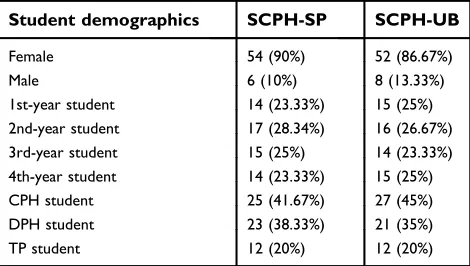
students at SCPH-UB (seeTable 1). The majority of students
were female, which reflects the overall demographic
compo-sition of the SCPH colleges, and 80% were studying Community Public Health (CPH) or Dental Public Health
(DPH); the remaining 20% were pursuing vocational certifi
-cates in Technical Pharmacy (TP). The two groups were well matched in terms of study level and other factors that have
been found to influence handwashing intentions or behaviors,
including gender31–33and handwashing knowledge.26,34,35
Intervention
The“Germ-Free Hands”intervention included a classroom
instructional component and a subsequent demonstration session. The instruction consisted of a lecture by the researcher on modes of microbe transmission,
handwash-ing’s effectiveness at preventing the spread of infectious
diseases, and the role of public health workers in their
Table 1Demographic characteristics
Student demographics SCPH-SP SCPH-UB
Female 54 (90%) 52 (86.67%)
Male 6 (10%) 8 (13.33%)
1st-year student 14 (23.33%) 15 (25%) 2nd-year student 17 (28.34%) 16 (26.67%) 3rd-year student 15 (25%) 14 (23.33%) 4th-year student 14 (23.33%) 15 (25%)
CPH student 25 (41.67%) 27 (45%)
DPH student 23 (38.33%) 21 (35%)
TP student 12 (20%) 12 (20%)
Abbreviations:SCPH-SP, Sirindhorn College of Public Health–Suphanburi; SCPH-UB, Sirindhorn College of Public Health–Ubonratchathani; CPH, Community Public Health; DPH, Dental Public Health; TP, Technical Pharmacy.
Journal of Multidisciplinary Healthcare downloaded from https://www.dovepress.com/ by 118.70.13.36 on 24-Aug-2020
communities. The demonstration modeled correct hand-washing procedures following World Health Organization
(WHO) guidelines.36 Students’ handwashing techniques
were then observed and feedback was provided by research assistants. The intervention was conducted over the course of a month, during which students also participated in a 1 hr discussion workshop about the importance of proper hand-washing. Posters that reminded students to wash their hands were also hung in prominent places.
Instruments
Hand hygiene questionnaire
A structured seven-part hand hygiene questionnaire was developed for this research based on WHO handwashing
guidelines36and the HBM and TPB theoretical frameworks.
Thefirst part collected information about the students’
demo-graphic and educational characteristics; the second part included a 22-question test of handwashing knowledge; and the third through seventh parts consisted of questions on handwashing beliefs, attitudes, subjective norms, PBC,
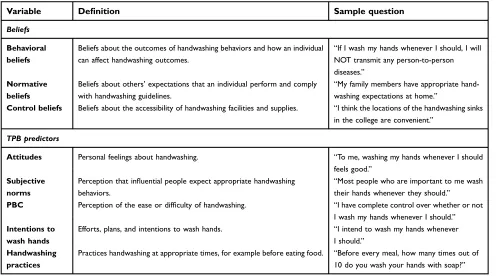
intentions, and behaviors (seeTable 2). The questionnaire’s
validity was assessed by expert review and its reliability was
determined by calculating Cronbach’s alpha scores.37 All
items on thefinal version of the questionnaire had reliability
coefficients of >0.7, thereby meeting the threshold for
acceptability.38
Handwashing observation checklist
Larson and Lusk’s Handwashing Observation Checklist39
was used to score handwashing behaviors and detect errors in technique. This instrument was selected for its high level of inter-rater agreement (95.2%). Observations were performed by three observers; agreement was determined by two of three raters.
Bacterial colonies on hands checklist
Sterile swabs moistened with sterile water were used to
swab for bacteria on participants’hands immediately after
a participantfinished washing their hands. A Kenner Fecal
(KF) Streptococcus agar plate was used to grow fecal
streptococci from each participant’s hand. A trained
tech-nician then incubated all of the KF agar plates at 35 °C for 48 hrs, after which the researcher and laboratory techni-cian counted the number of colony-forming units growing on each plate. We developed a bacterial colonies on hands checklist to record the number of bacterial colonies on the hands of each SCPH-SP participant at baseline, immedi-ately post-intervention, and 3 months post-intervention.
Table 2Definitions and sample questions from the hand hygiene questionnaire
Variable Definition Sample question
Beliefs
Behavioral beliefs
Beliefs about the outcomes of handwashing behaviors and how an individual can affect handwashing outcomes.
“If I wash my hands whenever I should, I will NOT transmit any person-to-person diseases.”
Normative beliefs
Beliefs about others’expectations that an individual perform and comply with handwashing guidelines.
“My family members have appropriate hand-washing expectations at home.”
Control beliefs Beliefs about the accessibility of handwashing facilities and supplies. “I think the locations of the handwashing sinks in the college are convenient.”
TPB predictors
Attitudes Personal feelings about handwashing. “To me, washing my hands whenever I should
feels good.”
Subjective norms
Perception that influential people expect appropriate handwashing behaviors.
“Most people who are important to me wash their hands whenever they should.”
PBC Perception of the ease or difficulty of handwashing. “I have complete control over whether or not I wash my hands whenever I should.”
Intentions to wash hands
Efforts, plans, and intentions to wash hands. “I intend to wash my hands whenever I should.”
Handwashing practices
Practices handwashing at appropriate times, for example before eating food. “Before every meal, how many times out of 10 do you wash your hands with soap?”
Journal of Multidisciplinary Healthcare downloaded from https://www.dovepress.com/ by 118.70.13.36 on 24-Aug-2020
Data collection and analysis
Participants from the intervention and control groups com-pleted the hand hygiene questionnaire at baseline, imme-diately post-intervention, and 3 months post-intervention. Handwashing observations, which occurred prior to lunch breaks over the course of 5 days, as well as swabbing for
bacteria on students’ hands, were performed by trained
research assistants for the intervention group at each assessment phase. The handwashing rate was the total
number of handwashing practices over five days divided
by the multiplication of the total number of sample sizes
andfive days.
Data analysis included descriptive statistics and inferen-tial analysis for hypothesis testing, with the threshold for
statistical significance set atp<0.05. Repeated-measures
ana-lysis of variance was used to test the intervention effect by comparing the TPB predictors and handwashing intentions of the two groups at the three timepoints since those were
continuous. The effect sizes were classified into 3 categories:
0.2 is small, 0.5 is medium, 0.8 is large, and 1.3 is very large. A generalized estimating equation was used to analyze the difference in self-reported handwashing practices at each timepoint between the two groups. The distribution of self-reported handwashing practice was considered a binomial distribution with a restricted upper bound.
Results
The intervention group’s baseline scores for handwashing
knowledge, TPB predictors, handwashing rates, correct handwashing scores, and number of microbial colonies on hands were compared to their scores immediately post-intervention and again 3 months post-post-intervention. The
immediate post-intervention scores changed significantly
from baseline for handwashing knowledge (p=0.0112) and
some of the TPB variables, including behavioral beliefs
(p=0.0001), control beliefs (p=0.0006), subjective norms
(p=0.0152), and handwashing intensions (p=0.0115).
However, the effect size of significant variables were
small meaning that the difference was trivial. No signifi
-cant differences were found for normative beliefs
(p=0.0695), attitudes (p=0.1715), or PBC (p=0.2119). We
also observed a trend of scores increasing from baseline to intervention but then decreasing at 3 months post-intervention. This suggests that gains from the intervention
were not maintained (seeTable 3).
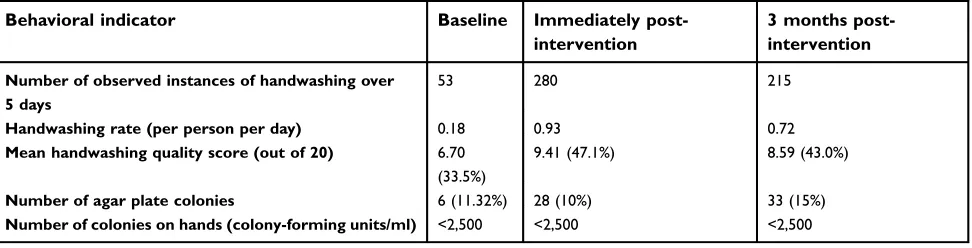
Handwashing rates prior to eating lunch over the course of the 5 days of observation increased substantially
from baseline (18%) to immediately post-intervention (93%), and although they decreased somewhat at 3 months
post-intervention (72%), they remained significantly
higher than baseline rates (see Table 4). Correct
hand-washing scores showed a similar trend, increasing from 33.5% at baseline to 47.1% immediately post-intervention and then falling to 43.0% at 3 months post-intervention.
However, the number of bacterial colonies on the students’
hands actually increased over the course of the study, and handwashing quality scores remained below 50% even immediately post-intervention.
Self-reported handwashing rates per 10 instances in circumstances in which handwashing is required increased
significantly from baseline to immediately
post-intervention but declined at 3 months post-post-intervention for the intervention group over the course of the study in all circumstances. As compared to the control group, the statistically changed handwashing rates in the intervention
group were after using toilet (p=0.0005), after coughing or
sneezing (p=0105), after touching dirty objects
(p<0.0001), after playing with pets (p<0.0001), and after
visiting patients (p=0.0133) (seeTable 5).
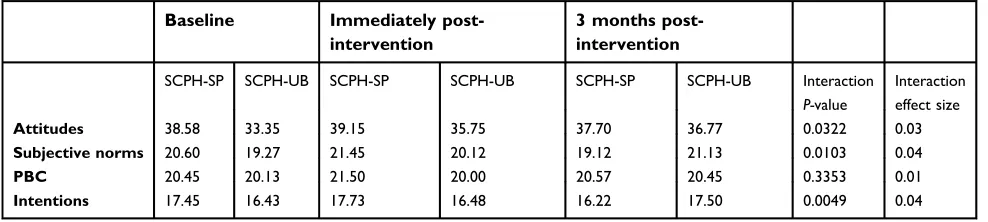
TPB predictors were also compared for the interven-tion and control groups immediately post-interveninterven-tion and
3 months post-intervention (seeTable 6). Statistically
sig-nificant group differences were found for attitudes
(p=0.0322), subjective norms (p=0.0103), and
handwash-ing intentions (p=0.0049). However, there was no signifi
-cant difference between the two groups for PBC
(p=0.3533).
Overall, thesefindings demonstrate partial support for
both H1 and H2. Differences in handwashing determinants and rates were found for the intervention group (SCPH-SP) between baseline and both post-intervention assess-ments, and between the intervention and control groups post-intervention. However, the intervention group scores
did not change significantly from baseline for all the TPB
variables. In addition, self-reported handwashing rate changes varied between handwashing situations, and the
bacterial colonies found on participants’ hands did not
decrease substantially from baseline as expected.
Discussion
Consistent with prior research,3,4,7–9,11,13–15,17–20,40 our
results indicate that education and training can improve hand hygiene practices. However, the relative effective-ness of handwashing interventions has varied between studies, likely due to the use of different interventions
Journal of Multidisciplinary Healthcare downloaded from https://www.dovepress.com/ by 118.70.13.36 on 24-Aug-2020
and outcome measures. Previous interventions have typi-cally included some combination of instruction, problem-based learning, reminders, evaluation, feedback, focus groups, and workshops, and some of these components
may be more beneficial than others. Observed
handwash-ing rates for the SCPH-SP intervention group rose from 18% at baseline to 93% immediately post-intervention and were maintained at 72% 3 months after the intervention. These post-intervention gains compare favorably to those seen in other studies, which have had highly variable starting points (ranging from 4% to 50%) and outcomes
(ranging from 25% to 84%).6–8,14,19,41,42
There were large differences between self-reported and observed handwashing rates for the intervention group at
all three assessments—a problem that has also been noted
by other hand hygiene intervention researchers.27,43,4Our
participants had much higher self-reported (61%) than
observed (18%) rates of handwashing at baseline and much smaller improvements in self-reported handwashing (7.5% increase) than observed practice (75% increase) at the immediate post-intervention assessment. It is possible that students over-reported their handwashing at baseline
due to a social desirability bias effect4,45 or faulty
mem-ories. However, it is also possible that their awareness of being observed increased their handwashing rates after the intervention, or that their handwashing rates prior to eating lunch were more susceptible to intervention effects than handwashing practices in other situations.
The findings of this study support the HBM,24 as we
found that handwashing practices changed in conjunction with behavioral and control beliefs related to perceived
seriousness, susceptibility, barriers, and benefits. Ourfi
nd-ings also provide limited support for the TPB,25 since
participant behavioral and control beliefs, subjective
Table 3SCPH-SP intervention group mean scores and standard deviations at baseline, immediately post-intervention, and 3 months
post-intervention
Determinant Baseline
mean score (SD)
Immediate post-intervention mean score (SD)
3 months
post-intervention mean score (SD)
F-test P-value Effect
size
Knowledge 16.37 (2.50) 17.42 (2.02) 17.33 (1.86) 4.67 0.0112 0.073
Behavioral beliefs
67.28 (7.22) 68.57 (6.24) 62.00 (9.36) 11.80 0.0001 0.167
Normative beliefs
31.97 (5.05) 32.23 (5.32) 30.17 (5.01) 2.72 0.0695 0.044
Control beliefs
71.57 (9.55) 74.45 (9.86) 66.82 (12.35) 7.89 0.0006 0.118
Attitudes 38.58 (3.79) 39.15 (3.00) 37.70 (5.96) 1.79 0.1715 0.029
Subjective norms
20.60 (3.89) 21.45 (4.36) 19.12 (4.67) 4.34 0.0152 0.068
PBC 20.45 (3.40) 21.50 (3.27) 20.57 (4.06) 1.57 0.2119 0.026
Intentions 17.45 (3.45) 17.73 (2.69) 16.22 (3.47) 4.63 0.0115 0.073
Abbreviations:SCPH-SP, Sirindhorn College of Public Health Suphanburi; PBC, perceived behavioral control; SD, standard deviation.
Table 4Observed handwashing behaviors, correct handwashing scores, and bacterial colonies on hands of students in the
interven-tion group before eating lunch (n=60)
Behavioral indicator Baseline Immediately
post-intervention
3 months post-intervention
Number of observed instances of handwashing over 5 days
53 280 215
Handwashing rate (per person per day) 0.18 0.93 0.72
Mean handwashing quality score (out of 20) 6.70
(33.5%)
9.41 (47.1%) 8.59 (43.0%)
Number of agar plate colonies 6 (11.32%) 28 (10%) 33 (15%)
Number of colonies on hands (colony-forming units/ml) <2,500 <2,500 <2,500
Journal of Multidisciplinary Healthcare downloaded from https://www.dovepress.com/ by 118.70.13.36 on 24-Aug-2020
norms, and intentions changed after the intervention along with actual handwashing behaviors (although no post-intervention changes were seen in normative beliefs,
atti-tudes, or PBC). Thesefindings are consistent with those of
other research that has shown that handwashing practices
are influenced by beliefs27 and subjective norms.27,28,30
The corresponding increases in handwashing knowledge and practice in this study are also in line with previous
findings that knowledge predicts healthcare providers’
hand hygiene behaviors.4,6,34
Overall, the intervention was effective at improving some handwashing determinants and behaviors for the inter-vention group between the baseline and post-interinter-vention
assessments, and the intervention group differed signifi
-cantly from the control group at post-intervention
assessments of attitudes, subjective norms, intentions, and self-reported handwashing rates, providing further evidence
for the benefits of hand hygiene education and training.
However, the change of determinants between timepoints
was negligible. Therefore, the full benefits of the
interven-tion were not maintained, as scores followed a U-shaped
curve of significant increase immediately after intervention
and a subsequent decline at 3 months post-intervention. This trend has been noted in other handwashing intervention
studies as well,4,7,9,15indicating a need for ongoing rather
than time-limited education and training programs.
Another notablefinding is that the number of bacterial
colonies on the students’ hands increased despite
improved handwashing rates. This unexpected result may
be attributable to insufficient use of soap or failure to wash
hands for the full 40–60 seconds recommended by the
WHO.36 However, it is also possible that some of the
participants did not dry their hands properly, thereby creat-ing a moist environment conducive to bacterial coloniza-tion, or dried their hands on their clothing, thereby adding new bacteria after washing.
Strengths of this study include that it provides informa-tion regarding handwashing behaviors among public health students, that results were measured by both self-report and external observation, and that it assessed handwashing determinants based on two theoretical foun-dations, the HBM and the TPB. However, given the
Table 6Group differences in TPB predictors and handwashing intentions
Baseline Immediately
post-intervention
3 months post-intervention
SCPH-SP SCPH-UB SCPH-SP SCPH-UB SCPH-SP SCPH-UB Interaction P-value
Interaction effect size
Attitudes 38.58 33.35 39.15 35.75 37.70 36.77 0.0322 0.03
Subjective norms 20.60 19.27 21.45 20.12 19.12 21.13 0.0103 0.04
PBC 20.45 20.13 21.50 20.00 20.57 20.45 0.3353 0.01
Intentions 17.45 16.43 17.73 16.48 16.22 17.50 0.0049 0.04
Abbreviations:SCPH-SP, Sirindhorn College of Public Health–Suphanburi; SCPH-UB, Sirindhorn College of Public Health–Ubonratchathani; PBC, perceived behavioral control.
Table 5 Comparison in self-reported handwashing practices per 10 incidences for which handwashing is required among the
intervention and control groups
Situation Intervention
effect
Interaction (Intervention x time)
beta P-value beta P-value
Before preparing food 0.05 0.8975 –0.21 0.1996
Returning to food preparation after stopping to do something else 0.28 0.4251 –0.28 0.0903
After using the toilet 2.07 0.0024 –0.99 0.0005
After coughing or sneezing 0.83 0.0109 –0.38 0.0105
After touching dirty objects 1.72 <0.0001 –0.91 <0.0001
After playing with pets 1.64 <0.0001 –0.79 <0.0001
Before eating –0.04 0.9024 –0.23 0.1622
After visiting patients –0.47 0.0359 –0.53 0.0133
Journal of Multidisciplinary Healthcare downloaded from https://www.dovepress.com/ by 118.70.13.36 on 24-Aug-2020
limitations of short-term interventions and assessments, additional research is needed to develop and evaluate long-term interventions that include instruction on hand drying
in addition to correct handwashing procedures.
Conducting ongoing education and training with longitu-dinal assessments of program effectiveness would be
ben-eficial for determining what sort of training or follow-ups
are required to maintain good hand hygiene practices.
Conclusion
Despite the known risks of hand-based transmission of noso-comial infections, rates of handwashing are relatively low among healthcare workers and students. This study assessed
the effectiveness of the “Germ-Free Hands”education and
training program for improving handwashing rates among students attending a Thai public health college, using the
HBM and TPB as theoretical frameworks. The intervention’s
effects on handwashing determinants and practices were assessed at baseline, immediately post-intervention, and 3 months post-intervention, and post-intervention scores were compared with baseline scores and with the scores of a matched control group from a similar public health campus. We found that the intervention improved the intervention
group’s handwashing knowledge, behavioral and control
beliefs that encourage handwashing, subjective norm per-ceptions of handwashing as a socially expected practice, handwashing intentions, and both self-reported and observed handwashing practices. However, the intervention had no impact on normative beliefs, attitudes toward handwashing, or PBC. There were also large differences between self-reported and observed rates of handwashing, which may be attributable to social desirability bias or faulty memories affecting self-reported rates, or to an observation effect on actual handwashing behavior. We also found that the
bene-fits of the intervention declined over time, with large gains in
handwashing rates immediately post-intervention followed by a decrease in scores at 3 months post-intervention, although observed handwashing rates remained well above the baseline level 3 months post-intervention. However,
despite participants’increased handwashing, the number of
bacterial colonies on their hands rose over the course of the study rather than substantially declining.
Studies tend to find major differences in self-reported
and observed handwashing rates, and future program assessments should use objective measures, such as covert observation and measurements of the volume of soap used. Moreover, whenever possible these evaluations should be conducted for all situations where handwashing is
indicated, since we found that study participants were more inclined to wash their hands in some situations than others. It would also be useful to compare the effects of different intervention components to determine which education and training strategies are likely to have the greatest long-term impacts on hand hygiene practices.
Ethics approval and informed
consent
This study’s protocol was approved by the Research Ethics
Committee for Research Involving Human Research
Participants, Health Sciences Group, Chulalongkorn
University, Thailand. Committee approval is in accordance
with the International Conference on Harmonization—Good
Clinical Practice. Written informed consent were obtained
from all participants. The research respected the confi
denti-ality of all information collected from participants.
Acknowledgments
The authors thank all students at SCPH-SP and SCPH-UB who participated in this study.
Disclosure
Miss Apaporn Kitsanapun reports that she is an instructor at Sirindhorn College of Public Health Suphanburi where the study was conducted. The authors report no further
conflicts of interest in this work.
References
1. Aiello AE, Coulborn RM, Perez V, Larson EL. Effect of hand hygiene on infectious disease risk in the community setting: a meta-analysis.
Am J Public Health. 2008;98(8):1372–1381. doi:10.2105/AJPH. 2007.124610
2. Curtis V, Cairncross S. Effect of washing hands with soap on diarrhoea risk in the community: a systematic review.Lancet Infect Dis.2003;3 (5):275–281.
3. Helder OK, Brug J, Looman CW, van Goudoever JB, Kornelisse RF. The impact of an education program on hand hygiene compliance and nosocomial infection incidence in an urban neonatal intensive care unit: an intervention study with before and after comparison.
Int J Nurs Stud. 2010;47(10):1245–1252. doi:10.1016/j.ijnurstu. 2010.03.005
4. Lam BC, Lee J, Lau Y. Hand hygiene practices in a neonatal intensive care unit: a multimodal intervention and impact on nosocomial infection.Pediatrics.2004;114(5):e565–e571. doi:10.1542/peds.2004-1107
5. Larson E. A causal link between handwashing and risk of infection? Examination of the evidence.Infect Control Hosp Epidemiol.1988;9 (1):28–36. doi:10.1086/645729
6. Bischoff WE, Reynolds TM, Sessler CN, Edmond MB, Wenzel RP. Handwashing compliance by health care workers: the impact of intro-ducing an accessible, alcohol-based hand antiseptic.Arch Intern Med. 2000;160(7):1017–1021.
Journal of Multidisciplinary Healthcare downloaded from https://www.dovepress.com/ by 118.70.13.36 on 24-Aug-2020
7. Erasmus V, Kuperus M, Richardus JH, Vos M, Oenema A, Van Beeck E. Improving hand hygiene behaviour of nurses using action planning: a pilot study in the intensive care unit and surgical ward.
J Hosp Infect.2010;76(2):161–164. doi:10.1016/j.jhin.2010.04.024 8. Higgins A, Hannan M. Improved hand hygiene technique and
com-pliance in healthcare workers using gaming technology. J Hosp Infect.2013;84(1):32–37. doi:10.1016/j.jhin.2013.02.004
9. KuKanich KS, Kaur R, Freeman LC, Powell DA. Original research: evaluation of a hand hygiene campaign in outpatient health care clinics. Am J Nurs. 2013;113(3):36–42. doi:10.1097/01. NAJ.0000427878.80053.f7
10. Martín-Madrazo C, Soto-Díaz S, Salinero-Fort MA, et al. Cluster randomized trial to evaluate the effect of a multimodal hand hygiene improvement strategy in primary care. Infect Control Hosp Epidemiol.2012;33(07):681–688. doi:10.1086/666343
11. Pittet D. Improving compliance with hand hygiene in hospitals.Infect Control Hosp Epidemiol.2000;21(06):381–386. doi:10.1086/501777 12. Pittet D. Hand hygiene: it’s all about when and how.Infect Control
Hosp Epidemiol.2008;29(10):957–959. doi:10.1086/592218 13. Scheithauer S, Rosarius A, Rex S, et al. Improving hand hygiene
compliance in the anesthesia working room work area: more than just more hand rubs. Am J Infect Control. 2013;41(11):1001–1006. doi:10.1016/j.ajic.2013.02.004
14. Song X, Stockwell DC, Floyd T, Short BL, Singh N. Improving hand hygiene compliance in health care workers: strategies and impact on patient outcomes. Am J Infect Control. 2013;41(10):e101–e105. doi:10.1016/j.ajic.2013.01.031
15. Tromp M, Huis A, de Guchteneire I, et al. The short-term and long-term effectiveness of a multidisciplinary hand hygiene improve-ment program. Am J Infect Control. 2012;40(8):732–736. doi:10.1016/j.ajic.2011.09.009
16. Doron SI, Kifuji K, Hynes BT, et al. Infection prevention and control a multifaceted approach to education, observation, and feedback in a successful hand hygiene campaign.Jt Comm J Qual Patient Saf. 2011;37(1):3–3AP.
17. Gould DJ, Moralejo D, Drey N, Chudleigh JH. Interventions to improve hand hygiene compliance in patient care. Cochrane Database Syst Rev.2010;9:1–50.
18. Pessoa-Silva CL, Hugonnet S, Pfister R, et al. Reduction of health care–associated infection risk in neonates by successful hand hygiene promotion. Pediatrics. 2007;120(2):e382–e390. doi:10.1542/ peds.2007-2361
19. Whitby M, McLaws ML, Slater K, Tong E, Johnson B. Three successful interventions in health care workers that improve compli-ance with hand hygiene: is sustained replication possible?Am J Infect Control.2008;36(5):349–355. doi:10.1016/j.ajic.2007.07.016 20. Hochbaum G, Rosenstock I, Kegels S.Health Belief Model. United
States Public Health Service;1952:W432W8784.
21. Ajzen I. The theory of planned behavior.Organ Behav Hum Decis Process.1991;50(2):179–211. doi:10.1016/0749-5978(91)90020-T 22. Pittet D, Simon A, Hugonnet S, Pessoa-Silva CL, Sauvan V,
Perneger TV. Hand hygiene among physicians: performance, beliefs, and perceptions.Ann Intern Med.2004;141(1):1–8.
23. O’Boyle CA, Henly SJ, Larson E. Understanding adherence to hand hygiene recommendations: the theory of planned behavior. Am J Infect Control.2001;29(6):352–360. doi:10.1067/mic.2001.18405 24. Jenner E, Watson P, Miller L, Jones F, Scott G. Explaining hand
hygiene practice: an extended application of the Theory of Planned Behaviour. Psychol Health Med. 2002;7(3):311–326. doi:10.1080/ 13548500220139412
25. De Wandel D, Maes L, Labeau S, Vereecken C, Blot S. Behavioral determinants of hand hygiene compliance in intensive care units.Am J Crit Care.2010;19(3):230–239. doi:10.4037/ajcc2010892
26. Whitby M, McLaws ML, Ross MW. Why healthcare workers don’t wash their hands: a behavioral explanation.Infect Control.2006;27 (05):484–492.
27. Hiller J, Schatz K, Drexler H. Gender influence on health and risk behavior in primary prevention: a systematic review.J Public Health (Bangkok).2017;25(4):339–349. doi:10.1007/s10389-017-0798-z 28. Korniewicz DM, El-Masri M. Exploring the factors associated with
hand hygiene compliance of nurses during routine clinical practice.
Appl Nurs Res.2010;23(2):86–90. doi:10.1016/j.apnr.2008.06.002 29. Sax H, Uçkay I, Richet H, Allegranzi B, Pittet D. Determinants of
good adherence to hand hygiene among healthcare workers who have extensive exposure to hand hygiene campaigns.Infect Control Hosp Epidemiol.2007;28(11):1267–1274. doi:10.1086/521663
30. Al-Khawaldeh OA, Al-Hussami M, Darawad M. Influence of nursing students handwashing knowledge, beliefs, and attitudes on their handwashing compliance. Health. 2015;7(5):572. doi:10.4236/ health.2015.75068
31. Zil-E-Ali A, Cheema MA, Ullah MW, Ghulam H, Tariq M. A survey of handwashing knowledge and attitudes among the healthcare pro-fessionals in Lahore, Pakistan.Cureus.2017;9(3):e1089.
32. World Health Organization.WHO Guidelines on Hand Hygiene in Health Care: First Global Patient Safety Challenge. Clean Care Is Safer Care. Geneva, Switzerland: World Health Organization;2009. 33. Cronbach LJ. Coefficient alpha and the internal structure of tests.
Psychometrika.1951;16(3):297–334. doi:10.1007/BF02310555 34. Cortina JM. What is coefficient alpha? An examination of theory and
applications. J Appl Psychol. 1993;78(1):98. doi:10.1037/0021-9010.78.1.98
35. Larson E, Lusk E. Evaluating handwashing technique.J Adv Nurs. 2006;53(1):46–50. doi:10.1111/j.1365-2648.2006.03666.x
36. O’Donoghue M, Ng S-H, Suen LK, Boost M. A quasi-experimental study to determine the effects of a multifaceted educational interven-tion on hand hygiene compliance in a radiography unit.Antimicrob Resist Infect Control.2016;5(1):36. doi:10.1186/s13756-016-0133-4 37. Doronina O, Jones D, Martello M, Biron A, Lavoie-Tremblay M.
A systematic review on the effectiveness of interventions to improve hand hygiene compliance of nurses in the hospital setting.J Nurs Scholarsh.2017;49(2):143–152. doi:10.1111/jnu.12274
38. Kingston L, O’Connell N, Dunne C. Hand hygiene-related clinical trials reported since 2010: a systematic review. J Hosp Infect. 2016;92(4):309–320. doi:10.1016/j.jhin.2015.11.012
39. Nematian SSS, Palenik CJ, Mirmasoudi SK, Hatam N, Askarian M. Comparing knowledge and self-reported hand hygiene practices with direct observation among Iranian hospital nurses. Am J Infect Control.2017;45(6):e65–e67. doi:10.1016/j.ajic.2017.03.007 40. Jenner EA, Fletcher BC, Watson P, Jones F, Miller L, Scott G.
Discrepancy between self-reported and observed hand hygiene beha-viour in healthcare professionals.J Hosp Infect.2006;63(4):418–422. doi:10.1016/j.jhin.2006.03.012
41. Contzen N, De Pasquale S, Mosler H-J. Over-reporting in handwash-ing self-reports: potential explanatory factors and alternative measurements. PLoS One. 2015;10(8):e0136445. doi:10.1371/jour-nal.pone.0136445
42. Korhonen A, Vuori A, Lukkari A, et al. Increasing nursing students’ knowledge of evidence-based hand-hygiene: a quasi-experimental study. Nurse Educ Pract. 2019;35:104–110. doi:10.1016/j. nepr.2018.12.009
43. Neo JRJ, Sagha-Zadeh R, Vielemeyer O, Franklin E. Evidence-based practices to increase hand hygiene compliance in health care facil-ities: an integrated review.Am J Infect Control.2016;44(6):691–704. doi:10.1016/j.ajic.2015.11.034
Journal of Multidisciplinary Healthcare downloaded from https://www.dovepress.com/ by 118.70.13.36 on 24-Aug-2020
Journal of Multidisciplinary Healthcare
Dove
press
Publish your work in this journal
The Journal of Multidisciplinary Healthcare is an international, peer-reviewed open-access journal that aims to represent and publish research in healthcare areas delivered by practitioners of different disciplines. This includes studies and reviews conducted by multi-disciplinary teams as well as research which evaluates the results or conduct of such teams or healthcare processes in general. The journal
covers a very wide range of areas and welcomes submissions from practitioners at all levels, from all over the world. The manuscript management system is completely online and includes a very quick and fair peer-review system. Visit http://www.dovepress.com/testimonials. php to read real quotes from published authors.
Submit your manuscript here:https://www.dovepress.com/journal-of-inflammation-research-journal
Journal of Multidisciplinary Healthcare downloaded from https://www.dovepress.com/ by 118.70.13.36 on 24-Aug-2020