
Implementing Knowledge Management solutions in Infosys:A Case Study
AftabAra
PhD Scholar in Management, Ravenshaw University,Cuttack.
Abstract
Knowledge Management approach is the incorporation of people, processes and technology involved for designing, capturing and executing the intelligent infrastructure of an organization . It permits the people within an organization to share, lead to improved services and results. KM plays an important role in the upgrading of organizational competitive advantage by sharing of best practices, accomplishing better decision making faster response to key institutional issues, better process handling and improved people skills. This article focuses on the history of KM, distinguishing data, information knowledge and Knowledge Management and strategy of Infosys for finding solutions to acquire, retain and build a satisfied customer base. The methodology of study is both primary and secondary from published articles and customer reviews . The study helps in reinvention of the wheel, relevant and focused policies in compliance with company’s goals and objectives which will help in improving customer retention and their satisfaction by applying KM strategies as it is known that the apparent failure in KM initiatives is caused due to lack of sharing culture, awareness of the benefits of KM and a failure to assimilate KM into our working practices.
Key Words: Knowledge Management, Knowledge Management Process, KM Strategy, Competitive Advantage, Customer retention and customer satisfaction
Introduction
Knowledge Management approach is the incorporation of people, processes and technology involved for designing, capturing and executing the intelligent infrastructure of an organization. It permits the people within an organization to share, lead to improved services and results. KM plays an important role in the upgrading of organizational competitive advantage by sharing of best practices, accomplishing better decision making faster response to key institutional issues, better process handling and improved people skills. This article focuses on the history of KM, distinguishing data, information knowledge and Knowledge Management and strategy of Infosys for finding solutions to acquire, retain and build a satisfied customer base. The study helps in giving solutions in compliance with company’s goals and objectives which will help in improving customer retention and their satisfaction by applying KM strategies as it is known that the apparent failure in KM initiatives is caused due to lack of sharing culture, awareness of the benefits of KM and a failure to assimilate KM into our working practices. Knowledge Management Evolution
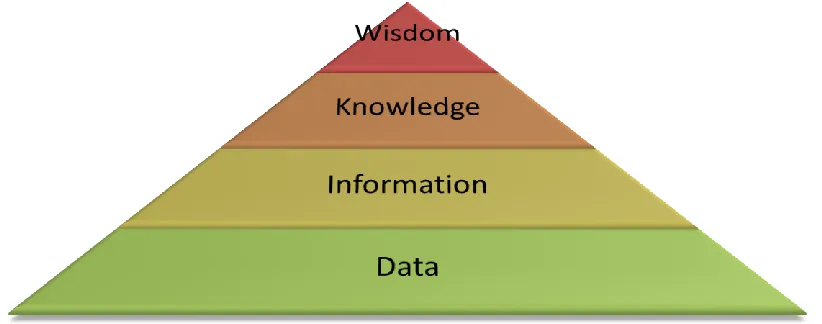
Before defining Knowledge Management, let us start with data, information and Knowledge. Data; Data is fact or information in raw form.
Knowledge management is defined as the process of applying a systematic approach to the capture, structuring, management, and dissemination of knowledge throughout an organization to work faster, reuse best practices, and reduce costly rework from project to project (Nonaka and Takeuchi, 1995; Pasternack and Viscio 1998; Pfeffer and Sutton, 1999; Ruggles and Holtshouse, 1999).
Wisdom is state of human mind characterized as human insight.Itis gained from formal knowledge.
Figure 1:Evolution of Knowledge
Looking back at Knowledge Management
In 1995 two Japanese academics, IkujiroNonaka and Hirotaka Takeuchi, published the Knowledge-Creating Company (Nonaka, I. and Takeuchi, H. 1995), a groundbreaking study of knowledge generation and use in Japanese firms. According to Nonaka and Takeuchi traditional western view of organizations (inherited from Cartesian dualism) as a mechanism that processes external information in order to adjust to new circumstances, does not explain innovation. Instead they recommended a theory of Organizational Knowledge Creation, which they describe as “the capability of a company as a whole to create new knowledge, disseminate it through the organization, and embody it in products, services, and systems”.
Nonaka and Takeuchi also differentiated tacit knowledges and explicit knowledge.
Tacit knowledge is personal, context-specific, and thus hard to formalize and communicate. It is highly ingrained into action. It is the knowledge that allows us to ride a car but we find it difficult to express it. Explicit knowledge on the other side is knowledge that we can capture and communicate as reports, articles, manuals, blueprints etc.
Tacit and explicit knowledge is one of the dimensions of a two-dimensional knowledge creating space. The second dimension comprises the levels of knowledge creating entities (individual, group, organizational and inter-organizational).
starts at the individual level and expands to larger communities of interaction (higher level entities). They differentiate four modes of interface or “knowledge conversion”, between tacit and explicit knowledge (fig. 2):
Figure 2: Graphical representation of this concept as presented in the SECI model:
Source: :http://www.knowledge-management-tools.net/knowledge-conversion.html#ixzz41Zlde1dC
Socialization (from tacit to tacit)is learning by sharing experience by creating new tacit knowledge through the sharing of experiences. Ex-An apprentice when learns by observing from his master in order to acquire his skills and technical knowledge.
Externalization(from tacit to explicit) is the stating of tacit knowledge in explicit forms like metaphors, analogies, concepts, hypotheses or models. This is the most critical of four modes of knowledge creation and communicated according to Nonaka and Takeuchi.
Combination (from explicit to explicit) is formation of new explicit knowledge by assimilating explicit knowledge entities into larger and more expressive knowledge systems
Internalization (from explicit to tacit) is the process of representing explicit knowledge into tacit knowledge. This mode of knowledge conversation is similar to “learning by doing” and is enabled when the explicit knowledge is expressed into documents, manuals, or oral stories.
the creation of new tacit knowledge by socialization, its externalization to explicit knowledge, its combination with other explicit knowledge and finally back to internalization as individual tacit knowledge. So tacit knowledge of individuals is the source of knowledge creation. No organization can create knowledge by itself but according to Nonaka and Takeuchi the tacit knowledge of the individuals, helps to to focus study at higher organizational levels, built on feedback provided by middle and higher level managers.
Knowledge Management Process
a. Knowledge Diagnosing
Some managers have natural abilities to rightly diagnose the knowledge which would contribute to the organizational performance based on their personal experience and some may have to be rained to seek knowledge. According to this definition, both diagnosis and management of organizational knowledge creation are performed in most organizations, although sometimes unconsciously(Dai at al., 2010).There is research evidence to prove that the organizational failure is attributed to its inability to diagnose the appropriate knowledge(Delong, 2004).
b.Knowledge Acquisition
Acquiring knowledge in a university can be viewed at both institutional level and individual level. At an organizational level (Professors and students), knowledge acquisition can be defined as accepting knowledge from the external environment and transforming it so that it can be used by an organization(Liao et al., 2009 and Pacharapha & Ractham, 2012).Acquisition capacity is a firm’s ability to locate, identify, value and acquire the external knowledge that is critical to its operations(Hoarau, 2014). c.Knowledge Generation
Effective knowledge generation in higher education requires not only a stock of knowledge, but also a constant flow of it, the essence of sharing knowledge is to support the generation of knowledge. In this situation, the combination of the individuals’ repertoire of skills and knowledge contains the potential to create new knowledge (Madhavan and Grover, 1998) .Knowledge generation can take place when four managerial tasks are executed effectively. These tasks are: planning, organizing, controlling, and staffing. Like the conventional management, knowledge generation also requires that these four tasks be systematically undertaken with the objective of generating knowledge. It requires teamwork to recognize, analyse, interpret, and share knowledge among the knowledge workers so that it becomes an integral part of organizational knowledge.
d. Knowledge Sharing
e. Knowledge Storing.
One of the purposes of KM is to store the organizational knowledge for future use. The idea is that people may come and go but the organization must grow and for that to happen there must be a very robust way of storing the knowledge in a systematic manner so that it may be retrieved with ease in a minimum time. There are other forms such as data mart, data repository, content and document management systems (Pérez et al., 2002; Sukula, 2006; Hsu et al., 2006; Roknuzzaman, 2009; Rah et al., 2010; Yulong, 2012).The RBT basically points to the fact that the organization should be able to store knowledge in a systematic manner and ensure that the knowledge is applicable to the current situation and should exploit the skills and competencies of the knowledge workers to enable them to promote innovation and gain the competitive advantage in the market(Fang et al. 2011).
f. Knowledge Application
It is not enough to share knowledge or disseminate knowledge to a receiving part. Rather, the methods, practices, and techniques in question must be used by the respondents in a way that changes their actions. Knowledge application represents the logical next step after knowledge sharing in the knowledge management cycle(Dalkir, 2005).Knowledge is applied when the experience of one individual or unit influences another unit through changes in behavior (Brachos et al., 2007).
Company Profile of Infosys
Infosys Limited (formerly Infosys Technologies Limited) is the second largest India-based IT service multinational corporation that provides business consulting,information technology, software engineering and outsourcing services. It is headquartered in Bangalore, Karnataka. Its market capitalisation presently was263,735 crores ($42.51 billion), making it India's sixth largest publicly traded company.
Infosys was co-founded in 1981 by CEO Narayan Murthy, NandanNilekani,, N. S. Raghavan, S. Gopalakrishnan, S. D. Shibulal, K. Dinesh and Ashok Arora . Infosys had 1,045 clients across 50 countries .In 2012, Infosys announced a new office in Milwaukee, Wisconsin to service Harley-Davidson, being the 18th international office. It provides software development, maintenance and independent validation services to companies like banking, finance, insurance, manufacturing and other domains..
In 1981, seven engineers started Infosys Limited with just US$250. In three decades, the company focused on bringing to life great ideas and enterprise solutions that drive progress for their clients such that 96.8 percent (as of December 31, 2015) Infosys has a total of 193,383 employees working from 32 countries (37 countries as per the base location). Out of its total workforce, 93.8% are software professionals, 17% are working in its BPO arm and remaining 6% work for support and sales,.It has 85 sales and marketing offices and 100 development centers as recorded by March 31, 2015.
Infosys was ranked 15th largest IT services provider in the world by HfS Research in its 2013 ranking. Infosys was ranked 19th on the world's most innovative companies list by Forbes(2013).It was in the list of top twenty green companies in Newsweek’s Green Rankings for 2012.
Knowledge management Solutions at Infocys
organize available and required knowledge resources across the enterprise. Efficient knowledge management braced by the right technology reduces customer resolving time and provides significant and accurate information to all users. Infosys Integrated Knowledge Management solution delivers a complete knowledge solution to enterprises viewing to boost their service capabilities.
The solution is based on the industry leading Knowledge Management product - Oracle Knowledge. Key areas that are covered –
1. Forming a knowledge base – A centralized knowledge base including all knowledge objects can be used to convey general training and video based training
2. Web self-service – It aids customers decide issues on their own and eases the inflow of service requests by enhancing the customer experience and refining overall service productivity
3. Real time knowledge provision– Best answers are available to service agents simaneously on a single click from a CRM solution.
4. Discussion forum–Discussion forum aids in providing platform for sharing idea and giving expert advice. All this is the solution of Knowledge management..
5. Knowledge creation – Enables the creation of knowledge items by SME on the recommendation by service agents and technicians. It can also be generated by technicians based on their knowledge.
6. Trouble shooting Wizards: These wizards are providing step by step guide to the users in using their services thus avoiding the continuous hassle of asking them directly.
Advantages of Knowledge Management Solution for Customers
1. Training time is reduced as the customers can solve their own problems themselves without calling for products and services.
2. Customers loyalty are increased by rewarding them after they make addition to the knowledge base by agents having access to product literature.
3. Reuse of Knowledge by preventing their waste and re-use. 4. Actively collaborate ideas with team through discussion forum.
5. As the service is easily available at CRM applications hence the productivity of service agents is easily increased.
6. New solutions are used leading to shorter implementation and less cost.
7. An Enterprise Repository helps in keeping safe all the Organization information thus maintaining the formal KM Process.
Conclusion
References
1. "Infosys Overview". Infosys. Retrieved 9 June 2014.
2. Top 5 India-Based IT Services Providers' Worldwide Revenue, 2012". Gartner. Retrieved 9 June 2014.
3. "INFOSYS LIMITED". Retrieved 2 July 2015.
4. "INFOSYS TECHNOLOGIES LIMITED". Retrieved 2 July 2015. 5. "Infosys Market Cap (INFY)". ycharts.com. Retrieved 8 June 2014.
6. "Top 100 Companies by Market Capitalization BSE". BSE. Retrieved 15 February2015.
7. "Infosys Q2 Profit Rises to Rs. 3,096 Crore, Shares Jump on Bonus Issue.". NDTV. Retrieved 10 October 2014.
8. SAINT-ONGE, H. (2002) Linking Knowledge to Strategy, presentation at the Strategic Planning for KM Conference, Toronto, May 28-29
9. DRUCKER, P. (2001) Management Challenges for the 21st Century, New York: Harper Business Press
10. PROBST, G. et alii (2002) Gestão do conhecimento- oselementosconstrutivos do sucesso.- Porto Alegre: Bookman.
11. Nonaka , I. , and H. Takeuchi . 1995 .The knowledge-creating company: How Japanese companies createthe dynamics of innovation . New York : Oxford University Press .
12. Pasternack , B. , and A. Viscio . 1998 .The centerlesscorporation . New York : Simon and Schuster .
13. Pfeffer , J. , and R. Sutton . 1999 .The knowing-doing gap: How smart companies turn knowledge intoaction . Boston, MA : Harvard Business School Press .
14. Ruggles , R. , and D. Holtshouse . 1999 .The knowledge advantage. Dover, New Hampshire : CapstonePublishers
15. Murthy to Patni, with love". The Economic Times. 18 October 2002. Retrieved30 November 2014..
16. "Investor Sheet". Infosys.com. Retrieved 22 May 2014
17. "TCS joins top 10 global IT services companies club". The Times of India. 22 Apr 2014. Retrieved 8 Jun 2014.
18. "The world's most innovative companies". Forbes. Retrieved 23 June 2013. 19. "Newsweek's Green Rankings 2012". Newsweek. Retrieved 3 July 2013.
20. "The Wall Street Journal Asia 200". The Wall Street Journal. 2 November 2010. Retrieved 29
October 2012.
21. Dai, Y.W., Rémy, S. &Magnier-Watanabe, (2010). Diagnosis for organizational knowledge creation: an ontological shift SECI model, Journal of Knowledge Management, Vol. 14 Iss 6 pp. 791 – 810.
22. Delong, D.W. (2004), Lost Knowledge: Confronting the Threat of an Aging Workforce, Oxford University Press, Oxford
23. Liao, S.-H., Wu, C.-C., Hu, D.-C. andTsuei, G.A. (2009). Knowledge acquisition, absorptive capacity, and innovation capability: an empirical study of Taiwan’s knowledge-intensive industries, Proceeding of World Academy of Science, Engineering and Technology, 41, 160-7. 24. Pacharapha, T. &Ractham, V.V. (2012). Knowledge acquisition: the roles of perceived value of
25. Hoarau, H., (2014). Knowledge Acquisition and Assimilation in Tourism-Innovation Processes, Scandinavian Journal of Hospitality and Tourism, Vol. 1, No. 1, pp. 1-17.
26. Madhavan, R. and Grover, R. (1998), From embedded knowledge to embodied knowledge: new product development as knowledge management, Journal of Marketing, 62(4), 1-12.
27. Hoarau, H., (2014). Knowledge Acquisition and Assimilation in Tourism-Innovation Processes, Scandinavian Journal of Hospitality and Tourism, Vol. 1, No. 1, pp. 1-17.
28. Madhavan, R. and Grover, R. (1998), From embedded knowledge to embodied knowledge: new product development as knowledge management, Journal of Marketing, 62(4), 1-12.
29. Peacre, J. A. and Robinson, R. B. (2009). Strategic Management, formulation, implementation, and control. Boston: McGraw Hill/Irwin.
30. Sukula, S.K. (2006). Developing indigenous knowledge databases in India, The Electronic Library, 24(1), 83 – 93.
31. Hsu, T., Ke, H., and Yang, W. (2006). Unified knowledge-based content management for digital archives in museums, The Electronic Library, 24(1), 38 – 50.
32. Roknuzzaman, M., Kanai, H. and Umemoto, K. (2009). Integration of knowledge management process into digital library system: A theoretical perspective, Library Review, 58(5), 372 – 386. 33. Rah, J.A., Gul, S. and Wani, Z. A. (2010). University libraries: step towards a web based
knowledge management system", VINE, 40(1), 24 – 38.
34. Yulong, Li., MonideepaTarafdar, S. and SubbaRao, (2012). Collaborative knowledge management practices: Theoretical development and empirical analysis, International Journal of Operations & Production Management, 32 (4), 398 – 422.
35. Dalkir, K. (2005). Knowledge Management in Theory and Practice, Elsevier-Butterworth-Heinmann, Oxford, UK
![(E) Ethyl 2 cyano 3 [4 (4,5 diphenyl 1H imidazol 2 yl)phenyl]acrylate dihydrate](data:image/gif;base64,R0lGODlhAQABAIAAAP///wAAACH5BAEAAAAALAAAAAABAAEAAAICRAEAOw==)