A Monthly Double-Blind Peer Reviewed Refereed Open Access International e-Journal - Included in the International Serial Directories
International Journal in IT and Engineering
http://www.ijmr.net.in
email id- [email protected]
Page
46
Third Party Auditing (TPA) For Secure Cloud Storage With Secret Sharing Algorithm
SHEETAL THITE[1],
M TECH,Computer Engineering,
BVDUCOE,
Pune,india
Prof. S.S.DHOTRE
Associate Professor,Department of Computer Engineering
BVDUCOE,
Pune,india
Abstract:
A scalable data storage service can be offered at a much lower cost by cloud storage providers.
Users can be used cloud storage to remotely store there data. It will be helpful for the user to freed
from extra load of storage space for data storage and manipulation of data but cloud storage also
leads to invite the risk of no longer having physical possession of the data theft. Necessary efforts
has been taken to build trust amongst use using different approaches for data security on cloud. Our
main approach is also one step towards reducing this risk. In this approach access based privacy
preserving authentication protocol (APPAP) is used. It will definitely address above privacy issue for
cloud sharing and storage.
Keywords:
Cloud Storage, Shared Data, Privacy Preserving, Secret Sharing, Authentication, Third
Party Auditor(TPA).
I.
INTRODUCTION
Cloud computing is the latest technological innovative architecture for enterprises and individual.
Even in a short span of time elapsed since its inception it has gained immense popularity due to
immense benefits it offers to its users. In the IT perspective there are many aspects where cloud
provides its services like Service On Demand, Uninterrupted Data access via Cloud storage services,
Pricing based on usage, quick resource expansion [6].On Demand service feature has many benefits:
freedom from burden of storage space and management, data access anywhere anytime, Relief
from the cost of hardware and software maintenance. As is always with many advantages there are
few concerns also raised by users, the major concern or the risk the user is exposed to is security of
the outsourced data, because the data is stored on remote cloud servers the availability and
integrity of the data is not always assured [8]. This issue if addressed will eventually increase the
users trust and confidence of its usage. To address the above mentioned anomalies our approach of
Access Controlled based Data Security in Cloud environment has been devised and discussed in this
paper.
Contribution:
The Contribution of this paper are:
1. Shared access authority by author access granting mechanism.
2. Permission Level based access control to realize that user can have access at which level
3. Effective Data Encryption mechanism so that security of the data can be preserved.
A Monthly Double-Blind Peer Reviewed Refereed Open Access International e-Journal - Included in the International Serial Directories
International Journal in IT and Engineering
http://www.ijmr.net.in
email id- [email protected]
Page
47
Organization:
The remaining of the paper talks about the analysis of the existing systems and there pro’s and
Con’s. Our approach discussed in detail and the problem statement along with the evolution of the
algorithm.
II.
EXISTING SYSTEM
Cong Wang has proposed public audit ability for cloud storage. To illustrate his approach he has
developed a cloud storage mechanism which is secured by the implementation of public auditing via
privacy preserving and designed a Third Party Auditor which will audit multiple users in parallel with
enhanced performance. but due to random masking at the cloud server and auditing task overhead
may have an impact on the efficiency of the cloud performance.
Earlier Researcher’s has proposed a public auditing based privacy preserving protocol for secure
cloud storage based on unpadded RSA based public auditing. This approach is better in terms of
data privacy and public audit ability, though this approach seems better but as claimed by author the
full fledged implementation is yet to be complete.
III.
SYSTEM FLOW
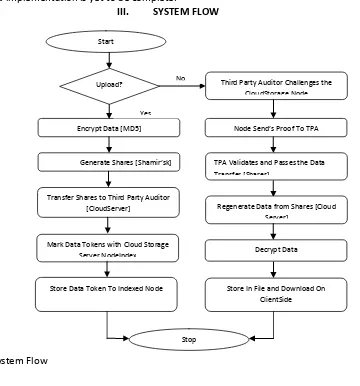
Figure 1 System Flow
Start
Encrypt Data [MD5]
Generate Shares *Shamir’sk]
Transfer Shares to Third Party Auditor [CloudServer]
Mark Data Tokens with Cloud Storage Server NodeIndex
Upload?
Store Data Token To Indexed Node Yes
Third Party Auditor Challenges the CloudStorage Node No
Node Send’s Proof To TPA
TPA Validates and Passes the Data Transfer [Shares]
Regenerate Data from Shares [Cloud Server]
Decrypt Data
Store In File and Download On ClientSide
A Monthly Double-Blind Peer Reviewed Refereed Open Access International e-Journal - Included in the International Serial Directories
International Journal in IT and Engineering
http://www.ijmr.net.in
email id- [email protected]
Page
48
IV. PROPOSED SYSTEM
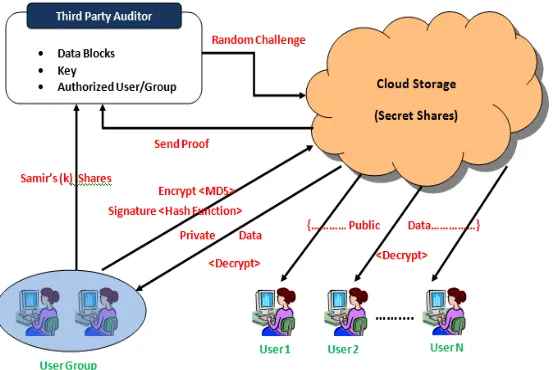
Third Party Auditor (TPA) mechanism thus the user is able to shared the data while having the
facility to allow/ deny access along with the read write permission to a single user an group of users.
The data which is shared by user is encrypted and secret shares are generated and some but not all
secret shares are stored on the distributed cloud Environment. Thus TPA has the complete data to
authenticate the integrity of the data. Thus as per our approach the TPA will be able to do the
auditing without asking for the local copy of the data which in turn will result in less communication
and computational load.
Figure 2 Proposed SystemArchitecture
Algorithm:
Secret Share Generation using Shamir’s Secret Sharing
Let the secret data be a value D. An algorithm defines a k-out-of-n threshold secret sharing scheme,
if it computes D(s) = *d1,d2,….,dn+ and the following conditions hold
Correctness:
D can be determined by any k shares from d1,d2,…, dn and there exists an algorithm S0
that efficiently computes D from these k shares.
Privacy:
having access to any one of the k shares from d1,d2,….,dn gives no information about the
value of D, i.e., the probability distribution of k isto 1 shares is independent of D.
Steps To Regenerate Original Data:-
Suppose we want to use (K,N) threshold scheme to share our secret D where K should be less than
or equal to N.
Choose at random (k-1) coefficients d1,d2,d3…dk-1 , and let D be the a0
Construct N points
(if(i)) where i=1,2…..N
1 1 2
2 1
0
...
)
(
x
a
a
x
a
x
a
kkA Monthly Double-Blind Peer Reviewed Refereed Open Access International e-Journal - Included in the International Serial Directories
International Journal in IT and Engineering
http://www.ijmr.net.in
email id- [email protected]
Page
49
Given any subset of K of these pairs, we can find the coefficients of the polynomial by interpolation,
and then evaluate a0=D , which is the secret message reconstructed.
MD5
MD5 is a hash table based encryption algorithm. It consists of five steps as described below:
1. Appending Padding Bits: The original message is taken as input and then it is extended so that its
length becomes equal to 448, modulo 512 bit. The rules for the extension are as below:
Initially original message is always padded with one bit "1".
Then zero or more bits "0" are added to bring the length of the message up to 64 bits a bit
lesser than a multiple of 512.
2. Appending Length: The 64 bits appending happens at the end of the extended message to show
the length of the original message in bytes. Rules of appending length are:
The original message length in bytes is converted into binary of 64 bits. In case of overflow,
the low-order 64 bits are used.
Separate the 64-bit length into 2 words of 32 bits each.
The high order word is appended after the low order word is appended.
3. MD Buffer Initialization: Because MD5 algorithm needs a 128-bit buffer with a specific initial
value. The rules of initializing buffer are:
The buffer is separated into 4 words (32 bits each), named as W1, W2, W3, and W4.
Word W1 is initialized to: 0x67452301.
Word W2 is initialized to: 0xEFCDAB89.
Word W3 is initialized to: 0x98BADCFE.
Word W4 is initialized to: 0x10325476.
4. Processing Message in 512-bit Blocks: This is one of the main step of MD 5 algorithm, which
converts padded and appended message into 512 block size. For each input block, 4 rounds of
operations are performed with 16 operations in each round.
5. Output: The contents in buffer words W1, W2, W3, W4 are returned in sequence with low-order
byte first.
V. EVALUATION AND ANALYSIS
As a proof of enhancement in security and data storage and retrieval correctness we considered
the two users scenario where we consider that both the users belong to same group. Beyond this we
have also demonstrated the assurance of security of bulk auditing for the TPA in multiple user
environment. We focus our result evaluation on the below discussed three parameters,
Storage and Retrieval Correctness
Security in form of privacy preservation and authentication
System Performance.
Storage And Retrieval Correctness
The classic cloud storage has two components
A Monthly Double-Blind Peer Reviewed Refereed Open Access International e-Journal - Included in the International Serial Directories
International Journal in IT and Engineering
http://www.ijmr.net.in
email id- [email protected]
Page
50
is Initialize client Thread to store socket and storage Manager Reference in data members. Run
Method will read a request first then process the request and send a response to the cloud user. In
the process request first it will read command, domain name and password from client request
packet. In datacenter to check a domain is registered or not if not registered then send a error
massage in a response to the cloud client else do operation according to request.
Figure 3 Storage and Retrieval Correctness
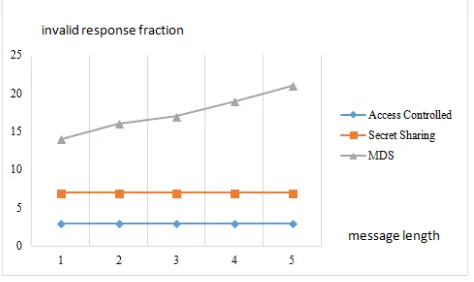
Security In Form Of Privacy
The three step approach of Encryption, Secret Sharing and User Group Authentication is
used to preserve the privacy more effectively. The existing systems used to work individually on the
approaches i.e. an encryption system only encrypts the data whereas we have seen many user group
authentication systems where data can be shared amongst trusted users only. The approach
implemented here is utilize the beneficial aspects of these approaches and combine to enhance the
privacy preserving manifolds.
Figure 4 Storage and Retrieval Correctness
System Performance
A Monthly Double-Blind Peer Reviewed Refereed Open Access International e-Journal - Included in the International Serial Directories
International Journal in IT and Engineering
http://www.ijmr.net.in
email id- [email protected]
Page
51
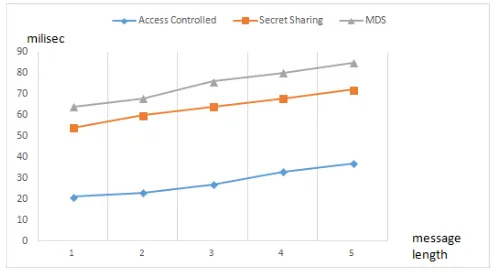
Figure 5 System performance
VI. CONCLUSION
Considering the evaluation results we conclude that our approach has enhanced the privacy
preserving feature of Cloud Storage environment, which will enhance the user trust on the Cloud
Storage service providers and thus the usage of Cloud will also be improved with a better user
experience on two aspects i.e. Performance and Data Security. Our system has been developed and
tested on homogeneous cloud environment so the scope of such system for heterogeneous cloud is
the area for future research.
REFERENCES
[1]
Aten,2011 R. Curtmola , G. Ateniese, R. Burns, J. Herring, L. Kissner, Z. Peterson, and D.
Song. In ACM CCS, 598–609, 2007.Provable data possession at untrusted stores.
[2]
Bowe,2009 K.D. Bowers, A. Juels & A. Oprea (2009A), Proc. ACM Conf. Computer and
Comm. Security (CCS ’09), 187–198.―HAIL: A High-Availability and Integrity Layer for
Cloud Storage,
[3]
Boya,2014 Boyang Wang; Baochun Li; Hui Li, Cloud Computing, IEEE Transactions on: 43 -
56 Volume: 2, Issue: 1, Jan.-March 2014. "Oruta: privacy-preserving public auditing for
shared data in the cloud".
A Monthly Double-Blind Peer Reviewed Refereed Open Access International e-Journal - Included in the International Serial Directories