2765
Microstructure of Low Cost and High Cost Brown
Semi-Permanent Makeup Ink Pigments
Hyun-Sook Jin, Byung-Soo ChangAbstract— In this study, microstructural characteristics of pigments added to these products were compared and analyzed by selecting low and high cost inks of brown type used in semi-permanent makeup procedure. The type of inorganic material added to the ink and morphological characteristics of particles were observed using a light and scanning electron microscope. Low cost ink pigments were observed in various sizes and shapes ranging from 100 nm to 150 ㎛ in diameter. In addition to iron oxide in the low cost ink pigment, a plate-like substance 10㎛ in diameter and a mass-like substance 150㎛ in diameter were observed. High-cost ink products consisted of nanoscale pigments 100 nm to 800 nm in diameter. Pigments were shaped like iron oxide and titanium dioxide in the form of rod and cubic forms. In conclusion, low-cost and high-cost inks used in this study differed in homogeneity and size of pigment particles. Inhomogeneity of ink pigments and contaminants added intentionally or unintentionally in manufacturing of the product may cause an after-effect as a result of cosmetic tattooing and have a major effect on satisfaction.
Index Terms— Cosmetics, Heavy metal, Iron oxide, Semi-permanent makeup, Tattoo, Titanium dioxide. Scanning electron microscope.
—————————— ——————————
1 I
NTRODUCTION The tattoo began in ancient Egypt from 3,000 BC or earlier to indicate that a male or female is a member of a certain social group or for skin decoration. Tattoos have become popular with the public since the late 1970s. In particular, the tattoo began becoming prevalent among women to show their facial personality and minimize facial asymmetry [1, 2].Tattoo means injecting an exogenous substance into the skin to make permanent pigmentation. The etymology of tattoos has first been known to originate from the Polynesian word “ta” meaning “hit something” and second the Tahitian word “tatau” meaning “indicate something” [3]. Tattoo has been often referred to as cosmetic tattooing, micropigmentation, contour makeup, art makeup, long time makeup, permanent makeup, and semi-permanent makeup according to the range, depth, and purpose of skin procedure. The purpose of the tattoo can be divided into two major types. A traumatic tattoo compliments tissue loss due to unexpected injuries to the skin or postoperative complications, and a beauty tattoo shows an individual’s beauty with symbolic meaning [3].
Modern women use tattooing for the convenience of makeup to permanently or semi-permanently paint eyeliner, eyebrows, lip liner, full lip pigment, cheek blush and beauty marks as a means of complementing their weaknesses and exuding a confident appearance [4, 5]. To show such beauty, eyebrow semi-permanent makeup treatment is widely used among people currently in various tattoo areas.
Pigments used in semi-permanent makeup are mainly comprised of mineral oxides. Iron oxide can be made into a variety of specific colors by mixing three kinds of red, yellow and black pigments at an appropriate ratio. Iron oxide is a fine
particle 300 nm-600 nm and is a nanomaterial in rod-like or cubic form depending on type [6]. However, iron oxide deposited in the human body may cause image interference during MRI scanning [7, 8]. Semi-permanent makeup procedures on eyebrows and lip lines for facial cosmetics are now globally prevalent in adults of all ages [9].
Semi-permanent makeup is a technique to inject pigment into the superficial layer of dermis using a digital permanent makeup machine equipped with a sharp needle. When the user is dissatisfied with semi-permanent tattooing, it is because a part of the treatment area is not natural due to the wrong color selection or tattoo asymmetry. In particular, there have been many complaints relative to pigment spreading in the treatment area and discrepancies in color tone or discoloration [10, 11]. Such complaints may be caused by contaminants entering the ink during the manufacturing process. However, studies on side effects that may occur depending on quality and ingredients of the ink used for tattooing including semi-permanent makeup procedures are insufficient.
Thus, in this study, researchers selected each 1 type of low-cost ink and high-low-cost ink that are mostly used in the semi-permanent makeup tattooing and observed microstructural properties of inorganic materials contained in such inks using an optical microscope and a scanning electron microscope.
2
M
ATERIALS ANDM
ETHODS2.1 Experimental materials
Each 1 type of low-cost brown ink (brown, E company, South Korea) and high-cost brown ink (light brown, V company, German), mainly used in semi-permanent makeup procedures, were selected and used as experimental materials.
2.2 Observation using an optical microscope
To compare ingredients of low-cost ink and high-cost ink, 1 ml of each sample was added to a Falcon tube, and then an absolute alcohol was added thereto, diluted with a stirrer, and deposited in the sediment. Subsequently, supernatant liquid ————————————————
Corresponding author: B.S. Chang, Department of Cosmetology, Hanseo University, Seosan, Chungnam 31962, Republic of Korea, PH-821062790810. E-mail: [email protected]
containing organic material was discarded, and sediment was stirred three times each in the same manner and then deposited. Each sediment was placed on a slide glass using a syringe, covered with a cover slip, sealed with a manicure solution, and observed with an optical microscope (BX 42, Olympus, Japan).
2.3 Observation using scanning electron microscope To identify the kind and microstructural characteristics of inorganic materials contained in low-cost and high-cost semi-permanent makeup inks, each sample was dropped onto a stub treated with carbon and copper tape and dried in nature. Subsequently, platinum coating was applied with a thickness of 20 nm using an ion-deposition machine (IB-5 ion coater, Eiko, Japan) and observed with a scanning electron microscope (S-4700, Hitachi, Japan) at 15 kV.
3 R
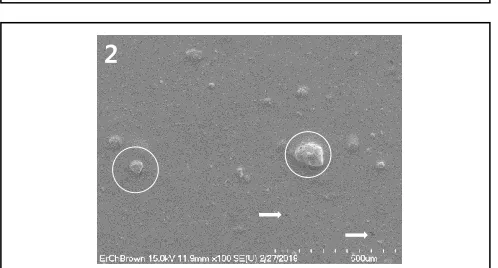
ESULTSLow-cost semi-permanent makeup ink used in this study was dissolved in organic solvents and observed with an optical microscope. As a result, most of the pigments added to the ink were brown, and there was small yellowish plate substance as well as substance forming a large blackish brown mass [Fig. 1]. In low-magnification scanning electron microscope observation, the surface of the sample was uniformly dispersed with fine pigment particles, but substances other than these fine particles were observed in a lump shape, and plate-like substances also existed [Fig. 2].
On the high magnification scanning electron microscope, plate-like material was in a multi-layer structure
approximately 10 ㎛ in diameter and approximately 2.5 ㎛ in thickness. These plate-like materials are polygonal in shape with sharp or angled distal ends and iron oxides were scattered around them. The surface of the plate-like material was relatively smooth [Fig. 3]. Iron oxides were characterized by morphological characteristics of rod-shaped ferric oxide and red iron oxide and cubic black iron oxide, 300 nm to 800 nm in diameter. Particularly, materials with different shapes and sizes were observed between these iron oxides. These materials were in the form of plates approximately 0.5 ㎛ to 1 ㎛ in diameter, with smooth surfaces [Fig. 4].
On the low magnification scanning electron microscope, a large elliptical mass-like substance approximately 150 ㎛ in diameter was found in a low-cost ink pigment. These lump materials were covered with iron oxides of micrometal size or less, and no external morphological features could be identified [Fig. 5]. In addition to iron oxide, dendrite-like nanometer-sized materials were also observed on the massive material surface on a high magnification scanning electron microscope. These materials were square, each with a diameter of 0.5 ㎛ in width, length and height respectively [Fig. 6].
Observation of the expensive semi-permanent makeup ink with an optical microscope revealed that fine metal materials were evenly dispersed and were light brown. Unlike low-cost ink ingredients, no plate-like or lumpy materials were observed [Fig. 7].
On the low magnification scanning electron microscope, metallic materials added to the high-cost semi-permanent
1
Fig. 1. Light microscopic image of low priced semi-permanent makeup ink.
2
Fig. 2. Low magnification scanning electron micrograph of low priced semi-permanent makeup ink. Arrows: Plate like material, circles: lumpy matter.
3
Fig. 3. Scanning electron micrograph of a plate-like substance added to a low priced semi-permanent makeup ink. Plate material is in multiple layers, approximately 10㎛ in diameter.
4
2767 makeup ink were uniformly dispersed in a markedly smooth
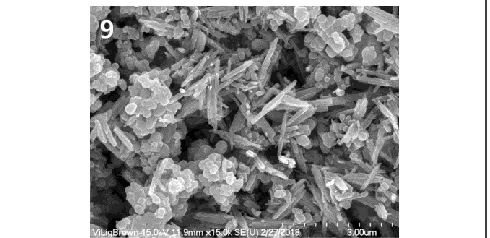
state like homogeneous film [Fig. 8] The observation with high magnification scanning electron microscopy showed that metal materials of high-cost ink consisted of rod-shaped iron oxide, red iron oxide, cubic black iron oxide, and titanium dioxide [Fig. 9]. Granular black iron oxide and titanium dioxide were 100-300 nm in diameter and rod iron oxide was 300 nm to 800 nm in length. Iron oxide was clustered by electrostatic attraction, rod-shaped iron oxides were clumped together, and cubic iron oxide or titanium dioxide was separated or aggregated in small amounts [Figs. 9, 10]. As shown in figure 10, bar-shaped iron oxides were clustered and observed as a mass of approximately 5 ㎛ in diameter.
4 D
ISCUSSIONIn today’s society, tattoo is a symbol of individualism that expresses uniqueness and beauty and is a human beauty art showing defiance, risk, affection, and joy [9].
Cosmetic tattooing, or semi-permanent makeup, has been used to emphasize facial features, minimize asymmetry, and show roominess [5, 12]. Semi-permanent makeup is a procedure that injects pigment into the skin for cosmetic makeup [2, 12]. Pigments used in inks are inactive materials classified as cosmetics or color additives (complementary agents) and do not dissolve in water or organic solvents [2]. In this study, the comparison of brown semi-permanent makeup ink with an optical microscope revealed that the low-cost ink pigment contained yellowish plate-like substance and blackish-brown large lump material among homogeneous metallic particles, were observed as metallic materials
5
Fig. 5. Scanning electron micrograph of lump material added to low-cost semi-permanent makeup ink
6
Fig. 6. Magnified scanning electron micrograph in figure 5. Square foreign matter (circles) adhere to the surface of lump material.
7
Fig. 7. Light microscopic image of high-cost semi-permanent makeup ink.
8
Fig. 8. Low magnification scanning electron micrograph of high-cost semi-permanent makeup ink.
10
Fig. 10. Scanning electron micrograph of high-cost semi-permanent makeup ink showing aggregated iron oxides.
9
composed of particles of a certain size.
It is considered that the difference in size and ingredients of low-cost and high-cost ink pigment particles is caused by the intentionally or unintentionally addition of impurities in the product. Forte et al., [10] reported that tattoo colorants available in the market are markedly diverse in color even in the same color product. In the production of tattoo ink, expression of specific hues varies depending on the amount of metal added and degree of refinement of these metals [13]. Semi-permanent makeup ink is composed of insoluble colorant and dispersant dispersed in water and additives such as preservatives and some fragrance is included. Colorant, an insoluble pigment in ink, is the most important component. Most of the ink for tattooing is comprised of carbon black, colorants, and auxiliary substances such as titanium dioxide and iron oxide [14].
In this study, the low-cost semi-permanent makeup ink pigment consisted of iron oxide and micrometer-size plate-like material and lump-shaped materials with uniform nanometer size. High-cost semi-permanent makeup ink pigment consisted only of nanometer-size iron oxide and titanium dioxide. As a result of this study, iron oxide was common to low-cost and high-cost semi-permanent makeup products, but it was confirmed that a plate material with a diameter of 10 ㎛ and a mass material with a diameter of 150 ㎛ were added as impurities in a low-cost semi-permanent makeup coloring product. Pigment particles used in the ink are sub-micrometer size or true nanoparticles smaller than 100 nm. However, some metal oxides are intentionally added to obtain the effect of certain colors, but these substances can result in body side effects or aftereffects [13, 15].
Iron oxide is divided into iron oxide red, iron oxide yellow, and iron oxide black. Particles of iron oxide red exist in the form of a rod approximately 500 to 600 nm in length and a cubic type approximately 100 nm, and iron oxide yellow is a rod-shaped particle 300 to 600 nm in diameter. Iron oxide black is a spherical or cubic particle approximately 200 to 300 nm in diameter [6].
Jeon & Chang [6] reported that iron oxide was observed as a lump of small granular powder when viewed with the naked eye. Additionally, red iron oxide particles aggregate with each other to form a mass of 15-20 ㎛ in diameter on a scanning electron microscope, and iron oxide yellow and iron oxide black are observed in a mass of approximately 20-30 ㎛ in diameter [6]. In this study, iron oxide of the same kind in the high-cost semi-permanent makeup ink coalesced to form a fine lump. Iron oxide particles have high tendency to coagulate and form a large surface area by fine particles with a high surface energy level [16].
It is considered that small particles of iron oxide are aggregated to form agglomerates because particles have magnetic field and high surface energy level as reported by Zeng & Zhang [16]. In this study, it was found that granular titanium dioxide was added only to high-cost semi-permanent make up inks and not to low-cost semi-permanent makeup inks. Titanium dioxide is a white powder that has anti-corrosion characteristics and high photocatalytic activity and is known as a non-toxic particle and used in most cosmetics [17, 18].
As a result of this study, it was found that high-cost ink
pigments consist of rod-shaped iron oxide yellow, iron oxide red, and cubic iron oxide black or titanium dioxide. However, low-cost ink pigments contain platy or lumpy contaminants respectively. To enhance safety of tattoo ink, it is necessary to minimize contamination of toxic heavy metals by using refined high purity metal.
5 C
ONCLUSIONThis study observed microstructural characteristics of low-cost and high-cost brown permanent makeup ink pigments by optical microscope and scanning electron microscope. Microscopic observations showed that most of the pigments added to the low-cost semi-permanent makeup ink were brownish, and there was substance in which small yellowish plate substance and large blackish brown mass were formed between them.
In SEM observation of low-cost semi-permanent makeup ink sediments, the surface of the sample was uniformly dispersed with fine iron oxide particles, but there were also large lump-like and plate-lump-like materials other than these fine particles. Plate-like material was laminated with sharp or angled distal parts and the surface was relatively smooth. These polygonal plate-like materials had approximately 10 ㎛ in diameter with thickness of approximately 2.5 ㎛. Lumpy material was measured as an oval shape approximately 150 ㎛ in diameter and the surface of the material was heated by fine particles such as iron oxide, such that morphological characteristics of the outside could not be confirmed.
On optical microscope observation, high-cost semi-permanent makeup ink pigment was light brown. Metal materials added to high-cost semi-permanent makeup ink on scanning by electron microscope were composed of rod-shaped iron oxide, red iron oxide, cubic iron oxide, and titanium dioxide. The granular iron oxide black was 100-300 nm in diameter and the rod-iron oxide was 300 nm to 800 ㎛ in length. On high magnification scanning electron microscope observation, iron oxides were agglomerated together by the same kind of iron oxides. Round agglomerated iron oxides was approximately 5 ㎛ in diameter.
A
CKNOWLEDGMENTThis study was conducted under the support of the 2019 Hanseo University intramural research project.
R
EFERENCES[1] N. Goldstein, “Tattoos defined,” Clin Dermatol, vol. 25, no. 4, pp. 417-420, Jul-Aug. 2007 .
[2] C. De Cuyper, “Permanent makeup: indications and complications,” Clin Dermatol, vol. 26, no. 1, pp. 30-34, Jan-Feb. 2008.
[3] F. Pesapane, G. Nazzaro, R. Gianotti, and A. Coggi, “A short history of tattoo,” JAMA Dermatol, vol. 150, no. 2, p. 145, Feb. 2014.
[4] A.K. Singh and D. Karki, “Micropigmentation: Tattooing for the treatment of lip vitiligo,” J Plast Reconstr Aesthet Surg, vol. 63, no. 6, pp. 988-991, Jun. 2010.
2769 and review of literature,” J Dermatol Dermatol Surg, vol. 21,
no.7, pp. 87-90, Jul. 2017
[6] M.O. Jeon and B.S. Chang, “Fine structure of the iron oxides containing to blemish balm cream,” J Invest Cosmetol, vol. 6, no. 2, pp. 219-226, Jun. 2010, DOI : 10.15810/jic.2010.6.2.016
[7] W.D. Tope and F.G. Shellock, “Magnetic resonance imaging and permanent cosmetics (tattoos): survey of complications and adverse events,” J Magn Reson Imaging, vol. 15, no. 2, pp. 180-184, Feb. 2002.
[8] D. Maiti and P.S. Devi, “Selective formation of iron oxide and oxyhydroxide nanoparticles at room temperature: Critical role of concentration of ferric nitrate,” Mater Chem Phys, vol. 154, pp. 144-151, Mar. 2015.
[9] D. F. Montgomery and D. Parks, “Tattoos: Counseling the adolescent,” J Pediatr Health Care, vol. 15, no. 1, pp. 14-19, Jan-Feb, 2001.
[10]G. Forte, F. Petrucci, A. Cristaudo, and B. Bocca, “Quantification of sensitizing metals in tattooing pigments by SF-ICP-MS technique,” Open Chem Biomed Meth J. vol. 2, no. 2, pp. 42-47, Apr. 2009.
[11]M. Arl, D.J. Nogueira, J.S. Köerich, N.M. Justino, D.S. Vicentini, and W.G. Matias, “Tattoo inks: Characterization and in vivo and in vitro toxicological evaluation,” J Hazard Mater. vol. 364, pp. 548-561, Feb. 2019.
[12]C.L. Wetzel, “Permanent cosmetics,” Plast Surg Nurs. vol. 32, no. 3, pp. 117-119, Jul-Aug. 2012.
[13]G. Forte, F. Petrucci, A. Cristaudo, and B. Bocca, “Market survey on toxic metals contained in tattoo inks,” Sci Total Environ. vol. 407, no. 23, pp. 5997-6002, Nov. 2009.
[14]P. Laux, T. Tralau, J. Tentschert, A. W. Bäumler, E. Bernstein, B. Bocca, A. Alimonti, H. Colebrook, C. de Cuyper, L. Dähne, U. Hauri, P.C. Howard, P. Janssen, L. Katz, B. Klitzman, N. Kluger, L. Krutak, T. Platzek, V. Scott-Lang, J. Serup, W. Teubner, I. Schreiver, E. Wilkniß, and A. Luch, “A medical-toxicological view of tattooing,” Lancet. vol. 387, no. 10016, pp. 395-402, Jan. 2016.
[15]P.S. Islam, C. Chang, C. Selmi, E. Generali, A. Huntley, S.S. Teuber, and M.E. Gershwin, “Medical complications of tattoos: a comprehensive review,” Clin Rev Allergy Immunol. vol. 50, no. 2, pp. 273-286, Apr. 2016.
[16]S. Zheng and Q. Zhang, “Surface-modification of fine red iron oxide pigment,” China Parmaticuol. vol. 1, no. 4, pp. 176-180, Sep. 2003. DOI: 10.1016/S1672-2515(07)60137-7.
[17]R. Banerjee, “Nanocosmetics. The Good, the Bad and the Beautiful,” Trichol Cosmetol Open J. vol. 1, pp. 9-11, May. 2017. DOI: 10.17140/TCOJ-1-e005.