R E V I E W
Prostaglandins as the Agents That Modulate the
Course of Brain Disorders
This article was published in the following Dove Press journal: Degenerative Neurological and Neuromuscular Disease
Hamidreza Famitafreshi
Morteza Karimian
Physiology Department, Tehran University of Medical Sciences, Tehran, Iran
Abstract:
Neurologic and neuropsychiatric diseases are associated with great morbidity and
mortality. Prostaglandins (PGs) are formed by sequential oxygenation of arachidonic acid in
physiologic and pathologic conditions. For the production of PGs cyclooxygenase is
a necessary enzyme that has two isoforms, that are named COX-1 and COX-2. COX-1
produces type 1 prostaglandins and on the other hand, COX-2 produces type 2
prostaglan-dins. Recent studies suggest PGs abnormalities are present in a variety of neurologic and
psychiatric disorders. In a disease state, type 2 prostaglandins are mostly responsible and
type 1 PGs are not so important in the disease state. In this review, the importance of
prostaglandins especially type 2 in brain diseases has been discussed and their possible role
in the initiation and outcome of brain diseases has been assessed. Overall the studies suggest
prostaglandins are the agents that modulate the course of brain diseases in a positive or
negative manner. Here in this review article, the various aspects of PGs in the disease state
have discussed. It appears more studies must be done to understand the exact role of these
agents in the pathophysiology of brain diseases. However, the suppression of prostaglandin
production may confer the alleviation of some brain diseases.
Keywords:
prostaglandins, depression, Alzheimer, addiction, Parkinson and multiple
sclerosis
Introduction
Neuropsychiatric diseases have a wide array of symptoms and related behaviors
that have a high prevalence in human societies.
1A great fraction of them occurs in
a subset of people that are suffering from other medical diseases.
2–5Many studies
have been performed to con
fi
rm the basic mechanisms that produce such diseases.
Prostaglandins are lipid-derived small molecules that are produced from
arachido-nic acid by sequential enzymatic reactions.
6Recently it has been given great
importance to these small molecules in the occurrence of neuropsychiatric
disorders.
7Recently it has been proposed that other than physiologic functions,
certain prostaglandins are associated with neuropsychiatric and neurologic
disorders.
8New studies aim to establish a relationship between certain types of
prostaglandins with a speci
fi
c disease. Here in this review article, we are going to
discuss the important aspects of prostaglandins in the occurrence of brain diseases.
Prostaglandins
Prostaglandins are lipid derives molecules that have important functions in our body.
All prostaglandins have 20 carbons but they have different structures that account for
Correspondence: Morteza KarimianDepartment of Physiology, Tehran University of Medical Science, Enghelab St., Shanzdahazar St., Poorsina St, Tehran, Iran Tel/Fax +98 02166419484
Email [email protected]
Degenerative Neurological and Neuromuscular Disease
Dove
press
open access to scientific and medical research
Open Access Full Text Article
Degenerative Neurological and Neuromuscular Disease downloaded from https://www.dovepress.com/ by 118.70.13.36 on 24-Aug-2020
diverse physiologic functions.
9The difference in the
recep-tor is responsible for the diverse functions of one
prosta-glandin that can be inhibitory or stimulatory.
10The
synthesis of prostaglandins is a multistep process that
begins with the formation of arachidonic acid from
diacyl-glycerol and phospholipase A2. Arachidonic acid can
choose the cyclooxygenase pathway or lipoxygenase
pathways.
11Prostaglandins are formed by sequential
oxy-genation of arachidonic acid. Cyclooxygenase has two
iso-forms COX-1 and COX-2. Recently it has been suggested
that a variant of COX-1 can be considered as COX-3.
12Constant production of COX-1 that results in the production
of type 1 prostaglandins. On the other hand, COX-2 is
activated in certain conditions such as in
fl
ammation and
growth.
13Prostaglandins Receptors
Eight subtypes of membrane prostanoid receptors have
already been discovered: the PGD receptor (DP), four
subtypes of the PGE receptor (EP1, EP2, EP3, and EP4),
the PGF receptor (FP), the PGI receptor (IP), and the TxA
receptor (TP)
14(
Table 1
). All are G protein-coupled
rho-dopsin-type receptors with seven transmembrane domains,
and each domain is encoded by a different gene. In
Table 1
we have summarized the various prostaglandin receptors
that are present in the body.
15Cyclooxygenase enzyme
releases prostaglandins from arachidonic acid in
mem-brane lipids (
Figure 1
). There are multiple steps that
even-tually all types of prostaglandins are produced. The
structural difference is to account for their different
biological properties. Also different kind of receptors
also may account for such differences. One prostaglandin
may have a stimulatory effect in a given context and in
another context have an inhibitory function. They act as
paracrine substances and usually targeted tissue in the
vicinity of the site of their production.
Prostaglandins and Cytokines
Cytokines are small protein molecules released by
differ-ent in
fl
ammatory cell types. Based on the cell type that
secretes cytokines, cytokines can be assigned different
names such as lymphokines that secrets from
lympho-cytes and monokines that release from monolympho-cytes. Also,
they have other names based on their speci
fi
c activities
such as chemokines (chemotactic activities) and
interleu-kins (cytokines that interact with other leukocytes).
Cytokines can act as autocrine, paracrine and endocrine.
They can mediate in
fl
ammatory or anti-in
fl
ammatory
pro-cesses and therefore that can be harmful or not harmful.
16Different cell types produce cytokines but mainly T cells
and macrophages secrete cytokines. Pieces of evidence
support the role of prostaglandins such as PGEs in the
production of certain cytokines.
17The produced cytokines
can be in
fl
ammatory or anti-in
fl
ammatory. However, most
studies support the theory that prostaglandins promote
cytokine production and the produced cytokines are
harm-ful to neurons.
18In other diseases such as diabetes
19and
atopic dermatitis
20also it has been documented the
in
fl
ammatory role of prostaglandins and increased
pro-duction of cytokines. In a recent article, the role of
Table 1
Different Prostaglandin Receptors and Their Potencies for a Speci
fi
c Type
Name of Related
Prostaglandin
The Potency of Related Prostaglandin
to Activate the Related Receptor
G Protein
Linkage
Signaling Pathway
Prostaglandin DP1 receptor PGD2≫PGE2>PGF2α>PGI2=TXA2 Gs alpha subunit Activates AC, increases cAMP, raises Ca 2+
Prostaglandin DP2 receptor PGD2≫PGF2α=PGE2>PGI2=TXA2 Gi alpha subunit Inhibits AC to depress cAMP levels
Prostaglandin EP1 receptor PGE2>PGF2α=PGI2>PGD2=TXA2 Gq alpha subunit Stimulates PLC, IP3, PKC, ERK, p38 Mpk, and CREB
Prostaglandin EP2 receptor PGE2>PGF2α=PGI2>PGD2=TXA2 Gs alpha subunit Stimulates AC, raises cAMP, stimulates beta-catenin and Glycogen
synthase kinase 3
Prostaglandin EP3 receptor PGE2>PGF2α,PGI2>PGD2=TXA2 Gi & G12 subunit Inhibits AC, decreases cAMP, stimulates PLC & IP3, raises Ca2+
Prostaglandin EP4 receptor PGE2>PGF2α=PGI2>PGD2=TXA2 Gs alpha subunit Stimulates AC, PKA, PI3K, AKT, ERK, p38 Mpk, & CREB; raises cAMP
Prostaglandin F2αreceptor PGF2α>PGD2>PGE2>PGI2=TXA2 Gq alpha subunit Stimulates PLC, IP3, & PKC; raises Ca2+
Prostacyclin I2 receptor PGI2≫PGD2=PGE2=PGF2α>TXA2 Gs alpha subunit Stimulates AC & PKA; raises cAMP
Thromboxane A2 receptor TXA=PGH2≫PGD2=PGE2=PGF2α=PGI2 Gq alpha subunit Stimulates PLC & IP3; raises Ca2+
Note:It can be seen that every prostaglandin has its own receptors. However, one prostaglandin may react with other types of receptors. The difference in subtypes of receptors may account for the different effects of prostaglandins in a different situation. They generally act through G-proteins. The G-proteins may be stimulatory or inhibitory, but prostaglandins usually act through stimulatory G-proteins. Recently for one new receptor for F2a and I2 have been introduced and more research should be done to be included in the table but in the text, some information has been given.
Degenerative Neurological and Neuromuscular Disease downloaded from https://www.dovepress.com/ by 118.70.13.36 on 24-Aug-2020
cytokines in the production of chronic in
fl
ammation has
been well discussed and these shreds of evidence support
the role of prostaglandins in the pathophysiology of
neurodegenerative diseases.
21However other studies
sup-port the fact that prostaglandins via production of
cyto-kines may be in
fl
ammatory or anti-in
fl
ammatory agents.
22)
d
i
c
a
c
i
n
o
d
i
h
c
a
r
A
(
Cyclooxygenase
G
G
P
(
2)
Hydroxyperoxidase
(Thromboxane A
2) Isomerase (PGH
2) Isomerase (PGI
2)
PGD
2PGE
2Peroxidase Reductase
15-deoxy-delta 12, 14-PGJ
2PGF
2αFigure 1Metabolic cascade of the arachidonic acid pathway that leads to prostaglandin production. The cyclooxygenase pathway has been illustrated in thefigure. Thromboxane A2 and prostaglandin I2 are synthesized by synthase enzymes.
Degenerative Neurological and Neuromuscular Disease downloaded from https://www.dovepress.com/ by 118.70.13.36 on 24-Aug-2020
Prostaglandins in In
fl
ammation
Prostaglandins are considered as the agents that most
commonly secreted in in
fl
ammation states. Here, we are
going to explain the possible role of PGs in neuroin
fl
am-mation that eventually leads to neurodegeneration.
23However, it is noteworthy to remember that prostaglandins
are not always considered as agents that may cause
rodegeneration and will be discussed later. Gilas and
neu-rons are in close talk with each other. Astrocyte
development is associated with the development of
synap-tic structures. Enough level of neuroplassynap-ticity can be
achieved by the proper function of astrocytes.
24Also in
later stages of life astrocytes play an important role in
neurotransmitter metabolism.
25Another important type of
glial cell is microglia cells that can act in two different
ways. They can be destructive to neurons and also they
can help to repair neurons. In this sense activation of
microglial cells after neuronal destruction can alleviate
the severity of disease.
26Prostaglandins as the agents
that are mostly produced in in
fl
ammation state, can disturb
the neuro-glial interaction and eventually disturb the
neu-ronal network. Also, they can impair the microglial
func-tion in later stages of the disease.
27The lack of studies
about this subject prevents us from further discussion
about this issue. However, in different studies, it has
been shown that prostaglandins are the cause of in
fl
amma-tion. This is important because prostaglandins are the
cause of many abnormalities independent of any
media-tors. Here we are going to discuss the important aspect of
prostaglandins in this context.
Prostaglandin E
2
and In
fl
ammation
It is one of the most abundant prostaglandins in the body.
It has diverse functions but in in
fl
ammation, it mediates
the emergence of all classical signs of in
fl
ammation such
as redness, swelling, and pain.
28The importance of PGE2
in the in
fl
ammation process mainly comes from mPGES-1.
mPGES-1 is a member of the MAPEG
(membrane-associated proteins involved in eicosanoid and glutathione
metabolism)
superfamily
that
needs
glutathione
as
a cofactor for PGE2
production.
29In mPGES-1 de
fi
cient
mice, there was a reduction in severity and incident of
rheumatoid arthritis (RA).
30,31Complementary studies
revealed that mPGES-1 can cause angiogenesis and
for-mation of granulation tissue.
31Other studies about pain
showed similar effects.
32PGE2
acts locally through four
different receptors (EP1-EP4). EP3 and EP4 have the
highest af
fi
nity for PGE2
and almost are found in all
tissues and in contrast to EP1 are found in some restricted
organs and EP2 is the least abundant.
33EP3 and EP4 are
associated with swelling that are one of the symptoms of
in
fl
ammation
34and EP2 and EP3 causes exudates
formation.
35Also, EP4 de
fi
cient mice showed an
attenu-ated response in antibody-induced RA.
36In contrast to
these effects, anti-in
fl
ammatory action can be considered
for this type of prostaglandins especially in allergic
asthma.
37More studies revealed that this prostaglandin
has both in
fl
ammatory and anti-in
fl
ammatory actions and
this is because of the presence of different types of
recep-tors and different kinds of actions of PGE2
on different
cell types.
38–41During neuroin
fl
ammation also these
con-trasting roles can be seen.
42,43Prostaglandin I
2
and In
fl
ammation
PGI2
is one of the most important regulators of circulation.
44However, besides this important role, PGI2
also is a mediator
of edema and pain that is seen in acute in
fl
ammation and also
mediates extravasations of cells through vessels.
45,46Complementary studies about the PGI2
receptor con
fi
rm
that this prostaglandin has a pivotal role in acute in
fl
amma-tion and most acute in
fl
ammation signs are associated with
the emergence of this prostaglandin.
47Furthermore, PGI2
has
an important role in pain perception.
48In other animal
mod-els of pain assessment, PGI2
was the origin of pain perception
that is a symptom of most neurologic diseases.
49,50This
prostaglandin also has a selective role through its action on
CD4-Th2.
51Prostaglandin D
2
and in
fl
ammation
PGD2
is found in the brain and also in peripheral tissues.
52In the central nervous system, this prostaglandin regulates
pain and also causes pain.
53,54PGD2
is synthesized in the
leptomeninges, choroid plexus and oligodendrocytes in the
brain and secreted to cerebrospinal
fl
uid (CSF).
54In
the peripheral tissues it is mostly secreted by mast cells
and other cells also produce PGD2.
55,56This prostaglandin
has two types of receptor: DP1 and DP2 (CRTH2).
Besides its role in in
fl
ammation especially in allergic
asthma,
this
prostaglandin
can
act
to
inhibit
in
fl
ammation.
57However, in contrast to the proin
fl
amma-tory role, PGD2
may take a role to inhibit in
fl
ammation in
other areas. This anti-in
fl
ammatory role has been reported
through the DP1 receptor that is present in dendritic
cells.
58–60PGD2
as the precursor of 15d-PGJ2, through
this prostaglandin, can suppress in
fl
ammation.
61–63Degenerative Neurological and Neuromuscular Disease downloaded from https://www.dovepress.com/ by 118.70.13.36 on 24-Aug-2020
Prostaglandin F
2
α
and In
fl
ammation
This is an in
fl
ammatory prostaglandin
64that has two
receptors: FPA and FPB. This prostaglandin mainly plays
an important role in the female reproductive system
65,66but also has a variety of roles in other parts of the body
such as brain injury and pain.
67,68Thromboxane and In
fl
ammation
TXA2
normally derived from platelet but also another cell
with a half-life of the 30s.
69It reacts mainly through TP
(thromboxane/endoperoxide receptor) but also two other
isoforms have been reported.
70Besides platelet
aggrega-tion and smooth muscle contracaggrega-tion, they have an
impor-tant role in in
fl
ammation.
71TP receptor also is activated
with PGH2
and HETEs.
72,73This prostaglandin has a role
in in
fl
ammation because TP de
fi
cient mice will not
develop full manifestation of septic shock syndrome.
74,75Prostaglandins in Neuropsychiatric
Disease
Neuropsychiatric disease encompasses a wide variety of
diseases. Schizophrenia, depression, bipolar disorder,
anxi-ety and addiction to drug abuse and many others are
classi
fi
ed as neuropsychiatric disorders. Recently it has
been given much interest to
fi
nd a biomarker for
neurop-sychiatric diseases.
76Recent studies suggest that
prosta-glandins
can
have
a
role
in
the
occurrence
of
neuropsychiatric diseases. However because of the lack
of enough studies that cover all types of neuropsychiatric
disorders, here we cannot discuss all types of
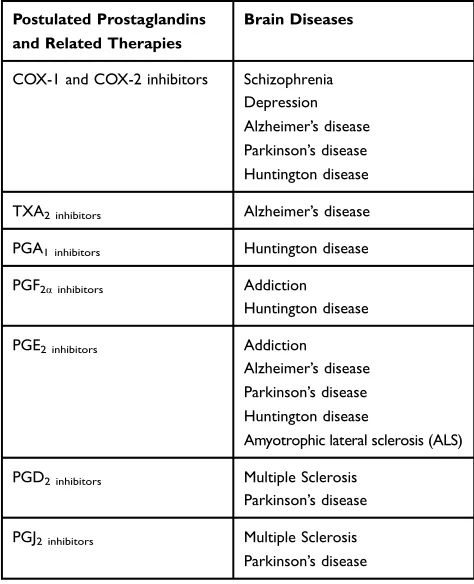
neuropsy-chiatric diseases (
Table 2
).
Schizophrenia
Schizophrenia is a mental health illness that globally
affects about 15.23/100,000 persons of all adults.
77Schizophrenia is a chronic, severe mental disorder that
affects thinking, feelings and behavior. Schizophrenic
patients often lose touch with reality.
78Schizophrenic
patients come to the clinician with different symptoms.
They may have negative or positive symptoms, or have
acute symptoms and maybe with exacerbation of
preex-istent disease.
79,80The evidence that supports
prosta-glandins plays an important role in schizophrenia
comes back to the 70s and 80s. Some studies proposed
that prostaglandin de
fi
ciency is present in this disease.
81In one study replacement therapy with prostaglandins
diminished
negative
and
positive
symptoms
in
schizophrenic patients.
82However, some studies support
the increased activity of prostaglandins in schizophrenic
patients.
83Thus it can be considered that the reduction of
prostaglandins can have a useful effect. Recent studies
suggest that treatment with drugs that inhibit
prostaglan-dins may have a palliative role for this disease. In recent
years, antipsychotic drugs are administered along with
anti-in
fl
ammatory such as aspirin to increase the ef
fi
cacy
of treatment in schizophrenic patients.
84The increased
in
fl
ammatory activity in the prefrontal cortex has been
associated with the severity of the disease.
85Depression
Major depressive disorder (MDD), also known simply as
depression, is a mental disorder characterized by at least
two weeks of low mood state that is present across most
situations. It is often accompanied by low self-esteem,
loss of interest in normally enjoyable activities, low
energy, and pain without a clear cause.
86The lifetime
prevalence of depression in the United States is about
15% to 20%.
87This disease affects women more than
Table 2
Protective Roles of NSAIDs and COX Inhibitors in Brain
Diseases
Postulated Prostaglandins and Related Therapies
Brain Diseases
COX-1 and COX-2 inhibitors Schizophrenia Depression Alzheimer’s disease Parkinson’s disease Huntington disease TXA2 inhibitors Alzheimer’s disease PGA1 inhibitors Huntington disease PGF2αinhibitors Addiction
Huntington disease PGE2 inhibitors Addiction
Alzheimer’s disease Parkinson’s disease Huntington disease
Amyotrophic lateral sclerosis (ALS) PGD2 inhibitors Multiple Sclerosis
Parkinson’s disease PGJ2 inhibitors Multiple Sclerosis
Parkinson’s disease
Note:Likewise, by application of selective prostaglandins receptor inhibitors also some certain diseases alleviate. Meanwhile, it should be noted that some prosta-glandins selectively react with certain receptors in some cases.
Degenerative Neurological and Neuromuscular Disease downloaded from https://www.dovepress.com/ by 118.70.13.36 on 24-Aug-2020
men.
88It is the leading risk factor for suicide.
89Recent
studies suggest that prostaglandins can play a role in
depression diagnosis and treatment. Overall all studies
support the theory that an increase in prostaglandins and
their activity are associated with depression. The existing
literature is not so rich about this subject. Based on a few
studies, increases in prostaglandins in salivary
90and in
serum
91have been associated with this disease. Also,
treatment with cyclooxygenase-2 inhibitor celecoxib had
a therapeutic effect in major depression.
92However, in
one study treatment with ethyl-eicosapentaenoic at
a dosage of 1 g/d was effective in treating depression in
patients who remained depressed despite adequate
stan-dard therapy.
93Addiction
Addiction to drug abuse is a devastating state that has
severe harmful effects on all aspects of life from school,
workplace city and families to many other areas.
94It is
mostly considered as a reward system dysfunction.
95,96Unrestricted abuse of a drug that is rewarding in nature
is considered as addiction despite the adverse effects.
95Preoccupation with good memories of the desired effects
of the drugs is mostly responsible for relapse to drug
abuse.
97The 12-month prevalence of drug addiction in
the United States is about 15% to 61%.
98Also, alcohol
addiction is another type of addiction that has a high
prevalence in western countries.
99The high rates of
mor-bidity and mortality mandate performing different
experi-ments to understand the basic mechanisms that help to
control the uncontrolled behaviors. Alcohol consumption
increases the production of prostaglandins. Animal studies
propose that alcohol consumption increase brain levels of
PGE, and PGF.
100Blocking PG production attenuates the
behavioral effects of alcohol, and it can be inferred that
PGs have a role in the development of alcohol
addiction.
101Chronic alcohol consumption also is
asso-ciated with paradoxical regulation of PGE1
and PGE2.
102In another study overproduction of PGE1
has been
asso-ciated with cocaine abuse.
103It has been proposed that
PGE is mainly involved in the reinstatement of
self-administration. It should be noted that prostaglandin
receptors are found in the cerebral cortex, hippocampus,
and midbrain.
104The reinstatement to drug abuse is
mainly mediated by the synergistic effect of the
cannabi-noid system and arachidonic acid by-products.
105From
this view, prostaglandins have an important role in drug
addiction.
Prostaglandins and Neurologic
Diseases
Neurological disorders are increasingly recognized as one
of the most prevalent disorders with a high burden to the
patients, their families, and society. Statistics showed that
globally, in 2016, neurological disorders were the leading
cause of DALYs (Years Lived with Disability) (276 [95%
UI 247
–
308] million) and the second leading cause of
deaths (9.0 [8.8
–
9.4] million). So this is very important
to introduce new mechanisms that are responsible for the
occurrence of these diseases and also introduce new hopes
for the treatment of such disorders (
Table 2
).
106Multiple Sclerosis
Multiple sclerosis (MS) is considered a disabling condition
that mainly involves the brain and spinal cord.
107The
symp-toms of the disease are different and miscellaneous such as
numbness or weakness, loss of vision, pain, tremor, slurred
speech,
fatigue,
dizziness
and
bowel
and
bladder
dysfunction.
108The reaction of the immune system to
mye-lin causes the production of autoantibody and loss of myemye-lin
which in turn causes loss of the brain connection to the rest
of the body. MS has four types 1) relapsing-remitting (the
most common type) 2) primary progressive MS 3)
second-ary progressive MS 4) progressive relapsing.
109Since the
neuroin
fl
ammation plays an important role in this disease,
new studies have been focused on the assessment of various
neuroregulators that causes in
fl
ammation. Animal studies
bring evidence that prostaglandins can interfere with the
disease process. The evidence to support this theory comes
from the alleviation of MS by systemic injection of
15d-PGJ2
in animal studies.
110Other evidence support that
anti-in
fl
ammatory agents such as peroxisome
proliferator-activated receptor (PPAR)-
γ
agonists, including
thiazolidi-nediones (TZDs) and 15-deoxy-
Δ
12, 14 prostaglandin J
2(15d-PGJ
2), have been shown to be effective in thetreat-ment
of
experimental
autoimmune
encephalomyelitis
(EAE).
111So, it has been suggested that glial cells especially
astrocytes have a vital role in controlling autoimmune
encephalitis.
112,11315d-PGJ2
a metabolite of PGD2
sup-presses the immune response and it is useful for the
treat-ment of MS. Also, the overproduction of this prostaglandin
in disease states suggests that this prostaglandin is
a necessary factor that controls the progression of the
dis-ease. On the other hand, prostaglandin E has a protective
role by activating oligodendrocytes that produce myelin.
114Experiments have suggested that prostaglandins are not the
Degenerative Neurological and Neuromuscular Disease downloaded from https://www.dovepress.com/ by 118.70.13.36 on 24-Aug-2020
same in all types of MS. A more recent study showed that
PGD2, PGI2
and 5-lipoxygenase pathways are suppressed in
the acute phase of EAE and return to constitutive levels in
the chronic phase,
114but in a relapsing-remitting MS, PGD2
does not change.
115Alzheimer
’
s Disease
Alzheimer
’
s disease is a neurodegenerative disorder that is
de
fi
ned as the most prevalent cause of dementia (60% to
80%).
116Sever memory loss occurs in this disease that
interferes with normal daily life.
117This disease is
asso-ciated with the accumulation of Amyloidal plaques and Tau
tangles in the brain.
118In most cases, it begins in individuals
over 65 years old. Different mechanisms have been
pro-posed for Alzheimer
’
s disease. The
fi
rst evidence that
sup-ports the role of in
fl
ammation derives from the reduction of
the occurrence of Alzheimer
’
s disease in the subset of
patients that take NSAIDs for rheumatoid arthritis.
119Further experiments showed the overproduction of PGE2
in a subset of patients and NSAID therapy was useful in
these patients.
120Astrocyte and microglia interplay plays an
important role in the pathophysiology of Alzheimer
’
s
dis-ease and PGE2
is present in some subset of patients. Indeed,
PGE2
is a necessary factor that mediates the negative
con-sequence of amyloid-beta and glial cell interaction.
Emerging data support the bene
fi
t of the application of
NSAIDs rather that cox-2 selective inhibitors in controlling
Alzheimer
’
s disease.
121In the later course of Alzheimer
’
s
disease, the negative effect of amyloid-beta aggregation is
mediated by PGE2
that its receptor is present in microglial
cells
that
play
an
important
role
in
Alzheimer
’
s
pathophysiology.
122Recent studies suggest that
suppres-sing prostaglandin
’
s action on neuronal metabolism is
asso-ciated with less neuronal injury and lower secretion of
proin
fl
ammatory cytokines, TNF
α
, and IL-6.
123,124Also,
it seems that prostaglandins may be an agent that alleviates
the severity of ischemia-induced dementia.
124The adverse
effect of prostaglandins in Alzheimer
’
s disease is mainly
mediated through disturbance that occurs as the
conse-quence of oxidative stress
125and microglia function
med-iates
immune
clearance
of
unwanted
by-product
materials.
126All these studies suggest that prostaglandins
are the agents that may interfere with all the stages that may
necessary for both progression and initiation of dementia.
Based on these reasons, prostaglandins antagonist have
used successfully for the alleviation of Alzheimer
’
s
disease.
127Prostaglandins have been shown to cause the
formation and disappearance of APP holoprotein that has
a toxic effect on the proteins.
128The positive effect of this
treatment is mainly mediated through the selective
antago-nist of the PGE2
receptor.
129Also, the PGE3
receptor
antagonist has a protective role in dementia that is caused
by disturbed oxidative stress that eventually leads to
amy-loid-beta plaque formation (Ikeda-Matsuo). PGE4
antago-nist also is an effective treatment for alleviating the
cognitive de
fi
cit of patients.
130Other prostaglandins such as
PGD2
have related to Alzheimer
’
s disease
131but about
PGF2
αand TXA2
studies are not con
fi
rmatory.
Parkinson
’
s Disease
Parkinson
’
s disease is a long-term progressive brain
dis-ease that affects movements. The disdis-ease usually
pro-gresses over time.
132The most prevalent symptoms at
the onset of the disease are shaking, rigidity, slowness of
movement and dif
fi
culty in walking.
133Destruction of
dopaminergic neurons in substantial nigra is necessary
for the occurrence of the symptoms of the disease.
Different
treatments
have
been
proposed
for
this
disease.
134An experiment that supports in
fl
ammation has
a role in this disease is derived from microglial activation.
However, prostaglandins in this disease have a negative
role. Dopamine is the main target for the treatment of
Parkinson
’
s disease can be considered for
prostaglandin-related treatment. A recent study suggests that
prostaglan-dins can cause unfolding and aggregation of Parkinson
’
s
disease associated with UCHL1.
135Also, COX-2
overpro-duction can cause PGE2
overexpression that results in the
death of dopaminergic neurons.
136COX-2 overproduction
has been con
fi
rmed in another study in this disease.
137NSAID (nonsteroidal anti-in
fl
ammatory drugs) intake has
been well substantially reduced the severity of Parkinson
’
s
disease by increasing the survival of dopaminergic
neurons.
138However, in some studies, this positive effect
did not observe. In different experiments, PGE has been
shown that is the most putative prostaglandin that
inter-feres with Parkinson
’
s disease.
139Other prostaglandins
such as PGD2
and PGJ2
have been shown to interfere
with normal protein metabolism but strong evidence that
supports the involvement of such prostaglandins in
Parkinson disease is not con
fi
rmatory.
140Huntington's Disease
Huntington
’
s disease is a progressive brain disease that
mainly affects individuals in their thirties and forties. It
manifests itself through uncontrolled movements,
emo-tional problems, and loss of cognition.
141Many people
Degenerative Neurological and Neuromuscular Disease downloaded from https://www.dovepress.com/ by 118.70.13.36 on 24-Aug-2020
with Huntington
’
s disease develop involuntary jerking or
twitching movements known as chorea. Also, juvenile
Huntington
’
s disease that is less common than adult-onset
tends to progress more quickly than adult form.
142Huntington
’
s disease affects an estimated 3 to 7 per
100,000 people. Mutations with an autosomal dominant
pattern in the HTT gene cause Huntington
’
s disease.
143COX-2 inhibitors overall improved the outcome of motor
function in Huntington
’
s diseases.
144–146This positive
effect
was
not
observed
in
transgenic
animals.
147Enhancement of prostaglandin levels such as PGE2, PGf2α
by injection has a negative effect of motor function and
neuronal markers and restoration of the normal level of
prostaglandins by COX-2 inhibitors had a positive outcome
in the treatment of Huntington
’
s disease.
148,149PGA1
has
also suggested having a role in Huntington Disease but
further experiments are needed to establish its role.
150Amyotrophic Lateral Sclerosis (ALS)
ALS is a rare neurologic disorder that is characterized by
the loss of neurons that are necessary for voluntary
movements.
151ALS manifests by stiff muscles, muscle
twitching, and muscle weakening. In 90% to 95% of the
case, no de
fi
nite cause is identi
fi
ed.
152The patient has
dif
fi
culty in all actions that movement of voluntary
mus-cles is necessary such as walking, swallowing and
fi
nally
breathing. In this disease, prostaglandin alternations also
have been observed. In ALS prostaglandins are elevated
and have a negative effect on neuronal function. Elevated
prostaglandins especially PGE2
has been associated with
an increased rate of neuronal death and disability.
153Also,
another study con
fi
rms that prostaglandin production can
cause the disease to progress.
154For this reason, NSAID
therapy has been proposed for the alleviation of this
disease.
155,156Conclusion
In this review article, the importance of prostaglandins in
brain diseases was discussed. Prostaglandins in some
dis-eases act as a protective role and in some disdis-eases act in
a negative manner. So NSAID therapy is not recommended
in all patients. So, more studies should be done to understand
the precise pathophysiology that is responsible for the
initia-tion and progression of brain diseases. Overall these studies
suggest prostaglandins are the agents that have an important
role in brain disorders
’
pathophysiology and these agents
modulate the course of the diseases.
Disclosure
The authors report no con
fl
icts of interest in this work.
References
1. Geda YE, Roberts RO, Mielke MM, et al. Baseline neuropsychia-tric symptoms and the risk of incident mild cognitive impairment: a population-based study. Am J Psychiatry. 2014;171(5):572–581. doi:10.1176/appi.ajp.2014.13060821
2. Lyketsos CG, Lopez O, Jones B, Fitzpatrick AL, Breitner J, DeKosky S. Prevalence of neuropsychiatric symptoms in dementia and mild cognitive impairment: results from the cardiovascular health study. JAMA. 2002;288(12):1475–1483. doi:10.1001/ jama.288.12.1475
3. Modrego PJ, Ferrández J. Depression in patients with mild cogni-tive impairment increases the risk of developing dementia of Alzheimer type: a prospective cohort study.Arch Neurol.2004;61 (8):1290–1293. doi:10.1001/archneur.61.8.1290
4. Pedersen KF, Larsen JP, Tysnes O-B, Alves G. Prognosis of mild cognitive impairment in early Parkinson disease: the Norwegian ParkWest study.JAMA Neurol.2013;70(5):580–586. doi:10.1001/ jamaneurol.2013.2110
5. Dieperink E, Willenbring M, Ho SB. Neuropsychiatric symptoms associated with hepatitis C and interferon alpha: a review. Am J Psychiatry.2000;157(6):867–876. doi:10.1176/appi.ajp.157.6.867 6. Kuehl FA, Egan RW. Prostaglandins, arachidonic acid, and
inflammation. Science. 1980;210(4473):978–984. doi:10.1126/ science.6254151
7. Gądek-Michalska A, Tadeusz J, Rachwalska P, Bugajski J. Cytokines, prostaglandins and nitric oxide in the regulation of stress-response systems. Pharm Rep. 2013;65(6):1655–1662. doi:10.1016/S1734-1140(13)71527-5
8. Bazinet RP, Layé S. Polyunsaturated fatty acids and their metabo-lites in brain function and disease.Nature Rev Neurosci.2014;15 (12):771. doi:10.1038/nrn3820
9. Rouzer CA, Marnett LJ. Cyclooxygenases: structural and func-tional insights. J Lipid Res. 2009;50(Supplement):S29–S34. doi:10.1194/jlr.R800042-JLR200
10. Narumiya S, Sugimoto Y, Ushikubi F. Prostanoid receptors: struc-tures, properties, and functions. Physiol Rev. 1999;79 (4):1193–1226. doi:10.1152/physrev.1999.79.4.1193
11. Meirer K, Steinhilber D, Proschak E. Inhibitors of the arachidonic acid cascade: interfering with multiple pathways.Basic Clin Pharmacol Toxicol.2014;114(1):83–91. doi:10.1111/bcpt.2013.114.issue-1 12. Chandrasekharan N, Dai H, Roos KLT, et al. COX-3, a
cyclooxygenase-1 variant inhibited by acetaminophen and other analgesic/antipyretic drugs: cloning, structure, and expression.
Proc National Acad Sci.2002;99(21):13926–13931. doi:10.1073/ pnas.162468699
13. Griswold DE, Adams JL. Constitutive cyclooxygenase (COX-1) and inducible cyclooxygenase (COX-2): rationale for selective inhibition and progress to date. Med Res Rev. 1996;16 (2):181–206. doi:10.1002/(ISSN)1098-1128
14. Narumiya S. Prostanoids in immunity: roles revealed by mice deficient in their receptors. Life Sci. 2003;74(2–3):391–395. doi:10.1016/j.lfs.2003.09.025
15. Tsuboi K, Sugimoto Y, Ichikawa A. Prostanoid receptor subtypes.
Prostaglandins Other Lipid Mediat.2002;68:535–556. doi:10.1016/ S0090-6980(02)00054-0
16. Zhang J-M, An J. Cytokines, inflammation and pain.Int Anesthesiol Clin.2007;45(2):27. doi:10.1097/AIA.0b013e318034194e
17. Haynes D, Whitehouse M, Vernon-Roberts B. The prostaglandin E1 analogue, misoprostol, regulates inflammatory cytokines and immune functions in vitro like the natural prostaglandins E1, E2 and E3.Immunology.1992;76(2):251.
Degenerative Neurological and Neuromuscular Disease downloaded from https://www.dovepress.com/ by 118.70.13.36 on 24-Aug-2020
18. Tzeng S-F, Hsiao H-Y, Mak O-T. Prostaglandins and cyclooxy-genases in glial cells during brain inflammation. Curr Drug Targets-Inflammation Allergy. 2005;4(3):335–340. doi:10.2174/ 1568010054022051
19. Schoenberger SD, Kim SJ, Sheng J, Rezaei KA, Lalezary M, Cherney E. Increased prostaglandin E2 (PGE2) levels in prolifera-tive diabetic retinopathy, and correlation with VEGF and infl am-matory cytokines. Invest Ophthalmol Vis Sci. 2012;53 (9):5906–5911. doi:10.1167/iovs.12-10410
20. Chan SC, Kim JW, Henderson WR, Hanifin JM. Altered prosta-glandin E2 regulation of cytokine production in atopic dermatitis.
J Immunol.1993;151(6):3345–3352.
21. Aoki T, Narumiya S. Prostaglandins and chronic inflammation.
Trends Pharmacol Sci. 2012;33(6):304–311. doi:10.1016/j.tips. 2012.02.004
22. Ricciotti E, FitzGerald GA. Prostaglandins and inflammation.
Arterioscler Thromb Vasc Biol.2011;31(5):986–1000. doi:10.1161/ ATVBAHA.110.207449
23. Teeling J, Perry V. Systemic infection and inflammation in acute CNS injury and chronic neurodegeneration: underlying mechanisms. Neuroscience. 2009;158(3):1062–1073. doi:10.1016/ j.neuroscience.2008.07.031
24. Dzyubenko E, Gottschling C, Faissner A. Neuron-glia interactions in neural plasticity: contributions of neural extracellular matrix and perineuronal nets.Neural Plast.2016;2016.
25. Terni B, López-Murcia FJ, Llobet A. Role of neuron-glia interac-tions in developmental synapse elimination. Brain Res Bull.
2017;129:74–81. doi:10.1016/j.brainresbull.2016.08.017
26. Amor S, Peferoen LA, Vogel DY, et al. Inflammation in neurode-generative diseases–an update.Immunology.2014;142(2):151–166. doi:10.1111/imm.12233
27. Block ML, Hong J-S. Microglia and inflammation-mediated neu-rodegeneration: multiple triggers with a common mechanism.
Prog Neurobiol. 2005;76(2):77–98. doi:10.1016/j.pneurobio.2005. 06.004
28. Funk CD. Prostaglandins and leukotrienes: advances in eicosanoid biology. Science. 2001;294(5548):1871–1875. doi:10.1126/science. 294.5548.1871
29. Jakobsson P-J, Thorén S, Morgenstern R, Samuelsson B. Identification of human prostaglandin E synthase: a microsomal, glutathione-dependent, inducible enzyme, constituting a potential novel drug target.Proc National Acad Sci.1999;96(13):7220–7225. doi:10.1073/pnas.96.13.7220
30. Trebino CE, Stock JL, Gibbons CP, et al. Impaired inflammatory and pain responses in mice lacking an inducible prostaglandin E synthase. Proc National Acad Sci. 2003;100(15):9044–9049. doi:10.1073/pnas.1332766100
31. Kamei D, Yamakawa K, Takegoshi Y, et al. Reduced pain hyper-sensitivity and inflammation in mice lacking microsomal prosta-glandin e synthase-1. J Biol Chem. 2004;279(32):33684–33695. doi:10.1074/jbc.M400199200
32. Brenneis C, Coste O, Schmidt R, et al. Consequences of altered eicosanoid patterns for nociceptive processing in mPGES-1-defi -cient mice. J Cell Mol Med. 2008;12(2):639–648. doi:10.1111/ j.1582-4934.2007.00110.x
33. Sugimoto Y, Narumiya S. Prostaglandin E receptors.J Biol Chem.
2007;282(16):11613–11617. doi:10.1074/jbc.R600038200 34. Honda T, Segi-Nishida E, Miyachi Y, Narumiya S. Prostacyclin-IP
signaling and prostaglandin E2-EP2/EP4 signaling both mediate joint inflammation in mouse collagen-induced arthritis. J Exp Med.2006;203(2):325–335. doi:10.1084/jem.20051310
35. Yuhki K-I, Ueno A, Naraba H, et al. Prostaglandin receptors EP2, EP3, and IP mediate exudate formation in carrageenin-induced mouse pleurisy.J Pharmacol Exp Ther.2004;311(3):1218–1224. doi:10.1124/jpet.104.071548
36. McCoy JM, Wicks JR, Audoly LP. The role of prostaglandin E2 receptors in the pathogenesis of rheumatoid arthritis.J Clin Invest.
2002;110(5):651–658. doi:10.1172/JCI0215528
37. Kunikata T, Yamane H, Segi E, et al. Suppression of allergic inflammation by the prostaglandin E receptor subtype EP3. Nat Immunol.2005;6(5):524. doi:10.1038/ni1188
38. Egan KM, Lawson JA, Fries S, et al. COX-2-derived prostacyclin confers atheroprotection on female mice. Science. 2004;306 (5703):1954–1957. doi:10.1126/science.1103333
39. Harris SG, Padilla J, Koumas L, Ray D, Phipps RP. Prostaglandins as modulators of immunity.Trends Immunol.2002;23(3):144–150. doi:10.1016/S1471-4906(01)02154-8
40. Krause P, Bruckner M, Uermösi C, Singer E, Groettrup M, Legler DF. Prostaglandin E2 enhances T-cell proliferation by inducing the costi-mulatory molecules OX40L, CD70, and 4-1BBL on dendritic cells.
Blood.2009;113(11):2451–2460. doi:10.1182/blood-2008-05-157123 41. Legler DF, Krause P, Scandella E, Singer E, Groettrup M. Prostaglandin E2 is generally required for human dendritic cell migration and exerts its effect via EP2 and EP4 receptors.
J Immunol.2006;176(2):966–973. doi:10.4049/jimmunol.176.2.966 42. Noda M, Kariura Y, Pannasch U, et al. Neuroprotective role of bradykinin because of the attenuation of pro-inflammatory cytokine release from activated microglia. J Neurochem. 2007;101 (2):397–410. doi:10.1111/jnc.2007.101.issue-2
43. Brenneis C, Coste O, Altenrath K, et al. Anti-inflammatory role of microsomal prostaglandin E synthase-1 in a model of neuroinflammation. J Biol Chem. 2011;286(3):2331–2342. doi:10.1074/jbc.M110.157362
44. Liou J-Y, Shyue S-K, Tsai M-J, Chung C-L, Chu K-Y, Wu KK. Colocalization of prostacyclin synthase with prostaglandin H synthase-1 (PGHS-1) but not phorbol ester-induced PGHS-2 in cultured endothelial cells. J Biol Chem. 2000;275 (20):15314–15320. doi:10.1074/jbc.275.20.15314
45. Murata T, Ushikubi F, Matsuoka T, et al. Altered pain perception and inflammatory response in mice lacking prostacyclin receptor.
Nature.1997;388(6643):678. doi:10.1038/41780
46. Berkenkopf JW, Weichman BM. Production of prostacyclin in mice following intraperitoneal injection of acetic acid, phenylbenzoquinone and zymosan: its role in the writhing response. Prostaglandins.
1988;36(5):693–709. doi:10.1016/0090-6980(88)90014-7
47. Ueno A, Naraba H, Ikeda Y, et al. Intrinsic prostacyclin contributes to exudation induced by bradykinin or carrageenin: a study on the paw edema induced in IP-receptor-deficient mice.Life Sci.2000;66 (12):PL155–PL160. doi:10.1016/S0024-3205(00)00420-3 48. Doi Y, Minami T, Nishizawa M, Mabuchi T, Mori H, Ito S. Central
nociceptive role of prostacyclin (IP) receptor induced by peripheral inflammation. Neuroreport. 2002;13(1):93–96. doi:10.1097/ 00001756-200201210-00022
49. Bley KR, Bhattacharya A, Daniels DV, et al. RO1138452 and RO3244794: characterization of structurally distinct, potent and selective IP (prostacyclin) receptor antagonists.Br J Pharmacol.
2006;147(3):335–345. doi:10.1038/sj.bjp.0706554
50. Pulichino A-M, Rowland S, Wu T, et al. Prostacyclin antagonism reduces pain and inflammation in rodent models of hyperalgesia and chronic arthritis. J Pharmacol Exp Ther.2006;319(3):1043–1050. doi:10.1124/jpet.106.110387
51. Jaffar Z, Wan K-S, Roberts K. A key role for prostaglandin I2 in limiting lung mucosal Th2, but not Th1, responses to inhaled allergen.
J Immunol. 2002;169(10):5997–6004. doi:10.4049/jimmunol.169. 10.5997
52. JOWSEY IR, THOMSON AM, FLANAGAN JU, et al. Mammalian class Sigma glutathione S-transferases: catalytic properties and tissue-specific expression of human and rat GSH-dependent prostaglan-din D2 synthases. Biochem J. 2001;359(3):507–516. doi:10.1042/ bj3590507
Degenerative Neurological and Neuromuscular Disease downloaded from https://www.dovepress.com/ by 118.70.13.36 on 24-Aug-2020
53. Eguchi N, Minami T, Shirafuji N, et al. Lack of tactile pain (allodynia) in lipocalin-type prostaglandin D synthase-deficient mice.Proc National Acad Sci.1999;96(2):726–730. doi:10.1073/ pnas.96.2.726
54. Urade Y, Hayaishi O. Prostaglandin D2 and sleep/wake regulation.
Sleep Med Rev.2011;15(6):411–418. doi:10.1016/j.smrv.2011.08.003 55. Michimata T, Tsuda H, Sakai M, et al. Accumulation of CRTH2-positive T-helper 2 and T-cytotoxic 2 cells at implantation sites of human decidua in a prostaglandin D2-mediated manner.
Mol Hum Reprod.2002;8(2):181–187. doi:10.1093/molehr/8.2.181 56. Lewis R, Soter N, Diamond P, Austen K, Oates J, Roberts L. Prostaglandin D2 generation after activation of rat and human mast cells with anti-IgE.J Immunol.1982;129(4):1627–1631. 57. Kabashima K, Narumiya S. The DP receptor, allergic inflammation
and asthma. Prostaglandins Leukotrienes Essential Fatty Acids.
2003;69(2–3):187–194. doi:10.1016/S0952-3278(03)00080-2 58. Hammad H, De Heer HJ, Soullie T, Hoogsteden HC, Trottein F,
Lambrecht BN. Prostaglandin D2 inhibits airway dendritic cell migration and function in steady state conditions by selective activation of the D prostanoid receptor 1. J Immunol. 2003;171 (8):3936–3940. doi:10.4049/jimmunol.171.8.3936
59. Angeli V, Faveeuw C, Roye O, et al. Role of the parasite-derived prostaglandin D2 in the inhibition of epidermal Langerhans cell migration during schistosomiasis infection.J Exp Med.2001;193 (10):1135–1148. doi:10.1084/jem.193.10.1135
60. Spik I, Brénuchon C, Angéli V, et al. Activation of the prostaglandin D2 receptor DP2/CRTH2 increases allergic inflammation in mouse.
J Immunol. 2005;174(6):3703–3708. doi:10.4049/jimmunol.174. 6.3703
61. Bell-Parikh LC, Ide T, Lawson JA, McNamara P, Reilly M, FitzGerald GA. Biosynthesis of 15-deoxy-Δ12, 14-PGJ 2 and the ligation of PPARγ. J Clin Invest. 2003;112(6):945–955. doi:10. 1172/JCI200318012
62. Ricote M, Li AC, Willson TM, Kelly CJ, Glass CK. The peroxi-some proliferator-activated receptor-γ is a negative regulator of macrophage activation. Nature. 1998;391(6662):79. doi:10.1038/ 34178
63. Straus DS, Pascual G, Li M, et al. 15-Deoxy-Δ12, 14-prostaglandin J2 inhibits multiple steps in the NF-κB signaling pathway.Proc National Acad Sci.2000;97(9):4844–4849. doi:10.1073/pnas.97.9.4844 64. Basu S. Oxidative injury induced cyclooxygenase activation in
experimental hepatotoxicity. Biochem Biophys Res Commun.
1999;254(3):764–767. doi:10.1006/bbrc.1998.9956
65. Sugimoto Y, Yamasaki A, Segi E, et al. Failure of parturition in mice lacking the prostaglandin F receptor. Science. 1997;277 (5326):681–683. doi:10.1126/science.277.5326.681
66. Saito O, Guan Y, Qi Z, et al. Expression of the prostaglandin F receptor (FP) gene along the mouse genitourinary tract. Am J Physiol Renal Physiol. 2003;284:F1164–F1170. doi:10.1152/ ajprenal.00441.2002
67. Kunori S, Matsumura S, Mabuchi T, et al. Involvement of prosta-glandin F2α receptor in ATP-induced mechanical allodynia.
Neuroscience. 2009;163(1):362–371. doi:10.1016/j.neuroscience. 2009.05.069
68. Saleem S, Ahmad AS, Maruyama T, Narumiya S, Doré S. PGF 2α FP receptor contributes to brain damage following transient focal brain ischemia. Neurotox Res. 2009;15(1):62–70. doi:10.1007/ s12640-009-9007-3
69. Félétou M, Verbeuren TJ, Vanhoutte PM. Endothelium-dependent contractions in SHR: a tale of prostanoid TP and IP receptors.Br J Pharmacol. 2009;156(4):563–574. doi:10.1111/bph.2009.156. issue-4
70. Félétou M, Vanhoutte PM, Verbeuren TJ. The thromboxane/endo-peroxide receptor (TP): the common villain. J Cardiovasc Pharmacol. 2010;55(4):317–332. doi:10.1097/FJC.0b013e3181d8 bc8a
71. Nakahata N. Thromboxane A2: physiology/pathophysiology, cellu-lar signal transduction and pharmacology. Pharmacol Ther.
2008;118(1):18–35.
72. Gluais P, Lonchampt M, Morrow JD, Vanhoutte PM, Feletou M. Acetylcholine-induced endothelium-dependent contractions in the SHR aorta: the Janus face of prostacyclin. Br J Pharmacol.
2005;146(6):834–845. doi:10.1038/sj.bjp.0706390
73. Montuschi P, Barnes PJ, Roberts LJ. Isoprostanes: markers and mediators of oxidative stress.FASEB J.2004;18(15):1791–1800. doi:10.1096/fj.04-2330rev
74. Yamada T, Fujino T, Yuhki K-I, et al. Thromboxane A2 regulates vascular tone via its inhibitory effect on the expression of inducible nitric oxide synthase. Circulation. 2003;108(19):2381–2386. doi:10.1161/01.CIR.0000093194.21109.EC
75. Boffa -J-J, Just A, Coffman TM, Arendshorst WJ. Thromboxane receptor mediates renal vasoconstriction and contributes to acute renal failure in endotoxemic mice. J Am Society Nephrol.
2004;15(9):2358–2365. doi:10.1097/01.ASN.0000136300.72480. 86
76. Quinones MP, Kaddurah-Daouk R. Metabolomics tools for identi-fying biomarkers for neuropsychiatric diseases. Neurobiol Dis.
2009;35(2):165–176. doi:10.1016/j.nbd.2009.02.019
77. McGrath J, Saha S, Chant D, Welham J. Schizophrenia: a concise overview of incidence, prevalence, and mortality.Epidemiol Rev.
2008;30(1):67–76. doi:10.1093/epirev/mxn001
78. Howard R, Rabins PV, Seeman MV, Jeste DV. Late-Onset tI. Late-onset schizophrenia and very-late-onset schizophrenia-like psychosis: an international consensus.Am J Psychiatry.2000;157 (2):172–178. doi:10.1176/appi.ajp.157.2.172
79. Ventura J, Nuechterlein KH, Subotnik KL, Gutkind D, Gilbert EA. Symptom dimensions in recent-onset schizophrenia and mania: a principal components analysis of the 24-item brief psychiatric rating scale.Psychiatry Res.2000;97(2–3):129–135. doi:10.1016/ S0165-1781(00)00228-6
80. Sikich L, Frazier JA, McClellan J, et al. Double-blind comparison offirst-and second-generation antipsychotics in early-onset schizo-phrenia and schizo-affective disorder:findings from the treatment of early-onset schizophrenia spectrum disorders (TEOSS) study.
Am J Psychiatry. 2008;165(11):1420–1431. doi:10.1176/appi.ajp. 2008.08050756
81. Horrobin D. Schizophrenia as a prostaglandin deficiency disease.
Lancet. 1977;309(8018):936–937. doi:10.1016/S0140-6736(77) 92228-0
82. Puri BK, Richardson AJ. Sustained remission of positive and nega-tive symptoms of schizophrenia following treatment with eicosa-pentaenoic acid. Arch Gen Psychiatry. 1998;55(2):188–189. doi:10.1001/archpsyc.55.2.188
83. Arvindakshan M, Sitasawad S, Debsikdar V, et al. Essential poly-unsaturated fatty acid and lipid peroxide levels in never-medicated and medicated schizophrenia patients. Biol Psychiatry. 2003;53 (1):56–64. doi:10.1016/S0006-3223(02)01443-9
84. Dean B, Gibbons A, Gogos A, Udawela M, Thomas E, Scarr E. Studies on prostaglandin-endoperoxide synthase 1: lower levels in schizophrenia and after treatment with antipsychotic drugs in con-junction with aspirin. Int J Neuropsychopharmacol. 2017;21 (3):216–225. doi:10.1093/ijnp/pyx092
85. Fillman S, Cloonan N, Catts V, et al. Increased inflammatory markers identified in the dorsolateral prefrontal cortex of indivi-duals with schizophrenia.Mol Psychiatry.2013;18(2):206. doi:10. 1038/mp.2012.110
86. Fava M, Kendler KS. Major depressive disorder.Neuron.2000;28 (2):335–341. doi:10.1016/S0896-6273(00)00112-4
87. Moussavi S, Chatterji S, Verdes E, Tandon A, Patel V, Ustun B. Depression, chronic diseases, and decrements in health: results from the World Health Surveys.Lancet.2007;370(9590):851–858. doi:10.1016/S0140-6736(07)61415-9
Degenerative Neurological and Neuromuscular Disease downloaded from https://www.dovepress.com/ by 118.70.13.36 on 24-Aug-2020
88. Belle D, Doucet J. Poverty, inequality, and discrimination as sources of depression among US women. Psychol Women Q.
2003;27(2):101–113. doi:10.1111/1471-6402.00090
89. Dumais A, Lesage A, Alda M, et al. Risk factors for suicide completion in major depression: a case-control study of impulsive and aggressive behaviors in men. Am J Psychiatry. 2005;162 (11):2116–2124. doi:10.1176/appi.ajp.162.11.2116
90. Ohishi K, Ueno R, Nishino S, Sakai T, Hayaishi O. Increased level of salivary prostaglandins in patients with major depression. Biol Psychiatry.1988;23(4):326–334. doi:10.1016/0006-3223(88)90283-1 91. Lieb J, Karmali R, Horrobin D. Elevated levels of prostaglandin E2 and thromboxane B2 in depression. Prostaglandins Leukotrienes Med.1983;10(4):361–367. doi:10.1016/0262-1746(83)90048-3 92. Müller N, Schwarz M, Dehning S, et al. The cyclooxygenase-2
inhibitor celecoxib has therapeutic effects in major depression: results of a double-blind, randomized, placebo controlled, add-on pilot study to reboxetine. Mol Psychiatry. 2006;11(7):680. doi:10.1038/sj.mp.4001805
93. Peet M, Horrobin DF. A dose-ranging study of the effects of ethyl-eicosapentaenoate in patients with ongoing depression despite apparently adequate treatment with standard drugs. Arch Gen Psychiatry.2002;59(10):913–919. doi:10.1001/archpsyc.59.10.913 94. Effertz T, Mann K. The burden and cost of disorders of the brain in Europe with the inclusion of harmful alcohol use and nicotine addiction. Eur Neuropsychopharmacol. 2013;23(7):742–748. doi:10.1016/j.euroneuro.2012.07.010
95. Volkow N, Li T-K. The neuroscience of addiction.Nat Neurosci.
2005;8(11):1429. doi:10.1038/nn1105-1429
96. Koob GF, Le Moal M. Drug addiction, dysregulation of reward, and allostasis. Neuropsychopharmacology. 2001;24(2):97. doi:10.1016/ S0893-133X(00)00195-0
97. Julien RM. A Primer of Drug Action: A Concise Nontechnical Guide to the Actions, Usesand side effects of psychoactive drugs,
revised and updated. Holt Paperbacks;2013.
98. Sussman S, Lisha N, Griffiths M. Prevalence of the addictions: a problem of the majority or the minority? Eval Health Prof.
2011;34(1):3–56. doi:10.1177/0163278710380124
99. Hasin DS, Stinson FS, Ogburn E, Grant BF. Prevalence, correlates, disability, and comorbidity of DSM-IV alcohol abuse and depen-dence in the United States: results from the National Epidemiologic Survey on Alcohol and Related Conditions.Arch Gen Psychiatry.
2007;64(7):830–842. doi:10.1001/archpsyc.64.7.830
100. Rotrosen J, Mandio D, Segarnick D, Traficante L, Gershon S. Ethanol and prostaglandin E1: biochemical and behavioral interactions. Life Sci.1980;26(22):1867–1876. doi:10.1016/0024-3205(80)90615-3
101. George FR, Meisch RA. Cyclooxygenase inhibitors antagonize the rate-depressant effects of ethanol on fixed-ratio responding.
Alcohol.1990;7(4):355–360. doi:10.1016/0741-8329(90)90095-T 102. Backon J. Vasopressin inhibition via combined head-out water
immersion and a prostaglandin E-1 precursor in the treatment of male reproductive failure due to chronic alcohol abuse.Med Hypotheses. 1989;29(2):81–83. doi:10.1016/0306-9877(89)90 066-2
103. Leishman E, Kokesh KJ, Bradshaw HB. Lipids and addiction: how sex steroids, prostaglandins, and cannabinoids interact with drugs of abuse. Ann N Y Acad Sci. 2013;1282(1):25–38. doi:10.1111/ nyas.12081
104. Akaneya Y. The remarkable mechanism of prostaglandin E2 on synap-tic plassynap-ticity. Gene Regul Syst Bio. 2007;1:117762500700100009. doi:10.1177/117762500700100009
105. Yamamoto T, Anggadiredja K, Hiranita T. New perspectives in the studies on endocannabinoid and cannabis: a role for the endocannabinoid-arachidonic acid pathway in drug reward and long-lasting relapse to drug taking. J Pharmacol Sci. 2004;96 (4):382–388. doi:10.1254/jphs.FMJ04003X5
106. Feigin VL, Vos T. Global burden of neurological disorders: from global burden of disease estimates to actions.Neuroepidemiology.
2019;52(1–2):1–2. doi:10.1159/000495197
107. Hemmer B, Archelos JJ, Hartung H-P. New concepts in the immu-nopathogenesis of multiple sclerosis.Nature Rev Neurosci.2002;3 (4):291. doi:10.1038/nrn784
108. Polman CH, Reingold SC, Banwell B, et al. Diagnostic criteria for multiple sclerosis: 2010 revisions to the McDonald criteria.Ann Neurol.2011;69(2):292–302. doi:10.1002/ana.22366
109. Lublin FD, Reingold SC, Cohen JA, et al. Defining the clinical course of multiple sclerosis: the 2013 revisions. Neurology.
2014;83:278–286. doi:10.1212/WNL.0000000000000560 110. Natarajan C, Bright J. Peroxisome proliferator-activated
receptor-gamma agonists inhibit experimental allergic encephalo-myelitis by blocking IL-12 production, IL-12 signaling and Th1 differentiation. Genes Immun. 2002;3(2):59. doi:10.1038/sj. gene.6363832
111. Storer PD, Xu J, Chavis J, Drew PD. Peroxisome proliferator-activated receptor-gamma agonists inhibit the activation of microglia and astro-cytes: implications for multiple sclerosis.J Neuroimmunol.2005;161 (1–2):113–122. doi:10.1016/j.jneuroim.2004.12.015
112. Drew PD, Xu J, Storer PD, Chavis JA, Racke MK. Peroxisome proliferator-activated receptor agonist regulation of glial activation: relevance to CNS inflammatory disorders.Neurochem Int.2006;49 (2):183–189. doi:10.1016/j.neuint.2006.04.003
113. Xu J, Chavis JA, Racke MK, Drew PD. Peroxisome proliferator-activated receptor-αand retinoid X receptor agonists inhibit infl amma-tory responses of astrocytes.J Neuroimmunol.2006;176(1–2):95–105. doi:10.1016/j.jneuroim.2006.04.019
114. Kihara Y, Matsushita T, Kita Y, et al. Targeted lipidomics reveals mPGES-1-PGE2 as a therapeutic target for multiple sclerosis.Proc National Acad Sci. 2009;106(51):21807–21812. doi:10.1073/ pnas.0906891106
115. Ayoub SS, Wood EG, Hassan S-U, Bolton C. Cyclooxygenase expression and prostaglandin levels in central nervous system tis-sues during the course of chronic relapsing experimental autoim-mune encephalomyelitis (EAE). Inflammation Res. 2011;60 (10):919. doi:10.1007/s00011-011-0352-3
116. Barnes DE, Yaffe K. The projected effect of risk factor reduction on Alzheimer’s disease prevalence. Lancet Neurol. 2011;10 (9):819–828. doi:10.1016/S1474-4422(11)70072-2
117. Sperling RA, Aisen PS, Beckett LA, et al. Toward defining the pre-clinical stages of Alzheimer’s disease: recommendations from the National Institute on Aging-Alzheimer’s Association workgroups on diagnostic guidelines for Alzheimer’s disease.Alzheimer’s Dementia.
2011;7(3):280–292. doi:10.1016/j.jalz.2011.03.003
118. Scheuner D, Eckman C, Jensen M, et al. Secreted amyloid β– protein similar to that in the senile plaques of Alzheimer’s disease is increased in vivo by the presenilin 1 and 2 and APP mutations linked to familial Alzheimer’s disease. Nat Med. 1996;2(8):864. doi:10.1038/nm0896-864
119. Mcgeer P, Mcgeer E, Rogers J, Sibley J. Anti-inflammatory drugs and Alzheimer disease.Lancet.1990;335(8696):1037. doi:10.1016/ 0140-6736(90)91101-F
120. Chaudhry UA, Zhuang H, Crain BJ, Doré S. Elevated microsomal prostaglandin-E synthase–1 in Alzheimer’s disease. Alzheimer’s Dementia.2008;4(1):6–13. doi:10.1016/j.jalz.2007.10.015 121. Hoozemans JJ, Veerhuis R, Janssen I, van Elk E-J, Rozemuller AJ,
Eikelenboom P. The role of cyclo-oxygenase 1 and 2 activity in prostaglandin E2 secretion by cultured human adult microglia: implications for Alzheimer’s disease. Brain Res. 2002;951 (2):218–226. doi:10.1016/S0006-8993(02)03164-5
122. Jin J, Shie F-S, Liu J, et al. Prostaglandin E 2 receptor subtype 2 (EP2) regulates microglial activation and associated neurotoxicity induced by aggregatedα-synuclein.J Neuroinflammation.2007;4 (1):2. doi:10.1186/1742-2094-4-2
Degenerative Neurological and Neuromuscular Disease downloaded from https://www.dovepress.com/ by 118.70.13.36 on 24-Aug-2020
123. Keene CD, Chang R, Stephen C, et al. Protection of hippocampal neurogenesis from toll-like receptor 4-dependent innate immune activation by ablation of prostaglandin E2 receptor subtype EP1 or EP2. Am J Pathol. 2009;174(6):2300–2309. doi:10.2353/ ajpath.2009.081153
124. Shimamura M, Zhou P, Casolla B, et al. Prostaglandin E2 type 1 receptors contribute to neuronal apoptosis after transient forebrain ischemia. J Cereb Blood Flow Metab. 2013;33(8):1207–1214. doi:10.1038/jcbfm.2013.69
125. Keene CD, Chang RC, Lopez-Yglesias AH, et al. Suppressed accumulation of cerebral amyloidβ peptides in aged transgenic Alzheimer’s disease mice by transplantation with wild-type or prostaglandin E2 receptor subtype 2-null bone marrow. Am J Pathol.2010;177(1):346–354. doi:10.2353/ajpath.2010.090840 126. Johansson JU, Woodling NS, Wang Q, et al. Prostaglandin signaling
suppresses beneficial microglial function in Alzheimer’s disease mod-els.J Clin Invest.2015;125(1):350–364. doi:10.1172/JCI77487 127. Abe T, Kunz A, Shimarnura M, Zhou P, Anrather J, Iadecola C.
The neuroprotective effect of prostaglandin E2 EP1 receptor inhibi-tion has a wide therapeutic window, is sustained in time and is not sexually dimorphic.J Cereb Blood Flow Metab.2009;29(1):66–72. doi:10.1038/jcbfm.2008.88
128. Pooler AM, Arjona AA, Lee RK, Wurtman RJ. Prostaglandin E2 regulates amyloid precursor protein expression via the EP2 receptor in cultured rat microglia. Neurosci Lett. 2004;362(2):127–130. doi:10.1016/j.neulet.2004.03.013
129. Birrell MA, Maher SA, Buckley J, et al. Selectivity profiling of the novel EP2 receptor antagonist, PF-04418948, in functional bioas-say systems: atypical affinity at the guinea pig EP2 receptor.Br J Pharmacol. 2013;168(1):129–138. doi:10.1111/j.1476-5381. 2012.02088.x
130. Hoshino T, Namba T, Takehara M, et al. Improvement of cognitive function in Alzheimer’s disease model mice by genetic and phar-macological inhibition of the EP4 receptor.J Neurochem.2012;120 (5):795–805. doi:10.1111/jnc.2012.120.issue-5
131. Kanekiyo T, Ban T, Aritake K, et al. Lipocalin-type prostaglandin D synthase/β-trace is a major amyloidβ-chaperone in human cere-brospinalfluid.Proc National Acad Sci.2007;104(15):6412–6417. doi:10.1073/pnas.0701585104
132. Beitz JM. 1. Abstract 2. Introduction and epidemiology 3. Pathophysiology 4. Risk factors/diagnosis 5. Clinical Presentation 5.1. Motor.Front Biosci.2014;6(6574.31).
133. Jankovic J. Parkinson’s disease: clinical features and diagnosis.
J Neurol Neurosurg Psychiatry.2008;79(4):368–376. doi:10.1136/ jnnp.2007.131045
134. Lang AE, Obeso JA. Challenges in Parkinson’s disease: restoration of the nigrostriatal dopamine system is not enough.Lancet Neurol.
2004;3(5):309–316. doi:10.1016/S1474-4422(04)00740-9 135. Koharudin LM, Liu H, Di Maio R, Kodali RB, Graham SH,
Gronenborn AM. Cyclopentenone prostaglandin-induced unfolding and aggregation of the Parkinson disease-associated UCH-L1.Proc National Acad Sci. 2010;107(15):6835–6840. doi:10.1073/ pnas.1002295107
136. Teismann P, Tieu K, Choi D-K, et al. Cyclooxygenase-2 is instru-mental in Parkinson’s disease neurodegeneration. Proc National Acad Sci.2003;100(9):5473–5478. doi:10.1073/pnas.0837397100 137. Wang T, Pei Z, Zhang W, et al. MPP+-induced COX-2 activation
and subsequent dopaminergic neurodegeneration.FASEB j.2005;19 (9):1134–1136. doi:10.1096/fj.04-2457fje
138. Chen H, Jacobs E, Schwarzschild MA, et al. Nonsteroidal
antiin-flammatory drug use and the risk for Parkinson’s disease. Ann Neurol.2005;58(6):963–967. doi:10.1002/(ISSN)1531-8249 139. Mattammal MB, Strong R, Lakshmi VM, Chung HD,
Stephenson AH. Prostaglandin H synthetase-mediated metabolism of dopamine: implication for Parkinson’s disease. J Neurochem.
1995;64(4):1645–1654. doi:10.1046/j.1471-4159.1995.64041645.x
140. Li Z, Melandri F, Berdo I, et al.Δ12-Prostaglandin J2 inhibits the ubiquitin hydrolase UCH-L1 and elicits ubiquitin–protein aggrega-tion without proteasome inhibiaggrega-tion.Biochem Biophys Res Commun.
2004;319(4):1171–1180. doi:10.1016/j.bbrc.2004.05.098
141. Novak MJ, Tabrizi SJ. Huntington’s disease: clinical presentation and treatment.Int Rev Neurobiol.2011;98:297–323.
142. Nance MA, Myers RH. Juvenile onset Huntington’s disease— clin-ical and research perspectives.Ment Retard Dev Disabil Res Rev.
2001;7(3):153–157. doi:10.1002/mrdd.1022
143. Pringsheim T, Wiltshire K, Day L, Dykeman J, Steeves T, Jette N. The incidence and prevalence of Huntington’s disease: a systematic review and meta-analysis.Mov Disorders.2012;27(9):1083–1091. doi:10.1002/mds.25075
144. Kalonia H, Kumar P, Kumar A, Nehru B. Protective effect of rofecoxib and nimesulide against intra-striatal quinolinic acid-induced behavioral, oxidative stress and mitochondrial dys-functions in rats. Neurotoxicology. 2010;31(2):195–203. doi:10.1016/j.neuro.2009.
12.008
145. Kumar P, Padi S, Naidu P, Kumar A. Cyclooxygenase inhibition attenuates 3-nitropropionic acid-induced neurotoxicity in rats: pos-sible antioxidant mechanisms.Fundam Clin Pharmacol.2007;21 (3):297–306. doi:10.1111/fcp.2007.21.issue-3
146. Trottier Y, Lutz Y, Stevanin G, et al. Polyglutamine expansion as a pathological epitope in Huntington’s disease and four dominant cerebellar ataxias. Nature. 1995;378(6555):403. doi:10.1038/ 378403a0
147. Norflus F, Nanje A, Gutekunst C-A, et al. Anti-inflammatory treat-ment with acetylsalicylate or rofecoxib is not neuroprotective in Huntington’s disease transgenic mice. Neurobiol Dis. 2004;17 (2):319–325. doi:10.1016/j.nbd.2004.07.011
148. Kumar P, Kalonia H, Kumar A. Role of LOX/COX pathways in 3-nitropropionic acid-induced Huntington’s Disease-like symptoms in rats: protective effect of licofelone. Br J Pharmacol. 2011;164 (2b):644–654. doi:10.1111/j.1476-5381.2011.01418.x
149. Anglada-Huguet M, Xifro X, Giralt A, Zamora-Moratalla A, Martin ED, Alberch J. Prostaglandin E2 EP1 receptor antagonist improves motor deficits and rescues memory decline in R6/1 mouse model of Huntington’s disease. Mol Neurobiol. 2014;49 (2):784–795. doi:10.1007/s12035-013-8556-x
150. Qin Z-H, Wang Y, Chen R-W, et al. Prostaglandin A1 protects striatal neurons against excitotoxic injury in rat striatum.
J Pharmacol Exp Ther.2001;297(1):78–87.
151. Zarei S, Carr K, Reiley L, et al. A comprehensive review of amyotrophic lateral sclerosis.Surg Neurol Int.2015;6.
152. Andersen PM, Al-Chalabi A. Clinical genetics of amyotrophic lateral sclerosis: what do we really know? Nature Rev Neurol.
2011;7(11):603. doi:10.1038/nrneurol.2011.150
153. Almer G, Teismann P, Stevic Z, et al. Increased levels of the pro-inflammatory prostaglandin PGE2 in CSF from ALS patients. Neurology. 2002;58(8):1277–1279. doi:10.1212/WNL. 58.8.1277
154. Liang X, Wang Q, Shi J, et al. The prostaglandin E2 EP2 receptor accelerates disease progression and inflammation in a model of amyotrophic lateral sclerosis. Ann Neurol. 2008;64(3):304–314. doi:10.1002/ana.21437
155. Pompl P, Ho L, Bianchi M, McManus T, Qin W, Pasinetti G. A therapeutic role for cyclooxygenase-2 inhibitors in a transgenic mouse model of amyotrophic lateral sclerosis.FASEB J.2003;17 (6):725–727. doi:10.1096/fj.02-0876fje
156. Kiaei M, Kipiani K, Petri S, et al. Integrative role of cPLA2 with COX-2 and the effect of non-steriodal anti-inflammatory drugs in a transgenic mouse model of amyotrophic lateral sclerosis.
J Neurochem.2005;93(2):403–411. doi:10.1111/j.1471-4159.2005. 03024.x
Degenerative Neurological and Neuromuscular Disease downloaded from https://www.dovepress.com/ by 118.70.13.36 on 24-Aug-2020
Degenerative Neurological and Neuromuscular Disease
Dove
press
Publish your work in this journal
Degenerative Neurological and Neuromuscular Disease is an inter-national, peer-reviewed, open access journal focusing on research into degenerative neurological and neuromuscular disease, identifi -cation of therapeutic targets and the optimal use of preventative and integrated treatment interventions to achieve improved outcomes,
enhanced survival and quality of life for the patient. The manu-script management system is completely online and includes a very quick and fair peer-review system. Visit http://www.dovepress.com/ testimonials.php to read real quotes from published authors.
Submit your manuscript here:http://www.dovepress.com/degenerative-neurological-and-neuromuscular-disease-journal
Degenerative Neurological and Neuromuscular Disease downloaded from https://www.dovepress.com/ by 118.70.13.36 on 24-Aug-2020