OncoTargets and Therapy 2016:9 6461–6466
OncoTargets and Therapy
Dove
press
submit your manuscript | www.dovepress.com 6461
O r i g i n a l r e s e a r c h
open access to scientific and medical research
Open access Full Text article
Dephosphorylated cofilin expression is associated
with poor prognosis in cases of human breast
cancer: a tissue microarray analysis
Yusufu Maimaiti1,2,*
Zeming liu1,*
Jie Tan1
Kelimu abudureyimu2
Bangxing huang3
chunping liu1
Yawen guo1
changwen Wang1
Xiu nie3
Jing Zhou1
Tao huang1
1Department of Breast and Thyroid
surgery, Union hospital, Tongji Medical college, huazhong University of science and Technology, Wuhan,
2Department of general surgery,
research institute of Minimally invasive, People’s hospital of Xinjiang Uygur autonomous region, Urumqi,
3Department of Pathology, Union
hospital, Tongji Medical college, huazhong University of science and Technology, Wuhan, People’s republic of china
*These authors contributed equally to this work
Background: Proteins in the cofilin pathway regulate actin dynamics and may be involved in
cancer cell migration and invasion. However, there are no direct data that suggest that dephos-phorylated cofilin can affect breast cancer prognosis.
Methods: We assessed the expressions of cofilin and phosphorylated cofilin (P-cofilin) in breast cancer tissue microarrays (290 patients, mean follow-up: 95.7±2.49 months) to evaluate dephosphorylated cofilin and its relationship with breast cancer prognosis. The associations of pathological characteristics with cumulative survival were evaluated using Kaplan–Meier analysis.
Results: Univariate analyses revealed that overall survival was associated with cofilin levels, N category, TNM stage, estrogen receptor status, progesterone receptor status, and molecular subtypes. Cofilin status and TNM stage independently affected overall survival, although P-cofilin expression was not associated with patient survival. In the P-cofilin-negative subgroup, cofilin expression was significantly associated with patient survival, although cofilin expression was not significantly associated with patient survival in the P-cofilin-positive subgroup. We further analyzed the P-cofilin-negative cases and found that Ki-67 expression was significantly elevated in the subgroup that was strongly positive for cofilin (P=0.002).
Conclusion: Among P-cofilin-negative patients with breast cancer, cofilin expression defines a population of patients with lower overall survival, which suggests that dephosphorylated cofilin expression might predict the prognosis in cases of P-cofilin-negative breast cancer. Furthermore, our results suggest that inhibitors of dephosphorylated cofilin expression may provide therapeutic benefits in patients with breast cancer.
Keywords: cofilin, P-cofilin, poor prognosis, breast cancer
Introduction
Breast cancer is the most common carcinoma among women and the second most common cause of cancer-related death among women. Unfortunately, the incidence of breast cancer has been increasing during recent decades.1–3 Nevertheless, consider-able progress in breast cancer treatments (eg, surgery, chemotherapy, radiation, and hormone and targeted therapies) has recently led to decrease in breast cancer-related mortality rates.4 However, not all cases benefit from these treatments. Therefore, it would be useful to develop additional biomarkers to predict the prognosis of patients with breast cancer.
Cancer cell migration and invasion lead to cancer metastasis, which accounts for a majority of cancer-related deaths. The increased motility of cancer cells helps drive migration and invasion and is an essential step in breast cancer metastasis.5,6
correspondence: Tao huang; Jing Zhou Department of Breast and Thyroid surgery, Union hospital, Tongji Medical college, huazhong University of science and Technology, 1277 JieFang avenue, Wuhan 430022, People’s republic of china
email [email protected]; [email protected]
Journal name: OncoTargets and Therapy Article Designation: Original Research Year: 2016
Volume: 9
Running head verso: Maimaiti et al
Running head recto: Dephosphorylated cofilin and prognosis in breast cancer DOI: http://dx.doi.org/10.2147/OTT.S107321
OncoTargets and Therapy downloaded from https://www.dovepress.com/ by 118.70.13.36 on 25-Aug-2020
For personal use only.
Number of times this article has been viewed
This article was published in the following Dove Press journal: OncoTargets and Therapy
Dovepress
Maimaiti et al
Therefore, targeting tumor cell motility is a potential antitumor strategy.7 As proteins in the cofilin pathway are key regulators of actin dynamics at the leading edge of motile cells, these proteins are likely to be involved in cancer cell migration and invasion. Recent data also indicate that components of the cofilin pathway are frequently misregulated in cancer cells, although there are conflicting reports regarding how cofilin and the upstream regulators contribute to the malignant phenotype (via overexpression or suppression). These data suggest that the balance between the cofilin pathway regula-tors and the “output” of the cofilin pathway (cofilin activity, most contributed by dephosphorylated cofilin) determines the invasiveness of tumor cells.8 However, there is currently no direct evidence that suggests that dephosphorylated cofilin expression can affect breast cancer prognosis. Our previous data revealed that cofilin expression was associated with poor outcomes, although cofilin expression itself is not a direct indicator of dephosphorylated cofilin expression. Therefore, this study used immunohistochemistry (IHC) to analyze the expressions of cofilin and phosphorylated cofilin (P-cofilin) in tissue microarrays of tumors from 290 patients with breast
cancer (mean follow-up: 95.7±2.49 months). Our data
pro-vide insight regarding the role of cofilin levels in invasive breast cancer and highlight the correlations between cofilin levels and various clinical and pathological parameters.
Materials and methods
Tissue microarrays and immunostaining
We obtained breast cancer tissues from 300 patients who were diagnosed with primary breast cancer at the Institute of the National Engineering Center for BioChips in Shanghai, People’s Republic of China. This study and the study design were approved by the Human Research Ethics Committee of Taizhou Hospital (Zhejiang Province), and written informed consent to be included in the study was obtained from each patient before their original examination. All tissues had originally been fixed using formalin and embedded in paraf-fin. Due to lack of tumor tissues in some certain individual punches, we finally evaluated 290 cases of breast cancer solid tumors successfully. Clinicopathological data were obtained from the records and pathology reports of the Breast Cancer Surgery Department.The expressions of cofilin, P-cofilin, estrogen receptor (ER), progesterone receptor (PR), Ki-67, and human epider-mal growth factor receptor 2 (HER-2) were determined in the arrays and normal samples using IHC. To evaluate cofilin expression, we used a cofilin-specific antibody from Abcam (ab42824; Cambridge, UK) at a dilution of 1:1,500, based on
the manufacturer’s protocol. To evaluate P-cofilin expression, we used a P-cofilin-specific antibody (CST, #3313) at a dilu-tion of 1:100. We defined ER and PR negativity according to the current Swedish clinical guidelines (,5% positive nuclei).
Ki-67 expression was defined as positive (.14%
immunos-tained nuclei) or negative (#14% immunostained nuclei). The patient’s HER-2 status was semiquantitatively assessed using a standard protocol (HercepTest, DakoCytomation Denmark A/S, Glostrup, Denmark), and fluorescence in situ hybrid-ization (FISH) analysis was performed for HER-2-positive samples. HER-2 expression was defined as weak (IHC grade 0–1+ or FISH-) or strong (IHC grade 3+ or FISH+). The patient’s metastasis status was expressed using the American Joint Committee on Cancer TNM staging system.
Scoring for cofilin and P-cofilin
All IHC staining results were evaluated by two experienced pathologists, who were blinded to the patient’s clinical information. Cofilin staining intensity in the cytoplasm of tumor cells was graded using a scale of 0–3, and the percent-age of cofilin-positive cells was graded using a scale of 0–4 (0: 0%–5%, 1: 6%–25%, 2: 26%–50%, 3: 51%–75%, and 4: 76%–100%). The final cofilin expression score ranged from 0 to 3 and was based on the sum of the intensity and percent-positive scores (0: total score 0–1, 1: total score 2–3, 2: total score 4–5, and 3: total score 6–7). For the Kaplan– Meier analysis, the final cofilin scores were analyzed as either weak (scores of 0–2) or strong (a score of 3) expres-sion. We graded the percentage of P-cofilin-positive cells
as 0 or 1 (0: 0%–10%, 1: .10%) and graded the intensity
of P-cofilin staining using a scale of 0–3. The final P-cofilin expression (score 0 or 1) was calculated as the sum of the percent-positive and intensity scores (0: total score 0–2, 1: total score 3–4).
survival and statistical analysis
Overall survival (OS) was defined as the time from the first operation to death because of any cause, and survivors were censored at the date of last contact. The chi-square test, Student’s t-test, and Pearson’s correlation test were used to analyze the patient and clinical characteristics that were associated with the expressions of cofilin and P-cofilin. The Kaplan–Meier method and log-rank test were used to analyze the correlation between OS and dephosphorylated cofilin expression. All statistical analyses were performed using SPSS software (Version 13.0; SPSS Inc., Chicago, IL, USA); all tests were two-sided, and a P-value of ,0.05 was considered statistically significant.
OncoTargets and Therapy downloaded from https://www.dovepress.com/ by 118.70.13.36 on 25-Aug-2020
Dovepress Dephosphorylated cofilin and prognosis in breast cancer
Results
Pathological information from the
invasive ductal cancer tissue microarrays
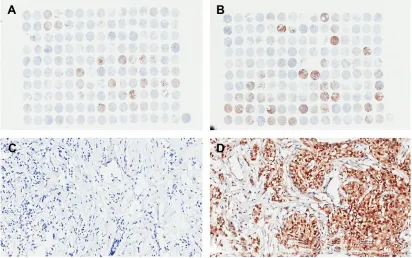
The tissue microarrays and examples of positive and nega-tive P-cofilin expression are shown in Figure 1. P-cofilin expression was not significantly associated with patient survival in the univariate analysis (P=0.232) (Figure 2). When we performed subgroup analyses according to cofilin expression status, we found that patient survival was only significantly associated with negative P-cofilin expression (P=0.002) (Table 1). Positive P-cofilin expression was not significantly associated with patient survival (P=0.355) (Table 1; Figures 3–4).We excluded ten patients who had missing information and 50 patients with positive P-cofilin expression. Thus, 240 patients with invasive ductal cancer (IDC) were included in the subsequent analyses, and their clinicopathological characteristics are shown in Table 1. Among the 240 patients
with IDC, the mean follow-up was 95.7±2.49 months (range:
2–160 months) and the mean age at diagnosis was 56.5 years (range: 29–88 years). Approximately 17.2% of these patients exhibited positive P-cofilin expression, and ~82.8% of these patients exhibited negative P-cofilin expression. We observed T1, T2, and T3/T4 stages in 27.9%, 60.8%, and 11.3% of the P-cofilin-negative patients, respectively. No lymph
node metastasis (N0) was observed in 44.2% of the cases. The patients with IDC exhibited a TNM stage of 0/I (13.8%), II (53.8%), and III (32.5%), and positive ER expression (60.8%), positive PR expression (45.8%), positive HER-2 expression (25.0%), positive Ki-67 expression (30.0%), and the luminal A subtype (42.1%). When we excluded the interference from P-cofilin, we found that only Ki-67 expres-sion was significantly higher in the cofilin-positive subgroup (P=0.002) (Table 2).
Associations of P-cofilin, cofilin, and
other clinicopathological features with
iDc prognosis
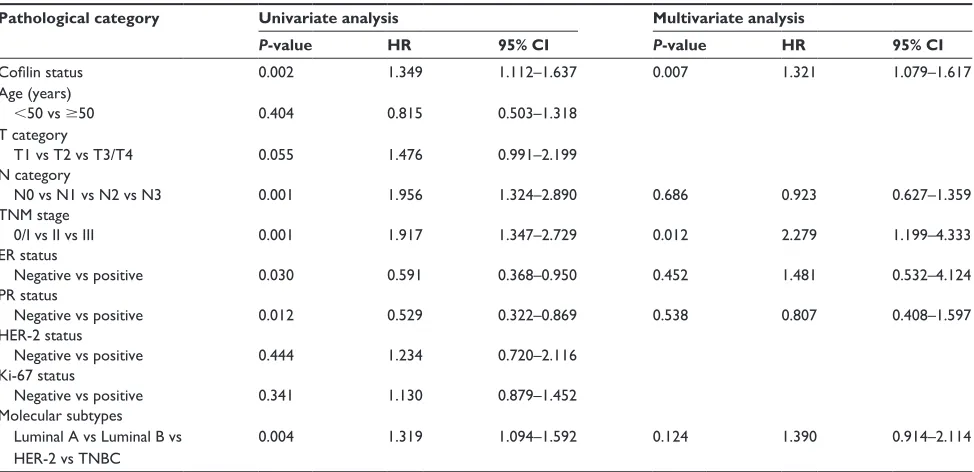
The Kaplan–Meier method and log-rank test were used to evaluate the associations of the various factors with OS (Figure 2; Table 3). The univariate analyses of the patients with IDC revealed that cofilin status, N category, TNM stage, ER status, PR status, and molecular subtypes were associated with OS. Multivariate analyses revealed that cofilin status and TNM stage were independent predictors of OS (Table 3).
Discussion
Actin is the major component of the cytoskeleton, which plays an important role in tumor cell migration, invasion, and mitosis. Cofilin is a ubiquitously expressed actin-binding
Figure 1 Tissue microarray and immunohistochemistry staining of P-cofilin in invasive ductal breast cancer tumors.
Notes: (A) Tissue microarray 1 (150 cases), 1× magnification; (B) tissue microarray 2 (150 cases), 1× magnification; (C) negative expression of P-cofilin, 200× magnification; and (D) positive expression of P-cofilin, 200× magnification.
Abbreviation: P-cofilin, phosphorylated cofilin.
OncoTargets and Therapy downloaded from https://www.dovepress.com/ by 118.70.13.36 on 25-Aug-2020
Dovepress
Maimaiti et al
protein, which is responsible for the formation of the actin cytoskeleton and is indispensable for cell cycle control.8 Furthermore, cofilin is essential for cell cycle progression and cancer cell migration, intravasation, and invasion.9 Cofilin overexpression increases the rate of cell migration in human glioblastoma cultures10 and is correlated with poor prognosis in other human malignancies.11–13 The overexpression of cofilin has also been detected in invasive subpopulations of mammary tumor cells and is directly related to the invasion,
intravasation, and metastasis of mammary tumors.9,14
Our previous data revealed that cofilin expression was associated with poor outcomes, although we only measured total levels of cofilin, rather than dephosphorylated cofilin expression. However, recent studies have indicated that the overall activity of the cofilin pathway, and not that of any single gene within the pathway, determines the invasive and metastatic phenotype of tumor cells.15 In this context, the cofilin pathway is composed of various kinases and phos-phatases that regulate cofilin, and phosphorylation of serine 3 in cofilin is a critical step for cofilin recycling and actin polymerization.10,16 However, P-cofilin is inactive, and it is assumed that the amount of dephosphorylated cofilin in breast cancer cells is a direct measure of cofilin activity. Therefore, we analyzed the expressions of both cofilin and P-cofilin in
the tissue microarrays in order to determine whether cofilin activity (dephosphorylated cofilin expression) was correlated with outcomes in cases of human breast cancer.
In this study, we found that elevated cofilin expression in P-cofilin-negative breast cancer tissues predicted poor clinical and survival outcomes. In this context, cofilin expres-sion directly represents dephosphorylated cofilin expresexpres-sion when P-cofilin is not present. However, in the P-cofilin-positive subgroup, the strong and weak cofilin expressions were not significantly associated with OS. Therefore, the presence of P-cofilin may confound any correlation between dephosphorylated cofilin expression and breast cancer prognosis. These results indicate that dephosphorylated cofilin expression, rather than overall expression, might be a preferred biomarker for predicting prognosis in cases of P-cofilin-negative breast cancer.
Because of its effects on actin polymerization and depo-lymerization, active cofilin has been linked to mammary
Table 1 Cofilin with or without phosphorylation for predicting
overall survival in invasive ductal breast cancer
P-cofilin Cofilin Death (n) Survival (n) P-value
negative negative 54 154 0.002
Positive 15 17
Positive negative 11 22 0.355
Positive 7 10
Abbreviation: P-cofilin, phosphorylated cofilin.
Figure 2 Association of P-cofilin with overall survival among patients with invasive ductal breast cancer.
Abbreviation: P-cofilin, phosphorylated cofilin.
7LPHPRQWKV 6XUYLYDOIXQFWLRQV
2YHUDOOVXUYLYDO
3 3FRILOLQ
3FRILOLQ±
Figure 3 Association of cofilin with overall survival among P-cofilin-negative patients with invasive ductal breast cancer.
Abbreviation: P-cofilin, phosphorylated cofilin.
1.0
0.8
0.6
0.4
0.2
0.0
0 50 100
Time (months)
Overall survival
150 200
P=0.002 Cofilin+
Cofilin– Survival functions
Figure 4 Association of cofilin with overall survival among P-cofilin-positive patients with invasive ductal breast cancer.
Abbreviation: P-cofilin, phosphorylated cofilin.
7LPHPRQWKV 6XUYLYDOIXQFWLRQV
2YHUDOOVXUYLYDO
3
&RILOLQ &RILOLQ±
OncoTargets and Therapy downloaded from https://www.dovepress.com/ by 118.70.13.36 on 25-Aug-2020
Dovepress Dephosphorylated cofilin and prognosis in breast cancer
Table 2 clinicopathological characteristics of breast cancer with different cofilin expression
Pathological category
Cases, n (%)
Negative cofilin
Positive cofilin
P-value
age (years) 0.155
,50 87 (36.6%) 79 8
$50 153 (63.8%) 129 24
T category 0.136
T1 67 (27.9%) 62 5
T2 146 (60.8%) 125 21
T3/T4 27 (11.3%) 21 6
n category 0.510
n0 106 (44.2%) 93 13
n1 67 (27.9%) 55 12
n2 47 (19.6%) 43 4
n3 20 (8.3%) 17 3
TnM stage 0.688
0/i 33 (13.8%) 30 3
ii 129 (53.8%) 110 19
iii 78 (32.5%) 68 10
er status 0.177
negative 94 (39.2%) 78 16
Positive 146 (60.8%) 130 16
Pr status 0.075
negative 130 (54.2%) 108 22
Positive 110 (45.8%) 100 10
HER-2 status 0.380
negative 180 (75.0%) 158 22
Positive 60 (25.0%) 50 10
Ki-67 status 0.002
negative 168 (70.0%) 153 15
Positive 72 (30.0%) 55 17
Molecular subtypes 0.100
luminal a 101 (42.1%) 94 7
luminal B 52 (21.7%) 43 9
HER-2 31 (12.9%) 25 6
TnBc 56 (23.3%) 46 10
Abbreviations: ER, estrogen receptor; HER-2, human epidermal growth factor receptor 2; PR, progesterone receptor; TNBC, triple-negative breast cancer.
tumor invasion, intravasation, and metastasis, as well as lymph node metastasis and a higher nodal stage. Findings from studies of other human malignant tumor types also support these associations. However, in this study, cofilin expression was not correlated with nodal stage or the number of metastatic lymph nodes in the P-cofilin-negative subgroup. As the number of lymph nodes largely depends on the completeness of the axillary lymph node dissection, this approximation may not always be accurate. Moreover, the time interval between tumor diagnosis and surgery may affect the nodal stage, which may not accurately reflect any tendency toward lymphatic metastasis.17,18 Therefore, these factors may explain why dephosphorylated cofilin expression was not correlated with clinical nodal stage in the P-cofilin-negative subgroup. However, most breast cancer-related deaths result from metastasis and/or recurrence, and the correlation between dephosphorylated cofilin expression and poor prognosis may reflect an association with the potential for metastasis.
We also found that Ki-67 expression was significantly higher in the P-cofilin-negative samples that were strongly positive for cofilin. In this context, Ki-67 is a nuclear fac-tor that is expressed in proliferating cells. As actin is the major component of the cytoskeleton, which also plays an important role in tumor cell mitosis, dephosphorylated cofilin expression may be associated with cellular proliferation (as indicated by Ki-67 expression). These results may indicate that dephosphorylated cofilin expression is correlated with
Table 3 Univariate and multivariate analysis of factors that predict overall survival in invasive ductal breast cancer
Pathological category Univariate analysis Multivariate analysis
P-value HR 95% CI P-value HR 95% CI
Cofilin status 0.002 1.349 1.112–1.637 0.007 1.321 1.079–1.617
age (years)
,50 vs $50 0.404 0.815 0.503–1.318
T category
T1 vs T2 vs T3/T4 0.055 1.476 0.991–2.199
n category
n0 vs n1 vs n2 vs n3 0.001 1.956 1.324–2.890 0.686 0.923 0.627–1.359
TnM stage
0/i vs ii vs iii 0.001 1.917 1.347–2.729 0.012 2.279 1.199–4.333
er status
negative vs positive 0.030 0.591 0.368–0.950 0.452 1.481 0.532–4.124
Pr status
negative vs positive 0.012 0.529 0.322–0.869 0.538 0.807 0.408–1.597
HER-2 status
negative vs positive 0.444 1.234 0.720–2.116
Ki-67 status
negative vs positive 0.341 1.130 0.879–1.452
Molecular subtypes luminal a vs luminal B vs HER-2 vs TNBC
0.004 1.319 1.094–1.592 0.124 1.390 0.914–2.114
Abbreviations: ER, estrogen receptor; HER-2, human epidermal growth factor receptor 2; HR, hazard ratio; PR, progesterone receptor; TNBC, triple-negative breast cancer.
OncoTargets and Therapy downloaded from https://www.dovepress.com/ by 118.70.13.36 on 25-Aug-2020
OncoTargets and Therapy
Publish your work in this journal
Submit your manuscript here: http://www.dovepress.com/oncotargets-and-therapy-journal
OncoTargets and Therapy is an international, peer-reviewed, open access journal focusing on the pathological basis of all cancers, potential targets for therapy and treatment protocols employed to improve the management of cancer patients. The journal also focuses on the impact of management programs and new therapeutic agents and protocols on
patient perspectives such as quality of life, adherence and satisfaction. The manuscript management system is completely online and includes a very quick and fair peer-review system, which is all easy to use. Visit http://www.dovepress.com/testimonials.php to read real quotes from published authors.
Dovepress
Dove
press
Maimaiti et al
Ki-67 expression and that cofilin levels may be a marker for rapid proliferation in patients who had negative P-cofilin expression.
This study included two important limitations. First, we used a retrospective single-center design. Second, we only evaluated associations with OS, as we did not have access to data regarding recurrence-free and disease-free survivals. Therefore, a prospective multicenter study with long-term follow-up is needed to confirm whether dephosphorylated cofilin expression is an independent prognostic biomarker for patients with P-cofilin-negative breast cancer.
Conclusion
Dephosphorylated cofilin expression might be a useful biomarker for predicting prognosis in patients with breast cancer. Furthermore, inhibitors of the cofilin pathway may provide therapeutic benefits in these patients.
Disclosure
The authors report no conflicts of interest in this work.
References
1. Jemal A, Bray F, Center MM, Ferlay J, Ward E, Forman D. Global cancer statistics. CA Cancer J Clin. 2011;61(2):69–90.
2. Xiao J, Zhou Y, Zhu W. Association of ultrasonographic features with NGX6 expression and prognosis in invasive ductal breast carcinoma. Int J Clin Exp Pathol. 2015;8(6):6458–6465.
3. Zhang Q, Ma B, Kang M. A retrospective comparative study of clini-copathological features between young and elderly women with breast cancer. Int J Clin Exp Med. 2015;8(4):5869–5875.
4. Yang J, Li X, Liu X, Liu Y. The role of tumor-associated macrophages in breast carcinoma invasion and metastasis. Int J Clin Exp Pathol. 2015;8(6):6656–6664.
5. Roussos ET, Condeelis JS, Patsialou A. Chemotaxis in cancer. Nat Rev Cancer. 2011;11(8):573–587.
6. Sidani M, Wessels D, Mouneimne G, et al. Cofilin determines the migration behavior and turning frequency of metastatic cancer cells. J Cell Biol. 2007;179(4):777–791.
7. Moretti RM, Montagnani Marelli M, Mai S, Limonta P. Gonadotropin-releasing hormone agonists suppress melanoma cell motility and invasiveness through the inhibition of alpha3 integrin and MMP-2 expression and activity. Int J Oncol. 2008;33(2):405–413.
8. Wang W, Eddy R, Condeelis J. The cofilin pathway in breast cancer invasion and metastasis. Nat Rev Cancer. 2007;7(6):429–440. 9. Wang W, Mouneimne G, Sidani M, et al. The activity status of cofilin is
directly related to invasion, intravasation, and metastasis of mammary tumors. J Cell Biol. 2006;173(3):395–404.
10. Yap CT, Simpson TI, Pratt T, Price DJ, Maciver SK. The motility of glioblastoma tumour cells is modulated by intracellular cofilin expression in a concentration-dependent manner. Cell Motil Cytoskeleton. 2005; 60(3):153–165.
11. Yang ZL, Miao X, Xiong L, et al. CFL1 and Arp3 are biomarkers for metastasis and poor prognosis of squamous cell/adenosquamous carci-nomas and adenocarcicarci-nomas of gallbladder. Cancer Invest. 2013;31(2): 132–139.
12. Li D, Zhang Y, Li Z, Wang X, Qu X, Liu Y. Activated Pak4 expression correlates with poor prognosis in human gastric cancer patients. Tumour Biol. 2015;36(12):9431–9436.
13. Lu LI, Fu NI, Luo XU, Li XY, Li XP. Overexpression of cofilin 1 in prostate cancer and the corresponding clinical implications. Oncol Lett. 2015;9(6):2757–2761.
14. Wang W, Goswami S, Lapidus K, et al. Identification and testing of a gene expression signature of invasive carcinoma cells within primary mammary tumors. Cancer Res. 2004;64(23):8585–8594.
15. Tsai CH, Chiu SJ, Liu CC, et al. Regulated expression of cofilin and the consequent regulation of p27(kip1) are essential for G(1) phase progression. Cell Cycle. 2009;8(15):2365–2374.
16. Yin C, Li H, Zhang B, et al. RAGE-binding S100A8/A9 promotes the migration and invasion of human breast cancer cells through actin polymerization and epithelial-mesenchymal transition. Breast Cancer Res Treat. 2013;142(2):297–309.
17. Olivotto IA, Gomi A, Bancej C, et al. Influence of delay to diagnosis on prognostic indicators of screen-detected breast carcinoma. Cancer. 2002;94(8):2143–2150.
18. Chen L, Jian W, Lu L, Zheng L, Yu Z, Zhou D. Elevated expression of E-cadherin in primary breast cancer and its corresponding metastatic lymph node. Int J Clin Exp Med. 2015;8(7):11752–11758.
OncoTargets and Therapy downloaded from https://www.dovepress.com/ by 118.70.13.36 on 25-Aug-2020