Journal of Multidisciplinary Healthcare
Update on prescription extended-release
opioids and appropriate patient selection
Michael J Brennan
The Pain Center of Fairfield, Fairfield, CT, USA
Correspondence: Michael J Brennan
The Pain Center of Fairfield, 140 Sherman Street, 2A, Fairfield,
CT 06824, USA Tel +1 203 255 3451 Fax +1 203 255 7478 Email [email protected]
Abstract: Chronic pain is largely underdiagnosed, often undertreated, and expected to increase as the American population ages. Many patients with chronic pain require long-term treatment with analgesic medications, and pain management may involve use of prescription opioids for patients whose pain is inadequately controlled through other therapies. Yet because of the potential for abuse and addiction, many clinicians hesitate to treat their patients with pain with potentially beneficial agents. Finding the right opioid for the right patient is the first – often complicated – step. Ensuring that patients continue to properly use the medication while achiev-ing therapeutic analgesic effects is the long-term goal. Combined with careful patient selection and ongoing monitoring, new formulations using extended-release technologies incorporating tamper-resistant features may help combat the growing risk of abuse or misuse, which will hope-fully reduce individual suffering and the societal burden of chronic pain. The objective of this manuscript is to provide an update on extended-release opioids and to provide clinicians with a greater understanding of which patients might benefit from these new opioid formulations and how to integrate the recommended monitoring for abuse potential into clinical practice.
Keywords: chronic pain, opioid analgesics, extended release, abuse prevention
Introduction
Chronic pain is a societal problem that is likely to become increasingly significant with the aging of the American population. The most recent estimate from the Institute of Medicine suggests that at least 100 million American adults have chronic pain: more than those affected by heart disease, cancer, and diabetes combined.1 It is believed that
25% of American adults are affected by moderate to severe chronic pain, and 6%–13% of adults report severe disabling pain.2,3 The prevalence of chronic pain appears to be
higher among women than men,2,3 and seems to increase with age.2–4 Chronic pain
interferes with quality of life (QoL) and sleep; it leads to diminished cognitive function, impaired relationships, decreased productivity, and increased mental health concerns, particularly anxiety and depression.5–7
Despite its high prevalence, chronic pain remains underdiagnosed and undertreated. More than half of patients with pain are managed by their primary care physician; only 2% are managed by a pain specialist.3,8 Paradoxically, while nearly half of all patients
with chronic pain receive inadequate analgesia,3,7,9,10 the use of prescription opioids
for pain management has escalated to approximately 20% of all prescriptions.11 These
findings suggest that some patients are receiving a disproportionately large amount of analgesics while others remain undertreated.
Dove
press
R E v i E w
open access to scientific and medical research
Open Access Full Text Article
Journal of Multidisciplinary Healthcare downloaded from https://www.dovepress.com/ by 118.70.13.36 on 24-Aug-2020
For personal use only.
Number of times this article has been viewed
This article was published in the following Dove Press journal: Journal of Multidisciplinary Healthcare
Most patients with chronic pain receive long-term treatment with analgesic medications. Opioids are suggested when other, less problematic approaches are ineffective or poorly tolerated, or if the benefit–risk of their use is surpassed by opioids.12–14 However, there are issues associated with
long-term opioid therapy for chronic noncancer pain, particularly with respect to the risk of tolerance, dependence, or abuse.15–18
While it is broadly accepted that chronic opioid therapy is associated with the development of tolerance, the exact nature of this and the extent to which it may limit the clinical utility of opioid therapy are still poorly characterized.19 Evidence
of long-term improvements in functional activity is also inconclusive, and the continuing effectiveness of opioids taken chronically is difficult to quantify, as the quality of long-term efficacy studies varies widely.16 However, despite
these concerns, multiple expert panels have concluded that chronic opioid therapy can be effective for patients with chronic noncancer pain who are carefully selected and monitored.17
The introduction of new extended-release (ER) for-mulations has provided physicians with a range of man-agement options. More recently, a selection of putative abuse-deterrent formulations (ADFs) of these agents have also been employed. Early data suggest that these formula-tions may be impacting abuse specific to individual drugs, although no impact on community rates of abuse has so far been reported.20 The objective of this review is to provide an
update on ER opioids and to furnish clinicians with a greater understanding of which patients might benefit from these new opioid formulations and how recommended monitoring for abuse potential may be integrated into clinical practice.
Managing chronic pain with
extended-release opioids
Several well-described reasons have been identified for lim-iting prescription of opioids for patients who might benefit from them. Clinicians are especially reluctant to prescribe opioid analgesics because of regulatory oversight concerns, documentation requirements, fear of abuse potential, and lack of foundational knowledge regarding these agents.8,21
Consequently, nearly one in three clinicians do not initiate opioid therapy.22 Recent data suggest this fear or lack of
understanding exists across various diseases and clinical environments. For example, a recent study showed that one-third of patients with invasive cancer pain had inadequate analgesic prescribing, and minorities were twice as likely not to receive adequate pain medication.23 Furthermore, some
patients may choose to live with some degree of chronic
pain for various reasons (eg, to avoid common side effects of opioids or other analgesics).24 Patient-centered care must
therefore encourage greater understanding of the appropriate use of opioids, to enable more patients with chronic pain to receive analgesia that is adequate for their requirements and to experience improvements in work capacity, functioning, and QoL, while minimizing abuse potential.
Pharmacokinetics of extended-release
formulations
Prescription opioids can be categorized according to several different parameters, including affinity and selectivity for opioid receptors, pharmacodynamic effects, and pharma-cokinetic profiles. Most commercially available prescription opioids exert clinical effects via interactions with mu-opioid receptors and produce a constellation of typical opioid-mediated effects, including analgesia, sedation, nausea, constipation, and (potential) elevations in mood. Regarding their relative ability to produce such effects, opioid analgesics are categorized as either weak (eg, codeine, hydrocodone plus acetaminophen, and tramadol) or strong (eg, oxycodone, hydromorphone, morphine, fentanyl, and oxymorphone).25
Prescription opioids are available as immediate-release (IR) or ER formulations, distinguishing features that have relevance for their clinical utility. As with IR opioids, which typically have clinical effect for 3–6 hours, common side effects with ER formulations include constipation, nausea, and somnolence.26–31 In addition, respiratory depression and
risk of death from overdose have been directly associated with higher opioid doses.32
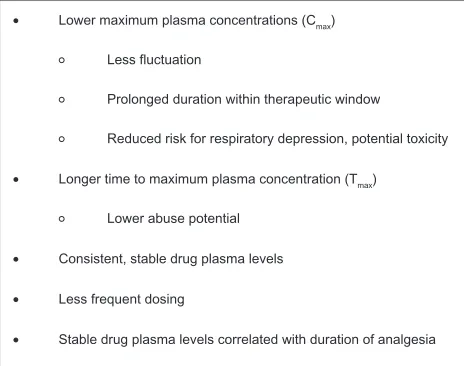
Compared with IR formulations, ER formulations are spe-cifically designed to allow a controlled release of the active agent to provide relatively consistent and prolonged plasma drug levels with lower maximum concentration (Cmax) and fewer peak-to-trough fluctuations (Figure 1).26,33 To prevent
gaps in pain relief, IR formulations require regular adminis-tration every 4–6 hours, and consequently produce numerous peaks and troughs in plasma drug levels throughout the day. In contrast, ER formulations are dosed less frequently (one to three times per day or fewer), allowing for less fluctuation and affording an elongated duration within the therapeutic window.34 In addition, a lower maximum daily dose has
been associated with a reduced risk of respiratory depression and overdose.32 The time to peak blood concentration level
(Tmax) is generally longer with ER formulations, a parameter that may confer a reduced abuse liability when intact tablets are taken whole (see below).35,36 Two separate surveys, one
sent to patients and the other to physicians, concluded that Dovepress
Brennan
Journal of Multidisciplinary Healthcare downloaded from https://www.dovepress.com/ by 118.70.13.36 on 24-Aug-2020
the two most important factors when selecting an opioid are the ability to relieve pain and the duration of pain relief.37
Studies demonstrate that duration of stable blood plasma levels is significantly correlated with the overall duration of analgesia.26,34
ER opioids have been shown to be efficacious for treat-ment durations of up to 1 year in patients with chronic nonmalignant pain associated with a variety of underlying etiologies, including low-back pain,38–44 osteoarthritis,40,41,45–47
postherpetic neuralgia,48 and neuropathic pain.49,50 Although
prescriptions using IR preparations are far more prevalent than those using ER formulations,51 few studies have directly
compared ER with IR opioid formulations. At the time of this
writing, there is no clear evidence to recommend one over the other.30,51,52 Additional head-to-head studies are necessary
to elucidate the range of conditions under which ER opioids perform better.
Extended-release opioid formulations
A number of oral and transdermal ER opioid formulations are currently available (Table 1).53–66 Clinically importantdiffer-ences focus on the pharmacokinetics of individual agents and the benefits related to specific formulations. Potency, defined as the dose required to produce a given effect, is typically compared relative to morphine and differs not only between agents but also by both route of administration and whether the formulation is IR or ER.67 Recent additions to the
phar-macologic armamentarium include formulations designed to reduce abuse liability among the subset of people who manipulate existing formulations to obtain a faster or greater opioid response; although these ADFs cannot reduce or elimi-nate all means for opioid abuse, they may help deter particular forms of opioid abuse among specific populations.
Morphine
Morphine is considered the prototype of pure mu-agonist opioids.27 Oral controlled-, extended-, and sustained-release
morphine formulations are available in the United States as tablets or capsules. Recent additions include a once-daily cap-sule formulation containing both IR and ER beads that release morphine in a distinct time-dependent manner using a sphe-roidal oral drug-absorption system, or SODAS (Avinza; King Pharmaceuticals, Bristol, TN, USA), and a once- or
twice-Lower maximum plasma concentrations (Cmax)
Less fluctuation
Prolonged duration within therapeutic window
Reduced risk for respiratory depression, potential toxicity
Longer time to maximum plasma concentration (Tmax)
Lower abuse potential
Consistent, stable drug plasma levels
Less frequent dosing
Stable drug plasma levels correlated with duration of analgesia
•
•
•
•
•
Figure 1 Putative pharmacokinetic advantages of extended-release versus immediate-release opioids.26,33
Table 1 Extended-release opioids53–66
Opioid Generic name Brand name Available doses Dosing interval
Morphine Morphine sulfate ER capsules Avinza 30, 45b, 60b, 75b, 90b, 120b mg Once daily Morphine sulfate and naltrexone
HCl ER capsules
Embedaa –a Once or twice daily
Morphine sulfate ER capsules Kadian 10, 20, 30, 40, 50, 60, 70, 80, 100b, 130, 150, 200b mg
Once or twice daily
Morphine sulfate CR tablets MS Contin 15, 30, 60, 100b, 200b mg Every 8–12 hours Morphine sulfate SR tablets Oramorph SR 15, 30, 60, 100 mg Every 8–12 hours Oxymorphone Oxymorphone HCl ER tablets Opana ER 5, 10, 20, 30, 40 mg Every 12 hours Hydromorphone Hydromorphone HCl ER tablets Exalgo 8b, 12b, 16b, 32b mg Once daily Tapentadol Tapentadol ER oral tablets Nucynta ER 50, 100, 150, 200, 250 mg Every 12 hours Oxycodone Oxycodone HCl CR tablets OxyContin 10, 15, 20, 30, 40, 60b, 80b mg Every 12 hours Methadonec Methadone HCl tablets Dolophine
Methadose
5, 10 mg 10 mg
Every 8–12 hours
Fentanyl Fentanyl transdermal system Duragesic 12b, 25b, 50b, 75b, 100b mcg/hour 1 patch every 72 hours Buprenorphined Buprenorphine transdermal system Butrans 5, 10, 20 mcg/hour 1 patch weekly
Notes:aEmbeda is not currently being marketed in the United States; bdoses available only for opioid-tolerant patients; cmethadone is the only medication considered a
long-acting opioid formulation; dSchedule iii agent.
Abbreviations: CR, controlled release; ER, extended release; HCl, hydrochloride; SR, sustained release.
Dovepress Update on extended-release opioid analgesics
Journal of Multidisciplinary Healthcare downloaded from https://www.dovepress.com/ by 118.70.13.36 on 24-Aug-2020
daily ER capsule (Kadian; Actavis Elizabeth, Morristown, NJ, USA).27,54,56,68 The once-daily formulation provides the
same total systemic exposure over 24 hours as the twice-daily formulation, but with different pharmacokinetics, including a lower Cmax and higher Cmin, resulting in reduced peak-to-trough fluctuations compared with the twice-daily formulation.27,68,69
The controlled-release (MS Contin; Purdue Pharma, Stam-ford, CT, USA) and sustained-release formulations (Oramorph SR; Xanodyne Pharmaceuticals, Newport, KY, USA) are dosed every 12 hours but can be dosed every 8 hours for patients whose pain is not fully controlled over the 12-hour release time.57,58 An ADF that combines morphine sulfate
with naltrexone hydrochloride has been developed, but is not currently being marketed (Embeda; King Pharmaceuticals).55
For all available morphine formulations, studies suggest that food impacts the pharmacokinetics, predominantly by increasing Tmax, although some research suggests that food can also increase the area under the curve (AUC) and Cmax for IR and specific ER morphine formulations.34
Oxymorphone
Oxymorphone is a semisynthetic opioid agonist with approxi-mately two to three times greater analgesic potency and a more rapid onset of action compared with morphine.70,71 Originally,
an ER matrix formulation using the TIMERx (Endo Phar-maceuticals, Chadds Ford, PA, USA) delivery system slowly releases oxymorphone over 12 hours to afford consistent plasma levels with low peak-to-trough fluctuations. Studies suggest a reasonable oral morphine: oxymorphone equianal-gesic potency ratio of 2–3:1.59,67 A recently released putative
ADF of oxymorphone ER (Opana ER; Endo Pharmaceuticals, Chadds Ford, PA, USA), in which the active drug is embedded in a hard polymer matrix (INTAC; Grünenthal, Aachen, Ger-many) is currently marketed in the United States.59,72 Clinical
studies suggest these two oxymorphone ER formulations are bioequivalent and have similar safety profiles.72 Modest
alcohol consumption (modeled using 240 mL of 4% ethanol) along with oxymorphone ER tablets does not appear to have an effect, whereas moderate alcohol use or abuse (modeled using 240 mL of 20% and 40% ethanol, respectively) may produce meaningful consequences.73 Coadministration of
oxymorphone ER with 20% or 40% ethanol increased Cmax levels by an average of 31% and 70%, respectively, and the median Tmax was shortened by 30 minutes.59,73
Hydromorphone
A new once-daily, oral osmotic pump (OROS; Alza, Mountain View, CA, USA) formulation of the semisynthetic
opioid hydromorphone (Exalgo, Mallinckrodt Brand Phar-maceuticals, Hazelwood, MO, USA) was approved in 2010 by the US Food and Drug Administration (FDA).60 This ADF
provides relatively constant steady-state concentrations over 24 hours, equivalent AUCs, and a 26% lower Cmax and 43% higher Cmin compared with an IR hydromorphone formula-tion.74,75 Bioavailability is only minimally affected by food
or alcohol.76 This formulation has low plasma protein
bind-ing and low probability of interferbind-ing with the metabolism of other drugs.76,77 Research has demonstrated comparable
steady-state plasma drug concentrations and bioequivalence between the OROS ER and IR formulations, with substan-tially smaller peak-to-trough fluctuations associated with OROS ER compared with IR hydromorphone formulations (61% vs 172%, respectively).74 The hard exterior of the tablet
has been shown to withstand significant force, minimizing its ability to be intentionally manipulated through biting or chewing.78 In addition, after milling the tablet, only 30% of
active ingredient could be recovered, minimizing the appeal of bolus doses through this form of manipulation.78 When
switching to OROS hydromorphone from morphine sulfate, the relative potency dose ratio is 5:1 (HM:MS).75,79
Tapentadol
Tapentadol has a dual mechanism of action: it is a mu-opioid receptor agonist and a norepinephrine-reuptake inhibitor, with minimal serotonin effects.80,81 As a mu-opioid,
it has similar abuse liability to the other strong mu-opioids. The synergistic interaction may be particularly beneficial for patients with neuropathic pain,80 and limited protein
binding minimizes the risk of drug–drug interactions.80 An
oral ER formulation (Nucynta ER, Janssen Pharmaceuticals, Titusville, NJ, USA) provides a 12-hour duration of effect with comparable analgesia and a favorable gastrointestinal tolerability profile.61,80,82–85 Tapentadol has recently had its
indication expanded from chronic moderate to severe pain to include neuropathic pain resulting from diabetic peripheral neuropathy.61
Oxycodone
Oxycodone controlled release (OxyContin; Purdue Pharma) is a pure mu-opioid receptor agonist that has an abuse potential similar to that of other strong opioids.62 The
controlled-release oxycodone formulation provides delivery of oxycodone continuously over a 12-hour period and has high oral bioavailability (60%–87%) due to low presystemic and/or first-pass metabolism.62 Upon repeated dosing in
healthy subjects in pharmacokinetic studies, steady-state Dovepress
Brennan
Journal of Multidisciplinary Healthcare downloaded from https://www.dovepress.com/ by 118.70.13.36 on 24-Aug-2020
plasma concentrations of oxycodone were achieved within 24–36 hours.62
Methadone
Methadone (Dolophine, Roxane Laboratories, Columbus, OH, USA; Methadose, Mallinckrodt Brand Pharmaceuticals) is a highly lipophilic synthetic mu-opioid agonist with unique pharmacokinetic and pharmacodynamic properties.63,64,86
The relative potency may depend upon the dose of the opioid taken before the switch to methadone, and whether the patient was switching from or to methadone.67 Unlike
other ER opioids, methadone is an intrinsically long-acting opioid because it has a long and variable half-life, ranging from 12 to 120 hours, compared with 2–4 hours with oral morphine. This has been associated with an elevated risk of overdose deaths, because severe toxicities may not become apparent for 2–5 days.33,86 The low cost of methadone may
account for the dramatic increases in prescriptions over the past decade.22,87 Although methadone represents fewer than
5% of opioid prescriptions dispensed, it is implicated in one in three opioid-related deaths.87 Because of its unpredictable
pharmacokinetics, caution should be used when prescribing methadone.13
Transdermal formulations
In addition to the ER oral formulations, two transdermal for-mulations are available, one containing fentanyl and the other containing buprenorphine.65,66 Both fentanyl and
buprenor-phine are potent synthetic opioids that are highly lipophilic and have a low molecular weight.88,89 In addition to possible
cutaneous reactions to the patches, patients should be aware that any direct heat to the attached patch – including increases in body temperature (eg, fevers) or elevations in ambient tem-peratures (eg, hot tubs, heating blankets) – can substantially increase the amount of active drug released.88,90
Fentanyl
The original transdermal fentanyl reservoir formulation has had problems with adhesion and is associated with a risk of drug leakage and greater ease of drug extraction, limit-ing its use.91,92 The newer matrix patch (Duragesic, Janssen
Pharmaceuticals) was designed with a reduced drug load: drug-containing droplets are contained within a silicone matrix with a rate-controlling membrane.65,91,92 The patch
is to be replaced every 72 hours. Comparing reservoir to matrix systems indicates comparable systemic and topical safety profiles, as well as bioequivalent systemic exposures of fentanyl.93 However, increased skin temperature, as through
exposure to heat, has been associated with greater fentanyl absorption and may increase the risk of overdose.94,95 In
addition, recent research indicates greater intrasubject and intersubject variability in absorption, metabolism due to genetic polymorphisms, and interference of metabolism associated with concomitant medication use than was previ-ously observed, which has been associated with unpredictable adverse effects, including fatalities.96 In general, the matrix
patch appears to be less amenable to tampering than the traditional reservoir system: the design of the matrix patch makes it more difficult to extract active drug. Nevertheless, both types of patches contain very high doses of fentanyl both before and after use, increasing the risk for overdose.94
Buprenorphine
Buprenorphine is a semisynthetic derivative of thebaine, and its unique mechanism of action as a partial agonist at the mu-opioid receptor shows a decreased propensity to produce respiratory depression unless combined with other central nervous system (CNS) depressants.89,97 In contrast
to the other mu-opioid receptor agonists that are Schedule II agents, buprenorphine is considered a Schedule III drug, meaning that it can be used for medical purposes and has a moderate (vs high) addiction potential. Therapeutic efficacy is achieved with daily doses of 0.5–2 mg, making it 25–50 times more potent as an analgesic per milligram than morphine.89,98 The low-dose transdermal 7-day
buprenorphine matrix patch (Butrans, Purdue Pharma), recommended for patients with moderate to severe pain, appears to be efficacious, generally well tolerated, and convenient.66,99–101 The formulation provides continuous
delivery of buprenorphine to afford generally consistent plasma drug concentrations throughout the 7-day dosing interval.97 It does not require dosage adjustments in older
patients (aged $ 65 years) and has an adverse-event profile comparable to other opioid analgesics,97 although local skin
reactions can be therapy-resistant and may be treatment-limiting.89 In an analysis of long-term use, data from a
Norwegian Prescription Database study of 13,451 new users of this patch, from its introduction in November 2005 through December 2008, showed that nearly half (44%) of patients were dispensed only one prescription.102
Therapeutic benefits of extended-release
opioids
Among the putative benefits associated with the pharma-cokinetic properties of ER formulations are the potential for sustained and consistent analgesia, less end-of-dose
Dovepress Update on extended-release opioid analgesics
Journal of Multidisciplinary Healthcare downloaded from https://www.dovepress.com/ by 118.70.13.36 on 24-Aug-2020
failure or breakthrough pain, and better consolidated nighttime pain control with less need for nighttime dosing.5,26,27 Nearly 89% of patients with chronic pain
report comorbid pain-related sleep disturbance; pain exacerbates sleep problems that can lead to physical and mental symptoms, including depression.26,103–105 Although
both IR and ER opioid formulations have the potential to improve sleep, IR agents may not provide as much benefit as ER formulations for patients who wake during the night with pain or who have early morning pain.26 ER
agents may facilitate more consolidated sleep patterns compared with IR agents.106,107 Sleep problems resulting
from osteoarthritis-induced chronic pain were qualitatively and quantitatively improved after treatment with a once-daily ER morphine formulation.108 Similarly, a higher
percentage of patients with pain receiving a buprenorphine transdermal patch compared with patients receiving a placebo patch reported uninterrupted sleep for durations longer than 6 hours.109
Both IR and ER formulations improve QoL measures of mood, social and overall physical function, and work.26
However, ER formulations appear to improve treatment responses and afford better patient perceptions of QoL than do IR formulations.107,110 A recent study under real-world
conditions involving once-daily ER morphine sulfate tab-lets demonstrated significantly reduced pain scores that led to improved sleep and physical functioning among patients with chronic moderate to severe pain over the 3-month study period.65 Another study showed that a once-daily
ER morphine sulfate formulation was associated with significantly better and earlier improvements in physical function and ability to work than a twice-daily oxycodone formulation.111
Less frequent dosing may also facilitate greater treatment adherence.5 ER formulations appear to increase adherence
and reduce pain-related anxieties.107 Good adherence has
been associated with improved treatment efficacy in pain relief and QoL.112
Clinical practices to promote
appropriate choice and use
of opioid formulations
Whether prescribing ER or IR opioid therapy for an indi-vidual patient, selecting an appropriate formulation must take into consideration a variety of factors, including patient age, hepatic and renal status, the risk for drug–drug interactions, and the effects of coadministration with alcohol and other CNS depressants (Figure 2).12–14
identifying appropriate candidates
for extended-release opioid therapy
Opioids have demonstrated efficacy against most forms of pain.13 However, prescription opioids are not appropriate
for all patients and all chronic pain conditions. Accord-ing to labelAccord-ing by the FDA, modified-release opioids are “for the management of moderate to severe pain when a continuous, around-the-clock analgesic is needed for an extended period of time; they are not intended for intermit-tent dosing or as an as-needed analgesic.”113 In addition,
the boxed warning on all modified-release prescription opioids highlights the need for proper patient selection, noting that “persons at increased risk for opioid abuse include those with a personal or family history of substance abuse or mental illness. Patients should be assessed for their clinical risks for opioid abuse or addiction prior to being prescribed opioids. All patients receiving opioids should be routinely monitored for signs of misuse, abuse and addiction.”113
Reviewing relevant patient
health conditions
Health conditions such as hepatic or renal impairment and presence of cardiovascular disease, dementia, or
Personal or family history of substance use or abuse Advancing patient age
Altered ability to perceive pain May need to adjust dosage Medical comorbidity
Renal insufficiency: dosage adjustments, titrate slowly, closely monitor Hepatic insufficiency: care with agents if cytochrome P450 (CYP)-mediated metabolism; oxymorphone contraindicated
Preexisting cardiorespiratory impairments Cerebrovascular disease, brain injury, dementia Comorbid psychiatric illness
Concurrent medication use
Phase I metabolism mediated by CYP3A4 and CYP2D6 increases risk of drug–drug interactions
Opioids not metabolized by CYP system: morphine, hydromorphone, oxymorphone, tapentadol Genetic polymorphisms
Coadministration with alcohol
•
•
•
•
•
•
•
•
•
•
•
Figure 2 Factors to consider before initiating treatment with an opioid analgesic.12–14
Dovepress
Brennan
Journal of Multidisciplinary Healthcare downloaded from https://www.dovepress.com/ by 118.70.13.36 on 24-Aug-2020
cerebrovascular conditions can impact opioid effects, and patients should be assessed for these conditions prior to initiating opioids. Older patients, in particular, may be likely to have one or more of these comorbidities.114 The slower
metabolism of older patients, along with decreased renal and hepatic blood flow and mass, make them particularly vulnerable to adverse events and increased sensitivities to opioid agents.14,76,115,116 In addition, this population has a high
use of polypharmacy, which may increase the likelihood of drug–drug interactions.117Similarly, older patients experience
an elevated risk of respiratory depression, bradycardia, or hypotension with prescription opioid use.114,118,119 Patients
with existing cardiorespiratory impairment should be moni-tored very carefully if prescribed opioids.52,114,120
Most opioid analgesics or their metabolites – active or inactive – are primarily eliminated in the urine, necessitat-ing dosage adjustments for patients with significant renal impairments.114 Clinicians can prescribe opioid analgesics –
albeit with caution – to patients with renal or hepatic failure, using low doses and slow titration schedules.114,121,122 Specific
agents, including morphine, codeine, and hydromorphone, should be avoided or used with caution, because of the accu-mulation of bioactive drug or metabolites, which might result in potential toxicities.59,62,65,114,123–127 In patients with renal
impairment, accumulation of morphine or codeine can cause severe adverse effects; administration of hydromorphone to patients with chronic renal failure can cause neuroexcit-atory symptoms, including pain, cognitive impairments, and seizures.114 The high variability in pharmacokinetics
associ-ated with methadone leads to recommendations against its use as a first-line agent among older patients.
Reviewing existing medications
for interactions
Research indicates that nearly one in five patients take mul-tiple opioid analgesics: 32% take more than five concurrent medications, and 21% take more than ten medications.114,128
Polypharmacy has been associated with poor adherence to treatment and increased potential risk of drug–drug interactions.76,129
Many prescription opioids undergo phase I metabolism mediated by cytochrome P450 (CYP) enzymes, especially CYP3A4 and CYP2D6. Multiple agents affect 3A4 activity. Fewer affect 2D6, but genetic variations in 2D6 expression may result in altered pharmacokinetics as well. Thus, agents metabolized this way may substantially increase the risk of drug–drug interactions and can influence the efficacy or tolerability of the agent.114,130–133 For example, absorption of
methadone is mediated by gastric pH and P-glycoprotein and is metabolized in part by CYP3A4 and CYP2D6, resulting in many potential drug interactions.86 Morphine,
hydromor-phone, oxymorhydromor-phone, and tapentadol are among the few opioid agents that undergo phase II hepatic metabolism via glucuronidation, bypassing CYP-mediated metabolism and thereby reducing the risk of drug–drug interactions involv-ing the CYP450 system.114,123,133–136 However, the metabolites
themselves may vary in biologic effect, activity, and potency, and therefore awareness of these pathways alone might not be sufficient in avoiding drug–drug interactions or the con-sequences of accumulated breakdown products.
Educating patients on alcohol use
Coadministration of prescription opioids with alcohol or other CNS depressants can exacerbate the respiratory depressant effects of opioids. Concurrent use of specific opioid-delivery systems with alcohol can also result in an increase in the release rate of the opioid, an effect known as “dose dumping,” resulting in absorption of a potentially fatal dose of the analgesic.137 This phenomenon was observed
with an ER formulation of hydromorphone (Palladone CL), leading to the removal of this product from the market.138
Variable effects have been observed with an ER formulation of oxymorphone,59,139 although a new formulation is being
developed that is more resistant to the effects of alcohol.73 On
the other hand, alcohol has not been found to alter appreciably the release characteristics of morphine sulfate ER capsules or OROS hydromorphone ER tablets.137,140–142 Regardless of
the pharmacokinetic effects, warnings concerning the coad-ministration of any opioid with alcohol are warranted, due to the pharmacodynamic effects and the combination of two CNS depressants.
Collecting complete histories
of substance-use behavior
Balancing the risks and benefits of opioid analgesics, there-fore, is essential in the management of pain with opioids. In recent decades, a structured approach to manage risk has been recommended (Figure 3).13,33,143 Clinicians can adopt a
uni-versal precautions approach, in which all patients who might benefit from prescription opioids undergo a substance-use assessment, using an appropriate minimum level of precau-tion (Figure 3).13,33,143 A number of rapid-assessment tools are
amenable for use in the primary care setting, including the Opioid Risk Tool144 and the Screener and Opioid Assessment
for Patients with Pain.145 Patients should be asked in a
non-judgmental manner about current and prior use of licit and
Dovepress Update on extended-release opioid analgesics
Journal of Multidisciplinary Healthcare downloaded from https://www.dovepress.com/ by 118.70.13.36 on 24-Aug-2020
illicit drugs, their willingness to see specialists if referred, and their willingness to participate in urine drug testing. Patients with current or a history of drug abuse can be safely treated with opioid analgesics, but typically require more careful monitoring.146 However, those patients who demonstrate a
high risk for misuse or abuse of opioids might not be appro-priate candidates.143 The high comorbidity between pain
and psychiatric conditions, especially depression, leads to poorer prognoses for both conditions76 and might increase the
patient’s risk for substance abuse or addiction.114,147 Clinicians
need to continually monitor all patients, regardless of their age, for signs of tolerance, hyperalgesia, or drug abuse.112
Given the wide variability in response of patients to differ-ent opioids, selecting a specific agdiffer-ent that is effective and well tolerated in a given patient initiating opioid therapy represents yet another challenge.132 Specific genetic polymorphisms
have been identified that may explain some of this variability (eg, CYP2D6 polymorphisms that result in either rapid or slow drug metabolism can impact both the analgesic response to an opioid and the risk for adverse events),132,148–150 but
genetic testing is not yet routinely performed.149 Accordingly,
a trial of several different opioids may be necessary to find the appropriate regimen for an individual patient. In a retrospec-tive chart review of patients with chronic pain initiated on opioid therapy, four opioid rotations were required in order for 80% of patients (cumulatively) to find an effective and well-tolerated opioid.151 Only 36% of patients responded to
the first opioid prescribed; approximately one-third discon-tinued treatment because of ineffectiveness, and another 30% because of side effects.151
incorporating regular urine screening
Urine toxicology screening can be of use in monitoring patients on long-term opioid therapy,152 especially those atrisk for aberrant behavior. Screening can help improve adher-ence to therapy by detecting use of prescribed medications, as well as illicit drug use. However, physicians should be aware of the limitations of screening: it is not particularly effective at detecting synthetic opioids, and cross-reactivity between drugs is common.153
Planning to address side effects
Given that side effects frequently cause patients to discon-tinue opioid therapy, clinicians should assess and treat comor-bidities and discontinue as appropriate current medications that contribute to the incidence and severity of side effects. Pharmacological approaches for preventing or treating opioid-induced side effects include symptomatic treatment (eg, antiemetics), switching route of administration, using an opioid-sparing regimen (eg, by addition of a nonsteroidal anti-inflammatory agent), or, as discussed above, switching to an alternative opioid.15
Minimizing potential
for abuse and diversion
The abuse liability of opioids has been well established. Opioids have mood-altering and anxiolytic effects that can induce euphoria, especially when plasma drug levels quickly rise.154 However, the means of misuse and abuse
differ depending upon an individual’s drug-use history. Experienced abusers are likely to manipulate the tablets (by crushing, injecting, or snorting) to obtain the greatest or fast-est response, whereas less experienced users of prescription opioids are likely to misuse the agents by taking more than the recommended dose or by taking the prescribed dose more frequently than recommended. Consequently, rapid-acting IR formulations can be particularly attractive to experienced abusers. Similarly, the greater amount of active agent in ER
1. Make a diagnosis with appropriate differential a. Include comorbid medical illnesses 2. Complete psychological assessment
a. Include psychiatric comorbidities b. Include risk of addiction 3. Informed consent
4. Treatment agreement (verbal and/or written) a. Include pain and functional goals
5. Assessment of pain intensity and impact on functioning (preintervention[s]) 6. Appropriate trials of opioid therapy (alone or with adjunctive medications) 7. Reassessment of pain intensity and level of function (postintervention) 8. Regular assessment of “four A’s” of pain medicine
a. Analgesia (pain relief) b. Activity (functional goals) c. Adverse effects
d. Aberrant behavior (and adherence to treatment plan) 9. Periodic reviews
a. Pain diagnosis b. Comorbid conditions c. Addictive disorders 10. Documentation
Figure 3 Ten steps of universal precautions in pain medicine.
Note: datafrom Gourlay et al.143
Dovepress
Brennan
Journal of Multidisciplinary Healthcare downloaded from https://www.dovepress.com/ by 118.70.13.36 on 24-Aug-2020
formulations also makes them attractive to experienced abus-ers, and it makes these formulations potentially more lethal when abused. However, clinicians should be aware that the vast majority of opioid abuse is through oral use and does not entail tablet manipulation. Both forms of abuse are important to address, albeit through different venues. Conventional abuse of oral tablets can only be addressed through appro-priate patient selection, counseling, and monitoring. Drug manufacturers are trying to address abuse through nonoral routes by developing ADFs. In addition, US governmental agencies have developed Risk Evaluation and Mitigation Strategies (REMS) that include, among other strategies, physician education and patient counseling.
Epidemiology of abuse
In the US, an increasing number of people are misusing pre-scription opioids.26,155–157 The proportion of the US population
aged 12 years or over that has ever used prescription pain relievers nonmedically increased from 30 million in 2002 to 35 million in 2010.142 Among first-time users of illicit drugs,
nonmedical use of prescription pain relievers was second only to marijuana use in 2009.156 During the 7-year period
between 2002 and 2009, the percentage of young adults aged 18–25 years who misused pain relievers increased from 4.1% to 4.8%, whereas the percentage who abused cocaine or methamphetamines decreased (from 2.0% to 1.5%, and from 0.6% to 0.2%, respectively).156 College-age students
have the highest prevalence rate of nonmedical use of opi-oids, which they predominantly obtained from friends or parents.158 Abuse is not limited to young adults, and the rate
of illicit drug use in adults aged 50–59 years increased from 2.7% to 5.8% between 2002 and 2010.156 One study suggests
that as many as 75% of patients with pain do not take their prescriptions as prescribed.159 The prevalence of addiction in
the general population is estimated at 10%; compared with general population samples, the frequency of opioid-use disorders is substantially elevated among patients receiving opioid therapy.160–163
Essentially three types of persons abuse or misuse opioid drugs: patients receiving pain medication who also abuse (those who obtain the drug legally for medical use but use it unsafely or in ways not prescribed), recreational drug abusers who obtain the drug illegally for experimentation or to get high, and experienced drug abusers.164 Patients with pain
typi-cally fall into the first category: their most common means of misuse or abuse is through oral administration, by taking more of the medication at or above the recommended doses using the normal route of administration, or by taking the
pills when not in pain.158,165,166 This use may be for euphoria,
to address other complaints such as anxiety or insomnia (referred to as chemical coping), or for undertreated pain. In contrast, recreational and experienced drug abusers who use opioids may be more likely to alter the drug to change the route of administration.167 By altering sustained-release
formulations through crushing, snorting, or injecting, a greater portion of the drug can be released than originally intended, to provide the high.154,164,165
Identifying patients at elevated risk of progressing from misuse to abuse is imperative. The boxed warning on all prescription-opioid agents highlights that persons with a personal or family history of substance abuse or mental ill-ness (including but not limited to depression) are at increased risk for opioid abuse.113 Other potential risk factors include
patients with other medical or psychiatric comorbidities and patients with (typically undertreated) significant levels of pain.4,168,169 Aberrant behaviors that suggest misuse or
abuse include the use of pain medications for reasons other than pain, evidence of impaired control, compulsive use of the medication, continued use of the opioid agent despite a lack of benefit or a risk of harm, calling for early refills, “losing” prescriptions, or other drug-seeking behaviors, including “doctor shopping.”170
Source of abused prescription opioids
While the most common motives for opioid abuse include relieving pain, getting high, or experimentation, the most common source of prescription opioids used for nonmedical purposes is from a friend or relative – for free – the majority of whom had originally received the drug as a prescription from one physician.21,154,156,158 Fewer than 5% of persons overage 12 years have obtained a prescription pain reliever from a drug dealer or stranger.21,156 Data from the National
Epidemio-logic Survey on Alcohol and Related Conditions report that prescription-opioid abusers are more likely to be white, male, and college-educated adults.171 What is unclear is whether the
source of the drug is from a legitimate prescriber or from a source that is or is likely an illegitimate prescribing source (ie, so-called pill mills). Recent arrests in Florida highlight the concern of legitimate pain clinics compared to those solely dealing in the illegal prescribing of opioids.172
Pharmacokinetic factors
Specific drug factors that influence the abuse liability of an agent include its intrinsic pharmacologic activity, its physicochemical properties, and its pharmacokinetic properties (ie, absorption, distribution, biotransformation,
Dovepress Update on extended-release opioid analgesics
Journal of Multidisciplinary Healthcare downloaded from https://www.dovepress.com/ by 118.70.13.36 on 24-Aug-2020
excretion).173 Regarding pharmacokinetic parameters,
increases in Cmax and decreases in Tmax have been associated with greater abuse potential of an opioid formulation.164,174 The
ratio between these two factors (Cmax/Tmax) has been advanced as a common metric to quantify the abuse potential of a par-ticular formulation, although additional research is necessary to assess the validity of this “abuse quotient.” Consistent with findings from the controlled human abuse-liability studies above, veteran abusers indicate that “attractive” agents are those that produce a rapid onset and a sustained duration of effect.175 In contrast, unattractive attributes, such
as withdrawal effects, slow onset of effect, unpleasantness of administration, and other negative formulation issues, have been associated with reduced abuse potential.175
Abuse-deterrent formulations
Altering formulations to address the problem of overcon-sumption, either unintentional or intentional, is not currently possible.164 However, drug manufacturers are now developing
ADFs with the aim of either making opioid analgesics less attractive for nonoral abuse or increasing the consequences of abuse, ultimately to minimize the abuse of opioids among recreational reward-seekers. Current ER opioid formula-tions maintain constant plasma levels for prolonged periods, thereby reducing the euphoric effects of the drug through less rapid rises in plasma levels and lower peak levels.35,176
The current approaches for ADFs or abuse-resistant for-mulations involve including physical barriers to tampering, agonist–antagonist formulations (eg, adding naltrexone), modified-release formulations, and formulations that are or become highly viscous when attempts are made to defeat the ER mechanisms.154,164,177,178 Examples include the currently
available OROS hydromorphone ER (Exalgo), the new OxyContin formulation that has tamper-resistant proper-ties, and a number of possible formulations currently under investigation: oxycodone ER in high-viscosity hard gelatin capsules (Remoxy; Pain Therapeutics, Austin, TX, USA); two oral oxycodone formulations using the DETERx tamper-resistant formulation (COL-003 and COL-172; Collegium Pharmaceutical, Cumberland, RI, USA); and an oxycodone formulation combined with naltrexone (OxyNal, Elite Phar-maceuticals, Northvale, NJ, USA; PTI-801 or Oxytrex, Pain Therapeutics).21
A study that compared the abuse potential of OROS hydromorphone ER with IR hydromorphone among subjects with a history of recreational opioid use showed that the delayed onset of good drug effects and prominent bad drug
effects of the OROS ER formulation was likely to decrease its potential for abuse.35 The hard outer shell of the OROS
hydro-morphone ER tablet further minimizes its abuse potential by making the tablet substantially more difficult to manipulate through chewing or biting.78 In addition, research indicates
that only 50% of active ingredient was recovered after 24 hours of immersion in water, and only 30% was recovered after milling.78 Another ADF involves embedding pellets of
ER morphine sulfate with a sequestered core of naltrexone (MS-sNT, Embeda): naltrexone is released if the capsule is crushed, mitigating any morphine-induced effects.179 This
formulation is currently not being marketed. There are, as yet, no data establishing an increased efficacy or decreased risk of misuse or abuse with this formulation.180
A controlled-release formulation of oxycodone has been associated with less drug-liking than the IR formulation when intact tablets are taken whole, requiring nearly twofold-higher doses to achieve comparable subjective effects.176 In
an effort to curb the widespread nonmedical use and abuse of controlled-release oxycodone, the FDA approved a new tamper-resistant formulation in 2010.181 The
controlled-release polymer system of the new formulation makes the tab-let more difficult to crush, chew, dissolve, or melt, potentially discouraging injection and inhalation.20,181 Recent data from
103 opioid-dependent patients entering treatment programs in the United States showed that reporting of controlled-release oxycodone as the primary drug of abuse decreased from 35.6% of respondents before release of the new formulation to 12.8% 21 months later (P, 0.001),20 supporting the utility
of tamper-resistant properties in curbing abuse. A water-insoluble oral formulation of oxycodone ER is also currently in development. Research suggests this formulation (either whole or chewed) has a significantly lower abuse potential on a drug-liking subscale compared with either oxycodone ER or oxycodone IR, when manipulated.36
In summary, ADFs are an incremental improvement that may decrease certain forms of abuse involving tablet manipu-lation. However, because oral abuse is more common, it is important for clinicians to adhere to best-practice guidelines for prescribing opioids, which include stratifying patients according to risk, counseling patients about the risks of their medications, and periodically monitoring and reassessing patients for signs of misuse or abuse. Unfortunately, it is not possible for ADFs to fully address the problems of abuse, misuse, or diversion. While these formulations may offer additional deterrence, clinicians should not have a false sense of security associated with ADFs.
Dovepress
Brennan
Journal of Multidisciplinary Healthcare downloaded from https://www.dovepress.com/ by 118.70.13.36 on 24-Aug-2020
Risk Evaluation and Mitigation Strategies
The goal of REMS is to ensure that a drug’s benefits outweigh any risks in clinical practice.21 To address theescalating problem of prescription-drug abuse, the FDA has proposed a prescription-drug abuse-prevention plan that includes opioid REMS, patient–provider agreements and guidelines, an increased use of prescription-drug monitoring programs, and establishing regulations for controlled-substance prescription drugs.182,183 Toward this
end, physicians may be required to undergo mandatory education, provide patient education, and potentially enroll patients into registries.155,182 A government blueprint has
been created that emphasizes that health-care professionals have a responsibility to ensure the safe and effective use of ER opioid analgesics, and that providers are knowledgeable about these agents.113
The four main components of this blueprint comprise patient screening, initiating and discontinuing treatment, managing opioid treatment (including goal-setting), and counseling patients about appropriate opioid use. When assessing patients for possible treatment with ER opioid analgesics, clinicians are recommended to assess the potential risks against the potential benefits of prescription-opioid use, and to determine the individual patient’s risk of abuse and tolerance for opioids.
Physicians should be aware of current regulations and appropriate dose selection and titration of opioid therapies. This includes familiarity with converting from IR to ER for-mulations, as well as equianalgesic dosing concepts. While managing patients on opioid therapy, clinicians must focus on appropriate goal-setting and integrating patient–provider agreements and prescription-drug monitoring programs. In addition, clinicians should be familiar with how to man-age adverse events and tolerance, and should continue to monitor the patient’s symptoms and any underlying medical conditions. During chronic treatment, physicians should peri-odically assess continuing requirements for opioid analgesia on an individual patient basis.
Of particular importance is the need to counsel patients and their caregivers adequately regarding the safe use, stor-age, and disposal of ER opioids. Proper disposal of unused medicine is essential for preventing unintentional overdose. Although most medications can be disposed of in the house-hold trash (after mixing them with an unpalatable substance such as coffee grounds and sealing the mixture in a bag) or taken to drug “take-back” programs in the community, for controlled substances such as strong ER opioids, the FDA
recommends flushing the unused medication to reduce risk of exposure to patients’ household members.184
These processes embody many best practices recom-mended by numerous authors for the safe use of opioids.13,143
However, the degree to which REMS and other opioid-prescribing guidelines will impact the upward trend in opioid prescribing is unknown.
Conclusion
Chronic pain is a substantial problem that is likely to con-tinue growing with the aging of the American population. It is currently underdiagnosed and undertreated, leading to substantial burdens on both the personal and the national level. Appropriate management typically includes the use of prescription-opioid analgesics; however, many clinicians remain hesitant and confused about the proper use of opioid analgesics. In addition to proper patient selection and ongo-ing monitorongo-ing, new formulations usongo-ing ER technologies and other abuse-deterrent approaches may help combat the growing risk of abuse or misuse.
Acknowledgments
Technical editorial and medical writing support for the preparation of this manuscript was provided by Lynne Kolton Schneider, PhD, and Synchrony Medical Communications, LLC, West Chester, PA, USA. Funding for this support was provided by Mallinckrodt Inc, the Pharmaceuticals business of Covidien, Hazelwood, MO, USA.
Disclosure
Dr Brennan reports serving as a consultant or speaker for Apricus Biosciences, Covidien Pharmaceuticals, Eli Lilly, Endo Pharmaceuticals, Forest Pharmaceuticals, Insys Therapeutics, Johnson and Johnson, Purdue Pharma, and Teva Pharmaceuticals.
References
1. Institute of Medicine of the National Academies. Relieving Pain in America:A Blueprint for Transforming Prevention,Care,Education, and Research. Washington: IOM; 2011. Available from: http://www. iom.edu/relievingpain. Accessed October 12, 2011.
2. Croft P, Blyth FM, van der Windt D. The global occurrence of chronic pain: an introduction. In: Croft P, Blyth FM, van der Windt D, editors.
Chronic Pain Epidemiology:From Aetiology to Public Health. Oxford: Oxford University Press; 2010:9–18.
3. Breivik H, Collett B, Ventafridda V, Cohen R, Gallacher D. Survey of chronic pain in Europe: prevalence, impact on daily life, and treatment.
Eur J Pain. 2006;10:287–333.
4. Cicero TJ, Surratt HL, Kurtz S, Ellis MS, Inciardi JA. Patterns of prescrip-tion opioid abuse and comorbidity in an aging treatment populaprescrip-tion. J Subst Abuse Treat. 2012;42:87–94.
Dovepress Update on extended-release opioid analgesics
Journal of Multidisciplinary Healthcare downloaded from https://www.dovepress.com/ by 118.70.13.36 on 24-Aug-2020
5. Nicholson B. Benefits of extended-release opioid analgesic formulations in the treatment of chronic pain. Pain Pract. 2008;9:71–81.
6. Gureje O, Von Korff M, Simon GE, Gater R. Persistent pain and well-being: a World Health Organization study in primary care. JAMA. 1998;280:147–151.
7. Gureje O, Simon GE, Von Korff M. A cross-national study of the course of persistent pain in primary care. Pain. 2001;92:195–200.
8. Breuer B, Cruciani R, Portenoy RK. Pain management by primary care physicians, pain physicians, chiropractors, and acupuncturists: a national survey. South Med J. 2010;103:738–747.
9. Kuehn BM. Opioid prescriptions soar: increase in legitimate use as well as abuse. JAMA. 2007;297:249–251.
10. Moskovitz BL, Benson CJ, Patel AA, et al. Analgesic treatment for moderate-to-severe acute pain in the United States: patient perspectives in the Physicians Partnering Against Pain (P3) survey. J Opioid Manag. 2011;7:277–286.
11. Manchikanti L, Singh V, Datta S, Cohen SP, Hirsch JA. Comprehensive review of epidemiology, scope, and impact of spinal pain. Pain Physician. 2009;12:E35–E70.
12. Manchikanti L, Abdi S, Atluri S, et al. American Society of Interven-tional Pain Physicians (ASIPP) guidelines for responsible opioid pre-scribing in chronic non-cancer pain: Part 2 – guidance. Pain Physician. 2012;15:S67–S116.
13. Chou R, Fanciullo GJ, Fine PG, et al. Clinical guidelines for the use of chronic opioid therapy in chronic noncancer pain. J Pain. 2009;10: 113–130.
14. American Geriatrics Society Panel on the Pharmacological Management of Persistent Pain in Older Persons. Pharmacological management of persistent pain in older persons. Pain Med. 2009;10:1062–1083. 15. McNicol E. Opioid side effects and their treatment in patients with
chronic cancer and noncancer pain. J Pain Palliat Care Pharmacother. 2008;22:270–281.
16. Chan BKB, Tam LK, Wat CY, Chung YF, Tsui SL, Cheung CW. Opioids in chronic non-cancer pain. Expert Opin Pharmacother. 2011; 12:705–720.
17. Manchikanti L, Ailinani H, Koyyalagunta D, et al. A systematic review of randomized trials for long-term opioid management for chronic non-cancer pain. Pain Physician. 2011;14:91–121.
18. Stannard CF. Opioids for chronic pain: promise and pitfalls. Curr Opin Support Palliat Care. 2011;5:150–157.
19. Angst MS, Chu LF, Tingle MS, Shafer SL, Clark JD, Drover DR. No evidence for the development of acute tolerance to analgesic, respiratory depressant and sedative opioid effects in humans. Pain. 2009;142:17–26.
20. Cicero TJ, Ellis MS. Effect of abuse-deterrent formulation of OxyContin. N Engl J Med. 2012;367:187–189.
21. Webster L, St Marie B, McCarberg B, Passik SD, Panchal SJ, Voth E. Current status and evolving role of abuse-deterrent opioids in managing patients with chronic pain. J Opioid Manag. 2011;7:235–245. 22. Leverence RR, Williams RL, Potter M, et al. Chronic non-cancer pain:
a siren for primary care – a report from the Primary Care Multiethnic Network (PRIME Net). J Am Board Fam Med. 2011;24:551–561. 23. Fisch MJ, Lee JW, Weiss M, et al. Prospective, observational study of
pain and analgesic prescribing in medical oncology outpatients with breast, colorectal, lung, or prostate cancer. J Clin Oncol. 2012;30: 1980–1988.
24. Pappagallo M. Incidence, prevalence, and management of opioid bowel dysfunction. Am J Surg. 2001;182:11S–18S.
25. Trescot AM, Datta S, Lee M, Hansen H. Opioid pharmacology. Pain Physician. 2008;11:S133–S153.
26. Argoff CE, Silvershein DI. A comparison of long- and short-acting opioids for the treatment of chronic noncancer pain: tailoring therapy to meet patient needs. Mayo Clin Proc. 2009;84:602–612.
27. Portenoy RK, Sciberras A, Eliot L, Loewen G, Butler J, Devane J. Steady-state pharmacokinetic comparison of a new, extended-release, once daily morphine formulation, Avinza, and a twice-daily controlled-release morphine formulation in patients with chronic moderate-to-severe pain. J Pain Symptom Manage. 2002;23:292–300.
28. Caldwell JR, Hale ME, Boyd RE, et al. Treatment of osteoarthritis pain with CR oxycodone or fixed combination oxycodone plus acet-aminophen added to nonsteroidal antiinflammatory drugs: a double blind, randomized, multicenter, placebo controlled trial. J Rheumatol. 1999;26:862–869.
29. Hagen NA, Thirlwell M, Eisenhoffer J, Quigley P, Harsanyi Z, Darke A. Efficacy, safety, and steady-state pharmacokinetics of once-a-day controlled-release morphine (MS Contin XL) in cancer pain. J Pain Symptom Manage. 2005;29:80–90.
30. Carson S, Thakurta S, Low A, Smith B, Chou R. Drug class review. Long-acting opioid analgesics. Final update 6 report. Portland (OR): Oregon Health and Science University; 2011. Available from: http:// www.ncbi.nlm.nih.gov/books/NBK62335. Accessed September 14, 2012.
31. Coluzzi F, Mattia C. Oxycodone. Pharmacological profile and clinical data in chronic pain management. Minerva Anestesiol. 2005;71:451–460. 32. Bohnert AS, Valenstein M, Bair MJ, et al. Association between
opi-oid prescribing patterns and opiopi-oid overdose-related deaths. JAMA. 2011;305:1315–1321.
33. Fine PG, Mahajan G, McPherson ML. Long-acting opioids and short-acting opioids: appropriate use in chronic pain management. Pain Med. 2009;10 Suppl 2:S79–S88.
34. Gourlay GK. Sustained relief of chronic pain. Pharmacokinetics of sustained release morphine. Clin Pharmacokinet. 1998;35:173–190. 35. Shram MJ, Sathyan G, Khanna S, et al. Evaluation of the abuse
poten-tial of extended release hydromorphone versus immediate release hydromorphone. J Clin Psychopharmacol. 2010;30:25–33.
36. Setnik B, Roland CL, Cleveland JM, Webster L. The abuse potential of Remoxy, an extended-release formulation of oxycodone, com-pared with immediate- and extended-release oxycodone. Pain Med. 2011;12:618–631.
37. Duensing L, Eksterowicz N, Macario A, Brown M, Stern L, Ogbonnaya A. Patient and physician perceptions of treatment of moderate-to-severe chronic pain with oral opioids. Curr Med Res Opin. 2010;26:1579–1585.
38. Hale M, Khan A, Kutch M, Li S. Once-daily OROS hydromorphone ER compared with placebo in opioid-tolerant patients with chronic low back pain. Curr Med Res Opin. 2010;26:1505–1518.
39. Gordon A, Callaghan D, Spink D, et al. Buprenorphine transdermal system in adults with chronic low back pain: a randomized, double-blind, placebo-controlled crossover study, followed by an open-label extension phase. Clin Ther. 2010;32:844–860.
40. Wild JE, Grond S, Kuperwasser B, et al. Long-term safety and toler-ability of tapentadol extended release for the management of chronic low back pain or osteoarthritis pain. Pain Pract. 2010;10:416–427. 41. Friedmann N, Klutzaritz V, Webster L. Long-term safety of Remoxy
(extended-release oxycodone) in patients with moderate to severe chronic osteoarthritis or low back pain. Pain Med. 2011;12:755–760. 42. Wallace M, Thipphawong J. Open-label study on the long-term efficacy,
safety, and impact on quality of life of OROS hydromorphone ER in patients with chronic low back pain. Pain Med. 2010;11:1477–1488. 43. Pergolizzi J, Alon E, Baron R, et al. Tapentadol in the management
of chronic low back pain: a novel approach to a complex condition?
J Pain Res. 2011;4:203–210.
44. Chao J. Retrospective analysis of Kadian (morphine sulfate sustained-release capsules) in patients with chronic, nonmalignant pain. Pain Med. 2005;6:262–265.
45. Matsumoto AK, Babul N, Ahdieh H. Oxymorphone extended-release tablets relieve moderate to severe pain and improve physical function in osteoarthritis: results of a randomized, double-blind, placebo- and active-controlled phase III trial. Pain Med. 2005;6:357–366. 46. Gibofsky A, Barkin RL. Chronic pain of osteoarthritis: considerations
for selecting an extended-release opioid analgesic. Am J Ther. 2008;15:241–255.
47. Katz N, Sun S, Johnson F, Stauffer J. AOL-01 (morphine sulfate and naltrexone hydrochloride) extended-release capsules in the treatment of chronic pain of osteoarthritis of the hip or knee: pharmacokinetics, efficacy, and safety. J Pain. 2010;11:303–311.
Dovepress
Brennan
Journal of Multidisciplinary Healthcare downloaded from https://www.dovepress.com/ by 118.70.13.36 on 24-Aug-2020