Extended Combinatorial Constructions for Peer-to-peer
User-Private Information Retrieval
C.M. Swanson and D.R. Stinson? David C. Cheriton School of Computer Science
University of Waterloo
Abstract. We consider user-private information retrieval (UPIR), an interesting alternative to private information retrieval (PIR) introduced by Domingo-Ferrer et al. In UPIR, the database knows which records have been retrieved, but does not know the identity of the query issuer. The goal of UPIR is to disguise user profiles from the database. Domingo-Ferrer et al. focus on using a peer-to-peer community to construct a UPIR scheme, which we term P2P UPIR. In this paper, we establish a strengthened model for P2P UPIR and clarify the privacy goals of such schemes using standard terminology from the field of privacy research. In particular, we argue that any solution providing privacy against the database should attempt to minimize any corresponding loss of privacy against other users. We give an analysis of existing schemes, including a new attack by the database. Finally, we introduce and analyze two new protocols. Whereas previous work focuses on a special type of combinatorial design known as a configuration, our protocols make use of more general designs. This allows for flexibility in protocol set-up, allowing for a choice between having a dynamic scheme (in which users are permitted to enter and leave the system), or providing increased privacy against other users.
1 Introduction
We consider the case of a user who wishes to maintain privacy when requesting documents from a database. One existing method to address this problem is private information retrieval (PIR). In PIR, the content of a given query is hidden from the database, but the identity of the user making the query is not protected. In this paper, we focus on an interesting alternative to PIR dubbeduser-private information retrieval (UPIR), introduced by Domingo-Ferrer et al. [3]. UPIR, however, is only nominally related to PIR, in that it seeks to provide privacy for users of a database. In UPIR, the database knows which records have been retrieved, but does not know the identity of the person making the query. The problem that we address, then, is how to disguise user profiles from the point of view of the database.
We draw some of our terminology from Pfitzmann [6]. Here we understand anonymity as the state of not being identifiable within a set of subjects, and the anonymity set is the set of all possible subjects. Byuntraceable queries from the point of view of the database, we mean that the database cannot determine that a given set of queries belongs to the same user. One interesting caveat, which is addressed below, is that a set of queries might be deemed to come from the same user based on the subject matter of those queries. If the subject matter of a given set of queries is esoteric or otherwise unique, the database (or some other adversary) can surmise that the identity of the source is the same for all (or most) queries in this set; we call such a set of queries linked. In the case of linked queries, we wish to provide as much privacy as possible, in the sense that we wish the database to have no probabilistic advantage in guessing the identity of the source of a given set of linked queries. In this way, we can say the user making the linked queries still has pseudonymity—his identity is not known.
?
With this terminology in mind, we might better explain UPIR as a method of database query-ing that is privacy-preservquery-ing and satisfies the followquery-ing properties from the point of view of the database:
1. For any given user Ui, some (large) subset of all users U is the query anonymity set for Ui;
2. User queries are anonymous; 3. User queries are untraceable;
4. Given a set of queries that is unavoidably traceable due to subject matter, the person making the query is protected by pseudonymity.
In addition to these basic properties of user-privacy against a database, we may wish to provide user-privacy against other users. Ideally, a UPIR scheme would provide the same privacy guarantees against other users as against the database, but we will see that this usually cannot be attained in practice.
Previous work [2, 3, 8, 9] has focused on the use of a P2P network consisting of various encrypted “memory spaces” (i.e., drop boxes), to which users can post their own queries, submit queries to the database and post the respective answers, and read answers to previously posted queries. That is, in the P2P UPIR setting, we have a cooperating community of users who act as proxies to submit each other’s queries to the database. In particular, a class of combinatorial designs known as configurations have been suggested by Domingo-Ferrer, Bras-Amor´os et al. [2, 3, 8, 9] as a way to specify the structure of the P2P network. In this work, we focus on P2P UPIR and consider the application of other types of designs in determining the structure of the P2P network. We introduce new P2P UPIR protocols and explore the level of privacy guarantees our protocols achieve, both against the database and against other users.
1.1 Our Contributions
The main contributions of our work are as follows.
– We establish a strengthened model for P2P UPIR and clarify the privacy goals of such schemes using standard terminology from the field of privacy research.
– We provide an analysis of the protocol introduced by Domingo-Ferrer and Bras-Amor´os [2, 3], as well as its subsequent variations. In particular, we reconsider the choice to limit the designs used as the basis for the P2P UPIR scheme to configurations. We provide a new attack on user-privacy against the database, which we call the intersection attack, to which the above protocol variations are vulnerable.
– We introduce two new P2P UPIR protocols (and variations on these), and give an analysis of the user-privacy these protocols provide, both against the database and against other users. Our protocols utilize more general designs and resist the intersection attack by the database. In particular, our protocols provide more flexibility in designing the P2P network.
– We consider the possible trade-offs of using different types of designs in the P2P UPIR setting, both with respect to the overall flexibility of the scheme as well as user-privacy. Our protocols provide viable design choices, which can allow for a dynamic UPIR scheme (i.e., one in which users are permitted to enter and leave the system), or provide increased privacy against other users.
the P2P UPIR scheme; that is, we consider a stronger adversarial model than previous work. We analyze the ability of different types of designs to provide user-privacy against other users, and explore how well our protocol resists an intersection attack launched by a coalition of users on linked queries. Finally, we introduce methods to improve privacy against other users without compromising privacy against the database.
We now give an outline of our paper. In Section 2, we give a model for P2P UPIR schemes and provide the relevant privacy goals. Section 3 provides background information on designs. We then review previous work in Section 4 and give attacks on these protocols in Section 4.1. We introduce our protocols in Section 5 and give an analysis of the privacy guarantees our protocols provide against the database. In Section 6, we analyze the ability of our protocols to provide user-privacy against other users and consider ways to improve this type of privacy. We conclude in Section 7.
2 Our P2P UPIR Model
AP2P UPIR schemeconsists of the following players: a finite set of possibleusersU ={U1, . . . , Uv},
thetarget database DB, and anexternal observer,O. We assume all communication in a P2P UPIR scheme is encrypted, including communication between the users and DB.
In a basic P2P UPIR scheme, users have access to secure drop boxes known as memory spaces. More precisely, amemory space is an abstract (encrypted) storage space in which some subset of users can store and extract queries and query responses; the exact structure of these spaces is not specified. We let S = {S1, . . . , Sb} denote the set of memory spaces, and we let Ki denote the
(symmetric) key associated with Si, for 1 ≤ i ≤ b. We assume that encryption keys for memory
spaces are only known to a given subset of users, as specified by the P2P UPIR protocol. For the sake of simplicity, we assume that these keys are initially distributed in a secure manner by some trusted external entity (not the database DB). However, the precise method by which these keys are distributed is not relevant to the results we prove in this paper. If two distinct usersUi, Uj ∈ U have
access to a common memory space, then we sayUiandUj areneighbors. Similarly, theneighborhood
of a userUi is defined as the set of all neighbors ofUi, and it is denoted as N(Ui).
When a user Ui wishes to send a query q to DB, we say Ui is the source of the query. Rather
than sending the query directly to DB,Ui writes an encrypted copy ofq, together with a requested
proxy Uj, to a memory spaceS`. Here Uj is the proxy forUi’s queryq, and consequently Uj must
know the encryption keyK`corresponding to the memory spaceS`. The userUj decrypts the query,
re-encrypts q under a secret key shared with DB, say KDBj , and forwards this re-encrypted query
eKj
DB(q) to DB. DB sends back a response, whichUj first decrypts, then re-encrypts underK` and
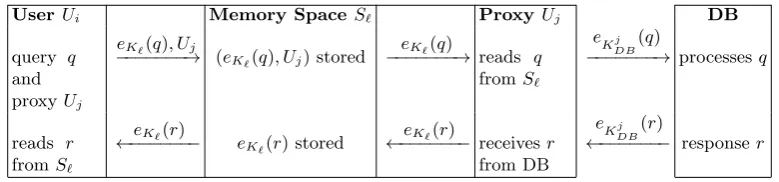
records in the memory spaceS`. We give a schematic of the information flow of a basic P2P UPIR
scheme in Figure 1.
2.1 Attack Model
We consider each type of player as a possible adversary A. We assume that A has full knowledge of the P2P UPIR scheme specification, including any public parameters, as well as any secret information assigned to A as part of the P2P UPIR scheme. In addition, we assume A does not conduct traffic analysis. The following definition will be useful.
Fig. 1.Schematic of Information Flow
User Ui Memory SpaceS` ProxyUj DB
query q
and proxyUj
eK`(q), Uj
−−−−−−−→ (eK`(q), Uj) stored
eK`(q)
−−−−−−−→ reads q
fromS`
eKj DB
(q)
−−−−−−−→ processesq
reads r
fromS`
eK`(r)
←−−−−−−− eK`(r) stored
eK`(r)
←−−−−−−− receivesr
from DB
eKj DB
(r)
←−−−−−−− responser
In addition to the above, we make the following assumptions about each specific type of adver-saryA:
– Suppose A is the database DB. As stated above, we assume that DB does not observe infor-mation being posted to or read from memory spaces. In addition, we assume that DB does not collaborate with any users and answers queries honestly. We note DB necessarily observes the content of all queries and the proxy of each query.
– Suppose A consists of a user or a subset of colluding users C ⊂ U. We assume users are honest-but-curious. Users in C can communicate outside of the given P2P UPIR scheme and collaborate using joint information. The users of C can see the content of any queries within
C’s query sphere, but cannot identify the original source of these queries.
– SupposeAis an external adversaryO. An external observerOcan see the encrypted content of memory spaces. We consider the possibility of key leakage as the main attack launched by O. This refers to a party gaining access to a memory space key outside of the P2P UPIR scheme specification (e.g., by social engineering or other means).
Although we do not specifically treat traffic analysis as an attack, we wish to avoid a trivial analysis of traffic entering and leaving a given memory space. That is, we assume that memory spaces have encryption and decryption capabilities, so that a user acting as a proxy may decrypt and re-encrypt a given query within its associated memory space, before forwarding the query to the database.
2.2 Privacy and Adversarial Goals in P2P UPIR
In considering the privacy guarantees for a userUi, we assume either the database DB or a group
of other users may try to determine whether Ui is the source of a given set of queries, or try to
establish whether or not a given set of queries originates from the same source. We will need the following definition:
Definition 2.2. We say two or more queries q1, q2, . . . arelinked if, given the subject matter, one
can infer that the queries are likely to be from the same source.
We also consider the possibility of an external observerOgaining information that compromises the privacy ofUi. We recognize the following goals for Ui’s privacy:
– Anonymity: the identity of a query source is protected;
– Untraceability: a user’s query history cannot be reconstructed as having originated from the same user;
– Pseudonymity in the presence of linked queries: given a set of linked queries, the identity of the source is protected.
We now analyze each type of adversary Awith respect to the above privacy goals:
– Suppose A is the database DB. We are not concerned with confidentiality against DB, but rather anonymity, untraceability, and pseudonymity in the presence of linked queries. The goal of the database is to create a profile of Ui. That is, the database would like to establish the set
of queries for which Ui is the source. The database also attempts to trace user query histories;
that is, DB would like to establish that a given set of queries came from the same source, even if DB cannot determine the identity of the source.
– SupposeAconsists of a user or a subset of colluding usersC⊂ U. The coalitionCcollaborates to try to determine the query history of another userUi∈/ C. Here we are interested in maintaining
anonymity, untraceability, and pseudonymity in the presence of linked queries against C. We are also interested in maintaining confidentiality, in the sense that C should not have access to the content of queries outside the query sphere for C.
– SupposeAis an external adversary O. The goal ofO is to compromise both the confidentiality and the anonymity ofUi. External adversaries may try to compromise the encryption mechanism
of the memory spaces.
We are now almost ready to consider the P2P UPIR protocols of Domingo-Ferrer, Bras-Amor´os et al. [2, 3], as well as the subsequent modification of Stokes and Bras-Amor´os [8, 9]. Both these protocols and ours, however, draw heavily from the field of combinatorial designs. In the next section, we introduce the requisite background knowledge on combinatorial designs.
3 Background on Designs
For a general reference on designs, we refer the reader to Stinson [7].
Definition 3.1. A set system is a pair (X, A) such that the following are satisfied: 1. X is a set of elements calledpoints, and
2. A is a collection (i.e., multiset) of nonempty proper subsets ofX calledblocks.
In the rest of this section, we abuse notation by writing blocks in the formabcinstead of{a, b, c}.
Definition 3.2. The degree of a point x ∈ X is the number of blocks containingx. If all points have the same degree,r, we say (X, A) is regular (of degree r).
Definition 3.3. The rank of (X, A) is the size of the largest block. If all blocks contain the same number of points, sayk, then (X, A) is uniform (of rankk). Note thatk < v.
Example 3.1. A covering design.
X ={1,2,3,4,5,6,7} andA={13,23,157,124,347,356,2567,14567}.
Definition 3.5. A pairwise balanced design (or PBD) is a set system such that every pair of distinct points is contained in exactly λblocks, where λ is a fixed positive integer. Note that any PBD is a covering design.
Example 3.2. A PBD with λ= 2.
X={1,2,3,4,5} and A={12,25,135,145,1234,2345}.
Definition 3.6. Let (X, A) be a regular and uniform set system of degree r and rank k, where |X|=v and |A|=b. We say (X, A) is a (v, b, r, k)-1 design.
Example 3.3. A (5,5,3,3)-1 design.
X ={1,2,3,4,5} and A={123,451,234,512,345}.
Definition 3.7. A (v, b, r, k, λ)-balanced incomplete block design (orBIBD) is a (v, b, r, k)-1 design in which every pair of points occurs in exactlyλblocks. Equivalently, a (v, b, r, k, λ)-BIBD is a PBD that is regular and uniform of degreer and rankk.
Example 3.4. A (10,15,6,4,2)-BIBD.
X={0,1,2,3,4,5,6,7,8,9} and
A={0123,0147,0246,0358,0579,0689,1258,1369,
1459,1678,2379,2489,2567,3478,3456}.
Definition 3.8. A (v, b, r, k)-configuration is a (v, b, r, k)-1 design such that every pair of distinct points is contained in at most 1 block.
Example 3.5. A (9,9,3,3)-configuration.
X={1,2,3,4,5,6,7,8,9}and A={147,258,369,159,267,348,168,249,357}.
Remark 3.1. A (v, b, r, k)-configuration withv=r(k−1) + 1 is a (v, b, r, k,1)-BIBD. A (v, b, r, k, 1)-BIBD with parameters of the form (n2+n+ 1, n2+n+ 1, n+ 1, n+ 1,1) is afinite projective plane of order n.
Definition 3.9. A symmetric BIBD is a BIBD in whichb=v. Remark 3.2. A projective plane is a symmetric BIBD.
Theorem 3.1. (Fisher’s Inequality) In any(v, b, r, k, λ)-BIBD, b≥v.
3.1 P2P UPIR using Combinatorial Designs
We model a P2P UPIR scheme using a combinatorial design. That is, we consider pairs (U,S) (where as before |U |=v and |S| =b ), such that each memory space, or block, consists of kusers and each user, orpoint, is associated withr memory spaces. That is, we assume that the pair (U,S) is a (v, b, r, k)-1 design.
We can also view the b memory spaces as points and define v blocks, each of which contains the memory spaces to which a given user belongs. This yields the dual design (S,U), which is a (b, v, k, r)-1 design.
4 Previous Work: Using Configurations
We briefly review the P2P UPIR scheme proposed by Domingo-Ferrer et al. [3] and the proposed modification of Stokes and Bras-Amor´os [9]. We fix a (v, b, r, k)-configuration (U,S). As before, we have a finite set of users U ={U1, . . . , Uv}, a database DB, and a finite set of memory spaces
S ={S1, . . . , Sb}.
Each user has access to rmemory spaces, and each memory space is accessible to kusers. Each memory space is encrypted via a symmetric encryption scheme; for each memory space, only thek
users assigned to that memory space are given the key. The following protocol [3] assumes the user
Ui has a query to submit to the database:
Protocol 1 Domingo-Ferrer–Bras-Amor´os–Wu–Manj´on (DBWM) Protocol We fix a(v, b, r, k)-configuration.
1. The user Ui randomly selects a memory spaceS` to which he has access
2. The user Ui decrypts the content on the memory sector S` using the corresponding key. His
behavior is then determined by the content on the memory space as follows: (a) The content is garbage. Then Ui encrypts his query and records it in S`.
(b) The content is a query posted by another user. Then Ui forwards the query to the database
and awaits the answer. When Ui receives the answer, he encrypts it and records it in S`. He
then restarts the protocol with the intention to post his query.
(c) The content is a query posted by the user himself. Then Ui does not forward the query to
the database. Instead Ui restarts the protocol with the intention to post his query.
(d) The content is an answer to a query posted by another user. Then Ui restarts the protocol
with the intention to post his query;
(e) The content is an answer to a query posted by the user himself. Then Ui reads the query
answer and erases it from the memory space. Subsequently Ui encrypts his new query and
records it in S`.
The modification proposed by Stokes and Bras-Amor´os [9] replaces 2c as follows:
Protocol 2 DBWM–Stokes (DBWMS) Protocol
20(c). If the content is a query posted by the user himself, then Ui forwards the query to the database
Remark 4.1. This protocol is ambiguous as stated by Stokes and Bras-Amor´os. The intent of the system is that users periodically run the protocol with “garbage” queries, in this way collecting the answers to their previous queries.
Stokes and Bras-Amor´os [8, 9] argue that the finite projective planes are the optimal configu-rations to use for P2P UPIR. Their argument is that privacy against the database is an increasing function ofr(k−1), since there arer(k−1) users in the anonymity set of any given userUi. That is,
the query profile ofUi is diffused amongr(k−1) other users in the neighborhood ofUi. Now, since r(k−1)≤v−1 in a configuration, the authors consider configurations satisfyingr(k−1) =v−1, which yield the finite projective planes. In our protocols, introduced in Section 5, we also have neighborhoods of maximum size, without limiting ourselves to configurations. We also ensure that the database DB has no advantage in guessing the identity of the source of any given query.
4.1 Attacks
We consider the privacy properties of the DBWM and DBWMS protocols with respect to the database, before offering an improved protocol in Section 5. We fix a (v, b, r, k)-configuration, where
v is the number of users and b is the number of memory spaces. We associate a block with each memory space, where the block consists of the users that have access to the memory space.
The weakness of the DBWM and DBWMS protocols lies in the possibility of a user’s query history being identifiable as originating from one user. That is, if a series of queries is on some esoteric subject, the adversary (such as the database) can surmise that the source of these queries is the same. As before, we refer to such queries aslinked.
Stokes and Bras-Amor´os [9] noticed a weakness in the DBWM protocol when a projective plane is used as the configuration, that is, when v = r(k−1) + 1. In this case, each user Ui has a
neighborhood consisting of all other users. Then, given a large enough set of linked queries, the only user who never submits one of these linked queries is the source, Ui. That is, the database
can eventually identify Ui as the source. Subsequent to our research, Stokes and Bras-Amor´os [10]
noted this weakness applies more generally to (v, k,1)-BIBDs.
We introduce another type of attack, which we call the intersection attack. This attack only applies to configurations satisfyingv > r(k−1) + 1, as it requires that all users have neighborhoods of cardinality less than v−1. The idea behind the intersection attack is that, given a query q1
submitted by proxy Uj, an attacker can, by analyzing the neighborhood of Uj, compute a list of
possible sources Q1. If the attacker has access to a set of linked queries q1, q2, . . . , qn, and the
neighborhoods of these users do not consist of all users in the system, the intersection of the possible source sets Q1, Q2, . . . , Qn can perhaps identify the source (or narrow down the list of
possible sources). We demonstrate this attack in the following example.
Example 4.1. Supposev = 12 andb= 8 and we have the following blocks (memory spaces): {U1, U2, U3} {U4, U5, U6} {U7, U8, U9} {U10, U11, U12}
{U1, U4, U7} {U2, U5, U10} {U3, U8, U11} {U6, U9, U12}
Note this is a (12,8,2,3)-configuration. We consider the DBWM protocol here; that is, we assume that the proxy of a given query is always different from the source of the query. Now suppose three queries are transmitted from users U2, U11, and U8.
– If the proxy is U11, then the source Ui∈ {U3, U8, U10, U12}.
– If the proxy is U8, then the sourceUi ∈ {U3, U7, U9, U11}.
Suppose that the subject of the queries is similar, so it can be inferred that the source of the three queries is probably the same user. Then it is easy to identify the source of the queries:
Ui ∈ {U1, U3, U5, U10} ∩ {U3, U8, U10, U12} ∩ {U3, U7, U9, U11},
soUi =U3. Clearly, user-privacy with respect to the database is not achieved here.
We do not claim that the above-described attack will always work for any configuration; it is easy to come up with examples where the attack does not work. For example, suppose that
N(Ui)∪ {Ui} = N(Uj)∪ {Uj} for two distinct users Ui and Uj. Then it would be impossible for
DB to determine whether Ui or Uj is the source of a sequence of linked queries. Independently of
this research, Stokes and Bras-Amor´os [10] noted that by choosing the configuration carefully, it is possible to ensure the neighborhood-to-user mapping is not unique, and to guarantee a specified lower bound on the number of possible users for a given neighborhood.
Observe that the intersection attack is not useful when one uses a finite projective plane as the configuration and users are allowed to submit their own queries. This follows because, at each stage of the intersection attack, the set of possible sources includes all users in the set system. In the next section, we formalize this observation and discuss the use of more general types of designs in P2P UPIR protocols that resist the intersection attack in a very strong sense.
5 Using More General Designs
As observed in Section 4, in order to achieve user-privacy with respect to the database, we need to allow users to sometimes transmit their own queries. We suggest a different solution to the problem than that given by Bras-Amor´os et al., however. In particular, we see no reason to limit the P2P network topology to configurations. Bras-Amor´os et al. indicate use of configurations as a method to increase service availability and decrease the number of required keys. Indeed, configurations were proposed as key rings in wireless sensor networks by Lee and Stinson [5] due to memory constraints of sensor nodes. However, storage constraints are not so much an issue in P2P UPIR. We therefore consider the possibility of using other types of designs.
We will make use of memory spaces that “balance” proxies for every source. We suggest to use a balanced incomplete block design (BIBD) for the set of memory spaces. We will show that these designs provide optimal resistance against the intersection attack.
Our scheme also differs from DBWMS in the treatment of proxies. In the previous schemes, the identity of a proxy was not specified by the source. Queries were simply forwarded to the database by whichever user had most recently checked the corresponding memory space. We propose that each source designates the proxy for each query. This enables us to balance the proxies for each possible source, thereby providing “perfect” anonymity with respect to the database. Moreover, we do not assume that each memory space holds only a single query; rather, we assume that memory spaces are capable of storing multiple queries.
Protocol 3 Proxy-designated BIBD Protocol (Version 1)
We fix a (v, b, r, k, λ)-BIBD. To submit a query, a user Ui uses the following steps:
2. Otherwise, user Ui chooses uniformly at random one of the r memory spaces with which he is
associated, sayS`, and then he chooses uniformly at random a user Uj ∈S`\{Ui}. Finally, user Ui requests that userUj act as his proxy using the memory spaceS`.
Protocol 4 Proxy-designated BIBD Protocol (Version 2)
We fix a (v, b, r, k, λ)-BIBD. To submit a query, a user Ui uses the following steps:
1. With probability 1/v, user Ui chooses to act as his own proxy. User Ui then writes the query
uniformly at random to one of the r memory spaces with which he is associated, and transmits his own query to DB.
2. Otherwise, user Ui chooses uniformly at random one of the r memory spaces with which he is
associated, sayS`, and then he chooses uniformly at random a user Uj ∈S`\{Ui}. Finally, user Ui requests that userUj act as his proxy using the memory spaceS`.
Remark 5.1. We note that Protocol 4 differs from Protocol 3 only in the first step.
Remark 5.2. We assume users check memory spaces regularly and act as proxies as requested within a reasonable time interval.
Remark 5.3. We make the assumption that, when a sourceUi requestsUj to be his proxy, everyone
in the associated memory space knows that this request has been made, but no one (except forUi)
knows the identity of the source.
Remark 5.4. The choice between Protocol 3 and Protocol 4 impacts the amount of privacy the scheme provides against other users. This will be discussed in Section 6.
We analyze the situation from the point of view of the database. For the rest of the paper, we let variables S,P,M be random variables for source, proxy, and memory space, respectively.
Theorem 5.1. From the point of view of the database, the Proxy-designated BIBD Protocols (Pro-tocols 3 and 4) satisfy Pr[S=Ui|P=Uj] = Pr[S=Ui] for allUi, Uj ∈ U.
Proof. First, the schemes ensure that Pr[P=Uj|S =Ui] = 1v for allUi, Uj. To see this, first note
that Ui will pick himself as the source with probability 1v. In Protocol 3, Ui will then submit his
query directly to the database. In Protocol 4, Ui will pick one of the r memory spaces with which
he is associated uniformly at random and then act as his own proxy. So in both cases, we have
Pr[P=Ui|S=Ui] =
1
v.
Then in both protocols, with probability v−v1, userUiwill pick a memory spaceS`(withUi∈S`)
uniformly at random, followed by a proxy Uj associated with S`. The probability that a fixed Uj
withi6=j will act as proxy can be computed as follows. For i6=j, we have
Pr[P=Uj|S=Ui] = v−1
v
X
S`:Ui,Uj∈S`
Pr[M=S`]Pr[P=Uj|M=S`]
= v−1
v
X
S`:Ui,Uj∈S`
1
r(k−1) =
v−1
v
λ r(k−1)
= 1
Similarly, we can see that Pr[P=Uj] = 1/v for all Uj ∈ U:
Pr[P=Uj] =
X
S`:Uj∈S`
Pr[M=S`]Pr[P=Uj|M=S`] = r bk =
1
v.
Now we have
Pr[S=Ui|P=Uj] =
Pr[P=Uj|S=Ui]Pr[S=Ui]
Pr[P=Uj]
= Pr[S=Ui]
so the identity of the proxy gives no information about the identity of the source.
We observe that this analysis is independent of any computational assumptions, so the security is unconditional. Since we have achieved a perfect anonymity property, it follows that no information is obtained by analyzing linked queries.
Example 5.1. To illustrate, consider a projective plane of order 2 with the following blocks: {U1, U2, U3} {U1, U4, U5} {U1, U6, U7} {U2, U4, U6}
{U2, U5, U7} {U3, U4, U7} {U3, U5, U6}
We note that this is a (7,3,3,3,1)-BIBD. Suppose that the first query uses block {U2, U4, U6}
with proxy U4, and the second query uses block {U2, U5, U7} with proxy U2. From the first query,
DB knows that one of three blocks were used:{U1, U4, U5},{U2, U4, U6}, or {U3, U4, U7}. However,
Pr[S =Ui|P =U4] = Pr[S =Ui] for all possible sources Ui, so DB has no additional information
about the identity of the source, given that P =U4. From the second query, DB knows that one
of three blocks were used:{U1, U2, U3},{U2, U4, U6}, or{U2, U5, U7}. Again, Pr[S=Ui|P =U2] =
Pr[S =Ui] for all possible sourcesUi, so DB has no additional information about the identity of the
source, given that P =U2. So even if DB suspects that both queries came from the same source,
he has no way to identify the source.
5.1 Extensions
We can consider using less structured designs than BIBDs, such as pairwise balanced designs or covering designs. It turns out that we can still achieve perfect anonymity with respect to DB, because our anonymity argument remains valid provided that Pr[P = Uj|S = Ui] = 1v for all Ui, Uj ∈ U.
We next give a generalized protocol based on an arbitrary covering design. That is, we do not require constant block sizek or constant replication numberr.
Protocol 5 Proxy-designated Covering Design Protocol (Version 1)
We fix a covering design. To submit a query, a user Ui performs the following steps:
1. User Ui chooses the designated proxy Uj uniformly at random. If Ui =Uj, thenUi submits his
query directly to DB and skips Step 2.
2. If Ui 6=Uj, then user Ui chooses uniformly at random one of the memory spaces that contains
Protocol 6 Proxy-designated Covering Design Protocol (Version 2)
We fix a covering design. To submit a query, a user Ui performs the following steps:
1. UserUi chooses the designated proxyUj uniformly at random. (The userUi may choose himself
as the proxy Uj.)
2. User Ui chooses uniformly at random one of the memory spaces that contains both Ui and Uj,
say S`. Then Ui requests that userUj act as his proxy using memory space S`.
Remark 5.5. If the covering design is a BIBD, then Protocol 5 is equivalent to Protocol 3 and Protocol 6 is equivalent to Protocol 4.
Remark 5.6. We must have a covering design to ensure that a suitable memory space S` always
exists in Step 2 of Protocols 5 and 6.
Remark 5.7. As in Protocols 3 and 4, we assume users check memory spaces regularly, and act as proxies as requested within a reasonable time interval. We also assume, as before, that when source
Ui requests that Uj 6= Ui be his proxy, everyone in the associated memory space knows that this
request has been made, but no one (except forUi) knows the identity of the source.
Theorem 5.2. From the point of view of the database, for a given query, the Proxy-designated Covering Design Protocols (Protocols 5 and 6) satisfy Pr[S = Ui|P = Uj] = Pr[S = Ui] for all Ui, Uj ∈ U.
Proof. Step 1 of both Protocol 5 and Protocol 6 ensures that Pr[P = Uj|S = Ui] = 1v for all Ui, Uj ∈ U. Similarly, we can see that Pr[P=Uj] = 1v for all Uj. We once again have
Pr[S=Ui|P=Uj] =
Pr[P=Uj|S=Ui]Pr[S=Ui]
Pr[P=Uj]
= Pr[S=Ui]
so the identity of the proxy gives no information about the identity of the source.
As before, we observe that this analysis is independent of any computational assumptions, so the security is unconditional. Since we have achieved a perfect anonymity property, no information is obtained by analyzing linked queries.
5.2 Dynamic P2P UPIR Schemes
One benefit of using less structured designs than BIBDs is that the scheme can be dynamic. That is, we can add and remove users, which allows greater flexibility in practice.
To delete a user Ui from Protocols 5 and 6, we simply remove Ui from all the memory spaces
with which he is associated. To avoid Ui from reading any more queries written to these memory
spaces, we also need a rekeying mechanism to update the associated keys. The same external entity that distributed the initial set of keys could be responsible for rekeying. The end result is a covering design with one fewer users than before.
To add a user Unew in Protocols 5 and 6, we may use the following method. We first find
M={Sh1, . . . , Sh`} ⊆ S such that Sh1 ∪ · · · ∪Sh` =U. That is, we need a set of memory spaces
Once we have identified a suitable set M, we simply add Unew to each memory space in M,
and give Unew the associated keys. In addition, we need a mechanism by which to inform all users
of Unew’s presence in the scheme. The resulting set system is still a covering design—one which
contains one more user than before.
6 Privacy Against Other Users
In this section, we consider our Protocols 3, 4, 5, and 6 in the context of analyzing user-privacy against other users. We remind the reader of Remarks 5.3 and 5.7: we assume that when a sourceUi
requests thatUj be his proxy, everyone in the associated memory space knows that this request has
been made, but no one (except forUi) knows the identity of the source. We now analyze the privacy
of a given user relative to other users of the scheme. As we will see, if we wish to provide privacy against other users, a design that has more structure than a general covering design becomes useful. In particular, we will observe that the use of a regular PBD (see Definition 3.5) in Protocols 5 and 6 is desirable.
It is helpful to begin with an example:
Example 6.1. Consider the projective plane from Example 5.1 and suppose we use Protocol 3. Suppose that user P =U4 is requested to make a query in memory space {U1, U4, U5} by source
S = U1. User U4 knows that the source must be U1 or U5 (since he did not make the request
himself). UserU5, however, knows that the source must beU1 because
1. U5 did not make the request himself, and
2. U4would not post a request to himself to transmit a query—he would just go ahead and transmit
it himself.
We can generalize the concept from Example 6.1. Observe that in Protocols 3 and 5, the requested proxy can rule out one possible source, and anyone else in the memory space (who is not the source) can rule out two possible sources. If we consider Protocols 4 and 6, then users can rule out only one possible source (namely, themselves). That is, Protocols 4 and 6 improve the information theoretic privacy guarantees of the scheme with respect to the viewpoint of other users. However, we remark that in these versions, when a source acts as his own proxy, other users associated with the chosen memory space can see the content of the query. In Protocols 3 and 5, if a userUi is both the source and proxy of a given query, thenUi is the only user who sees the content
of that query. Hence it may still be desirable to use Protocols 3 and 5, if additional confidentiality is required.
An interesting related question is, when a particular userUtsees a queryqposted to the memory
spaceS` that is not his own, whether or notUthas a probabilistic advantage in guessing the source
of q. The following theorems show that, in order to minimize any such advantage, it is helpful to use a regular PBD in our protocols.
Theorem 6.1. Let (X, A) be a regular PBD of degree r. Assume (X, A) is used in the Proxy-designated Covering Design Protocol (Protocol 5) and assume that Pr[S=Ui] = 1v for all Ui ∈ U.
Suppose Ut ∈ S` sees a query q posted to S` that is not his own. Then, from the point of view of Ut, for a given queryq andUi, Uj ∈S` such thati6=t, it holds that
Pr[S=Ui|M=S`,P=Uj] =
0 if i=j
1
Proof. We first note that the protocol definition ensures that when i=j, we have Pr[S=Ui|M= S`,P=Uj] = 0.
We now consider the case i6=j. We set λij =|{Sq|Ui, Uj ∈Sq}|=λ. Thus, we have
Pr[M=S`,P=Uj|S=Ui] = Pr[M=S`|P=Uj,S=Ui]Pr[P=Uj|S=Ui]
= 1
λijv
= 1
λv.
Then because i6=t, j, we have Pr[S=Ui] = v−12 and
Pr[S=Ui|M=S`,P=Uj] =
Pr[S=Ui]Pr[M=S`,P=Uj|S=Ui]
Pr[M=S`,P=Uj]
= P Pr[S=Ui]Pr[M=S`,P=Uj|S=Ui]
Uh∈S` h6=t,j
Pr[S=Uh]Pr[M=S`,P=Uj|S=Uh]
=
1
v(v−2)λ
P
Uh∈S` h6=t,j
1
v(v−2)λ
= 1
|S`| −2 ,
as desired.
Theorem 6.2. Let (X, A) be a regular PBD of degree r. Assume (X, A) is used in the Proxy-designated Covering Design Protocol (Protocol 6) and assume that Pr[S=Ui] = 1v for all Ui ∈ U.
Suppose Ut ∈ S` sees a query q posted to S` that is not his own. Then, from the point of view of Ut, for a given queryq andUi, Uj ∈S` such thati6=t, it holds that
Pr[S=Ui|M=S`,P=Uj] =
( λ
λ+r(|S`|−2) if i=j r
λ+r(|S`|−2) if i6=j.
Proof. We first calculate Pr[M = S`,P = Uj|S = Ui], where Ui ∈ S`. We again set λij =
|{Sq|Ui, Uj ∈Sq}|. Since (X, A) is a PBD of degreer, we have
λij =
r ifi=j λ ifi6=j.
We have
Pr[M=S`,P=Uj|S=Ui] = Pr[M=S`|P=Uj,S=Ui]Pr[P=Uj|S=Ui]
=
1
λij
1
v
Then because i6=t, we have Pr[S=Ui] = v−11 and
Pr[S=Ui|M=S`,P=Uj] =
Pr[S=Ui]Pr[M=S`,P=Uj|S=Ui]
Pr[M=S`,P=Uj]
= P Pr[S=Ui]Pr[M=S`,P=Uj|S=Ui]
Uh∈S` h6=t
Pr[S=Uh]Pr[M=S`,P=Uj|S=Uh]
=
1
v(v−1)λij
P
Uh∈S` h6=t
1
v(v−1)λhj
= 1
λij
1
r+ |S`|−2
λ
,
which yields the desired result.
Remark 6.1. Theorems 6.1 and 6.2 apply to Protocols 3 and 4, respectively, since a BIBD is also a PBD that is regular of degree r.
Theorems 6.1 and 6.2 demonstrate that the use of a regular PBD increases privacy against other users. This is because, from the point of view of another user, the possible source distribution is closer to uniform.
Theorem 6.1 implies that forUt∈S`, ifUtsees a queryqwith proxyUj posted toS` that is not
his own, any of the remaining|S`| −2 users in S` are equally likely to be the source. If Protocol 6
is used instead of Protocol 5, then Ut can no longer completely eliminate the possibility of the
proxy Uj being the source. However, as Theorem 6.2 shows, the likelihood of the proxyUj being
the source is not the same as the likelihood ofUi 6=Uj being the source. Indeed, it is far less likely
that Uj is acting as both proxy and source forq in this situation. Intuitively, if a userUi is acting
as both source and proxy, he hasr possible memory spaces to choose from, whereas if Ui chooses
another user Uj as proxy, he has onlyλmany memory spaces to choose from.
6.1 Linked Queries and Coalitions of Users
Users can also launch an intersection attack against a series of linked queries, similar to the inter-section attack launched by DB against the DBWM and DBWMS protocols (Protocols 1 and 2). The difference here is that users have access to the content of queries via the shared memory spaces; that is, users of a given memory space know which queries have been posted to that memory space, whereas the database only knows the identity of the proxy.
Example 6.2. Consider the projective plane from Example 5.1 and suppose we use Protocol 4. Suppose that U1 is the source of two linked queries, where the first query uses memory space
{U1, U2, U3}and the second query uses memory space{U1, U4, U5}. Now suppose that usersU2 and
U5 collude. From the first query, userU2 knows thatUi ∈ {U1, U3} (regardless of the proxy). From
the second query, userU5 knows thatUi ∈ {U1, U4} (regardless of the proxy). If users U2 and U5
collude, then they can identify U1 as the source.
Definition 6.1. Consider a set ofρlinked queries and fix a maximum coalition sizec. If there are always at least κ users who could possibly be the source (regardless of the queries and coalition) then we say that the scheme provides (ρ, c, κ)-anonymity.
Remark 6.2. Of course we wantκ≥2 because the source might be identified if κ= 1.
First, we consider security against a single user (i.e., the case c= 1). Here, it is advantageous to use a design withλ= 1:
Lemma 6.1. Suppose the BIBD chosen for Protocol 4 satisfiesλ= 1. Then we achieve(ρ,1, k− 1)-anonymity for any ρ.
Proof. If Ui sees a sequence of ρ linked queries from the same source, the queries must all involve
the same memory space, becauseλ= 1. The result then follows from Theorem 6.2.
Remark 6.3. The result of Lemma 6.1 does not apply to Protocol 3. This is because in Protocol 3, given a series of linked queries posted to a given memory space, the only user who will never act as proxy for one of these queries is the query issuer. This is similar to the projective plane attack in [9] that we mentioned in Section 4.1.
On the other hand, the security of Protocol 4 against a single user might be completely elim-inated if we use a design with λ > 1. For example, suppose we use a BIBD withλ = 2 in which every pair of blocks intersects in at most two points (such a BIBD is termedsupersimple). Consider two users Ui and Uj. There exist two memory spaces, say S1 and S2, where S1∩S2 = {Ui, Uj}.
Suppose Ui observes two linked queries, say q1 and q2, that involve S1 and S2, respectively. Then
Ui can deduce thatUj is the source.
We now consider some more special cases of this problem, for small values of ρ and for certain special types of designs. This is because, in order to analyze the problem of linked queries, it becomes necessary to understand the block intersection properties of the scheme’s chosen design. In Section 6.2, we consider a more general approach to mitigate this type of attack in the Proxy-designated Covering Design Protocols (Protocols 5 and 6).
The case ρ= 1 (i.e., security against a single query) is easy to analyze:
Lemma 6.2. We achieve (1, c, k−c−1)-anonymity in Protocol 3, wherec≤k−3. In Protocol 4, we achieve (1, c, k−c)-anonymity, with the requirement thatc≤k−2.
Proof. We first consider Protocol 3. LetCbe a coalition of size at mostcand letSh be the memory
space used for the query q1. Then |C∩Sh| ≤ c. C can rule out as possible sources the users in C∩Sh as well as the proxyUj (provided thatUj 6∈C∩Sh). Since|Sh\(C∪ {Uj})| ≥k−c−1, the
result follows. An obvious requirement here is c≤k−3.
For Protocol 4, all other users with access to the given memory space can only eliminate them-selves as the possible source of the query. This improves the information theoretic security for user-privacy against other users, as we now have |Sh\C| ≥k−c. An obvious requirement here is c≤k−2.
For the case ρ= 2, we consider BIBDs with a special intersection property.
Lemma 6.3. Suppose the BIBD of Protocols 3 and 4 satisfies the additional property that any two blocks intersect in at least µ points. Consider two linked queries, q1 and q2. Then we achieve
Proof. Let C be a coalition of size at most c and let Sh1 be the memory space used for the query
q1 and Sh2 be the memory space used for q2. LetUi be the proxy for q1 and let Uj be the proxy
forq2.
In Protocol 3, we have
|(Sh1\(C∪ {Ui}))∩(Sh2\(C∪ {Uj}))|=|(Sh1 ∩Sh2)\(C∪ {Ui, Uj})| ≥µ−c−2,
so we achieve (2, c, µ−c−2)-anonymity. An obvious requirement here isc≤µ−4. In Protocol 4, we have
|(Sh1\C)∩(Sh2\C)|=|(Sh1 ∩Sh2)\C| ≥µ−c,
so we achieve (2, c, µ−c)-anonymity. Here, an obvious requirement is c≤µ−2.
We can apply Lemma 6.3 to the case of a symmetric BIBD, in which any two blocks intersect in exactlyλpoints, as noted in Theorem 3.2. This achieves the following result:
Corollary 6.1. Suppose the BIBD chosen for Protocols 3 and 4 is a symmetric(v, v, k, k, λ)-BIBD. Then Protocol 3 provides (2, c, λ−c−2)-anonymity for any c ≤ λ−4 and Protocol 4 provides (2, c, λ−c)-anonymity for any c≤λ−2.
An interesting extension to the concept of (ρ, c, κ)-anonymity is to consider an average-case analysis of privacy against other users. With (ρ, c, κ)-anonymity, we are analyzing the worst-case scenario—the minimum level of privacy the scheme achieves againstany possible coalition. While this is useful in some respects, schemes exhibiting powerful worst-case scenario attacks might actu-ally perform quite well against a typical coalition. In particular, if a scheme needs to be concerned about random coalitions of users, such an average-case analysis might prove informative, as the following example shows.
Example 6.3. Suppose we use a symmetric (v, v, k, k,3)-BIBD in any of our P2P UPIR protocols. Consider linked queriesq1 andq2 submitted byUi, with corresponding memory spacesSh1 andSh2.
By Theorem 3.2, since the BIBD is symmetric, we have |Sh1∩Sh2|= 3. That is, there are exactly
two other users, sayUj andUt, in bothSh1 andSh2. This implies that there is onlyone coalition of
users of size 2 that can identifyUi as the source. If we consider random coalitions, the probability
that a random coalition of size 2 consists of {Uj, Ut} is
1
v−1 2
.
Let us consider other coalitions of size 2. SupposeC ={Uj, U`}, for some userU` 6=Ut, Ui. Then Cknows the source is eitherUtorUi. There arev−3 such coalitions. The analysis forC containing Ut but notUj is similar. If we considerC={U`, U`0} such thatUt, Uj ∈/ C, the most advantageous coalition satisfies (without loss of generality)U` ∈Sh1,U`0 ∈Sh2. In this case, C sees both q1 and
q2 and can conclude that the source is one of {Ui, Uj, Ut}. There are (k−3)2 such coalitions. Other
coalitions of size 2 either see only one of {q1, q2}, in which case the analysis reduces to that of
Theorem 6.1 or 6.2, or neither of the linked queries, in which caseC can do nothing.
6.2 Some Methods to Increase Privacy
queries. In particular, it becomes difficult to analyze the case of intersections of three or more memory spaces, and the size of these intersections probably decreases quickly. We might, however, wish to provide privacy for ρ > 2. One possible solution is to introduce the notion of built-in permanent anonymity sets for each user. That is, suppose the set of users U is partitioned into anonymity sets T1, . . .Tg, where each T` consists of at leasttusers. We further assume that the set system satisfies the property T`∩Sj ∈ {∅,T`} for all `, j. We call such a construction a covering
design with t-anonymity sets.
Theorem 6.3. Fix a partition T ={T1, . . .Tg}of the set of users U, such that each T` consists of at least t users. Then we can construct a covering design with t-anonymity sets.
Proof. We can construct a covering design with t-anonymity sets by the following method. First, we construct a covering design on a set ofgpoints, sayX ={x1, . . . , xg}. We then define a bijection σ between the set of g points and the g anonymity sets, so σ(X) = T. Finally, for each x` ∈ X,
we replace the point x` by the anonymity set σ(x`) =T`0, where 1≤`0 ≤g. This yields a covering design satisfying the desired property.
Theorem 6.4. Fix a covering design with permanent anonymity sets of minimum size t. Then we achieve (ρ, c, t−c−ρ)-anonymity in Protocol 5 and (ρ, c, t−c)-anonymity in Protocol 6:
Proof. LetC be a coalition of size at mostcand consider a set of linked queries q1, . . . , qρ. LetSh`
be the memory space used for the query q` and let Uh` denote the proxy for q`, for 1≤`≤ρ.
In Protocol 5, we have
|(Sh1\(C∪ {Uh1}))∩(Sh2\(C∪ {Uh2}))∩ · · · ∩(Shρ\(C∪ {Uqρ}))|
=|(Sh1 ∩Sh2∩ · · · ∩Shρ)\(C∪ {Uh1, Uh2, . . . , Uhρ})| ≥t−c−ρ.
In Protocol 6, we have
|(Sh1\C)∩(Sh2\C)∩ · · · ∩(Shρ\C)|=|(Sh1 ∩Sh2∩ · · · ∩Shρ)\C| ≥t−c.
This completes the proof.
The idea of using permanent anonymity sets changes the trust requirements of the scheme. In particular, Ui must trust the users contained in Ti to a greater extent than users in U \Ti, since
members of Ti necessarily have access to Ui’s query sphere. That is, there is no confidentiality
among members of an anonymity set.
Query hops Another possible method to increase privacy against other users, which we briefly introduce here, involves the introduction ofquery hops into the protocols. That is, we can consider allowing a designated proxy to rewrite a given query to another memory space, rather than simply forwarding the query to DB. We can establish a probabilistic approach, such that a designated proxy Uj will, with some fixed probability p, forward the query to DB; otherwise Uj rewrites the
7 Conclusion
In this paper, we have given an overview and analysis of current research in UPIR, including introducing an attack by the database on user privacy. We have established a new model for P2P UPIR and considered the problem of user privacy against other users in detail, going well beyond previous work. We have given two new P2P UPIR protocols and provided an analysis of the privacy properties provided by these protocols. Our P2P UPIR schemes, by taking advantage of the wide variety of available combinatorial designs, provide flexibility in the set-up phase, allowing for a choice between having a dynamic scheme (in which users are permitted to enter and leave the system), or providing increased privacy against other users. Finally, we have pointed out several directions for future research in this area. In particular, there is much work to be done regarding user privacy against other users, such as moving beyond the worst-case analysis we provide here and considering an average-case analysis, as well as the construction of P2P UPIR schemes that utilize query hops to mitigate loss of privacy against other users.
Acknowledgements
We would like to thank the referees for their helpful remarks and suggestions.
References
1. J. Domingo-Ferrer,Coprivacy: towards a theory of sustainable privacy, in Proceedings of the 2010 International Conference on Privacy in Statistical Databases (PSD 2010), LNCS,6344(2010), 258–268.
2. J. Domingo-Ferrer and M. Bras-Amor´os, Peer-to-peer user-private information retrieval, in Proceedings of the 2008 International Conference on Privacy in Statistical Databases (PSD 2008), LNCS,5262(2008), 315–323. 3. J. Domingo-Ferrer, M. Bras-Amor´os, Q. Wu and J. Manj´on,User-private information retrieval based on a
peer-to-peer community, Data & Knowledge Engineering,68(2009), 1237–1252.
4. M. Garey and D. Johnson, “Computers and Intractability: A Guide to the Theory of NP-Completeness,” W. H. Freeman, 1979.
5. J. Lee and D. Stinson,A combinatorial approach to key predistribution for distributed sensor networks, in Wireless Communications and Networking Conference (WCNC 2005), IEEE,2(2005), 1200–1205.
6. A. Pfitzmann and M. Hansen,A terminology for talking about privacy by data minimization: anonymity, unlink-ability, undetectunlink-ability, unobservunlink-ability, pseudonymity, and identity management, version 0.34, 2010. Available from: http://dud.inf.tu-dresden.de/literatur/Anon Terminology v0.34.pdf.
7. D. Stinson, “Combinatorial Designs: Constructions and Analysis,” Springer-Verlag, 2003.
8. K. Stokes and M. Bras-Amor´os,Optimal configurations for peer-to-peer user-private information retrieval, Com-puters and Mathematics with Applications,59(2010), 1568–1577.
9. K. Stokes, and M. Bras-Amor´os,On query self-submission in peer-to-peer user-private information retrieval, in Proceedings of the 4th International Workshop on Privacy and Anonymity in the Information Society (PAIS 2011), ACM (2011).