Proofs of Ownership in Remote Storage Systems
∗
Shai Halevi
1, Danny Harnik
2, Benny Pinkas
3, and Alexandra Shulman-Peleg
2 1IBM T. J. Watson Research Center,2IBM Haifa Research Lab,3Bar Ilan UniversityAbstract
Cloud storage systems are becoming increasingly popular. A promising technology that keeps their cost down isdeduplication, which stores only a single copy of repeating data.Client-side dedu-plicationattempts to identify deduplication opportunities already at the client and save the bandwidth of uploading copies of existing files to the server.
In this work we identify attacks that exploit client-side dedu-plication, allowing an attacker to gain access to arbitrary-size files of other users based on a very small hash signatures of these files. More specifically, an attacker who knows the hash signature of a file can convince the storage service that it owns that file, hence the server lets the attacker download the entire file. (In parallel to our work, a subset of these attacks were recently introduced in the wild with respect to the Dropbox file synchronization service.)
To overcome such attacks, we introduce the notion of proofs-of-ownership (PoWs), which lets a client efficiently prove to a server that that the client holds a file, rather than just some short infor-mation about it. We formalize the concept of proof-of-ownership, under rigorous security definitions, and rigorous efficiency require-ments of Petabyte scale storage systems. We then present solutions based on Merkle trees and specific encodings, and analyze their security. We implemented one variant of the scheme. Our perfor-mance measurements indicate that the scheme incurs only a small overhead compared to naive client-side deduplication.
Keywords:Cloud storage, Deduplication, Merkle trees, Proofs of ownership.
1.
Introduction
Cloud computing provides a low-cost, scalable, location-independent infrastructure for data management and storage. The rapid adoption of Cloud services is accompanied by increasing volumes of data stored at remote servers, so techniques for saving disk space and network bandwidth are needed. A central up and coming concept in this context isdeduplication, where the server stores only a single copy of each file, regardless of how many clients asked to store that file. All clients that store the file merely use links to the single copy
∗The work of Benny Pinkas was supported by the SFEROT project funded
by the European Research Council (ERC). The work of Danny Harnik and Alexandra Shulman-Peleg has received funding from the European Com-munity’s Seventh Framework Programme (FP7/2007-2013) under grant agreement n 257019.
[Copyright notice will appear here once ’preprint’ option is removed.]
of the file stored at the server. Moreover, if the server already has a copy of the file, then clients do not even need to upload it again to the server, thus saving bandwidth as well as storage (this is termed client-side deduplication). Reportedly, business applications can achieve deduplication ratios from 1:10 to as much as 1:500, result-ing in disk and bandwidth savresult-ings of more 90% [8]. Deduplication can be applied at the file level or at the block level, and this paper focuses on file-level deduplication. (Block-level deduplication is discussed briefly in Section 6.)
In a typical storage system with deduplication, a client first sends to the server only a hash of the file and the server checks if that hash value already exists in its database. If the hash is not in the database then the server asks for the entire file. Otherwise, since the file already exists at the server (potentially uploaded by someone else), it tells the client that there is no need to send the file itself. Either way the server marks the client as an owner of that file, and from that point on there is no difference between the client and the original party who has uploaded the file. The client can therefore ask to restore the file, regardless of whether he was asked to upload the file or not.
Harnik et al. observed recently that client-side deduplication in-troduces new security problems [13]. For example, a server telling a client that it need not send the file reveals that some other client has the exact same file, which could be a sensitive information. The findings in [13] apply to popular file storage services such as MozyHome and Dropbox, among others.
A New Attack. The starting point of this work is a much more direct threat to storage systems that use client-side deduplication across multiple users. Specifically, by accepting the hash value as a “proxy” for the entire file, the server allows anyone who gets the hash value to get the entire file. Consider for example the following case: Bob is a researcher who routinely publishes hashes of his lab reports, as a time-stamp for the results of his research. Bob is also careful to daily backup his hard disk to an online file storage service. Alice is interested in learning the results of Bob’s research. She signs up to the same storage service, asks to backup a file, and when asked to present its hash value she presents the value that was published by Bob as a time-stamp for his file. The service forgoes the upload, and just makes note that Alice and Bob uploaded the same file. Later on, Alice asks to recover that file and the service complies, sending her a copy of Bob’s lab report.
The problem illustrated above stems from the fact that by learn-ing just a small piece of information about the file, namely its hash value, an attacker is able to get the entire file from the server. This extra piece of information is not really meant to be secret, and in fact it must be computable from the file via a deterministic public algorithm which is shared by all clients.
this solution is still unsatisfactory, in that it does not address the root cause of the attack: There is still a very short piece of informa-tion that represents the file, and an attacker that learns that piece of information can get access to the entire file. Although we plugged one avenue by which the attacker was able to get this piece of in-formation, there could be others.
Potential Attacks
Below we list some plausible attack scenarios, supporting our main point that representing a large file by a small piece of “not really secret” information is a bad idea. Some of the attacks were demon-strated against popular storage services.
Usage of a common hash function. This is essentially the attack described in the previous example, where the deduplication system uses a standard hash function in a straightforward manner. (It was recently reported that Dropbox uses SHA256 for this purpose [1].) In that case it is plausible that an attacker can get hold of the hash values of files owned by other users (e.g., if these hash values are used elsewhere or the user publishes a signature on the file).
Using the storage service as an unintended CDN. In this sce-nario, Alice the attacker uploads a copy of a (potentially huge, and possibly copyright infringing) file to the storage server and pub-lishes the hash of that file (e.g., on her web page). Now anyone wishing to obtain the file can attempt to upload it to the storage service, present the hash value to the service and be identified as owning that file, and then ask to restore the file from the storage service. Hence Alice essentially uses the storage service as a con-tent distribution network(CDN). This behavior may run afoul with the business model of that storage server, which is likely to be de-signed to support many uploads but very few restore operations. This behavior might also support piracy and copyright infringing behavior.
Server break-in. Consider an attacker that is able to temporarily compromise a server machine, getting access to its internal cache, which includes the hash values for all the recently accessed files. Having obtained this (relatively small) piece of information, the attacker is now able to download all these files, which may include confidential files of others. The attacker can even publish these hash values, thus enabling anyone in the world to get these files.
Note that it is unlikely that the attacker can use a short compro-mise event to actually download all the large files themselves, but the server cache may be many orders of magnitude smaller. Further, note that even if the server learns about the attack early on, there is not much that it can do about it. The only effective remedy that it has is to turn off client side deduplication for the affected files, essentially “forever.”
Malicious client software. A similar attack to the above attack is also possible on the client side. For example, Alice the attacker can install malicious software on the machine of Bob the victim. The malicious software can use a very low-bandwidth covert channel to send to Alice the hash of interesting files, thus enabling Alice to get the file itself from the server. (In fact, in [13] it was shown how to use the deduplication service itself as a low bandwidth covert channel. The attack described here can amplify this covert channel and enable the leakage of much larger amounts of data.)
As opposed to the malicious software stealing Bob’s access password to the storage server, the hash-based attack works no matter how well Bob protects his credentials (e.g., even if Bob uses an external device or some TPM-based scheme to authenticate to the server). Further, the usage of a stolen password can be identified by Bob checking his account login audit files. A hash based attack cannot be easily tracked since the attacker pose as legitimate users who happen to upload the same files as Bob.
In one variant of this attack, the software temporarily copies a file on Bob’s machine to a directory whose contents are routinely backed up online, wait for a backup operation, then delete the file from that directory. Online storage services typically keeps deleted files for a at least 30 days, giving Alice ample opportunity to recover the file with very little chance for Bob to trace how the leak happened.
The attack can be amplified even further in the following way. The examination of Dorredorf and Pinkas [7] revealed that the client software of several file storage services, including Dropbox, stores local unencrypted manifest files, written in SQLite format. These files include an entry for each file stored by the service, which includes the hash value of the file. A malicious software can leak to Alice the hash value of this file itself. Alice can use this value to recover the manifest file, and then use the hash values stored in the manifest file to recover all files stored by Bob. The implication is that a leakage of a short hash value, which is either 20 or 32 byte long (depending on the service), leaks all of Bob’s files, in a way which is essentially undetectable.
Accidental leakage. Even without malicious software, when a short value is used to represent a big file there always exists a risk of it leaking (e.g., by swapping the value into disk via storage-area network, storing that value in a “control file” that may be left behind in a directory, etc.) If many clients have the same file (e.g., a department-wide document), it may become quite likely that one of them will accidentally leak the short summary of that document, thus allowing unauthorized access to it via the storage service.
Implementations of the attack
We stress that the attacks that we describe are not just theoreti-cal. Independently of our work, the attack was very recently dis-covered by Wladimir van der Laan, who started an open-source project called Dropship that uses the Dropbox storage servers as a CDN. The Dropship project was withdrawn after Dropbox had asked “in a really civil way” that its creator take down the source code, since they “felt that it is a violation of the TOS (Terms of Service)” [1, 18].1This attack against Dropbox, as well as a simi-lar attack that was implemented against another major file storage service, was also discovered and implemented by Dorrendorf and Pinkas [7]. (The name of the second service is withheld since the relevant company has not yet been notified.). Another recent and in-dependent implementation of the attack on Dropbox was described by Mulazzani et al. [16].
Effect on Open APIs for Remote Storage. Given the many av-enues, described above, for the attacker to get hold of the hash val-ues of files, it is clear that using only a small hash as a proxy for a large file is a security vulnerability in systems that use client-side deduplication. This vulnerability must be addressed before we can attempt to create open APIs for remote-storage that support client-side deduplication, since such APIs have to be usable in environ-ments that are sensitive to some of the attacks above. We thus view a solution to this problem as an enabler for the creation of advanced open storage APIs.
1.1 Proofs of Ownership (PoWs)
To solve the problem of using a small hash value as a proxy for the entire file, we want to design a solution where a client proves to the server that it indeed has the file. We call a proof mechanism that
1It is interesting to note that even though the Dropbox service allows its
prevents such leakage amplification aproof of ownership(PoW). We note that this is somewhat similar to proofs of retrievability (PORs) [14, 17] and proofs of data possession (PDPs) [3] with a role reversal (the client is the prover rather than the server). However, this role reversal between client and server is significant, and in particular the advanced POR and PDP protocols in the literature are inapplicable in our setting, see more discussion in Section 1.3.
Some important requirements that constrain the solution in our setting are discussed next:
Public hash function. To support cross-user deduplication, all clients must use the same procedure for identifying duplicate files. Hence this procedure must bepublic(since it is implemented in every client), which means that a determined attacker can learn it.
Bandwidth constraints.The protocol run between the server and client must bebandwidth efficient. Specifically, it must consume a lot less bandwidth than the size of the file (otherwise the client could just send the file itself to the server).
Server constraints. The server typically has to handle a huge number of files. (For example, Mozy reports storing more than 25 Petabytes of data.) The files themselves are stored on a secondary storage with a large access time, and the server can store only a small amount of data per file in fast storage (such as RAM). Moreover, the server cannot afford to retrieve the file or parts of it from secondary storage upon every upload request. The solution must therefore allow the server to store only an extremelyshort information per file, that will enable it to check claims from clients that they have that file, without having to fetch the file contents for verification.
Client constraints.The client should be able to efficiently prove to the server that it knows the file in question. This could be hard, e.g., if the file is very large and does not fit in local memory. We therefore seek a solution where the client can compute the proof by making asingle passover the file (and using a reasonable amount of memory).
On the other hand, during the computation of the proof there should beno very-short statefrom which the proof can be com-puted. Otherwise the very-short state itself can serve as a proxy for the large file, and the system will remain vulnerable to some of the atacks above.
1.1.1 Our security definition
For security we want to ensure that as long as the file has a lot of min-entropy (from the attacker’s perspective), the attacker has only a small chance of convincing the server. We stress that in many cases, an attacker may have somepartial informationabout the file, e.g., it may know the format of the file, its language, or the contents of large portions in the file. Hence we require security even when the entropy of file (from the attacker’s perspective) is much smaller than the file length, as long as there are still a lot of uncertainty left in the file.2
Defining what it means for the file to have a lot of min-entropy from the attacker’s perspective turns out to be somewhat subtle. The formal definition roughly follows the CDN/malicious-software attack scenarios. Specifically, we consider an attacker that does not know all of the file, but has accomplices who have the file. The accomplices can interact with the storage server, and can help the attacker in arbitrary ways, subject to only two constraints. One constraint is that the total number of bits that the accomplices send to the attacker is much smaller than the initial min-entropy of the file (hence the file still has a lot of min-entropy even after all
2Note that the security also holds for computational notions of entropy, e.g.,
even if the adversary holds an encrypted version of the file.
that communication). The other constraint is that the accomplices can only help the attacker during an off-line phase before the proof protocol begins, since otherwise the attacker could just relay messages back and forth between the server and an accomplice who has the file. (The no-man-in-the-middle restriction seems justified in many of the attack scenarios from above.) This formulation can be viewed as an instance of the “bounded retrieval model” [6, 9].
1.2 Our Solutions
In this work we consider a few different formal formulations of the intuitive requirement above and associated protocols that realize them. The first solution is the most stringent in terms of security, but lacks in efficiency (mainly of computation time and memory requirements). The next solutions two solutions each improve on these aspects at the cost of relaxations on the security guarantees.
A general solution. Our most stringent security requirement says that as long as the min-entropy in the original fileminus the number of bits sent to the adversary by the accomplicesis more than the security parameter, the adversary should not be able to convince the server that it has the file (except with insignificant probability). This notion can be achieved by adopting the Merkle-tree-based proof-of-retrievability protocol. Namely, we first encode the file using an erasure code, such that it is possible to recover the whole file from any (say) 90% of the encoded bits. We then build a Merkle tree over the encoded file, and have the server ask for a super-logarithmic number of leaves, chosen at random.
From the properties of the erasure code, if the adversary is missing any of the file then there are at least 10% of the leaves that it does not know. Moreover, if the file has high min-entropy from the adversary’s perspective then it cannot even guess the value of these 10% leaves with any noticeable chance for success. Hence, it will be caught with overwhelming probability.3 This solution is described in Section 3.
A more efficient solution using universal hashing. The above solution is not as efficient for the client as we would like. First, computing the erasure code requires random access to bits of the file, hence for large files that do not fit in RAM it entails too many disk accesses. Also, the server must ask for a number of leaves which is super-logarithmic in the security parameter, which means that the communication complexity of the proof protocol is ω(klogklogn)for ann-leaf tree and security parameterk.
We therefore seek more efficient protocols, even at the price of settling for a somewhat weaker form of security. Specifically, we relax our security requirement by having an upper-thresholdT such that if the attacker getsTbits from its accomplices then it is allowed to convince the prover (even ifT is much smaller than the entropy of the file). This allows us to have a mechanism in which the client only needsO(T)bits of internal memory in order to process the file, even if the file itself is much larger, and the communication in the protocol depends (polylogarithmically) onT and not on the size of the file. In realistic scenarios, we may get adequate security by settingT to be a rather large value (but not huge), e.g., 64 MByte. With this relaxation, a good solution would be to use universal hashing to hash the potentially large file into areduction bufferof size at most 64MByte, and then implement the Merkle-tree protocol on the hashed values. This solution is described in Section 4.
3Without erasure codes, an adversary could have very high success
A streaming scheme and implementation The more efficient so-lution can be implemented with reasonable memory, but univer-sal hashing with such large output size is very expensive to com-pute. We, thus, optimize for a more practical solution for which we can still offer meaningful security analysis, albeit under some restrictions. We may argue that in realistic settings the input distri-bution (from the attacker’s perspective) is not arbitrary, but rather is taken from a specific class of distributions. Specifically, these distributions capture cases in which there are parts of the file that the attacker may know and other parts that are essentially ran-dom. We formulate this condition (which is a generalization of “block-fixing” distributions), and describe a protocol that can be proved secure for this class of input distributions. Roughly speak-ing, for these common input distributions we can replace the uni-versal hashing with a procedure that generates a good erasure code over the reduction buffer.
We stress that it is impossible to verify experimentally the as-sumption about the input distribution, since it is an asas-sumption about the view of an attacker. Still it seems a reasonable assumption to make in many settings (e.g., even files in a known format contain some file specific information that is essentially random, see exam-ples in Section 2.2.1). We also stress that we do not know of any efficiently computable input distributions under which there is an attack on our streaming scheme. It is interesting to either prove that no such distributions exist (maybe in the random-oracle model) or to exhibit one.
We implemented this streaming scheme and measured its ex-pected effect on performance of the system (see details of the im-plementation and test results in Section 5.3). For large files (over 2GByte) the overhead of our protocol above reading the file and computing its SHA256, is less than50%, and this figure drops as the file grows. The overhead for smaller files is larger, yet it is still very beneficially to run the protocol when considering the saved data transfer times. When considering an average5Mbps network, the protocol takes no more than4%of the time it would have taken to transfer the file via the network (and less than1%for large files). Even with a fast100Mbps network, client-side deduplication with our protocol beats sending the entire file to the server already for files as small as125KByte.
1.3 Related Work
As we mentioned above, proofs-of-ownership are closely related to proofs of retrievability (POR) [14, 17, 19] and proofs of data possession (PDP) [3]. The two main differences are that (a) proofs of retrievability/data-possession often use a pre-processing step that cannot be used in proofs of ownership, and (b) our security notion is weaker than that of proofs of retrievability. We now elaborate on these two points:
No pre-processing step. In PORs/PDPs the input file is pre-processed by the client by embedding some secrets in it, which makes it possible for the server to later prove that it has the file by replying to the client queries with answers that are consistent with these secrets. In our setting, a new client comes with the only original file itself, we cannot embed secrets in it for the purpose of proofs. This rules out solutions based on MACs or signatures, for example the schemes from [3, 4, 14, 17].
Weaker security guarantee.Our definition is not in the style of proofs-of-knowledge [11], in that we do not require extractions. Instead, we assume that the file is chosen from a distribution and talk about the success probability of the attacker given that distri-bution. In this sense, our definition is somewhat reminiscent of the Storage-enforcing Commitment of Golle et al. [12]. It is obvious that our security notion is implied by the stronger extraction prop-erty. It is also not hard to show an example of a protocol which is
secure according to our notion but does not have an efficient extrac-tor.4
Another well studied, related problem is that of verifying the integrity of memory contents in computing platforms and ensuring that no memory corruption affects the performed computations [10]. Many of these schemes utilize Merkle trees [15] for memory and data authentication.
2.
Preliminaries
We briefly survey the tools that we use in our solutions and state our security definition. Below we denote by[n]the set{1,2, . . . , n}.
Error correction codes. An[n, k, d]code representsk-bit values usingn-bit codewords which at at leastdapart. We identify the code with an encoding functionE:{0,1}k→ {0,1}n, and it has
the property that for any two different valuesx, y ∈ {0,1}k, the
Hamming distance betweenE(x)andE(y)is at leastd. The small-est distance between any two codewords is called the minimum-distance of the code. It is clear that a code with minimum-minimum-distanced can recover from anyd−1erasures.
Pairwise independent hashing. A familyH of functions from
{0,1}k
to{0,1}n
is pairwise independent (aka 2-universal) if for every two different valuesx, y ∈ {0,1}k
and every two strings a, b∈ {0,1}n
, when choosing at randomh∈RHthe probability
thathmaps xto a and yto b is exactly2−2n. An example of a pairwise independent family is the family of affine functions, H={(x7→Ax+b) :A∈ {0,1}k×n, b∈ {0,1}n}
.
Collision resistant hashing. A collision-resistant hash function has shorter output than input, and yet it is hard to find efficiently two inputs that maps to the same output. Formally, a family of functionsHis collision resistant if no efficient algorithm can find, on input a randomh∈ H, two different inputsx6= ysuch that h(x) = h(y)(except with insignificant probability). In practice we use a single function that accepts arbitrary-size input and has a fixed-size output (e.g., SHA256 with 256 bits of output).
2.1 Merkle Trees
A Merkle tree provides a succinct “commitment” to a large buffer, such that it is later possible to “open” and verify individual blocks of the buffer without giving the entire buffer. To construct a Merkle tree we split the input buffer into blocks, then group the blocks in pairs and use a collision-resistant hash function to hash each pair. The hash values are then again grouped in pairs and each pair is further hashed, and this process is repeated until only a single hash value remains. This results in a binary tree with the leaves corresponding to the blocks of the input buffer and the root corresponding to the last remaining hash value. (When the number of blocks in the input buffer is2h, the resulting tree is a height-h complete binary tree.)
We denote byM Th,b(X)the binary Merkle tree over bufferX
usingb-bit leaves and the hash functionh. For each node in the treen ∈ M Th,b(X), we denote byvnthe value associated with
that node. That is, the value of a leaf is the corresponding block ofX, and the value of an intermediate noden∈M Th,b(X)is the
hashvn = h(vl, vr)wherevl, vr are the values for the left- and
right-children ofn, respectively. (If one of the children of a node is missing from the tree then we consider its value to be the empty string.)
4For example, applying the solution of Section 3 to a one-way permutation
For a leaf nodel∈M Th,b(X), thesibling pathoflconsists of
the valuevland also the values of all thesiblings of nodes on the
path fromlto the root. Given the index of a leafl ∈ M Th,b(X)
and a sibling path for l, we can compute the values of all the leaves on thel-root path itself in a bottom-up fashion by starting from the two leaves and then repeatedly computing the value of a parent as the hash of the two children values. (The order of the children in the hash computation is determined by the bits of the binary representation of the index ofl.)
We say that an alleged sibling pathP = (vl, vn0, vn1, . . . , vni) isvalid with respect toM Th,b(X)ifiis indeed the height of the
tree and the root value as computed on the sibling path agrees with the root value ofM Th,b(X). Note that in order to verify that
a given alleged sibling path is valid, it is sufficient to know the number of leaves and the root value ofM Th,b(X). (We also note
that any two different valid sibling paths with respect to the same Merkle tree imply in particular a collision in the hash function.)
The Merkle-tree proof protocol. All our solutions use the follow-ing basic proof protocol, between a verifier that has the root value of a Merkle treeM Th,b(X)(and the number of leaves in the tree),
and a prover who claims to know the underlying bufferX. The verifier simply chooses some number of leaf indexes and ask the prover for the value of the corresponding leaves. The prover replies with these leaves and with a sibling path for each one of them, and the verifier accepts if all these sibling paths are valid.
Below we useM T Ph(v, s, u)to denote the Merkle-tree
proto-col (with respect to hash functionh) where the verifier knows the root valuevand number of leavess, and asks to seeuleaves of the tree (with their sibling paths).
The Merkle-tree lemma. Our security proofs rely on the follow-ing well-known Merkle-tree lemma, which says that every prover that passes the Merkle-tree protocol with high enough probability can be converted into an extractor that extracts most of the leaves of the tree. We provide the proof in the appendix for self-containment.
Lemma 1(Merkle-tree lemma). There exists a black-box extrac-torKwith oracle access to a Merkle-tree-prover, that has the fol-lowing properties:
1. For every proverP andv∈ {0,1}∗,s, u∈N, andδ∈[0,1],
KP(v, s, u, δ)
makes at mostu2s(log(s) + 1)/δ
calls to its prover oracleP.
2. Fix any hash functionhand input buffer X withs leaves of b-bits each, and letvbe the root value ofM Th,b(X). Also fix
someu ∈ Nand a prover (that may depend onh, Xandu)
P∗=P∗(h, X, u).
Then ifP∗has probability at least(1−α)u+δof convincing the verifier in the Merkle-tree protocol M T Ph(v, s, u) (for
someα, δ ∈ (0,1]), then with probability at least1/4(over its internal randomness) the extractorKP∗(v, s, u, δ)outputs values for at least a(1−α)-fraction of the leaves of the tree, together with valid sibling paths for all these leaves.
2.2 Proofs of Ownership
Proof-of-ownership is a protocol in two parts between two players on a joint inputF(which is the input file). First the verifier summa-rizes to itself the input fileFand generates a (shorter) verification informationv. Later, the prover and verifier engage in an interactive protocol in which the prover hasFand the verifier only hasv, at the end of which the verifier either accepts or rejects. Hence a proof-of-ownership is specified by a summary functionS(·)(which could be randomized and takes the input fileFand a security parameter), and an interactive two-party protocolΠ(P↔V).
Validity.The scheme P = (S,Π)is valid if (a)S and Π are efficient, and (b) for every input file F ∈ {0,1}n
and every
value of the security parametern, it holds thatΠ(P(F,1n) ↔
V(S(F,1n))) ⇒ accept with all but a negligible probability (inn).
Efficiency.The main efficiency parameters of a proof-of-ownership are (a) the size of the summary informationv=S(F,1n), (b) the communication complexity of the protocolΠ, and (c) the computa-tion complexity of computing the funccomputa-tionSand of the two parties inΠ(all with respect to the file size|F|and the security param-etern). We seek solutions where the dependence on the security parameter is linear, and where the computation complexity ofS andPis linear in|F|and everything else is at most (poly) logarith-mic in|F|.
Another efficiency parameter that can be important is the space complexity ofS, Pwhen viewed as one-pass algorithms that access the input file in a streaming fashion. (This is significant since for large files we would like to read them sequentially from disk only once, and we do not have enough memory to store them all.)
2.2.1 Security of Proofs-of-Ownership
As we explained in the introduction, our goal is to ensure that the file does not have a “small representation” that when leaked to an attacker allows the attacker to obtain the file from the server. Ideally, we would like the smallest representation of the file to be as long as the amount of entropy in the file itself. There are three regimes of parameters to keep in mind here:
Low-entropy files.These could be either small files, or large files that are mostly known. For example, consider an MS-Word doc-ument describing an employee in a company. The file describing two different employees may be very large, but they differ on very few fields. Hence from the point of view of employee A, the file of employee B has very small entropy. In this case we want to en-sure that employee A cannot use the storage server to get the file of employee B without knowing the (very few) fields that separate the two files.
Medium-entropy files.These are files that have quite a lot of uncertainty, but still much less than their actual size. For example, consider an attacker that has a new movie with an invisible digital watermarking, and wants to get the non-watermarked movie from the storage server. Here the movie itself could be many megabytes long, and the only thing that the attacker does not know is the exact embedding of the watermarks which could be just a few kilobytes. In this case we want to ensure that even if some information about the watermarks leaks to the attacker (by accident or malice), as long as not all the information leaked the attacker cannot use the storage server to get the non-watermarked movie. (We remark that security in this setting is the most technically complicated of the three.)
High-entropy files.These are large files that are mostly unknown to the attacker. For example, one can think of attackers that try to use the storage server as a content-distribution network (CDN): One client uploads the file to a server, then want to send to a second client just a short message that allows the second client to get the file from the server. In this case we would like to ensure that the “short message” cannot be very short, ideally it has to be about as long as the file itself.
To capture security in these various settings, our attack scenario postulates an arbitrary distributionDfrom which the input file is chosen,F ← D$ . The file is then given to the storage server who runs the summary function to getv=S(F).
the honest verifier with inputv and the accomplices follow any arbitrary protocol set by the adversary.) The accomplices can also interact with the adversary during the same “learning phase.”
Then the game moves to a “proof phase”, in which the adversary engages in the proof protocol with the server, trying to prove that it has the file. (We can even iterate between “learning phases” and “proof phases”, as long as the adversarial clients cannot talk to the adversary concurrently with any run of the proof protocol between the adversary and the server.
Our first (and strongest) security definition seamlessly captures security in all of these settings. Roughly it says that as long as the min-entropy in the original distribution is sufficiently larger than the number of bits sent to the adversary by the accomplices, the adversary should not be able to convince the server that it has the file.
Definition 1. Fix parameterss ∈ N, ε∈ [0,1]. A schemeP =
(S,Π)is astrong proof of ownership with slacknesssand sound-ness errorεif for anyt∈Nand any input distributionDwithtbits
of min entropy, and any adversary as above that receives less than t−sbits from the accomplices during the game, the adversary has probability of convincing the storage server that it has the file that is at most negligible insmore thanε.
In Section 3 we present our basic scheme that satisfies Defini-tion 1.
Our second definition relaxes the restriction that the proof fails unless the accomplices send all the entropy of the file to the adver-sary. Instead, we have a leakage thresholdT (set by the designers of the system) such that we allow the attacker to convince the server if it receivesTor more bits from the accomplices, regardless of the entropy of the original file. In terms of the three parameter regimes above, this does not effect much the low- or medium-entropy cases (since we can set the threshold to a few megabytes), but it weak-ens the defweak-ense in the high-entropy case. For example, if we set the threshold at 64Mbyte then the server can still be used as a CDN, except that the “short” message that clients must send to each other in order to use it will be 64Mbyte long.5
Definition 2. Fix parameters s, T ∈ N, ε ∈ [0,1]. A scheme
P = (S,Π)is aproof of ownership with leakage thresholdT, slacknesss, and soundness errorε, if for any t ∈ N, any input
distributionDwith tbits of min entropy, and any adversary as above that receives less thanmin(T, t−s) bits from the accomplices during the game, the verifier rejects the proof with all but negligibly more thanεprobability.
In Section 4 we present a more efficient scheme that satisfies Definition 2. Our last definition further relaxes the security require-ment, in that we do not insist on protecting every input distribu-tion, but just distributions taken from some class (which we believe captures all the “input distributions that appear in practice”). The streaming scheme in Section 5 adheres to this definition.
Definition 3. Fix parameterss, T∈N, ε∈[0,1]and a classCD
of distributions. A schemeP= (S,Π)is aproof of ownership with respect toCDwith leakage thresholdT, slacknesss, and soundness errorε, if for anyt∈N, any input distributionD ∈ CDwithtbits
of min entropy, and any adversary as above that receives less than min(T, t−s) bits from the accomplices, the adversary has at most negligibly more thanεprobability of convincing the storage server that it has the file.
Note that our definitions and solutions also generalize to a com-putational analog of entropy, i.e. the distribution is computation-ally indistinguishable from one with the relevant entropy. The
rea-5See Section 6 for a way to add protection against CDN attacks also to our
more efficient protocols from Sections 4 and 5.
son is that since the verifier in a proof-of-ownership can be effi-ciently simulated, then an efficient strategy that fools the proof on a pseudo-entropy distribution, can be used to distinguish between the pseudo-entropy and real entropy distributions.
3.
A Merkle-Tree-based Solution
Our first solution is also a proof of retrievability protocol: in a nutshell it works by encoding the file using an erasure code, and then building a Merkle-tree over the encoded file. Specifically, let E :{0,1}M → {
0,1}M0
be an erasure code, resilient to erasure of uptoαfraction of the bits (for some constantα >0). Namely, from any(1−α)M0 bits ofE(F)it is possible in principle to completely recover the originalF ∈ {0,1}n
. For this application it is not important that the recovery procedure be efficient, in fact any codeE(·)with minimum distance greater thanαM0will do.
In addition, letH be a collision resistant hash function with output length ofn bits (e.g., SHA256 with n = 256), and we denote byM TH,b(X)the binary Merkle tree over bufferXusing
b-bit leaves and the hash functionH.
The Basic Construction. We have parameters b = 256 (the Merkle-tree leaf size),ε (the desired soundness bound), and α (the erasure recovery capability of the code). We use the collision-resistant hash functionH(·)and theα-erasure-codeE(·).
OnM-bit input fileF ∈ {0,1}M
, the verifier computes the en-codingX=E(F)and then the Merkle treeM TH,b(X)and keeps
only the root of the tree (and the number of leaves) as verification information. During the proof protocol, the verified chooses at ran-domuleaf indexes,`1, . . . , `u, whereuis the smallest integer such
that(1−α)u< ε. The verifier asks the prover for the sibling-paths
of all the leaves, and accepts if all the sibling paths are valid with respect toM TH,b(X).
Theorem 1. The basic construction is a strong proof-of-ownership protocol as per Definition 1 with soundness(1−α)u
.
Proof.Assume that we have an adversaryAthat breaks the strong proof-of-ownership property. Specifically, assume that the erasure code can correct erasures of up toα-fraction of the input and that the adversaryAruns at most somekproof protocols and succeeds in convincing the server with probability better thant(1−α)u+δ for a noticeableδ. (The probability is taken over choosingH ∈ H
andF ∈Dand over the internal randomness of the adversary and server.) We then show a collision attack onHthat succeeds with probability at leastδ/8k.
The collision finder gets as input a randomH ∈ H, it chooses F ∈ D, runs the proof-of-ownership game with the prover as per Definition 1, and whenever the adversary begins a new interaction with the server (in the role of a proverP∗), the collision finder uses the extractorKP∗from Merkle-tree lemma, trying to extract
a(1−α)-fraction of the leaves of the tree. If these1−αfraction of the leaves differ than the corresponding leaves in the encoding ofFthen the forger extract a collision forHfrom the Merkle tree, since both the paths in the real treeM TH,b(X)and the paths given
byP∗are valid.
It is left to analyze the success probability of this collision finder. On one hand, we know that the adversary (and therefore also the extractor) is missing at leastsbits of (min-)information aboutF, even when we throw-in the Merkle-tree root as additional information aboutF, and hence the probability of the extractor outputting(1−α)-fraction of the encoding ofF(which determine the entire fileFvia the encodingE(·)) is at most2−s.
δ/2kover the choice ofH ∈ H, this functionHstill leaves the ad-versary with probability greater than(1−α)u+δ/2kof convincing the verifier in this run. For suchH, by Lemma 1 the extractor will have probability of at least 1/4 to output (1−α)-fraction of the leaves. Hence for suchH’s we will find collisions with probability at least1/4−2−s
, and the overall collision probability is at least
δ
2k·(
1 4 −2
−s)≈δ/8k, which is still noticeable.
4.
Protocols with Small Space
The problem with using the generic solution from the previous section is that good erasure codes for very large files are expensive to compute. In particular, it seems that computing a good erasure code require random access to the bits of the file, which means that for files larger than the available memory this computation entails many accesses to the disk.
We get around this problem by introducing a security/space tradeoff: Namely we allow the designer of the system to specify a memory-boundLsuch that (a) the client only needs roughlyL bits of memory during the computation even for a very large files, but (b) leaking more thanO(L)bits may allow the adversary to cheat in the proof (even if the file has much higher entropy).
The idea is that instead of encoding the file with an erasure code, we hash it down toLbits using a hash function with public random-ness, and then do the Merkle tree protocol over the hashed value. What makes this solution nontrivial is the fact that the adversary can choose the leakage functions depending on the public random-ness, for example the adversary can ask to seeL/2bits of the hash value. In a little more details, we consider a game where the file is chosen from an arbitrary distribution (that does not depend on the hash function), then we choose the hash function at random, and then the adversary sees the hash function and can ask the accom-plices for leakage that depends on it.
4.1 Using Pairwise Independent Hashing
One solution that works is to use an arbitrary pairwise-universal hash familyHthat mapsMbit files to (say)Lbits. In is instruc-tive to think of the settingM Ls, and about input distribu-tionDwithk =L+ 2sbits of min-entropy. Note that with high probability over choice ofh ∈ H it is likely thath(F)has high min-entropy, but this is not enough for us. For example, an adver-sary can try to find a large set of blocks in the bufferh(F)such that the projection ofh(F) onto these blocks has small min en-tropy. Then the adversary can ask for leakage only on these blocks, and hope that all the queries during the Merkle-tree hash will fall in this large set of blocks.
To show that this line of attack does not work we need to prove that when h is chosen at random from a pairwise independent family, then with high probabilityeverylarge subset of the blocks ofh(F)has high min-entropy. This is proved in Lemma 2, whose proof is given in Appendix A.2.
Lemma 2. Fix integersb, k, M, Lsuch that4bdividesL,k≤M and2k < L(2
3 − 1
b), and denoteη=L(
2 3−
1
b)−2k. Also letH
be a pairwise independent family of hash functions from{0,1}M
to
{0,1}L
and letDbe a distribution over{0,1}M
with min-entropy ofkor more.
Consider a partition of{0,1}L
intob-bit blocks. Then for all but a2−ηfraction of the functionsh∈Hit holds forevery subset
of 2/3 of the blocksthat the projection ofh(D)onto these blocks has min-entropy ofk−1or more.
Given Lemma 2, it is easy to show that the “small-space” pro-tocol based on universal hashing meets our intermediate notion of security from Definition 2. The proof is nearly identical to the proof of Theorem 1 and is omitted here.
Theorem 2. A protocol where the input file is first hashed to an L-bit buffer using pairwise-independent hash function and then we run the Merkle-tree protocol on the resultingL-bit buffer is a proof-of-ownership as per Definition 2, with leakage threshold T=L(1
3− 1 2b).
5.
A Streaming Protocol
Although it is possible in principle to implement pairwise-independent hashing ofM bits into anL-bit buffer in a one-pass fashion using only roughlyLbits of memory (e.g., if we use linear hashing), such implementation would be prohibitively expensive for largeM, L. In this section we present a variant of the space-efficient protocol that can be implemented much more efficiently, and for which we can still argue security in realistic settings. We “pay” for the effi-ciency by only being able to prove security for a more restrictive set of input distributions, and only under a (reasonable) assumption about the linear code that we obtain.
We present our scheme as a series of modifications to the gen-eral universal hashing scheme using linear hashing. In the basic universal hashing scheme the file is viewed as a bit vector and mul-tiplied by a random Boolean matrix. Namely, each bit in the file is XORed to a random subset of locations in the buffer (approx-imately to half of the locations). The main modifications that we make are as follows:
Blocks vs. bits:Viewing the file as a bit vector is very taxing performance wise, as we need to process the bits individually. Instead we operate on blocks ofB bits at a time (for example, B = 512bits to match the block size of SHA256). For a file of Mbits we denote the number of blocks bym=dM/Be, and the L-bit buffer holds`= dL/Beblocks. All operations in the final solutions will be XOR operations on blocks of bits, allowing for high performance.
Theoretically, this choice could severely hurt the properties of our encoding (since now the first bits of the blocks never interact with the second bits of the blocks, etc.) But practically we can justify this choice under the assumption that real life uncertainty about file contents comes at the granularity of blocks, rather than uncertainty of single bits. Roughly, the attacker may have some parts of the file that it knows and others that it does not, and these parts are not individual bits but rather they are larger blocks. We thus prove the security of our scheme with respect to a input distributions that come in blocks, and argue that this should still provide adequate security in practical settings. See Section 5.1 for a precise description of the input distributions that we consider.
Sparse reduction and mixing phases:Even when working with full blocks, adding every input block to a large number of random locations requires an order of m`operations, which is still too expensive. (Even for not-so-long files of size≈ `blocks requires work that is quadratic in the buffer length,O(`2).) Instead we aim for a solution that takes as close tom+`operations as we can get. Our encoding solution consists of two phases:
First we have areduction phase in which them-blocks file’s content is reduced into thereduction bufferof`blocks. In this stage each block from the file is XORed to aconstantnumber of random locations in the buffer (where the constant is as small as4in our implementation). The small constant is significant for performance, but it means that we have poor diffusion. For example starting from a file with only a single unknown block we end up with a buffer with only four unknown blocks.
from the buffer rather than input blocks from the original file. Intuitively, this “unbalanced Feistel” structure should give us good diffusion if we run enough passes, since each unknown block will eventually “contaminate” all the blocks in the buffer. (We evaluated the required number of passes experimentally, and observed that 4-5 passes are enough to get very good diffusion, see Section 4-5.2.)
Cyclic shifts on blocks:Simply XORing full blocks onto the buffer causes an unknown block to cancel itself if it is XORed an even number of times. Hence in general we expect each unknown block to influence only 50% of the blocks in the buffer, even after many passes. To get better diffusion (without paying in performance) we apply a very simple cyclic shift to the block before XORing it. Specifically, in our implementation (with B = 512-bit blocks) we XOR each block into four location, with shifts of 0,128,256 and 384 positions, respectively. (These shift values were chosen to give good performance on machines with word-size up to 128 bits.) With this twist each unknown block will influence roughly15/16 of the blocks in the output buffer as opposed to only 1/2.
Using self contained pseudorandomness:As described so far, the transformation can be viewed as a fixed linear mapping from an m-block file to an`-block buffer. However, the description of this mapping is quite large: for each block position in the file/buffer we need to specify four indexes in the buffer where this block should be XORed. Note that the server and all clients have to agree on this mapping, so we cannot just let each of them choose it at random as they go along. One option may be to choose this randomness “once and for all” and hard-wire it in the code, but this would entail choosing as many random values as the size of the largest possible file that we may want to process and storing all these values with the code.
Alternatively, we can generate this mapping pseudo-randomly from a small description, but then we need to make sure that com-puting the mapping itself does not consume too much resources. In out implementation we use a speedup that allows us to get the mapping “for free”: Observe that the client must anyway hash the input file, so that the server could compare the hash value and decide if that file already exists in the database. Hashing the file (say with SHA256) require applying the underlying SHA256 com-pression function to each block of the input file, thus computing a 256-bit chaining value that is used when hashing the next block. In our implementation these intermediate IV values double also as the specification of our mapping. Namely, we derive from each in-termediate chaining value the four indexes that tell us where in the output buffer to XOR the current block. Under therandom oracle model (where SHA256 is assumed to approximate a random func-tion), this gives us the random mapping that we need (and we store these indexes and use them again during the mixing phase). This trick greatly improves performance, since the mapping can now be computed from the file using quantities that we have anyway.
Note that we are using a different set of pseudorandom choices for different files, which heuristically could help security, but we are using it here as a performance optimization trick rather than a security enhancement mechanism. Indeed below we analyze the security for the simpler setting of a fixed random map.
5.1 Security of the Streaming Scheme
As we said above, for this implementation we can only prove se-curity for a restrictive class of input distributions. This class is a (slight generalization of) block-fixing distribution: Essentially, from the attacker’s perspective there are blocks in the input file that are completely random, and others that are fully known. We gener-alize block-fixing distributions somewhat by allowing the random blocks to be chosen from a low-rank linear space, this captures for example the case where the same random block appears in the file
several times. We argue that these generalized block-fixing distri-butions are a reasonably good approximation to input distridistri-butions that can be found in practice, in that a real-world attacker may know some parts of a file (e.g., fixed formatting), and may even know that some unknown parts must be equal to each other (e.g., the same in-formation appears multiple times), but typically cannot know much more complicated information about the file.
A good way of thinking about this generalized bit-fixing sources is that a length-Minput file withk-bits of (min)-entropy is obtained by choosing ak-bit random vectorw~ ∈ {0,1}k
and computing the file itself asf~ ← w~ ·A+~b where A ∈ {0,1}k×M
and ~b ∈ {0,1}M
are chosen by the adversary (andA has full rank). This is generalized toB-bit blocks if each bit inwis replaced by a randomB bit block but the operation ofA remains the same (except applied to full blocks rather than bits).
Our hashing function can therefore be thought of as taking the “adversarially encoded”f~=w~·A+~band “re-encoding” it as~r←
h(f~). Ifhitself is linear,h(f~) =f~·C (withC ∈ {0,1}M×L
), then we can view the hashed image as a (coset of a) linear code, E(w~) =w~·AC+ (~bC). We show below that the resulting scheme will be secure as long as the linear code generated by the matrix AChas large minimum distance.
Theorem 3. Consider a PoW scheme as described with the fol-lowing parameters:`is the number of blocks in the buffer,tis the number of challenges on Merkle-tree leaves, andC is the matrix representing the reduce and mix transformation frommblocks to `blocks. If the matrixCin the scheme is chosen so thatfor every full-rankk×mmatrixAit holds with high probability (overC) that the code generated by the rows ofAChas minimum distance at least somed, then the scheme is a secure proof-of-ownership with soundness(L−Ld+1)twith respect to generalized block-fixing distributions with min-entropyk.
The proof of Theorem 3 is given in Appendix A.3. For the security of our protocol we argue that when choosing a matrixC as a product of a random sparse reduction matrixR and many Feistel mixing stepsMi, we get a good code with high probability
(for every full rankA). For example, if the code has minimum distance≥`/3then we get soundness of(2/3)t
. Unfortunately, it seems very hard to analyze the error-correction properties of such a construction, so we can only argue security under the unproven assumption that we get a good code. (In fact we can get by with a slightly weaker condition: Instead of requiring that the codeAC does not have low-weight words, it is enough to assume that an efficient adversary cannot find a low-weight word in this code.)
5.2 Implementation
We turn to describe the actual implementation and parameters that we chose for our scheme, following the techniques described above.
Block size:We use512-bit blocks, which is also the block size of SHA256.
Buffer size:For smaller files uses a buffer roughly the size of the file.6For large files we limit the buffer to size 64MByte. This seems sufficient for most applications (leaking 64MByte is quite a bit), and at the same time fits comfortably in main memory of contemporary machines.
Usage of Hash IVs:HashIVs are computed in the reduction phase and then the same IVs are used again in the mixing phase. Each IV contains256bits and we typically use 80 (or less) of these bits as
Input:AnM-bit file, broken intom= 512M blocks.
Initialize buffer.A buffer is allocated with`blocks of512 bits, where`= min{220,2dlog2me}. (Note that220blocks is 64MByte.)
Also allocate an IV buffer ofm256-bit IVs, setIV[0] = SHA256-IV. We view eachIV[i]as both a 256-bit value and as an array of 4 indexes into Buffer.
Reduction phase.For each blocki∈[m]:
1.ComputeIV[i] = SHA256(IV[i−1];F ile[i])
2.Forj= 0to3:
3. Block=Cyclic Shift ofF ile[i]byj∗128bits.
4. XORBlockinto locationIV[i][j]in Buffer
Mixing phase.Repeat5times:
1.For each blocki∈[`], Forj= 0to3:
2. Block=Cyclic Shift of Buffer[i]byj∗128bits.
3. Ifi6=IV[i][j]then
XORBlockinto locationIV[i][j]in Buffer
Figure 1. Outline of the implemented construction.
Figure 2. Mixing iterations.The number of mixing passes needed to get full diffusion, when the input file has different numbers of unknown blocks.
indexes for4locations in the buffer (there are at most220
blocks in the reduction buffer). If the buffer is longer than the input file then we use more bits from the IVs as indexes.
Number of iterations: The number of required iterations was tested empirically and shown in Figure 2. We see a convergence to affecting15/16of the blocks within4−5iterations. For the smaller buffer sizes, the mixing is slightly faster, and in addition, if a larger number of blocks is initially unknown, then the mixing may be as fast as3iterations. We set the number of iterations to 5 to accommodate for the largest buffer size (64MByte) and as low as one unknown block.
Number of challenge leaves: We set the number of challenge leaves in the Merkle tree to20. Under the assumption that the code gives distance of0.1Lthis will translate to a soundness error on the
order of2−66if no leakage from accomplices is allowed, and to an error on the order of2−20if leakage of up to0.4Lis allowed. Note that the error does not have to be negligibly small, since the service can block de-duplication attempts for a file once it has failed a PoW more than, say,3times.
5.3 Performance Evaluation
We implemented a prototype of the PoW protocol, and ran it to evaluate performance and asses the PoW scheme benefits. We ran the protocol on random files of sizes 16KByte through 16GByte. The measurements were performed on an Intel machine with Xeon X5570 CPU running at 2.93GHz. We implemented the protocol in C++ and used the SHA256 implementation from Crypto++ [5]. We considered the following aspects of the implementation:
Client time (Ctime). This includes the time for reading the file
from disk, computing its SHA256 value, performing the reduction and mixing phases, and finally computing the Merkle-tree over the resulting buffer.
Our measurements show that the XORs during the reduction phase add less than 28% time over the insecure solution of just computing the SHA256 value of the file. The mixing and Merkle-tree times are relatively significant for small files (about 3 fold slowdown compared to only computing the SHA256 value), but once the file grows beyond 64MByte these times remain constant (844and1158ms. respectively) because these procedures are only applied to the 64MByte buffer.7
For files larger than 2GByte the overhead of our scheme (vs. only computing SHA256) is less than 50%. When further increas-ing the file size this overhead continues to decrease and the time to compute SHA256 becomes more dominant. These results are depicted in Figure 3, and the full set of numbers are given in Ta-ble A.1
Server time (Stime). This is the time spent by the server checking
the Merkle tree authentication signatures. We observed that the overhead of these tests is very low, validating 20 sibling paths takes approximately 0.6 ms.
Network time (Ntime). This is the estimated time required to
transfer the protocol data. The overall size of the message trans-mitted by the protocol for 20 challenges is less than 20K. Thus, the network transmission time for a 5Mbps network is less than 0.1ms and is negligible.
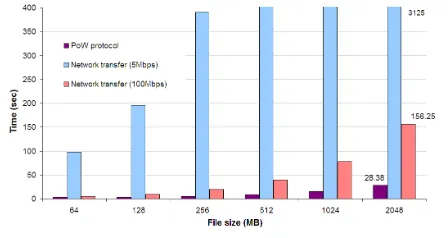
Time savings by using deduplication. In Figures 4 and 5 we demonstrate the time-saving for the client by using deduplica-tion (including the overhead of our scheme) compared to a pol-icy of always sending the entire file to the server. We considered two network settings, one with an average speed for a fast net-work (5Mbps) [2] and the other being an extremely fast netnet-work (100Mbps). We observed that for the 5Mbps network, the PoW scheme always consumes less time than transmitting the file over the network (even for files of about 15KBytes). For the 100Mbps network deduplication (including the PoW) is faster than transmit-ting the file for files larger than 64KBytes. Furthermore, the benefit from using the PoW increases with the file size, e.g., for files larger than 1GByte the time consumed by PoW comprises of less than 1% and 20% of the upload time (for 5Mbps and 100Mbps respectively). Overall, by using PoWs one can get the benefits of client-side deduplication without sacrificing security. The benefits become higher as files grow and for better deduplication ratio, as well as for slower networks.
7Note that the mixing and Merkle-tree computations can be performed after
Figure 3. Performance of PoW phases.The running times of the differ-ent stages of the PoW algorithm compared to the time to read the file from the disk or calculate its SHA256.
Figure 4. PoW overall performance.Comparison of the overall time consumed by the PoW scheme to the time to send the file over the networks with 5Mbps and 100Mbps upload speed. The overall running times of the PoW scheme are calculated asT=Ctime+Stime+Ntime.
Figure 5. Benefits of deduplication with PoWComparisons between systems that perform deduplication with PoW to those that always transmit the data over the 5Mbps and 100Mbps networks respectively. We consider a relatively conservative workload in which only 50% of the data is dedupli-cated and we pay the overhead of the reduction phase of the PoW scheme for remaining 50% of the files.
6.
Additional Comments and Conclusions
In this work we put forward the notion of proof-of-ownership, by which a client can prove to a server that it has a copy of a file
with-out actually sending the file. This can be used to counter attacks on file-deduplication systems where the attacker obtains a “short summary” of the file and uses it to fool the server into thinking that the attacker owns the entire file. We gave three definitions for secu-rity in this setting and three matching protocols, the last of which is very practical. Our streaming protocol allows the designer of the scheme to set a threshold for how “short” a summary can a file have (e.g., 64MBytes in our implementation). This seem suitable for the attack scenarios of common hash functions, malicious software, or accidental leakage that were described in the introduction.
For CDN attacks the protection of our protocol is not quite as strong as one could perhaps hope for, but we point out that a very simple fix can augment this streaming system also against CDN-type attacks: simply use two Merkle trees, one over the file itself and the other over the encoded buffer (and the server can keep only the hash of the two roots). Roughly speaking, the buffer-Merkle-tree addresses the low-entropy and medium-entropy cases from Section 2 while the file-Merkle-tree addresses the high-entropy case. This composed solution can be implemented using small space, and the running time will be about twice the ones that are reported in Section 5.3, since computing a Merkle tree is about twice as expensive as computing plain SHA256 over the same file. The threshold-free notion of security from Definition 1 does not capture the added security of this composed solution, since there are setting of parameters that it does not address. For example, for a 16GByte file with 128MByte of entropy, an attacker can use only 64MByte of leakage – i.e., the encoded buffer – and has a reasonable chance of convincing the server. This is because, unlike the described solution, the Merkle-tree queries into the file itself are unlikely to hit the small fraction of the file that the attacker does not know. However this setting which is not addressed does not seem to appear much in typical applications.
We remark that the new attacks that we consider and our solu-tions to them are more relevant for file-level de-duplication than for block-level deduplication. (Indeed, if an attacker can learn a hash value for each 8KByte block of the file, then it can probably learn also the blocks themselves and does not need to fool the storage server.) Note, however, that the attack remains relevant (and our solution useful) when a service uses both file- and block-level de-duplication, as is likely to be the case in practical systems.
Acknowledgment: We thank Dalit Naor for her support through-out this work.
References
[1] Dropship - dropbox api utilities. https://github.com/ driverdan/dropship, April 2011.
[2] Akamai. The State of the Internet, 3rd Quarter 2010. www.akamai.com/stateoftheinternet.
[3] G. Ateniese, R. Burns, R. Curtmola, J. Herring, L. Kissner, Z. Peter-son, and D. Song. Provable data possession at untrusted stores. In
ACM CCS ’07, pages 598–609. ACM, 2007.
[4] K. D. Bowers, A. Juels, and A. Oprea. Hail: a high-availability and integrity layer for cloud storage. InACM CCS ’09, pages 187–198. ACM, 2009.
[5] W. Dai. Crypto++ Library, 5.6.1, Jan, 2011. http://www.cryptopp.com/.
[6] G. DiCrescenzo, R. J. Lipton, and S. Walfish. Perfectly Secure Pass-word Protocols in the Bounded Retrieval Model. In3rd Theory of Cryptography Conference (TCC’06), volume 3876 ofLNCS, pages 225–244. Springer, 2006.
[7] L. Dorrendorf and B. Pinkas. Deduplication volnurabilities in major storage services. Under preparation, 2011.
[9] S. Dziembowski. Intrusion-Resilience Via the Bounded-Storage Model. In3rd Theory of Cryptography Conference (TCC’06), volume 3876 ofLNCS, pages 207–224. Springer, 2006.
[10] R. Elbaz, D. Champagne, C. Gebotys, R. B. Lee, N. Potlapally, and L. Torres. Hardware mechanisms for memory authentication: A survey of existing techniques and engines. Transactions on Computational Science IV, LNCS, pages 1–22, March 2009 2009.
[11] S. Goldwasser, S. Micali, and C. Rackoff. The Knowledge Complexity of Interactive Proof Systems.SIAM J. Comput., 18(1):186–208, 1989.
[12] P. Golle, S. Jarecki, and I. Mironov. Cryptographic primitives enforc-ing communication and storage complexity. In”Financial Cryptogra-phy ’02”, volume 2357 ofLNCS, pages 120–135. Springer, 2003.
[13] D. Harnik, B. Pinkas, and A. Shulman-Peleg. Side channels in cloud services, the case of deduplication in cloud storage.IEEE Security and Privacy Magazine, special issue of Cloud Security, 2010.
[14] A. Juels and B. S. Kaliski, Jr. Pors: proofs of retrievability for large files. InACM CCS ’07, pages 584–597. ACM, 2007.
[15] R. C. Merkle. A certified digital signature. InProceedings on Ad-vances in cryptology, CRYPTO ’89, pages 218–238, New York, NY, USA, 1989. Springer-Verlag New York, Inc.
[16] M. Mulazzani, S. Schrittwieser, M. Leithner, M. Huber, and E. Weippl. Dark clouds on the horizon: Using cloud storage as attack vector and online slack space. InUSENIX Security, 8 2011.
[17] H. Shacham and B. Waters. Compact proofs of retrievability. In
ASIACRYPT ’08, pages 90–107. Springer-Verlag, 2008.
[18] K. Thomas. Dropbox: A file sharer’s dream tool? PC World, April 2011. http://www.pcworld.com/businesscenter/ article/226280/.
[19] Q. Wang, C. Wang, J. Li, K. Ren, and W. Lou. Enabling public verifi-ability and data dynamics for storage security in cloud computing. In
ESORICS’09, pages 355–370. Springer-Verlag, 2009.
A.
Proofs
A.1 Proof of the Merkle Tree Lemma
Proof. (of Lemma 1) This lemma follows from standard hardness-amplification arguments, namely a prover that succeeds in answer-inguleaves with probability better than(1−α)k
can be converted to one that can answer a single query with probability better than (1−α). We provide the details below.
For the fixedXandh, we say that “P∗(l1, . . . , lu)is valid” if
P∗replies with valid sibling paths for all the leaves when queried on leaf indexesl1, ...lu, . For a leaf indexl∈[s]and a query index
i∈[u], we say that “lisi-good” if when thei-th leaf index island all the others are chosen at random, the prover gives a valid answer with high enough probability:
lisi-good ⇔
Pr
l1...lu
[P(j1. . . ji−1, j, ji+1. . . ju)is valid]≥δ/u
For i ∈ [u] denote Goodi = {l ∈ [s] : l is i-good}. We
prove that there exists at least one query-indexi∈ [u]for which
|Goodi|/s≥1−α. By contradiction, if not then we have
Pr
l1...lu
[P(l1, . . . , lu)is valid]
= Pr[P(l1, . . . , lu)valid and allli’s arei-good]
+ Pr[P(l1, . . . , lu)valid and∃is.t.linoti-good]
≤ Pr[allli’s arei-good]
+
u
X
i=1
Pr[P(l1, . . . , lu)valid &linoti-good]
≤
u
Y
i=1
|Goodi|
s +
u
X
i=1 Pr
P(l1, . . . , ln)valid
|linoti-good
< (1−α)u+u·(δ/u) = (1−α)u+δ
but we know thatPrl1...lu[P(l1. . . lu)is valid]≥(1−α)u+δ,
so we have contradiction. We can now describe the extractorK:
1. for i= 1tou, forl= 1tos
2. repeatdu(log(s) + 1)/δetimes:
3. choose at randoml1. . . lu∈[s]
and queryP(l1. . . li−1, l, li+1. . . lu)
4. output sibling paths for all the leaves for whichPever gave any valid sibling path.
Clearly, iflisi-good then during the loop withi, lthe prover will return a valid answer with probability at least1−e−logs−1> 1− 1
e·s. Hence when we arrive at the indexifor which|Goodi|/s≥
1−α, we will find valid sibling paths for an(1−α)-fraction of the leaves, except with probability smaller than1/e.
Note that the lemma does not rely on the hash functionhbeing collision resistant. However, when used with a collision-resistant hash function, the lemma implies that the leaf values thatKoutputs are consistent with the original input bufferX(otherwise we get a collision).
A.2 Pairwise-Independent Hashing
To prove Lemma 2 we first prove that hashing a file withkbits of entropy into a buffer of size more than2kbits does not lose much entropy.
Lemma 3. Fix integersk, M, Ssuch thatk ≤ M and2k < S. Also letHbe a pairwise independent family of hash functions from
{0,1}M
to{0,1}S
and letDbe a distribution over{0,1}M
with min-entropy ofkor more. Then for all but a22k−Sfraction of the functionsh∈Hit holds that the distributionh(D)(over{0,1}S
) has min-entropyk−1or more.
Proof.LetD(x)denote the probability mass of the pointxunder
D. For anyh ∈ H, denote byCol(h) the “nontrivial collision probability” ofh(D), namely
Col(h) def= Pr
x,y∈D[x6=yandh(x) =h(y)]
= X
x6=y
D(x)D(y)·χ[h(x) =h(y)]
(whereχ[h(x) =h(y)]is the indicator variable which is 1 when h(x) =h(y)and zero otherwise). We will show that for all but a 22k−Sfraction of the functionsh∈H we haveCol(h) ≤2−2k,