A 3-Subset Meet-in-the-Middle Attack:
Cryptanalysis of the Lightweight Block Cipher
KTANTAN
Andrey Bogdanov and Christian Rechberger
Katholieke Universiteit Leuven, ESAT/COSIC and IBBT, Belgium
[email protected] [email protected]
Abstract. In this paper we describe a variant of existing the-middle attacks on block ciphers. As an application, we propose meet-in-the-middle attacks that are applicable to the full 254-round KTANTAN family of block ciphers accepting a key of 80 bits. The attacks are due to some weaknesses in its bitwise key schedule. We report an attack of time complexity 275.170encryptions on the full KTANTAN32 cipher with only
3 plaintext/ciphertext pairs and well as 275.044 encryptions on the full
KTANTAN48 and 275.584 encryptions on the full KTANTAN64 with 2
plaintext/ciphertext pairs1. All these attacks work in the classical attack
model without any related keys.
In the differential related-key model, we demonstrate 218- and 174-round differentials holding with probability 1. This shows that a strong related-key property can translate to a successful attack in the non-related-related-key setting. Having extremely low data requirements, these attacks are valid even in RFID-like environments where only a very limited amount of text material may be available to an attacker.
Keywords:cryptanalysis, meet-in-the-middle attacks, block cipher, key schedule, lightweight cipher, key-recovery, RFID
1 Introduction
A number of new cipher designs have been proposed recently, targeting use cases with severe implementation constraints imposed. Block cipher design methods have advanced to a stage where strong arguments for the resistance of the design against large classes of attacks such as differen-tial and linear cryptanalysis are possible. However, if aggressive design decisions have been made forced by a restrictive application scenario, 1 The SAC 2010 pre-proceedings version of this paper [6] reporting a runtime of 279
some other, more dedicated analysis techniques may turn out useful for attacking the cipher.
Cryptographic techniques move into applications like sensor nodes, RFID tags, or the “the Internet of things” at large. The ever increasing de-mand for security and privacy in these very constrained environments re-quires new cryptographic primitives, like tiny yet efficient ciphers. A num-ber of designs and implementation techniques have been proposed recently to address this need. Stream ciphers like Trivium [10, 8], Grain [17, 18], or Mickey [3], or block ciphers like DESL [22], PRESENT [4], HIGHT [19], mCrypton [24], KATAN and KTANTAN [9], or the hash functions based on PRESENT [5] are among the important ones.
Motivation. The economical and physical constraints force designers to make design decisions which are often considered to be “on the edge”. In this context it is often argued that block ciphers are better under-stood than stream ciphers and are hence more trustworthy. Some re-cent designs like PRESENT and KATAN/KTANTAN have come with strong arguments that large classes of attacks shown powerful in the past are not applicable. The technique used is to provide bounds on various non-random properties, like differential or linear characteristics. Indeed, whereas in the eStream project a number of lightweight stream ciphers were broken, sometimes even with practical attack complexities, none of the recently proposed block ciphers have been broken so far.
KTANTAN [9] accepts a key of 80 bits. It was designed to resist differential and linear attacks, and exhibits strong bounds in the non-related-key model, an upper bound 2−b on the probability of every
dif-ferential/linear characteristic over 128 rounds being an essential design criterion (b∈ {32,48,64} is the block size of the cipher). Even if related keys are considered, a much less realistic setting, designers report no dif-ferential characteristic with a higher probability than 2−b for 150 out of the 254 rounds. In [2], Albrecht et al. study algebraic approaches to amplify differential attacks on this family of ciphers.
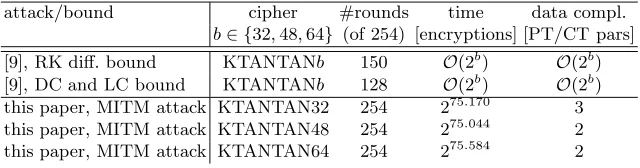
Table 1.Results on MITM cryptanalysis for KTANTAN
attack/bound cipher #rounds time data compl.
b∈ {32,48,64} (of 254) [encryptions] [PT/CT pars]
[9], RK diff. bound KTANTANb 150 O(2b) O(2b)
[9], DC and LC bound KTANTANb 128 O(2b) O(2b)
this paper, MITM attack KTANTAN32 254 275.170 3
this paper, MITM attack KTANTAN48 254 275.044 2
this paper, MITM attack KTANTAN64 254 275.584 2
outlined in Table 4. Note that the data complexity of our attacks is the lowest possible and exactly corresponds to that of a brute-force attack. We conclude with a discussion on links to other works, high-level design choices for low-resource ciphers, and future work in Section 5.
2 Framework for MITM Attacks
2.1 Basic MITM Attack
The basic meet-in-the-middle (MITM) approach will be a starting point for our attack. MITM techniques are arguably much less common than differential or linear attacks on ciphers. There are some applications of MITM principles to block ciphers like DES or AES, see e.g. [7, 11, 12, 14, 15, 20] for dedicated attacks, and e.g. [25, 26] for meet-in-the-middle attacks on a higher level.
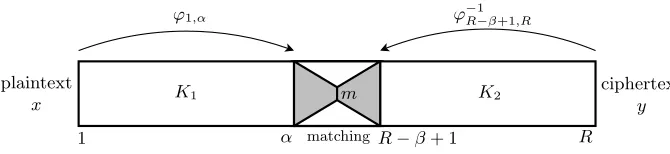
The basic MITM technique is due to Diffie and Hellman [13]. Letϕi,j
denote the partial transform of an R-round block cipher beginning in round iand ending directly after roundj under some fixed key, 1≤i≤
j ≤R, see Figure 1. Then if ϕ1,α and ϕα+1,R use subkeys with distinct
key bits, the key can be as a rule recovered much more efficiently than by brute force over two subkeys. The central idea here, as also applied to reduced DES in [15], is that the subkeys in both parts of the cipher can be guessed independently. Each guess of the first subkey allows the adversary to compute ϕ1,α(p) and of the second subkey to obtain ϕ−α+11 ,R(c). The
right key will be among those fulfilling the equationϕ1,α(p) =ϕ−α+11 ,R(c).
2.2 The 3-subset MITM Approach
Instead of considering two subsets of key bits, we consider three subsets. Our attack consists of two parts. In the MITM stage, we filter out some wrong key candidates and reduce the key space. In thekey testing stage, we look for the right key in the reduced key space.
K1 K2
plaintext
x
ciphertext
y
ϕ1,α ϕ−R1
−β+1,R
matching m
1 α R−β+ 1 R
Fig. 1.MITM
Let K = kℓ−1kℓ−2. . . k1k0 be the ℓ-bit key. Then if K1 = {ki :
kiused byϕ1,α}andK2 ={ki:kiused byϕR−β+1,R}, thenA0=K1∩K2 is the set of key bits used both by the firstα and last β rounds, see Fig-ure 1. Moreover,A1=K1\K1∩K2 andA2=K2\K1∩K2 are the sets of key bits used byK1 only and byK2 only, respectively. We further assume that K1∪K2=K.
For the attack we need n plaintext/ciphertext pairs {(xi, yi)}, i =
1, . . . , n. Letxi be plaintext andyi ciphertext.
MITM Stage. The meet-in-the-middle part of the attack on R rounds of the cipher can be performed as follows:
– For each guess of key bits inA0:
• For each guess of key bits inA1:
∗ Computev=ϕ1,α(x)
• For each guess of key bits inA2:
∗ Computeu=ϕ−R1−β+1,R(y)
• Perform matching in the middle between the values ofv and the values of u on m bits, 1 ≤ m ≤ b (see Subsection 4.3) and add surviving key candidates to the listK of surviving keys. We expect to have false positives with probability 2−mwhich is called thefalse
positive rate of a MITM attack.
distance of the cipher which essentially depends on the block size and key length. If we can significantly reduce the key space in the MITM stage (by ruling out a large part of the keys), the complexity of the key test-ing stage will be negligible with respect to the MITM stage. Generally speaking, however, this is not necessarily the case.
Attack Complexity. The computational complexity of the attack will be dominated by
Ccomp= 2|A0|(2|A1|+ 2|A2|)
| {z }
MITM stage
+ (2ℓ−m+ 2ℓ−m−b+ 2ℓ−m−2b+. . .)
| {z }
key testing stage
. (1)
If A1 and A2 are both non-empty and |A1|+|A2|> 2, then the attack becomes more efficient than exhaustive search provided that the false positive rate is low enough.
The MITM stage requires exactly one plaintext/ciphertext pair. How-ever, of thebbits onlymare used for matching. That is, the information contained in the other b−m state bits is not used in this stage and can be used in the key testing stage. For the key testing stage, more pairs might be required, depending on the relation between the key length and the block size. This results in data complexity
Cdata=
ℓ
b
depending on the block size b and the key length ℓ. The memory com-plexity is defined by matching in the MITM stage. For small setsA1 and
A2, it is negligible.
3 A Short Description of KTANTAN
KTANTAN is a block cipher which accepts an 80-bit user-supplied key. Versions with block size b ∈ {32,48,64} bit have been specified. Each version has 254 rounds. While the definition of a round transform differs from version to version, the key schedule remains the same. Through-out the paper, we refer to the KTANTAN version with b-bit blocks as KTANTANb.
3.1 Round Transform
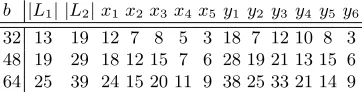
The state of the cipher is represented as two disjunct parts L1 and L2. The transform of roundris based on two Boolean functionsf1,r andf2,r,
having L1 andL2 as their domain, correspondingly:
f1,r(L1) =L1[x1]⊕L1[x2]⊕(L1[x3]·L1[x4])⊕(L1[x5]·IRr)⊕κ1,r
f2,r(L2) =L2[y1]⊕L2[y2]⊕(L2[y3]·L2[y4])⊕(L2[y5]·L2[y6])⊕κ2,r,
where xi, yi are the numbers of active bit positions, IRr is the round
constant bit in round r, and κ1,r, κ2,r are the bits of the extended key
defined by the key schedule for roundr. The lengths ofL1 and L2 as well as the bit positions xi,yi are specific for each KTANTAN version.
Oncef1,r andf2,r are computed, the registersL1 and L2 are shifted, the MSB of each register falls off and the LSB is set to the output of
f2,r and the output of f1,r, respectively. KTANTAN32 applies
transfor-mations f1,r and f2,r once in a round. One round of KTANTAN48 and
KTANTAN64 updates the registers using f1,r and f2,r two and three
times, respectively.
Table 2.Version-specific parameters of KTANTAN
b |L1| |L2|x1x2 x3 x4x5 y1 y2 y3 y4 y5y6
32 13 19 12 7 8 5 3 18 7 12 10 8 3
48 19 29 18 12 15 7 6 28 19 21 13 15 6 64 25 39 24 15 20 11 9 38 25 33 21 14 9
Table 3.Round constant bitsIRr:IR1 first,IR254 last
1111111000 1101010101 1110110011 0010100100 0100011000 1111000010 0001010000 0111110011 1111010100 0101010011 0000110011 1011111011 1010010101 1010011100 1101100010 1110110111 1001011011 0101110010 0100110100 0111000100 1111010000 1110101100 0001011001 0000001101 1100000001 0010
3.2 Key Schedule
The functionsf1,r and f2,r require input from the key schedule, which is
a function mapping the 80-bit user-supplied key K = k79k78. . . k1k0 to
differs from KATAN. This difference, together with some properties of the data transform, makes KTANTAN vulnerable to our attack.
An 8-bit round counting LFSR is used to control the key schedule. It is defined by the feedback polynomial
ζ8+ζ7+ζ5+ζ3+ 1
and its initial state is all ones. The value of IRr is specified as the most
significant bit of this LFSR in roundr. Letl7,rl6,r...l1,rl0,rdenote the 8-bit
state of the LFSR in roundr.
The key schedule of KTANTAN chooses two bits ofK in each round. This is done by applying two layers of MUX logic. First, K is divided into 5 chunks Wi of 16 bits each:K=W4||W3||W2||W1||W0. One bit out of each chunk is selected:
ωi,r= MUX16to1(Wi, l7,rl6,rl5,rl4,r), i= 0, . . . ,4,
where the LFSR bits define the position in Wi to choose. Second, two
out of these five bits are chosen controlled by the other half of the LFSR state:
κ1,r =l3,r·l2,r·ω0,r⊕(l3,r∨l2,r)·MUX4to1(ω4,rω3,rω2,rω1,r, l1,rl0,r)
κ2,r =l3,r·l2,r·ω4,r⊕(l3,r∨l2,r)·MUX4to1(ω3,rω2,rω1,rω0,r, l1,rl0,r).
4 Low Data-Complexity Attacks on KTANTAN
In here, we apply our generalized MITM framework to KTANTAN withR
rounds. The resulting attack requires an extremely small number of known plaintext/ciphertext pairs (basically, the minimum due to the unicity dis-tance) and negligible memory. The MITM techniques make use of the fact that several key bits remain unused by the KTANTAN key schedule in large connected parts of the cipher. More precisely, it is the rounds at the beginning and end of KTANTAN which we are most interested in to make the attack work.
4.1 Related-Key Differentials of Probability 1
We start with a note on probability-1 related-key differentials of KTAN-TAN over many rounds.
holds with probability 1, where 0 is the zero input and output difference in the data transformation and ∆is the key difference with ones at key bit position not used in the R rounds (first key bit positions are on the left-hand side). Some of the longest related-key differentials of this type we found for KTANTANbare given in Table 4. These differentials are due to the fact that the first 218 and last 174 rounds of KTANTAN do not use key bits k32 and k63, respectively.
We notice that it seems possible that these properties can be turned into low-complexity differential related-key attacks on KTANTAN. How-ever, we are mostly concerned with attacks that do not require related keys, and hence continue by exploiting this property in another way.
Table 4.Related key differentials for KTANTANb,b∈ {32,48,64}
covered #rounds differential probability
rounds
ϕ1,218 218 (0,00000000800000000000)7→0 1
ϕ−1
81,254 174 (0,00000000000000010000)7→0 1
4.2 Application of the MITM Framework to KTANTAN
Depending on the KTANTAN version, different properties of the key schedule are exploited in our attack. This is due to the fact that all three versions of KTANTAN have different numbers of register clocks in one round. The versions with a larger block size have heavier rounds with more diffusion which complicates the partial matching phase. Effectively, this reduces the number of rounds in the middle for which matching is possible. This circumstance has not allowed us to come up with attacks on the full KTANTAN48 and KTANTAN64 so far.
In Table 5 we give a summary of the properties and parameters of our attacks. We aim for the full, and if this is not possible for the highest number of rounds. Considering variants with a more reduced number of rounds would lead to more neutrals key bits, and generally lower attack complexities.
Table 5.Details of the proposed attacks
b R α A2 R−β A1 matching complexityCcomp
bitsm MITM key test total
32 254 111 32,39,44,61,66,75 131 3,20,41,47,63,74 8 75.000 72 75.170
48 254 111 32,39,44,61,66,75 131 3,20,41,47,63,74 10 75.000 70 75.044
64 254 123 32,44,61,66,75 131 3,20,41,47,63,74 47 75.584 33 75.584
Fact 1 ϕ1,α does not use key bits{k32, k39, k44, k61, k66, k75}for 1≤α≤ 111.
Fact 2 ϕ254−β+1,254 does not use key bits {k3, k20, k41, k47, k63, k74} for 1≤β ≤131.
This means that if we fix α= 111 and β = 131, then ϕ1,111 and ϕ123,254 will have 6 neutral key bits in each direction. Moreover, one can effi-ciently match vand uin 8 bits, despite being 21 rounds apart due to the slow diffusion in one round of KTANTAN32, which is demonstrated in Subsection 4.3.
4.3 Partial-Matching Phase
In here, we describe in more detail the matching procedure that is used as a sub-routine in the MITM stage.
Procedure. The starting point are two completely determined internal states u and v, one at round 106, the other one at round 136 (see Sub-section 2.2). If we considered a cipher where those middle 31 rounds were cut away, then the matching phase would be trivial as we would simply check if theu=v. With a probability of about 2−b this check would give
a false positive, but overall the number of key candidates is reduced to about 280−b. Remember that b ∈ {32,48,64}. Hence the number of key
candidates is small enough to not influence the attack complexity during the key testing state.
In total, we hence need only between 3 (for block size b={48,64}) or 4 (for b= 32) known plaintext/ciphertext pairs.
We note that this procedure can be implemented in an essentially memoryless way, as every match can immediately be tested with another plaintext/ciphertext pair. Also in our estimate of the attack complexity, we do not consider any implementation optimizations that e.g. would also be possible for a brute force search that does not use any shortcut attacks. Examples of such optimizations would e.g. be a reuse of computations from one key guess to the next.
Details on the Partial Matching Phase. In the following we trace those bits that remain unaffected during the middle rounds for the block size ofb= 32. ’1’ means affected, ’0’ means not affected.k1 andk2 denote disturbances caused by the unknown neutral bits from the opposite chunk at the respective rounds. For other block sizes, we refer to Appendix A.
10 bits match as follows
forward part:
forward R=111: k1=1, k2=1 0 0 0 0 0 0 0 0 0 0 0 0 0 0 0 0 0 0 0 0 0 0 0 0 0 0 0 0 0 0 0 0 forward R=112: k1=0, k2=0 1 0 0 0 0 0 0 0 0 0 0 0 0 1 0 0 0 0 0 0 0 0 0 0 0 0 0 0 0 0 0 0 forward R=113: k1=0, k2=0 0 1 0 0 0 0 0 0 0 0 0 0 0 0 1 0 0 0 0 0 0 0 0 0 0 0 0 0 0 0 0 0 forward R=114: k1=0, k2=0 0 0 1 0 0 0 0 0 0 0 0 0 0 0 0 1 0 0 0 0 0 0 0 0 0 0 0 0 0 0 0 0 forward R=115: k1=0, k2=0 0 0 0 1 0 0 0 0 0 0 0 0 0 0 0 0 1 0 0 0 0 0 0 0 0 0 0 0 0 0 0 0 forward R=116: k1=0, k2=0 1 0 0 0 1 0 0 0 0 0 0 0 0 1 0 0 0 1 0 0 0 0 0 0 0 0 0 0 0 0 0 0 forward R=117: k1=0, k2=0 0 1 0 0 0 1 0 0 0 0 0 0 0 0 1 0 0 0 1 0 0 0 0 0 0 0 0 0 0 0 0 0 forward R=118: k1=0, k2=0 0 0 1 0 0 0 1 0 0 0 0 0 0 1 0 1 0 0 0 1 0 0 0 0 0 0 0 0 0 0 0 0 forward R=119: k1=0, k2=0 0 0 0 1 0 0 0 1 0 0 0 0 0 0 1 0 1 0 0 0 1 0 0 0 0 0 0 0 0 0 0 0 forward R=120: k1=0, k2=0 1 0 0 0 1 0 0 0 1 0 0 0 0 1 0 1 0 1 0 0 0 1 0 0 0 0 0 0 0 0 0 0 forward R=121: k1=0, k2=0 1 1 0 0 0 1 0 0 0 1 0 0 0 1 1 0 1 0 1 0 0 0 1 0 0 0 0 0 0 0 0 0 forward R=122: k1=0, k2=0 1 1 1 0 0 0 1 0 0 0 1 0 0 1 1 1 0 1 0 1 0 0 0 1 0 0 0 0 0 0 0 0 forward R=123: k1=1, k2=0 1 1 1 1 0 0 0 1 0 0 0 1 0 0 1 1 1 0 1 0 1 0 0 0 1 0 0 0 0 0 0 0 forward R=124: k1=0, k2=0 1 1 1 1 1 0 0 0 1 0 0 0 1 1 0 1 1 1 0 1 0 1 0 0 0 1 0 0 0 0 0 0 forward R=125: k1=0, k2=0 1 1 1 1 1 1 0 0 0 1 0 0 0 1 1 0 1 1 1 0 1 0 1 0 0 0 1 0 0 0 0 0 forward R=126: k1=0, k2=0 1 1 1 1 1 1 1 0 0 0 1 0 0 1 1 1 0 1 1 1 0 1 0 1 0 0 0 1 0 0 0 0 forward R=127: k1=0, k2=1 1 1 1 1 1 1 1 1 0 0 0 1 0 1 1 1 1 0 1 1 1 0 1 0 1 0 0 0 1 0 0 0
backward part:
backward R=131: k1=0, k2=1 0 0 0 0 0 0 0 0 0 0 0 0 0 0 0 0 0 0 0 0 0 0 0 0 0 0 0 0 0 0 0 0 backward R=130: k1=1, k2=1 0 0 0 0 0 0 0 0 0 0 0 0 0 0 0 0 1 0 0 0 1 1 0 1 0 1 0 0 0 0 0 1 backward R=129: k1=0, k2=0 0 0 0 1 0 1 0 1 1 0 0 0 1 0 0 1 1 0 0 1 1 1 1 1 1 1 0 0 0 0 1 1 backward R=128: k1=0, k2=0 0 0 1 0 1 0 1 1 0 0 0 1 0 0 1 1 0 0 1 1 1 1 1 1 1 0 0 0 0 1 1 0 backward R=127: k1=0, k2=0 0 1 0 1 0 1 1 0 0 0 1 0 0 1 1 0 0 1 1 1 1 1 1 1 0 0 0 0 1 1 0 0
The highest number of matching bits is obtained at round 127:
forward R=127: k1=0, k2=1 1 1 1 1 1 1 1 1 0 0 0 1 0 1 1 1 1 0 1 1 1 0 1 0 1 0 0 0 1 0 0 0 backward R=127: k1=0, k2=0 0 1 0 1 0 1 1 0 0 0 1 0 0 1 1 0 0 1 1 1 1 1 1 1 0 0 0 0 1 1 0 0
As can be seen, at three positions in the state both in the forward and in the backward part no changes happen, which is the property needed for the matching part.
5 Discussion and future work
on block ciphers. We proposed key-recovery attacks with an extremely low number of known plaintexts. The approach we describe is inspired by recent advances in MITM preimage attacks on hash functions like those that succeeded in breaking MD5 or Tiger [16, 28], even though it remains an open problem to transfer most of the techniques there from the key-less hash setting to the cipher setting. The MITM approach may be seen as a way to turn very strong related-key properties into attacks in the single-key setting, complementing e.g. the work on the self-synchronized stream-cipher Moustique [21]. Even though the time complexity of our attack remains high, optimizations may result in reduced time complexi-ties, by e.g. allowing the attacker to choose the plaintext instead (possible in many protocols), or asking for more plaintext/ciphertext pairs. Also, implementation techniques that speed-up brute force search, such as de-termining a good sequence of keys to guess and save computations that way, are likely to carry over to the meet-in-the-middle attack.
Among the ciphers most vulnerable to the meet-in-the-middle attacks, are those with little key-dependency in the sense that large parts of the cipher depend on a subset of key bits only. This is opposed to substitution-permutation networks which usually use subkeys of the block length in each round. For such ciphers, it is often difficult to mount a meet-in-the-middle attack even on a small number of rounds because of the strong key dependency. However, this approach as a rule results in a much higher number of XOR-operations needed for the key addition which in turn leads to higher area and/or time requirements and, thus, to a lower efficiency. An optimal trade-off between the level of resistance and the amount of key dependency remains, however, an area of research.
Acknowledgements. Andrey Bogdanov was sponsored in part by a visiting postdoctoral fellow grant from the Fund for Scientific Research - Flanders (FWO) within the FWO research project ”Linear codes and cryptography” G.0317.06. This work was also supported by the Research Fund K.U.Leuven grant (OT/08/027) ”A mathematical theory for the de-sign of symmetric primitives”, by the IAP Programme P6/26 BCRYPT of the Belgian State (Belgian Science Policy), and by the European Com-mission under contract ICT-2007-216646 (ECRYPT II).
reviewers of SAC 2010 whose insightful comments improved the presen-tation of the paper.
References
1. Bit-sliced reference code of KATAN and KTANTAN. Available from
http://www.cs.technion.ac.il/˜orrd/KATAN/katan.c (2010)
2. Albrecht, M., Cid, C., Dullien, T., Faugre, J.C., Perret, L.: Algebraic Precompu-tations in Differential Cryptanalysis. ECRYPT Tools for Cryptanalysis Workshop 2010 (2010)
3. Babbage, S., Dodd, M.: The MICKEY Stream Ciphers. In: Robshaw and Billet [27], pp. 191–209
4. Bogdanov, A., Knudsen, L.R., Leander, G., Paar, C., Poschmann, A., Robshaw, M.J.B., Seurin, Y., Vikkelsoe, C.: PRESENT: An Ultra-Lightweight Block Cipher. In: Paillier, P., Verbauwhede, I. (eds.) CHES. Lecture Notes in Computer Science, vol. 4727, pp. 450–466. Springer (2007)
5. Bogdanov, A., Leander, G., Paar, C., Poschmann, A., Robshaw, M.J.B., Seurin, Y.: Hash Functions and RFID Tags: Mind the Gap. In: Oswald, E., Rohatgi, P. (eds.) CHES. Lecture Notes in Computer Science, vol. 5154, pp. 283–299. Springer (2008)
6. Bogdanov, A., Rechberger, C.: Generalized Meet-in-the-Middle Attacks: Crypt-analysis of the Lightweight Block Cipher KTANTAN. Preproceedings of SAC 2010 (2010)
7. Chaum, D., Evertse, J.H.: Crytanalysis of DES with a Reduced Number of Rounds: Sequences of Linear Factors in Block Ciphers. In: Williams, H.C. (ed.) CRYPTO. Lecture Notes in Computer Science, vol. 218, pp. 192–211. Springer (1985) 8. De Canni`ere, C.: Trivium: A Stream Cipher Construction Inspired by Block Cipher
Design Principles. In: Katsikas, S.K., Lopez, J., Backes, M., Gritzalis, S., Preneel, B. (eds.) ISC. Lecture Notes in Computer Science, vol. 4176, pp. 171–186. Springer (2006)
9. De Canni`ere, C., Dunkelman, O., Knezevic, M.: KATAN and KTANTAN - A Family of Small and Efficient Hardware-Oriented Block Ciphers. In: Clavier, C., Gaj, K. (eds.) CHES. Lecture Notes in Computer Science, vol. 5747, pp. 272–288. Springer (2009)
10. De Canni`ere, C., Preneel, B.: Trivium. In: Robshaw and Billet [27], pp. 244–266 11. Demirci, H., Sel¸cuk, A.A.: A Meet-in-the-Middle Attack on 8-Round AES. In:
Nyberg, K. (ed.) FSE. Lecture Notes in Computer Science, vol. 5086, pp. 116–126. Springer (2008)
12. Demirci, H., Taskin, I., C¸ oban, M., Baysal, A.: Improved Meet-in-the-Middle At-tacks on AES. In: Roy, B.K., Sendrier, N. (eds.) INDOCRYPT. Lecture Notes in Computer Science, vol. 5922, pp. 144–156. Springer (2009)
13. Diffie, W., Hellman, M.: Exhaustive Cryptanalysis of the NBS Data Encryption standard. Computer 10(6), 74–84 (1977), IEEE Computer Society Press
16. Guo, J., Ling, S., Rechberger, C., Wang, H.: Advanced Meet-in-the-Middle Preim-age Attacks: First Results on Full Tiger, and Improved Results on MD4 and SHA-2. Cryptology ePrint Archive, Report 2010/016 (2010), http://eprint.iacr.org/ 17. Hell, M., Johansson, T., Maximov, A., Meier, W.: The Grain Family of Stream
Ciphers. In: Robshaw and Billet [27], pp. 179–190
18. Hell, M., Johansson, T., Meier, W.: Grain: a stream cipher for constrained envi-ronments. IJWMC 2(1), 86–93 (2007)
19. Hong, D., Sung, J., Hong, S., Lim, J., Lee, S., Koo, B., Lee, C., Chang, D., Lee, J., Jeong, K., Kim, H., Kim, J., Chee, S.: HIGHT: A New Block Cipher Suitable for Low-Resource Device. In: Goubin, L., Matsui, M. (eds.) CHES. Lecture Notes in Computer Science, vol. 4249, pp. 46–59. Springer (2006)
20. Indesteege, S., Keller, N., Dunkelman, O., Biham, E., Preneel, B.: A Practical At-tack on KeeLoq. In: Smart, N.P. (ed.) EUROCRYPT. Lecture Notes in Computer Science, vol. 4965, pp. 1–18. Springer (2008)
21. K¨asper, E., Rijmen, V., Bjørstad, T.E., Rechberger, C., Robshaw, M.J.B., Sekar, G.: Correlated Keystreams in Moustique. In: Vaudenay, S. (ed.) AFRICACRYPT. Lecture Notes in Computer Science, vol. 5023, pp. 246–257. Springer (2008) 22. Leander, G., Paar, C., Poschmann, A., Schramm, K.: New Lightweight DES
Vari-ants. In: Biryukov, A. (ed.) FSE. Lecture Notes in Computer Science, vol. 4593, pp. 196–210. Springer (2007)
23. Lei, W.: Personal communication, August 2010.
24. Lim, C.H., Korkishko, T.: mCrypton - A Lightweight Block Cipher for Security of Low-Cost RFID Tags and Sensors. In: Song, J., Kwon, T., Yung, M. (eds.) WISA. Lecture Notes in Computer Science, vol. 3786, pp. 243–258. Springer (2005) 25. Merkle, R.C., Hellman, M.E.: On the Security of Multiple Encryption. Commun.
ACM 24(7), 465–467 (1981)
26. van Oorschot, P.C., Wiener, M.J.: A Known Plaintext Attack on Two-Key Triple Encryption. In: EUROCRYPT. pp. 318–325 (1990)
27. Robshaw, M.J.B., Billet, O. (eds.): New Stream Cipher Designs - The eSTREAM Finalists, Lecture Notes in Computer Science, vol. 4986. Springer (2008)
28. Sasaki, Y., Aoki, K.: Finding Preimages in Full MD5 Faster Than Exhaustive Search. In: Joux, A. (ed.) EUROCRYPT. Lecture Notes in Computer Science, vol. 5479, pp. 134–152. Springer (2009)
A More details on partial matching
A.1 Block size 48 bits
The details for the partial matching phase for the attack on KTANTAN withb= 48 are as follows:
10 bits match as follows
forward part:
forward R=122: k1=0, k2=0 1100111100000110000 11101111100011100000110000000 forward R=123: k1=1, k2=0 1111001111000001100 11111011111000111000001100000
backward part:
backward R=131: k1=0, k2=1 0000000000000000000 00000000000000000000000000000 backward R=130: k1=1, k2=1 0000000000000000000 00000110000011110011110000011 backward R=129: k1=0, k2=0 0000011100011011011 00011110001111111111110001111 backward R=128: k1=0, k2=0 0001110001101101100 01111000111111111111000111100 backward R=127: k1=0, k2=0 0111000110110110000 11100011111111111100011110000 backward R=126: k1=0, k2=0 1100011111011011011 10001111111111110001111000000 backward R=125: k1=0, k2=0 0001111101111111111 00111111111111110111110000011 backward R=124: k1=0, k2=0 0111110111111111100 11111111111111011111000001100 backward R=123: k1=0, k2=0 1111011111111111011 11111111111101111100000110000
The highest number of matching bits is obtained at round 123:
forward R=123: k1=1, k2=0 1111001111000001100 11111011111000111000001100000 backward R=123: k1=0, k2=0 1111011111111111011 11111111111101111100000110000
A.2 Block size 64 bits
The details for the partial matching phase for the attack on KTANTAN withb= 64 are as follows:
47 bits match as follows
forward part:
forward R=123: k1=1, k2=0 0000000000000000000000000 000000000000000000000000000000000000000 forward R=124: k1=0, k2=0 0000000000000000000000000 111000000000000000000000000000000000000 forward R=125: k1=0, k2=0 0000000000000000000000000 000111000000000000000000000000000000000 forward R=126: k1=0, k2=0 0000000000000000000000000 000000111000000000000000000000000000000 forward R=127: k1=0, k2=1 1100000000000000000000000 000000000111000000000000000000000000000 forward R=128: k1=0, k2=0 1111100000000000000000000 000000000000111000000000000000000000000 forward R=129: k1=0, k2=0 1111111100000000000000000 000000000000000111000000000000000000000 forward R=130: k1=0, k2=0 0001111111100000000000000 100000000000000000111000000000000000000 forward R=131: k1=0, k2=0 1100001111111100000000000 111100000000000000000111000000000000000
backward part:
backward R=131: k1=0, k2=1 0000000000000000000000000 000000000000000000000000000000000000000
The highest number of matching bits is obtained at round 131: