Side-channel Analysis of Six SHA-3 Candidates
?Olivier Benoˆıt and Thomas Peyrin
Ingenico, France
{forename.name}@ingenico.com
Abstract. In this paper we study six 2nd roundSHA-3 candidates from a side-channel crypt-analysis point of view. For each of them, we give the exact procedure and appropriate choice of selection functions to perform the attack. Depending on their inherent structure and the internal primitives used (Sbox, addition or XOR), some schemes are more prone to side channel analysis than others, as shown by our simulations.
Key words:side-channel, hash function, cryptanalysis, HMAC, SHA-3.
1 Introduction
Hash functions are one of the most important and useful tools in cryptography. An-bit cryp-tographic hash functionH is a function taking an arbitrarily long message as input and out-putting a fixed-length hash value of sizenbits. Those primitives are used in many applications such as digital signatures or key generation. In practice, hash functions are also very useful for building Message Authentication Codes (MAC), especially in a HMAC [5, 34] construction. HMAC offers a good efficiency considering that hash functions are among the fastest bricks in cryptography, while its security can be proven if the underlying function is secure as well [4].
In recent years, we saw the apparition of devastating attacks [39, 38] that broke many standardized hash functions [37, 31]. The NIST launched theSHA-3competition [33] in response to these attacks and in order to maintain an appropriate security margin considering the increase of the computation power or further cryptanalysis improvements. The outcome of this competition will be a new hash function security standard to be determined in 2012 and 14 candidates have been selected to enter the 2nd round of the competition (among 64 submissions).
Differential and Simple Power Analysis (DPA and SPA) were introduced in 1998 by Kocheret al.[26] and led to a powerful class of attacks called side-channel analysis. They consist in two main steps. First, the power consumption, the electro-magnetic signal [1] or any others rele-vant physical leakage from an integrated circuit is measured during multiples execution of a cryptographic algorithm. Then, one performs a hypothesis test on subkeys given the algorithm specification, the algorithm input and/or output values and the traces obtained during the first step. This second step requires to compute an intermediary results of the algorithm for a given key guess and all the input/output and analyze correlation [13] with the actual experimen-tal traces. The intermediary result is the output of what we will call hereafter the “selection function”.
Because of the widely developed utilization of HMAC (or any MAC built upon a hash func-tion) in security applications, it makes sense to consider physical security of hash functions [28, 17, 29, 19, 35, 20]. Indeed, those functions usually manipulate no secret and have been at little bit left apart from side-channel analysis for the moment. In practice, the ability to retrieve
?
the secret key that generates the MACs with physical attacks is a real threat that needs to be studied and such a criteria is taken in account by the NIST for the candidates selections [24].
Our contributions. We present a side-channel analysis of six hash functions selected to the 2nd round of the SHA-3 competition: ECHO [7], Grøstl [18], SHAvite-3 [11] (three AES -based hash functions),BLAKE[3],CubeHash [9] andHAMSI[36]. This paper aims at finding the appropriate selection function for each SHA-3 candidates in a MAC setting and evaluating the relative efficiency through simulations of the corresponding attacks. Then, we draw conclusions concerning the relative complexity for protecting each candidate against first order side-channel cryptanalysis.
Of course, the intend of this paper is not to show that some particular hash functions can be broken with side-channel analysis, which should be easy in general when the implementation is not protected. However, we believe there are constructions that are naturally harder to attack or easier to implement in a secure and relatively efficient way.
2 How to perform side-channel attacks on hash functions
2.1 Message Authentication Codes with hash functions
A Message Authentication Code (MAC) is an algorithm that takes as input a arbitrary long message M and a secret key K and outputs a fixed-length value V = M AC(M, K). One requires that it should be computationally impossible for an attacker to forge a valid MAC without knowing the secret key K, or to retrieve any information about K. This primitive allows the authentication of messages between two parties sharing the same secret key. MACs can be built upon block ciphers (i.e. CBC-MAC [6]) or hash functions in the case of HMAC [5, 34]. HMAC instantiated with the hash functionH is defined as follows:
HM AC(K, M) =
H((K⊕opad)||H((K⊕ipad)||M))
CV0in h K⊕ipad
CV1in h M1
h Mk
Hin
CVout
0 h
K⊕opad
CV1out
h Hout
where || denotes the concatenation of bit strings and ⊕ represents the bitwise exclusive or (XOR) boolean function. The two wordsopadandipadare two constants of the size of a message block in the iterative hash function. This point is important: HMAC implicitly considers that
H is an iterative hash function. Thus, for each iteration iwe have an internal state (so-called chaining variable)CVi that is updated thanks to a compression functionhand a message block Mi :CVi+1 =h(CVi, Mi). The first chaining variable CV0 is initialized with an initial vector
IV and the hash output is the very last chaining variable or a truncated version of it.
It is easy to see that when computing the first hash function call of HMAC (Hin =H((K⊕ ipad)||M))), the first iteration is CV1 =h(IV, K ⊕ipad) and one only needs to guess CV1 to
complete the rest of this hash function computation, whatever the messageM. Then, for the second hash function call (Hout = H((K ⊕opad)||Hin)), the same remark applies: one only
needs to guessCV1 to complete the MAC computation whateverHin. We denote byCViin the
In practice, one can speed up the implementation by precomputing the CV1in and CV1out and starting the two hash processes with those two new initial chaining variables.
Therefore, when attacking HMAC with a side-channel technique, it is very interesting to recoverCV1in and CV1out. We are now left with the problem of being able to retrieve a fixed unknown chaining variable with random message instances. This will have to be done two times, first for CV1in and then for CV1out. The attack process will be identical for each call, so in this article we only describe how to recover the unknown chaining variable with several known random message instances. However, note that attacking CV1in should be easier than attackingCVout
1 because in the former the attacker has full control over the messageM, which
is not the case in the latter (the incoming message for the second hash call isHin, over which the attacker has no control). For some SHA-3 candidates, the ability to control the incoming message may reduce the number of power traces needed to recoverCVin
1 . However, the maximal
total improvement factor is at most 2 since the leading complexity phase remains the recovering ofCV1out.
In the case of the so-called stream-based hash functions (for example Grindahl [25] or
RadioGat´un [10]), for which the message block size is rather small (smaller than the MAC key and hash output lengths), the HMAC construction is far less attractive and one uses in general the prefix-MAC construction: M AC(K, M) = H(K||M). In order to avoid trivial length-extension attacks (which makes classical Merkle-Damg˚ard [30, 14] based hash functions unsuitable for the prefix-MAC construction), the stream-based hash functions are usually com-posed of a big internal state (much bigger than the hash output length) and define an output function composed of blank rounds (iterations without message blocks incorporation) and a final truncation phase. However, the corresponding side-channel attack for breaking the prefix-MAC construction will not change here and our goal remains to recover the full internal state.
In this paper, we will study the 256-bit versions of the hash functions considered, but in most of the case the analysis is identical for the 512-bit versions. Moreover, when available, the salt input is considered as null. For all candidates reviewed, the message to hash is first padded and since we only give a short description of the schemes, we refer to the corresponding specification documents for all the details. Finally, since our goal is to recover the internal state before the message digesting phase, there is no need to consider potential output functions performed after all the message words have been processed.
2.2 Correlation side-channel attacks
Regardless of the compression function h(CV, M) considered, at some point in the algorithm (usually in the very first stage), the incoming chaining variableCV will be combined with the incoming message blockM. The selection functions will be of the form:
w=f(cv, m)
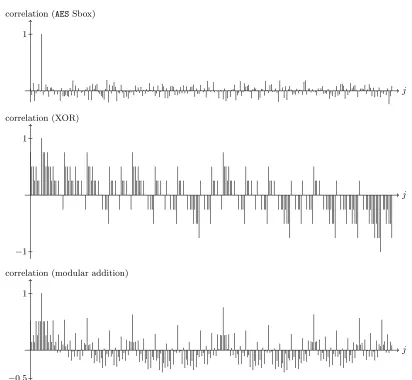
Some algorithms orSHA-3candidates (i.e.BLAKEorCubeHash) do not use such substitution table, while they rely exclusively on modular addition, rotation ≪and XOR ⊕operations (so-called ARX constructions). In this case, side-channel analysis is still possible but the XOR or modular addition selection functions are less efficient than for the Sbox case. Moreover, it has been theoretically proven that the XOR selection function is less efficient that the modular addition operations [28]. Indeed, the propagation of the carry in the modular addition leads to some non-linearity whereas the XOR operation if completely linear. More precisely, we can quantify the efficiency difference between the AES Sbox, the HAMSI Sbox, the XOR and the modular addition selection functions by looking at the theoretical correlation results in the so-called hamming-weight model. The rest of this paper exclusively deals with the Hamming weight model since in practice this model leads to good results for the majority of the target devices.
In order to estimate the efficiency of a selection function f(k, m), it is interesting to look at the theoretical correlation c(j, r) between the data set xi for a key guess j and the data
set yi for an arbitrary real key r. Where xi = HW(f(j, mi)) and yi = HW(f(r, mi)), with i∈[0, . . . ,2N −1], N being the number of bits of the selection function input messagem and
HW(w) being the Hamming Weight of the wordw. We also denote by x (respectively y) the average value of the data setxi (respectively yi).
c(j, r) =
P
(xi−x)(yi−y)
pP
(xi−x)2.pP(yi−y)2
Of course, when the key guess is equal to the real key (j =r), we havec(j, r) = 1.
The Figure 1 displays c(j,8) for j∈[0, . . . ,255] for the AESselection function Sbox(k, m), for the XOR selection function k⊕m and for the modular addition selection function km.
HAMSI is specific because the selection function is using a subset of the Sbox for a given key, therefore, the following table displays c(j, r) forj∈[0, . . . ,3] andr ∈[0, . . . ,3]. Only two bits of the message and two bits of the key are handled in this selection function.
XX XX
XX
XXX
key value
key guess
j= 0 j= 1 j= 2 j= 3
r= 0 +1.00 −0.17 −0.56 −0.87
r= 1 −0.17 +1.00 +0.87 −0.09
r= 2 −0.56 +0.87 +1.00 +0.17
r= 3 −0.87 −0.09 +0.17 +1.00
The efficiencyE(f) of the selection functionf is directly linked with the correlation contrast
ccbetween the correct key guess (correlation = 1) and the strongest wrong key guess (correlation
=cw). The higher this contrast, the more efficient the selection function will be to perform a
side-channel analysis. Indeed, it will be able to sustain a much higher noise level.
1
cc= 1−||cwcw||
selection AES modular
XOR1 HAMSI function Sbox addition Sbox
cw 0.23 0.75 −1 0.87
cc 3.34 0.33 0 0.15
The values ofcware extracted from Figure 1 by measuring the highest correlation peak (except
the peak with correlation equal to 1 which corresponds to the correct guess). The result of this theoretical/simulation study is the following:
E(AES Sbox)> E(modular addition)> E(HAMSISbox)> E(XOR)
In the rest of this article, we will search for the best selection function for eachSHA-3candidate analyzed with this conclusion in mind.
j
correlation (AESSbox)
1
j
correlation (XOR)
1
−1
j
correlation (modular addition)
1
−0.5
3 Experimental results on elementary selection functions
3.1 Test protocol
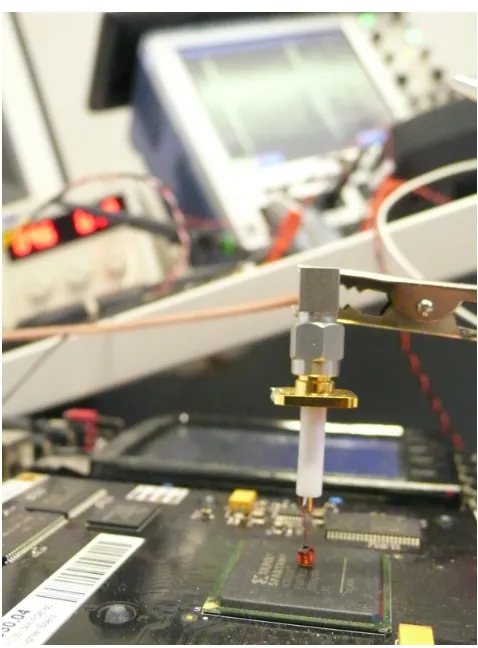
In order to verify the theoretical results of the previous section regarding the relative efficiency of the four elementary selection functions that can be found in theSHA-3candidates, we setup a platform to experimentally perform a correlation attack on an electromagnetic side-channel. Our target is a Xilinx Spartan 3 FPGA in which we instanciate a 32-bit RISC CPU. We then execute on this CPU a software which computes a 16 bytes output R from a 16 bytes input
M and a fixed 16 bytes key K. Output bytes number 0 to 3, 4 to 7, 8 to 11 and 12 to 15 are respectively the output of the following four selection function:
Ri =Ki⊕Mi with i∈[0,3]
Ri = (KiMi)mod256 with i∈[4,7]
Ri =SboxAES(Ki⊕Mi) with i∈[8,11]
Ri =SboxHAMSI(Ki(j+ 1)||Mi(j+ 1)||Ki(j)||Mi(j))with i∈[12,15]
ElectroMagnetic (EM) signal is recorded during the execution of a transfert loop that reads
Ri and writes the value to another 16 bytes array for i∈[0,15]. This experiment protocol is
used in order to avoid bias that could occur if we were analysing the EM signal during the actual computation ofRi. Indeed, these computation do not perform the same operations and
therefore, depending on the position of the EM sensor, the results could be irrelevant.
For example, if the sensor is above the ALU, the two first selection functions could lead to good correlation results whereas the two selection functions based on the output of an Sbox substitution would lead to poor correlation results.
The EM signal is recorded for 100.000 executions of the above process at a sampling fre-quency of 5GS/s. Each input message value is repeated ten times in order to average the curves and reduce the noise. Moreover, the Lecroy oscilloscope Noise Reduction mode is used. The sensor is a small coil of approximately 1mm diameter and 10 spires (see Figure 2). A broadband amplifier with a bandwidth of 1GS/s and 30db gain is also used. Each curve weight 20kB and consists of 20.000 samples (8-bit data) . The key value has been fixed to (0, 1, 2, 3, 0, 1, 2, 3, 0, 1, 2, 3, 0, 1, 2, 3).
3.2 Practical correlation analysis
With a homemade software, we perform a correlation analysis in order to retrieve the 16 bytes of the secret key. For each byte from index 0 to 11, 256 guesses are made, for each byte from index 12 to 15, only 4 guesses are made and the corresponding correlation curves are computed. We then look for the best correlation among the guesses in order to find the best key candidate. It appears that the best results are achieved by sorting our key guess according to negative correlation values rather than positive correlation values. This means that the chip leakage in EM is the complement of our model. A hamming weight of 0 leads to the highest signal level and a hamming weight of 8 leads to the lowest signal level.
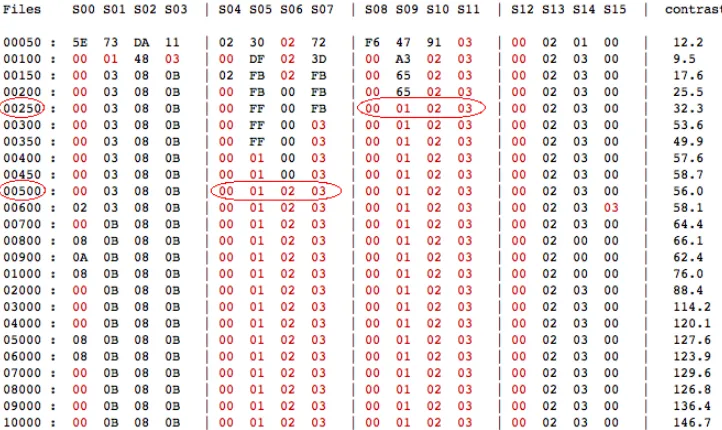
On Figure 3 we can see that the correct key bytes values are found for theAESSbox and the modular addition selection functions. Moreover, the contrast (last column) is in line with the theoretical values. As predicted by the theory, the XOR and HAMSI Sbox selection functions are less efficient and despite the use of 100k curves, the key bytes are not fully retreived.
Fig. 2.ElectroMagnetic sensor above the target FPGA running the elementary selection functions.
AESSbox selection function are retrieved wih only 250 curves. The four key bytes handled by the Modular Addition selection function are retrieved with 500 curves. The 8 key bytes handled respetively by the XOR and theHAMSISbox selection function are not fully retrieved whatever the number of curves.
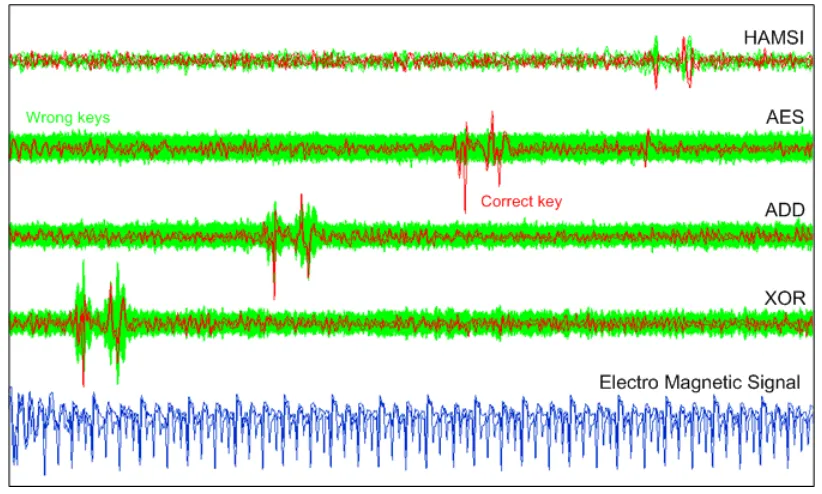
The Figure 5 displays the correlation curves for all the wrong key guesses (green) and the correct key guess (red) for key byte 0, 4, 8, 12 (respectively handled by XOR, ADD,AESSbox and HAMSI Sbox selection functions). We notice that there are strong correlation peaks for wrong key guesses in the case of the XOR and theHAMSISbox selection function. For the AES
Sbox selection function, there are no correlation peaks above noise level for wrong key guesses.
Fig. 4.Best key candidate retrieved by correlation analysis with 50 to 10000 curves.
These results are close to the theoretical results but we would have expected to retrieve the key bytes handled by the XOR and the HAMSI Sbox selection functions by increasing the number of curves. Obviously, some additional factors come into picture that are not consider in our theoretical model. There could be some quantization issues (the present measurement have been performed with an 8-bit oscilloscope).
4 AES-based SHA-3 candidates
In this section, we analyze ECHO [7], Grøstl [18] and SHAvite-3 [11], three AES-basedSHA-3
candidates. We recall that the round function of AES is composed of four layers (we use the order AddRoundKey, SubBytes, ShiftRows and Mixcolumns) and we refer to [32] for a complete specification of this block cipher.
4.1 ECHO
Description. ECHO [7] is an iterated hash function whose chaining variable CVi is 512-bit
Fig. 5.Correlation curves for correct (red) and wrong (green) key guesses and one EMA curve of the target process (blue).
variableCVi+1. More precisely, withCVi andMi the compression functionhinitializes a
2048-bit internal state which is viewed as a 4×4 matrix of 128-bit words (CVi initializes the first
column while Mi fills the three other ones). A fixed-key permutation PE is applied to this
internal state and the output chaining variable is built by calling the shrink256 function that
XORs all the 512-bit columns together after a feedforward:
CVi+1=shrink256(PE(CVi||Mi)⊕(CVi||Mi)).
The permutation PE contains 8 rounds, each composed of three functions very similar to the AESones, but on 128-bit words instead of bytes. First, the BIG.SubBytes function mimics the application of 128-bit Sboxes on each state word by applying 2 AES rounds with fixed round keys (determined by the iteration and round numbers). Then, BIG.ShiftRows rotates the posi-tion in their matrix column of all the 128-bit words according to their row posiposi-tion (analog to the AES). Finally, BIG.MixColumns is a linear diffusion layer updating all the columns inde-pendently. More precisely, for one matrix column, it applies sixteen parallelAESMixColumns transformations (one for each byte position in a 128-bit word).
Side-channel analysis. The incoming chaining variable CV fills the first 128-bit words column (denotedcvi in Figure 6) of the matrix representing the internal state, while the three
other columns are filled with the known random incoming message (denoted mi in Figure 6).
The goal of the attacker is therefore to retrieve the wordscvi.
The first layer (BIG.SubBytes) handles each 128-bit word individually. The known and secret data are not mixed yet (cvi 7→ cvi0 and mi 7→ m0i) and therefore it is not possible
to derive a selection function at this point. The same comment applies to the second layer (BIG.ShiftRows) and one has to wait for the third layer (BIG.MixColumns) to observe known and secret data mixing: each column will depend on one secret wordcvi0 and three known words
sixteen parallel and independentAESMixColumns transformations (one for each byte position) and each MixColumns call manipulates one byte of secret and three bytes of known data. Overall, in the end of the first round, every bytew[b] of an internal state word w (we denote
w[b] theb-th byte ofw) can be written as the following affine equation (see theAESMixColumns definition for the α,β,γ and δ values):
wi0[b] =α·cv0i1[b]⊕β·m
0
i2[b]⊕γ·m
0
i3[b]⊕δ·m
0
i4[b]
withb∈[0, . . . ,15],i0∈[0, . . . ,15],i1∈[0, . . . ,3] andi2, i3, i4∈[0, . . . ,11]. One could use those
wi[b] as selection functions, but the mixing operation would be the exclusive or. As already
explained, the selection function involving an XOR is the least efficient one. It seems much more promising to wait the first layer from the second round of theECHOinternal permutation.
cv0 cv1 cv2 cv3 m0 m3 m6 m9 m1 m4 m7 m10 m2 m5 m8 m11 Big.SB
cv00
cv10
cv20
cv30
m00
m03
m06
m09
m01
m04
m07
m010
m02
m05
m08
m011
Big.ShR cv00
m03
m07
m011
m00
m04
m08
cv03
m01
m05
cv02
m09
m02
cv01
m06
m010
Big.MC w0 w4 w8 w12 w1 w5 w9 w13 w2 w6 w10 w14 w3 w7 w11 w15
Fig. 6.Recovering the internal state forECHO. The gray cells represent the words that depends on the initial secret chaining variable. Each cell represents a 128-bit word.
Indeed, the BIG.SubBytes transformation applies directly two AES rounds independently for each words wi. The first function of the first AES round is the subkey incorporation and
in the case of ECHO those subkeys are fully known constants (we denote them ti). Then, the
second function of the first AESround applies theAES Sbox to each byte of the internal state. Therefore, we obtain the wordswi0 on the output:
w0i[b] =Sbox(wi[b]⊕ti[b]).
These equations can be used as selection functions manipulating only theAESSbox which is much more efficient than the XOR case. Overall, one has to perform 64AESSbox side-channel attacks in order to guess all the wordscvi0 byte per byte. By inverting the BIG.SubBytes layer from the words cv0i, one recovers completely CV. Note that for each byte of cvi0, one gets 4 selection functions involved. Thus, the overall number of curved can be reduced by a factor 4 at maximum by using and combining this extra information.
Overall, 64 correlation analysis based on the AESSbox selection function are required.
4.2 Grøstl
Description. Grøstl [18] is an iterated hash function whose compression functionh maps a 512-bit chaining variable CVi and a 512-bit message block Mi to a new chaining variable CVi+1. More precisely, two fixed-key permutations PG and QG, only differing in the constant
subkeys used, are applied:
CVi+1=PG(CVi⊕Mi)⊕QG(Mi)⊕CVi.
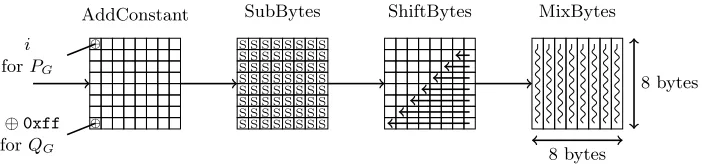
round, constant subkeys are first XORed to the state (AddRoundConstant), then the AES
Sbox is applied to each byte (SubBytes), the matrix rows are rotated with distinct numbers of positions (ShiftBytes) and finally a linear layer is applied to each byte column independently (MixBytes). This is depicted in Figure 7.
AddConstant 8 bytes 8 bytes ⊕ ⊕ i
forPG
i⊕0xff forQG
SubBytes S S S S S S S S S S S S S S S S S S S S S S S S S S S S S S S S S S S S S S S S S S S S S S S S S S S S S S S S S S S S S S S S ShiftBytes MixBytes
Fig. 7.One round of the internal permutationPGofGrøstl. Each cell represents a byte.
Side-channel analysis. The Grøstl case is very simple. One can see that the incoming message blockM is processed trough the QG permutation. Since the output of this
permuta-tion only depends on the message block and not on the incoming chaining variable CV, we can completely ignore this part of the compression function. Then, the permutationPG takes
as input M ⊕CV and one may be tempted to perform the side-channel attack during this operation. As demonstrated earlier, it is much more convenient to wait for the opportunity to attack the AES Sbox instead. The first layer of the permutation PG is the AddConstant
function which XORs the round numberi(the counting starting from 0) to the top left byte of the internal and therefore the operation is fully transparent. Then, the second layer of the first
PG round is the SubBytes function which applies the AES Sbox to every byte of the internal
statew=M⊕CV:
w[b] =m[b]⊕CV[b]
with b ∈ [0, . . . ,63]. The output state is denoted w0 and we obtain the following selection function which recoversCV byte per byte:
w0[b] =Sbox(w[b]).
Overall, 64 correlation analysis based on theAESSbox selection function are required. Note that it is possible to improve this attack when dealing with CV1in (the unknown chaining variable for the first hash call) by choosing appropriately the message. More precisely, one can divide the computation time by a factor 64 when choosing allm[b] as equals. Indeed, this allows to perform in parallel the side-channel analysis of the 64 unknown bytes.
4.3 SHAvite-3
Description. SHAvite-3[11] is an iterated hash function whose compression functionhmaps a 256-bit chaining variable CVi and a 512-bit message block Mi to a new chaining variable CVi+1. Internally, we have a block cipherES in classical Davies-Meyer mode
CVi+1 =CVi⊕EMSi(CVi).
This block cipher derives many subkeys thanks to a key schedule (all subkeys depending on the message Mi only) and is composed of 12 rounds of a 2-branch Feistel scheme (128 bits
Side-channel analysis. For SHAvite-3, we divide the attack in two phases (see Figure 8). In the first one, we recover the right part (in the Feistel separation) of the incoming chaining variable (CVR) during the first round. Once this first phase succeeded, we recover the left part
of the incoming chaining variable (CVL) during the second round. The message expansion maps the incoming message M to three 128-bit message words (mj0,mj1,mj2) for each roundj. One roundj ofSHAvite-3 consists in executing sequentially threeAESround functions with as input one branch of the current SHAvite-3 state and (mj0,mj1,mj2) as subkeys. Consequently, for the firstSHAvite-3round, the secret vector (CVR) is mixed with the known message word
m10 during the AddRoundKey layer of the firstAESround and we note:
w[b] =CVR[b]⊕m10[b].
with b ∈ [0, . . . ,15]. One could use this equation as the selection function, but it is more appropriate to use the output of the very next transformation instead, i.e. the SubBytes layer:
w0[b] =Sbox(w[b]).
Before executing the second round ofSHAvite-3, the left part of the chaining variable (CVL) is XORed with the output w00 of the three AES rounds. Then, this word is mixed with m20[b] just before the firstAESround of the secondSHAvite-3 round and we note:
z[b] =CVL[b]⊕w00[b]⊕m20[b].
Obviously, after a successful first phase, it is possible to compute w00[b] and therefore CVL is the only unknown constant. Once again, one could use this equation as the selection function, but it is more appropriate to use the output of the very next transformation instead, i.e. the SubBytes layer:
z0[b] =Sbox(z[b]).
Overall, we recover byte per byte theCVLandCVRvalues. Only 32 correlation analysis based
on the AESSbox selection function are required.
CVL⊕w00 CVR
AES
m22 AES
m21 AES
m20
z
second round CVR
CVL
AES
m12
w00
AES
m11 AES
m10
w
first round
Fig. 8.Recovering the internal state forSHAvite-3. The AES rounds we use for recovering the internal state are depicted in black.
5 Other SHA-3 candidates
In this section, we analyze BLAKE [3], CubeHash [9] and HAMSI [36], three 2nd round SHA-3
5.1 BLAKE
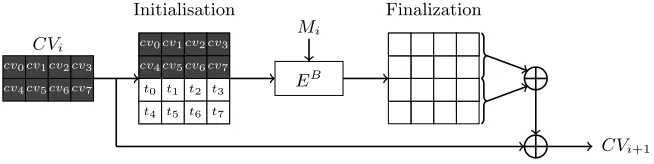
Description. BLAKE [3] is an iterated hash function whose compression function h maps a 256-bit chaining variable CVi and a 512-bit message block Mi to a new chaining variable CVi+1. Internally, the update is done with a block cipher EB, keyed with the message block
(see Figure 9):
CVi+1 =f inal(EMBi(init(CVi)), CVi).
where theinitfunction initializes the 512-bit internal state withCVi and constants. Thef inal
function computes the output chaining variables according toCVi, constants and the internal
state after the application ofEB. The internal state is viewed as a 4×4 matrix of 32-bit words and the block cipher EB is composed of 10 rounds, each consisting of the application of eight 128-bit sub-functionsGi. Assume an internal state forBLAKEwithvi+4j representing the 32-bit
word located on rowj and columni, one round ofEB is:
G0(v0, v4, v8, v12) G1(v1, v5, v9, v13) G2(v2, v6, v10, v14) G3(v3, v7, v11, v15)
G4(v0, v5, v10, v15) G5(v1, v6, v11, v12) G6(v2, v7, v8, v13) G7(v3, v4, v9, v14)
A sub-functionGi incorporates 32-bit message chunksmiand is itself made of additions, XORs
and rotations. During the roundr, the functionGs(a, b, c, d) processes the following steps:
a←(ab)(mi⊕kj) d←(d⊕a)≫16
c←(cd)
d←(b⊕c)≫12
a←(ab)(mj⊕ki) d←(d⊕a)≫8
c←(cd)
d←(b⊕c)≫7
where ≫ x denotes the right rotation of x positions, i = σr(2s) and j = σr(2s = 1). The
notation σr represents a family of permutations on {0, . . . ,15} defined in the specifications
document.
CVi
cv4cv5cv6cv7 cv0cv1cv2cv3
Initialisation
t4 t5
cv4cv5
t2 t3
cv2cv3
t6 t7 t0 t1
cv6cv7 cv0cv1
EB Mi
Finalization
CVi+1
Fig. 9.The compression function ofBLAKE.
Side-channel analysis. The sixteen 32-bit internal state words are initialized with the eight secret chaining valueCV words (denotedcvi) and constants valuesti (see Figure 9). Then, the
eight Gi functions during the first BLAKE round are applied to the internal state and one can
(cv6, cv7) respectively. Our goal is therefore to recovera0 andb0 when applyingGi(a0, b0, c0, d0)
with 0≤i≤3. The functionsGi consist in a sequence of eight transformations, the five first
being:
a1= (a0b0)mk
d1= (d0⊕a1)16
c1=c0d1
b1= (b0⊕c1)12
a2=a1b1ml
In practice, the first transformation will be computed in one of the three following way:
firsta←ab thena←ami
firsta←ami thena←ab
first x←bmi thena←ax
For the second and third case, a0 and b0 can be found by two side-channel analysis applied
successively to the two modular addition selection function (working byte per byte):
wi =cvimk andzi =cvi+1wi.
For the first case, a0 b0 can be recovered by performing the side-channel analysis on the
second modular addition selection function. In order to solve the problem and estimatea0 and
b0 the attacker has to target the output of the fourth transformation of Gi. However, in this
case the selection function would be based on the XOR operation. Therefore it seems more interesting to aim for the fifth transformation ofGi, a modular addition.
Overall, the full chaining variable can be retrieved by exploiting exclusively the modular addition selection function. A total of 32 modular addition correlation analysis at byte level must be performed.
5.2 CubeHash
Description. CubeHash [9] is an iterated hash function whose compression functionh maps a 1024-bit chaining variable CVi and a 256-bit message block Mi to a new chaining variable CVi+1. Internally, the update is done with a permutation PC:
CVi+1 =PC(CVi⊕(Mi||{0}768)).
The internal state is viewed as a table of 32 words of 32 bits each. The permutation PC is
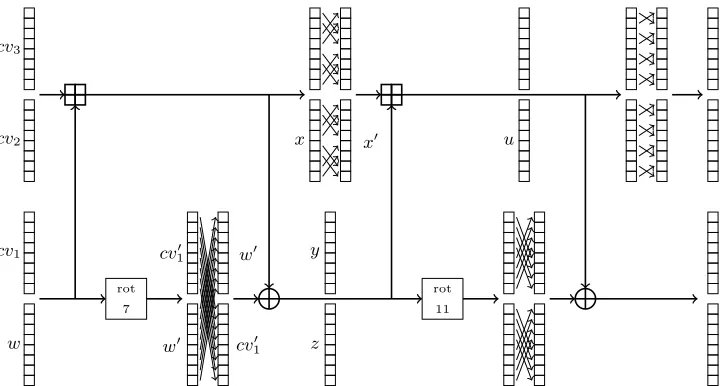
composed of 16 identical rounds and one round is made of ten layers (see Figure 10): two intra-word rotation layers, two XOR layers, two 232modular addition layers and four word positions permuting layers.
Side-channel analysis. The attack is divided into 4 steps. The incoming chaining variable
CV fills an internal state represented by a vector of four 256-bit words or eight 32-bit words (denoted cvi). The known random incoming message M is first XORed with cv0 and then
starts the first round of permutationPC. Thus, without any other alternative, the first selection
function is of XOR type and recoverscv0 byte per byte:
w cv1
cv2
cv3
rot 7
cv01
w0 cv10
w0
x x0
y
z
rot 11
u
Fig. 10.Recovering the internal state ofCubeHashduring one round of the internal permutationPC. Each cell
represents a 32-bit word.
withb∈[0, . . . ,7]. Once this first step successfully performed, the attacker fully knowsw for a given incomming message and the first layer ofPC adds each 32-bit words fromwto those from cv2 modulo 232 (and each words from cv1 to those from cv3). The second selection function is
therefore of modular addition type and recovers cv2 byte per byte (starting from the LSB of
the modular addition):
x[b] =cv2[b]w[b].
The second layer of PC applies a rotation to each 32-bit word of w and cv1 (we denote the
rotated variantsw0 and cv01 respectively) and then XORsx to this rotated version of cv1:
z[b] =cv01[b]⊕x[b]
This could be used as a selection function in order to retrieve cv1, but being of XOR type its
seems more advantageous to wait one more computation step and hope for a modular addition selection function. This can be achieved during the very next modular addition and we recover
cv01 byte per byte:
u[b] = (cv10[b]⊕x[b])x0[b].
Note that one may think that this selection function is of XOR type, but during the attack the bytesx[b] and x0[b] are independent (x0 is a permutation of the byte ordering ofx without fixed point). Our simulations indicate that such a selection function with XOR and modular addition imbricated is roughly equivalent to a modular addition one.
Finally, going backward in the computation to the firstPC layer, the selection function for
the fourth step is of XOR type and recoverscv3 byte per byte:
y[b] = (cv3[b]cv1[b])⊕w0.
Mi
expansion(Mi)
m4m5m6m7 m0m1m2m3
CVi
cv4cv5cv6cv7 cv0cv1cv2cv3
Concatenation
cv6cv7 cv4cv5 cv2cv3
cv0cv1
m6m7 m4m5
m2m3 m0m1
PH
Truncation
CVi+1
Fig. 11.The compression function ofHAMSI. Each cell represents a 32-bit word.
5.3 HAMSI
Description. HAMSI [36] is an iterated hash function whose compression function h maps a 256-bit chaining variableCVi and a 32-bit message blockMi to a new chaining variableCVi+1.
First, the message block is expanded into eight 32-bit wordsmi that are concatenated toCVi
in order to initialize a 512-bit internal state (viewed as a 4×4 matrix of 32-bit words). Then a permutationPH is applied to the state and a truncation allows to extract 256 bits. In the end,
there is a feedforward of the chaining variable (see Figure 11):
CVi+1=trunc(PH(CVi||expansion(Mi)))⊕CVi.
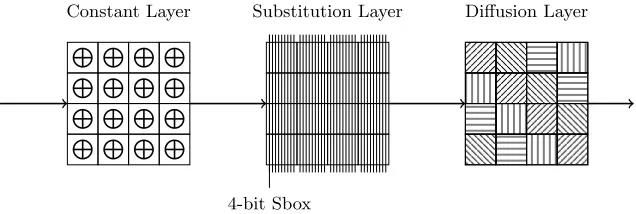
The permutation PH contains three identical rounds. One round is composed of three layers:
constants are first XORed to the internal state, then 4-bit Sboxes are applied to the whole state by taking one bit of each 32-bit word of the same column of the 4×4 matrix and repeating the process for all bit positions. Finally, a linear layer is applied to four 32-bit words diagonals of the 4×4 matrix independently (see Figure 12).
Constant Layer Substitution Layer
4-bit Sbox
Diffusion Layer
Fig. 12.One round of the internal permutationPH ofHAMSI. Each cell represents a 32-bit word.
Side-channel analysis. The known random message M (after expansion) and the secret chaining variable CV fill the internal state matrix as shown in Figure 11 (32-bit words are denotedmi and cvi). The first layer of the permutationPH XORs each matrix element with a
constantti:
Then is applied theHAMSISbox layer. This Sbox is acting over 4-bits (one bit per word located in the same column of the state matrix). Therefore, the input of each Sbox is composed of 2 known message bits and 2 unknown chaining variable bits. The generic selection function for
HAMSIcan therefore be written as:
w=Sbox(m0i[b]||cv0i+2[b]||m0i+4[b]||cvi0+6[b]) orw=Sbox(cv0i[b]||m0i+2[b]||cvi0+4[b]||m0i+6[b])
for i ∈ [0,1] and b ∈ [0, . . . ,127] where b is the bit index in a 128-bits word. Overall, one recovers two bits ofcvi0 at a time with a total of 4 times 128 correlation computations (with 4 guess each).
6 Conclusion and Discussions
For each hash proposal considered in this article, we described an appropriate selection function for an efficient side-channel attack. The table below summarize these results in terms of selection function and secret chaining variable size.
Candidates Selection function Correlation analysis
ECHO AESSbox 64 analysis at byte level (x4 possibilities)
Grøstl AESSbox 64 analysis at byte level
SHAvite-3 AESSbox 16 + 16 analysis at byte level
BLAKE Modular addition 32 analysis at byte level
CubeHash Modular addition and XOR 64 ADD + 64 XOR analysis at byte level
HAMSI HAMSISbox 128 analysis at 2-bit level
In the case of the AES-basedSHA-3 candidates, we did not found significant differences of performance when choosing the selection function. Indeed, in ECHO, Grøstl and SHAvite-3, one has to compute several AES Sbox side-channel attacks in order to retrieve the full secret internal state. Up to a small complexity/number of power traces factor, the three schemes seem to provide the same natural vulnerability to side-channel cryptanalysis. As expected, their situation is therefore very close to the realAES block cipher.
AttackingBLAKE seems feasible in practice since we managed to derive a modular addition selection function for recovering the 256 bits of unknown chaining variable. The modular ad-dition non-linearity is very valuable for the attacker as it increases the correlation contrast. Then, forCubeHash (a typical ARX function) we tried to force the selection function to be of modular addition type as much as possible. Overall, 512 bits can be recovered with modular addition selection function and 512 bits with XOR selection function. In practice, depending on the underlying hardware, it could be challenging to mount the attack. One must notice that the internal state is bigger forCubeHashthan for other candidates. This is an additional strength since in practice, if the side-channel attack gives only probabilistic results, the final exhaustive search complexity will be higher. Finally, forHAMSI, the attack would be difficult to mount despite the fact that a substitution table is used. Indeed, the correlation contrast for this primitive is quite low compared to the AES Sbox. We believe that a better selection function involving a modular addition might possibly be found in the inner layer.
For example, in the case of AES-based hash functions, one could perform secure round com-putations and leverage all the research achieved so far on this subject [2, 21]. Also, as ECHO
processes parallel AES rounds, we believe it could benefit from secure bit-slice implementa-tions regarding some side-channels attacks [27], while maintaining its normal use efficiency. Finally, ECHO and SHAvite-3 can take advantage of the natural protection inherited from the hardware implementations of theAES round such as the new AES NI instruction set on Intel microprocessor [8].
Side-channel countermeasures for ARX constructions such as BLAKE or CubeHash are of course possible, but they will require to constantly switch from boolean to arithmetic masking. As a consequence, one will observe an important decrease of the speed performance for secure implementations. AES-based hash functions seem naturally easier to attack regarding side-channel cryptanalysis, but are also easier to protect.
References
1. Dakshi Agrawal, Bruce Archambeault, Josyula R. Rao, and Pankaj Rohatgi. The EM Side-Channel(s). In Jr. et al. [23], pages 29–45.
2. Mehdi-Laurent Akkar and Christophe Giraud. An Implementation of DES and AES, Secure against Some Attacks. In C¸ etin Kaya Ko¸c, David Naccache, and Christof Paar, editors,CHES, volume 2162 ofLNCS, pages 309–318. Springer, 2001.
3. Jean-Philippe Aumasson, Luca Henzen, Willi Meier, and Raphael C.-W. Phan. SHA-3 proposal BLAKE. Submission to NIST, 2008.
4. Mihir Bellare. New Proofs for NMAC and HMAC: Security Without Collision-Resistance. Cryptology ePrint Archive, Report 2006/043, 2006. http://eprint.iacr.org/.
5. Mihir Bellare, Ran Canetti, and Hugo Krawczyk. Keying Hash Functions for Message Authentication. In Neal Koblitz, editor,CRYPTO, volume 1109 ofLNCS, pages 1–15. Springer, 1996.
6. Mihir Bellare, Joe Kilian, and Phil Rogaway. The Security of Cipher Block Chaining. In Advances in Cryptology -CRYPTO’94, Santa Barbara, Californie, tats-Unis, pages 341–355. LNCS 839, Springer-Verlag, 1994.
7. Ryad Benadjila, Olivier Billet, Henri Gilbert, Gilles Macario-Rat, Thomas Peyrin, Matt Robshaw, and Yannick Seurin. SHA-3 Proposal: ECHO. Submission to NIST, 2008. Available online at http://crypto. rd.francetelecom.com/echo/.
8. Ryad Benadjila, Olivier Billet, Shay Gueron, and Matthew J. B. Robshaw. The Intel AES Instructions Set and the SHA-3 Candidates. In Mitsuru Matsui, editor,ASIACRYPT, volume 5912 ofLNCS, pages 162–178. Springer, 2009.
9. Daniel J. Bernstein. CubeHash specification (2.B.1). Submission to NIST (Round 2), 2009.
10. Guido Bertoni, Joan Daemen, Micha¨el Peeters, and Gilles Van Assche. Radiogatun, a belt-and-mill hash function. Presented at Second Cryptographic Hash Workshop, Santa Barbara (August 24-25, 2006). See http://radiogatun.noekeon.org/.
11. Eli Biham and Orr Dunkelman. The SHAvite-3 Hash Function. Submission to NIST (Round 2), 2009. http://www.cs.technion.ac.il/~orrd/SHAvite-3/Spec.15.09.09.pdf.
12. Gilles Brassard, editor.Advances in Cryptology - CRYPTO ’89, 9th Annual International Cryptology Con-ference, Santa Barbara, California, USA, August 20-24, 1989, Proceedings, volume 435 ofLNCS. Springer, 1990.
13. Eric Brier, Christophe Clavier, and Francis Olivier. Correlation Power Analysis with a Leakage Model. In Joye and Quisquater [22], pages 16–29.
14. Ivan Damg˚ard. A Design Principle for Hash Functions. In Brassard [12], pages 416–427.
15. FIPS 197. Advanced Encryption Standard. Federal Information Processing Standards Publication 197, 2001. U.S. Department of Commerce/N.I.S.T.
16. FIPS 46-3. Data Encryption Standard. Federal Information Processing Standards Publication, 1999. U.S. Department of Commerce/N.I.S.T.
17. Pierre-Alain Fouque, Ga¨etan Leurent, Denis R´eal, and Fr´ed´eric Valette. Practical Electromagnetic Template Attack on HMAC. In Christophe Clavier and Kris Gaj, editors, CHES, volume 5747 of Lecture Notes in Computer Science, pages 66–80. Springer, 2009.
19. Praveen Gauravaram and Katsuyuki Okeya. An Update on the Side Channel Cryptanalysis of MACs Based on Cryptographic Hash Functions. In K. Srinathan, C. Pandu Rangan, and Moti Yung, editors, INDOCRYPT, volume 4859 of Lecture Notes in Computer Science, pages 393–403. Springer, 2007.
20. Praveen Gauravaram and Katsuyuki Okeya. Side Channel Analysis of Some Hash Based MACs: A Response to SHA-3 Requirements. In Liqun Chen, Mark Dermot Ryan, and Guilin Wang, editors, ICICS, volume 5308 ofLecture Notes in Computer Science, pages 111–127. Springer, 2008.
21. Jovan Dj. Golic and Christophe Tymen. Multiplicative Masking and Power Analysis of AES. In Jr. et al. [23], pages 198–212.
22. Marc Joye and Jean-Jacques Quisquater, editors. Cryptographic Hardware and Embedded Systems - CHES 2004: 6th International Workshop Cambridge, MA, USA, August 11-13, 2004. Proceedings, volume 3156 of LNCS. Springer, 2004.
23. Burton S. Kaliski Jr., C¸ etin Kaya Ko¸c, and Christof Paar, editors. Cryptographic Hardware and Embedded Systems - CHES 2002, 4th International Workshop, Redwood Shores, CA, USA, August 13-15, 2002, Revised Papers, volume 2523 ofLNCS. Springer, 2003.
24. John Kelsey. How to Choose SHA-3. http://www.lorentzcenter.nl/lc/web/2008/309/presentations/ Kelsey.pdf.
25. Lars R. Knudsen, Christian Rechberger, and Søren S. Thomsen. The Grindahl Hash Functions. In Alex Biryukov, editor,FSE, volume 4593 ofLNCS, pages 39–57. Springer, 2007.
26. Paul C. Kocher, Joshua Jaffe, and Benjamin Jun. Differential Power Analysis. InCRYPTO, pages 388–397, 1999.
27. Robert K¨onighofer. A Fast and Cache-Timing Resistant Implementation of the AES. InCT-RSA, pages 187–202, 2008.
28. Kerstin Lemke, Kai Schramm, and Christof Paar. DPA on n-Bit Sized Boolean and Arithmetic Operations and Its Application to IDEA, RC6, and the HMAC-Construction. In Joye and Quisquater [22], pages 205–219.
29. Robert P. McEvoy, Michael Tunstall, Colin C. Murphy, and William P. Marnane. Differential Power Analysis of HMAC Based on SHA-2, and Countermeasures. InWISA, pages 317–332, 2007.
30. Ralph C. Merkle. One Way Hash Functions and DES. In Brassard [12], pages 428–446.
31. National Institute of Standards and Technology. FIPS 180-1: Secure Hash Standard.http://csrc.nist.gov, April 1995.
32. National Institute of Standards and Technology. FIPS PUB 197, Advanced Encryption Standard (AES). Federal Information Processing Standards Publication 197, U.S. Department of Commerce, 2001.
33. National Institute of Standards and Technology. Announcing Request for Candidate Algorithm Nominations for a NewCryptographic Hash Algorithm (SHA-3) Family.Federal Register, 27(212):62212–62220, November 2007. Available:http://csrc.nist.gov/groups/ST/hash/documents/FR_Notice_Nov07.pdf(2008/10/17). 34. NIST. FIPS 198 – The Keyed-Hash Message Authentication Code (HMAC), 2002.
35. Katsuyuki Okeya. Side Channel Attacks Against HMACs Based on Block-Cipher Based Hash Functions. In Lynn Margaret Batten and Reihaneh Safavi-Naini, editors, ACISP, volume 4058 of Lecture Notes in Computer Science, pages 432–443. Springer, 2006.
36. ¨Ozg¨ul K¨uc¨uk. The Hash Function Hamsi. Submission to NIST (updated), 2009.
37. Ronald L. Rivest. RFC 1321: The MD5 Message-Digest Algorithm. http://www.ietf.org/rfc/rfc1321. txt, April 1992.
38. Xiaoyun Wang, Yiqun Lisa Yin, and Hongbo Yu. Finding Collisions in the Full SHA-1. InCRYPTO, pages 17–36, 2005.