© 2017, IJCSMC All Rights Reserved 448 Available Online atwww.ijcsmc.com
International Journal of Computer Science and Mobile Computing
A Monthly Journal of Computer Science and Information Technology
ISSN 2320–088X
IMPACT FACTOR: 6.017
IJCSMC, Vol. 6, Issue. 6, June 2017, pg.448 – 456
The End-User Continuance Intention with an Open
Source ERP: A Proposal for an Integrated Model
Mohammed Khadir¹, Mustapha Belaissaoui²
¹²SIAD laboratory, University Hassan I, ENCG, Settat, Morocco ¹ [email protected], ² [email protected]
Abstract— The massive recourse to the use of the Open Source ERP (Enterprise Resource planning) recalls the necessity of the evaluation of its success with the end user, the objective of this study is to propose a model to evaluate the tendency of the end user to continue using an Open Source ERP. The proposed model is the result of a review of theories and concepts linked with the IS Success in addition to a qualitative study in the use context of the Open Source ERP. This model retains the causal link between the expectations confirmation and the satisfaction of the end user in one hand, and the continuance intention in the other hand as has been proved in the Bhattacherjee model of IS Continuance, furthermore, we suggest to adopt the quality of the system, the information and the service as an explanatory variable of the end user satisfaction, finally, the user background is shown as a moderator variable.
Keywords: ERP, Open Source Software, Success, Continuance Intention, End user
I. INTRODUCTION
The Open Source Software occupies currently an increasingly large and important share of the ERP Market, the principles on which they are founded have favoured the significant increase of its use specially by the small or medium-sized companies who find in this kind of software an economical solution for a simple and efficient management of their information system, however, despite its adoption for many years and in various fields, there is little researches into the success of OS ERP
[24]
especially in the relationship with the end user, therefore, There is a lack in the determination of the appropriate construct reflecting this success and the dimensions leading to. In this context, this article proposes to summarise the factors influencing the end user OS ERP success with a continuance intention view, we suppose that the success of the OS ERP lies in the tendency of the user to continue to use it rather than accept it for a first use[3]
.© 2017, IJCSMC All Rights Reserved 449
II. THE END-USER INFORMATION SYSTEM SUCCESS: THEORIES, CONSTRUCTS AND DIMENSIONS
A. Theoretical Foundations of IS End User Success
The Previous researches in IS Success are based mainly on three basic theories: Expectation confirmation theory [21], theory of reasoned action [8] and Theory of Planned Behavior [2. The Expectation confirmation theory is used in marketing to explain the origin of the satisfaction feeling in the use of a product, it argues that the consumer compare his decision on the expected performance before using the product and the perceived performance after the use, this comparison leads to either positive feeling (satisfaction) if the perceived performance coincide with or exceed the expectations, or negative feeling (dissatisfaction) if the perceived performance is not up to the expectations, in the Context of use of information system, the Expectation Confirmation theory has served as a base for several models of success to explain user satisfaction [16] and continuance intention
[3]
[6]. In other reference models[7][28][29][30][32][33]
, the Theory of reasoned action has been used to explain the influence of the attitude toward using the system and subjective norm on behavioural intention to use it and on the use Behavior, it explains that the behaviour (the use of the system in IS context) is the result of a pre-existing attitudes and behavioural intentions. As an extension of the Reasoned action theory, Azjen (1991) has included in a Planned Behavior Theory theimpact of the perceived behavioural control on behavioural intention, according to this theory, the individual connects the ease or the difficulty of performing the particular behaviour to some facilitating factors such as self-efficacity, this concept has been retained in TAM 3 to explain the perceived ease of use of an information system.B. IS Success constructs
The literature review shows a diversity in the choice of constructs reflecting end user IS success, the most widespread constructs are the acceptance, the satisfaction, the net benefits and the continuance intention. Some researchers
[29][30]
have measured the success of an IS through the tendency of the user to accept to use the system rather than refuse to use it (Davis 1989), this success construct is logically adapted to voluntary use contexts because in mandatory use context the user cannot refuse the system. Some researchers[1[13]
[16][17]
have chosen the satisfaction as a substitute of IS Success because of the validity of its content, the ease of its measurement and its reliability [16][26]
. In their Information System Success Model (ISSM), Delone and Mclean[33]
have retained the use of the system and user satisfaction as two independent variables leading to the perceived benefits of Information System, they considered that the success of an IS is a result of its capacity to positively influence the managerial decisions of the user (individual level) and the organizational performance of the company (organizational level). The continuance intention is another success construct that have been introduced by Bhattacherjee[3]
and based on the Expectation confirmation theory [21], he argues that « while initial acceptance of IS is an important first step toward realizing IS success, long-term viability of an IS and its eventual success depend on its continued use rather than the first time use », this construct have gained prominence because it is seen as “the key indicator to the successfulness of information systems”
[15]
. In this paper, we consider that the success of the ERP OS lies in its positive long-term relationship with the user, which foster the continuous intention to use it.C. IS Success Dimensions:
1) System Characteristics: Referring to IS end user Success models, we have observed that different System
characteristics have been deployed to explain success constructs. in the Technology Acceptance Model
[28][29]
, the acceptance of the technology depends on two major factors: the perceived usefulness or “the degree to which a person believes that using a particular system would enhance his or her job performance” and perceived ease of use or “the degree to which a person believes that using a particular system would be free of effort”[7]
, hence, the intrinsic performance of the system is determined by its capacity to make the work more effective in terms of productivity, clarity and effortlessness. following the same logic, the Unified Theory of Acceptance and Use of Technology[30]
links the usage behaviour with the performance expectancy and effort expectancy (respectively usefulness and ease of use in TAM). In the ISSM[33]
, the user satisfaction and system acceptance are the result of the system quality: “the desired characteristics such as accuracy, meaningfulness, and timeliness”, the information quality “the desired characteristics of the information system itself which produces the information” and the service quality, in this model, Delone and Mclean have criticised the ease of use dimension in TAM because of its “inability to capture the system quality as a whole”[25]
. In our article, we propose to retain the system characteristics given by Delone and Mclean because they appeared in several IS Success studies especially in ERP use context[26]
.© 2017, IJCSMC All Rights Reserved 450
demonstrated the moderator role of the user experience and the voluntariness in influencing the perceived usefulness and intention to use, in the same model, they have also found that the subjective norm defined as “The degree to which an individual perceives that most people who are important to him think he should or should not use the system” has also a direct impact on perceived usefulness. The UTAUT Model
[30]
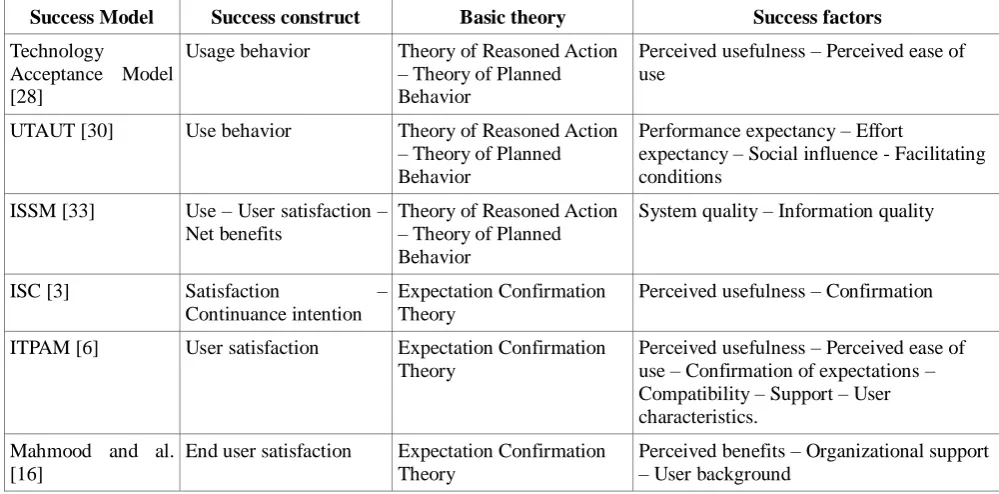
have added the gender, the age to the moderator variable that appear in TAM. Finally, the user experience, skills and involvement in system development have been proposed by Mahmood and al. [16] to explain the IT end-user satisfaction.The summary table below gives a review of the several theories, constructs and dimensions deployed in the reference models of IS Success.
Success Model Success construct Basic theory Success factors
Technology
Acceptance Model [28]
Usage behavior Theory of Reasoned Action – Theory of Planned Behavior
Perceived usefulness – Perceived ease of use
UTAUT [30] Use behavior Theory of Reasoned Action – Theory of Planned Behavior
Performance expectancy – Effort
expectancy – Social influence - Facilitating conditions
ISSM [33] Use – User satisfaction – Net benefits
Theory of Reasoned Action – Theory of Planned Behavior
System quality – Information quality
ISC [3] Satisfaction – Continuance intention
Expectation Confirmation Theory
Perceived usefulness – Confirmation
ITPAM [6] User satisfaction Expectation Confirmation Theory
Perceived usefulness – Perceived ease of use – Confirmation of expectations – Compatibility – Support – User characteristics.
Mahmood and al. [16]
End user satisfaction Expectation Confirmation Theory
Perceived benefits – Organizational support – User background
Table 1: Constructs, Theories and Concepts deployed in IS Success Reference Models
III. THE OPEN SOURCE SORTWARE USE CONTEXT
An Open Source Software is an application that the user can execute, study, modify and redistribute the modifications without restrictions from the publisher, the possibility to read the source code lets see how the application works through an understandable language by the user. The Open source software presents a development model that differs from that of the proprietary software, the user and the developer are in mutual collaboration for the study and the amelioration of the software, thereby constituting an informal community. In the usage context of an Open Source ERP, the user can either have recourse directly to the community for assistance or request the services of an integration service provider.
In the aim to understand the factors leading the user to continue using an Open Source ERP, we have conducted two qualitative studies, the first one concerns an analysis of thirty texts of user feedback collected from forums, download websites and articles. The second study consists of ten semi-structured interviews with ERP OS Integrators.
A. Textual Analysis
We have bundled thirty texts about user feedback after using an Open Source ERP in one corpus, we then have searched the most repeated words and that have the strongest links with “OSS” word, the results of the textual analysis are shown in
Appendix A and B.
The textual analysis shows that other factors could be taken in measuring ERP OS Success:
© 2017, IJCSMC All Rights Reserved 451
The control over the software: the visibility of the source code allows the user to see how the software works, which imparts the assurance about the security, the availability, the stability and the independence vis-a-vis the publisher.
The role of the community: the community has an important contribution in facilitating software use, the majority of users has cited their recourse to the community for help and support.
B. Interviews with Integrators
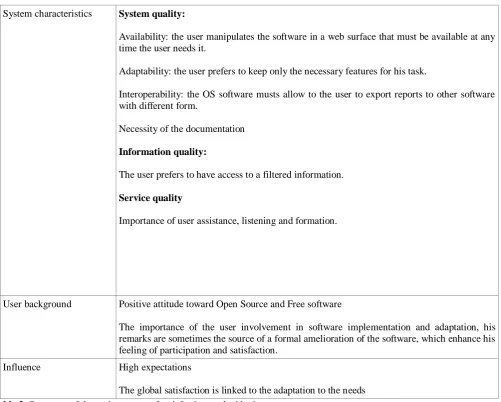
We have conducted ten interviews with an integration service providers using a semi-structured interview guide based on the dimensions retained from the literature review, we suppose that the integrators are sufficiently close to report the user interactions with the ERP OS and have largely the experience and the knowledge to address the subject of its Success, we have synthesised the most relevant answers in the table below:
System characteristics System quality:
Availability: the user manipulates the software in a web surface that must be available at any time the user needs it.
Adaptability: the user prefers to keep only the necessary features for his task.
Interoperability: the OS software musts allow to the user to export reports to other software with different form.
Necessity of the documentation
Information quality:
The user prefers to have access to a filtered information.
Service quality
Importance of user assistance, listening and formation.
User background Positive attitude toward Open Source and Free software
The importance of the user involvement in software implementation and adaptation, his remarks are sometimes the source of a formal amelioration of the software, which enhance his feeling of participation and satisfaction.
Influence High expectations
The global satisfaction is linked to the adaptation to the needs
Table 2: Summary of the main sources of satisfaction evoked by integrators
IV. PROPOSAL for THE INTEGRATED MODEL
© 2017, IJCSMC All Rights Reserved 452
Delone and Mclean
[32][33]
namely system quality, information quality and service quality, this structure has been proposed in several researches specially in measuring End User Satisfaction with an ERP System[26]
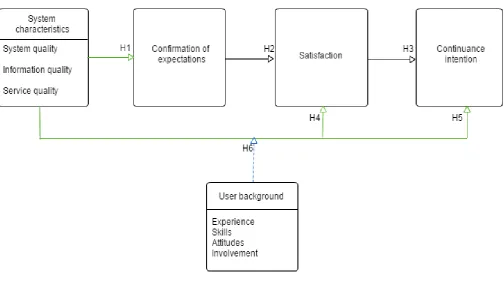
, furthermore, we propose to include the user background to the model either as an independent or a moderator variable, in this sense, we suggest that user attitude and feeling of control could affect the user satisfaction and continuance intention in addition with the user skills, experience and involvement proposed by Mahmood and al. (2000).The proposed causal links between the dimensions of the Open Source ERP Success are presented in the Research Model below.
Figure 1. Research Model of Open Source ERP End-user Continuance Intention
V. CONCLUSION
This article proposes a conceptual model for measuring the user continuance intention with Open Source ERP, the factorial structure is mainly adopted from the ISC model of Bhattacherjee (2001) with a difference concerning the factors leading to the satisfaction, we propose to adopt the dimensions figured in ISSM of Delone and Mclean, we suppose that the influence of the system quality, the information quality and the service quality could be moderated by some factors referring to the user background, such as the experience and involvement. We have tried to assemble the influencing factors of the continuance intention of ERP OS user in a same conceptual model, however, the present model is still in the theoretical level, the validity and the reliability of this model must be reinforced by empirical studies.
REFERENCES
[1] Amy W. Gatian:"Is user satisfaction a valid measure of system effectiveness” Information & Management, vol.26, pp. 119-131, 1994.
© 2017, IJCSMC All Rights Reserved 453
[3] Anol Bhattacherjee: «Understanding Information Systems Continuance: An Expectation-Confirmation Model", MIS Quarterly, Vol. 25, No. 3, pp. 351-370,2001.
[4] Blake Ives and Margrethe H. Olson: “User Involvement and MIS Success: A Review of Research", Management Science, vol.30, No.5, pp. 586-603,1984.
[5] Brahim Hadji and Patrice Degoulet:"Information System End-user Satisfaction and Continuance Intention: a Unified Modelling Approach” Journal of Biomedical Informatics,2015.
[6] Brahim Hadji, Isabelle Dupuis, Laurence Leneveut, Didier Heudes, Jean-François Wagner et Patrice Degoulet:"La satisfaction des utilisateurs des Systèmes d'Information Clinique du Groupe Hospitalier Paris Ouest (HUPO)", Articles longs des 15ième Journées francophones d’informatique médicale, ,2014, pp. 115-126.
[7] Davis, Fred D.: "Perceived usefulness perceived ease of use and user acceptance of information technology", MIS Quarterly, vol.13, pp. 319-339,1989.
[8] Fishbein, M., and Ajzen, I.: “Belief, Attitude, Intention and Behavior: An Introduction to Theory and Research” Addison-Wesley, Reading, MA, 1975.
[9] Fred D. Devis:"User acceptance of information technology: system characteristics and behavioral impacts", International J.
Man-Machine Studies, vol.38, pp. 475-487,1993.
[10] Iosif Alvertisa, Sotiris Koussourisa, Dimitris Papaspyrosa, Evangelos Arvanitakisa, Spiros Mouzakitisa, Sebastian Frankenb, Sabine Kolvenbachb, and Wolgang Prinzb:"User Involvement in Software Development Processes", Procedia Computer Science, vol.97, pp. 73-83,2016.
[11] Jack J. BAROUDI, Margrethe H. OLSON, and Blake IVES: "An empirical study of the impact of user involvement on System Usage and Information satisfaction”, Management of Computing, vol.29, No.3, pp. 232-238, 1986.
[12] James D. McKeen, Tor Guimaraes and James C:"The Relationship between User Participation and User Satisfaction: An Investigation of Four", MIS Quarterly, vol. 18, No. 4, pp. 427-451,1994.
[13] Jamshid Etezadi-Amoli and Ali F. Farhoomand :"A structural model of end user computing satisfaction and user performance", Information & Management, vol.30, pp. 65-73, 1996.
[14] Jean-Marc Palm, Thierry Dart, Isabelle Dupuis, Laurence Leneveut and Patrice Degoulet: "Clinical Information System Post-Adoption Evaluation at the Georges Pompidou University Hospital", Collaborative Research for Effective Diagnostics, Sherbrooke University, pp. 582-585,2010.
[15] Michael Yu-Ching Lin: “Understanding information systems continuance intention: a five-factor model of personality perspective”, Pacific Asia Conference on Information Systems,2010, pp. 367-376.
[16] Mo A. MAHMOOD, Janice M. BURN, Leopoldo A. GEMOETS and Carmen JACQUEZ: "Variables affecting information technology end-user satisfaction: a meta-analysis of the empirical literature", International J. Human-Computer Studies,52, pp 751-771, 2000.
[17] Moshe Zviran:"Measuring IS User Satisfaction: Review and Implications", Communications of the Association for Information System,2003s, vol.12, pp. 81-103.
[18] Muneera Bano and Didar Zowghi:"A systematic review on the relationship between user involvement and system success",
Information and Software Technology, vol.58, pp. 148-169,2015.
[19] Muneera Bano and Didar Zowghi:"User Involvement in Software Development and System Success: A Systematic Literature Review", the 17th International Conference on Evaluation and Assessment in Software Engineering, 2013, pp 125-130
[20] Norman Aua, Eric W.T. Ngaib and T.C. Edwin Chengb:"A critical review of end-user information system satisfaction research and a new research framework", OMEGA, vol.30, pp. 451-478,2002.
[21] Oliver, R. L. "A Cognitive Model for the Antecedents and Consequences of Satisfaction," Journal of Marketing Research
(17), pp. 460-469, 1980.
[22] Peter B. Seddon: "Dimensions of information systems success», Communications of AIS,1999, vol.2, No.20.
[23] Rajiv Sabherwal, Anand Jeyaraj and Charles Chowa:"Information System Success: Individual and Organizational Determinants", Management Science, vol. 52, No. 12, pp. 1849-1864,2006.
[24] Sang-Yong Tom Leea, Hee-Woong Kimb and Sumeet Guptab:"Measuring open source software success", The International Journal of Management Science, vol.37, pp. 426-438,2009.
© 2017, IJCSMC All Rights Reserved 454
[26] Toni M. Somers: “Confirmatory factor analysis of the end-user computing satisfaction instrument: Replication within an ERP domain", Department of information systems and manufacturing, vol.34, No 3, pp. 595-621,2003.
[27] Udo Konradta, Timo Christopher sena, Ute Schaeffer-Kuelzb:"Predicting user satisfaction, strain and system usage of employee self-services", International J. Human-Computer Studies, vol.64, pp. 1141-1153,2006.
[28] Viswanath Venkatesh: "Technology Acceptance Model 3», Journal compilation, vol.39, No.2, pp. 275-315,2008.
[29] Viswanath Venkatesh and Fred D. Davis: "A Theoretical Extension of the Technology Acceptance Model: Four Longitudinal Field Studies», Management Science, vol. 46, No. 2, pp. 186-204,2000.
[30] Viswanath Venkatesh, Michael G. Morris, Gordon B. Davis and Fred D. Davis: "User Acceptance of Information Technology: Toward a Unified View", MIS Quarterly, vol.27, No.3, pp. 425-478,2003.
[31] W.J. DOLL and G. TORKZADEH: “The Measurement of End-User Software involvement", OMEGA Int. J. of Management Science, vol. 18, No. 4, pp. 399-406,1990.
[32] William H. DeLone and Ephraim R. McLean: «Information Systems Success: The Quest for the Dependent variable»,
Institute for Operations Research and the Management Sciences, vol. 3, No. 1, pp. 60-95,1992.
[33] William H. DeLone and Ephraim R. McLean: «The DeLone and McLean Model of Information Systems Success», Journal of Management Information Systems, vol.19, No. 4, pp. 9-30,2003.
© 2017, IJCSMC All Rights Reserved 455 APPENDIX