Higginbotham, I. 1975. Composition and production of vegetation on the Steel, R.G.D., and J.H. Tonie. 1960. Principles and Procedures of Statis- Zachry Ranch in the South Texas Plains. Unpub. M.S. Thesis. Texas tics. McGraw-Hill Book Co., Inc., New York. 481 p.
A&I Univ., Kingsville. 131 p. United States Department of Commerce. 1970. Climatological summary.
Jennings, W.S., and J.T. Harris. 1953. The collared peccary in Texas. Brownsville, Texas. 46 p. Texas Game and Fish Comm., Fed. Aid Rep. Ser. 10, Austin. 31 p.
Potential Herbicides for Brush Control
R.W. BOVEY, R.E. MEYER, AND J.R. BAUR
Abstract
Several new herbicides and herbicide combinations were evalu- ated in the greenhouse for control of honey mesquite, huisache, whitebrush, live oak and Texas persimmon. Sprays of picloram, triclopyr ester and 3,6-dichloropicolinic acid at 0.56 kg/ha were the most effective herbicides in reducing the canopy of honey mesquite. Picloram at 0.14 to 0.56 kg/ha effectively defoliated huisache. At 1.12 kg/ha tebuthiuron, buthidazole, hexazinone and 3,6_dichloropicolinic acid also defoliated huisache. Whitebrush was effectively controlled with picloram, triclopyr ester, tebuthiu- ron, buthidazole, hexazinone, dicamba and ethidimuron at 0.56 kg/ha. None of the treatments was effective against live oak or Texas persimmon. Certain combinations of picloram plus tric- lopyr effectively defoliated whitebrush and honey mesquite. Piclo- ram plus 3,6-dichloropicolinic acid was also effective for honey mesquite control.
Development of herbicides for woody plant control is expensive, requires relatively large land areas and several years of investiga- tion. Use of a woody plant nursery (Bovey et al. 1979) can hasten the evaluation of herbicides, but also requires large material and labor inputs. The greenhouse offers a more rapid method to evalu- ate potential herbicides for woody plant control (Bovey and Meyer 1974; Bovey et al. 1967; Bovey et al. 1968). The greenhouse also allows a large number of herbicide treatments to be evaluated in a relatively limited space. Evaluations at 2 and 6 months after treat- ment in the greenhouse is a valid indication of herbicide effective- ness, whereas field evaluations may take 2 to 3 years or longer (Bovey and Meyer 1978; Meyer et al. 1969; Meyer and Bovey
1979a, 1979b, and 1979~; Scifres 1975).
Several herbicides that have become available since 1972 were evaluated alone and in mixtures in the greenhouse for their poten- tial to control undesirable woody plants. The objective of this paper is to present the relative efficacy of those compounds to expedite selection of potential treatments for brush control which warrant continued evaluation under field conditions.
Materials and Methods
Honey mesquite [Prosopis juliflora (Swartz) DC var. glandulosa (Torr.) Cockerell], huisache [Acacia farnesiana (L.) Willd.], live oak (Quercus virginiana (Mill.), and Texas persimmon (Diospyros zexana Scheele) plants were grown in the greenhouse for 1 to 2 4- years in 12.7-cm-diam pots containing 1:l: 1 Houston black clay-
:sand:peat moss mixture. Woody stems ranged from 20 to 40cm in Authors are research agronomist, plant physiologist and plant physiologist, respec- tively, U.S. Department of Agriculture, Science and Education Administration, Agricultural Research, Department of Range Science, Texas A&M University, Col- lege Station, TX 77843.
This paper reports results of research only. Mention ofa pesticide in this paper does not constitute a recommendation by the USDA nor does it imply registration under FIFRA.
Manuscript received September 13, 1979.
height, with one primary stem per plant. Usually, one to three plants were grown per pot. Propagation methods for these woody plants are given elsewhere (Bovey et al. 1979).
All herbicides were applied as foliar-soil sprays at rates ranging from 0.14 to 4.48 kg/ha in water at the equivalent of 93.5 l/ha with a laboratory spray chamber described by Bouse and Bovey ( 1967). After treatment, plants were returned to the greenhouse and top- watered after 24 hours and watered daily thereafter.
Herbicide formulations consisted of the propylene glycol butyl ether ester of (2,4,5-trichlorophenoxy)acetic acid (2,4,5-T), the ethylene glycol butyl ethel ester and the triethylamine salt of [(3,5,6- trichloro-2-pyridinyl)oxy] acetic acid (triclopyr), the potassium salt of 4-amine-3,5,6-trichloropicolinic acid (picloram), the dime- thylamine salt of 3,6dichloro-+anisic acid (dicamba), the ammo- nium salt of ethyl hydrogen (aminocarbonyl)phosphonate (fosamine), the isopropylamine salt of N-(phosphonomethyl)glycine (glyphosate) the alkanolamine salt of (2,4_dichlorophenoxy)-acetic acid (2,4-D), 3[5-( 1, I-dimethylethyl)-1,3,4-thiadiazol-2-yl]-4- hydroxyl-1-methyl-2-imidazolidinone (buthidazole), N-[5-( 1, I- dimethylethyl)-1,3,4-thiadiazol-2-yl]-N,N’-dimethylurea (tebuthi- uron), 3-Cyclohexyl-6-(dimethylamino)-l-methyl-l,3,5-triazine-2,- 4( lH, 3H)-dione (hexazinone), 1,2,-dihydro-3,6_pyridazinedion (MH), rert-butylcarbamic acid ester with 3(m-hydroxyphenyl)-1, l- dimethylurea (karbutilate), 5-bromo-3-see-butyl-6-methyluracil (bromacil), N-[5-(ethylsulponyl)-1,3,4-thiadiazol-2-yl]-N,N’-di- methylurea (ethidimuron), and N3,N3-Di-n-propyl-2-4-dinitro-6-
trifluoromethyl 3-m-phenylenediame (prodiamine) and
3,6-dichloropicolinic acid.
Coded materials included N-[5-(Zchloro- l,l-dimethylethyl)- 1,3,4-thiadiazol-2-yl]-N,N’dimethylurea (“EL-l 12’11, N’(2,5di- fluorophenyl)-h!N’-dimethylurea (DS-17338)1, N-(2,5-difluoro- phenyl)-N-methylurea (DS-18507)‘,6-(l,l-dimethylethyl)-3-( 1 methylethyl)iSothiazolo-[3,4-d]pyrimidin-4(5~)-one (NIA- 19873)‘, N-(2,2dimethoxyethy1)-N’-[5-(1,l-dimethylethyl)-1,3, 4- thiadiazol-2-yl]-N-methylurea (HCS-3510)‘, N-(2,Zdimethyoxy- ethyl)-N’-methyl-~~5~trifluoromethyl)-1,3,4-thiadiazol-2-yl]urea (HCS-3438)1, 4-hydroxy-l-methyl-3-[5-(trifluoromethyl)-1,3,4-thi- adiazol-2-yl]-2-imidiazolidinone (VEL-5028)1, 2-chloro-N-(2,6di- methylphenyl)-N-( 1,3-dioxolan-2-yl methyl)acetamide (VEL 5052)‘. An experimental growth regulator, N,N-dimethylcoco- amine succinate salt (1: 1) (TD-692)’ was also included.
Treatments were evaluated by visually estimating canopy reduc- tion (defoliation) of leaves of each plant at approximately 1 week and 1 to 6 months after treatment. Data reported are from evalua-
Table 1. Percent canopy reduction of l- to 2-year-old honey mesquite, 3 to 6 months after spraying with various herbicides and rates in the greenhouse.1
Herbicide 0 0.14 0.28
Herbicide rate (kg/ ha)
0.56 1.12 2.24 4.48
2,4,5-T (ester) 5c
Picloram 5c
Triclopyr (ester) 5d Triclopyr (amine) 5d
Tebuthiuron 5d
Buthidazole 5c
Hexazinone 5d
Dicamba 5c
Glyphosate 5d
MH 5c
Fosamine 5b
Karbutilate 5c
Bromacil 5c
Ethidimuron 5c
EL-l 12 5c
Prodiamine 5a
3,6dichloropicolinic acid 5 c
HCS 3510 5a
HCS 3438 5c
DS 17338 5b
DS 18507 5c
VEL 5028 5b
VEL 5052 5a
NIA 19873 5b
- 51 b
76 b 79 b
61 c 78 b
11 d 52 c
- 44bc
- 62 b
5d 34 c
- 42 b
13 cd 38 b
- 17 b
- _
- -
- -
- -
- 34 b
- 8a
82 b 94 a
- -
- -
- _
64b 99 a 96 a 92 a 28 c 54 77 b 53 b 25 bc
-
17 a 34 b 14 bc
5c
- 100 a
7a 52 a
5b 38 b 24 a 15 a 8b
95 a 76 b 1OOa 76 b 61 b 95 a 93 a 83 a 35 b 19 b
29 ab 20 b 42 b 6a 1OOa
-
70 b -
87 a 94 a 97 a -
67 a
14 a 80 a 30 ab 62 a
5a -
19 b 48 a 98 a 25 a 9a 73 a
- 1OOa 1OOa 1OOa 94 a 94 a 1OOa -
68 a 52 a
- 46 a 62 a 78 a 5a 1OOa
- -
‘Numbers in horizontal rows followed by the same letter are not significantly different at the 5% level of significance.
tions conducted 3 to 6 months after treatment. Plants with 100% canopy reduction were considered dead. Experiments were repeated at least twice from 1972 to 1978, and data were pooled for presentation in this paper.
A completely randomized design was employed with live repli- cations (pots) for each treatment. One-way analysis of variance was used to allow calculation of a LSD value for paired means with unequal replication. Means were ranked by making paired com- parisons (Steel and Torrie 1960).
Results and Disccusion
0.28, 0.56 and 1.12 kg/ ha was about the same as from equivalent rates of 2,4,5-T (Table 1). In the field equivalent control of honey mesquite from aerial applications of 2,4,5-T or dicamba has been reported (Scifres and Hoffman 1972). Picloram (potassium salt), triclopyr (triethylamine salt and ethylene glycol butyl ether esters), and 3,6_dichloropicolinic acid were equally effective at 0.56 kg/ ha or half the effective rate of 2,4,5-T. At 0.14 and 0.28 kg/ ha the ester of triclopyr was more effective than the amine formulation. In addition, 3,6dichloropicolinic acid was extremely effectiveat only 0.28 kg/ha, reducing the honey mesquite canopy by 94%. Preliminary field data indicated that triclopyr and 3,6-
Honey Mesquite dichloropicolinic acid showed promise for control of honey
Canopy reduction of honey mesquite from dicamba at rates of mesquite in Texas (Jacoby et al. 1979). Based on our experiments,
Table 2. Percent canopy reduction of l- to 2-year-old huisache 3 to 6 months after spraying with various herbicides and rates in the greenhouse.’
Herbicide 0 0.14 0.28
Herbicide rate (kg/ ha)
0.56 1.12 2.24 4.48
2,4,5-T (ester) 4c
Picloram 4b
Triclopyr (ester) 4e Triclopyr (amine) 4c
Tebuthiuron 4d
Buthidazole 4c
Hexazinone 4d
Dicamba 4b
Glyphosate 4d
Fosamine 5b
Karbutilate 4b
Ethidimuron 4d
EL-l 12 4d
Prodiamine 4
3,6-dichloropicolinic acid 4 c
HCS 3510 4a
HCS 3438 4a
DS 17338 4c
DS 18507 4b
VEL 5028 4a
VEL 5052 4a
NIA 19873 4b
- 41 b
94 a 99 a 36 d 50 c
48 b 50 b
_ 90 ab
_ 68 b
Id 68 bc
_ 50 a
5d 34 bc
- _
- 60 b
_ 20 c
_ 0
64 b 71 b
67 a 1OOa 77 b 56 b 58 c 51 b 63 c 47 a 25 c 8b 4b 30 c
0 86 ab
2a 3a 46 b 99 a la 2a lb
64 a 100 a 89 ab 53 b 94 a 92 a 98 a 37 a 48 b
- 74 b 78 b 0 100 a
_ 100 a
77 b 67 b 77 b
87 a 22 a 61 a 89 a
0
4a 77 a 100 a 3a 6a 90 a
- 1OOa
90a 81 a 1OOa 100 a 98 a
75 a
100 a 98 a 0 1OOa
triclopyr and 3,6dichloropicolinic acid have demonstrated adequate herbicidal activity for continued investigations in the field for honey mesquite control.
Soil-applied herbicides, such as buthidazole, hexazinone, DS 18507, and tebuthiuron were very active at 1.12, 1.12,2.24 and 2.24 kg/ ha, respectively, in reducing the canopy of honey mesquite. All other herbicides were less effective on honey mesquite:Tebuthiu- ron and karbutilate are only moderately effective under field con- ditions (Meyer and Bovey 1979b; Scifres et al. 1978; Scifres et al. 1979).
Huisache
Picloram was the most effective herbicide for controlling huisache. Excellent control (<90%) resulted from application rates of 0.14 kg/ ha or more (Table 2). Tebuthiuron at 0.28,1.12 and 4.48 kg/ ha also effectively defoliated huisache, but control was erratic at 0.56 and 2.24 kg/ ha of tebuthiuron. Buthidazole and hexazinone at 1.12 kg/ ha effectively defoliated huisache whereas DS 18507 and 3,6-dichloropicolinic acid were effective at 0.56 kg/ha. NIA
19873 was effective at 2.24 kg/ ha but not at 1.12 kg/ha. Ethidimuron and EL-l 12 (chemically similar to tebuthiuron) were effective at 4.48 kg/ ha. In the field DS- 18507 killed 55,20, and 75% of huisache at 2.24, 4.48 and 8.96 kg/ ha, respectively, 2 years after spray application (Bovey and Meyer, Unpublished data). Tebuthiuron has been investigated and found to be moderately effective for huisache control under field conditions as a soil- applied treatment (Bovey and Meyer 1978; Scifres et al. 1979). Tebuthiuron and bromacil were about equally effective in the field and were more effective than picloram, prometon [2,4- bis(isopropylamino-6-methoxy-s-triazine], 2,3,6-TBA (2,3,6- trichlorobenzoic acid), karbutilate or diuron [3-(3,4-dichloro- phenyl)- 1, I-dimethylurea] at equal rates (Bovey and Meyer 1978). Based on these evaluations and our greenhouse experiments, buthidazole, hexazinone, 3,6dichloropicolinic acid and DS 18507 should be investigated further in the field for huisache control. Whitebrush
Tebuthiuron at 0.14 kg/ ha was more effective on whitebrush than the same rates of picloram, triclopyr or 2,4-D (Table 3). Herbicides at 0.28 kg/ha that killed all plants included 2,4,5-T, tebuthiuron, hexazinone, and dicamba. At 0.56 kg/ha, picloram, triclopyr, tebuthiuron, buthidazole, hexazinone, and ethidimuron were exceptionally effective. Applications of 2.24 kg/ ha of karbut- ilate, DS 18507 or NIA 19873 were required to kill all whitebrush. Glyphosate was effective at 1.12 kg/ ha. The alkanolamine salt
formulation of 2,4-D at 0.56 kg/ha was relatively effective in defoliating whitebrush (80%). Consequently, several new herbi- cides appear promising for improving whitebrush control com- pared to the effectiveness of 2,4-D. In the field, picloram (K salt) has been more effective than any of the phenoxy herbicides for whitebrush control (Meyer et al. 1969). Tebuthiuron also effec- tively control whitebrush in the field (Meyer and Bovey 1979a, Scifres et al. 1979). Herbicides such as triclopyr warrant study under field conditions.
Live Oak and Texas Persimmon
None of the herbicides sprayed on live oak or Texas persimmon was very effective, possibly because the plants were not in an active stage of growth (Table 4). Under field conditions, control of live oak with tebuthiuron at 2.24 kg/ ha was excellent (Meyer and Bovey 1979~). Hexazinone also appears extremely promising for live oak control. Picloram is also effective on live oak, but less so than tebuthiuron. Under field conditions, picloram is one of the most effective soil-applied treatments for control of Texas persim- mon (Meyer and Bovey 1979a; Scifres 1975). In the greenhouse, tebuthiuron, hexazinone and bromacil at 2.24 kg/ ha were not effective and tebuthiuron has not effectively controlled Texas per- simmon in the field (Scifres et al. 1979).
Herbicide Mixtures
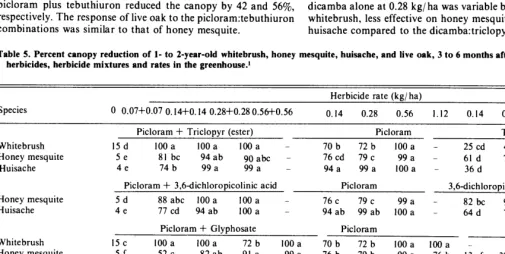
A 1: 1 mixture of picloram (K salt) plus triclopyr (ester) at 0.07 i- 0.07 and 0.14 -I- 0.14 kg/ ha was more effective (synergistic) on whitebrush than comparable rates (0.14 and 0.28 kg/ ha) of either herbicide alone (Table 5). At a total of 0.56 kg/ ha of herbicide, the mixture and single herbicides were about equally effective. On honey mesquite, the picloram:triclopyr mixture was more effective at a total of 0.28 kg/ ha of herbicide than comparable rates of triclopyr alone and picloram alone at 0.28 kg/ha (Table 5). On huisache, all rates of picloram plus triclopyr were more effective than triclopyr alone, but were no more effective than picloram alone at 0.14 kg/ha (Table 5).
Picloram plus 3,6dichloropicolinic acid at 0.14 kg/ ha of each herbicide was more effective on honey mesquite than picloram alone at 0.28 kg/ ha but not 3,6dichloropicolinic acid at 0.28 kg/ ha (Table 5). At a total of 0.56 kg/ha of herbicide, picloram, 3,6- dichloropicolinic acid, or picloram plus 3,6-dichloropicolinic acid were all extremely effective on honey mesquite. On huisache, picloram was more effective than either 3,6-dichloropicolinic acid alone or picloram plus 3,6-dichloropicolinic acid at 0.14 kg/ ha of total herbicide.
Table 3. Percent canopy reduction of l- to 2-year-old whitebrush 3 to 6 months after spraying with various herbicides and rates in the greenhouse.’
Herbicide 0 0.14 0.28
Herbicide rate (kg/ ha)
0.56 1.12 2.24 4.48
2,4,5-T (ester) 15 c
Picloram 15 c
Triclopyr (ester) 15 c
Triclopyr (amine) 15 d
Tebuthiuron 15 b
Buthidazole 15 b
Hexazinone 15 b
Dicamba 15 b
Glyphosate 15 c
MH 15 b
Fosamine 15 ab
Karbutilate 15 c
Bromacil 15 a
Ethidimuron 15 b
2,4-D (amine) 15 b
Pro&amine 15 a
TD 692 15 b
DS 17338 15 c
DS 18507 15 c
NIA 15 b
_ 100 a 50 b 100 a - _
70 b 72 b 100 a 100 a 100 a _
25 bc 42 b 95 a 100 a _ 100 a
48 c 58 bc 68 bc 80 ab _ 100 a
100 a 100 a 100 a 100 a 100 a _
_ _ 100 a 1OOa 100 a _
_ 100 a 100 a 100 a 100 a 100 a
- 100 a 100 a 89 a - _
_ _ 53 b 100 a 94 a -
- 21 b _ 97 a - 92 a
_ _ 16 ab 4b 35 a 19 ab
_ _ 69 b - 100 a _
- 15a - 34 a 22 a -
- - 100 a 1OOa 100 a -
67 a _ 80 a _ - _
- 26 a - 15 a 23 a 30 a
56 a _ 65 a _ - -
- _ 21 b - 57 a -
_ _ 33 b - 100 a _
_ _ 83 a _ 100 a -
Table 4. Percent canopy reduction of l- to 2-year-old live oak and Texas persimmon 3 to 6 months after spraying with various herbicides in the greenhouse.1
Herbicide rate (kg/ ha)
Species and herbicide 0 0.14 0.28 0.56 1.12 2.24 4.48
Live oak 2,4,5-T (ester) Picloram Tebuthiuron Glyphosate Fosamine Karbutilate DS 17338 DS 18507 NIA 19873 Texas persimmon
Tebuthiuron Hexazinone Fosamine Bromacil
16 a 16 c 16 a 16 a 16 b 16 a 16 b 16 b 16 a
7b 7b 7c 7a
-
- 20 a
70 a 42 b
- 20 a
_ 18 a
_ 13 b
- 6a
- 12 b
- 14 b
- 10 a
- 17 bc
-
- - -
- 41 a
10 a 30 a 19 a 42 a 54 a
59 a 8b
39 b 5a
38 a -
46 a -
- 72 a
10 a -
‘Numbers in horizontal rows followed by the same letter are not significantly different at the 5% level of significance.
The addition of glyphosate appeared to enhance the activity of picloram on whitebrush at a total herbicide rate of 0.14 and 0.28
The addition of TD 692 to picloram did not significantly kg/ ha, but not at 0.56 kg/ ha (Table 5). However, the picloram:gly-
enhance the activity of the herbicide compared to piclomm alone on whitebrush (Table 5). TD 692, an experimental growth regula- phosate combination did not improve canopy reduction of honey
mesquite, huisache or live oak, compared to picloram applied
tor, showed considerable herbicidal activity when applied alone, and reduced the whitebrush canopy by 56 and 65% at rates of 0.14
alone at comparable rates. and 0.56 kg/ ha respectively.
The picloram plus tebuthiuron mixtures were applied at rates too high on whitebrush and huisache to determine herbicide inter- actions (Table 5). However, the mixture wasantagonistic on honey mesquite and live oak. For example, picloram alone on honey mesquite at 0.28 and 0.56 kg/ha reduced the honey mesquite canopy by 79 and 99%, respectively, whereas comparable rates of picloram plus tebuthiuron reduced the canopy by 42 and 56%, respectively. The response of live oak to the picloram:tebuthiuron combinations was similar to that of honey mesquite.
Dicamba had little effect on the activity of 3,6-dichloropicolinic acid when applied in a mixture to honey mesquite and huisache compared to 3,6-dichloropicolinic acid alone (Table 6).
On whitebrush, honey mesquite and huisache, dicamba plus triclopyr (ester) were about equally effective to triclopyr alone at comparable rates in the mixture (Table 6). The response of dicamba alone at 0.28 kg/ ha was variable being more effective on whitebrush, less effective on honey mesquite and about equal on huisache compared to the dicamba:triclopyr mixture or triclopyr
Table 5. Percent canopy reduction of l- to 2-year-old whitebrush, honey mesquite, huisache, and live oak, 3 to 6 months after spraying with various herbicides, herbicide mixtures and rates in the greenhouse.’
Herbicide rate (kg/ ha)
Species 0 0.07+0.07 0.14+0.14 0.28+0.280.56+0.56 0.14 0.28 0.56 1.12 0.14 0.28 0.56 1.12
Whitebrush Honey mesquite
Huisache
Picloram •i- Triclopyr (ester) Picloram Triclopyr (ester)
15 d 100 a 100 a 1OOa - 70 b 72 b 100a - 25 cd 42 c 95a - 5e 81 bc 94 ab 90 abc - 76 cd 79 c 99a - 61 d 78 c 96 ab -
4e 74 b 99 a 99a - 94 a 99 a IOOa - 36 d 50 c 77 b _
Picloram + 3,6dichloropicolinic acid Picloram 3,6-dichloropicolinic acid
Honey mesquite 5d 88 abc 100 a 1OOa - 76 c 79 c 99a - 82 bc 94ab 100 a -
Huisache 4e 77 cd 94 ab 1OOa - 94 ab 99 ab 100a - 64 d 71 d 86bc -
Picloram + Glyphosate Picloram Glyphosate
Whitebrush 15 c 100 a 100 a 72 b 100 a 70 b 72 b 100 a 1OOa - _ Honey mesquite
53 b IOOa 5f 52 c 82 ab 91 a 99 a 76 b 79 b 99 a 76b 13ef 38 cd
Huisache
25 de 35 d 4f 90 b 100 a 100 a 100 a 94 b 99 a 100 a 1OOa 5f 34 d 25 e Live oak
48 c
15 d _ _ 32 bc 88a - 70 a 42b - _ _ 18cd -
Picloram + Tebuthiuron Picloram Tebuthiuron
Whitebrush 15 c _
_ 100 a 100a - 72 b 100 a 100a - 100 a 1OOa Honey mesquite
100 a 5f - - 42 de 56 cd - 79 b 99 a 76 bc - 44 de 28 e Huisache
61 cd
4c _ _ 97 a 100 a _ 99 a
Live oak 16~ 100 a 1OOa - 90 a 58 b 94 a
_ _ 22 c 24c - 70 a 42b -
_ _ 2oc -
Picloram -t- TD 692 Picloram TD-692
Whitebrush 15 c _ 84 ab - 100 a 70 b 72b - 1OOa 56b - 65b -
Table 6. Percent canopy reduction of l- to 2-year-old whitebrush, honey mesquite, huisache and Live oak, 3 to 6 months after spraying with various herbicides, herbicide mixtures and rates in the greenhouse.1
Species 0
Herbicide rate (kg/ha)
0.07+0.07 0.14+0.14 0.28+0.28 0.56+0.56 0.14 0.28 0.56 1.12 0.14 0.28 0.56 1.12
Honey mesquite Huisache
Whitebrush Honey mesquite Huisache
Whitebrush Honey mesquite Huisache Live oak
Whitebrush Honey mesquite Huisache Live oak
Whitebrush
Dicamba + 3,6dichloropicolinic acid Dicamba
5e 63 c 87 ab 100a - - 42 d 53 cd -
4e 49 d 52 bed 73 ab - - 50 cd 47 d -
Dicamba •t Triclopyr (ester) Dicamba
15 c 15 c 50 b 93a - - 100 a 100a -
5c 42 b 79 a 88a - - 42 b 53b -
4e 26 d 37 cd 64 ab - - 50 bc 47 bc -
Glyphosate i- Tebuthiuron Glyphosate
15c - - 99 a 100a - - 53b 1OOa
5e - - 11 de 17cde - 38 bc 25 cde 35 bc
4e - - 25 d 83a - 34 cd 25 d 48 bc
16a - - 26 a 24a - - 18a -
Glyphosate -t 2,4,5-T (ester) Glyphosate
15c - _ 16 c 36b - - 53 b 100 a
5f - _ 80 ab 75b - 38 de 25 e 35 e
4e - _ 1OOa 83ab - 34 cd 25 d 48 c
16a - _ 34 a 18a - - 18a -
2,4-D (amine) + TD 692 2,4-D (amine)
15c - 84 ab - 100 a 67b - 80 ab -
3,6dichloropicolinic acid
82 b 94ab 100 a - 64ad 71abc 86a -
Triclopyr (ester)
25 bc 42 b 95a - 61 b 78 a 96a - 38 cd 50 bc 77 a -
Tebuthiuron
- 100 a 1OOa 1OOa - 44 b 28bcd 61a _ 90 a 58 b 94 a
- - 20a -
2,4,5-T (ester)
- - 50b 1OOa
- 51cd 64bc 95 a - 41 c 67b 64b
_ - 20a -
TD-692
56b - 65b -
‘Numbers in horizontal rows followed by the same letter are not significantly different at the 5% level of significance.
alone at comparable rates.
No consistent trends were noted for the glyphosate:tebuthiuron mixture compared to each herbicide alone, indicating that there were no interactions on control of wood plants evaluated (Table 6). However, 2,4,5-T combined with glyphosate was less effective (antagonistic) than either herbicide applied alone on whitebrush.
On honey mesquite, glyphosate was ineffective and the addition of glyphosate to 2,4,5-T did not enhance its activity. Glyphosate plus 2,4,5-T combined at equal rates of 0.28 kg/ha was significantly more effective than either herbicide alone at 0.56 kg/ha when applied to huisache. Live oak control was poor with 2,4,5-T, glyphosate or the mixture of 2,4,5-T plus glyphosate. The addition of TD 692 to 2,4-D amine did not appear to improve the effective- ness of 2,4-D for whitebrush control.
Bovey, R.W., F.S. Davis, and H.L. Morton. 1968. Herbicide combinations for woody plant control. Weeds 16:332-335.
Bovey, R.W., F.S. Davis, and M.G. Merkle. 1967. Distribution of picloram in huisache after foliar and soil applications. Weeds 15:245-249. Bovey, R.W., and R.E. Meyer. 1974. Mortality of honey mesquite and
huisache seedlings from herbicides and top removal. Weed Sci. 22:276- 279.
Bovey, R.W., and R.E. Meyer, 1978. Control of huisache with soil applied herbicides. J. Range Manage. 3 1: 179- 182.
Bovey, R.W., R.E. Meyer, and H.L. Morton. 1979. Use of a woody plant nursery in herbicide research. Tex. Agr. Exp. Sta. Tech. Bull. B- 12 16.80 P.
Greenhouse evaluation of herbicides under the system described in this paper should identify promising herbicides for woody plant control. Sprays of picloram, triclopyr ester, or 3,6- dichloropicolinic acid effectively controlled honey mesquite. Soil- applied herbicides such as buthidazole, hexazinone, tebuthiuron, and DS 18507 also controlled honey mesquite. Picloram was more effective than other herbicides for control of huisache. However, triclopyr, tebuthiuron, buthiadazole, hexazinone, 3,6- dichloropicolinic acid, and DS 18507 showed considerable prom- ise for huisache control. Several herbicides effectively controlled whitebrush, including picloram, triclopyr, tebuthiuron, buthida- zole, hexazinone, dicamba, ethidimuron and 2,4,5-T. None of the herbicides effectively controlled live oak or Texas persimmon.
Herbicide mixtures such as picloram plus triclopyr ester were more effective on whitebrush and honey mesquite than either herbicide of the mixture applied alone but the interaction was sometimes rate specific.
Jacoby, P.W., C.H. Meadors, and M.A. Foster. 1979. Relative effective- ness of ester and amine formulations of triclopyr for control of honey mesquite [Prosopis julifloru var. glandulosu (Torre.) Cockerell]. Weed Sci. Sot. Amer. Abst. No. 115, p. 56.
Meyer, R.E., and R.W. Bovey. 1979a. Control of whitebrush (Aloysiu lycioides) and associated species with soil applied herbicides. Weed Sci. 28:204-212.
Meyer, R.E., and R.W. Bovey. 1979b. Control of honey mesquite [Prosopis juliflora var. glundulosa (Torre.) Cockerell] and Macartney rose (Rosa bracteatu) and understory vegetation with soil-applied herbicides. Weed Sci. 28:5 l-58.
Meyer, R-E., and R.W. Bovey. 1979~. Control of live oak(Quercus virgini- ana) and understory vegetation with soil-applied herbicides. Weed Sci. 28:51-58.
Meyer, R.E., T.E. Riley, H.L. Morton, and M.G. Mkrkle. 1969. Control of live oak (Quercus virginiana) with soil-applied herbicides. Weed Sci. (In press).
Meyer, R.E., T.E. Riley, H.L. Morton, and M.G. Merkle. 1969. Control of white-brush and associates species with herbicides in Texas. Tex. Agr. Exp. Sta. MP-930. 18 p.
Some of these herbicides have been extensively investigated in the field. Results from field studies usually confirm greenhouse data. On the basis of this and other work, we concluded that herbicides successful in the greenhouse under the conditions of these experiments will show similar activity in the field.
Literature Cited
Se&s, C.J. 1975. Texas persimmon distribution and control with individ- ual plant treatments. Tex. Agr. Exp. Sta. B-l 157. 12 p.
Scifres, C.J., and G.O. Hoffman. 1972. Comparative susceptibility of honey mesquite to dicamba and 2,4,5-T. J. Range Manage. 25: 143-146. S&es, C.J., J.L. Mutz, and W.T. Hamilton. 1979. Control of mixed brush
with tebuthiuron. J. Range Manage. 32: 155-158.
Scifres, C.J., J.L. Mutz, and C.H. Meadors. 1978. Response of range vegetation to grid placement and aerial application of karbutilate. Weed Sci. 26: 139- 144.
Bouse, L.F., and R.W. Bovey. 1967. A laboratory sprayer for potted plants. Weeds 15:89-9 1.