Available Online atwww.ijcsmc.com
International Journal of Computer Science and Mobile Computing
A Monthly Journal of Computer Science and Information Technology
ISSN 2320–088X
IJCSMC, Vol. 4, Issue. 7, July 2015, pg.247 – 252
REVIEW ARTICLE
A REVIEW OF CLOCK
SYNCHRONIZATION TECHNIQUES
IN WIRELESS SENSOR NETWORKS
Harmeet Kaur
1, Dr. Mohit Srivastava
2, Er. Suniti Dutt
31Student (M.Tech ECE), Chandigarh Engineering College, Mohali, India
2Professor, Department of ECE, Chandigarh Engineering College, Mohali, India
3
Assitant Professor, Department of ECE, Chandigarh Engineering College, Mohali, India
Abstract: The wireless network uses the air through the operation of the communication protocols. Wireless networks use a carrier sense protocol for the synchronization and these protocols are similar to the Ethernet standard. This paper presents a review on Carrier Sense Multiple Access and Radio Frequency Identification protocol. RFID is an enhancement of CSMA protocol. RFID protocol controls collision and packet loss problem.
Keywords: RFID, CSMA/CA, Packet loss, Collision.
1. INTRODUCTION
Fig.1.1 OSI Model
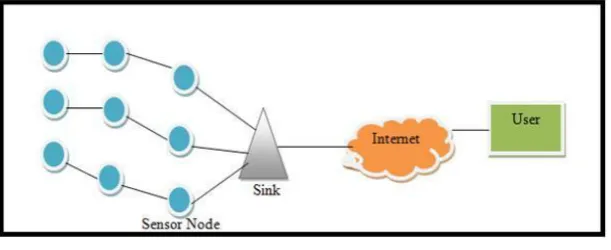
1.1 Wireless Sensor Network (WSN):The WSNs arethe self-configured wireless networks. These networks are used to monitor the physical and the various environmental conditions such as temperature, pressure, motion, sound etc. The WSN network passes their data through the sink, these sink basically act as the foremost location of the network [5] [6]. In this location sink, the data can be observed and analyzed for communication.
Fig.1.2 WSN Architecture
Fig. 1.2 shows the wireless architecture. A sink acts as an interface between the user and the network. To retrieve any information from the network, it is required to inject the queries and the sink provides the necessary information about the given query in the network. Sensor nodes are those which are able of sensing environment around them. Sensor nodes are devices which are able of gathering, storing, sensing and transmitting information. Sensor nodes can be deployed anyplace without the need to install it. The gathered information can be retrieved. WSN is a term which is used to depict an emerging category of embedded communication products that provide fault-tolerant wireless connections between sensors, controllers, and actuators.
In the WSN Global Positioning System (GPS) and Network Time Protocol (NTP) algorithms are used [7]. These algorithms are used to obtain the location of the particular information. NTP is generally used for synchronization of time between clocks.
1.2 CSMA/CA: CSMA/CA is Carrier Sense Multiple Access/Collision Avoidance a protocol for carrier transmission in 802.11 networks. It is slightly different from CSMA/CD i.e. Carrier Sense Multiple Access/Collision Detect which concern with transmissions after a collision has occurred [8], CSMA/CA helps to put off smashes before they happen. In CSMA/CA, the instant a node accepts a packet that is to be sent, it firstly checks if the channel is clear. If the channel is not busy, then the packet is transferred from source and destination. If the channel is busy, the node chosen period after some wait, and again checks to see if the channel is busy or not. This phase of time is called the backoff element and is counted down by a backoff counter [9]. It supports asynchronous data transfer. It adopts an acknowledgment mechanism to verify booming transmissions and handshaking mechanism to reduce collisions [10].
1.3 RFID Protocol
RFID (Radio Frequency Identification) is a contactless automatic identification skill that is based on radio frequency. There are usually two types of RFID according to the power source: active RFID and passive RFID.
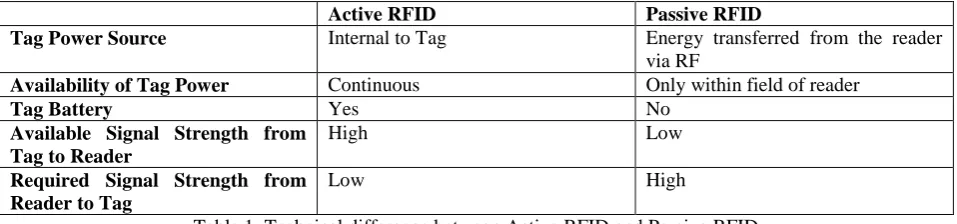
1.3.1 Active RFID: Active RFID system uses an internal power source (battery) inside the tag to constantly power the tag and its RF communication circuitry. It allows very low-level signals to be received by the tag. The tag can produce high-level signals back to the reader, driven from its inner power cause [12].
1.3.2 Passive RFID: Passive RFID relies on RF energy transferred from the reader to the tag to power the tag. Passive RFID either 1) reflects energy from the reader or 2) absorbs and provisionally stores a very little amount of energy from the reader’s signal to produce its own fast response [12].
Active RFID is less advantageous than passive RFID in terms of its tag cost, size, and battery management, but more advantages in term of sensing nature, its nature, sensing rate ad sensing distance [13]. RFID is developed so that physical information can be stored and sensed for a long time to improve the quality of the system in the addition of basic functions.
Active RFID/WSN will be performing the availability of tag-to-tag communication. Active RFID is less useful than passive due to its cost, tags size, battery consumption. Active RFID saves the energy of tag operates on the tag ID period and data collection period [14]. The active RFID tag uses the radio module to deliver the stored physical information to the reader. RFID provides the point-to-multipoint (P2MP) Communication structure where the reader controls the tags. To minimize the energy consumption of the tag, the reader reins the energy that the radio module consumes by making the tag works in the active and sleep periods [7]. The reader transmits a collection command to multiple tags which are going to deliver the ID to the reader with contention. Data collection period, the reader collects the data on the tags that are sensed from the tag ID collection period using their IDs with the help of the point-to-point (P2P) method. The active period is divided into two periods first one is the tag identification period and other is the data collection period. The id period is called contention period [9]. A reader can be transmitting a command to multiple tag which also deliver ID to the reader via contention. In the data collection period, the reader collects the data on the tags that are sensed from the tag ID collection period using their IDs, via the point-to-point (P2P) method. Then the sleep command turns off the radio module of the tag from which the data have been collected. This is called the collection period (CP). The reader repeats this process proceeds until all the tags within its communication range are collected. Table1. Shows the technical difference between Active and Passive technologies as follows:
Active RFID Passive RFID
Tag Power Source Internal to Tag Energy transferred from the reader
via RF
Availability of Tag Power Continuous Only within field of reader
Tag Battery Yes No
Available Signal Strength from Tag to Reader
High Low
Required Signal Strength from Reader to Tag
Low High
Table 1: Technical difference between Active RFID and Passive RFID
1.4 Network Time Protocol: Network Time Protocol (NTP) is a protocol based upon switching of packets and provides clock synchronization between computer systems. It is an internet protocol provides some interfaces as well. It is also known as Simple network time protocol. NTP is a protocol that is superimposed on top of TCP/IP that assures the time to the time and clock on the radio that is accurate [19]. Within milliseconds, this protocol is capable of synchronizing scattered clocks over long time periods.
1.5 Global Positioning System: Nodes synchronized their clock according to the GPS which is act as a master clock. So GPS is a master clock and all other nodes are like slaves which set their clock according to the master
clock. Mutual authentication is also present between all the nodes. A true relationship is maintained.First of all the
1.6 Clock Synchronization: Clock synchronization is a technique in which all the nodes in a network agree at the same time slot. In this process all the nodes or cluster head of the node set their time slot according to the master node. In data link layer, it works in an efficient manner if it is synchronized with the master clock. Clock synchronization has two techniques:
1. Time-lay synchronization 2. Diffusion based synchronization
In time-lay synchronization, all the nodes of the network set their clock according to the third party clock. In diffusion based technique, any two nodes set their clock accordingly when communication with each other.
2. LITERATURE REVIEW
Alshawi, et al. proposed [4] a new routing technique for WSNs to widen network life span using a grouping of an A-star algorithm and a fuzzy approach. These techniques are to calculate a most advantageous routing path from the source to the destination by favoring a minimum number of hops, the highest remaining battery power, and less traffic load. To demonstrate the usefulness of the proposed technique in terms of maximization of network life span and balancing energy consumption, the authors compared their approach with the fuzzy approach and A-star search algorithm using equal routing criteria in two dissimilar topographical areas. A sensor network topology that control balances load on sensor nodes and improves network scalability and lifetime has been discussed by Fatma Othman and Nizar Bouabdallah [1]. In sensor network clustering of sensor nodes is an effective topology. The authors proposed a distributed clustering approach for prolonged ad-hoc sensor networks. They obtained Hybrid Energy Efficient Distribution protocol (HEED) which chooses cluster heads, according to a hybrid of the node remaining energy and a secondary parameter, such as node closeness to its neighbors. Fatma Othman and Nizar [1] summarized the design paradigms of the Energy Efficient MAC protocol based on Collision Avoidance (EECA-MAC) etiquette in WSN, which were based on ring topology and virtual grid and token ring ideas for wireless sensor networks. On comparing with other algorithms it was found that EECA-MAC has two understandable features: Firstly, it tries to enhance energy utility by changing the motion of wireless communication module of sensor nodes, energy replica and state change of sensor nodes. Secondly, EECA-MAC used ring topology based on virtual grid intra-cluster and time slit concepts to avoid the collision. Simulation results showed that, compared with Sensor Medium Access Control (SMAC) and Time Division Multiple Access (TDMA), EECA-MAC significantly diminish in energy consumption and prolong the network life span.
A new energy efficient MAC etiquette for WSNs has been proposed by Wei Heidemann and Estrin [4] which was named the TEEM (Traffic aware, Energy Efficient MAC). To decrease energy consumption, TEEM is also based on the idea of “listen/sleep modes cycle” like SMAC. However, TEEM is more energy efficient because it has much shorter and adaptive listen to phase by utilizing “traffic information”. The experimental results confirmed that the method works well and saves considerable energy compared to S-MAC or 802.11 schemes. Dahlila Singh and Ho [15], presented a relative study of clustering techniques and cluster formation and cluster quality of a single criterion cluster heads election in WSNs. The Low Energy Adapting Clustering Hierarchy (LEACH), HEED and Energy-based LEACH protocols are implemented and their working are compared in terms of the cluster size, number of cluster head generated cluster head distribution, scalability and coverage.
Wen-Kuang and Kuo, proposed an enhanced CSMA/CA protocol to be used in the MAC layer of the 802.11 standard for wireless LANs. The enhanced etiquette improves the exponential backoff scheme by animatedly adjusting the contention window (CW) in the region of the optimal price [10].
To improve the network lifetime cross-layer design has been extensively used in WSNs. When cross-layer key is united to a transmission advertisement and medium access method has been chosen, the network throughput increases by 10% and to double the network lifetime has been observed by Mendes et al. [11]. The effects of these set of rules are presented to show how the cluster creation helps to increase the network life span. The authors found scalability aspects in the existence of highly developed nodes in the network and its consequences on the network life span.
Shankar et al. [16] explained the selection of cluster head done efficiently used by sensor nodes. In cluster based routing, exceptional nodes called cluster heads figure a wireless backbone to the sink. The cluster heads gather the data from sensing nodes and promote data to their sink. In homogeneous networks, all nodes have same capabilities. In heterogeneous networks, cluster nodes have more resources than other nodes. Energy economy can be obtained by cluster-head election, cluster formation and facts aggregation at the cluster-leader nodes to diminish data redundancy and thus save energy.
3. MAJOR ISSUES IN SENSOR NETWORKS
There are several problems which are faced by the sensor networks. These are as follows:
1. Energy Consumption: It is one of the major issues of the sensor network. WSNs are battery-powered. The
difficult to change batteries regularly.
2. Localization: In the wireless network the sensor nodes are deployed in ad-hoc manner so they do not have
knowledge about their position. The problem of determining the position of nodes is called localization. This problem can be solved by using GPS and beacon nodes. Beacon nodes are merely ordinary sensor nodes that recognize their worldwide coordinates from causes to effects.
3. Data Gathering: Data gathering is a commission of collecting data from different sensors by removing
redundant data. Sensor nodes transfer their own packet and frontward packets produced by others sensors. Compression technique and aggregation technique uses the number of security threats in data gathering.
4. Scheduling: It is a major issue of WSN. Nodes are switched from one mode to another and consume energy.
Scheduling also plays an important role for coverage and connectivity.
4. CONCLUSION
Wireless sensor networks are application-based networks which are widely used for faraway places. There are many issues and challenges in WSNs. Energy consumption, packet loss and clock synchronization are the major issues. This paper presents the review of the efficiency of CSMA/CA and RFID over various issues occurred in wireless sensor networks. It is concluded that RFID is an enhancement of CSMA/CA protocol to reduce collision and energy consumption.
REFERENCES
[1] Bouabdallah, F.; Bouabdallah, N.; Boutaba, R., "Load-Balanced Routing Scheme for Energy-Efficient Wireless Sensor Networks," Global Telecommunications Conference, 2008. IEEE GLOBECOM 2008. IEEE, vol., no., pp.1,6, Nov. 30 2008-Dec. 4 2008.
[2]Ismail, M.; Sanavullah, M.Y., "Security topology in wireless sensor networks with routing optimisation," Wireless Communication and Sensor Networks, 2008. WCSN 2008. Fourth International Conference on , vol., no., pp.7,15, 27-29 Dec. 2008.
[3]Modares, H.; Salleh, R.; Moravejosharieh, A., "Overview of Security Issues in Wireless Sensor Networks," Computational Intelligence, Modelling and Simulation (CIMSiM), 2011 Third International Conference on , vol., no., pp.308,311, 20-22 Sept. 2011.
[4] AlShawi, I.S.; Lianshan Yan; Wei Pan; Bin Luo, "Lifetime Enhancement in Wireless Sensor Networks Using Fuzzy Approach and A-Star Algorithm," Sensors Journal, IEEE, vol.12, no.10, pp.3010,3018, Oct. 2012.
[5] Wei Ye; Heidemann, J.; Estrin, D., "An energy-efficient MAC protocol for wireless sensor networks," INFOCOM 2002. Twenty-First Annual Joint Conference of the IEEE Computer and Communications Societies. Proceedings. IEEE, vol.3, no., pp.1567,1576 vol.3, 2002.
[6] Akyildiz, I. F., Su, W., Sankarasubramaniam, Y., & Cayirci, E. (2002). Wireless sensor networks: a survey. Computer networks, 38(4), 393-422.
[7] Yu Cheng; Hongkun Li; Peng-Jun Wan; Xinbing Wang, "Wireless Mesh Network Capacity Achievable Over the CSMA/CA MAC," Vehicular Technology, IEEE Transactions on , vol.61, no.7, pp.3151,3165, Sept. 2012.
[8] Ebin Deni Raj “An Efficient Cluster Head Selection Algorithm for Wireless Sensor Networks –Edrleach”IOSR Journal of Computer Engineering (IOSRJCE), volume 2, Issue 2, pp. 39-44 (July-Aug. 2012).
[9] Ewa Hansen, Jonas Neander, Mikael Nolin and Mats Bjorkman “Efficient Cluster Formation for Sensor Networks”.
[10] Wen-Kuang Kuo; Kuo, C.-C.J., "Enhanced backoff scheme in CSMA/CA for IEEE 802.11," Vehicular Technology Conference, 2003. VTC 2003-Fall. 2003 IEEE 58th , vol.5, no., pp.2809,2813 Vol.5, 6-9 Oct. 2003.
[11] Mendes, L.D.P.; Rodrigues, J.J.P.C.; Vasilakos, A.V.; Liang Zhou, "Lifetime Analysis of a Slotted ALOHA-Based Wireless Sensor Network Using a Cross-Layer Frame Rate Adaptation Scheme," Communications (ICC), 2011 IEEE International Conference on , vol., no., pp.1,5, 5-9 June 2011.
[13] IEEE.Chae-Seok Lee; Dong-Hyun Kim; Jong-Deok Kim, "An Energy Efficient Active RFID Protocol to Avoid Overhearing Problem," Sensors Journal, IEEE, vol.14, no.1, pp.15,24, Jan. 2014.
[14] Basilis Mamalis, Damianos Gavalas, Charalampos Konstantopoulos and Grammati Pantziou “Clustering in Wireless Sensor Networks” RFID and Sensor Networks, pp. 323, june 2009.
[15] Dahnil, D. P., Singh, Y. P., & Ho, C. K. (2011, February). Energy-efficient cluster formation in heterogeneous Wireless Sensor Networks: A comparative study. In Advanced Communication Technology (ICACT), 2011 13th International Conference on (pp. 746-751).
[16] T. Shankar, S. Shanmugavel, A. Karthikeyan, R. Dhanabal “Selection of Cluster Head using Neural Network in Wireless Sensor Network”, European Journal of Scientific Research, volume 83, Issue 3, no. 3, pp. 320- 337, Aug. 2012.
[17] Mehrdad Ahadi and Amir Masoud Bidgoli, “A Multiple-Sink Model for Decreasing the Energy Hole Problem in Large-Scale Wireless Sensor Networks”, International Journal of Computer Theory and Engineering, vol. 4, No. 5, pp. 843-846, October 2012.
[18] Xiangning, F & Yulin, S. .Improvement on LEACH Protocol of Wireless Sensor Network.International Conference on Sensor Technologies and Applications.(pp. 260 -264). IEEE, 2012.
[19] Karim El Defrawy, Gene Tsudik, “ALARM: Anonymous Location-Aided Routing in Suspicious MANETs”, IEEE Transactions on Mobile Computing, vol.10, no. 9, pp. 1345-1358, September 2011.