Abstract—Multicasting is the communication between single sender and multiple receivers. The legacy multicasting over the WLAN standard IEEE 802.11 has two problems- poor reliability and low transmission rates. Existing multicast protocols for 802.11 are not so efficient when they are used along with the frame aggregation of IEEE 802.11n WLANS. Therefore we propose a new multicast protocol for WLAN standard IEEE 802.11n, named as Reliable and Efficient Multicast Protocol (REMP), which selectively retransmits the errored multicast frames. In addition, we propose the extension by transmitting MPEG-4 video transmission over IEEE 802.11n. In our proposed approach, (1) P and B frames will be discarded by the MPEG 4 decoder at the receiver if the corresponding I frame is lost; (2) the individual MPEG-4 frames are prioritized at the receiver in such a way that I frames have a higher priority than P frames, which have higher priority than B frames.
Keywords—- IEEE 802.11n, MPEG-4, Multicast, Wireless Local Area Networks.
1. INTRODUCTION
The IEEE 802.11n wireless local area network has been one of the most popular wireless access technologies due to its advantages of high data rate, low cost and easy deployment. One of the key enhancements of IEEE 802.11n is the frame aggregation, which maximizes the throughput. We focus on multicast transmissions over 802.11n WLANs. Most of the existing multicast protocols have been designed on the 802.11 MAC. Since 802.11n MAC has a backward compatibility with the 802.11 MAC, the existing multicast protocols can be used in 802.11n.
However it will not be used as since it causes serious problems as frame aggregation is employed in 802.11n. Hence we propose a multicast protocol named Reliable and Efficient Multicast Protocol (REMP) [1]. In this paper, we extend REMP for
Available Online atwww.ijcsmc.com
International Journal of Computer Science and Mobile Computing
A Monthly Journal of Computer Science and Information Technology
ISSN 2320–088X
IJCSMC, Vol. 4, Issue. 11, November 2015, pg.344 – 349
RESEARCH ARTICLE
Reliable and Efficient Multicast Protocol for
MPEG - 4 Transmissions over IEEE 802.11n
ANAND A, SELVAKUMAR G
Assistant Professor, Department of Electronics and Communication Engineering, SVS College of Engineering,
Coimbatore, India
Email:
[email protected]
PRASANNA RAJ N
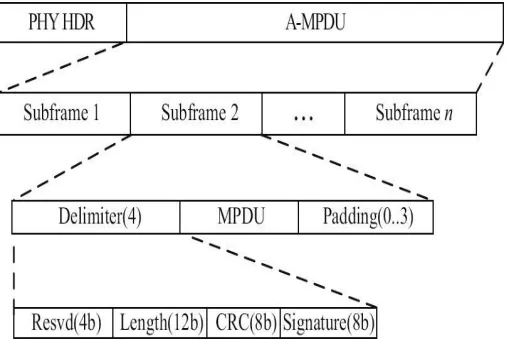
uses FCS field, which is used to verify each subframes and uses Block acknowledgement to acknowledge the individual subframes. Thus A-MPDU aggregation is an unique feature in IEEE 802.11n WLANs and reduces larger overhead when compared to legacy 802.11 WLANs [3]. The A-MPDU aggregation is shown as follows:
Figure 1: A-MPDU Aggregation in 802.11n
3. MPEG-4
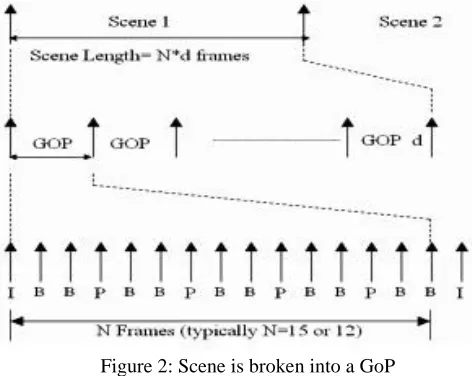
One of the most significant improvements in video compression has been the MPEG suit of standards, of which MPEG-4 is the newest. The main methods of compression used by MPEG-4 is to remove redundant information found in the individual frames that comprise the video and to predict changes from one frame to the next. MPEG-4 encodes an input stream into a sequence of frames known as GOPs. The main concept here is that, one frame or picture to the next, very few changes may occur in short time between frames. MPEG-4 takes a sequence of raw frames at any rate and splits the frame into a sequence of pictures called a GoP. One second of video may be decomposed into several GoPs depending on the complexity of the overall scene and the compression rate. A sequence of scenes from the raw video is decomposed into several GoPs. Figure 2 illustrates how a GoP is further decomposed into I, B and P frames. A brief discussion of individual frames is given as follows:
(1) I (Intra coded picture): This is a single still compressed image that is used as a starting point for the next sequence of frames (B and P types). This single image is also used to resynchronize the entire scene at the receiver. In the event that a GoP is lost or corrupted, the next GoP has a fresh image from which it may start.
(2) P (Predicted pictures): These are the pictures that are compressed and used as a reference point for B frames. The compression used here involves motion-compensated prediction.
Figure 2: Scene is broken into a GoP
I frame acts as a reference point used to start the next GoP and to resynchronize the video errors in transmission. The P frames are compressed versions of the I frame and they contain some predicted information. The B frames are compressed even further and are comprised mostly of predicted information from neighboring I and B frames up to the next I frame are of no use.
4. REMP OPERATIONS
REMP basically adopts the leader-based approach. Access Point [AP] maintains a list of receivers for each multicast group and selects one leader for a multicast group. In order to maintain the multicast group, the AP maintains a Group Table which has six fields. They are Group address field, Leader address field, Address List field, SNR list field, Timestamp field and Tdelay field. Group address field denotes the MAC addresses of multicast group whereas Leader address field denotes the leader’s address of corresponding group. Address list field maintains the address of multicast receivers; Timestamp field stores the last transmission time for the group. Tdelay field stores the recent waiting time for accessing the channel. The initial value of Tdelay field is zero whereas Timestamp field is given by the product of the size of minimum congestion window and the time length of one time slot. The leader selection procedure for a multicast group is as follows: leader for a multicast group is selected by using Multicast Feedback Request (MFR) and Multicast Channel Acknowledgment (MCA) frames by the AP. First, the AP sends MFR frames to the multicast receivers. After receiving MFR, the multicast receivers in the group report the current SNR value to the AP by sending MCAs one by one according to the order in MFR. Based on the received MCAs, the AP selects a receiver having the worst SNR as the leader. After that, the Leader address field and SNR list field in the Group Table will be updated by AP [5]. After the leader selection, the transmission of A-MPDU frames to the destination group is as follows: AP waits for a channel contention and sends a Multicast Transmission Announcement (MTA) to the multicast receivers. The receivers receiving the MTA frame can learn that the Group G will be the target of the following A-MPDU transmission and who is the leader of Group. After sending MTA, the AP waits for a reduced inter frame space (RIFS) and then sends an A-MPDU frames. The various frame formats of control frames are shown as follows:
Frame control (2) Duration (2) RA (6) TA (6) Type (1/8) #of receive rs (7/8) Addre sses of receiv ers
FC S (4)
Figure 3: MCR Frame format
Frame control (2) Duration (2) RA (6) TA (6) SNR (1) FCS (4)
stored in the Timestamp field by the AP.
(iii) The third case is that some of non-leaders receive errored frames and they send NAK to the AP. In this case, leader change procedure is performed again. The leader change procedure is same as discussed above, the only change
is multicast receivers send MBA [Multicast Block Acknowledgement] instead of MCA. In this case, AP transmits only errored sub frames in response to the Block acknowledgements.
5. PROPOSED MPEG-4 FRAMES TRANSMISSION
In the above section we studied the transmission of A-MPDU frames over IEEE 802.11n by using REMP. In order to make the system more reliable, we propose the transmission MPEG-4 transmission over 802.11n. It inherits the basic features of REMP such as leader selection/change procedures. In this section we extend the REMP by the transmission of MPEG-4 frames and applying following modifications.
In MPEG-4 frames, we observe that I, P and B frames are in decreasing order of importance. If an I frame of MPEG-4 video is lost, the next N-1 frames are useless, where N is the total frames within one GoP. First, the P and B frames must be discarded by the MPEG-4 decoder at the receiver on the account of the lost I frame. Therefore we propose the following protocols to improve MPEG-4 transmission over 802.11n WLANs.
(i) P and B frames will be discarded by the MPEG-4 decoder at the receiver if the corresponding I frame is lost since all the frames become useless once I frame is lost.
(ii) The individual MPEG-4 frames are prioritized in such a way that I frames have a higher priority than P frames which have a higher priority than B frames at the MPEG-4 decoder.
The individual MPEG-4 frames could be prioritized in such a way by assigning higher priority to I frames. Priority can be assigned by the following way:
Retry-limit of I frames > retry-limit of P frames > retry-limit of B frames; e.g, the retry-limit of frames can be the same as the retransmission limit in the normal 802.11 standard frame (i.e., 7 for I frames, 3 or 4 for P frames. 1 or 2 for B frames). First, I frames must have the higher priority and thus the most retransmission retries because a lost I frame affects so many later P and B frames. Second are the P frames; if one of these is lost, only the least important B frames are affected. If a B frame is lost, no other frames are affected; however, the decoder may experience a delay as it waits for a B frame that will never arrive. Finally it would be least effective to drop B frames by only attempting one retransmission.
6. SIMULATION RESULTS
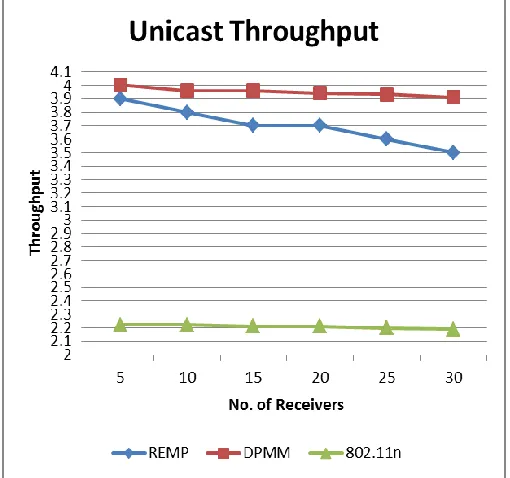
Figure 7: Multicast Throughput
We studied the performance when number of receivers varies from 5 to 30 and the maximum distance is limited to 150 m. It is observed that REMP shows higher performance than DPMM and the legacy 802.11n multicast protocol. In case of unicast throughput REMP and DPMM outperforms the legacy 802.11n multicast protocol since they make AP use shorter time for multicast transmissions.
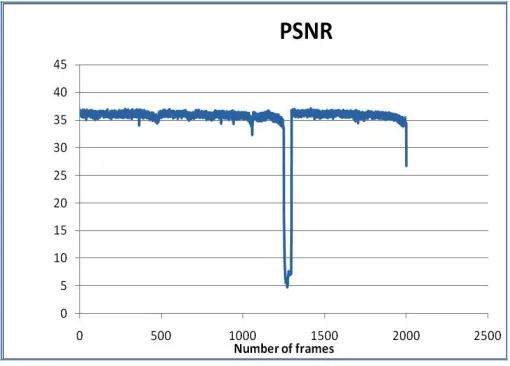
Figure 9: PSNR
7. CONCLUSION
We proposed a multicast protocol named REMP which enhances reliability and efficiency of multicast transmissions in 802.11n. Also, we extended the work by transmitting MPEG-4 video using the same transmission procedures. In the transmission of MPEG-4 video frames, we observed that if an I frame was lost, the next N-1 frames were uselss. In addition we observed that I, P and B frames were in decreasing order of importance. As our future work, this paper can be further modified by discarding the least important B frames if the delay between I and next P frame is too long.
References
[1] Wan-Seon Lim, Dong-wook Kim and Young-Joo suh, “Design of Efficient Multicast protocol for IEEE 802.11n WLANs and Cross-Layer Optimization for Scalable Video Streaming,” IEEE transactions on mobile computing, Vol. 11,No. 5, May 2012.
[2] Yang Xiao, Yan Zhang, Mike Nolen, “A Cross Layer Approach for Prioritized Frame Transmissions of MPEG-4 Over the IEEE 802.11e Wireless Local Area Networks,” IEEE Systems Journal, Vol. 5, No. 4, December 2011.
[3] X. Wang, L. Wang, Y. Wang, and Y. Zhang, “Supporting MAC Layer Multicast in IEEE 802.11n: Issues and Solutions,”
Proc. IEEE Wireless Comm. and Networking Conf. (WCNC ’09), Apr. 2009.
[4] V. Srinivas and L. Ruan, “An Efficient Reliable Multicast Protocol for 802.11-Based Wireless LANs,” Proc. IEEE Int’l
Symp. World of Wireless, Mobile and Multimedia Networks and Workshops (WoWMoM’09), June 2009.
[5] N. Choi, Y. Seok, T. Kwon, and Y. Choi, “Leader-Based Multicast Service (LBMS) in IEEE 802.11v Networks,” Proc IEEE Seventh Consumer Comm. and Networking Conf. (CCNC ’10), Jan. 2010.
[6] M.T. Sun, L. Huang, A. Arora, and T.H. Lai, "MAC Layer Multicast in IEEE 802.11 Wireless Networks," Proc. Int'l Conf. Parallel Processing (ICPP '02), Aug.2002.
[7] SVEF: Scalable Video Streaming evaluation framework, http://svef.netgroup.uniroma2.it, 2011.
[8] Chih-Heng Ke, Ce-Kuen Shieh, Wen-Shyang and Artur Ziviani, “An Evaluation for More Realistic Simulations of MPEG Video Transmission,” Journal of Information Science and Engineering 24, 2008.
[9] Lal Chand Bishnoi, Dharm Singh, Shailendra Mishra, “Simulation of Video Transmission over Wireless IP Network in Fedora Environment,” IP Multimedia Communications, A Special issue from LICA(1): 9-14,October 2011.