Michael Backes
a,band Dominique Unruh
a a Saarland UniversitybMax Planck Institute for Software Systems (MPI-SWS)
September 10, 2009
Comments and corrections are welcome. Please send them to Dominique Unruh<u r h m c . n - a r a d dn u @ m i u i s a l n . e>.
The abstraction of cryptographic operations by term algebras, called Dolev-Yao models, is essential in almost all tool-supported methods for proving security protocols. Recently significant progress was made in proving that Dolev-Yao models offering the core cryptographic operations such as encryption and digital signatures can be sound with respect to actual cryptographic realizations and security definitions. Recent work, however, has started to extend Dolev-Yao models to more sophisticated operations with unique security features. Zero-knowledge proofs arguably constitute the most amazing such extension.
In this paper, we first identify which additional properties a cryptographic (non-interactive) zero-knowledge proof needs to fulfill in order to serve as a computationally sound implementation of symbolic (Dolev-Yao style) zero-knowledge proofs; this leads to the novel definition of asymbolically-sound zero-knowledge proof system. We prove that even in the presence of arbitrary active adversaries, such proof systems constitute computationally sound implementations of symbolic zero-knowledge proofs. This yields the first computational soundness result for symbolic zero-knowledge proofs and the first such result against fully active adversaries of Dolev-Yao models that go beyond the core cryptographic operations.
Keywords: Computational soundness, zero-knowledge, symbolic cryptography.
Contents
1 Introduction 2
2 Zero-Knowledge Proofs 4 2.1 Symbolic Zero-Knowledge
Proofs . . . 4 2.2 Computational
Zero-Knowledge Proofs . . . 5
3 The Symbolic Model 9
3.1 Postponed definitions . . . 15 4 The Computational Model 17
4.1 Postponed definitions . . . 20 5 Computational Soundness 24
6 Proof of the Main Theorem 27
7 Conclusions 40
A Postponed proofs 41
References 56
Index 62
1
Introduction
Proofs of security protocols are known to be error-prone and, owing to the distributed-system aspects of multiple interleaved protocol runs, awkward for humans to make. In fact, vulner-abilities have accompanied the design of such protocols such as early authentication proto-cols like Needham-Schroeder [DS81, NS78], carefully designed de-facto standards like SSL and PKCS [WS96, Ble98], and current widely deployed products like Microsoft Passport [Fis03] and Kerberos [BCJ+06]. Hence work towards the automation of such proofs started soon
af-ter the first protocols were developed. From the start, the actual cryptographic operations in such proofs were idealized into so-called Dolev-Yao models, following [DY83, EG83, Mer83], e.g., see [KMM94, Sch96, nAG97, Low96, Pau98, BMV04]. This idealization simplifies proof construction by freeing proofs from cryptographic details such as computational restrictions, probabilistic behavior, and error probabilities. It was not at all clear from the outset whether Dolev-Yao models are a sound abstraction from real cryptography with its compu-tational security definitions. Recent work has largely bridged this gap for Dolev-Yao mod-els offering the core cryptographic operations such as encryption and digital signatures, e.g., see [AR02, Lau01, BPW03a, BP04, Lau04, MW04, CW05, CH06, SBB+06].
While Dolev-Yao models traditionally comprised only basic cryptographic operations such as encryption and digital signatures, recent work has started to extend them to more sophisticated primitives with unique security features that go far beyond the traditional goal of cryptography to solely offer secrecy and authenticity of communication.
Zero-knowledge proofs constitute arguably the most prominent and most amazing such prim-itive (though not the only one2). A zero-knowledge proof consists of a message or a sequence of
messages that combines two seemingly contradictory properties: First, it constitutes a proof of a statementx(e.g,x= ”the message within this ciphertext begins with 0”) that cannot be forged, i.e., it is impossible, or at least computationally infeasible, to produce a zero-knowledge proof of a wrong statement. Second, a zero-knowledge proof does not reveal any information besides the bare fact that xconstitutes a valid statement. Zero-knowledge proofs were introduced in [GMR89], they were proven to exist for virtually all statements [GMW91], and they in particular serve as the central ingredient of modern e-voting and attestation protocols such as the Direct Anonymous Attestation (DAA) protocol [BCC04].
A Dolev-Yao style (symbolic) abstraction of (non-interactive) zero-knowledge proofs has re-cently been put forward in [BMU08]. The proposed abstraction is suitable for mechanized proofs and was already successfully used to produce the first fully mechanized proof of central properties of the DAA protocol. However, no computational soundness guarantee for this abstraction has been established yet, i.e., it is not clear if security guarantees established using the symbolic ab-straction of zero-knowledge will carry over to protocol implementations relying on cryptographic zero-knowledge proofs, or which of the various standard or nonstandard additional properties of zero-knowledge proofs would be required to achieve this computational soundness result.
In this paper, we first identify which standard and which more sophisticated properties a cryp-tographic (non-interactive) zero-knowledge proof needs to fulfill in order to serve as a computa-tionally sound implementation of symbolic zero-knowledge proofs. This process culminates in the novel definition of a symbolically-sound zero-knowledge proof system; we remark that protocols already exist that satisfy this definition. Our main result will then show that symbolically-sound zero-knowledge proof systems constitute computationally sound implementations of symbolic zero-knowledge proofs. This in particular yields the first computational soundness result against fully active attackers of Dolev-Yao models that go beyond the core cryptographic operations, and it constitutes the first soundness result for symbolic zero-knowledge proofs. Our soundness result applies to trace-properties like authentication and weak secrecy.
language and security properties handled were extended in [AJ01, Lau01, HLM03, ABW06], but still apply only for passive adversaries. This excludes most of the typical ways of attacking protocols, e.g., man-in-the-middle attacks and attacks by reusing a message part in a concurrent protocol run.
A cryptographic justification of a Dolev-Yao model for arbitrary active attacks and within arbitrary surrounding interactive protocols (within the Reactive Simulatability (RSIM) Frame-work [BPW07]) was first given by Backes, Pfitzmann, and Waidner in [BPW03a] with extensions in [BPW03b, BP04]. Tool support for this Dolev-Yao model was subsequently added in [SBB+06].
Laud [Lau04] has subsequently presented a cryptographic underpinning for a Dolev-Yao model of symmetric encryption under active attacks. His work enjoys a direct connection with a formal proof tool, but it is specific to certain confidentiality properties and restricts the surrounding pro-tocols to straight-line programs. Micciancio and Warinschi [MW04] and Janvier, Lakhnech, and Mazar´e [JLM05] have presented cryptographic underpinnings for a Dolev-Yao model of public-key encryption. Their results are narrower than those in [BPW03a] since they are specific for public-key encryption and restricted classes of protocols, but they consider simpler real implemen-tations. Baudet, Cortier, and Kremer [BCK05] have established the soundness of specific classes of equational theories in a Dolev-Yao model under passive attacks. Canetti and Herzog [CH06] have shown that a Dolev-Yao-style symbolic analysis can be conducted using the framework of universal composability [Can01] for a restricted class of protocols.
Subsequent work concentrated on linking symbolic and cryptographic secrecy properties. Cortier and Warinschi [CW05] have shown that symbolically secret nonces are also computa-tionally secret, i.e., indistinguishable from a fresh random value given the view of the adversary. Backes and Pfitzmann [BP05] and Canetti and Herzog [CH06] have established new symbolic cri-teria for showing that a key is cryptographically secret. Laud [Lau05] has designed a type system for proving payload secrecy of security protocols based on the BPW model [BPW03a]. His work is extended to key secrecy in [BL06]. Kremer and Mazar´e [KM07] have established computational soundness results for static equivalence. Ad˜ao and Fournet [AF06] have shown computational soundness in the sense of observational equivalence of cryptographic implementations of pro-cesses. Cortier and Comon-Lundh [CLC08] have established computational soundness results as the preservation of observational equivalence within a fragment of the applied π-calculus (this fragment is restricted to protocols that do not branch).
Further work aimed at establishing computational soundness results for additional crypto-graphic primitives. Cortier, Kremer, K¨usters, and Warinschi [CKKW06a] and Backes, Pfitzmann, and Waidner [BPW06] have shown computational soundness of hash functions in the random oracle model. Janvier, Lakhnech, and Mazar´e [JLM07] have shown computational soundness of hash functions under a non-standard cryptographic assumption in the standard model, i.e., without random oracles. Garcia and van Rossum [GvR08] have showed computational sound-ness of hash functions under passive adversaries when implemented using perfect one-way hash functions [CMR98]. Bresson, Lakhnech, Mazar´e, and Warinschi [BLMW07] have provided a com-putationally sound theory for reasoning about protocols based on the decisional Diffie-Hellman assumption (DDH) for passive adversaries. Limitations of computational soundness in the sense of Reactive Simultability were shown by Backes and Pfitzmann for hash functions [BPW06] and the XOR operation [BPW05].
Recently, efforts have also been started to formulate syntactic calculi with a probabilistic, polynomial-time semantics to directly reason about cryptographic primitives/protocol, including approaches based on process algebra [MMS98, LMMS98], security logics [IK03, DDM+05] and
cryptographic games [Bla06, BP06, Cd06, Now07, BGJZ07, BBU08]. In general, this line of work is orthogonal to the work of justifying Dolev-Yao models, which offer a higher level of abstractions and thus much simpler proofs where applicable, so that proofs of larger systems can be automated.
symbolic and computational execution model. Section 5 contains our computational soundness result for symbolic zero-knowledge. Section 7 concludes and outlines future work.
Notation. By [n] we denote{1, . . . , n}. We abbreviatex1, . . . , xnbyxwherenis implicit. We will sometimes use sets and non-terminals interchangeably, e.g., given a grammar A=B|(C,A) we write x∈(C,A), or we say “xhas the form (C,A)”. We also write “xhas the form (c,A)” for a givenc ∈C. Given a termt and a substitution θ, we write tθ for the result of applying the substitutionθ to t. We call two partial functionsθ and θ′ compatible ifθ(x) =θ′(x) whenever
both are defined. Given two compatible partial functionsθandθ′, we writeθ∪θ′for the function
satisfyingθ∪θ′(x) = θ(x) if θ(x) and θ∪θ′(x) = θ′(x) otherwise. We write θ[x:= y] for the
functionθ′ defined byθ′(z) =θ(z) forz6=xandθ′(x) =y.
We call a functionf negligible if for all positive polynomialspand sufficiently largen,f(n)≥
1/p(n). We call a function non-negligible if it is not negligible. We call a functionf overwhelming iff ≥1−µfor some negligible functionµ.
2
Zero-Knowledge Proofs
In this section, we first introduce our modeling of symbolic zero-knowledge proofs in an intuitive manner to familiarize the reader with our notation and to prepare the ground for the examples discussed below. A formal semantics will be given to these expressions in Section 3. We after-wards review computational (non-interactive) zero-knowledge proofs, i.e., zero-knowledge proofs in the cryptographic setting. Our particular focus is on identifying which standard and more sophisticated properties such a proof needs to fulfill in order to serve as a cryptographically sound implementation of symbolic zero-knowledge proofs.
2.1
Symbolic Zero-Knowledge Proofs
We start with an example that involves a zero-knowledge proof of medium complexity. Assume that an agent B expects a message m and is supposed to answer with an encryption c :=
{hhm, ni, m′i}R1
ek(A)
R2
ek(S)for a random noncen, a valuem
′∈ {m1, m2, m3}and for some agents
AandS. Hereek(X) denotes the public key ofX, andR1, R2 denote the symbolic randomness used to build the encryptions. The protocol under consideration now aims at convincing the recipientC of c thatc is of the right form, i.e., the inner plaintext should containmand some valuem′ ∈ {m1, m2, m3}. In addition, the protocol aims at hiding fromC the nonce nand the
precise selection of the message m′. Zero-knowledge proofs constitute salient tools to achieve
these seemingly contradictory properties in that they allowBto prove that it knows some terms that satisfy the desired properties without revealing those terms.
In the example we consider, B intends to prove that it knows some symbolic randomness
ρ1, ρ2 and some valuesα1, α2 such that withβ1 :=m1, β2 :=m2, β3:=m3,β4:=S,β5:=D,
β6:=c, andβ7:=mthe following formulaF evaluates to true:
β6=
{hhβ7, α1i, α2i}ρ1
ek(β5)
ρ2
ek(β4) ∧ (α2=β1∨α2=β2∨α2=β3).
Immediately including the values of βi in the formula F would arguably have increased the readability of the formula; our language defined in Section 3, however, will require a strict separation of the actual formulaF and the public parameters that are determined at runtime, resulting in this slightly more complicated notation.
formula F yields true. Second, while the formula F and the values b can be retrieved from a zero-knowledge proof, the valuesaand the randomnessrare kept secret. These properties imply that the proof z indeed guarantees that c has the right form without revealing any additional information aboutn, m. In a symbolic zero-knowledge proof, we call r;a thewitness andb the
public part.
For more elaborate examples on how zero-knowledge proofs can be used in a symbolic setting, comprising a larger set of base constructors such as blind signatures, we refer the interested reader to [BMU08].
2.2
Computational Zero-Knowledge Proofs
We now move to computational zero-knowledge proofs, i.e., zero-knowledge proofs in the cryp-tographic setting. A central contribution of this paper is to identify which standard and more sophisticated additional properties of zero-knowledge proofs are required to establish the desired computational soundness result. Hence we now explain in some detail why each such property is needed. In the end, this task will culminate in the novel definition of a symbolically-sound zero-knowledge proof system. We first state the properties in an informal way and give the exact definitions in Definition 1.
Completeness, Soundness, and Zero-knowledge. We start with the basic definition of a non-interactive zero-knowledge proof. We need to focus on non-interactive proofs since the symbolic model considers a proof as a single message that can be processed further locally, e.g., it can be encrypted. This would not be meaningful if the zero-knowledge proof was allowed to be interactive.
A zero-knowledge proof consists of four algorithmsK, P, V, S, called the CRS-generator, the prover, the verifier, and the simulator, respectively. The CRS-generator outputs a random bit-string called thecommon reference string (CRS) (such a CRS is comparable to the public key of an encryption scheme). The proverP expects as inputs the CRS, a circuitC, and a witness
w such that C(w) = 1 and outputs a corresponding proof z (intuitively denoting that C is a satisfiable circuit). The verifier expects the CRS, a circuitC, and a proofz and checks whether
z is indeed a proof for the satisfiability ofC. (It is sufficient to consider satisfiability of circuits since every NP-language can be reduced to this problem.)
Three properties are expected from a zero-knowledge proof: It should be possible to prove correct statements (completeness), it should not be possible to prove incorrect statements ( sound-ness), and the verifier should not learn anything about the witness, beyond what can be deduced from the fact thatCis satisfiable (zero-knowledge):
• Completeness: For any C andw withC(w) = 1, ifz is the proof produced byP, thenV
accepts z.
• Soundness: For anyC and w with C(w) = 0, and for any polynomial-time adversaryA
that outputs a proofz, the verifier does not acceptz.
• Zero-knowledge: When computing the CRS, the algorithmKadditionally outputs a simu-lation trapdoor simtd (that can be seen as a secret key for the CRS) such that the following holds: FixCandwwithC(w) = 1. Letzbe the proof produced by proverP. Letz′be the
proof produced bySon inputsimtdandC(but notw). Thenzandz′are computationally
indistinguishable.
In this section, we omit certain details such as the fact that the conditions are allowed to be broken with negligible probability. Similarly, we implicitly assume thatP andV use the circuit
C and the witnessw. The final Definition 1 below will contain all these details.
Extractability. While the three properties of completeness, soundness, and zero-knowledge are sufficient for many applications, they do not suffice to offer a cryptographically sound im-plementation of symbolic zero-knowledge proofs. This can be seen by inspecting the following example: Assume that we are using an encryption scheme that permits to efficiently check that a given ciphertextcconstitutes a valid encryption of some message (without having to know this message or the secret key). Then letc:={m}R
ek(a) and consider the proofz:=ZK
R′
F (R;m;c, a) with F := (β1={α1}ρ1
ek(β2)), i.e., a proof that one knows the message and the randomness
con-tained inc. In the cryptographic setting, this proof would be performed by first constructing a circuitC such that C(R, m) = 1 iff m encrypted with randomness R and the public key of a
yields the ciphertextc. Since one can efficiently check ifcis the encryption of some message, one can hence efficiently check as well ifC has a satisfying input. Thus, one can prove the satisfia-bility ofC without having to useR, m. Such a proof trivially conforms to the zero-knowledge property, since the proof does not exploit the witness, and it satisfies soundness since it only proves valid statements (ifC was not satisfiable, the proof would not succeed). In the symbolic model, however, it is obvious that one needs to knowmin order to producez. What went wrong? The soundness condition only guarantees the existence of a witness, but it does not require the prover to actually know this witness. We introduce an additional algorithmE(besidesK, P, V, S, called the extraction algorithm) to capture this requirement and define the stronger condition of extractability. A proof system with extractability is called aproof of knowledge.
• Extractability: When computing the CRS, the algorithm K additionally outputs an ex-traction trapdoor extd such that: Fix C (where C may or may not be satisfiable). For a polynomial-time adversaryAthat outputs a proofproof, we have that ifV acceptsproof, thenE(C,proof,extd) outputs a witnesswwithC(w) = 1.
With this definition, our example no longer causes any problems: An extractable proof system that allows to prove the satisfiability ofC without using wwould lead to a contradiction since the machinesAandEtogether could then computew. (Technically, this is only a contradiction if w is not easy to compute from C in the first place.) We stress that extractability already implies soundness: IfC is not satisfiable, thenE(C,proof,extd) cannot output a witnesswwith
C(w) = 1, thus by contraposition we have thatV does not acceptproof.
Extraction zero-knowledge. Even complementing the properties completeness, soundness, and zero-knowledge with the extractability property is still not sufficient for the desired com-putational soundness result. Consider a proof system with the following property: If proof1
constitutes a proof for the circuit C1 and proof2 constitutes a proof for the circuit C2,
then (proof1,proof2) constitutes a proof for the circuit C1∧C2 (with (C1 ∧C2)(w1, w2) := C1(w1)∧C2(w2)). This property is not unrealistic, and for circuits that are of this conjunctive form, concatenating proofs for the individual circuits indeed often constitutes the most efficient way to produce a proof for the combined circuit. Furthermore, allowing to prove these sub-circuit individually does not contradict the properties we have discussed so far. In the symbolic model, however, given ZKRF(r;a;b) and ZKFR′′(r′;a′;b′), it is not possible to construct a proof
ZKF∧F′( ; ;b, b′) without knowingr, r′, a, a′ (where matches everything, and where in the
for-mula F′ the ρ1, α1, β1 are renamed to ρ2, α2, β2). We hence have to exclude the possibility of
concatenating proofs to generate new proofs. More precisely, we have to ensure that given a proof for some statementx1, it is not possible to construct a proof for another statementx2, even ifx2
is logically related tox1. This property is callednon-malleabilityand closely resembles the notion of non-malleability of encryption schemes. In the context of zero-knowledge, several properties are known to imply non-malleability. We will exploit theextraction zero-knowledgeproperty from [GO07]. Although this is a rather strong property and weaker definitions of non-malleability exist, our proof relies on this particular property; we leave it as an open problem if our computational soundness result can be proven using a weaker formalization of non-malleability.
simulation trapdoorsimtdand to an extraction oracleE(C,·,extd), i.e., when invoking the oracleE(C,·,extd) with inputproof, it returnsE(C,proof,extd) whereE is the extraction algorithm. The adversary may outputC, wwithC(w) = 1. Then the adversary gets either (a) a real proof proof produced by P, or (b) a simulated proof proof produced by the simulator S (which has no access to w). We then require that A cannot distinguish the cases (a) and (b) as long as it does not queryproof from the extraction oracle.
We stress that extraction zero-knowledge implies the zero-knowledge property since it implies that for any C, w with C(w) = 1 the proofs produced by the prover and the simulator are indistinguishable.
Why does extraction zero-knowledge indeed imply non-malleability? (We only give an intu-itive argument here as formally we will directly use the property of extraction zero-knowledge in our proofs.) Assume that from a proofproof1for the satisfiability ofC1, some algorithmM can produce a proofproof2for the satisfiability ofC2where the satisfiability ofC2follows from that
ofC1 (in the sense that a witnessw1 for C1 can be converted into a witnessw2 for C2). Then an adversary A could break the extraction zero-knowledge property roughly as follows: First, it outputs C1, w1 and gets a proofproof1 (this might be a fake proof). It applies M to proof1
and gets a proofproof2 for C2. Sinceproof2 6= proof1, the adversary may give proof2 to the
extraction oracle. In case (a), the extraction oracle will output a witnessw2. In case (b), however, the proof proof1 has been produced without exploiting the witness w1, and so has proof2. If
the extraction oracle could produce a witness givenproof2, this would mean that the extraction
oracle (together with the M and the simulator) has produced a witness for the satisfiability of
C2 (which we can assume to be hard). Since the extraction oracle, M, and the simulator are all polynomial-time, this happens with negligible probability. Hence in case (b) the extraction oracle fails to produce a witness for proof2. Thus the adversary can distinguish the two cases,
contradicting the extraction zero-knowledge property.
Unpredictability. We need an additional property for soundly implementing symbolic zero-knowledge proofs. If a proof using the same witness and the same public part is produced by two different agents in the symbolic model, it will always lead to two different terms because the two terms will have different randomness. A proof system with the properties described in this section, however, does not necessarily ensure that two proofs produced with the same witness and circuit will always be different (with overwhelming probability). Indeed, it is possible to construct proofs that are deterministic for at least some inputs. We hence additionally require that any two independently produced proofs are different, or equivalently:
• Unpredictability. Let a polynomial-time adversaryA output C, w,proof′ with C(w) = 1. Letproof be produced by P. Then with overwhelming probability,proof 6=proof′. Unpredictability is an easily achievable property, e.g., by letting the prover include some ran-domness in the proof.
Length-regularity. To get computational soundness, we additionally need that the length of a zero-knowledge proof is independent of its public part (although it may depend on thelengthof its public part). Consider a protocol which chooses a nonceN and then sends{ZKRtrue(; ;N)}Rek(a).
That is, the protocol produces a trivial proof and includes the nonce N in the public part. Then it encrypts that proof. Abstractly, this should preserve the secrecy ofN. If, however, in the computational model the length of ZKRtrue(; ;N) could depend on the first bit ofN, then {ZKRtrue(; ;N)}R
ek(a) might leak the length of ZK
R
true(; ;N) and thus the first bit of N.3 This
example can easily be extended to leak all bits ofN and thus break the secrecy ofN. Note that the requirement of length-regularity is not particular to zero-knowledge; even the encoding of pairs needs to be length-regular.
Symbolically-sound zero-knowledge. Finally, we further require that the verifier V and the extraction algorithmE are deterministic. This is not strictly necessary but it will simplify the proof of soundness, and we are not aware of a non-interactive zero-knowledge proof system where this condition is not fulfilled. The full name of a zero-knowledge scheme satisfying all the above properties would be unpredictable non-interactive multi-theorem adaptive extraction zero-knowledge argument of knowledge with deterministic verification and extraction. Since this is somewhat unwieldy, we coin the term symbolically-sound zero-knowledge proof system. The following definition formally defined the properties we informally discussed above.
Definition 1 (Symbolically-sound zero-knowledge proof system). A symbolically-sound zero-knowledge proof systemis a tuple of polynomial-time algorithms(K, P, V, S, E)with the following properties (all probabilities are taken over the coin tosses of all algorithms and adversaries):
• Completeness: Let a nonuniform polynomial-time adversary A be given. Let
(crs,simtd,extd) ← K(1η). Let (C, w) ← A(1η,crs). Let proof ← P(C, w,crs). Then
with overwhelming probability in η,C(w) = 0 or V(C,proof,crs) = 1.
• Extractability: Let a nonuniform polynomial-time adversary A be given. Let
(crs,simtd,extd) ← K(1η). Let (C,proof) ← A(1η,crs). Let w ← E(C,proof,extd).
Then with overwhelming probability, if V(C,proof,crs) = 1thenC(w) = 1.
• Unpredictability: Let a nonuniform polynomial-time adversary A be given. Let
(crs,simtd,extd)← K(1η). Let(C, w,proof′)← A(1η,crs,simtd,extd). Then with
over-whelming probability, we have proof′ 6=P(C, w,crs).
• Extraction Zero-Knowledge: Let a nonuniform polynomial-time adversaryAbe given. Con-sider the following experiment parametrized by a bitb: Let(crs,simtd,extd)←K(1η). Let (C, w,state) ← AE(·,·,extd)(1η,crs,simtd). Then let proof ← P(C, w,crs) if b = 0 and
proof ←S(C,crs,simtd)if b= 1. Let guess =AE(·,·,extd)(1η,crs,simtd,state,proof). Let
Pb(η)denote the following probability:
Pb(η) := Pr
guess= 1 andC(w) = 1 and
(C,proof)has not been queried from E(·,·,extd)
.
Then |P0(η)−P1(η)| is negligible.
• Length-regularity. Let two circuits C, C′ and witnesses w, w′ with C(w) = C′(w′) = 1
be given such that |C| =|C′| and |w| =|w′|. Let (crs,simtd,extd) ← K(1η). Then let
proof ← P(C, w,crs) and proof′ ← P(C′, w′,crs). Then |proof| = |proof′| holds with
probability 1.4
• Deterministic verification and extraction. The algorithms V andE are deterministic.
We stress that protocols already exist that satisfy this notion, e.g., the one proposed in [GO07, Sect. 4] under the assumption that enhanced trapdoor permutations [Gol04, Def. C.1.1] exist.5 The latter exist, e.g., under the assumption that factoring is hard. (The length-regularity
property can be ensured by a suitable padding.)
We have formulated symbolically-sound zero-knowledge proof systems against nonuniform adversaries. We believe that our results easily carry over to the uniform case.
4We could relax this property to require that this equality holds only with overwhelming probability, or even to only require the distributions of|proof|and|proof′|to be indistinguishable. We opt for this simpler formulation
because we are not aware of examples that need the more lenient formulations.
3
The Symbolic Model
In the following we define the symbolic model in which the execution of a symbolic protocol involving zero-knowledge proofs takes place. The basic ideas follow the framework presented in [CKKW06b]. However, to incorporate zero-knowledge proofs, we have to make various nontrivial modifications to the symbolic model. In the following sections, we try to highlight and explain the design choices made in our modeling.
ZK-proofs and messages. First, we fix several countably infinite sets. ByAwe denote the set of agent identifiers, byNoncethe set of nonces. We use elements fromGarbageto represent ill-formed messages (corresponding to unparseable bitstrings in the computational model). Finally, elements of Randdenote symbolic randomness used in the construction of ciphertexts and zero-knowledge proofs. We assume thatNonceis partitioned into infinite setsNonceag andNonceadv,
representing the nonces of honest agents and the nonces of the adversary. Similarly, Rand is partitioned into infinite setsRandag andRandadv.
We proceed by defining the syntax of messages that can be sent in a protocol execution. Since such messages can contain zero-knowledge proofs, and these are parametrized over a statement that is to be proven, we first have to define the syntax of these formulas. Let the setZKTermof
ZK-termsbe defined by the following grammar:
ZKTerm=ek(βi)|vk(βi)| αi |βi| hZKTerm,ZKTermi | {ZKTerm}ρeki(βj)
where i, j = 1,2, . . .. On the intuitive level,ek(a) denotes a public encryption key of agent a,
h·,·i a pair, and{t}R
ek(a) an encryption of t with the public key of ausing randomness R. The
symbolβi is a reference to thei-th component of the public part, and the symbolsαi andρi are references to the witness of the zero-knowledge proof.
Note that we do not include signatures in the syntax of ZK-terms. This is because we explicitly deal with signatures using the Verify-ZK-atoms below.
A ZK-atom is a term of the form ZKTerm = ZKTerm or Decrypt(ZKTerm, αi,ek(βj)) =
ZKTermor Verify(ZKTerm,ZKTerm,vk(βj)). On an intuitive level, Decrypt(c, k,ek(a)) =pmeans
that k is the decryption key dk(a) corresponding to ek(a) and that c decrypts to p using k. We include the encryption key ek(a) in such a ZK-atom to allow the verifier to check that the decryption is indeed performed using the right decryption key. A ZK-atom of the form Verify(s, m,vk(a)) means thatsis a valid signature of musing the verification keyvk(a).
A ZK-formula F is a Boolean formula over ZK-atoms satisfying the following conditions: If
ρi occurs in F, thenρ1, . . . , ρi occur all in F.6 Each ρi appears at most once.7 We denote the set of ZK-formulas with Formula. The α-arity of a ZK-formula F is the largest index of anαi occurring inF. The ρ-arity and the β-arity are defined analogously.
The intuitive interpretation of a ZK-formula is that it is a term with free variablesρ,α, and
β. The ρwill be substituted with randomness, theα andβ with messages. A zero-knowledge proofZKRF(r;a;b) then represents a proof that when substitutingr, a, bforρ, α, β, the resulting expressionFr,a,b
ρ,α,β is a true statement. (By F
r,a,b
ρ,α,β we denote the result of substitutingri forρi,ai forαi, andbi forβi.) The randomnessr and the messagesawill be considered secret, while the messagesbwill be contained in the proof in clear (one can think of the formula as being parametrized in the valuesb).
Note the following interesting asymmetry: We allowek(βi) andvk(βi) to appear in a formula, but notek(αi) orvk(αi). This is due to the fact that a proof with a formula containingek(αi) or
vk(αi) would not be easily realizable computationally: In order to perform the zero-knowledge proof, we need to build a circuit accepting only satisfying valuesa for the α. To build such a circuit for a formula withek(αi) orvk(αi), one would have to encode a list ofall public keys in 6This is a purely technical condition that simplifies the proof at one place. We include it because it does not seem to be a strong restriction.
this circuit. On the other hand, in the case ofek(βi), the valuebi substituted for βi is known while constructing the circuit, thus we can directly hard-codeek(bi) into the circuit.
Note further that we have introduced two different ways to formulate proofs about the content of an encryption: To show that c is an encryption of m, we can either show that there is some randomness R such that {m}R
ek(a) = c (so the corresponding zero-knowledge
proof would be ZKRF′(R; ;m, c, a) with F = ({β1}ρ1
ek(β3) = β2)) or we can show that
decrypt-ingcyields m(the corresponding zero-knowledge proof would beZKRF′(;dk(a);m, c,ek(a)) with
F = (Decrypt(β2, α1, β3) = β1)). However, the first type of proof can only be constructed by the agent that producedc, and the second can only be constructed by the agent that knows the decryption key forc. Hence, to cover all relevant cases, we need to enable both constructions.
Given the syntax for ZK-formulas, we can define the setMof messages as
M=A| Nonce|ek(A)|ek(Garbage)|dk(A)| hM,Mi
|vk(A)| vk(Garbage)|sk(A)
| {M}Randek(A) | {Garbage}Randek(Garbage) |Garbage
|[M]Rand
sk(A)|[M]Randsk(Garbage)|ZK
Rand
Formula(Rand
∗;
M∗;M∗).
with the following additional condition: For each subtermZKRandF (r;a;b), we have that|r|,|a|,|b|
are the ρ-arity, α-arity, and β-arity of F, respectively. In a message ek(a), dk(a), vk(a), and
sk(a) represent encryption, decryption, verification, and signing keys for the agenta,h·,·imeans pairing, {t}R
ek(a) is the encryption of message t under the key ek(a) with randomness R, and
ZKRF(r;a;b) denotes a zero-knowledge proof for the formulaF produced using the randomnessR
where the (secret) witness consists of the randomnessrand the messagesa, and the public part consists of the messagesb.
Since both the honest agents and the adversary should only send ZK-proofs that actually cor-respond to true statements, we will need the following definition that characterizes the messages that do not contain wrong proofs.
Definition 2(True ZK-Proofs). Let a message of the formZ :=ZKRF(r;a;b) be given. We say Z is valid if for every subterm ek(βi)orvk(βi)ofZ, we have that bi∈A.
Then F =B(t) where all ti are ZK-atoms and B is a Boolean formula. Let gi:=tiρ,α,βr,a,b .
(Bytr,a,b
ρ,α,β we denote the result of substituting ri forρi,ai for αi, andbi for βi.)
We say gi is true if it is of the form m1 =m1 or Decrypt({m1}rek1(a1),dk(a1),ek(a1)) =m1
or Verify([m1]r1
sk(a1), m1,vk(a1)) with m1 ∈ M, a1 ∈ A, and r1 ∈ Rand. Let hi := True if gi is
true, andhi:=Falseotherwise.
We say Z is a true proofif it is valid and B(h) =True.
We say a message M contains true proofsif every subterm of M of the formZKRandFormula(. . .)
is a true proof.
Note that if Z is valid, every gi has the form M = M or Decrypt(M,M,M) = M or Verify(M,M,M) (we produce no terms that are not messages).
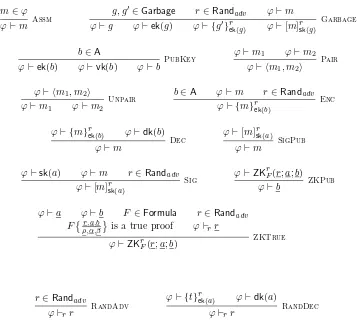
Deduction rules. In order to restrict the actions the adversary may perform during a protocol execution, we have to introduce a deduction relation⊢ which is given by the rules in Figure 1. The rules for the deduction are standard, only the rules concerning zero-knowledge proofs merit additional comment. The rule ϕ ⊢ ZKrF(r;a;b) =⇒ ϕ⊢b (ZKPub) corresponds to the zero-knowledge property; from a zero-zero-knowledge proofZKrF(r;a;b), all that can be extracted is the public partb, but not the witness r, a.8
8Formally, of course, the zero-knowledge property does not correspond to any given rule, but to the absence of rules allowing to deduce more thanbfromZKr
m∈ϕ ϕ⊢m Assm
g, g′∈Garbage r∈Randadv ϕ⊢m
ϕ⊢g ϕ⊢ek(g) ϕ⊢ {g′}r
ek(g) ϕ⊢[m]rsk(g)
Garbage
b∈A
ϕ⊢ek(b) ϕ⊢vk(b) ϕ⊢b PubKey
ϕ⊢m1 ϕ⊢m2
ϕ⊢ hm1, m2i Pair
ϕ⊢ hm1, m2i
ϕ⊢m1 ϕ⊢m2 Unpair
b∈A ϕ⊢m r∈Randadv
ϕ⊢ {m}rek(b)
Enc
ϕ⊢ {m}r
ek(b) ϕ⊢dk(b)
ϕ⊢m Dec
ϕ⊢[m]r sk(a) ϕ⊢m SigPub
ϕ⊢sk(a) ϕ⊢m r∈Randadv ϕ⊢[m]r
sk(a)
Sig ϕ⊢ZK
r
F(r;a;b)
ϕ⊢b ZKPub
ϕ⊢a ϕ⊢b F ∈Formula r∈Randadv
Fr,a,b
ρ,α,β is a true proof ϕ⊢rr
ϕ⊢ZKrF(r;a;b) ZKTrue
r∈Randadv ϕ⊢rr
RandAdv ϕ⊢ {t}
r
ek(a) ϕ⊢dk(a) ϕ⊢rr
RandDec
More interesting and involved is the ruleZKTrue. This rule states under which conditions the adversary may construct a zero-knowledge proofZKrF(r;a;b). First, of course, the resulting proof must be a proof of a true statement. This is represented by the condition thatFr,a,b
ρ,α,β is a true proof (as in Definition 2). Furthermore, we have to require that the adversary actually knows the witness r, a and the public partb, corresponding to the fact that we model proofs of knowledge. For a and b this condition is modeled by requiring ϕ ⊢ a and ϕ ⊢ b. For the randomnessr, however, the condition is more involved. The adversary may know some symbolic randomnessri in two cases. First, if it is its own randomnessri ∈Randadv. Second, it may be
able to extract that randomness from an encryption produced by some honest party. Namely, the condition that a cryptosystem is IND-CCA secure does not imply that one cannot retrieve the randomness used in an encryptionprovided one can decrypt that message. For example, in the popular RSA-OAEP cryptosystem [BR95, FOPS04], the randomness used for encrypting a message is actually computed during an honest decryption. Thus we have to allow the adversary to use randomnessrifrom messages it was able to decrypt. We capture these two possibilities of extracting randomness in the definition of the relation0r(Figure 1). As an example why allowing the adversary to extract randomness from ciphertexts (rule RandDec) is actually needed for computational soundness, consider the following simple protocol. Agenta sends c :={m}R
ek(b)
and if it receives a proof matchingZKF( ; ;b, m, c) withF := (β3={β2}ρ1
ek(β1)), the protocol fails
(here the symbol matches everything). If we would only allow the adversary to useri∈Randadv
in the witness, the protocol would be secure abstractly, even if the adversary knows the secret decryption keydk(b). Yet a computational adversary could possibly (depending on the encryption scheme) extract the randomness fromc and produce such a proof.9
Patterns. In order to conveniently define the notion of a protocol, we need a way to succinctly describe how messages are parsed and constructed by honest agents. To this aim, we define the concept of a pattern.10
Let X.a, X.n, X.p, X.c, X.s, X.z be countably infinite sets (variables of sort agent, nonce, pair, ciphertext, signature, and ZK-proof, respectively). Let X := X.a|X.n|X.p|X.c|X.s|X.z. In the following, when considering substitutions mapping variablesXto messagesM, we will always assume that a variable is mapped to a message of corresponding type. We then define the set
Patof patterns as
Pat=X|ek(X.a)| vk(X.a)| hPat,Pati | {Pat}Randag
ek(X.a) | {Pat}ek(X.a) |
ZKRandag
Formula(Rand
∗
ag; (Pat|dk(X.a))
∗;
Pat∗)| ZKFormula( ∗; ∗;Pat∗)| [Pat]sk(X.a)|[Pat]Randag
sk(X.a)
with the following additional conditions: For each subterm ZKRandag
F (r;a;b) or ZKF(r;a;b), we have that |r|,|a|,|b| are the ρ-arity, α-arity, and β-arity of F, respectively. This condition is needed to ensure that a pattern (containing no ) becomes a valid message when the variables are instantiated.
9After these explanations, the reader might wonder why similar adjustments are not necessary for, e.g., the rule for deducing ciphertexts{m}r
ek(b) since a computational adversary could use extracted randomness also in this case. The rough reason why this is not necessary is that if the computational randomnessris used to encrypt another message or under another key, we can consider it to be another symbolic randomness. Only if thesame mis encrypted under thesame ek(b), we will have to consider the computational randomness to be the same. However, in this case the resulting ciphertext will be also be the same, thus the adversary has just produced a message it already knew.
The symbol is supposed to match anything. More exactly, we say a messagem∈Mmatches a patternp∈Patif there is a substitutionθ:X→Msuch thatpθequalsmup to occurrences of inpθ(where distinct occurrences of may correspond to different subterms inm). We callθthe matcher ofmandp. Thus intuitively in a pattern corresponds to a value we do not care about and that we do not intend to (and cannot) extract, e.g., the randomness used in a ciphertext11
or the witness of a zero-knowledge proof.
Note that patterns do not contain explicit nonces, agent identifiers, or garbage. We omit garbage because we do not want the protocol to explicitly construct ill-formed messages. Nonces and agents are not needed since the protocol execution (see below) will provide pre-initialized variables for the nonces used by an agent and for the ids of the communication partners in a given protocol session. We disallow patterns containing dk(·) (except in the witnesses of zero-knowledge proofs) or sk(·) since we do not allow protocols to explicitly use their private keys (except for decrypting or signing). This is to ensure that no key cycles occur; it is known that theIND-CCAproperty does not guarantee security in the presence of key cycles.
Roles and protocols. We are now ready to define what a protocol is. At this point, we give an informal description and postpone the exact definitions to Section 3.1. A k-party protocol
Π is a mapping that assigns each i ∈ [k] a role Π(i). In our setting, a role is modeled as an ordered edge-labeled finite tree. The nodes of the role tree correspond to states of an agent executing that role, and the edges correspond to transitions caused by incoming messages. We assume only insecure channels between agents, therefore all messages are sent to the adversary and received from the adversary. What messages a role sends, and the state the role enters upon receipt of a given message is specified by the labels on the edges of the role tree. More precisely, an edge is labeled with a pair (l, r) of patterns. Here l represents the pattern for matching incoming messages (parse-pattern), andrthe pattern for constructing the answers to these messages (construct-pattern). The complete state of a role consists of a node in its tree, and a partial mappingσ:X→M representing (fragments of) messages parsed so far. Given an incoming messagem, a state σ, and an edge (l, r), the following steps take place:12
• First, in the pattern l, the variables that have already been assigned are instantiated. Formally, the patternlσ is computed.
• Then m is matched against lσ. If this succeeds, let θ be the matcher. Otherwise, the transition corresponding to the edge (l, r) will not be taken.
• Now all variables in the outgoing patternrare instantiated, either with variables previously assigned inσ, or assigned in the previous step (θ). More formally, the messagem′:=rσθ
is computed. If m′ does not contain true proofs (Definition 2), the transition will not be
taken. Otherwise follow the edge, send messagem′ and let the new state beσ∪θ.
A node may have several outgoing (ordered) edges, in this case the first one will be chosen that matches and results in a messagem′containing true proofs. If no such edge is found, the role will
ignore the messagem(i.e., the state is unmodified). A role may access the agent id of the i-th communication partners in its session via the pre-initialized variableAi ∈X.a, and accesses its own nonces via the pre-initialized variablesXNj ∈X.n(accessing the nonces via variables enables us to model that each session has different nonces).
This model of a role is very similar to that presented in [CKKW06b] with the exception of the additional check whether the outgoing messagem′ contains true proofs. This check is necessary,
since we have no syntactic condition that guarantees that a role can only generate true proofs. In particular, if a role produces proofs that depend on incoming messages, and if these messages
11On the preceding page we said that it is possible to extract randomness from ciphertexts. However, at that point we were talking about the adversary and had to assume the worst case. When defining protocols, we may only include capabilities that may be implemented with any encryption scheme. E.g., in the Cramer-Shoup cryptosystem [CS98], extracting the randomness implies breaking the discrete logarithm problem, even when given the private key.
happen to be modified by the adversary, it may happen that the proofs are instantiated with the wrong values. Thus we have to make a design choice. We can restrict the patterns such that no matter how the variables are instantiated, no incorrect proofs can be produced. Or we can impose a static condition on the roles that guarantees that for no sequence of incoming messages, an incorrect proof can be produced. Or we can perform a runtime check to avoid incorrect proofs. The first method seems very restrictive, the second might make the definition of a role unnecessarily complicated, thus we have opted for the third variant. Note that not all current tools for protocol verification are able to handle such runtime checks and might need to be extended.
Of course, not all trees with edges labeled by patterns represent valid protocol roles. Instead, we have to impose a variety of sanity conditions, e.g., we have to require that the pattern r(for constructing messages) does not contain free variables, or that the matching an incoming message with the pattern l does not imply decrypting with someone else’s secret key. Most conditions are of this kind and just guarantee that the symbolic protocol can indeed be implemented as a computational protocol. Complete details are given in Definition 4 in Section 3.1 below. At this point, we only mention two conditions that are of particular importance.
First, as already discussed on the previous page, a pattern cannot explicitly contain secret keys (except for decryption keys in the witness of a zero-knowledge proof). Thus a role cannot sent these keys over the network. (Note that the adversary can, however, get access to secret keys by corrupting parties and then can send them.) This condition does not newly arise for zero-knowledge proofs; it is also present, e.g., in [CW05, CKKW06b].
Since both encryption and zero-knowledge proofs are probabilistic, we have to ensure that each randomness is used only once. In a model without zero-knowledge proofs (as, e.g., [CW05, CKKW06b]) this can be done by requiring that for any randomness R, there is at most one subterm containing R (but the same subterm may occur several times to allow for sending several copies of a single ciphertext). In the presence of zero-knowledge proofs, however, such a rule would be too restrictive. For example, an agent might want to send a ciphertextc:={t}R
ek(a)
and then prove thatt satisfies some propertyP(t), i.e., it sendsz :=ZKFR′(R;t;c, a) with F := (β1 = {α1}ρ1
ek(β2)∧P(α1)). Since both c and z contain R, such an agent would be disallowed.
To relax this restriction, we have to allow the use of a given randomness R in the (ρ-part of the) witness of a zero-knowledge proof. However, allowing completely unrestricted use ofR in the witness could also lead to problems. For example, consider an agent creating and sending a ciphertextc using a given randomnessR, and then trying to produce a zero-knowledge proofz
proving a statement aboutanother ciphertextc′using thesamerandomnessR. In this case, the
adversary learns the ciphertextc and whether the proofz is true (since the further actions of the agent depends on whether it succeeded in constructing the proof or not). It is not clear that the information whether the proofzis true might not already leak up to one bit of information aboutc. We therefore have to ensure that a given randomnessRoccurs only in a single subterm
tplus additionally in the witness of zero-knowledge proofsas long as it is used in the formula to produce the same termt. To capture this more formally, we introduce the notion of an effective
R-subpattern. Roughly, an effective R-subpattern of a pattern P is either a subterm of P, or a subterm that results from substituting the arguments of a zero-knowledge proof in P into its formula. Formally, we get the following definition:
Definition 3 (True and effective subpatterns). For a given R∈Rand, we callP an R-pattern if it is of the form {Pat}R
Pat or[Pat]RPat orZK R
Formula(Rand∗;Pat∗;Pat∗).
Let P be a pattern. We say that a patternS is an effective subpattern ofP if • S is a subterm ofP, or
• there is a subterm ZKRF(r;a;b)of P, and a ZK-termz in the ZK-formulaF, such that S is a subpattern of zr,a,b
ρ,α,β .
We can now formulate the condition that randomness may not be reused: For any randomness
R, there is at most one effective R-subpattern in the role tree Π(k) (but that subpattern may occur in several places).
Protocol execution. The definition of the execution of a symbolic protocol Π closely resembles the one in [CKKW06b]. A symbolic trace for ak-party protocol Π is a sequence of global states with some restrictions on the possible transitions (detailed below). A global state is a triple (Sid, f, ϕ) whereϕis the set of messages the adversary learned so far (theadversary knowledge, initially set to Nonceadv), the setSidcontains the ids of all sessions currently running, and the
functionf maps every session id sid inSidto the local state of that session. A session contains exactly one agent aexecuting one role. However, since the intended protocol execution always involvesk parties, a session additionally specifies what other agents the agentais (supposedly) communicating with. The local state of a given session is a tuple (i, σ, p,(a1, . . . , ak)). Here iis the number of the role the agenta executes in this session. The tuple (a1, . . . , ak) specifies the indented communication partners for that session, in particular,a =ai is the agent executing this session. The state of the agent ais given by the current node pof the role tree Π(i) and the mappingσ that maps variables to (fragments of) messages received by the agentain that session. See the discussion of the role tree on page 13.
We allow three kinds of transitions between global states, namely corrupt(a1, . . . , al), new(i, a1, . . . , ak), andsend(sid, m). In acorrupt(a1, . . . , al) transition, the adversary specifies an list of agentsa1, . . . , alwhom it wants to corrupt. In consequence, the adversary’s knowledge
ϕ in the next global state will be extended by {dk(a1), . . . ,dk(al),sk(a1), . . . ,sk(al)}, i.e., the adversary learns all secrets of the corrupted parties. Only the first transition is allowed to be of this type, i.e., we consider static corruptions. In anew(i, a1, . . . , ak) transition, a new session id
sid is allocated and added toSid. The local state ofsid is initialized as (i, σ, ε,(a1, . . . , ak)) where
ε is the root of the role tree Π(i) and σmaps the variables Aj to aj and the variablesXNj to fresh nonces. In other words, a new session is initialized in which agentairuns role Π(i) and sup-posedly interacts with agentsa1, . . . , ak. The most important transition issend(sid, m). Here, the agentaexecutingsid is given the messagemand its answerm′ is added to the adversaries
knowledge ϕ. Assume that agenta has the local state (i, σ, p,(a1, . . . , ak)). Then to compute the answerm′, the first outgoing edge frompis searched such that its label (l, r) matchesmand
produces an answerm′that contains true proofs. Details on how this is done have already been
given in the discussion of roles on page 13. If no such edge is found, both the local state as well as the knowledge of the adversary are unmodified. Asend(sid, m) transition can only be taken if the adversary knowsm, i.e., ifϕ⊢m. Note that the only change with respect to the modeling in [CKKW06b] is that we have introduced the additional condition for taking an edge that the answer should contain true proofs.
We call sequences of global states satisfying these rules symbolic traces or Dolev-Yao traces. The set of Dolev-Yao traces for Π is denoted Execs(Π). The full definition is given in the next section.
3.1
Postponed definitions
In the following, letAi∈X.abe pairwise distinct agent variables (fori∈N), and letX j N ∈X.n be pairwise distinct nonce variables (forj∈N). Assume thatX.a\ {Ai:i∈N}andX.n\ {X
j N :
j∈N}are infinite. Byna,j,s ∈Nonce
ag witha∈Aand j, s∈N we denote distinct nonces. Byr
a,j,s ∈Rand
ag
with a∈A, j ∈Randag, s∈N we denote distinct symbolic randomnesses. Byγ
a,s we denote a mapping that maps everyR∈Randag tora,R,s.
Definition 4 (Role). A role tree RT is an ordered edge-labeled finite tree where each edge is labeled by an agent rule (l, r) wherel, r∈Pat. The patternsl are called parse-patternsand the patternsr are called construct-patterns.
A role for agent iin a k-party protocol is a role tree RT satisfying the following conditions for each nodepof RT :
1. For everyR∈Randag, there is at most one effectiveR-subpattern in the labels of the path top(but that effectiveR-subpattern may occur several times).
2. For any subterm ofl of the form{t}t′ it holds that t′ =ek(Ai).
3. For any subterm ofl of the form{t}Rand
t′ it holds thatt andt′ do not contain free variables
nor .
4. For any subterm ofl of the formZKRandFormula(Rand∗;a;b)it holds thataandbdo not contain free variables nor .
5. r does not contain nor free variables that are not free inl.
6. For any subterm oflorr of the formZKRF(. . .;. . .;b)we have that ifek(βi)orvk(βi)is a subterm of F, thenbi∈X.a.
7. For any subterm ofl of the form[t]Rand
t′ it holds thatt′=sk(Ai)and thattdoes not contain
free variables nor .
8. For any subterm ofrof the form [t]Rand
t′ it holds thatt′=sk(Ai).
9. For any subterm ofl orr of the formdk(t) it holds thatt=Ai.
Note that the syntax ofPat(page 12) imposes additional constraints that are not explicit in Definition 4.
Definition 5(Symbolic protocol execution). Let a k-party protocolΠ be given.
A global stateis a triple (Sid, f, ϕ)whereϕ is a set of messages (the adversary knowledge),
Sidis a finite set of session ids, and the functionf maps every session id sid inSidto the current state of the session sid . This state is called the local stateand is of the form(i, σ, p,(a1, . . . , ak))
wherei∈[k]is the index of the role executed in this session, the partial function σ:X→Mis a substitution mapping variables to messages, pis a node in the role tree Π(i), and aj ∈A is the
agent identifier assigned to role j in this session (thusai is the agent carrying out this session).
The initial state is qI = (∅,∅,Nonceadv).
We allow three kinds of transitions between global states.
• Corruption. The adversary corrupts a subset of the parties involved in the protocol and learns their private keys. This transition can only be applied in the beginning.
qI
corrupt(a1,...,al)
−−−−−−−−−−−→(∅,∅,Nonceadv ∪ {dk(aj),sk(aj) :j ∈[l]}).
• Session initialization. The adversary can initialize new sessions.
(Sid, f, ϕ) new(i,a1,...,ak)
−−−−−−−−−−→(Sid′, f′, ϕ).
Here sid:=|Sid|+1is the identifier of the new session andSid′:=Sid∪{sid}. The function f′ is defined as f′(sid′) :=f(sid′) for sid′ ∈
Sidandf′(sid) := (i, σ, ε,(a1, . . . , ak)). Here
ε is the root of the role tree Π(i) and the substitution σ is defined by σ(Aj) :=aj for all
j ∈[k] andσ(XNj) :=nai,j,sid for every Xj
• Sending of messages. The adversary can send messages to agents.
(Sid, f, ϕ)−−−−−−−−→send(sid,m) (Sid, f′, ϕ′).
Here we require sid ∈Sid,m∈M,ϕ⊢m, and ϕ′ andf′ are defined as follows. We define
f′(sid′
) := f(sid′) for every sid′ 6=sid . Let(i, σ, p,(a1, . . . , ak)) :=f(sid). Then let (l, r)
be the label of the first outgoing edge from psuch that the following holds:
– The message mmatches the pattern lγai,sidσ. Letθ denote the matcher.
– Let m˜ :=rγai,sidσθ. Thenm˜ contains true proofs.
If no such edge exists, let f′(sid) :=f(sid) and ϕ′ =ϕ. Otherwise, let f′(sid) := (i, σ∪
θ, p′,(a1, . . . , a
k))wherep′ is the successor ofpalong that edge, and letϕ′:=ϕ∪ {m}.˜
A finite sequence of global states starting withqI with the above transitions is called asymbolic traceor Dolev-Yao tracefor Π. The set of Dolev-Yao traces forΠ is denotedExecs(Π).
4
The Computational Model
Cryptographic assumptions. At this point, we list all the properties that the encryption scheme, the signature scheme, and the zero-knowledge proof system used in the computational model need to fulfill.
We assume thatZK is a symbolically-sound zero-knowledge proof system (Definition 1). We assume that the encryption schemeAE has the following properties:
• Valid encryption/decryption key pairs. It is well-defined which is the decryption key be-longing to a given encryption key. Formally, there is a functionf such that (a) given ek
andsk, it can be verified in deterministic polynomial time whethersk=f(ek) and (b) with probability 1, the key generation algorithm produces a key pair (ek,sk) with sk =f(ek). We call (ek,sk) withsk =f(ek) a valid encryption/decryption key pair.
• Perfect correctness. If (ek,sk) is a valid encryption/decryption key pair, then for any messagem, we have that encryptingmunderek and then decrypting the ciphertext using
sk succeeds yieldsmwith probability 1.
• Deterministic decryption. The decryption algorithm is deterministic.
• IND-CCA.The encryption scheme satisfies the CCA security notion. Roughly, IND-CCA security means that the adversary that has access to an encryption oracle and a decryption oracle cannot distinguish between the case that the encryption oracle encrypts the messagemit gets from the adversary, or the case where the encryption oracle encrypts a random message m′ with |m| =|m′|. (Assuming that the adversary never queries the
decryption oracle with any ciphertext produced by the encryption oracle.)13 See [Gol04]
for details (there IND-CCA is called indistinguishability of encryptions under a posteriori chosen ciphertext attacks).
We assume that the signature scheme SIG has the following properties:
• Deterministic verification. The verification algorithm is deterministic.
• Perfect correctness. For any messagemand a verification/signing key pair (vk,sk) returned by the key generation algorithm, signingmusingsk and then verifying the resulting signa-ture usingvk succeeds with probability 1.
• Unpredictability. The signature schemeSIG is unpredictable (in the sense that for a fixed signature key and a fixed message, two honestly generated messages are equal only with negligible probability). This implies that SIG has to be probabilistic. Alternatively, one could have requiredSIG to be deterministic and removed the symbolic randomness in the symbolic model. Then, however, we would have to exclude probabilistic signature schemes.
• Length-regularity. The signature schemeSIGis length regular in the following sense: Given an honestly generated signing key sk and two messages m1, m2 of the same length, the signatures for m1 and m2 will have the same length, too. See the discussion on length-regularity on page 7.
• Strong existential unforgeability. The signature is strongly existentially unforgeable. Roughly, strong existential unforgeability means that no adversary with access to a signing oracle can produce a valid message/signature pair (m, σ) unless that pair was output by the signing oracle. (I.e., the adversary is not even allowed to produce a signatureσ′ form
if he received a signature σ6=σ′ form from the signing oracle.)14 See [Gol04] for details
(there strongly existentially unforgeable signatures are called super-secure signatures). Note that for the encryption scheme AE, we also need the unpredictability and the length-regularity properties. In the case of encryption schemes, however, they follow directly from the IND-CCA property, so we do not need to require them explicitly.
We assume all security properties to hold againstnonuniform polynomial-time adversaries.
Computational execution. We now proceed to define the computational execution of a pro-tocol Π. We use the same formalization of propro-tocols Π as in the symbolic model in the preceding section, but the messages exchanged over the network now are bitstrings, and the patterns (l, r) on the edges of the role tree specify how to parse or construct these bitstrings, respectively.
We first give a short overview over the computational execution model, stressing the design issues particular to the include of zero-knowledge proofs. We give the detailed definitions in Section 4.1.
Fix a security parameter η ∈ N. A computational trace is a sequence of computational
global states of the form (Sid, g, C) where Sid is the set of session ids, g maps sessions ids to computational local states andCis the list of corrupted agents. Acomputational local stateis of the form (i, τ, p,(a1, . . . , ak)). As with the symbolic state,iis the role executed byai, the node
pindicates which point of the role tree the agentai has reached so far, and (a1, . . . , ak) list the communication partners. The mapping τ maps variables to bitstrings (instead of terms) that result from parsing incoming messages. The transitions between the global states are invoked by a probabilistic polynomial-time adversaryA. The adversary may invoke a corrupt(a1, . . . , al) transition (only in the first step) and will then learn the secret keys of the agents a1, . . . , al. Further the idsa1, . . . , al are stored in the setCin the global state. The adversary may invoke a new(i, a1, . . . , ak) transition. In this case a new session id sid with computational local state (i, τ, p,(a1, . . . , ak)) is allocated where in the mappingτthe variablesAjandXNj are preinitialized toaj and fresh nonces, respectively. Finally, the adversary may invoke asend(sid, m) transition where m is a bitstring. In this case, for each edge leaving the current node p, the following is tried: Let (l, r) be the label of that edge. Then the bitstring m is parsed according to the pattern l using the variable substitution τ (see below). This results in a new substitution τ′
where the variables that were free in l are now assigned bitstrings. Then the pattern ris used with the variable assignmentsτ′ to construct a new bitstringm′ (see below). If both parsing and
constructing succeed, this edge is taken,τ′ becomes part of the new local state of the sessionsid,
and the adversary getsmas input. If no edge matches, no action is taken.