Fully Homomorphic Encryption over the Integers
Marten van Dijk MIT
Craig Gentry IBM Research
Shai Halevi IBM Research
Vinod Vaikuntanathan IBM Research
June 8, 2010
Abstract
We describe a very simple “somewhat homomorphic” encryption scheme using only elemen-tary modular arithmetic, and use Gentry’s techniques to convert it into a fully homomorphic scheme. Compared to Gentry’s construction, our somewhat homomorphic scheme merely uses addition and multiplication over the integers rather than working with ideal lattices over a polynomial ring. The main appeal of our approach is the conceptual simplicity.
We reduce the security of our somewhat homomorphic scheme to finding an approximate integer gcd – i.e., given a list of integers that are near-multiples of a hidden integer, output that hidden integer. We investigate the hardness of this task, building on earlier work of Howgrave-Graham.
1
Introduction
What is the simplest encryption scheme for which one can hope to achieve security? The Caesar cipher is simple, but not secure. We believe that conventional public-key encryption schemes with modular exponentiations are secure, but modular exponentiation is not a very simple operation. If we were to forget our current schemes and start from scratch, perhaps something like the following scheme would be a good candidate for a simple symmetric encryption scheme:
KeyGen: The key is an odd integer, chosen from some interval p∈[2η−1,2η).
Encrypt(p, m): To encrypt a bit m∈ {0,1}, set the ciphertext as an integer whose residue mod p has the same parity as the plaintext. Namely, set c = pq+ 2r+m, where the integers q, r are chosen at random in some other prescribed intervals, such that 2r is smaller thanp/2 in absolute value.
Decrypt(p, c): Output (cmodp) mod 2.
When the noise r is sufficiently smaller than the secret key p, this simple encryption scheme turns out to be “somewhat homomorphic” in the sense of [6] – namely, it can be used to evaluate low-degree polynomials over encrypted data. Moreover, with a judicious choice of parameters (say r≈2√η and q ≈2η3), this simple scheme may even be secure!
a generalized version of his attack (as well as various other attack avenues, such as solving the associated simultaneous Diophantine approximation problem).
So far we only described a symmetric scheme, but turning it into a public key encryption scheme is easy: The public key consists of many “encryptions of zero”, namely integers xi =qi·p+ 2ri where qi, ri are chosen from the same prescribed intervals as above. Then to encrypt a bit m, the ciphertext is essentially set asm plus a subset sum of the xi’s.
As described, the scheme supports a limited number of additions and multiplications over encrypted bits. However, it is easy to see that the scheme is not fully homomorphic: as-is, it cannot evaluate high-degree polynomials over the encrypted data. However, we show in this work that this simple scheme is amenable to Gentry’s “blueprint” for constructing a fully homomorphic scheme out of certain somewhat homomorphic schemes [7]. Namely we can “squash the decryption circuit” to get a bootstrappable scheme, and then invoke Gentry’s bootstrapping theorem to obtain a fully homomorphic public-key encryption scheme.
We stress that our main motivation is conceptual simplicity – namely, to demonstrate that even something as complex as fully homomorphic encryption can be achieved using “elementary” techniques.
1.1 Prior Work
Variants of the simple scheme that we described above have appeared in prior work, but the full potential of their homomorphic properties was never realized. Here, we discuss two of these results, and relate them to the current work.
First, in a discussion thread on thecypherpunksmailing list from 2000, Bram Cohen proposed a public key encryption scheme [4] that is quite similar to the scheme above. Secondly, in 2008, Levieil and Naccache applied the same general technique to construct what they called an “Insecure and Clumsy” Cryptographic Test Correction scheme, and used the additive homomorphic properties of the scheme to prevent students from cheating on their exams [17, Sec. 3]. Both these works appeared prior to the breakthrough result of Gentry in 2009 that showed thefirstfully homomorphic encryption scheme, and as such, do not observe or utilize the multiplicative homomorphism that the scheme could support. We point out the two main distinctions of our work below.
1. First, the security analysis in these prior works was informal, and concrete parameters were either not set at all, or set to trivially breakable values. The scheme in [17] is trivially broken when considered as a cryptographic scheme, irrespective of the choice of parameters. This is justified in their case since the adversary model they considered is very weak.
In fact, prior to our work there was widespread belief in the cryptographic community that schemes of this form are inherently insecure, due to the attacks that we describe in Section 5. Hence, one of the contributions of our work is to point out that with an appropriate choice of parameters, this simple scheme can be made to resist all known attacks.
3. Finally, we exhibit a search-to-decision reduction which shows that the semantic security of the scheme above can be based on a well-defined search problem, namely the approximate GCD problem (see Section 4 for more details).
A third cryptosystem which is superficially similar to ours is Regev’s first encryption scheme [22] based on the unique shortest vector problem. In fact, a slight variation of Regev’s scheme can be described by exactly the same formula as ours, Enc(p, m) = qp+ 2r +m. One major difference between these schemes is that the secret key p in our scheme is an integer, whereas in Regev’s scheme, the secret key is an integral fraction of the domain size (i.e.,p =N/h for a publicN and a secret h). A consequence of this difference is that Regev’s scheme does not offer multiplicative homomorphism. Another important difference is that our choice of parameters is much more aggressive than Regev’s. Unfortunately, this means that Regev’s worst-case to average-case security reductions from [22] do not seem to apply to our scheme.
2
Preliminaries
Below we usually denote parameters by Greek letters (e.g., η, γ, τ, etc.), with λ always denoting the security parameter. Real numbers and integers are denoted by lowercase English letters (p, q, x, y, etc.). All logarithms in the text are base-2 unless stated otherwise.
For a real number z, we denote by ⌈z⌉,⌊z⌋,⌊z⌉ the rounding ofa up, down, or to the nearest integer. Namely, these are the unique integers in the half open intervals [z, z+ 1), (z−1, z], and (z−12, z+12], respectively.
For a real number z and an integer p, we use qp(z) and rp(z) to denote the quotient and remainder of z with respect to p, namely qp(z) def= ⌊z/p⌉ and rp(z) def= z−qp(z)·p. (Note that
rp(z) ∈ (−p/2, p/2].) We also denote the remainder by [z]p or (zmodp), we use these three notations interchangeably throughout the paper.
A family H of hash functions from X toY, both finite sets, is said to be 2-universal if for all distinct x, x′ ∈ X, Pr
h←HR [h(x) = h(x
′)] = 1/|Y|. A distribution D is ǫ-uniform if its statistical
distance from the uniform distribution is at most ǫ, where the statistical difference between two distributions D1, D2 over a finite domainX is 12Px∈X|D1(x)−D2(x)|.
Lemma 2.1(Simplified Leftover Hash Lemma [10]). LetHbe a family of 2-universal hash functions from X to Y. Suppose that h ← HR and x ←R X are chosen uniformly and independently. Then, (h, h(x)) is 12p|Y|/|X|-uniform over H ×Y.
2.1 Homomorphic Encryption
Our definitions are adapted from Gentry [7]. Below we only consider encryption schemes that are homomorphic with respect to boolean circuits consisting of gates for addition and multiplication mod 2. (Considering only bit operations also means that the plaintext space of the encryption schemes that we consider is limited to {0,1}.) See the works of Ishai and Paskin [12] for a more general definitional treatment of homomorphic encryption with respect to other forms of “pro-grams.”
key pk, a circuitC, a tuple of ciphertexts~c=hc1, . . . , cti(one for every input bit ofC), and outputs another ciphertext c.
Definition 2.2 (Correct Homomorphic Decryption). The scheme E = (KeyGen,Encrypt,Decrypt, Evaluate) iscorrect for a given t-input circuitC if, for any key-pair (sk,pk) output byKeyGen(λ), any tplaintext bitsm1, . . . , mt, and any ciphertexts~c=hc1, . . . , cti withci ←EncryptE(pk, mi), it is the case that:
Decrypt(sk, Evaluate(pk, C, ~c)) =C(m1, . . . , mt)
Definition 2.3 (Homomorphic Encryption). The schemeE = (KeyGen,Encrypt,Decrypt,Evaluate) is homomorphic for a classCof circuits1 if it is correct for all circuitsC∈ C. Eisfully homomorphic if it is correct for all boolean circuits.
The semantic security of a homomorphic encryption scheme is defined in the usual way [9], without reference to theEvaluatealgorithm. (IndeedEvaluateis a public algorithm with no secrets.) It is clear that as defined above, fully homomorphic encryption can be trivially realized from any secure encryption scheme, by an algorithm Evaluatethat simply attaches a description of the circuitCto the ciphertext tuple, and aDecryptprocedure that first decrypts all the ciphertexts and then evaluates C on the corresponding plaintext bits. Two properties of homomorphic encryption that rule out this trivial solution arecircuit-privacy and compactness.
Circuit privacy roughly means that the ciphertext generated by Evaluatedoes not reveal any-thing about the circuit that it evaluates beyond the output value of that circuit, even for someone who knows the secret key. We discuss circuit privacy in Appendix C. It is folklore that circuit-private fully-homomorphic encryption can be realized using Yao’s “garbled circuits” [23, 18] and a two-flow oblivious transfer protocol. (This construction is similar to the trivial solution from above, essentially it replaces the plaintext circuit with a garbled circuit.) Hence the “real challenge” in constructing fully homomorphic encryption comes from the compactness property, which essentially means that the size of the ciphertext that Evaluate generates does not depend on the size of the circuitC.
Definition 2.4 (Compact Homomorphic Encryption). The schemeE = (KeyGen,Encrypt,Decrypt, Evaluate) iscompact if there exists a fixed polynomial boundb(λ) so that for any key-pair (sk,pk) output by KeyGen(λ), any circuit C and any sequence of ciphertext ~c = hc1, . . . , cti that was generated with respect to pk, the size of the ciphertextEvaluate(pk, C, ~c) is not more thanb(λ) bits (independently of the size of C).
2.2 Bootstrappable Encryption
Following Gentry [7], we construct homomorphic encryption for circuits of any depth from one that is capable of evaluating just a little more than its own decryption circuit.
Definition 2.5 (Augmented Decryption Circuits). Let E = (KeyGen,Encrypt,Decrypt,Evaluate) be an encryption scheme, where decryption is implemented by a circuit that depends only on the security parameter.2
1
Formally,Cis an ensemble, parametrized by the security parameter.
2
For a given value of the security parameterλ, the set of augmented decryption circuits consists of two circuits, both take as input a secret key and two ciphertexts: One circuit decrypts both ciphertexts and adds the resulting plaintext bits mod 2, the other decrypts both ciphertexts and multiplies the resulting plaintext bits mod 2. We denote this set by DE(λ).
Definition 2.6 (Bootstrappable Encryption). Let E = (KeyGen,Encrypt,Decrypt,Evaluate) be a homomorphic encryption scheme, and for every value of the security parameter λ let CE(λ) be a set of circuits with respect to whichE is correct. We say thatE isbootstrappable ifDE(λ)⊆ CE(λ) holds for everyλ.
Theorem 2.7 ([7]). There is an (efficient, explicit) transformation that given a description of a bootstrappable scheme E and a parameter d = d(λ), outputs a description of another encryption scheme E(d) such that:
1. E(d) is compact (in particular the Decryptcircuit in E(d) is identical to that inE), and
2. E(d) is homomorphic for all circuits of depth up to d.
Moreover, E(d) is semantically secure if E is: Any attack with advantage ε against E(d) can be converted into an attack with similar complexity against E with advantage at least ε/ℓd , where ℓ is the length of the secret key in E.
We also note that if the bootstrappable schemeE is “circular secure” then it can be converted into a single compact fully-homomorphic encryption schemeE′. See [7] for details.
3
A Somewhat Homomorphic Encryption Scheme
Parameters. The construction below has many parameters, controlling the number of integers in the public key and the bit-length of the various integers. Specifically, we use the following four parameters (all polynomial in the security parameterλ):
γ is the bit-length of the integers in the public key,
η is the bit-length of the secret key (which is the hidden approximate-gcd of all the public-key integers),
ρ is the bit-length of the noise (i.e., the distance between the public key elements and the nearest multiples of the secret key), and
τ is the number of integers in the public key.
These parameters must be set under the following constraints:
• ρ=ω(logλ), to protect against brute-force attacks on the noise;
• η ≥ρ·Θ(λlog2λ), in order to support homomorphism for deep enough circuits to evaluate the “squashed decryption circuit” (cf. Sections 3.2 and 6.2);
• τ ≥ γ +ω(logλ), in order to use the leftover hash lemma in the reduction to approximate gcd (cf. Lemma 4.3).
We also use a secondary noise parameter ρ′ =ρ+ω(logλ). A convenient parameter set to keep in
mind is ρ =λ, ρ′ = 2λ, η = ˜O(λ2), γ = ˜O(λ5) and τ = γ+λ. (This setting results in a scheme with complexity ˜O(λ10).)
For a specific (η-bit) odd positive integerp, we use the following distribution overγ-bit integers:
Dγ,ρ(p) =
n
chooseq ←$ Z∩[0, 2γ/p), r←$ Z∩(−2ρ, 2ρ) : output x=pq+ro
This distribution is clearly efficiently sampleable.
3.1 The Construction
KeyGen(λ). The secret key is an oddη-bit integer: p←$ (2Z+ 1)∩[2η−1,2η).
For the public key, sample xi ← D$ γ,ρ(p) for i= 0, . . . , τ. Relabel so that x0 is the largest.
Restart unless x0 is odd andrp(x0) is even. The public key is pk =hx0, x1, . . . , xτi.
Encrypt(pk, m∈ {0,1}). Choose a random subset S ⊆ {1,2, . . . , τ} and a random integer r in (−2ρ′
, 2ρ′
), and outputc←
m+ 2r+ 2P
i∈Sxi
x0.
Evaluate(pk, C, c1, . . . , ct). Given the (binary) circuitCE withtinputs, and t ciphertextsci, apply the (integer) addition and multiplication gates of CE to the ciphertexts, performing all the operations over the integers, and return the resulting integer.
Decrypt(sk, c). Outputm′ ←(cmodp) mod 2.
Remark 3.1. Recall that (cmodp) =c−p· ⌊c/p⌉, and as pis odd we can instead decrypt using the formulam′←[c− ⌊c/p⌉]2 = (cmod 2)⊕(⌊c/p⌉mod 2).
Remark 3.2. Originally, we described encryption as adding m to a random subset sum of “en-cryptions of zero”. Indeed, the scheme can viewed this way. Let wi = [2xi]x0 for i = 1, . . . , τ. Each wi, and also x0, is essentially an encryption of zero; its noise is even. Moreover, c =
m+ 2r+P
i∈Swi−k·x0 for some integerk.
3.2 Correctness
Permitted Circuits and Polynomials. For a mod-2 arithmetic circuit (composed of mod-2 Add and Mult gates), we consider its generalization to the integers, i.e., the same circuits with theAdd and Mult gates applied to integers rather than to bits. Similar to Gentry [7], we define a permitted circuit as one where for any α ≥ 1 and any set of integer inputs all less than 2α(ρ′+2) in absolute value, it holds that the generalized circuit’s output has absolute value at most 2α(η−4).
LetCE denote the set of permitted circuits. Clearly, we have:
Lemma 3.3. The scheme from above is correct for CE.
Remark 3.4. Since “fresh” ciphertexts output byEncrypthave noise at most 2ρ′+2
, the ciphertext output by Evaluate applied to a permitted circuit has noise at most 2η−4 < p/8. The bound
2η−2 < p/2 would suffice for correct decryption. But we will later use the fact that the noise remains belowp/8 in Section 6 to perform the decryption operation using a very shallow arithmetic circuit.
The definition of the set CE from above is rather indirect. In particular this definition does not give a good picture of what CE “looks like”. By the triangle inequality, a k-fan-in Add gate clearly increases the magnitude of the integers by at most a factor ofk. However, a 2-fan-in Mult gate maysquarethe magnitude of the integers – i.e., double their bit-lengths. So, clearly, the main bottleneck is the multiplicative depth of the circuit, or the degree of the multivariate polynomial computed by the circuit. We have the following lemma.
Lemma 3.5. Let C be a boolean circuit with t inputs, and let C† be the associated integer circuit
(where boolean gates are replaced with integer operations). Let f(x1, . . . , xt) be the multivariate polynomial computed by C†; let dbe its degree. If |f~| ·(2ρ′+2)d≤2η−4 (where |f~|is the l1 norm of
the coefficient vector off) then C ∈ CE.
In particular, E can handlef as long as
d ≤ η−4−log|f~|
ρ′+ 2 (1)
Below we refer to polynomials that satisfy Equation (1) as permitted polynomials and we denote by PE the set of permitted polynomials and byC(PE) the set of circuits that compute them. The discussion above implies thatC(PE)⊆ CE.
Remark 3.6. For our purposes, we consider settings where log|f~| is small in relation toη, ρ′ = ω(logλ) and t, τ ≤ λβ, and we need to support polynomials of degree up to αλlog2λ (for some
constantsα, β). Plugging these expressions in Equation (1), it is sufficient to setη=ρ′·Θ(λlog2λ).
3.3 Variations and Optimizations
3.3.1 Modular-reduction during Evaluate.
Note that while Encrypt reduces the ciphertext modulo the public key element x0, we cannot do
the same inEvaluate. The reason is that after just one multiplication the ciphertext becomes much larger thanx0, so modular reduction will include a large multiple ofx0hence introducing intolerable
error.
To reduce the ciphertext size during Evaluate, we can add to the public key more elements of the form x′i =q′ip+ 2ri′ where the r′i’s are chosen as usual from the interval (−2ρ,2ρ) but the qi’s are chosen much larger than for the other public key elements. Specifically, fori= 0, . . . γ, we set:
qi′ ←$ Z∩[2γ+i−1/p, 2γ+i/p), ri′ ←$ Z∩(−2ρ,2ρ), x′i ←2(q′i·p+ri′),
thus getting x′i ∈ [2γ+i, 2γ+i+1]. During Evaluate, every time we have a ciphertext that grows beyond 2γ, we reduce it first modulo x′γ, then modulox′γ−1, and so on all the way down to x′0, at which point we again have a ciphertext of bit-length no more thanγ.
reductions involves only small multiples of thex′
i’s, which means that it only adds a small amount of noise. (We note that in addition to smaller ciphertexts, this optimization also reduces the public key size when we use the “decryption squashing” technique as described in Section 6.1.)
It is not clear to what extent adding these larger integers to the public key influences the security of the scheme. It does change the specifics of the approximate-GCD assumption that we need to make, but the same decision-to-search reduction from Section 4 still goes through.3 Also, we note that having integers with these very large quotients does not seem to help in any of the attacks on approximate-GCD that we considered.
Remark 3.7. Note that when using the original scheme without the optimization, homomorphic evaluation of different circuits that compute the same polynomial would result in the exact same output ciphertext (i.e., the polynomial applied to the input ciphertexts over the integers). This is no longer true when using the size-reduction optimization, because of the additional modular reduction steps. For example, evaluating the circuit “x1(x2 +x3)” is likely to yield a different
ciphertext than the circuit “x1x2+x1x3.”
In principle, it is plausible that evaluating one circuit would yield a ciphertext with small enough noise to be decrypted, while evaluating another circuit for the same polynomial will produce a ci-phertext with too much noise. Adapting the “bootstrappability analysis” from Section 6.2 to the optimized scheme, one would have to take into account not only the degree of the polynomial im-plementing the decryption process but also the particular circuit that implements this polynomial. It should not be hard to argue that the circuit in Section 6.2 does not introduce too much noise, but the analysis is quite tedious and is omitted here.
3.3.2 An even slightly simpler scheme.
One variation of our scheme is to choose the integer x0 in the public key not as a near multiple
of p, but as an exact multiple. This choice allows reducing modulo x0 also during Evaluate, and
also simplifies the analysis from Section 6.2 and the decision-to-search reduction from Section 4. Although the resulting approximate-GCD problem appears to be “clearly easier” (since the attacker is given one multiple ofpwith no noise), we do not know of ant attack that works for this “easier case” but not for the general case.
3.3.3 Ciphertext compression.
Even though the optimizations from above keep evaluated ciphertexts at the same length as original ciphertexts, the size of these ciphertexts is still very large – ˜θ(λ5) bits under our suggested
param-eters. We next show how to “compress”, or post-process the ciphertexts, down to (asymptotically) the size of an RSA modulus, reducing the communication complexity of our scheme dramatically.
The price of this optimization, however, is that we cannot evaluate anything on these compressed ciphertexts. Hence we can only use this compression technique on the final output ciphertexts, after all applications of the Evaluate algorithm have been completed. (This technique also introduces another hardness assumption, similar to the φ-hiding assumption of Cachin et al. [3].)
Roughly, we supplement the public key with the description of a groupGand an elementg∈G whose order is a multiple of the secret key p. Then, given the ciphertextc from our scheme, the compressed ciphertext is simply c∗ ← gc. Note that DL
g(c∗) = c (mod p), so decrypting is done
3
Allowing this reduction to go through is the reason that thex′
by first computing y← DLg(c∗) modp, and thenm← ymod 2. Correctness follows immediately from the correctness of the original scheme.
To implement this idea, we need to choose the secret key p as a smooth number so that we can compute (DLg(c∗) modp) on decryption. It seems sufficient to choose the secret key as a product of random distinct λ2/logλ small primes (say, all smaller than λ3). Also, we need to
ensure that publishing G, g does not violate the security of the scheme. This can be accomplished by publishing an RSA modulus N such that p|φ(N) (and logN sufficiently larger than 4 logp),4 along with a random elementg∈RZN∗, relying on a variant of theφ-hiding assumption [3]. Namely, we assume that given two smooth numbers p1, p2 as above and given N such that one of the pi’s dividesφ(N), it is hard to determine which of the twopi’s dividesφ(N). In Appendix D we describe this optimization in more details, and provide a proof of security for it under thisφ-hiding variant.
4
Security of the Somewhat Homomorphic Scheme
We reduce the security of the scheme from Section 3 to the hardness of the approximate-gcd problem. Namely, given a set of integersx0, x1, . . . , xτ, all randomly chosen close to multiples of a large integerp, find this “common near divisor” p.
On a high level, our reduction resembles classical hard-core-bit proofs in factoring-based cryp-tography (e.g., Alexi et al. [1]): Fixing a randomly-chosen public key, we roughly show that an adversary who can predict the encrypted bit in a random ciphertext under this public key can be used to find the secret key (for this fixed public key). As in [1], we describe a random-self-reduction and accuracy-amplification step that uses the promised adversary to get a reliable oracle for the least-significant bit, and then a binary-GCD algorithm that uses that reliable oracle to findp.
The technical details, of course, are very different than in factoring-based cryptography. Perhaps the main difference is that our random self-reduction entails a loss in parameters. Specifically, we show that a noticeable advantage in guessing the encrypted bit in a random “high noise ciphertext” – where the noise is ρ′ bits – can be converted into the ability to predict reliably the parity bit of
the quotient in an arbitrary “low noise integer” – where the noise is ρ bits. (Roughly, the reason for this is that we need to add extra noise to “wipe out the traces” of the non-random noise in the arbitrary input integer.)
The implication is that we can only reduce the security of our cryptosystem in the “high-noise regime” to the hardness of approximate-gcd in the “low-noise regime.” Note that the difference between “high noise” and “low noise” is rather small: onlyω(logλ) bits.
4.1 Reduction to Approximate-GCD The approximate-gcd problem is defined as follows:
Definition 4.1 (Approximate GCD). The (ρ, η, γ)-approximate-gcd problem is: given polynomi-ally many samples from Dγ,ρ(p) for a randomly chosenη-bit odd integerp, output p.
Theorem 4.2. Fix the parameters (ρ, ρ′, η, γ, τ) as in the Somewhat Homomorphic Scheme from Section 3 (all polynomial in the security parameter λ).
4
Any attack A with advantageεon the encryption scheme can be converted into an algorithm B for solving (ρ, η, γ)-approximate-gcd with success probability at leastε/2. The running time ofB is polynomial in the running time of A, and in λand 1/ǫ.
Proof Recall that we useqp(z) andrp(z) to denote the quotient and remainder ofz with respect top, hencez=qp(z)·p+rp(z). LetAbe an attacker against the scheme. Namely,Atakes as input a public key and a ciphertext (as produced byKeyGenandEncryptof our scheme), and outputs the correct plaintext bit with probability 12 +ǫfor some noticeable ǫ. (The probability is overKeyGen and Encrypt, as well as the choice of the plaintext bit and the internal randomness ofA.)
We use Ato construct a solverB for approximate-gcd with parametersρ, η, γ. For a randomly chosen η-bit odd integer p, the solver B has access to as many samples from Dγ,ρ(p) as it needs, and the goal is to find p.
Step 1: Creating a public key. The solverBbegins by constructing a public key for the scheme. B drawsτ + 1 samplesx0, . . . , xτ ← D$ γ,ρ(p). It relabels so thatx0 is the largest. It restarts unless
x0 is odd. B then outputs a public key pk =hx0, x1, . . . , xτi. Clearly, ifrp(x0) happens to be even
then the distribution induced on the public key is identical to that of the scheme.
Step 2: A subroutine for high-accuracy LSB predictor. Next, B produces a sequence of integers, and attempts to recover pby utilizingA to learn the least-significant bit of the quotients of these integers with respect top. For this,B uses the following subroutine:
Subroutine Learn-LSB(z,pk): Input: z∈[0,2γ) with|r
p(z)|<2ρ, a public key pk =hx0, x1, . . . , xτi Output: The least-significant-bit ofqp(z)
1. For j= 1 to poly(λ)/ǫ do: // ǫis the overall advantage of A 2. Choose noiserj ←$ (−2ρ
′
,2ρ′), a bit mj ← {$ 0,1}, and a random subset Sj ⊆R{1, . . . , τ} 3. Setcj ←
h
z+mj+ 2rj + 2Pk∈Sjxk
i
x0 4. CallA to get a predictionaj ← A(pk, cj)
5. Setbj ←aj ⊕parity(z)⊕mj // bj should be the parity ofqp(z) 6. Output the majority vote among the bj’s.
In Lemma 4.3 we show that for all but a negligible fraction of the public keys generated by the scheme, the “ciphertext”cj in line 3 is distributed almost identically to a valid encryption of the bit [rp(z)]2⊕mj. Note also that sincepis odd, we always have [qp(z)]2= [rp(z)]2⊕parity(z). It follows
that ifAhas a noticeable advantage in guessing the encrypted bit under pk (and the conditions in Lemma 4.3 are met), thenLearn-LSB(z,pk) will return [qp(z)]2 with overwhelming probability.
Step 3: Binary GCD. Once we turned A into an oracle for the least-significant-bit of qp(z), recovering p is rather straightforward. Perhaps the simplest way of doing it is using the binary GCD algorithm [14]: Given any two integers z1 = qp(z1)·p+rp(z1) and z2 = qp(z2)·p+rp(z2)
(with rp(zi)≪p), repeatedly apply the following process to them:
2. Use the oracle to learn the parity bit of bothqp(z1) and qp(z2), denotebi= [qp(zi)]2.
3. If both qp(zi) are odd then replace z1 byz1 ←z1−z2 and setb1 ←0.
4. For each zi with bi = 0, replace zi by zi ← (zi −parity(zi))/2. (Note that zi −parity(zi) is even, so the new zi is an integer.)
Observe that when p ≫ rp(zi), subtracting the parity bit does not change the quotient with respect to p, only the remainder. That is, qp(zi−parity(zi)) =qp(zi). It follows that when we set
z′
i←(zi−parity(zi))/2 in line 4 (where we know thatqp(zi) is even), we get
qp(z′i) =qp(zi)/2 and rp(z′i) = rp(zi)−parity(zi)/2.
We now show that the noise in z1, z2 never grows too large in this process. Clearly, settingzi′ ← (zi−parity(zi))/2 in line 4 we have|rp(zi′)| ≤(|rp(zi)|+ 1)/2≤ |rp(zi)|. Moreover, when we replace
z1 by z′1←z1−z2 in line 3 and then byz1′′←(z′1−parity(z1′))/2 in line 4, we have
|rp(z1′′)| = (|rp(z1′)−parity(z1′)|)/2 = |rp(z1)−rp(z2)−parity(z1′)|
/2 ≤ max
|rp(z1)|,|rp(z2)|
Hence the rp(zi)’s never grow beyond the largest of the initial two, so we always have p≫rp(zi). This implies that the operations above correspond to the usual operations of the binary GCD algorithm, applied to theqp(zi)’s. Hence after O(γ) iterations we will finally get two integersz1′, z2′
withz2′ = 0 andqp(z′1) being the odd part ofGCD(qp(z1), qp(z2)) (for the two initial integers).
Step 4: Recovering p. To recoverp, the solverBdraws a pair of elementsz∗
1, z2∗ $
← Dγ,ρ(p) and applies the binary-GCD algorithm to them. With probability at least π2/6≈0.6, the odd part of GCD(qp(z∗1), qp(z2∗)) is one, which means that the procedure will output an element ˜z = 1·p+r
with|r| ≤2ρ. (If this does not happen then B draws two new integers and tries again.)
Lastly B repeats the binary-GCD procedure from above using z1 = z∗1 and z2 = ˜z, and the
sequence of parity bits of the qp(z1)’s in all the iterations spell out the binary representation of
qp(z1∗). Now Brecovers p=⌊z1∗/qp(z1∗)⌉.
Summary. We have shown that B can recoverp given access to a reliable oracle for computing [qp(z)]2(forz’s with noise much smaller thanp). It is left to analyze the probability (overB’s choice
of public key) with which the procedureLearn-LSB(z,pk) from above is indeed such a reliable oracle.
4.1.1 The Success Probability of B
Below we prove a simple technical lemma about the distribution of ciphertexts in our scheme. Recall that conditioned on some probability-12 event in our reduction (i.e.,qp(x0) is odd), the distribution
of the public key that B generates is identical to the correct distribution from the scheme. Let us denote this probability-12 “good event” by G. In Lemma 4.3 we prove that for every secret key p and for all but a negligible fraction of the public keys (as generated byKeyGenfor the secret keyp), the procedure that B uses to generate ciphertexts in line 3 of the subroutine Learn-LSB produces a distribution which is statistically close to the ciphertext distribution of the scheme. This lets us analyze the success probability of B, as follows: Let P be the set of odd integers in [2η−1,2η) for which Ahas more than ε/2 advantage
P def=
A counting argument shows that the fraction of odd integers from [2η−1,2η) that are in P is at least ε/2. For a given p ∈ P, we similarly denote by PKp the set of public keys for whichA has advantage at least ε/4:
PKp def= {pk for p : advantage(A) conditioned on pk is at least ε/4}
Again, for every p ∈ P, the KeyGen algorithm (when using the secret key sk = p) must output pk∈ PKp with probability at leastε/4.
Consider now a single run of B when it is given access to Dγ,ρ(p) for some p ∈ P. With probability 1/2 the “good event” G happens, in which case the public key that B produces is negligibly close to the right distribution. Hence conditioned on G, B generates some pk ∈ PKp with probability ε′ ≥ ε/4−negl. Moreover, by Lemma 4.3, with probability ε′ −negl not only
is the public key in PKp, but also the ciphertext-generation that B uses in line 3 of Learn-LSB “works” for this public key (meaning that the ciphertexts that it generates are chosen from almost the right distribution). If that happens thenAreturns the right answer in line 4 ofLearn-LSBwith probabilityε/4−negl. As that subroutine callsAfor poly(λ)/εtimes and takes majority vote, it will return the right answer with overwhelming probability, andB will recover the approximate-gcd p. Thus, when the hidden secret is p ∈ P then B has probability at least 1/2·(ε/4−negl) of recovering it in a single run. Repeating the algorithm B for (8/ǫ)·ω(logλ) times will therefore recover such p’s with overwhelming probability. Hence we have a solver of complexity poly(λ,1/ε) that works with overwhelming probability for everyp∈ P, so the overall success probability of this solver is at least the density ofP, which is at leastε/2. This completes the proof of Theorem 4.2.
Lemma 4.3. Fix the parameters(ρ, ρ′, η, γ, τ), fix any sk =p, and let pk =hx0, . . . , xτi be chosen
at random as in the KeyGenof our scheme. For every integer x∗ ∈[0,2γ]which is at most 2ρaway from a multiple of p, consider the following distribution
Cpk(x∗) =
S⊆R{1, . . . , τ}, r←$ (−2ρ ′
, 2ρ′) : output c′←
"
x∗+ 2r+X i∈S
xi
#
x0
Then with overwhelming probability (over the choice of (sk,pk)), every distribution Cpk(x∗) is
statistically close to to the distributionEncrypt(pk, m= [x∗]2)(up to a negligible statistical distance).
Proof. (sketch) Writingc′ =q′p+ 2r′+m, again the argument boils to separate arguments thatq′
and r′ are distributed as in the scheme.
Regardingq′, we claim that in the scheme the valueqp(c) of a ciphertext is uniform in (−q0/2, q0/2]
by the leftover hash lemma; since the summation used to generatec′ is as in the scheme, this implies
that the value q′ is also uniform in (−q0/2, q0/2]. This claim follows from Lemma 4.4 below. To
apply the lemma meaningfully – i.e., to ensure that the distribution is negligibly within uniform – we needτ >logq0+ω(logλ), as indicated in our parameter choices.
Lemma 4.4. Consider the following distribution. Set x1, . . . , xT ←R ZM uniformly and indepen-dently, sets← {R 0,1}T, and setxT+1 ←PTi=1si·xi modM. Then,(x1, . . . , xT, xT+1)is 12
p
M/2T -uniform over ZTM+1.
Proof. Define a family H of hash functions from {0,1}T to ZM as follows. The members h ∈ H are associated to elements (h1, . . . , hT) ∈ZTM. Fors ∈ {0,1}T, h(s) is given by
PT
i=1si·hi ∈ZM. This family is clearly 2-universal. Therefore, by the leftover hash lemma (Lemma 2.1), (h, h(x)) is
1 2
p
M/2T-uniform over ZT+1
M .
Note that Lemma 4.4 means in particular that for all but a p4
2T/M fraction of the choices of
x1, . . . , xT, the induced distribution overxT+1 is at most 4
p
2T/M away from uniform.
Remark 4.5. We point out that the reduction above (and therefore our scheme) can work with distributions other than the uniform for the qi’s and ri’s. For the ri’s, all we need is that the distribution is “smooth enough” so that taking any fixed number x and adding to it noiser with variance ≫ x2 yields a distribution that is almost identical to the distribution of r itself. (In particular we can use a Gaussian distribution for theri’s, as is done in Regev’s scheme [22].)
For theqi’s all we need is that the distribution has high enough entropy to use the leftover hash lemma.
5
Known Attacks
Consider the approximate-gcd instance {x0, . . . , xt} where xi = pqi +ri. In this section, we first review known attacks on the approximate-gcd problem for two numbers (i.e., when t = 1) – including brute-forcing the remainders, continued fractions, and Howgrave-Graham’s approximate gcd algorithm [11]. Later, we consider attacks for arbitrarily large values of t – including lattice-based algorithms for simultaneous Diophantine approximation [15], Nguyen and Stern’s orthogonal lattice [20], and extensions of Coppersmith’s method to multivariate polynomials [5].
5.1 The Approximate GCD of Two Numbers
A simple brute-force attack is to try to guessr1andr2, and verify the guess with a gcd computation.
Specifically, for r′
1, r′2∈(−2ρ, 2ρ), set
x′1 ←x1−r′1 , x′2←x2−r2′ , p′ ←gcd(x′1, x′2)
If p′ has η bits, output p′ as a possible solution. The solution p will definitely be found by this technique, and for our parameter choices, where ρ is much smaller than η, the solution is likely to be unique. The running time of the attack is approximately 22ρ.
A variant of the brute-force attack is to set x′1 as above, factor x′1, and, if there is an η-bit factorp′, see whetherp′ is an approximate divisor ofx′
2. Since in our parametersγ is substantially
Continued fractions seem like a natural way to recover p from x1 and x2. Using continued
fractions, one obtains a sequence of integer pairs (ai, bi) such that |x1/x2−ai/bi| <1/b2i. More-over, every pair (s, t) such that |x1/x2 −s/t| < 1/2t2 is in the sequence. Since q1/q2 is a good
approximation of x1/x2, one may hope that it occurs as a pair in the sequence; if so, one recovers
p = ⌊x1/q1⌉. However, in our scheme, |x1/x2−q1/q2| is not small enough to be recovered using
continued fractions. Specifically, we have
x1
x2 −
q1 q2 =
q2r1−q1r2
q2(pq2+r2)
≈
q2r1−q1r2
p · 1 q2 2
where (q2r1−q1r2)/p in the final term is likely to be much larger than 1. To describe the failure
of continued fractions another way, the mere fact that an approximant ai/bi is close tox1/x2 does
notmean that there exist r1′, r′2≪p such thatx1 =pai+r1′ and x2 =pbi+r′2 – i.e., the continued
fractions method is not constrained to output the kind of approximants that we need. See [11] for a more detailed exposition of the continued fractions approach to approximate-gcd.
Howgrave-Graham [11] also gives a lattice attack on the two-element approximate-gcd problem that is related to Coppersmith’s celebrated algorithm for finding small solutions to univariate and bivariate modular equations [5]. For the case wherex1 is exactly divisible byp, where his algorithm
performs slightly better, the attack recoverspwhenρ/γ is smaller than (η/γ)2. The algorithm does not degrade gracefully forρ, η, γthat do not satisfy the constraint. Rather, in this case, the relevant lattice may contain exponentially vectors unrelated to the approximate-gcd solution, so that lattice reduction yields nothing useful.
5.2 The Approximate GCD of Many Numbers
Now, let us consider attacks – specifically, lattice attacks – for arbitrary t. First, note that the rational numbersyi =xi/x0are an instance of the simultaneous Diophantine approximation (SDA)
problem: indeed for all iit holds that xi
x0 = qi+si
q0 , where |si| ≈2
ρ−η. We can therefore try to use
Lagarias’ algorithm for SDA [15], namely apply LLL to the (t+ 1)-dimensional latticeL spanned by the rows of the following matrix:
M =
2ρ x
1 x2 . . . xt −x0
−x0
. .. −x0
Our target solution corresponds to a vector of length roughly 2γ+ρ−η√t+ 1 – specifically,
~v=hq0, q1, . . . , qti ·M = hq02ρ, q0x1−q1x0, . . . , q0xt−qtx0i
=
q02ρ, x0q0(
x1
x0 −
q1
q0
), . . . , x0q0(
xt
x0 −
qt
q0
)
,
where the first entry in~vsatisfies|q02ρ|<2γ−η+ρand all the other entries satisfy|x0q0(xx0i −qq0i)|=
|x0si| ≈2γ+ρ−η.
us that L has a nonzero vector of length at most det(L)1/(t+1)√t+ 1 < 2(ρ+tγ)/(t+1)√t+ 1 =
2γ+(ρ−γ)/(t+1)√t+ 1. This is shorter than our target solution when t+ 1< γ/η. In fact,
heuristi-cally, L will tend to have exponentially (in t) many vectors of length poly(t) det(L)1/(t+1), which obscure our target solution.5
On the other hand, when t is large, ~v likely is the shortest vector in L, but known lattice reductions algorithms will not be able to find it efficiently. Specifically, as a rule of thumb, they require time roughly 2t/k to output a 2k approximation of the shortest vector. Since clearly there are exponentially (int) many vectors inLof length at mostkx0k√t+ 1<2γ√t+ 1, which is about
2η−ρtimes longer than~v, we need better than a 2η−ρapproximation. Fort≥γ/η, the time needed to guarantee a 2η approximation (which is not even good enough to recover ~v) is roughly 2γ/η2. Thus settingγ/η2 =ω(logλ) foils this attack.
Other known attacks are described in Appendix B. These attacks do not perform any better than the ones above, and our choice of parameters achieves at least 2λ security against all of them.
6
Making the Scheme Fully Homomorphic
We follow Gentry’s approach [7] for constructing a fully homomorphic encryption scheme from a somewhat homomorphic scheme E that isbootstrappable as per Definition 2.6. For reasons similar to those in Gentry’s construction from [7], computing the decryption equation m′ ← [c− ⌊c/p⌉]2
seems to require boolean circuits that are deeper (by a constant factor) than what our somewhat homomorphic scheme can handle. Hence we use Gentry’s transformation to “squash the decryp-tion circuit.” In this transformadecryp-tion, we add to the public key some extra informadecryp-tion about the secret key, and use this extra information to “post process” the ciphertext. The post-processed ciphertext can be decrypted more efficiently than the original ciphertext, thus making the scheme bootstrappable. We pay for this saving by having a larger ciphertext, and also by introducing another hardness assumption (basically assuming that the extra information in the public key does not help an attacker break the scheme).
6.1 Squashing the Decryption Circuit
Letκ, θ,Θ be three more parameters, which are functions ofλ. Concretely, below we useκ=γη/ρ′, θ=λ, and Θ =ω(κ·logλ).6 For a secret key sk∗=pand public key pk∗ from the original somewhat
homomorphic scheme E∗, we add to the public key a set ~y ={y1, . . . , yΘ} of rational numbers in
[0,2) with κ bits of precision, such that there is a sparse subset S ⊂ {1, . . . ,Θ} of size θ with
P
i∈Syi ≈1/p (mod 2). We also replace the secret key by the indicator vector of the subsetS. In more details, we modify the encryption scheme from Section 3 as follows:
KeyGen. Generate sk∗ =p and pk∗ as before. Set xp ← ⌊2κ/p⌉, choose at random a Θ-bit vector with Hamming weightθ,~s=hs1, . . . , sΘi, and letS ={i:si = 1}.
Choose at random integers ui ∈ Z∩[0,2κ+1), i = 1, . . . ,Θ, subject to the condition that
P
i∈Sui =xp (mod 2κ+1). Setyi =ui/2κ and ~y ={y1, . . . , yΘ}. Hence each yi is a positive 5
Whentis very small – e.g.,t= 1 – the information that one obtains from the two dimensional lattice is related to what one obtains from the continued fractions approach.
6
number smaller than two, with κ bits of precision after the binary point. Also, [P
i∈Syi]2 =
(1/p)−∆p for some |∆p|<2−κ.
Output the secret key sk =~sand public key pk = (pk∗, ~y).
Encrypt and Evaluate. Generate a ciphertextc∗as before (i.e., an integer). Then fori∈ {1, . . . ,Θ},
set zi ← [c∗ ·yi]2, keeping only n = ⌈logθ⌉+ 3 bits of precision after the binary point for
each zi. Output both c∗ and~z=hz1, . . . , zΘi.
Decrypt. Outputm′ ←
c∗− ⌊P
isizi⌉
2 .
Recall our definition of permitted polynomials from Section 3.2. We proved that our somewhat homomorphic scheme was correct for the setC(PE) of circuit that compute permitted polynomials, and we now show that this is true also of the modified scheme.
Lemma 6.1. The modified scheme from above is correct forC(PE). Moreover, for every ciphertext (c∗, ~z) that is generated by evaluating a permitted polynomial, it holds thatP
sizi is within 1/4 of an integer.
Proof. Fix public and secret keys, generated with respect to security parameterλ, with{yi}Θi=1the
rational numbers in the public key and{si}Θi=1 the secret-key bits. Recall that theyi’s were chosen so that [P
isiyi]2= (1/p)−∆p with|∆p| ≤2−κ.
Fix a permitted polynomial P(x1, . . . , xt)∈ PE, an arithmetic circuitC that computes P, and
tciphertexts {ci}ti=1 that encrypt the inputs to C, and denotec∗=Evaluate(pk, C, c1, . . . , ct). We need to establish that
⌊c∗/p⌉=
$ X
i
sizi
'
(mod 2)
where thezi’s are computed as [c∗·yi]2 with only⌈logθ⌉+ 3 bits of precision after the binary point,
so [c∗·yi]2 =zi−∆i with|∆i| ≤1/16θ. We have
h
(c∗/p)−Xsizi
i
2 =
h
(c∗/p)−Xsi[c∗·yi]2+
X
si∆i
i
2
= h(c∗/p)−c∗· X
siyi
2+
X
si∆i
i
2
= h(c∗/p)−c∗·(1/p−∆p) +
X
si∆i
i
2
= hc∗·∆p+
X
si∆i
i
2
We claim that the final quantity inside the brackets has magnitude at most 1/8. By definition, sincec∗ is a valid ciphertext output by a permitted polynomial, the value c∗/p is within 1/8 of an integer. Together, these facts imply the lemma.
To establish the claim, observe that|P
si∆i| ≤θ·161θ = 1/16. Regardingc∗·∆p, recall that the output ciphertextc∗is obtained by evaluating the polynomialP on the input ciphertextsci (as ifP was an integer polynomial). By the definition of a permitted polynomial, for anyα≥1, ifP’s inputs have magnitude at most 2α(ρ′+2), its output has magnitude at most 2α(η−4) when its inputs have magnitude. In particular, when P’s inputs are “fresh” ciphertexts, which have magnitude at most 2γ, P’s output ciphertext c∗ has magnitude at most 2γ(η−4)/(ρ′+2)
<2κ−4. Thus, |c∗·∆p|<1/16
6.2 Bootstrapping Achieved!
Theorem 6.2. LetEbe the scheme above, and letDE be the set of augmented (squashed) decryption circuits. Then, DE ⊂C(PE).
In other words, E is bootstrappable. The proof is similar to Gentry’s [6, 7]. By Theorem 2.7, we obtain homomorphic encryption schemes for circuits of any depth.
Proof. The goal is to express the modified decryption equation
m′←c∗−jXsi·zi
m
mod 2
as a permitted polynomial (i.e., one satisfying Equation (1)), and show that there is a polynomial-size circuit that computes this polynomial. Recall that c∗ is an integer, the si’s are bits, and the
zi’s are rational numbers in [0,2), in binary representation with n = ⌈logθ⌉+ 3 bits of precision after the binary point. Also, our parameter setting implies two promises – namely, that P
si·zi is within 1/4 of an integer, and that onlyθ of the bitss1, . . . , sΘ are nonzero.
We split the computation up into three steps:
1. For i ∈ {1, . . . ,Θ}, set ai ← si ·zi (i.e., ai = zi when si = 1 and ai = 0 otherwise). The
ai’s are still rational numbers in [0,2), given in binary representation withnbits of precision after the binary point.
2. From the Θ rational numbers{ai}Θi=1, generate othern+ 1 rational numbers {wj}nj=0, each
with less than nbits of precision, such that P
jwj =Piai (mod 2). 3. Outputc∗−(P
jwj) mod 2.
The first step can be performed with a 1-level sub-circuit of multiplication gates. However, the second and third steps require more complicated sub-circuits.
The problem of using a shallow boolean circuit to compute the sumPk
i=1riofkrational numbers
in binary representation is well-studied. A well-known technique uses the three-for-two trick (see [13]), whereby a constant-depth circuit is used to transform three numbers of arbitrary bit-length into two numbers that are at most 1 bit longer, such that the sum of the two output numbers is the same as the sum of the three input numbers. (The output bits of the constant-depth circuit are linear or quadratic expressions with 3 monomials in the input bits.) By applying this trick at most
l
log3/2km+2 times, one obtains two numberss1ands2 such thats1+s2 =Pki=1ri. Hence the total
depth that it takes to reduceknumbers to two numbers isd′≤2⌈log3/2k⌉+2 <8k1/log(3/2) <8k1.71. The depth of the circuit needed to compute the final sum of two numbers is logarithmic in their bit-lengths, but if we are only interested in⌊s1+s2⌉mod 2 and have the promise thats1+s2 is within
1/4 of an integer, this value can be computed by multivariate polynomial of degree 4 (and only nine terms). Overall, the circuit for computingjPk
i=1ri
m
mod 2 corresponds to a polynomial of degree
at most d≤32k1/log(3/2). with coefficient vector havingl
1-norm at most 27d. Unfortunately, this
degree (with k= Θ) is still too large for our scheme to handle. Hence we use Gentry’s technique from [6] that takes advantage of the fact that all butθ of the ai’s are zero.
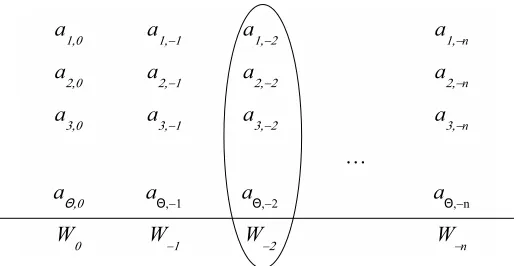
Denote the bit representation of each number ai by ai,0•ai,−1ai,−2. . . ai,−n. That is, ai =
Pn
Figure 1: The procedure for summing up the ai’s: The binary representation of the rational numberai isai,0•ai,−1ai,−2. . . ai,−n. The integerW−j is the Hamming weight of the column of bits
(a1,−j, a2,−j, . . . , aΘ,−j).
0,1, . . . , n, whereW−j is the Hamming weight of the “column” of bits (a1,−j, a2,−j, . . . , aΘ,−j) (see an illustration in Figure 1). Since at most θ of theai’s are nonzero, then the W−j’s are no larger thanθ, and hence can be represented by ⌈log(θ+ 1)⌉< n bits. By Lemma 6.3 below, every bit in the binary representation of W−j can be expressed as a polynomial of degree at most θ in the Θ variables ai,−j,i= 1,2, . . . ,Θ. Moreover all of these polynomials can be computed simultaneously by an arithmetic circuit of sizeO(θ·Θ).
Once we have the W−j’s, the sum of the ai’s can be obtained by Piai = Pj2−jW−j. For
j= 0,1, . . . , nwe setwj = (2−j·W−j) mod 2, so thewj’s are rational numbers with⌈log(θ+ 1)⌉< n bits of precision. We can now sum-up the wj’s using the three-for-two trick as above, this time withk=n+ 1, thus obtaining the sum of theai’s mod 2.
We conclude that the degree of the polynomials in the first step is two, the degree of polynomials in the second step is at mostθ, and the degree of the polynomial in the third step is at most
32(n+ 1)1/log(3/2) < 32⌈logθ+ 4⌉1.71 < 32 log2θ
Therefore the total degree of the decryption circuit is bounded by 2·θ·32 log2θ= 64θlog2θ, and since we are usingθ=λwe have degree at most 64λlog2λ.
It follows that the augmented decryption circuits DE (i.e., decryption followed by a single multiplication or addition, cf. Definition 2.5) can be expressed as polynomials of degree at most 128λlog2λ in the Θ variables si. Since the logarithm of l1-norm of this polynomial is small in
relation to η, and since Θ = ηγρ ·ω(logλ) < λ7 (and also τ < λ7) the argument in Remark 3.6 at
the end of Section 3.2 (with α = 128 and β = 7) indicates that we can get DE ⊂ C(PE), making the scheme bootstrappable, by settingη=ρ·Θ(λlog2λ).
It is left to show how to compute theWj’s using polynomials of degree no larger than θ.
Lemma 6.3. Let~σ=hσ1, σ2, . . . , σti be a binary vector, let W =W(~σ) be the Hamming weight of
~σ, and denote the binary representation of W by Wn. . . W1W0. (That is, W =Pni=02iWi and all the Wi’s are bits.)
Proof. It is well known that the i’th bit in the binary representation of the Hamming weight of bit-vector~σ is equal toe2i(~σ) modulo 2, whereek(·) is thek’th elementary symmetric polynomial,
see Lemma 4 of [2]. That is,
Wi(~σ) = e2i(~σ) mod 2 =
X
|S|=2i
Y
j∈S
σj
mod 2
Clearly, the degree of e2i is exactly 2i.
As for the “Moreover” part, we can compute the elementary symmetric polynomials in the σi’s as the coefficients of the polynomial P~σ(z) =Qit=1(z−σi) in the auxiliary formal variable z, with
ek(~σ) being the coefficient ofzt−k. Conveniently, to compute only the first few bitsW0, W1, . . . , Wi, we can simply discard the lower-order terms in P~σ(z) – i.e., we do not need the coefficients of zj forj < t−2i.
For example, one “dynamic programming” procedure for computing W0, W1, . . ., Wi (which can be trivially made into a circuit) would go as follows:
Input: bits σ1, . . . , σt
0. Initialization: Set P0,0 ←1 andPj,0 ←0 for j= 1,2,3, . . . ,2i
// Pj,k is the j’th symmetric polynomial in σ1. . . σk 1. For k= 1,2, . . . , t // incorporateσk
2. Forj= 2i down to 1, set Pj,k ←σk×Pj−1,k−1 +Pj,k−1
3. Output P1,t, P2,t, P4,t, . . . , P2i,t
We can do a little better by using fast Fourier transform multiplication of polynomials. Using this technique, we can compute the entire polynomialP~σ(z) with complexityt·polylog(t).
Remark 6.4. Note that our first circuit implementation of the procedure from above is not “shal-low”. Nonetheless, since it computes only “low degree polynomials” (i.e., up to degree 2i), then by Lemma 3.5 it is a permitted circuit.
6.3 Security of the Squashed Scheme
Putting the hint~yin the public key induces another computational assumption, related to the sparse subset sum problem (SSSP) used by Gentry [6], and studied previously (sometimes under the name “low-weight” knapsack) in the context of server-aided cryptography [19] and in connection to the Chor-Rivest cryptosystem [21]. We can easily avoid known attacks on the problem by choosing θ large enough to avoid brute-force attacks (and improvements using time-space trade-offs) and choosing Θ to be larger than ω(logλ) times the bit-length of the rational numbers in the public key (which have lengthκ).7
7
7
Conclusion and Open Problems
We described a fully homomorphic encryption scheme that uses only simple integer arithmetic. The primary open problem is to improve the efficiency of the scheme, to the extent that it is possible while preserving the hardness of the approximate-gcd problem.
References
[1] W. Alexi, B. Chor, O. Goldreich, and C.-P. Schnorr. Rsa and rabin functions: Certain parts are as hard as the whole. SIAM J. Comput., 17(2):194–209, 1988.
[2] J. Boyar, R. Peralta, and D. Pochuev. On the multiplicative complexity of boolean functions over the basis (∧,⊕,1). Theor. Comput. Sci., 235(1):43–57, 2000.
[3] C. Cachin, S. Micali, and M. Stadler. Computationally private information retrieval with polylogarithmic communication. InAdvances in Cryptology - EUROCRYPT’99, volume 1592 ofLecture Notes in Computer Science, pages 402–414. Springer, 1999.
[4] B. Cohen. Web document,http://bramcohen.com/simple_public_key.html, 2000. See also
http://www.mail-archive.com/[email protected]/msg00018.html.
[5] D. Coppersmith. Small solutions to polynomial equations, and low exponent RSA vulnerabil-ities. J. Cryptology, 10(4):233–260, 1997.
[6] C. Gentry. A fully homomorphic encryption scheme. PhD thesis, Stanford University, 2009.
http://crypto.stanford.edu/craig.
[7] C. Gentry. Fully homomorphic encryption using ideal lattices. In STOC ’09, pages 169–178. ACM, 2009.
[8] C. Gentry and Z. Ramzan. Single-database private information retrieval with constant com-munication rate. In ICALP’05, volume 3580 of Lecture Notes in Computer Science, pages 803–815. Springer, 2005.
[9] S. Goldwasser and S. Micali. Probabilistic encryption. Journal of Computer and System Sciences, 28(2):270–299, April 1984.
[10] J. H˚astad, R. Impagliazzo, L. A. Levin, and M. Luby. A pseudorandom generator from any one-way function. SIAM J. Comput., 28(4):1364–1396, 1999.
[11] N. Howgrave-Graham. Approximate integer common divisors. In CaLC ’01, volume 2146 of Lecture Notes in Computer Science, pages 51–66. Springer, 2001.
[12] Y. Ishai and A. Paskin. Evaluating branching programs on encrypted data. In 4th Theory of Cryptography Conference (TCC’07), volume 4392 of Lecture Notes in Computer Science, pages 575–594. Springer, 2007.
[14] D. E. Knuth. Seminumerical Algorithms, volume 2 of The Art of Computer Programming. Addison-Wesley, 3rd edition, 1997.
[15] J. C. Lagarias. The computational complexity of simultaneous diophantine approximation problems. SIAM J. Comput., 14(1):196–209, 1985.
[16] A. K. Lenstra. Factoring multivariate polynomials over algebraic number fields. SIAM J. Comput., 16(3):591–598, 1987.
[17] ´E. Levieil and D. Naccache. Cryptographic test correction. In R. Cramer, editor,Public Key Cryptography, volume 4939 of Lecture Notes in Computer Science, pages 85–100. Springer, 2008.
[18] Y. Lindell and B. Pinkas. A proof of security of yao’s protocol for two-party computation. J. Cryptology, 22(2), 2009.
[19] P. Q. Nguyen and I. Shparlinski. On the insecurity of a server-aided RSA protocol. InAdvances in Cryptology - ASIACRYPT’01, volume 2248 of Lecture Notes in Computer Science, pages 21–35. Springer, 2001.
[20] P. Q. Nguyen and J. Stern. The two faces of lattices in cryptology. InCryptography and Lattices, CaLC’01, volume 2146 of Lecture Notes in Computer Science, pages 146–180. Springer, 2001.
[21] P. Q. Nguyen and J. Stern. Adapting density attacks to low-weight knapsacks. In Advances in Cryptology - ASIACRYPT’05, volume 3788 of Lecture Notes in Computer Science, pages 41–58. Springer, 2005.
[22] O. Regev. New lattice-based cryptographic constructions. JACM, 51(6):899–942, 2004.
[23] A. C. Yao. Protocols for secure computations. In23rd Annual Symposium on Foundations of Computer Science – FOCS ’82, pages 160–164. IEEE, 1982.
A
Proof of Correctness
Proof. (Lemma 3.3] We first consider a “fresh” ciphertext output byEncrypt. The following lemma says that each such ciphertext is close to a multiple of p, and that its difference from the closest multiple of phas the same parity as m.
Lemma A.1. Let (sk,pk) be output by KeyGen(λ). Let c←R Encrypt(pk, m) for m∈ {0,1}. Then, c=a·p+ (2b+m) for some integers aand b with|2b+m| ≤τ2ρ+3.
Proof. By definition,c←
m+ 2r+P
i∈Sxi
x0. Since |x0| ≥ |xi|fori∈ {1, . . . , τ}, we have that
c= m+ 2r+X i∈S
xi
!
+k·x0 for some|k| ≤τ.
For everyi, there exist integersqi andri with|ri| ≤2ρsuch thatxi =qi·p+ 2ri, and also|ri| ≤2ρ. We have
c=p· kq0+
X
i∈S
qi
!
+ m+ 2r+k·2r0+
X
i∈S 2ri
Regarding the rightmost term, its parity is the same as m, and its absolute value is at most (4τ+ 3)2ρ< τ2ρ+3, as claimed.
The following lemma says that essentially the same is true for ciphertexts output byEvaluate– i.e., ciphertexts are close to multiples of p, though possibly not as close.
Lemma A.2. Let (sk,pk) be output by KeyGen(λ). Let C ∈ CE be a circuit with tinputs and one output. For i ∈ {1, . . . , t} and mi ∈ {0,1}, let ci ←R Encrypt(pk, mi). Let m ← C(m1, . . . , mt) and c ← Evaluate(pk, C, c1, . . . , ct). Then, c = a·p+ (2b+m) for some integers a and b with |2b+m|< p/8.
Proof. Let C′ be the generalized circuit corresponding to C, which operates over the integers rather than modulo 2. Generally, we have that C′(c1, . . . , ct) ∈ C′(2b1 +m1, . . . ,2bt+mt) +pZ.
So [C′(2b1+m1, . . . ,2bt+mt)]p has the same parity as m = C(m1, . . . , mt). We also have that |C′(2b1 +m1, . . . ,2bt+mt)| ≤ 2η/16 ≤ p/8 by the definition of CE, since |2bi +mi| ≤ τ2ρ+3 by Lemma A.1.
Lemmas A.1 and A.2 immediately imply Lemma 3.3: for any circuit inCE and any encryptions of inputs to that circuit, the integer output by Evaluate is of the form c = a·p+ (2b+m) with |2b+m| ≤ p/8 (where m is the plaintext that c is supposed to encrypt). Accordingly, we have [c]p = 2b+m, and thus m=
h
[c]pi
2.
B
More Known Attacks
B.1 Using Nguyen and Stern’s Orthogonal Lattice
As another lattice attack, consider the t-dimensional lattice L⊥~x of integer vectors orthogonal to ~x= (x0, . . . , xt). We have det(L⊥~x) =k~xk. (See Nguyen and Stern’s discussion of the orthogonal lattice [20].) Heuristically, if~xwere “random,” we would expect the shortest nonzero vector inL⊥
~ x to have length about √tdet(L~⊥x)1/t ≈√t·2γ/t. However ~x=p·~q+~r, where ~q= (q0, . . . , qt) and
~r = (r0, . . . , rt). Therefore, any vector that is orthogonal to both ~q and ~r – i.e., is in the lattice
L⊥
~
q,~r – is also inL⊥~x. For certain parameters, there will likely be t−1 linearly independent vectors inL⊥~q,~r that are much shorter than any vectors in L~⊥x \L⊥~q,~r. The idea of the attack is to reduceL⊥~x to recover these t−1 vectors of L⊥~q,~r, from which we can recover ~qand ~r, and hencep.
Consider the length of short vectors inL⊥
~
q,~r. The determinant ofL⊥~q,~r is at most k~qk · k~rk. Since
L⊥
~
q,~r has dimensiont−1, we expectL⊥~q,~r to have vectors of length approximately √
t2(γ+ρ−η)/(t−1).
Now, consider the length of the shortest vector in L⊥~x \Lq,~~⊥r. L⊥~x has one more dimension than L⊥~q,~r, and including this dimension increases the determinant by a factor of det(L⊥~x)/det(L⊥~q,~r) ≈ k~xk/k~qkk~rk ≈ 2η−ρ. The shortest vector in L⊥~x \L⊥~q,~r therefore has length at most about 2η−ρ+ (1/2)Pt−1
i=1k~bik, where the~bi’s are the shortest vectors inL⊥~x.
To recover vectors inL⊥~q,~r using lattice reduction, the attacker needs the shortest nonzero vector in L⊥~x \Lq,~~⊥r to be longer than an independent set of vectors in L⊥~q,~r. This occurs roughly when 2η−ρ>2(γ+ρ−η)/(t−1) ⇒t > γ/(η−ρ).
On the other hand, whent > γ/(η−ρ) is large, lattice reduction algorithms will not be able to recover the short vectors inL⊥
~
lattice reduction algorithm to provide at least a 2η−ρ approximation to obtain vectors guaranteed to be in L⊥
~
q,~r, and (for such large t) known lattice reduction algorithms take time roughly 2γ/η 2
to guarantee such a close approximation.
A very similar attack is the following. Consider the lattice spanned by the rows of the following t×(t+ 1) matrix, where row i corresponds to the constraint xi−ri = 0 (mod p), and Ri is an upper bound on|ri|.
M =
x1 R1
x2 R2
..
. . ..
xt Rt
Let ~v = hv0, v1, . . . , vti be a vector in this lattice, namely ~v = Pti=1µiMi for some integers µi. Then, we have
v0−
t
X
i=1
vi
Ri ·
ri = t
X
i=1
µixi− t
X
i=1
µiRi
Ri ·
ri = t
X
i=1
µi(xi−ri) = 0 (modp)
Suppose that the l1 norm of ~v is at most p/2. Then, |v0−Pti=1Rvii ·ri| ≤
Pt
i=0|vi| ≤p/2. Since this quantity also equals 0 modulo p, we have that v0−Pti=1Rvii ·ri = 0 over the integers. If we
heuristically suppose that we can find tsuch~v’s, all of which are orthogonal to (1,−r1
R1, . . . ,− rt
Rt),
then we can solve for the ri’s.
The determinant of this lattice is bounded by the product of the norms of the columns of M, namely at most√tXRt, whereX is an upper bound on|x
i|. Hence it has vectors roughly as short asR√tX. To obtain suitable vectors~v, we need this quantity to be at mostp. We obtainR√tX < p when t > γ/(η−ρ). The rest of the analysis is similar to that for the previous attack.
B.2 Extending Coppersmith’s Method
We may attempt to use Coppersmith’s technique [5] to augment the last attack from above. Namely, instead of looking only at the relations xi −ri = 0 (mod p), we can also look at their products, e.g. (xi−ri)2= 0 modp2, (xi−ri)(xj−rj) = 0 modp2, etc. As an illustrative example, consider the case of products of up to two relations from a total oft= 3 available relations. We then have a matrix whose rows correspond to the t+12
= 6 possible pairs of relations, and whose columns correspond to the t+22
= 10 terms that appear in these product relations:
M =
1 ρ1 ρ2 ρ3 ρ21 ρ1ρ2 ρ1ρ3 ρ22 ρ2ρ3 ρ23
x2
1 −2x1R1 R21
x1x2 −x2R1 −x1R2 R1R2
x1x3 −x3R1 −x1R3 R1R3
x2
2 −2x2R2 R22
x2x3 −x3R2 −x2R3 R1R3
x23 −2x3R3 R22
←(x1−r1)2
←(x1−r1)(u2−r2)
←(x1−r1)(u3−r3)
←(x2−r2)2
←(x2−r2)(u3−r3)
←(x3−r3)2