Available Online atwww.ijcsmc.com
International Journal of Computer Science and Mobile Computing
A Monthly Journal of Computer Science and Information Technology
ISSN 2320–088X
IMPACT FACTOR: 6.199
IJCSMC, Vol. 8, Issue. 7, July 2019, pg.167 – 172
Handwritten Character
Recognition Using SIFT Algorithm
Bhupinder Kaur
Research Scholar
Universal Group of Institutions, Lalru, Punjab, India
[email protected]
Prabhjot Kaur
Assistant Professor
Universal Group of Institutions, Lalru, Punjab, India
[email protected]
Abstract: Image processing is the procedure which is used to process various images. In this work, text is extracted from the natural scene images. The natural scene images are those images which are seen daily. In the recent times various techniques has been proposed and among these character detection and make apply grouping on these detected characters for batter recognizing. The daily scene images can oriented on many angles due to which accuracy of text extraction can be reduced. In this work, improvement will be proposed using SIFT algorithm for batter reorganization. The simulation of the algorithm is performed in MATLAB and it is analyzed that proposed algorithm performs well in terms of PSNR, MSE and Accuracy.
Keywords: Character Recognisation, SIFT, Handwritten
1.
Introduction
which the characters of a document can be recognized by scanning them from any surface is called the offline handwritten character recognition. The size of storage of scanned documents is huge and it is impossible to search, edit or maintain the content for several applications [4]. The process through which only the handwritten characters can be recognized is called online mode of recognition. Several means are used to capture and store the handwriting. Generally, along with an electronic surface a special pen is used in conjunction. As per the function of time, the two dimensional coordinates of next points are represented based on the mobility of pen across the surface. These coordinates are then stored as well. The popularity of online handwritten recognition is growing with the increase is usage of handheld devices [5]. The users can type on screen by handwriting on a pad through online handwritten recognition. The user and computer communication can be improved by applying online handwriting recognition. Comparably high recognition accuracy levels can be achieved by applying neural networks in offline systems. To perform handwriting recognition certain steps are followed generally. A scanned image is given as input by the recognition system in the initial step called image acquisition. Every image has its own specified format and is generated from a different source like camera, scanner or digital input device. The preparation of characters before giving them as input is done by performing certain changes through pre-processing [6]. The desired region of characters is extracted from the pictorial representation at first. Splitting of alphabets, scaling the segments to a fixed size and achieving the skeletal patterns by thinning the resultant character segments are the steps included within preprocessing. The recognition process is also furnished through the pre-processing step by thinning the alphabets and their skeletons before the extraction of their binary forms by applying several image processing techniques. The image processing techniques also help in cleaning and smoothing the scanned documents [7]. Since the neural networks need the inputs in the binary forms, digitization of segment grids is also done. The segments of character are then recognized in the following step by neural networks using the various network parameters provided by them [8]. For each node of the neural network that is designed to train those segments is them provided with each digitized segments available from total segmented grid. The system can recognize the characters one the network is trained for these segments. It is also possible to differentiate the characters that although look alike but are different [9]. Thus, it is possible to recognize the handwritten characters even when input characters are very close to the printed letters available in the input image.
2. Literature Review
Eko Hari Rachmawanto, et.al (2018) proposed a novel approach for the withdrawal of peculiarity and roundedness aspects on the basis of K-Nearest Neighbors (KNN) classifier for the recognition of handwritten characters [10]. Several image preprocessing steps like thresholding, noise sieving and cropping were utilized for the attainment of each handwritten character picture and this procedure also maximized the identification procedure. After this, features were extracted from every picture which was gone through the preprocessing procedure. Some features of retrieved picture like peculiarity and metric were also identified with the help of this approach. After the attainment of these aspects, a training process was executed for the grouping of features on all kinds of alphabet. In the subsequent phase, the KNN classification model was used for the classification of every alphabetical text. The experimental outcomes demonstrated that the projected approach achieved a precision rate of 85.38% for the identification of handwritten font.
Akm Ashiquzzaman et.al (2017) proposed a new algorithm which was relied on deep learning neural networks [13]. This approach utilized suitable commencement purpose and regularization layer for the attainment of considerably enhanced accurateness in comparison with the obtainable Arabic number detection techniques. The projected approach showed 97.4 percent precision rate, which was considered the uppermost precision of the data sample utilized in the research. The advancement of the preceding technique was also projected in this research work. The comparative outcomes demonstrated that modified approach gave a superior precision level of 93.8 percent in comparison with traditional approach.
Pritam Dhande, et.al (2017) presented a study interrelated to detection of cursive English handwritten characters. The script detection of transcribed cursive English characters was a very complicated task [14]. The texts in a word are related to one another in the cursive English script. Therefore, the segmentation and characteristic withdrawal of cursive English handwriting was proved very tricky. The horizontal and perpendicular protrusion techniques were utilized for segmentation in the presented study. The characteristic withdrawal process was performed with the help of convex hull algorithm and support vector machine classification model was utilized for categorization and acknowledgment. The tests were performed on CCC standard dataset. The tested results demonstrated that proposed approach gave competent outcomes.
Rathin Radhakrishnan Nair, et.al (2018) proposed a deep learning network approach which utilized the strategy of transport learning for handwritten character detection process [15]. A data sample named IAM was used for the training of a general mock-up and used the pre-prepared densities for the fine tuning of researcher specified Washington data sample. A generic script characteristic depiction was learned by this scheme during its training beside IAM, which learned client-specific characteristics during the fine-tuning of similar model on the Washington or Moore data sample. The presentation assessment of CER and WER showcased the capability of the mock-up in the learning and adapting of an objective data sample with restricted training sets. The experimental outcomes proved that revealing a mock-up to the profusion of training information, to a definite boundary, did not forever capitulate a comparative presentation enhancement.
3. Research Methodology
The part-based tree structure model was composed. This model was utilized to identify the text characters which are done through Latent-SVM. The recognizable proof of text words from the regions is done under a restrictive irregular field. Highlight coordinating was done through the Scale Invariant Feature Transform (SIFT). The false positive matches were evacuated by voting and geometric confirmations. A word reference is developed which is utilized to enhance the precision of detection and distinguishing proof. Utilizing HOG highlights the character structure was demonstrated.
The primary stage is to build a scale space. This is finished by more than once convolving the contribution of the image with Gaussian Convolution Kernel. This creates a settled arrangement which comprises of progressively obscured variants of the image. The Difference of Gaussian between nearby images is computed. At that point the filtering of conceivably flimsy keypoints which are predominantly in low contrast edges is finished. Subsequent to social affair the stable keypoints, the Gradient orientation histogram is ascertained in the area of the keypoint.
Fig 1 Proposed flowchart
4. Results and Discussion
Fig. 3: Images Displayed
As shown in the figure 3, in the wake of specifying the record name the images that match the interest given by the client are shown on the screen. The images are appeared with the text showing above them. These images are the outcomes that are given from the natural scene image text extraction files.
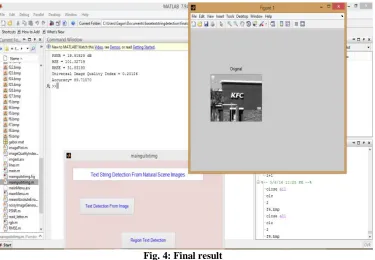
Fig. 4: Final result
5. Conclusion
A speedy and feasible pruning estimation is proposed to evacuate Maximally Stable Extremal Regions (MSERs) as character hopefuls using the procedure of minimizing regularized assortments. Character candidates are collected into substance hopefuls by the connection grouping algorithm, where division weights and bunching limit are discovered naturally by a novel self-training separation metric learning algorithm. A procedure to be specific Scale Invariant Feature Transform (SIFT) strategy is utilized for the extraction and detection purposes. It is been broke down that a portion of the texts stay unrecognized because of wrong orientation of the image. This technique straightforwardly prompts increment in precision of the detection, flaw detection rate and additionally the PSNR value of the image.
References
[1] R. Plamondon and S. N. Srihari, “On-line and off- line handwritten character recognition: A comprehensive survey”, IEEE,
Transactions on Pattern Analysis and Machine Intelligence, vol. 22, no. 1, pp. 63-84, 2000.
[2] N. Arica and F. Yarman-Vural, “An Overview of Character Recognition Focused on Off-line Handwriting”, IEEE Transactions on Systems, Man, and Cybernetics, Part C: Applications and Reviews, 2001, 31(2), pp. 216 - 233.
[3] U. Bhattacharya, and B. B. Chaudhuri, “Handwritten numeral databases of Indian scripts and multistage recognition of mixed numerals,” IEEE Transaction on Pattern analysis and machine intelligence, vol.31, No.3, pp.444-457, 2009.
[4] U. Pal, T. Wakabayashi and F. Kimura, “Handwritten numeral recognition of six popular scripts,” Ninth International conference on Document Analysis and Recognition ICDAR 07, Vol.2, pp.749-753, 2007.
[5] R.G. Casey and E.Lecolinet, “A Survey of Methods and Strategies in Character Segmentation,” IEEE Transactions on Pattern Analysis and Machine Intelligence, Vol. 18, No.7, July 1996, pp. 690-706.
[6] Anil.K.Jain and Torfinn Taxt, “Feature extraction methods for character recognition-A Survey,” Pattern Recognition, vol. 29, no. 4, pp. 641-662, 1996.
[7] R.G. Casey and E.Lecolinet, “A Survey of Methods and Strategies in Character Segmentation,” IEEE Transactions on Pattern Analysis and Machine Intelligence, Vol. 18, No.7, July 1996, pp. 690-706.
[8] C. L. Liu, H. Fujisawa, “Classification and Learning for Character Recognition: Comparison of Methods and Remaining Problems”, Int. Workshop on Neural Networks and Learning in Document Analysis and Recognition, Seoul, 2005.
[9] F. Bortolozzi, A. S. Brito, Luiz S. Oliveira and M. Morita, “Recent Advances in Handwritten Recognition”, Document Analysis, Umapada Pal, Swapan K. Parui, Bidyut B. Chaudhuri, pp 1-30.
[10] Eko Hari Rachmawanto, Galang Rambu Anarqi, De Rosal Ignatius Moses Setiadi, Christy Atika Sari, “Handwriting Recognition using Eccentricity and Metric Feature Extraction based on K-Nearest Neighbors”, 2018 International Seminar on Application for Technology of Information and Communication, Pages: 411 – 416.
[11] Kartik Dutta, Praveen Krishnan, Minesh Mathew and C.V. Jawahar, “Improving CNN-RNN Hybrid Networks for Handwriting Recognition”, 2018 16th International Conference on Frontiers in Handwriting Recognition.
[12] Lyzandra D’souza, Maruska Mascarenhas, “Offline Handwritten Mathematical Expression Recognition using Convolutional Neural Network”, 2018, 2018 International Conference on Information, Communication, Engineering and Technology (ICICET).