Security of Encryption Schemes
in Weakened Random Oracle Models
Akinori Kawachi∗ Akira Numayama∗ Keisuke Tanaka∗ Keita Xagawa∗ March 5, 2010
Abstract
Liskov proposed several weakened versions of the random oracle model, called weakened ran-dom oracle models (WROMs), to capture the vulnerability of ideal compression functions, which are expected to have the standard security of hash functions, i.e., collision resistance, second-preimage resistance, and one-wayness properties. TheWROMs offer additional oracles to break such proper-ties of the random oracle. In this paper, we investigate whether public-key encryption schemes in the random oracle model essentially require the standard security of hash functions by theWROMs. In particular, we deal with fourWROMs associated with the standard security of hash functions; the standard, collision tractable, second-preimage tractable, first-preimage tractable ones (ROM,
CT-ROM,SPT-ROM, andFPT-ROM, respectively), done by Numayama et al. for digital signature schemes in theWROMs. We obtain the following results: (1) The OAEP is secure in all the four models. (2) The encryption schemes obtained by the Fujisaki-Okamoto conversion (FO) are secure in theSPT-ROM. However, some encryption schemes with FO are insecure in theFPT-ROM. (3) We consider two artificial variants wFO and dFO of FO for separation of theWROMs in the con-text of encryption schemes. The encryption schemes with wFO (dFO, respectively) are secure in the CT-ROM (ROM, respectively). However, some encryption schemes obtained by wFO (dFO, respectively) are insecure in theSPT-ROM(CT-ROM, respectively). These results imply that stan-dard encryption schemes such as the OAEP and FO-based one do not always require the stanstan-dard security of hash functions. Moreover, in order to make our security proofs complete, we construct an efficient sampling algorithm for the binomial distribution with exponentially large parameters, which was left open in Numayama et al.’s paper.
Keywords: public-key encryption schemes, weakened random oracle models, OAEP, Fujisaki-Okamoto conversion.
∗Department of Mathematical and Computing Sciences, Tokyo Institute of Technology, W8-55, 2-12-1 Ookayama
Contents
1 Introduction 3
2 The Weakened Random Oracle Models 6
2.1 Definitions of the Weakened Random Oracle Models . . . 7
2.2 Difference from the Random Oracle Model . . . 7
2.3 Simulation Methods . . . 8
3 The Encryption Schemes and Their Security in the Weakened Random Oracle Models 9 3.1 The First Variant dFO . . . 10
3.2 The Second Variant wFO . . . 11
3.3 The Original Fujisaki-Okamoto Conversion . . . 13
3.4 OAEP . . . 14
4 Future Work 15 A Simulation Algorithms of Numayama et al. 16 B Proof of Lemma 2.4 18 C Proof of the Security of dFO, Theorem 3.1 20 D Proof of the Security of wFO, Theorem 3.3 25 E Proof of the Security of FO, Theorem 3.5 30 F Proof of the Security of OAEP, Theorem 3.7 35 G Overview of Approximation Sampling Algorithms 43 H Preliminaries for Approximation Sampling Algorithms 45 H.1 Calculations . . . 45
I Definitions of the Distributions 46 J Inequalities for the Distributions 47 J.1 Inequalities for the Cauchy Distribution . . . 47
J.2 Inequalities for the Gamma Distribution . . . 49
J.3 Inequality for the Beta Distribution . . . 51
J.4 Inequalities for the Binomial Distribution . . . 51
K Approximation Sampling Algorithms 53 K.1 The Acceptance–Rejection Method . . . 53
K.2 Sampling from the Cauchy Distribution based on the Uniform Distribution . . . 55
K.3 Sampling from the Gamma Distribution based on the Cauchy and the Uniform Distribution 57 K.4 Sampling from the Beta Distribution based on the Gamma Distribution . . . 60
K.5 Sampling from the Binomial Distribution based on the Bernoulli Experiments . . . 61
1
Introduction
Background: In order to design new cryptographic schemes, we often follow the random oracle methodology [BR93]. First, we analyze the security of cryptographic schemes, by idealizing hash func-tions as truly random funcfunc-tions called the random oracle. When it comes to implementafunc-tions of these schemes, we replace the random oracles by cryptographic hash functions such as MD5 [Riv92] and SHA-1 [Nat02]. This replacement is called an instantiation of the random oracle.
The random oracle methodology causes a trade-offbetween efficiency and provable security. The schemes proven secure in the random oracle model (ROM) are in general more efficient than those proven secure in the standard model. However, the security proofs in theROMdo not directly guarantee the security in the standard model, i.e., an instantiation of the random oracle might make the cryp-tographic schemes insecure. Even worse, several recent works [CGH04, GK03, BBP04] showed that some schemes secure in theROMhave no secure instantiation.
There are several properties of theROMto prove the security of cryptographic properties. In partic-ular, theROMis expected to satisfy the one-wayness, second-preimage resistance, and collision resist-ance properties. We call these properties as the standard security of hash functions. These properties are indeed critical in many schemes for their security proofs. For example, the security of the Full-Domain-Hash (FDH) signature schemes (e.g., [BR96]), which are secure in the ROM, relies on the collision-resistance property of theROM. That is, if we can obtain two distinct messages m,m′such that
H(m)= H(m′) and the signatureσ=Sig(H(m)), then we can obtain a valid forgery (m′, σ), where H is a hash function andSigis a signing algorithm. Leurent and Nguyen also presented the attacks extracting the secret keys on several hash-then-sign type signature schemes and identity-based encryption schemes if the underlying hash functions are not collision resistant [LN09].
Recent progress on the attacks against cryptographic hash functions such as MD5 and SHA-1 raises the question on the assumption that hash functions are collision resistant and one-way (e.g.,[WY05, WYY05, AS09]). Therefore, it is significant to investigate whether the collision resistance property (as well as the one-wayness and second-preimage resistance properties, which are weaker notions than the collision resistance one) of theROMis essential to prove the security of the schemes or not. More gener-ally, it is worth classifying the schemes by the first-preimage, second-preimage, and collision resistance properties of theROMthat their security essentially requires.
Weak versions of random oracle models: Several works recently highlighted some specific proper-ties of theROMfor secure cryptographic constructions in theROM.
Nielsen proposed the non-programmable random oracle model where the random oracle is not
pro-grammable [Nie02]. In this model, one cannot set the values that the random oracle answers to some
convenient values. It was showed in [Nie02] that a non-interactive non-committing encryption scheme exists in theROM(assuming that trapdoor permutations exists), but not in the non-programmable ran-dom oracle model.
Unruh proposed aROMwith oracle-dependent auxiliary inputs [Unr07]. In this setting, adversaries obtain an auxiliary input that contains information with respect to the random oracle (e.g. collisions). He showed that theRSA-OAEPencryption scheme [BR95] is secure in theROMeven under the presence of oracle-dependent auxiliary inputs.
Liskov proposed several weakened versions of the random oracle model, called weakened random
oracle models (WROMs), which offer additional oracles to break some properties of the random
others such as the second-preimage and collision ones that correspond to the attack to the properties. Thus, theWROMs can capture vulnerability of hash functions even if the parties are allowed to utilize ideal ones as in theROM. By usingWROMs, Liskov constructed hash functions based on weak ideal compression functions and proved it is indifferentiable from the random oracle.
Several results already analyzed the security in the WROMs. Hoch and Shamir applied Liskov’s idea to prove the indifferentiability of another hash construction [HS08]. Pasini and Vaudenay also ap-plied Liskov’s idea to the security analysis of digital signature schemes [PV07]. They considered the security of hash-then-sign type signature schemes in the first-preimage tractable random oracle model. Numayama, Isshiki, and Tanaka formalized theWROMs, which allows us to formally analyze the secu-rity of the schemes [NIT08]. By using these models, they classified several digital signature schemes by the properties of theROM. Fischlin and Lehmann also proposed a weakened random oracle model in a similar way to Liskov’s one in the context of secure combiners [FL07].
Our contributions: In this paper, we investigate whether public-key encryption schemes constructed in theROMessentially require the standard security of hash functions by further extending the direc-tion originated from Liskov. In particular, we consider their security in the standard, collision tracta-ble, second-preimage tractatracta-ble, and first-preimage tractable random oracle models (ROM, CT-ROM, SPT-ROM, and FPT-ROM, respectively for short). Note that they are ordered according to their strengths, i.e., the security of encryption schemes in theFPT-ROMimplies that in the SPT-ROMand such implications hold between each adjacent two models.
We demonstrate that the security notions in the fourWROMs can be strictly separated in the context of encryption schemes. For the separation, we focus on the security of the encryption schemes obtained by the Fujisaki-Okamoto conversion (FO) [FO99], its two artificial variants (dFO and wFO), and the OAEP [BR95]. Precisely, we prove the following four statements:
1. OAEP isIND-CCA2secure in theFPT-ROM.
2. FO isIND-CCA2secure in theSPT-ROM, but notIND-CPAsecure in theFPT-ROM.
3. wFO isIND-CCA2secure in theCT-ROM, but notIND-CCA2secure in theSPT-ROM.
4. dFO isIND-CCA2secure in theROM, but notIND-CCA2secure in theCT-ROM.
We summarize the security of four schemes in Table 1.
scheme/model ROM CT-ROM SPT-ROM FPT-ROM
OAEP secure
FO secure insecure
wFO secure insecure
dFO secure insecure
Table 1: Security of four schemes.
It also suggests that standard encryption schemes such as the OAEP and FO-based ones do not always require the standard security of hash functions for the random oracle. We believe that our results do not only give an example of the first application of the WROMs to encryption schemes, but they are also of independent interest. As far as we know, our results give the first evidence that the OAEP encryption scheme can be used in a practical application even without the first-preimage resistance property, i.e., the one-wayness property. In other words, the OAEP remains secure even if we remove the first-preimage resistance property. This can also be said on FO-based encryption schemes on the second-preimage resistance property.
On the security of the OAEP, Kiltz and Pietrzak recently showed that there is no construction for padding-based encryption schemes including the OAEP that has a black-box reduction from ideal trap-door permutations to its IND-CCA2 security in [KP09]. However, they wrote in the paper that the security proof in theROMcan be still a valid argument in practice. We believe so is our security proof in theWROMs.
For the security proof, we explicitly show how to sample approximately in polynomial time from binomial distributions with exponentially large parameters, that is, a polynomial-time sampling algo-rithm whose output distribution is statistically close to the binomial distribution. For this algoalgo-rithm, we arrange and combine sampling algorithms that run over real numbers proposed in the field of statistics [Dev86, AD74, AD80, Rel72], and give a precise analysis for discretization.
It should be noted that on the security proofs of the digital signature schemes in theWROMs [NIT08], Numayama et al. assumed such an efficient sampling algorithm and thus gave no explicit construction. They left the construction of the sampling algorithm as an open problem. By the sampling algorithm we explicitly show, it is no longer necessary to assume the sampling algorithm in their security proofs of the digital signature schemes [NIT08] as well as those of the public-key encryption scheme in this paper.
The sampling algorithm shown in this paper is adapted for cryptographic use since the statistical closeness to the original distribution is measured by the total variation distance, which is standard in cryptography but not usually required in statistics. The sampling algorithm is useful for other crypto-graphic tasks as in Numayama et al.’s and this paper.
Comparisons with other models: As mentioned above, a few models that weaken the power of the random oracle were already proposed such as the non-programmable model [Nie02] and the oracle-dependent auxiliary input model [Unr07].
The non-programmable model is not simply comparable with WROMs since the programmability does not imply the collision resistance and vice versa. The target of the oracle-dependent auxiliary input model partially overlaps that of theWROMs.
For a simple comparison, we now focus on the security of the OAEP in both models. Unruh showed a similar result as ours for the OAEP encryption scheme [Unr07]. He proposed a random oracle model where oracle-dependent auxiliary inputs are allowed. In his setting, the adversary of some cryptographic protocol obtains an auxiliary input that contains the information (e.g., collisions) on the random oracle. He showed that the OAEP encryption scheme [BR95] is still secure in the random oracle model even in his model. This result indicates an important fact that the security of the OAEP encryption scheme does not depend on the collision resistance property since the oracle-dependent auxiliary input can contain a sufficiently long list of collisions.
shows that the two adaptive securities of hash functions such as the first-preimage resistance and the second-preimage resistance are not necessary to prove the security of the OAEP encryption scheme.
Second, Unruh constructed the reduction algorithm which breaks the partial-domain one-wayness of the underlying trapdoor permutation using the adversary which breaks the IND-CCA2 security of the OAEP encryption scheme. The running time of the reduction algorithm is not bounded by any polynomial. Therefore, he use the security amplification technique for the partial-domain one-wayness. By using this technique, he can avoid employing a stronger assumption that even quasi-polynomial time adversary cannot break the partial-domain one-wayness, and can prove the security under the standard partial-domain one-wayness against polynomial-time adversary.
In contrast to Unruh’s result, we construct the polynomial-time reduction algorithm using the ad-versary, and hence we do not require the security amplification technique for the partial-domain one-wayness, which can be considered as a simplification of Unruh’s proof.
Organization: In Section 2, we describe the details of the WROMs and their properties. We also discuss the simulation methods that are applicable to these models. In Section 3, after reviewing the encryption schemes we consider, we show their (in)security in theWROMs. Appendices contain several technical details. Appendix A reviews the simulation methods ofWROMs by Numayama et al. Appen-dices ?? and B proves the technical lemmas, Lemmas 2.3 and 2.4, respectively. Proofs of the security of dFO, wFO, FO, andOAEPare in Appendices C, D, E, and F, respectively. In Appendix G, we give an overview of the approximation sampling algorithms. Appendix H reviews the standard notions and the arithmetic operations and Appendix I reviews the definitions of the standard distributions. In Ap-pendix J, we show several inequalities for the distributions. In ApAp-pendix K, we rigously analyze the approximation sampling algorithms for several distributions.
Notation: Before starting technical parts of this paper, we introduce our notation used in the rest of the paper. For a tableT= {(x,y)}, we defineT(y)= {(x′,y′)∈T| y′ = y}. For a distribution D, x ←D
denotes that x is sampled according to D. The function D(x) stands for the probability function of the distribution D.
Let s ← S denote that s is sampled from the uniform distribution over a finite set S . #S denotes
the number of elements in S . For a probabilistic Turing machineAand its input x, letA(x) denote the output distribution ofAon input x.
We usually denote by k a security parameter of a cryptographic scheme in this paper. We also denote by k′ length of plaintexts unless it is specified. k′ is implicitly assumed to be polynomially related to the security parameter k, that is, k′ = kΘ(1). We say a function f (k) is negligible in k if
f (k) = 2−ω(log k). For two distributions D1 and D2 over a finte set S , whose density functions are
denoted by fD1 and fD2, we denote the statistical distance (the total variation distance) between them
by∆(D1,D2), defined by 12∑s∈SfD1(s)− fD2(s). We say two distributions D1 and D2 are statistically
close if∆(D1,D2)=2−ω(log k).
2
The Weakened Random Oracle Models
2.1 Definitions of the Weakened Random Oracle Models
To give formal definitions of theWROMs, we define some notation. Let X and Y be finite sets. Let H be a hash function chosen randomly from all of the functions from X to Y. We denote byTHthe table {(x,H(x))|x∈X}. We identify the hash function H with the tableTH.
We next define the random oracle and the additional oracles associated with H : X →Y as follows.
(For more details, see [NIT08].)
Random oracleROH: Given x, return y such that (x,y)∈TH.
Collision oracleCOH: On the query, first pick one entry (x,y)∈THuniformly at random. If there is no other entry (x′,y)∈TH, then answer⊥. Otherwise, pick one entry (x′,y)∈THsatisfying x , x′ uniformly at random and answer (x,x′).
Second-preimage oracleSPOH: Given (x,y), if (x,y) < TH answer ⊥. If there is no other entry (x′,y)∈TH, then answer⊥. Otherwise, pick one entry (x′,y)∈THsatisfying x, x′ uniformly at random and answer x′.
First-preimage oracleF POH: Given y, if there is any entry (x,y)∈THthen return such an x uniformly at random. Otherwise return⊥.
Remark 2.1. We usually identify the random oracle and the underlying hash function. However, in
this paper as in [NIT08], we explicitly distinguish them by regarding the random oracle as an interface
to the underlying hash function. This setting helps us to make theWROMs with an additional oracle
well-defined.
The formal definitions of the WROMs are given as follows. TheWROMs consist of three compo-nents, a hash function h chosen randomly from all of the functions from X to Y, the random oracle, and the additional oracle associated with h. The models are called theCT-ROM,SPT-ROM, andFPT-ROM, if the additional oracle is the collision, second-preimage, and first-preimage oracle, respectively.
Remark 2.2. The collision oracle may output⊥even if there exists a collision (x,x′) in the table. This
stems from the simulation method of Numayama et al. [NIT08], and causes no serious problems. Note
that the collision oracle outputs⊥with probability (1−1/#Y)#X−1. In the case where #X ≥ #Y, we
can find a collision with polynomially many queries since (1−1/#Y)#X−1 ≤ exp(−(#X −1)/#Y). In
the case where #Y = kO(1)·#X, we can again find a collision with polynomially many queries since
(1−1/#Y)#X−1 ≤1−1/kO(1). Finally, in the case where #Y =kω(1)·#X, the following lemma shows that
there are no collisions with overwhelming probability.
Lemma 2.3. Let H : X → Y be the hash function, and ny the number of preimages of y under the
function H, that is, ny = #TH(y). LetBADdenote the event that there is some y such that ny > L. Then
for all sufficiently large Y, we have PrH[BAD] < (#Y)12, where L = 5 ln #Y ln ln #Y
#X
#Y if #X ≥ #Y, or L =
5 ln #Y ln ln #Y otherwise.
The proof is obtained by the standard argument on the balls and bins game by regarding X and Y as sets of balls and bins, respectively. For the details on the game, see a standard textbook (e.g., [MR95]).
2.2 Difference from the Random Oracle Model
We observe an important difference between the ROM and WROMs by considering the ROM and FPT-ROM. In the both models, the function H, i.e., the tableTHis uniformly distributed.
In theROM, if one queries some x that has never been queried to the random oracle, the value of
does not affect the entries not queried in the table. This property of the ROMis called uniformity. In contrast to the situation in the ROM, when it comes to the FPT-ROM, this property is not attained. Recall that the first-preimage oracle uniformly returns one of the preimages, say x, of queried value y. If the first-preimage oracle leaks a number of preimages of y, the value of H(x) is not uniformly distributed for an x not queried yet.
In order to observe this situation, let us consider the following extreme case. Let y∗= H(x∗) for some
x∗ ∈ X and suppose that y∗has the unique preimage x∗. Then the first-preimage oracle always returns
the same x∗on the input y∗, which convinces us that the number of the preimages of y∗is exactly 1. This implies that the other x , x∗does not take a value y∗under H. Therefore, the random oracle no longer has the uniformity in theFPT-ROM. This is a critical difference between theROMandFPT-ROMsince we often make use of the uniformity in the security proofs of the public-key encryption schemes.
We prove the following lemma to overcome this barrier in the WROMs, which states that the WROMs still has weak uniformity instead of the uniformity. The weak uniformity is still useful for the security proofs of the public-key encryption schemes in theWROMs. See Appendix B for the proof.
Lemma 2.4 (Weak Uniformity). In the WROMs, the output distribution of the random oracle is
sta-tistically close to the uniform distribution. More formally, it is stated as follows. Let H : X → Y be
the hash function in theWROMs. LetAbe a probabilistic oracle Turing machine that makes at most
q queries to the random oracle ROH and the additional oracleOH, where OH represents one of the
additional oraclesCOH,SPOH, andF POH. VA,H(x) denotes the random variable that represents the
hash valueROH(x), where x← AROH,OH and the correspondence (x,H(x))∈THis not answered by the
two oracles.
Then, for anyA, the following holds:
∆(VA,H(x),UY)≤
1 #Y
(
5q+1+ 4q#Y2 +20qln ln #Yln #Y )
if #X≥#Y,
1 #X
(
5q+1+ 4q#X2 +20qln ln #Yln #Y )
if #X<#Y.
Here, the probability is taken over random choices of the hash function H and the random coin ofA.
2.3 Simulation Methods
In almost all the security proofs in the ROM, the reduction algorithms simulate the random oracles. When it comes to the security proofs in theWROMs, the reduction algorithms have to simulate both the random and the additional oracle, which makes differences of the simulation methods in theWROMs from those in theROM.
Numayama et al.’s methods: Numayama et al. proposed the simulation methods for WROMs, but they required an unproven assumption. Let Bn(N,p) denote the binomial distribution with parameters
N and p whose probability function is fBn(x | N,p) = (Nx)px(1− p)N−x for x = 0, . . . ,N, where the
parameters N and p take values approximately #X and 1/#Y for a hash function H : X →Y, say, (N,p)=
(2128,2−128). Their simulation methods required the efficient sampler for Bn(N,p) with exponentially
large N and small p, and they assumed its existence.
Assumption 2.5. There is a probabilistic Turing machineBNsuch that the output distributionBN(N,p)
on inputs N and p is equal to the binomial distribution Bn(N,p) and it runs in polynomial time in log N
and log p−1, where N is a positive integer and 0≤ p≤1 is a rational number.
Proposition 2.6 (Simulation Method [NIT08]). We can perfectly simulate the random oracle, the
col-lision oracle, second-preimage oracle, and first-preimage oracle in theWROMs under Assumption 2.5.
That is, the output distributions of the random oracle, collision oracle, second-preimage oracle, and
first-preimage oracle in theWROMs are identical to the output distributions of the algorithmsRO,CO,
SPO, andFPO, under Assumption 2.5.
Removing the assumption: For the security proof in the WROMs of digital signature schemes in [NIT08] and encryption schemes in this paper, it is sufficient to utilize a weaker sampling algorithm that generates a distribution not equal but statistically close to the binomial distribution Bn(N,p). Then,
their security proofs can work by just adding negligibly small errors induced by the statistical distance in their analyses.
There are quite many papers (e.g., [Rel72]) on the efficient sampling methods from the binomial distribution in the field of statistics. However, their basic computation model is totally different from the model in the cryptography. As far as the authors’ knowledge, all these results are based on the compu-tation model that directly manipulates real numbers without errors. If we translate them to those in the bit computation model used in the cryptography, we have to bound the statistical distance between the real distribution and the output distribution generated by the sampling algorithms in the bit computation model rather than the real-number one. Numayama et al. mentioned that they could neither find precise analyses of the statistical distance, nor construct the sampling algorithms by themselves in [NIT08]. Therefore, they had to put the above assumption.
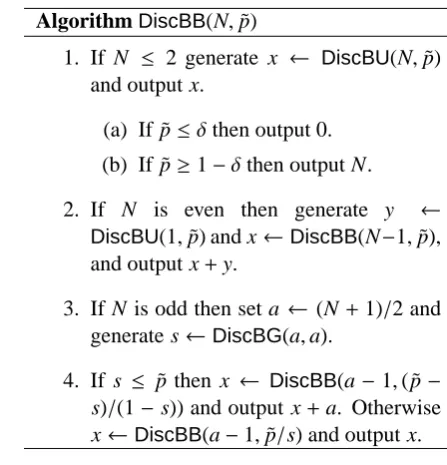
In fact, there is an efficient sampling algorithm appropriate for our purpose in the real-number com-putation model [Rel72]. We modify the algorithm and rigorously analyze the error bound in the bit computation model. We can finally obtain the following theorem on the sampling algorithm.
Theorem 2.7. Forϵ, there is a probabilistic Turing machineBN such that, for the output distribution
BN(N,p) on inputs N,p, the statistical distance betweenBN(N,p) and Bn(N,p) is at mostϵand it runs
in polynomial time in log N,log p−1and logϵ−1, where N is a positive integer and 0≤ p≤1,0< ϵ ≤1
are rational numbers.
Note that the algorithm can control the error parameterϵ. This property is useful in cryptographic applications for the security proofs even if the other parameters N and p are not sufficiently large. We put the details of the algorithm and its analysis in Appendices.
As a result, we can remove the above assumption and obtain the following theorem.
Theorem 2.8 (Simulation Method without Assumption 2.5). We can statistically simulate the random
oracle, collision oracle, second-preimage oracle, and first-preimage oracle in theWROMs. That is, the
output distributions of the oracles in theWROMs are statistically close to the output distributions of the
algorithmsRO,CO,SPO, andFPO, respectively.
3
The Encryption Schemes and Their Security in the Weakened Random
Oracle Models
In this section, we examine the security in the WROMs of the public-key encryption schemes. We particularly discuss separations for notions ofROM,CT-ROM,SPT-ROM, andFPT-ROMby showing (in)security of public-key encryption schemes obtained by the Fujisaki-Okamoto conversion (FO) and its two variants (dFO and wFO), and OAEP.
A public-key encryption schemePKE = (Gen,Enc,Dec) over a plaintext spaceMand a random coin spaceRis defined by the following three algorithms. Let k denote the security parameter.
Key Generation: On input 1k, the key generation algorithmGen(1k) produces a public/secret key pair (pk,sk).
Encryption: Given a public key pk, a plaintext m ∈ M, and a random string r ∈ R, the encryption algorithmEncpk(m; r) outputs a ciphertext c corresponding to the plaintext m.
Decryption: Given a secret key sk and ciphertext c, the decryption algorithmDecsk(c) outputs the plaintext m∈ Mor the special symbol⊥<Mcorresponding to the ciphertext c.
We require the perfect completeness, that is, for every (pk,sk) generated byGen(1k), every plaintext
m∈ M, and every random string r ∈ R, it should be satisfied thatDecsk(Encpk(m; r))=m.
We only consider three standard security notions for public-key encryption schemes, the one-wayness against chosen-plaintext attack (OW-CPA), the indistinguishability against chosen-plaintext attack (IND-CPA), and the indistinguishability against adaptive chosen-ciphertext attack (IND-CCA2).
For γ = γ(k), we say PKE is γ-uniform if for any key pair (pk,sk) generated by Gen(1k), any
m ∈ M, and c ∈ {0,1}∗, we have Prr←R[c = Encpk(m; r)] ≤ γ. There exists a OW-CPApublic-key encryption scheme withγ-uniformity (e.g., the ElGamal encryption scheme).
Brief review for FO: Fujisaki and Okamoto proposed a conversion, called the Fujisaki-Okamoto (FO) conversion, to obtain highly secure public-key encryption schemes in the ROM [FO99]. Since the standard one-time pad satisfies the requirement of the FO conversion, we fix the one-time pad as the symmetric-key encryption scheme used in the FO conversion for simplicity.
LetPKEbe aOW-CPAsecure andγ-uniform public-key encryption scheme over a plaintext space
Mand a randomness space R. Then the FO conversion convertsPKE to anIND-CCA2 secure one
PKE′ = FO(PKE) over a plaintext space M′ = {0,1}k′ and a randomness space R′ = M, where
k′ denotes the length of plaintexts, which is polynomially related to the security parameter k. The encryption procedure of PKE′ is given as follows: For a plaintext m ∈ M′ = {0,1}k′ and a random string r∈ R′ =M, the ciphertext is
(c1,c2)=(Encpk(r; H(m,r)),G(r)⊕m),
where H : {0,1}k′ × M → Rand G : M → {0,1}k′ are hash functions modeled as the random oracles. The decryption procedure is given as follows: For a given ciphertext (c1,c2), decrypt c1 by sk and
obtain r. Then, extract m by c2⊕G(r) and verify c1 = Encpk(r; H(m,r)). If not output ⊥. Roughly speaking, H(m,r) ensures that if a ciphertext (c1,c2) is valid then the encryptor producing (c1,c2) knows
corresponding m and r.
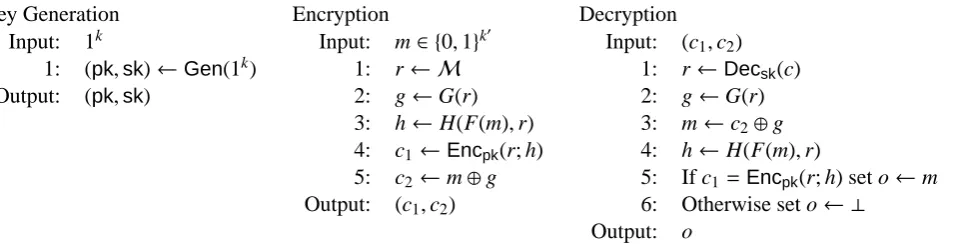
3.1 The First Variant dFO
We introduce the first artificial variant dFO and show that dFO is secure in theROM, but not secure in general in theCT-ROM.
The variant dFO converts a public-key encryption schemePKE(with the one-time pad) to another public-key encryption schemePKE′ =dFO(PKE) similarly to FO. The encryption procedure ofPKE′ is defined as follows. For a plaintext m∈ M′ ={0,1}k′ and a random string r∈ R′ =M, the ciphertext ofPKE′is
(c1,c2)=(Encpk(r; H(F(m),r)),G(r)⊕m),
Key Generation Encryption Decryption Input: 1k
1: (pk,sk)←Gen(1k) Output: (pk,sk)
Input: m∈ {0,1}k′
1: r← M
2: g←G(r)
3: h←H(F(m),r)
4: c1 ←Encpk(r; h) 5: c2 ←m⊕g
Output: (c1,c2)
Input: (c1,c2)
1: r ←Decsk(c)
2: g←G(r)
3: m←c2⊕g
4: h←H(F(m),r)
5: If c1=Encpk(r; h) set o←m 6: Otherwise set o← ⊥
Output: o
Figure 1:PKE′obtained by the dFO conversion.
The idea to weaken the conversion is summarized as follows: Recall that H(m,r) in the FO
con-version can be considered as encryptor’s signature (or a proof of knowledge) on m and r. To make it vulnerable by a collision, we introduce a new random oracle F and replace H(m,r) with H(F(m),r).
The replacement does not harm the security in the random oracle model, while it can be exploited by the presence of the collision oracleCOF.
Formally, we have following theorems on the (in)security. The proof of Theorem 3.1 is in Ap-pendix C.
Theorem 3.1. Assume thatPKEis aOW-CPAsecure andγ-uniform public-key encryption scheme for
some negligibleγ. Then,PKE′=dFO(PKE) isIND-CCA2secure in theROMif #P=2ω(log k).
Theorem 3.2. LetPKEbe a public-key encryption scheme. If #P ≤ 2k′ thenPKE′ = dFO(PKE) is
notIND-CCA2secure in theCT-ROM.
Proof. We construct the adversaryA = (A1,A2) that breaks theIND-CCA2security ofPKE′, which
exploits the collision oracleCOF of F.
The adversaryA1, on inputpk, first queries toCOF. If the answer is⊥, then the adversary flips a
random fair coin b′, outputs b′, and halts. Otherwise, it obtains a collision (m1,m2) of F and outputs it as
a challenge. The adversaryA2receives the target ciphertext (c∗1,c∗2)=(Encpk(r; H(F(mb),r)),G(r)⊕mb) for some r∈ R′. It queries (c′1,c′2)=(c1∗,c∗2⊕m0⊕m1) to the decryption oracle and obtains m1−b, since
c′1=Encpk(r; H(F(m0),r))=Encpk(r; H(F(m1),r)), c′2=G(r)⊕mb⊕m0⊕m1=G(r)⊕m1−b.
Hence, the adversary can answer b′=b correctly.
Finally, we upper-bound the probability that the collision oracle outputs ⊥, which stems from the definition of the collision oracle. The probability is bounded by (1−1/#P)2k′−1 ≤exp(−(2k′−1)/#P)≤
1/√e. This completes the proof.
3.2 The Second Variant wFO
We next introduce the second artificial variant wFO and show that the obtained scheme by wFO is secure in theCT-ROM, however not generally secure in theSPT-ROM.
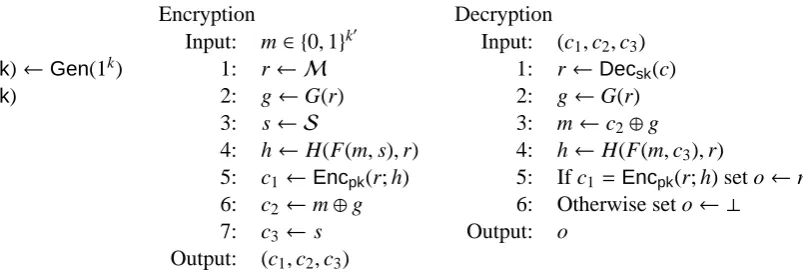
The encryption procedure of PKE′ = wFO(PKE) is given as follows. For a plaintext m ∈ M′ =
{0,1}k′ and random strings (r,s)∈ R′ =M × S, the ciphertext ofPKE′is
Key Generation Encryption Decryption Input: 1k
1: (pk,sk)←Gen(1k) Output: (pk,sk)
Input: m∈ {0,1}k′
1: r← M
2: g←G(r)
3: s← S
4: h←H(F(m,s),r)
5: c1 ←Encpk(r; h) 6: c2 ←m⊕g
7: c3 ←s
Output: (c1,c2,c3)
Input: (c1,c2,c3)
1: r ←Decsk(c)
2: g←G(r)
3: m←c2⊕g
4: h←H(F(m,c3),r)
5: If c1=Encpk(r; h) set o←m 6: Otherwise set o← ⊥
Output: o
Figure 2:PKE′obtained by the wFO conversion.
where F :{0,1}k′ × S → P, G :M → {0,1}k′, and H :P × M → Rare hash functions modeled as the random oracles. The formal definition is in Table 2.
Notice that (H(F(m,s),r),s) is a proof of knowledge on (m,r,s) which resists a collision on F
however is vulnerable by a second-preimage attack against F as in Numayama et al. [NIT08].
We can show that the obtained scheme isIND-CCA2secure in theCT-ROMby using Lemma 2.4. See Appendix D for the proof.
Theorem 3.3. Suppose thatPKEis aOW-CPAsecure andγ-uniform public-key encryption scheme for
some negligibleγ. Then,PKE′ = wFO(PKE) isIND-CCA2secure in theCT-ROMif #P−1and #S−1
are negligible in k.
However, its security is broken under the presence of the second-preimage oracle for F.
Theorem 3.4. Let PKE be a public-key encryption. If #P ≤ 2k′ · #S, then the scheme PKE′ =
wFO(PKE) is notIND-CCA2secure in theSPT-ROM.
Proof. We construct the adversaryA=(A1,A2) that exploits the second-preimage oracleSPOF
asso-ciated to F. The adversaryA1 chooses random distinct plaintexts m0 and m1 and queries them to the
challenger. The challenger responses
(c∗1,c∗2,c∗3)=(Encpk(r; H(F(mb,s),r)),G(r)⊕mb,s).
Receiving (c∗1,c∗2,c3∗), the adversary A2 queries (m0,s) to the second-preimage oracleSPOF. If it
re-ceives ⊥ from the second-preimage oracle, then it flips a random fair coin b′, outputs b′, and halts. Otherwise, it obtains (m′,s′),(m0,s) such that F(m0,s)=F(m′,s′). So, the adversary queries
(c′1,c′2,c′3)=(c1∗,c∗2⊕m0⊕m′,s′)
to the decryption oracle. Notice that, if (c∗1,c∗2,c∗3) is the valid ciphertext of m0, then we have
c′1=Encpk(r; H(F(m0,s),r))=Encpk(r; H(F(m′,s′),r)),
c′2=G(r)⊕m0⊕m0⊕m′=G(r)⊕m′, c′3= s′,
and (c′1,c′2,c′3) is a valid ciphertext for m′. On the other hand, if the ciphertext is the encryption of m1,
we have
Thus, if f = F(m1,s) is equal to F(m1⊕m0⊕m′,s′) the decryption oracle returns m1⊕m0⊕m′(,m′).
Otherwise, the decryption oracle returns⊥.
Thus, if the answer is m′, then the adversary concludes that (c∗1,c∗2,c∗3) is the ciphertext of m0, that
is, it outputs b′ =0. Otherwise, the adversary concludes that it is the ciphertext of m1, that is, it outputs b′ = 1. Therefore, A can output the correct answer unlessA receives ⊥from the second-preimage oracle.
We finally bound the probability that the oracle outputs⊥. It is bounded by (1−1/#P)2k′·#S−1 ≤
exp(−(2k′ ·#S −1)/#P)≤1/√e as required. This completes the proof.
3.3 The Original Fujisaki-Okamoto Conversion
We next show that the obtained scheme by the conversion FO with the one-time pad is secure in the SPT-ROM, but not secure in theFPT-ROMin some parameter setting.
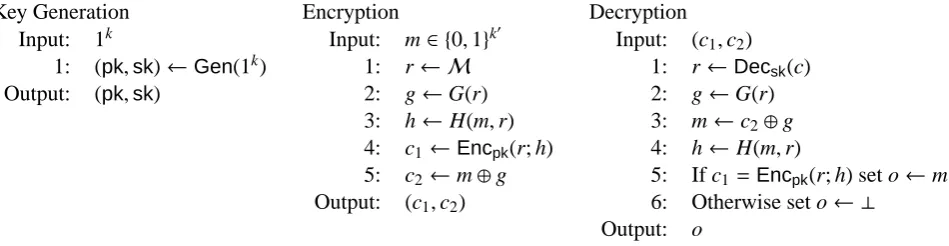
Let G : M → {0,1}k′ and H :{0,1}k′ × M → Rbe hash functions modeled as the random oracles. Recall the encryption procedure ofPKE′ =FO(PKE). For a plaintext m∈ M′ ={0,1}k′ and a random string r∈ R′ =M, the ciphertext is (Encpk(r; H(m,r)),G(r)⊕m). The scheme is in Figure 3.
Key Generation Encryption Decryption
Input: 1k
1: (pk,sk)←Gen(1k) Output: (pk,sk)
Input: m∈ {0,1}k′
1: r← M
2: g←G(r)
3: h←H(m,r)
4: c1 ←Encpk(r; h) 5: c2 ←m⊕g
Output: (c1,c2)
Input: (c1,c2)
1: r ←Decsk(c)
2: g←G(r)
3: m←c2⊕g
4: h←H(m,r)
5: If c1=Encpk(r; h) set o←m 6: Otherwise set o← ⊥
Output: o
Figure 3:PKE′obtained by the FO conversion.
Modifying the existing proofs, we can show the scheme is secure in theSPT-ROMusing Lemma 2.4. The proof appears in Appendix E.
Theorem 3.5. Suppose that PKE is OW-CPA secure and γ-uniform for some negligible γ. Then,
PKE′ =FO(PKE) isIND-CCA2secure in theSPT-ROM.
However, the presence of the first-preimage oracle for G violates theIND-CPAsecurity ofPKE′in some parameter settings. Note that if m is 0k′, the second component of the ciphertext is G(r), which is vulnerable the first-preimage oracle of G.
Theorem 3.6. Let C = #M/2k′. Assume that C = kO(1). Then, PKE′ = FO(PKE) is notIND-CPA
secure in theFPT-ROM.
Proof. We prove the theorem by constructing the adversary A = (A1,A2) which exploits the
first-preimage oracle of G,F POG. The adversary A1, on inputpk, queries m0 = 0k
′
and m1 = 1k
′ to the challenger. The adversaryA2, on input the target ciphertext (c∗1,c∗2), queries c∗2 to the first-preimage
oracle of G. If it obtains ˜r, it checks that c1 = Encpk(˜r; H(0k ′
,˜r)). If the check passes, the adversary outputs b′ =0. Otherwise, it flips a random fair coin b′, outputs b′, and halts.
It is obvious that if b = 0 and ˜r = r, the adversary answers correctly, that is, it outputs b′ = b.
We estimate the probability that the adversary wins. By Lemma 2.3, with probability at least 1−2−2k′, there is no preimage of size larger than L, where if C≥1 then L=5Ck′ln 2/(ln k′+ln ln 2)≤4Ck′/ln k′ and otherwise L=5k′ln 2/(ln k′+ln ln 2)≤4k′/ln k′for all sufficiently large k′.
LetGooddenote the event that r← F POG(G(r)). We then have Pr[Good]≥(1−2−2k
′
)/L. Hence,
we obtain that
Pr[b′=b]=Pr[b′=0|b=0∧Good] Pr[b=0∧Good]
+Pr[b′ =0|b=0∧ ¬Good] Pr[b=0∧ ¬Good]
+Pr[b′ =1|b=1] Pr[b=1]
=1· 1
2·Pr[Good]+ 1 2 ·
1
2 ·(1−Pr[Good])+ 1 2 ·
1 2
= 1
2 + 1
4Pr[Good]≥ 1 2 +
1−2−2k′
4L .
and 4L is a polynomial in the security parameter k. This completes the proof.
As shown above, the FO conversion is not secure in theFPT-ROM, but there is a way to modify it so as to maintain the security in theFPT-ROM. Naito, Wang, and Ohta proposed the conversion method that converts a cryptosystem secure in theROMto that secure even in theFPT-ROM[NWO09]. In the case of the FO conversion, the public key is (pk,c), where c← {0,1}k, and the ciphertext is
(c1,c2)=(Encpk(r; H(c,m,r)),G(c,r)⊕m),
where the domains of H and G are modified. Intuitively, this change makes the first-preimage oracles,
F POHandF POG, useless.
3.4 OAEP
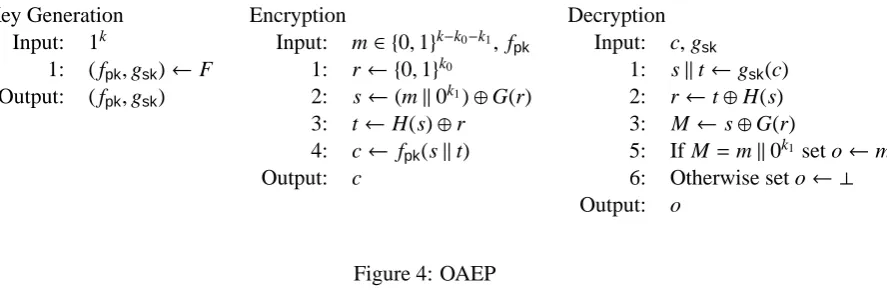
We finally focus on the OAEP and present itsIND-CCA2 security in theFPT-ROM. For the security parameter k, let k0 and k1 be functions in k, where k0 < k−k0. Let F be a family of partial-domain
one-way trapdoor permutations of a domain {0,1}k−k0 × {0,1}k0. (See [FOPS04] for the definition of
the partial-domain one-wayness.) Furthermore, let G and H be hash functions such that G :{0,1}k0 →
{0,1}k−k0 and H : {0,1}k−k0 → {0,1}k0. Then, the OAEP encryption scheme based on F is described in
Fig. 4. We obtain the following theorem that states the security of the OAEP encryption scheme in the
Key Generation Encryption Decryption
Input: 1k
1: ( fpk,gsk)←F Output: ( fpk,gsk)
Input: m∈ {0,1}k−k0−k1, f
pk 1: r← {0,1}k0
2: s←(m∥0k1)⊕G(r)
3: t←H(s)⊕r
4: c← fpk(s∥t) Output: c
Input: c, gsk
1: s∥t←gsk(c) 2: r←t⊕H(s)
3: M←s⊕G(r)
5: If M=m∥0k1 set o←m
6: Otherwise set o← ⊥
Output: o
Figure 4: OAEP
FPT-ROM.
Theorem 3.7. Let F be a family of partial-domain one-way trapdoor permutations. Then, the OAEP
encryption scheme based on F isIND-CCA2secure in theFPT-ROM.
4
Future Work
It should be noted that ourWROMs are based on a simplified variant, which Numayama et al. [NIT08] and Pasini and Vaudenay [PV07] also adopted, of the originalWROMs of Liskov [Lis07].
The original WROMs consists of the ideal compression function h : {0,1}k+k′ → {0,1}k of fixed
input length and the first-preimage oracle. Then, he discussed the security of the flexible input-length
hash functions Hh :{0,1}∗ → {0,1}k employing h as the component in the context of indiff erentiabil-ity [MRH04]. A random oracle H is often instantiated by employing a compression h. (See, e.g., the survey in [LN09, Section 2].) Therefore, his work reflects the attacks against the compression function of MD5 and SHA-1 rather than the construction H.
On the contrary, we (and similarly [NIT08, PV07]) discussed the monolithic random oracle H and the additional oracles associated with H. Hence, our model has a gap from such a realistic instantiation of the random oracle in some sense. We leave filling this gap as future work.
Except for the FO conversion, there are several conversion methods in the ROM, such as RE-ACT [OP01] and GEM [CHJ+02]. It would also be interesting as future work to examine the security of these conversion methods in theWROMs.
Acknowledgements
A
Simulation Algorithms of Numayama et al.
In this section, we review the details of the algorithms RO, CO, SPO, and FPOwhich simulate the random oracle, the collision oracle, the second-preimage oracle, and the first-preimage oracle in the WROMs, respectively.
In each ofWROMs, two tablesTandLare shared by the simulation algorithmROfor the random oracle and the simulation algorithm for the additional oracle, e.g.,COin theCT-ROM. In the start of the simulations, both tables are empty. In the simulations,Twill contain the pair of values (x,y) such
that x=h(y) andLwill contain the pair of values (y,n) such that n=#{x∈X | x=h(y)}. For the table
T={(x,y)}, we defineT(y)={(x′,y′)∈T|y′ =y}.
First, we review how the algorithmROruns on input ˆx in detail. If the hash value of ˆx is already determined, then the algorithmROreturns it. Otherwise, there are two situations depending on whether the algorithmROreturns old y which is already appeared in the tableTor the algorithmROreturns new
y which is not yet appeared in the tableT. There are (#X−#T) elements whose hash values are not yet
determined, and among them there are∑(˜y,˜n)∈L(˜n−#T(˜y)) elements whose hash values are expected to be old y. Therefore, the algorithmROreturns old y or new y with this ratio. In case of old y, the algorithm ROpicks old y according to the number of the preimages of each old y. In case of new y, the algorithm ROpicks new y uniformly at random, and defines the number of preimages of y. The whole algorithm is presented in Algorithm 2.
AlgorithmRO( ˆx)
1. If ( ˆx,y)∈Tfor some y, thenoutputy.
2. Let p be the following probability,
p=
∑
(˜y,˜n)∈L(˜n−#T(˜y))
#X−#T .
3. With probability p,outputold y as Steps (a)-(b).
(a) pick y←D according to the following distribution.
fD(y)=
n−#T ∑
(˜y,˜n)∈L(˜n−#T(˜y))
for (y,n)∈L.
(b) insert ( ˆx,y) inTandoutputy.
4. With probability 1−poutputnew y as Steps (a)-(d).
(a) pick y←Y\∪(˜y,˜n)∈L{˜y}uniformly at random.
(b) n′ ← Bn(#X−∑(˜y,˜n)∈L˜n−1,#Y−1#L). (Bn(N,p) denotes the binomial distribution with
pa-rameters N and p.)
(c) n←n′+1.
(d) insert (y,n) inL, insert ( ˆx,y) inT, andoutputy.
Algorithm 2: Simulation method of the random oracle.
Next, we review how the algorithmCOruns in detail. First, it picks x ← X as the original oracle
are two situations depending on whether the algorithmCOreturns new x which is not yet appeared in the table T or the algorithmCO returns old x which is already appeared in the tableT. There are n elements whose hash values are expected to be y, and among them there are #T(y) elements which are already appeared in the tableT. Therefore, the algorithmCOreturns old x or new x with this ratio. In case of old x, the algorithmCOpicks old x according to both the current tableTand the number of the preimages of each old y defined in the tableL. In case of new x, the algorithmCOpicks new x uniformly at random. The whole algorithm is presented in Algorithm 3.
AlgorithmCO() 1. Pick x←X.
2. Invoke algorithmRO() and obtains y←RO(x).
3. Look up (n,y)∈L.
4. If n=1,output⊥.
5. If n,1, then compute the threshold q= #Tn(y)−1−1.
6. With probability qoutputx with an old element.
(a) pick one entry uniformly fromTsuch that ( ˜x,y)∈T, andoutput(x,˜x).
7. Otherwiseoutputx with a new element.
(a) pick uniformly x′←X such that (x′,˜y)<Tfor any ˜y. (b) insert (x′,y) inT, andoutput(x,x′).
Algorithm 3: Simulation method of the collision oracle.
We next review how the algorithmSPOruns on input ( ˆx,ˆy) in detail. Since ( ˆx,ˆy) must be inT, the algorithm can obtain (ˆy,n) fromL. If n = 1, which implies that there is only one preimage of ˆy, then the algorithmSPOreturns⊥. Otherwise, it returns x as the algorithmCOdoes. The whole algorithm is presented in Algorithm 4.
AlgorithmSPO( ˆx,ˆy) 1. If ( ˆx,ˆy) <T,output⊥.
2. If n=1 for (ˆy,n)∈L,output⊥.
3. If n,1 for (ˆy,n)∈L, then compute the probability q= #Tn(ˆy)−1−1.
4. With probability qoutputold x.
(a) pick one entry ( ˜x,ˆy)∈Tsuch that ˜x, ˆx uniformly at random, andoutput ˜x.
5. Otherwiseoutputnew x.
(a) pick x←X such that (x,˜y)<Tfor any ˜y uniformly at random. (b) insert (x,ˆy) inT, andoutputx.
Finally, we review how the algorithm FPO runs on input ˆy in detail. If ˆy is not yet determined (i.e., the number n of preimages of ˆy is not determined either), then the algorithmFPOfirst defines the number n of preimages of ˆy. If n = 0, which implies that there is no preimage of ˆy, then the algorithm FPOreturns⊥. Otherwise, the algorithmFPOreturns x as the algorithmCOdoes. Note that the ratio in this case is not equal to that in the algorithmsCO andSPO. The whole algorithm is presented in Algorithm 5.
AlgorithmFPO(ˆy)
1. If (ˆy,n)<Lfor any n, then pick n←Bn(#X−∑(˜y,˜n)∈L˜n,#Y−1#L), and insert (ˆy,n)∈L, thenoutput
⊥.
2. If n,0 for (ˆy,n)∈L, then compute the probability q= #Tn(ˆy).
3. With probability qoutputold x.
(a) pick one entry uniformly fromTsuch that ( ˜x,ˆy) ∈T, andoutput ˜x.
4. Otherwiseoutputnew x.
(a) pick uniformly x←X such that (x,˜y)<T. (b) insert (x,ˆy) inT, andoutputx.
Algorithm 5: Simulation method of the first-preimage oracle.
B
Proof of Lemma 2.4
We now start the proof of our main lemma.
Proof. In order to bound the statistical distance, we consider the algorithmROinstead of considering
the random oracleROH. It makes no difference because the distribution of the outputs of the algorithm ROis identical to the distribution of the outputs of the random oracleROHby Proposition 2.6.
We denote by “old y” the value y which already appeared in the interaction with the two oracles, i.e., the correspondence (x,y) is already determined. We denote by “new y” the value y which did not yet
appear. Furthermore, we use the same notationBADas in Lemma 2.3. That is,BADdenotes the event that there is some y such that the number of preimages of y, ny, is larger than L.
Now, we evaluate the probability Pr[VA,H(x)=y] according to the algorithmRO.
Case 1: new y:
Pr[VA,H(x)=new y]=
#X−∑n
#X−#T · 1 #Y−#L.
the eventBADdoes not occur), this probability is bounded by
plow=
#X−qL
#X ·
1 #Y
≤Pr[VA,H(x)=new y|¬BAD]
≤ #X
#X−q ·
1 #Y−q
≤ 1
#Y · 1 1− #Xq ·
1 1− #Yq
≤ 1
#Y (
1+ 2q #X
) ( 1+ 2q
#Y )
= pup.
Then, for new y we have
Pr[VA,H(x)=y]−Pr[UY =y]
≤Pr[VA,H(x)=y|¬BAD]−Pr[UY =y|¬BAD]+Pr[BAD]
≤Pr[VA,H(x)=y|¬BAD]−
1
#Y+Pr[BAD]
≤ pup− plow+Pr[BAD]
≤ 1
#Y ((
1+ 2q #X
) ( 1+ 2q
#Y )
−(1− qL
#X ))
+Pr[BAD]
= 1
#Y (
q(L+2)
#X + 2q #Y + 4q2 #X#Y )
+Pr[BAD].
Case 2: old y:
Pr[VA,H(x)=old y]=
n−#T(y) #X−#T.
Then conditioned on ny≤ L for all y (i.e., the eventBADdoes not occur), this probability is bounded by,
Pr[VA,H(x)=old y|¬BAD]≤
L
#X−q.
Then, for old y we have
Pr[VA,H(x)=y]−Pr[UY =y]
≤Pr[VA,H(x)=y|¬BAD]−Pr[UY =y|¬BAD]+Pr[BAD]
≤Pr[VA,H(x)=y|¬BAD]−
1 #Y
+Pr[BAD]
≤Pr[VA,H(x)=y|¬BAD]+
1
#Y +Pr[BAD]
≤ L
#X−q+
1
#Y +Pr[BAD].
distribution on Y as follows: ∑
y
Pr[VA,H(x)=y]−Pr[UY =y]
= ∑
new y
Pr[VA,H(x)=y]−Pr[UY =y]+ ∑
old y
Pr[VA,H(x)=y]−Pr[UY=y]
≤ (
q(L+2)
#X + 2q #Y + 4q2 #X#Y ) + qL
#X−q + q
#Y +#Y·Pr[BAD]
≤ 2q #X + 3q #Y + 4q2 #X#Y + 2qL
#X−q+#Y ·Pr[BAD].
Finally by applying the lemma above, if #X ≥#Y then we have ∑
y
Pr[VA,H(x)=y]−Pr[UY =y]
≤ 2q #X+ 3q #Y + 4q2 #X#Y + 2q #X−q ·
5 ln #Y ln ln #Y ·
#X #Y + 1 #Y ≤ 1 #Y (
5q+1+ 4q
2
#Y +4q·
5 ln #Y ln ln #Y )
.
Otherwise we have
∑
y
Pr[VA,H(x)=y]−Pr[UY =y]
≤ 2q #X + 3q #Y + 4q2 #X#Y + 2q #X−q ·
5 ln #Y ln ln #Y +
1 #Y
≤ 1
#X (
5q+1+ 4q
2
#X +4q·
5 ln #Y ln ln #Y )
.
Therefore we have
∆(VA,H(x),UY)≤ 1 #Y (
5q+1+ 4q#Y2 +20qln ln #Yln #Y )
, if #X≥#Y,
1 #X
(
5q+1+ 4q#X2 +20qln ln #Yln #Y )
, if #X<#Y.
C
Proof of the Security of dFO, Theorem 3.1
We prove Theorem 3.1 in the game style. We define a sequence of games and bound the advantage of the adversary in theIND-CCA2game by showing each of the subsequent pairs of games is statistically close, and by relating the last game to theOW-CPAproperty of the underlying encryption scheme.
In order to prove the IND-CCA2security, it is necessary to simulate the decryption oracle without knowing the secret keysk. This is done by using the following plaintext extractorPEas in the original proof [FO99].
The plaintext extractorPE: The plaintext extractor shares the three tablesTF,TG, andTH that are involved in the simulation algorithms ROF, ROG, and ROH, respectively. Given a decryption query
c =(c1,c2),PEinspects each entry (µ,fµ) ∈TF, (γ,gγ) ∈TG, and ( f, γ,hf,γ) ∈TH. For each (γ,gγ) ∈ TG, it obtains µ ← c2⊕ gγ. It next picks (µ,f ) ∈ TF and picks ( f, γ,h) ∈ TH. It checks whether
Sequence of games: We start with the original attack game with respect to IND-CCA2in theROM, and modify it step by step in order to obtain a game directly related to the adversary which breaks the OW-CPAproperty ofPKE=(Gen,Enc,Dec).
• Game0: The original attack game with respect toIND-CCA2in theROM. A pair of keys (pk,sk)
is generated by using the key generation algorithm ofGen. The adversaryAis given the public keypkand has access to the decryption oracleD, the random oraclesROF,ROG, andROH. At some point in the game the adversaryAis expected to output a pair of messages (m0,m1). Next
a challenge ciphertext is produced by flipping a coin b and producing a ciphertext c∗of mb. This ciphertext c∗is constructed as follows:
r∗← M, g∗← ROG(r∗), c∗2←g∗⊕mb,
f∗← ROF(mb), h∗← ROH( f∗,r∗), c∗1←Encpk(r∗; h∗).
Then the ciphertext (c∗1,c∗2) is given toA. Finally, the adversaryAoutputs a bit b′.
• Game0.5: We replace the random oraclesROF,ROG, andROHwith the algorithmsROF,ROG, andROHrespectively. These algorithms are obtained by the standard “on-the-fly” method.
Furthermore we replace the decryption oracle D with the algorithm D which simply runs the decryption algorithm using secret keysk.
• Game1: We change the time for generating r∗. The challenger first chooses r+ uniformly at
random and obtains g+←ROG(r+).
• Game2: We modify the above game, by hooking queries to the algorithmsROGandROH. If the query to the algorithm contains r+, the challenger stops. Otherwise, the query is passed to the algorithms.
• Game3: We make the decryption algorithmDreject an undetermined r. That is, the algorithmD outputs⊥if (r,∗) <TGfor r←Decsk(c1) in step 2. In the after games, the algorithmDdoes not
query toROG.
• Game4: We modify the generation of g+. The challenger uses g+ ← {0,1}k
′
instead of g+ ← ROG(r+).
• Game5: We modify the generation of h+. The challenger chooses h+ ← R instead of h+ ←
ROH(ROF(mb),r+). Hence, c∗=(c∗1,c∗2) is (Encpk(r+; h+),g+⊕mb).
• Game6: We make the decryption algorithmDreject an undetermined m. That is,Doutputs⊥if
(m,∗) < TF in step 4. Additionally, we make Dreject an undetermined ( f,r). I.e.,Doutputs⊥ if ( f,r,∗) < TH in step 5. Notice that the algorithmDdoes not query toROF, ROG, and ROH anymore.
• Game7: Finally, we replace the decryption algorithmDwith the plaintext extractorPE.
Sequence of lemmas: In the proofs of the following lemmas, we repeatedly use Lemma C.1 below in order to bound the distance of each of the subsequent pairs of games.
Lemma C.1. Let E1,E2,F1, and F2be events defined on a probability space. If the followings hold:
|Pr[E1∧ ¬F1]−Pr[E2∧ ¬F2]| ≤δand Pr[F1]=Pr[F2]=ϵ,
then we have
Proof.
|Pr[E1]−Pr[E2]|=|Pr[E1∧ ¬F1]+Pr[E1∧F1]−Pr[E2∧ ¬F2]−Pr[E2∧F2]|
≤ |Pr[E1∧ ¬F1]−Pr[E2∧ ¬F2]|+|Pr[E1∧F1]−Pr[E2∧F2]|
≤δ+Pr[E1|F1]·Pr[F1]−Pr[E2|F2]·Pr[F2]
=δ+Pr[E1|F1]−Pr[E2|F2]·ϵ
≤δ+ϵ.
Let qF, qG, and qH denote the number of queries made by the adversary to the random oracles for
F, G, and H, respectively. qDdenotes the number of queries made by the adversary to the decryption
oracle. We denote by S0the event b′ =b in theGame0and use a similar notation Si in any subsequent game. We denote by AdvINDCCA2 the advantage of the adversary in the IND-CCA2 game in the ROM. Then by definition, we have AdvINDCCA2 =|2 Pr[S0]−1|. We can bound this probability by the following
lemmas.
In the following, we denote byAskGandAskHthe event that the adversary queries r∗to the random oracle for G and the event that the adversary queries (g,r∗) to the random oracle for H for some g, respectively. LetAskR=AskG∨AskH.
Note that
AdvINDCCA2 ≤ |Pr[S0]−Pr[¬S0]| ≤Pr[AskR0]+|Pr[S0∧ ¬AskR0]−Pr[¬S0∧ ¬AskR0]|.
Lemma C.2. Game0andGame0.5are identical and we have
Pr[S0]=Pr[S0.5].
Proof. The algorithmsROF,ROG, andROHcan simulate the random oracles for the hash functions F,
G, and H, respectively. Therefore,Game0andGame0.5are identical,
Lemma C.3. Game0.5andGame1are identical.
Proof. There is no change except the timing for the generation of r∗. It is obvious that the change does
not affect the games. ThereforeGame0.5andGame1are identical.
Lemma C.4. Game1andGame2are identical if the eventAskRdoes not occur. Hence, we have that
AdvINDCCA2 ≤Pr[AskR2]+|Pr[S2∧ ¬AskR2]−Pr[¬S2∧ ¬AskR2]|.
Proof. If the one of two events occurs, the challenger inGame2stops, but continues the game inGame1.
On the other hand, if the two events does not occur, the two games are identical. Therefore, we have that
Pr[AskR2]=Pr[AskR1],Pr[S2∧ ¬AskR2]=Pr[S1∧ ¬AskR1],Pr[¬S2∧ ¬AskR2]=Pr[¬S1∧ ¬AskR1].
The inequation thus follows from the above equations.
Lemma C.5. Game2andGame3are identical if the eventFailG3does not occur, whereFailGdenotes
the event that the adversary asks a valid ciphertext c but r is not contained in TG in some decryption
query inGame3. Then, we have
|Pr[AskR3]−Pr[AskR2]| ≤Pr[FailG3],
|Pr[S3∧ ¬AskR3]−Pr[S2∧ ¬AskR2]| ≤Pr[FailG3],
|Pr[¬S3∧ ¬AskR3]−Pr[¬S2∧ ¬AskR2]| ≤Pr[FailG3].
In particular, we have that
AdvINDCCA2≤Pr[AskR3]+|Pr[S3∧ ¬AskR3]−Pr[¬S3∧ ¬AskR3]|+3 Pr[FailG3].
Additionally,
Pr[FailG3]≤qD· (q
F 2k′ +
qH #P +2γ
)
.
Proof. The first part is trivial, since the decryption algorithms are equal ifFailGdoes not occur.
LetFailkdenote the event thatFailG3firstly occurs at the k-th query to the decryption oracle.
Obvi-ously, Pr[FailG3]=∑qD
k=1Pr[Failk].
Suppose that the k-th query to the decryption oracle is c = (c1,c2) and the eventFailkoccurs. This means that c1= Encpk(r; h′) for some h′, where (r,∗)<TG, andD2 obtains g←ROG(r), m←c2⊕g,
f ←ROF(m) and h←ROH( f,r) such that c1=Encpk(r; h). We split the event into the following four cases:
1. (m,f )∈TF and ( f,r,h)∈TH.
2. (m,∗)<TF but ( f′,r,h)∈THfor some f′. 3. (m,f )∈TF but ( f,r,∗)<TH.
4. (m,∗)<TF and (∗,r,∗)<TH.
In the case 1, for any (m,f ) ∈ TF, there is the corresponding triplet ( f,r,h) ∈ TH such that c1 =
Encpk(r; h) in the worst case. Hence, the probability that g ← ROG(r) satisfies m′ = c2⊕g for any
(m′,∗) ∈ TF is at least that thatFailk occurs in this case. The probability is simply upper bounded by
qF/2k
′ .
In the case 2, we assume that every triplet inTHis corresponding to c1in the worst case, that is every
triplet is in the form ( f′,r,h′) such that c1 = Encpk(r; h′). But, since the value f is not determined, the probability that f ←ROF(m) equals to the one of the elements in triplets, is at most qH/#P.
In the case 3, we have simply the upper boundγbecause h is not determined. In the case 4, since h is not determined yet, we have the upper boundγ. By summing up, we have
Pr[Failk]≤
qF 2k′ +
qH #P+2γ, Pr[Failk]≤qD·
(q F 2k′ +
qH #P+2γ
)
.
Lemma C.6. Game3andGame4are identical if the eventAskGdoes not occur. In particular, we have that