Security of Permutation-based Compression Function
lp231
Jooyoung Lee1? and Daesung Kwon2 1 Sejong University, Seoul, Korea,
2
The Attached Institute of Electronics and Telecommunications Research Institute, Daejeon, Korea, ds [email protected]
Abstract. In this paper, we study security of a certain class of permutation-based compression functions. Denotedlp231 in [10], they are 2n-to-n-bit compression functions using three calls to a singlen-bit random permutation. We prove that lp231 is asymptotically preimage resistant up to 223n/nquery complexity and collision resistant up to 2
n
2/n1+ query complexity for any
>0. Based on a single permutation,lp231 provides both efficiency and almost optimal collision security.
1 Introduction
A cryptographic hash function takes a message of arbitrary length, and returns a bit string of fixed length. The most common way of hashing variable length messages is to iterate a fixed-size compression function according to the Merkle-Damg˚ard paradigm. The underlying compression function can either be constructed from scratch, or be built upon off-the-shelf cryptographic primitives such as blockciphers. For example, the Whirlpool hash function, adopted as ISO/IEC 10118-3 standard, is based on the Miyaguchi-Preneel construction using a modified version of AES [1]. Compression functions based on blockciphers have been widely studied [4–8, 14, 15]. Recently, researchers has begun to pay attention to building compres-sion functions from fixed key blockciphers, where just a small number of constants are used as keys [2, 3, 9, 10, 12, 13]. Since each key of a blockcipher defines an independent random per-mutation in the ideal cipher model, such compression functions are often called permutation-based. Permutation-based compression functions have an obvious advantage over conventional blockcipher-based ones, since fixing the keys allows to save computational overload for key scheduling.
In earlier work, Black, Cochran and Shrimpton showed that any “highly-efficient” com-pression function using exactly one permutation call for each message block allows a query-efficient collision-finding attack [3]. Rogaway and Steinberger extended this result to a wide class of compression functions that map mn bits to rn bits using k calls to n-bit permuta-tions [11]. Such compression funcpermuta-tions, denoted m −→k r, allow collision-finding attacks with 2n(1−(m−0.5r)/k)query complexity, and preimage finding attacks with 2n(1−(m−r)/k)query com-plexity.
In [10], the authors focused on the security of a special class of permutation-based com-pression functions, where the input to each permutation is given by a linear combination of the inputs to the compression function and the outputs of the previously called permutations. Such compression functions are called linearly-dependent permutation-based, and denoted by LPmkr if the compression function is based on independent random permutations, and by
lpmkr if the compression function is based on a single random permutation. Taking into ac-count the attacks presented in [11], they investigated the security of LP231, LP241, LP352, LP362 and their “lpvariants”. From a practical point of view, it is obvious thatlpcompression functions are more efficient compared to LP ones since an lp compression function uses its basing blockcipher with only one fixed key. However, [10] gives a concrete analysis only for LP231. The analysis of the other compression functions rest on computer-aided approxima-tion. Especially, the authors claim that analyzinglp231 by hand would require about 30 times as much paper asLP231.
In this paper, we give a concrete security analysis oflp231 in terms of preimage resistance and collision resistance. Specifically, we prove preimage resistance up to (223n/n) query com-plexity and collision resistance up to (2n2/n1+) query complexity for any >0. Our analysis is not only simpler than the authors of [10] estimated, but also elegant based on a recursive approach.
2 Preliminaries
General Notations For a positive integern, let [1, n] ={1,2, . . . , n} and letΠn be the set
of permutations on{0,1}n. We let
F2n denote a finite field of order 2n. Throughout our work,
we will identifyF2n and {0,1}n, assuming a fixed mapping between the two sets.
For positive integers sand t, let Ms×t
F2n denote the set of all s×tmatrices over F2
n. For
A, B ∈ M2×1
F2n, [A, B] is the 2×2 matrix obtained by the concatenation of A and B. The
concatenation is similarly denoted for more than two matrices. For a 2×1 matrix
A=
a1
a2
let
A∗=a2a1
.
Note thatA∗A= 0. For A,B ∈ M2×1 F2n,A
∗B is the determinant of [A, B].
We writeu←$ U to denote uniform random sampling from the setU and assignment tou. For a multisetU,mult(U, u) is the multiplicity of u inU, and mult(U) = maxu∈Umult(U, u).
Linearly-dependent Permutation-based Compression Functions For positive integers
m,k and r with m > r, let MF2n(m, k, r) be a set of (k+r)×(m+k) matrices A = (aij)
overF2n such that
aij = 0 for 1≤i≤kand j≥m+i.
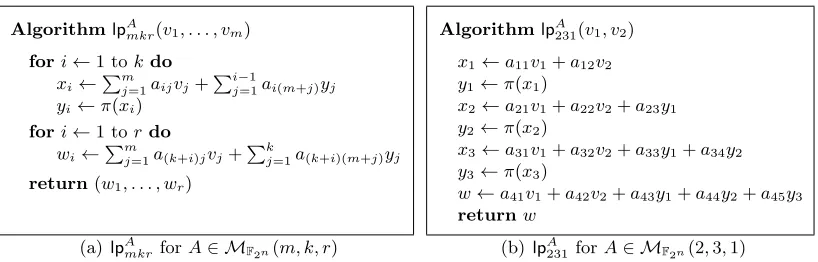
Then each matrixA∈ MF2n(m, k, r) defines a compression functionlpAmkr with oracle access
to a random permutationπ∈Πn as follows.
lpAmkr: ({0,1}n)m−→({0,1}n)r
(v1, . . . , vm)7−→(w1, . . . , wr)
where (w1, . . . , wr) is computed by the algorithm described in Figure 1(a). A function lpAmkr
AlgorithmlpA
mkr(v1, . . . , vm)
fori←1 tokdo
xi←Pm
j=1aijvj+
Pi−1
j=1ai(m+j)yj
yi←π(xi)
fori←1 tordo
wi←Pm
j=1a(k+i)jvj+
Pk
j=1a(k+i)(m+j)yj
return(w1, . . . , wr)
(a)lpAmkrforA∈ MF2n(m, k, r)
AlgorithmlpA
231(v1, v2)
x1←a11v1+a12v2
y1←π(x1)
x2←a21v1+a22v2+a23y1
y2←π(x2)
x3←a31v1+a32v2+a33y1+a34y2
y3←π(x3)
w←a41v1+a42v2+a43y1+a44y2+a45y3
returnw
(b) lpA231 forA∈ MF2n(2,3,1)
Fig. 1.Compression functionlpAmkr
Collision Resistance and Preimage Resistance For simplicity of notations, we will define collision resistance and preimage resistance focusing on linearly-dependent single-permutation-based compression functions, while these security notions can be extended in an obvious way to any hash function based on public ideal primitives.
LetlpAmkrbe a compression function forA∈ MF2n(m, k, r). Given an information-theoretic
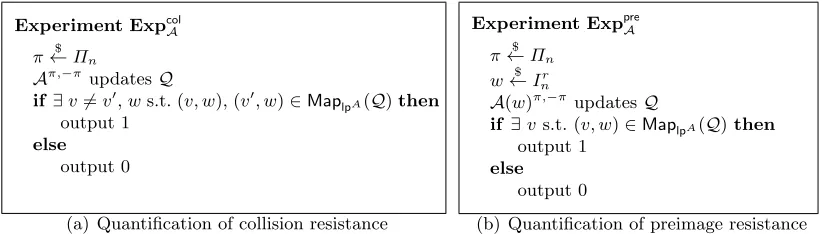
adversaryA with oracle access toπ andπ−1, we execute the experiment ExpcolA described in Figure 2(a) in order to quantify the collision resistance oflpAmkr. The experiment records the query-response pairs that the adversaryA obtains into aquery history Q. A pair (x, y) is in the query history ifAmakesπ(x) and gets backy, or it makesπ−1(y) and gets backx. Given a query historyQ, thenMaplpA(Q)⊂({0,1}n)m×({0,1}n)r is defined to be the set of pairs
(v, w) such that there exist evaluations (xi, yi)∈ Qsatisfying the following equations.
xi= m
X
j=1
aijvj + i−1
X
j=1
ai(m+j)yj, i= 1, . . . , k,
wi= m
X
j=1
a(k+i)jvj+ k
X
j=1
a(k+i)(m+j)yj, i= 1, . . . , r, (1)
where we writev= (v1, . . . , vm) andw= (w1, . . . , wr). Informally,MaplpA(Q) is the set of the
evaluations of lpAmkr that are determined by the query history Q. Now the collision-finding advantage ofA is defined to be
AdvcollpA(A) =Pr
h
ExpcolA = 1i.
The probability is taken over the random permutation π, andA’s coins (if any). For q >0, we defineAdvcollpA(q) as the maximum ofAdvcollpA(A) over all adversariesAmaking at mostq
queries.
The preimage resistance of lpAmkr is quantified similarly using the experiment ExppreA de-scribed in Figure 2(b). The adversary A takes as input a random w ∈ ({0,1}n)r before it
begins making queries toπ and π−1. The preimage-finding advantage of Ais defined to be
AdvprelpA(A) =Pr
ExppreA = 1.
Forq >0, Advpre
lpA(q) is the maximum of Adv
pre
lpA(A) over all adversaries A making at most
Experiment Expcol
A
π←$ Πn
Aπ,−πupdatesQ
if ∃v6=v0,ws.t. (v, w), (v0, w)∈MaplpA(Q)then
output 1
else
output 0
(a) Quantification of collision resistance
Experiment ExppreA
π←$ Πn w←$ Inr
A(w)π,−πupdatesQ
if ∃vs.t. (v, w)∈MaplpA(Q)then
output 1
else
output 0
(b) Quantification of preimage resistance
Fig. 2.Experiments for quantification of collision resistance and preimage resistance
3 Security of lp231
In this section, we will prove that a linearly-determined permutation-based compression func-tion lpA231 achieves good collision resistance and preimage resistance as long as the matrix
A∈ MF2n(m, k, r) satisfies a certain condition. Our strategy is to first define a certain “bad
event” parameterized by a matrix, and then show that collision or preimage finding is hard without the occurrence of the bad event. The bad event is the union of some “auxiliary events”, defined in the following subsection. Throughout this paper, we will write N = 2n andN0 =N −q.
3.1 Auxiliary Events
In order to analyze the security of lp231, we need to define some auxiliary events. Suppose that an adversary A makes q adaptive queries to a random permutation π and its inverse
π−1, and records a query history
Q={(xj, yj)∈ {0,1}n× {0,1}n: 1≤j≤q}
where (xj, yj) denotes the query-response pair obtained by the j-th query. Throughout this work, we will assume thatxj’s are all distinct. This means thatyj’s are also all distinct since
πis a permutation. It would not affectA’s collision finding advantage making any redundant query.
For t ≥ 1 and, ai, bi ∈ F2n and Ai, Bi ∈ M2×1
F2n, i = 1, . . . , t, we define the following
multisets.
Ut(a1, b1, . . . , at, bt) =
( t X
i=1
aixji+biyji
:j1, . . . , jt∈[1, q]
)
,
U6=t (a1, b1, . . . , at, bt) =
( t X
i=1
aixji+biyji
:j1, . . . , jt∈[1, q] are all distinct
)
,
Vt(A1, B1, . . . , At, Bt) =
( t X
i=1
Aixji+Biyji
:j1, . . . , jt∈[1, q]
)
For a positive integerl, these multisets are associated with the following events.
Et(a1, b1, . . . , at, bt;l)⇔ A setsmult(Ut(a1, b1, . . . , at, bt))> l,
Et6=(a1, b1, . . . , at, bt;l)⇔ A setsmult(Ut(a1, b1, . . . , at, bt))> l,
Ft(A1, B1, . . . , At, Bt;l)⇔ A setsmult(Vt(A1, B1, . . . , At, Bt))> l.
We will often write Et(l) = Et(a1, b1, . . . , at, bt;l), Et6=(l) =Et6=(a1, b1, . . . , at, bt;l) andFt(l) = Ft(A1, B1, . . . , At, Bt;l) for simplicity. The rest of this section is devoted to the estimation of
the probability of these auxiliary events for smallt’s (sayt= 1,2,3).
Theorem 1. Let a1, a2, b1, b2 be nonzero elements inF2n, and let
f1 =f1(d1) =N
q d1+ 1
1
N0
d1+1
,
f2 =f2(d2) =N
q d2+ 1
2q N0
d2+1
for positive integersd1 and d2. Then the following hold.
1. PrE1(a1, b1;d1)
≤f1.
2. PrhE26=(a1, b1, a2, b2; 2d1d2)
i
≤f2+ 2f1.
3. If either a1+a2 6= 0 or b1+b2 6= 0, then
PrE2(a1, b1, a2, b2; 2d1d2+d1)
≤f2+ 3f1.
Proof. First we give a proof for the first inequality. Fix c ∈ F2n. When A makes the j
-th forward query y = π(x∗), the probability that a1x∗ +b1y = c, which is equivalent to
y = b−11(c+a1x∗), is not greater than 1/(2n−(j−1)). Similarly, when A makes the j -th backward query x = π−1(y∗), the probability that a1x+b1y∗ = c is not greater than 1/(2n−(j−1)). The eventE1(a1, b1;d1) occurs when there exists a set{j1, . . . , jd1+1} ⊂[1, q] such that
a1xj1 +b1yj1 =. . .=a1xjd1+1+b1yjd1+1 =c for somec∈F2n. Since 1/(2n−(j−1))≤1/N0, it follows that
Pr
E1(a1, b1;d1)
≤N
q d1+ 1
1
N0
d1+1
=f1.
For the proof of the second inequality, we define events
E2j(c)⇔ Asetsa1xj1 +b1yj1 +a2xj2 +b2yj2 =c withj= max{j1, j2}, E2(c; 2d1d2)⇔ Asetsmult(U2, c)>2d1d2
where we simply write U2 = U2(a1, b1, a2, b2). Note that E2j(c) occurs when the j-th query
increases the multiplicity ofc inU2 at least by one. In order to estimatePrE2(2d1d2)
, we decomposeE2(2d1d2) as follows.
E2(2d1d2) =
_
c∈F2n
E2(c; 2d1d2)⇒Eex∨
_
c∈F2n
E2(c; 2d1d2)∧ ¬Eex
where
Eex =E1(a1, b1;d1)∨E1(a2, b2;d1). By the first inequality, it follows that
Pr[Eex]≤2f1. (3)
We now analyze the eventE2(c; 2d1d2)∧ ¬Eex for a fixedc∈F2n. Suppose that a certain
query, say thej-th query, completes equation
a1xj+b1yj+a2xj
0
+b2yj
0
=c
for somej0 < j. For the fixedj-th query, thej0-th query should satisfy
a2xj
0
+b2yj
0
=c+a1xj+b1yj
and the number of such queries is at mostd1 without the occurrence ofE1(a2, b2;d1). Taking into account the other position where the last query might contributes, we see that each query increases the multiplicity mult(U2, c) at most by 2d1 without the occurrence of Eex.
This implies that the number of queries that increasemult(U2, c) should be at least d2+ 1. Therefore we have
E2(c; 2d1d2)∧ ¬Eex⇒
_
J⊂[1,q] |J|=d2+1
^
j∈J
E2j(c)∧ ¬Eex
. (4)
In order to computePr
h V
j∈J
E2j(c)∧ ¬Eex
i
for a fixed J ⊂[1, q] such that |J|=d2+ 1, suppose thatAmakes thej∗-th queryπ(x∗) forj∗ ∈J. Then we can upper bound the number of responsesy=π(x∗) that contribute the equation
a1xj1+b1yj1+a2xj2+b2yj2 =c,
withj∗ = max{j1, j2}. Ifj1 =j∗> j2, then it should hold that
y=b−21(c+a1x∗+a2xj2 +b2yj2)
for some j2 < j∗ ≤ q. So the number of possible responses for this case is at most q. The case j2 = j∗ > j1 is analyzed similarly. Therefore the total number of possible responses
y=π(x∗) is at most 2q. With an analogous argument for π−1, we conclude that
Pr
^
j∈J
E2j(c)∧ ¬Eex
≤
2q N0
d2+1
. (5)
Now by (2), (3), (4), and (5), we have
PrE2(a1, b1, a2, b2; 2d1d2)
≤N
q d2+ 1
2q N0
d2+1
+ 2f1 =f2+ 2f1.
In order to prove the third inequality, note that
Ifa1+a2 6= 0 and b1+b26= 0, then by the first inequality,
PrE1(a1+a2, b1+b2;d1)
≤f1.
This inequality also holds for the case that either a1+a2 6= 0 or b1+b2 6= 0: since π is a permutation, this special case implies
Pr
E1(a1+a2, b1+b2; 1)
= 0.
Therefore by the first two inequalities,
Pr
E2(a1, b1, a2, b2; 2d1d2+d1)
≤Pr
E26=(a1, b1, a2, b2; 2d1d2)
+Pr
E1(a1+a2, b1+b2;d1)
≤f2+ 3f1. ut
Definition 1. For t ≥1, a matrix M = [A1, B1, . . . , At, Bt]∈ M2F×2t
2n is called column-sum independent if M satisfies the following conditions.
1. Pi∈I1Ai,Pi∈I2Ai
andPi∈I1Bi,Pi∈I2Bi
are invertible for any pair of distinct nonempty subsets I1, I2 ⊂[1, t].
2. P
i∈I1Ai,
P
i∈I2Bi
are invertible for any pair of (not necessarily distinct) nonempty subsets I1, I2 ⊂[1, t].
Definition 1 will be used for compact statement of the following corollary. We point out some useful properties of column-sum independent matrices.
Property 1 If [A1, B1, . . . , At, Bt]is column-sum independent, then[Ai1, Bi1, . . . , Ais, Bis]is also column-sum independent for every nonempty subset{i1, . . . , is} ⊂[1, t].
Property 2 If[A1, B1, . . . , At, Bt]is column-sum independent, thenPi∈IAi6= 0and
P
i∈IBi6=
0 for every nonempty subset I ⊂[1, t].
Property 3 Column-sum independence of M stipulates nonsingularity of
2 2t−1
2t−2
+ 2t−12
matrices determined byM.
Theorem 2. Let f1 =f1(d1) andf2 =f2(d2) be defined as in Theorem 1, and let
g2 =g2(d1, d2) =
d2(4d1q+ 2d1+ 1)q
N0 ,
g3=g3(d1, d2, d3) =N2
q d3+ 1
6d1d2+ 6d1+ 1
N0
d3+1
for positive integersd1,d2 andd3. If a matrix[A1, B1, A2, B2, A3, B3]∈ M2F×2n6 is column-sum
independent, then the following hold.
1. PrF1(A1, B1; 1)
= 0.
2. Pr
F2(A
1, B1, A2, B2; 1)
3. PrF3(A1, B1, A2, B2, A3, B3; 7d3)
≤g3+ 3g2+ 24f2+ 66f1.
Proof. The proof of the first equality is straightforward since [A1, B1] is invertible. In order to prove the second inequality, we define the following events.
F2col(j)⇔ A setsA1xj1+B1yj1 +A2xj2+B2yj2 =A1xj3+B1yj3 +A2xj4+B2yj4 wherej3 < j1≤j, j4 < j2≤j, and j= max{j1, j2}
and
Eex=E2((B1+B2)∗A1,(B1+B2)∗B1,(B1+B2)∗A2,(B1+B2)∗B2; 2d1d2+d1)
∨E2((A1+A2)∗A1,(A1+A2)∗B1,(A1+A2)∗A2,(A1+A2)∗B2; 2d1d2+d1)
∨E26=(B ∗
1A2, B1∗B2, B1∗A2, B1∗B2; 2d1d2)
∨E26=(A ∗
1A2, A∗1B2, A∗1A2, A∗1B2; 2d1d2)
∨E26=(B ∗
2A1, B2∗B1, B2∗A1, B2∗B1; 2d1d2)
∨E26=(A ∗
2A1, A∗2B1, A∗2A1, A∗2B1; 2d1d2). Then it follows that
F2(A1, B1, A2, B2; 1)⇒
_
1≤j≤q
F2col(j)⇒Eex∨
_
1≤j≤q
F2col(j)∧ ¬Eex
(6)
and
Pr[Eex]≤2 (f2+ 3f1) + 4 (f2+ 2f1) = 6f2+ 14f1 (7) by Theorem 1.
We now estimate the probabilityPr
F2col(j)∧ ¬Eex
. Suppose thatAmakes thej-th query
π(x∗), and consider the following three cases where y=π(x∗) contributes the equation
A1xj1 +B1xj1 +A2xj2 +B2xj2 =A1xj3+B1xj3+A2xj4+B2xj4. (8)
Case 1: j1=j2 =j. The equality (8) is reduced to
(A1+A2)x∗+ (B1+B2)y=A1xj3+B1yj3 +A2xj4+B2yj4. (9) Any response y satisfying (9) corresponds to a pair (j3, j4)∈[1, j−1]2 such that
(B1+B2)∗A1xj3 + (B1+B2)∗B1yj3 + (B1+B2)∗A2xj4 + (B1+B2)∗B2yj4
= (B1+B2)∗(A1+A2)x∗. (10)
The number of such pairs is at most 2d1d2+d1 without the occurrence of Eex.
Case 2: j1=j and j26=j. The equality (8) is reduced to
A1x∗+B1y=A2xj2 +B2yj2 +A1xj3 +B1yj3 +A2xj4 +B2yj4. (11) Any responseysatisfying (11) corresponds to a triple (j2, j3, j4)∈[1, j−1]3 such thatj2 6=j4 and
B1∗A1xj3+ (B1∗A2xj2 +B1∗B2yj2+B1∗A2xj4+B1∗B2yj4) =B1∗A1x∗. (12) For each j3 ∈[1, j−1], the number of pairs (j2, j4)∈[1, j−1]2 satisfying (12) andj26=j4 is at most 2d1d2 without the occurrence of Eex. Therefore the number of the triples satisfying
Case 3:j2=j and j16=j. The analysis of this case is essentially the same as Case 2. To summarize, we conclude that
PrF2col(j)∧ ¬Eex
≤ d2(4d1q+ 2d1+ 1)
N0 . (13)
We can apply a similar argument for π−1. So using a union bound, the second inequality is followed from (6), (7) and (13).
In order to prove the third inequality, we define events
F3j(C)⇔ A sets 3
X
i=1
Aixji+Biyji
=C withj= max{j1, j2, j3}, (14)
F3(C; 7d3)⇔ A setsmult(V3, C)>7d3
for C ∈ M2×1
F2n and j ∈ [1, q]. Here we simply write V
3 = V3(A
1, B1, A2, B2, A3, B3). The eventF3j(C) occurs when thej-th query increases the multiplicity of C inV3 at least by one. In order to estimatePr
F3(7d 3)
, we decompose F3(7d
3) as follows.
F3(7d3) =
_
C∈M2×1 F2n
F3(C; 7d3)⇒Fex∨
_
C∈M2×1 F2n
F3(C; 7d3)∧ ¬Fex
(15)
where
Fex=F1(A1, B1; 1)∨F1(A2, B2; 1)∨F1(A3, B3; 1)
∨F2(A1, B1, A2, B2; 1)∨F2(A2, B2, A3, B3; 1)∨F2(A3, B3, A1, B1; 1)
∨E1((A2+A3)∗A1,(A2+A3)∗B1;d1)∨E1((A3+A1)∗A2,(A3+A1)∗B2;d1)
∨E1((A1+A2)∗A3,(A1+A2)∗B3;d1)∨E1((B2+B3)∗A1,(B2+B3)∗B1;d1)
∨E1((B3+B1)∗A2,(B3+B1)∗B2;d1)∨E1((B1+B2)∗A3,(B1+B2)∗B3;d1)
∨E2(A∗3A1, A∗3B1, A3∗A2, A∗3B2; 2d1d2+d1)
∨E2(A∗1A2, A∗1B2, A1∗A3, A∗1B3; 2d1d2+d1)
∨E2(A∗2A3, A∗2B3, A2∗A1, A∗2B1; 2d1d2+d1)
∨E2(B3∗A1, B3∗B1, B3∗A2, B3∗B2; 2d1d2+d1)
∨E2(B1∗A2, B1∗B2, B1∗A3, B1∗B3; 2d1d2+d1)
∨E2(B2∗A3, B2∗B3, B2∗A1, B2∗B1; 2d1d2+d1). (16)
By Theorem 1 and the first two inequalities, it follows that
Pr[Fex]≤3(g2+ 6f2+ 14f1) + 6f1+ 6(f2+ 3f1) = 3g2+ 24f2+ 66f1. (17)
We now analyze the event F3(C; 7d3)∧ ¬Fex for a fixed C ∈ M2F×2n1. Since each query
increases the multiplicitymult(V3, C) at most by 7 without the occurrence ofFex (according
to the positions where the query contributes), the number of queries that increasemult(V3, C) should be at least d3+ 1. Therefore we obtain
F3(C; 7d3)∧ ¬Fex⇒
_
J⊂[1,q] |J|=d3+1
^
j∈J
F3j(C)∧ ¬Fex
In order to computePrhV
j∈J
F3j(C)∧ ¬Fex
i
for a fixedJ ⊂[1, q] such that |J|=d3+ 1, suppose thatAmakes thej∗-th queryπ(x∗) forj∗ ∈J. Then we can upper bound the number of responsesy=π(x∗) that contribute the equation
A1xj1 +B1yj1 +A2xj2 +B2yj2 +A3xj3 +B3yj3 =C (19) withj∗ = max{j1, j2, j3}. Fors∈ {0,1,2}, consider the case where thej∗-th query contributes 3−sterms in equation (19). If js+1 =· · ·=j3=j∗, then the equation (19) is reduced to
s
X
i=1
Aixji+Biyji
+ ¯Ax∗+ ¯By=C (20)
where ¯A = P3
i=s+1Ai 6= 0 and ¯B =
P3
i=s+1Bi 6= 0 by the column-sum independence. By
multiplying ¯B∗ on both sides of (20), we observe that eachysatisfying (20) is associated with a solution (j1, . . . , js)∈[1, j∗−1]s to the following equation.
s
X
i=1 ¯
B∗Aixji+ ¯B∗Biyji
= ¯B∗C+ ¯B∗Ax¯ ∗. (21)
Without the occurrence of Fex, the number of solutions (j1, . . . , js) to (21) is at most 1 if
s= 0,d1 ifs= 1 and 2d1d2+d1 ifs= 2. By symmetry in the positions of the j∗-th query and with an analogous argument forπ−1, we obtain
Pr
^
j∈J
F3j(C)∧ ¬Fex
≤
6d1d2+ 6d1+ 1
N0
d3+1
. (22)
Using a union bound, the proof is complete from (15), (17), (18) and (22). ut
3.2 Concrete Security Bounds for lp231
For A∈ MF2n(2,3,1), the system of equations (1) is rewritten as follows.
x1 =a11v1+a12v2 (23)
x2 =a21v1+a22v2+a23y1 (24)
x3 =a31v1+a32v2+a33y1+a34y2 (25)
w=a41v1+a42v2+a43y1+a44y2+a45y3. (26)
From equations (23) and (24), we obtain the following system of equations in variablesv1 and
v2.
a11a12
a21a22
v1
v2
=
x1
x2+a23y1
. (27)
If a11a22+a12a21 6= 0, then we can solve the system of equations (27). By substituting its solution into equations (25) and (26), we obtain an equation of the following form.
A1x1+B1y1+A2x2+B2y2+A3x3+B3y3 =Cw, (28)
where Ai, Bi and C are matrices in M2F×2n1. We write M(A) = [A1, B1, A2, B2, A3, B3] and
C(A) =C, indicating these matrices are determined by the matrix A. Note that
A3 =
1 0
, B3 =
0
a45
and C =
0 1
Preimage Resistance
Theorem 3. Let A = (aij) be a matrix in MF2n(2,3,1) such that a11a22+a12a21 6= 0. If
M(A) is column-sum independent, then for positive integers d1 and d2,
Advpre
lpA(q)≤
(6d1d2+ 6d1+ 1)q
N0 + 6f2+ 24f1 where f1=f1(d1) and f2=f2(d2) are defined as in Theorem 1.
Proof. We will upper bound AdvprelpA(A) for an adversary A makes q queries to a random
permutationπ and its inverseπ−1. Let
Gex =E1((A2+A3)∗A1,(A2+A3)∗B1;d1)∨E1((A3+A1)∗A2,(A3+A1)∗B2;d1)
∨E1((A1+A2)∗A3,(A1+A2)∗B3;d1)∨E1((B2+B3)∗A1,(B2+B3)∗B1;d1)
∨E1((B3+B1)∗A2,(B3+B1)∗B2;d1)∨E1((B1+B2)∗A3,(B1+B2)∗B3;d1)
∨E2(A∗3A1, A∗3B1, A3∗A2, A∗3B2; 2d1d2+d1)
∨E2(A∗1A2, A∗1B2, A1∗A3, A∗1B3; 2d1d2+d1)
∨E2(A∗2A3, A∗2B3, A2∗A1, A∗2B1; 2d1d2+d1)
∨E2(B∗3A1, B∗3B1, B3∗A2, B3∗B2; 2d1d2+d1)
∨E2(B∗1A2, B∗1B2, B1∗A3, B1∗B3; 2d1d2+d1)
∨E2(B∗2A3, B∗2B3, B2∗A1, B2∗B1; 2d1d2+d1).
Then by Theorem 1,
Pr[Gex]≤6f2+ 24f1. (29)
For w∈F2n and j∈[1, q], we define an event
Pj(w)⇔ AsetsA1xj1 +B1yj1 +A2xj2 +B2yj2 +A3xj3 +B3yj3 =Cw
withj= max{j1, j2, j3}. (30)
Since the occurrence ofPj(w) means that thej-th query determines a preimage ofw, it follows
that
Advpre
lpA(A)≤wmax∈F2n
Pr
_
1≤j≤q
Pj(w)
. (31)
For a fixed w∈F2n, we use the following decomposition.
Pr
_
1≤j≤q
Pj(w)
≤Pr
_
1≤j≤q
(Pj(w)∧ ¬Gex)
+Pr[Gex]. (32)
Note that the event Pj(w) is identical with F3j(Cw) as defined in (14). So with the same
analysis as F3
j(Cw), the number of responses that determine a preimage of w is at most
6d1d2+ 6d1+ 1 for each query without the occurrence of Gex. Therefore we obtain
Pr
_
1≤j≤q
(Pj(w)∧ ¬Gex)
≤
(6d1d2+ 6d1+ 1)q
N0 . (33)
Corollary 1. Let A = (aij) be a matrix in MF2n(2,3,1) such that a11a22+a12a21 6= 0. If
M(A) is column-sum independent, then
lim
n→∞Adv
pre lpA
223n/n
= 0.
Proof. Letq = 223n/n,d1 = 2 and d2 = 5·2
n
3 −1. Since
(6d1d2+ 6d1+ 1)q
N0 =
(60·2n3 + 1)q
N0 ≤ 122
n
f1 =N
q d1+ 1
1
N0
d1+1
≤N
2eq
(d1+ 1)N
d1+1 =N
2eq
3N
3
= 8e 3
27n3
and
f2 =N
q d2+ 1
2q N0
d2+1
≤N
2eq2
(d2+ 1)N0
d2+1
≤N
12e
5n2
5·2
n
3
usingN0 ≥N/2, it follows that
lim
n→∞
(6d1d2+ 6d1+ 1)q
N0 = limn→∞f2(d1, d2) = limn→∞f1(d1) = 0.
The proof is complete from Theorem 3. ut
Collision Resistance
Theorem 4. Let A= (aij) be a matrix in MF2n(2,3,1)such that a11a22+a12a21 6= 0, and letM(A) = [A1, B1, A2, B2, A3, B3]and C(A) =C satisfy the following conditions.
1. M(A) is column-sum independent.
2. [A1, C],[A2, C], [A3, C], [B1, C]and [B2, C]are invertible.
3. The following 2×6 matrices are column-sum independent.
D1 =
[B2, C]−1[A1, B1],[B1, C]−1[A2, B2],[B1, C]−1[A3, B3]
,
D2 =[A2, C]−1[A1, B1],[A1, C]−1[A2, B2],[A1, C]−1[A3, B3]
,
D3 =[A3, C]−1[A1, B1],[A3, C]−1[A2, B2],[A1, C]−1[A3, B3]
, D4 =
[A3, C]−1[A1, B1],[A3, C]−1[A2, B2],[A2, C]−1[A3, B3]
.
Then for positive integers d1, d2 and d3,
AdvcollpA(q)≤N q2
6d1d2+ 6d1+ 1
N0
2
+ 3(2d1d2+d1)q+ 3qmax{7d3q,2d1d2+d1}
N0 + 4g3+ 15g2+ 121f2+ 333f1,
Proof. We will upper bound AdvcollpA(A) for an adversary A makes q queries to a random
permutationπ and its inverseπ−1. Let
Hex=Fex∨E2 B¯∗A1,B¯∗B1,B¯∗A2,B¯∗B2; 2d1d2+d1
∨F3 D1; 7d3
∨F3 D2; 7d3
∨F3 D3; 7d3
∨F3 D4; 7d3
where ¯B =B1+B2+B3 and Fex is defined as in (16). Then it follows that
Pr[Hex] = 3g2+ 24f2+ 66f1+ (f2+ 3f1) + 4(g3+ 3g2+ 24f2+ 66f1)
= 4g3+ 15g2+ 121f2+ 333f1. (34)
Forj∈[1, q] and ρ1,ρ2 ∈ {0,1}3\{(0,0,0)}, we define the following event.
C2j(ρ1, ρ2)⇔AsetsA1x 1 1 +B
1y 1 1+A
2x 1 2 +B
2y 1 2 +A
3x 1 3+B
3y 1
3 =Cw and
A1x 2 1 +B
1y 2 1 +A
2x 2 2+B
2y 2 2+A
3x 2 3 +B
3y 2
3 =Cw, where w∈F2n, (11, 12, 31)6= (21, 22, 23), j= max
i=1,2,3
s=1,2
{si} and
si =j if and only ifρsi = 1 for i= 1,2,3 and s= 1,2.
Hereρ1 andρ2 specify the positions where thej-th query contributes within the two different evaluations. Since ρ1, ρ2 6= (0,0,0), the occurrence of C2j(ρ1, ρ2) means that the single j-th query completes two colliding evaluations oflpA231 at the same time. Let
C1 = _ 1≤j1<j2≤q
w∈F2n
(Pj1(w)∧Pj2(w))
where eventsPj1(w) andPj2(w) are defined as in (30) and let
C2= _ 1≤j≤q
(ρ1,ρ2)∈P
C2j(ρ1, ρ2)
whereP =P1∪P2∪P3 and
P1=
ρ1, ρ2
:∃ i∈ {1,2,3}such that ρ1i =ρ2i = 1 ,
P2={((1,1,0),(0,0,1)),((1,0,1),(0,1,0)),((0,1,1),(1,0,0))},
P3={((1,0,0),(0,1,0)),((1,0,0),(0,0,1)),((0,1,0),(0,0,1))}.
Then by the symmetry ofρ1 and ρ2, it follows that
AdvcollpA(A) =Pr
C1∨C2≤Pr[Hex] +Pr
C1∧ ¬Hex
+PrC2∧ ¬Hex
. (35)
Estimation of Pr
C1∧ ¬H
ex
. If eventsP are defined as (30), then
Pr
C1∧ ¬Hex
=Pr
_
1≤j1<j2≤q
w∈F2n
(Pj1(w)∧Pj2(w)∧ ¬Hex)
With a similar argument as the analysis of preimage resistance, we obtain
PrPj∗
1(w ∗
)∧Pj∗
2(w ∗
)∧ ¬Hex
≤
6d1d2+ 6d1+ 1
N0
2
for fixedw∗ ∈F2n and 1≤j1∗ < j2∗≤q. Therefore we have
PrC1∧ ¬Hex
=Pr
_
1≤j1<j2≤q
w∈F2n
(Pj1(w)∧Pj2(w)∧ ¬Hex)
≤N q2
6d1d2+ 6d1+ 1
N0
2
. (36)
Estimation of PrC2∧ ¬Hex
. In order to use
Pr
C2∧ ¬Hex
≤ X
1≤j≤q
(ρ1,ρ2)∈P Pr
C2j(ρ1, ρ2)∧ ¬Hex
(37)
we focus on the estimation ofPrhC2j ρ1, ρ2
∧ ¬Hex
i
for each (ρ1, ρ2)∈P. We consider three cases as follows.
Case 1: We estimate the probability PrhC2j ρ1, ρ2
∧ ¬Hex
i
for (ρ1, ρ2) ∈P1. Suppose that
ρ1 =ρ2 = (1,0,0). If the eventCj2((1,0,0),(1,0,0)) occurs, then it holds that
A1xj+B1yj+A2x 1
2+B2y12+A3x13 +B3y13 =Cw, (38)
A1xj+B1yj+A2x 2
2+B2y22+A3x23 +B3y23 =Cw (39)
for some12,13,22,23 < j and w∈F2n. The equations (38) and (39) imply that
A2x 1 2+B
2y 1 2+A
3x 1 3 +B
3y 1 3 =A
2x 2 2 +B
2y 2 2 +A
3x 2 3+B
3y 2 3.
Therefore it follows that
C2j((1,0,0),(1,0,0))⇒F2(A2, B2, A3, B3; 1)⇒Hex,
and hence,
Pr
C2j((1,0,0),(1,0,0))∧ ¬Hex
= 0.
The same argument applies to any eventC2j ρ1, ρ2 such that ρ1∧ρ26= (0,0,0).
Case 2: We estimate the probability PrhC2j ρ1, ρ2
∧ ¬Hex
i
for (ρ1, ρ2) ∈ P2. Say ρ1 = (1,1,0) andρ2= (0,0,1). Suppose thatA makes thej-th query π(x∗). Among (N−(j−1)) possible responses fory =π(x∗), we need to upper bound the number ofy=π(x∗) satisfying
(A1+A2)x∗+ (B1+B2)y+A3x 1
3 +B3y13 =Cw, (40)
A1x 2
for some13,21,22< j andw∈F2n. Adding (40) and (41), we obtain
¯
Ax∗+ ¯By+A1x 2 1+B
1y 2 1 +A
2x 2 2+B
2y 2 2+A
3x 1 3 +B
3y 1 3 = 0
which implies the following equation.
¯
B∗A1x 2
1+ ¯B∗B 1y
2
1+ ¯B∗A 2x
2
2+ ¯B∗B 2y
2 2+
¯
B∗A3x 1
3 + ¯B∗B 3y
1 3
= ¯B∗Ax¯ ∗. (42)
The number of solutions (13, 21, 22) to (42) is at most (2d1d2+d1)q without the occurrence of Hex. (We can first fix the13-th query, and then count the number of pairs (21, 22) satisfying equation (42).) For events C2j((0,1,1),(1,0,0)) and C2j((1,0,1),(0,1,0)), we have the same equation as (42). Therefore we have
Pr
C2j ρ1, ρ2
∧ ¬Hex
≤ (2d1d2+d1)q
N0 .
Case 3: We estimate the probability PrhC2j ρ1, ρ2
∧ ¬Hex
i
for (ρ1, ρ2) ∈ P3. Say ρ1 = (1,0,0) andρ2= (0,1,0). Suppose thatA makes thej-th query π(x∗). Among (N−(j−1)) possible responses fory =π(x∗), we need to upper bound the number ofy=π(x∗) satisfying
A1x∗+B1y+A2x 1 2+B
2y 1 2+A
3x 1 3 +B
3y 1
3 =Cw,
A1x 2 1+B
1y 2 1+A
2x∗+B2y+A3x 2 3 +B
3y 2
3 =Cw,
for some 12, 13, 21, 23 < j and w ∈ F2n. Removing variables y and w from this system of
equations, we obtain the following equation.
[B1, C]−1A2x 1
2+ [B1, C]−1B2y12 + [B1, C]−1A3x13 + [B1, C]−1B3y13 + [B2, C]−1A1x
2
1 + [B2, C]−1B1y21+
[B2, C]−1A3x 2
3 + [B2, C]−1B3y23
= [B1, C]−1A1+ [B2, C]−1A2
x∗. (43)
For each23, the number of solutions (12, 13, 21) to (43) is at most 7d3 without the occurrence ofF3 D1; 7d3
. Therefore the number of solutions (12, 13, 12, 23) to (43) is at most 7d3q. One special case is whenρ1 orρ2 is (0,0,1) andAmakes a forward queryy=π(x∗). Since [B3, C] is not invertible, the above argument does not apply to this case. Sayρ1 = (0,0,1). Then the responsey=π(x∗) should satisfy
A1x 1 1+B
1y 1 1+A
2x 1 2 +B
2y 1 2 +A
3x∗+B3y=Cw, (44)
for some 11,12 andw∈F2n. Multiplying B3∗ on both sides of (44) and using B3∗C= 0, we see
that each y satisfying (44) is associated with a solution (11, 12) to the following equation.
B3∗A1x 1 1+B∗
3B1y 1 1 +B∗
3A2x 1 2+B∗
3B2y 1 2 =B∗
3A3x∗. (45)
The number of solutions (j1, j2) to (45) is at most 2d1d2 +d1 without the occurrence of E2(B3∗A1, B3∗B1, B3∗A2, B3∗B2; 2d1d2+d1). Therefore we have
PrC2j ρ1, ρ2∧ ¬Hex
≤ max{7d3q,2d1d2+d1}
To summarize the analysis for the three cases, we conclude that
Pr
C2∧ ¬Hex
≤ X
1≤j≤q
(ρ1,ρ2)∈P Pr
C2j(ρ1, ρ2)∧ ¬Hex
≤ 3(2d1d2+d1)q+ 3qmax{7d3q,2d1d2+d1}
N0 . (46)
Now the proof is complete from (34), (35), (36) and (46). ut
Corollary 2. Let A = (aij) be a matrix in MF2n(2,3,1) such that a11a22+a12a21 6= 0. If
M(A) and C(A) satisfy the conditions described in Theorem 4, then
lim
n→∞Adv
col lpA
2n2/n1+
= 0,
for any >0.
Proof. Letq = 2n2/n1+ and (d1, d2, d3) = (1, n,3). Then it is easy to check that max{7d3q,2d1d2+d1}= 7d3q
and
N q2
6d1d2+ 6d1+ 1
N0
2
=O
1
n2
, 3(2d1d2+d1)q+ 21d3q
2
N0 =O
1
n2+2
,
f1(d1) =O
1
n2+2
, f2(d2) =O
1
n(2+2)n
,
g2(d1, d2) =O
1
n1+2
, g3(d1, d2, d3) =O
1
n4
.
Since all the terms converge to 0 as n goes to infinity, and by Theorem 4, we obtain the
corollary. ut
Example 1. Letn= 128 and letF2128 =F[ζ]/(ζ128+ζ7+ζ2+ζ+ 1) be a finite field of order 2128, where f(ζ) =ζ128+ζ7+ζ2+ζ+ 1 is an irreducible polynomial overF2. For simplicity of computation, assume that a23= 0,a45= 1, and
a11a12
a21a22
=
1 0 0 1
.
Then we have
M(A) =
a31a33a32a341 0
a41a43a42a440 1
and C(A) =
0 1
.
If we seta31=a44=ζ,a33=a42=ζ3,a32=a43=ζ2+ζ, anda34=a41= 1, then
A=
1 0 0 0 0
0 1 0 0 0
ζ ζ2+ζ ζ3 1 0 1 ζ3 ζ2+ζ ζ1
and the corresponding matricesM(A) andC(A) satisfy all the conditions described in Theo-rem 4. With respect to the threshold distinguishing advantage 1/2, the resulting compression function lpA is preimage resistant up to 281.5 queries (with (d
References
1. P. Barreto and V. Rijmen. The Whirlpool hashing function. Primitve submitted to NESSIE, September 2000, revised on May 2003.
2. G. Bertoni, J. Daemen, M. Peeters and G. Van Assche. On the indifferentiability of the Sponge construction. Eurocrypt 2008, LNCS 4965, pp. 181–197, Springer-Verlag, 2008.
3. J. Black, M. Cochran and T. Shrimpton. On the impossibility of highly-efficient blockcipher-based hash functions. Eurocrypt 2005, LNCS 3494, pp. 526–541, Springer-Verlag, 2005.
4. J. Black, P. Rogaway and T. Shrimpton. Black-box analysis of the block-cipher-based hash-function con-struction from PGV. Crypto 2002, LNCS 2442, pp. 320–325, Springer-Verlag, 2002.
5. S. Hirose. Provably secure double-block-length hash functions in a black-box model. ICISC 2004, LNCS 3506, pp. 330–342, Springer-Verlag, 2005.
6. S. Hirose. Some plausible construction of double-block-length hash functions. FSE 2006, LNCS 4047, pp. 210–225, Springer-Verlag, 2006.
7. S. Matyas, S. Meyer and J. Oseas. Generating strong one-way functions with cryptographic algorithm. IBM Technical Disclosure Bulletin 27, 10a, pp. 5658–5659, 1985.
8. B. Preneel, R. Govaerts and J. Vandewalle. Hash functions based on block ciphers: A synthetic approach. Crypto 1993, LNCS 773, pp. 368–378, Springer-Verlag, 1994.
9. T. Ristenpart and T. Shrimpton. How to build a hash function from any collision-resistant function. Asi-acrypt 2007, LNCS 4833, pp. 147–163, Springer-Verlag, 2007.
10. P. Rogaway and J. P. Steinberger. Constructing cryptographic hash functions from fixed-key blockciphers. Crypto 2008, LNCS 5157, pp. 433–450, Springer-Verlag, 2008.
11. P. Rogaway and J. P. Steinberger. Security/efficiency tradeoffs for permuation-based hashing. Euro-crypt 2008, LNCS 4965, pp. 220–236, Springer-Verlag, 2008.
12. T. Shrimpton and M. Stam. Building a collision-resistant function from non-compressing primitives. ICALP 2008, LNCS 5126, pp. 643–654, Springer-Verlag, 2008.
13. M. Stam. Beyond uniformity: Better security/efficiency tradeoffs for compression functions. Crypto 2008, LNCS 5157, pp. 397–412, Springer-Verlag, 2008.
14. J. P. Steinberger. The collision intractability of MDC-2 in the ideal-cipher model. Eurocrypt 2007, LNCS 4515, pp. 34–51, Springer-Verlag, 2008.