International Journal of Computer Science and Mobile Computing
A Monthly Journal of Computer Science and Information Technology
ISSN 2320–088X
IMPACT FACTOR: 5.258
IJCSMC, Vol. 5, Issue. 6, June 2016, pg.525 – 531
Security and Privacy Challenges in the
Internet of Things
Abha Kiran Rajpoot*, Mukul Varshney, Aparajita Nailwal
CSE, Sharda University, Greater NoidaAbstract: The Internet of Things is the idea that everything around us from cars to ovens can be connected. If everything around us is linked and collecting information, these networks must be able to provide security and privacy to the end-user particularly in low-power lossy networks. Certain features including energy conservation and automation differentiate low-power lossy networks from the standard Internet. This paper examines how these qualities affect implementations of security and privacy.
Keywords: IoT, PANA, LLN, IKEv2, HIP, EAP, ROLL, Security, Privacy, LLN, RPL
1. Introduction
2. Lifecycle of a "thing":
Even though there are a high variety of uses and deployments of the Internet of Things, this paper will focus on security and privacy for low power and lossy networks. A device or thing goes through several stages in its lifetime [Garcia13]. At each stage, there are different security and privacy concerns to address. Most things cycle through the same three phases manufacturing, installation, and operational.
With the many applications of IoT, devices tend to be tailored towards very specific tasks. As a result, it is unlikely a network will contain nodes created by the same manufacturer. An attack that could occur during this phase would involve an untrustworthy manufacturer that clones the device. In the best-case scenario, the cloned device is sold for a cheaper price but functions the same as a genuine device. In the worst-case scenario, the software may be changed to implement harmful features such as a backdoor [Garcia13]. As a result, there exists an implicit user trust of vendors and their manufacturers.
2.2 Installation
The commissioning and installation phase for a thing entails providing device identity and secret keys which will be used for communication during the operational phase. An untrustworthy installer may substitute a device for a lower quality one. This attack would save the installer money and can be profitable if the genuine device is resold [Garcia13]. Once again, there exists an implicit user trust of the installers.
2.3 Operational
This paper is focused on attacks during the operational phase. These attacks can vary from eavesdropping to active routing attacks to denial-of-service attacks. These attacks can be separated into a few categories, physical capture, disrupt, degrade, deny, or destroy a part of the network, manipulation attacks, and eavesdropping attacks [Covington13]. This paper will return to these attacks and their countermeasures in Section 4.
3. Architecture of IoT
3.1 Centralized
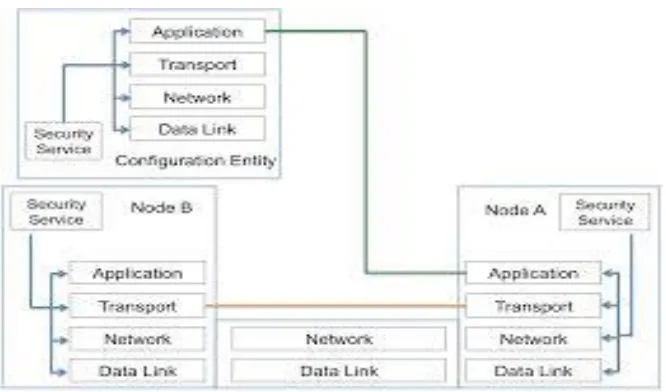
Even though there are a multitude of uses for IoT, Figure 3 shows a general overview of a centralized security mechanism. For the IoT, the most common architectures are completely centralized mainly due to security. For ZigBee, there is a trust center. For 6LoWPAN/CoRE, the 6LoWPAN Border Router is the central entity [IEEE802.15.4k]. A centralized architecture simplifies the task of device and key management but represents a distinct point of failure. Another factor to consider is that for low-power lossy networks, nodes will sometimes sleep, thus complicating authentication and the synchronization of security states [Tsao13].
3.2 Bootstrapping
Bootstrapping refers to the process of securely connecting a thing to the Internet of Things. Currently, there are a few protocols which help authenticate nodes. Protocol for Carrying Authentication for Network Access (PANA) is an UDP-based, network-layer transport for Extensible Authentication Protocol (EAP) [RFC5191]. EAP is a two-party protocol, which generates keying material. An important difference between IoT and the standard Internet protocols is that the Internet protocols assume the identity of a host is always available. The design of IoT and its aspects as a low-power lossy network affects this assumption. After EAP authenticates the node, configuration parameters are sent via Internet Key Exchange version 2 (IKEv2), Host Identity Protocol (HIP), Transport Layer Security (TLS), or Datagram Transport Layer Security (DTLS) [Tsao13]. As privacy becomes a bigger issue, these protocols built in privacy protection. TLS and DTLS allow the option of only authenticating the responding host. This feature prevents eavesdroppers from discovering the initiating host's identity [RFC5246]. HIP and IKEv2 have public-key identities, which are used to authenticate the initiating host [RFC5282]. Both of these protocols encrypt the packets sent. Diet-HIP, which is based off of HIP but aims to reduce the computation and energy usage involved in encryption, does not provide a similar privacy feature due to computational limits.
4. Attacks and Countermeasures:
To examine the security threats and possible attacks, this paper will survey security at the physical and network layers. The IoT has to protect against attacks from the following categories: authentication, access control, confidentiality, integrity, and availability.
Commonly, the Internet of Things networks are centralized with many remote nodes. Many of these nodes are in distant locations and may not have adequate protection from being captured. Attackers can seize and extract security information, keys, etc. from the device. They may even re-program the device for their own needs. If a group key is used throughout the network, this sort of attack can compromise the entire network. If unique keys are used, this attack is not as damaging [Garcia13].
4.2 Network Layer
The routing protocols used in the network layer of IoT are similar to the network layer of standard Internet; however, the network layer of IoT is specified towards low-power and lossy networks. Failure to Authenticate Attacks: Node impersonation occurs when an attack gains access to a network as a legitimate node. It would be able to carry attacks, which involve reporting false data or readings, provide bad control messages, or control/affect the traffic flow of the network. A dummy node is when the attack pretends to be a legitimate node. Many times, it can carry out the same attacks as an impersonated node [Tsao13]. Node resource spam occurs when an attacker continuously joins a network to drain the resources of the network. The attacker would aim to fill up storage memory and potentially take down a portion of the network [Tsao13].
5. Privacy and Regulation
As more companies and manufacturers aim to sell the Internet of Things, the Federal Trade Commission (FTC) is looking for ways to ensure consumer protection and to regulate the industry. The IoT changes the traditional business landscape.
5.1 Privacy Concerns
5.2 Regulations and Policy
With such an asymmetry of power between businesses and their consumers, the FTC is looking for ways to protect users against abuse of their data. The IoT, a data-driven ecosystem, requires a trust between the business and consumer that exists even now. A user shares data with a business and in return receives a service. The FTC is seeking to push businesses and companies towards built-in security and designing security into new devices. For the IoT, the data is usually passively and ubiquitously collected. As a result, the FTC believes businesses will have to earn user trust and at a data level, which means involving the user.
5.3 Violations and Criticisms
There have been many critics and skeptics regarding security and regulation in the Internet of Things. In 2013, the FTC sued a company called TRENDnet Inc. that produces wireless webcams. The FTC believed that TRENDnet did not provide enough security for end-users. In the end, over 700 webcams were compromised and even some geographical information was compromised [Dimov13]. Despite these actions, many skeptics believe the FTC will not be able to regulate privacy in the IoT. One reason is because of the large variety and quantity of manufacturers. Regulation for each manufacturer, which builds very specific devices, is inconceivable. Other critics and experts believe software patching and updating will not be feasible for many applications of the IoT [Schneier14]. At the same time, with such growth in the industry, the FTC is slow and ineffective as a deterrent [Clearfield13]. As the IoT develop towards medical fields and vehicular automation, security and privacy can be come physical threats to users.
6. Summary
The ultimate differences between the Internet of Things and the standard Internet is the difference in which the networks are deployed. IoT uses low-power lossy networks, which complicates security issues by adding an additional constrain, energy. Protocols such as ROLL aim to secure lower layers from the described attacks while conserving resources. The Internet of Things is set the change the world in the upcoming decade; however, security, privacy, and policy must keep up to protect the users of these networks.
References
[Tsao13] Tsao, T., Alexander, R. Security Threat Analysis for Routing Protocol for Low power and lossy networks (RPL), Dec. 15, 2013. http://tools.ietf.org/pdf/draft-ietf-roll security-threats-06.pdf
Commission: Internet of Things Workshop. Federal Trade Commission, Washington DC. 19 Nov. 2013. FTC.gov. http://www.ftc.gov/sites/default/files/documents/public_events/internet-
things-privacy-security-connected-world/final_transcript.pdf
[Covington13] Covington, M. J., and R. Carskadden. "Threat Implications of the Internet of Things." 5th International Conference on Cyber Conflict (2013): 1-12. IEEE.
[Schneier14] Schneier, Bruce. "The Internet of Things Is Wildly Insecure" And Often Unpatchable."
Wired.com. Conde Nast Digital, 04 Jan. 2014. http://www.wired.com/opinion/2014/01/theres-no-
good-way-to-patch-the-internet-of-things-and-thats-a-huge-problem/
[Gartner13] Rivera, Janessa, and Rob Van Der Meulen. Gartner's 2013 Hype Cycle for Emerging Technologies Maps Out Evolving Relationship Between Humans and Machines. Gartner, 19 Aug.
2013. http://www.gartner.com/newsroom/id/2575515
[Covert14] Covert, Ed, and Angela Orebaugh. "Ethical Challenges of the Internet of Things." SC Magazine 29 Jan. 2014. Web. http://www.scmagazine.com/ethical challenges-of-the-internet-of- things/article/331460/1/
[Dimov13] Dimov, Daniel. "Privacy Implications of the Internet of Things." InfoSec Institute, 14 Nov. 2013. Web. http://resources.infosecinstitute.com/privacy-implications-internet-things/
[Clearfield13] Clearfield, Chris. "Why The FTC Can't Regulate The Internet Of Things." Forbes. Forbes Magazine, 18 Sept. 2013. Web. http://www.forbes.com/sites/chrisclearfield/2013/09/18/why- the-ftc-cant-regulate-the-internet-of-things/
[Shipley13] Shipley, AJ. "Security in the Internet of Things." Wind River, Sept. 2013. Web. http://www.windriver.com/whitepapers/security-in-the-internet-of-things/wr_security-in-the-internet- of-things.pdf