Selected Issues in Non-Perturbative QCD
Luca Trentadue1,2,a
1Dipartimento di Fisica e Scienze della Terra, Università di Parma, Parma, Italy 2INFN Sezione di Milano Bicocca, Milano, Italy
Abstract. A short selection of the topics presented and discussed at the Workshop on the long term strategy of INFN-CSN1:The next 10 Years of accelerator based esperiments. Isola d’Elba, May 21-24, 2014 - Working group " NP-QCD"
Introduction
From May 22nd-24th 2014, as an integral part of the INFN "What’s Next" process started with the kick-offmeeting held in Rome on April 7-8, 2014, a workshop organized by the INFN-CSN1 (Com-missione Scientifica Nazionale I - National Scientific Committee I) has been held at "La Biodola" in the Isola d’Elba [1]. The aim of this workshop was "The development of a strategic plan for the CSN1 to be followed over the next 10-year timescale, in the context of a 20-year global vision for the field". The plan is "to identify clear scientific priorities, while taking into account technical readi-ness and financial feasibility of the potential new activities and infrastructures. The unique aspects of the science achievable with accelerator based experiments relative to other approaches also has to be emphasized".
Here we present a short and incomplete list of the topics that have been presented during the meetings of one of the four working groups: the Non Perturbative QCD Working Group1. A complete collection of the transparencies of the talks given in the parallel and plenary sessions can be found at the workshop site [1].
1 Nucleon 3D Structure
1.1 Nucleon 3D Structure - Theory
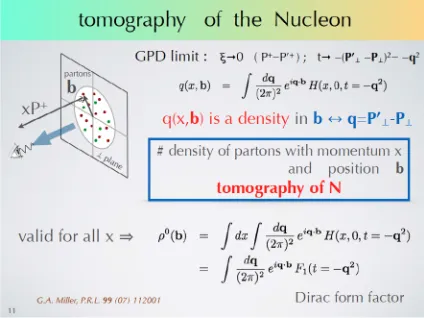
Presented by Marco Radici. The structure of the nucleons. The most relevant aspects. A key role is the kinematics of the infinite momentum frame (IMF) within the Deep Inelastic Framework and the collinear limit. Proposal of a new way of seeing already known facts: as the proton spin issue (see Fig.1) and the tomography of the nucleon (see Fig. 2). An extensive discussion of the Generalized Parton Distributions (GPD) functions, their model dependent parametrization and the connection with the lattice with an extensive list of references (for details see the transparencies on [1]). A discussion of the transverse momentum distribution (TMD) functions and the relevant role played by the soft gluon dynamics and the multiple gluon radiation resummation. As future directions the LHeC collider and the opening a new era of 3D view of the nucleons is envisaged. A comprehensive presentation about all the future LHeC projects has been presented by R. Ent [1].
ae-mail: [email protected],[email protected] 1Convened by M. Anselmino, M. Ruspa and L. Trentadue. DOI: 10.1051/
C
Owned by the authors, published by EDP Sciences, 2014 /2 01
, 0001 (2014) Conferences
EP Web ofJ 80
80 ep confj
Figure 1.M. Radici. The list of the various contributions to the proton spin.
Figure 2.M. Radici. A pictorial view. The tomography of the Nucleon.
1.2 Nucleon 3D Structure - Experimental data and perspectives
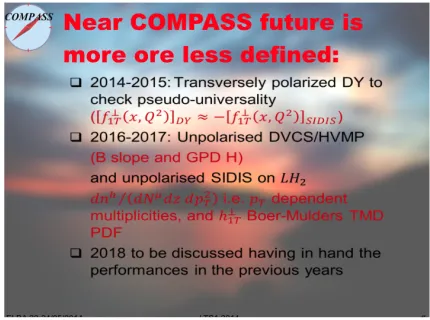
Presented by A. Bressan. The extensive amount of the data obtained by the COMPASS experiment starting form the 2002 until 2014 with both polarized and unpolarized targets. The transversity mea-surement. The access to GPD from COMPASS in the future as well as the polarized Drell-Yan and the semi-inclusive Deep Inelastic Scattering for the TMD functions. The future of COMPASS (see Fig. 3 and Fig. 4).
1.3 Drell-Yan Scattering and the structure of hadrons
O. Denisov. Drell-Yan and Deep Inelastic Scattering can allow the access to the same physics quan-tities via different probes. Only if TMD function manifest themselves similarly one can claim the hadron structure is showing up. A list of FermiLab experiments and the proposal of DY@COMPASS (see Fig. 5).
Figure 3.A. Bressan. GPD at COMPASS.
Figure 4.A. Bressan. COMPASS near future.
1.4 Parton Distribution Function
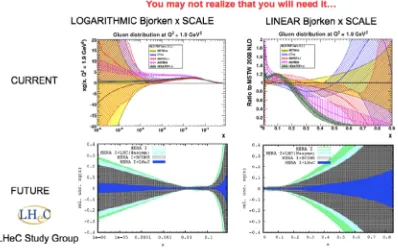
Presented by K. Wichmann. The crucial role played now and in the future LHC physics by the exact determination of the gluon structure function. A crucial issue (see Fig. 6).
2 Multiple Parton Interaction
Presented by L. Fanò. Multiple Parton Interactions (MPI) have been introduced to solve the unitarity problem generated by the fast raise of the inclusive hard pp cross sections at small x. The approach turns out to be highly predictive on hadronic final states. MPI helps to probe proton matter distribution; understanding the collision dynamics and to define, at the best, backgrounds to new physics search. Several indications of MPI in pp collision can be shown. For the double parton interaction see Fig. 7.
Figure 5.O. Denisov. DY@COMPASS.
Figure 6.K. Wichmann. The indetermination on the gluon structure function.
3 Cosmic ray physics at accelerators
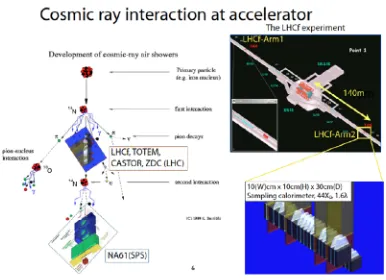
Presented by G. Mitsuka. The cosmic ray interactions can be reproduced at the accelerators (see Fig. 8). The analysis of data performed by the experiment LHCf at LHC has considered ElectroMagnetic showers events at the beginning, and has extended it after to the neutron events and to p-Pb events. The analysis is still continuing.
4 Spectroscopy
Presented by R. Mussa. Striking regularities among the ground state mesons despite the large scale variation of the masses of the constituent quarks: s, c, b (see Fig. 9).
Related to spectroscopy is the project presented by Elena Santopinto of constituting a group of study on hadron spectroscopy and hybrids, a collaboration between experimentalist and theoreticians (see [1]).
Figure 7.L. Fanò. The double parton scattering case.
Figure 8.G. Mitsuka. Reproducing cosmic rays at the LHC.
5 Diffraction
5.1 Theoretical aspects of diffraction
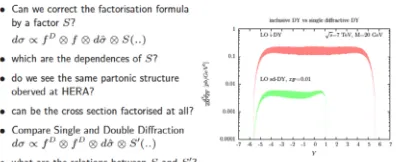
Presented by F. Ceccopieri. Hard Diffraction in DIS has a complete perturbative QCD description, factorization theorems and parton evolution. At hadron colliders factorization cannot be proven apart from the case of inclusive Drell-Yan. When factorization fails it opens a new view on the Non Pertur-bative physics and on the hadronic structure. An extensive set of measures on hard and soft diffractions are ongoing at LHC. A very interesting channel is the diffractive Drell-Yan (Fig. 10) and a set of new open questions (Fig. 11).
Figure 9.R. Mussa. Spin averaged 1P-1S splitting for s,c and b mesons.
Figure 10.F. Ceccopieri. Diffractive Drell-Yan.
Figure 11.F. Ceccopieri. Open questions.
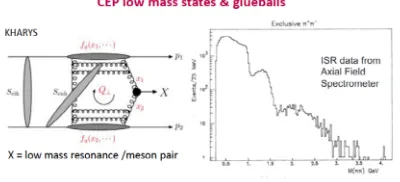
Figure 12.K. Osterberg. CEP processes.
Figure 13.K. Osterberg. CEP processes - glueball production.
5.2 Total, elastic and diffractive cross sections
Presented by K. Osterberg. A new rich and very promising tool to investigate diffraction is given by the Central Exclusive production (CEP) (Fig. 12). It allows an extensive range of production processes from jets to low mass states and glueballs: a gluon collider with a known initial state energy (Fig. 13) .
6 Highlights on confinement
Presented by M. D’Elia. Understanding the Non Perturbative properties of QCD is amajor challenge. Confinement but deconfinement also: is the strongly interacting matter confined forever? (see Fig. 14). Some considerations (Fig.15) and some conclusions: goals and perspectives (Fig. 16).
Figure 14.M. D’Elia. Deconfinement.
Figure 15.M. D’Elia. Some considerations.
Figure 16.M.D’Elia. Conclusions.
Let me make a final a comment. By trying to translate in the Italian language the words “New Physics” one may do it in two different ways: one way is to translate it as “Nuova Fisica”, meaning new and unexpected phenomena or facts; a second one is “Fisica Nuova”, meaning a new way of seeing and describing already known phenomena. We believe both should be considered as equally important.
Acknowledgements
I would like to thank all the colleagues who gave the presentations and contributed to the discussions, especially those who came from abroad. I am also very much grateful to Fulvia De Fazio and to Pietro Colangelo for inviting me at this lively Workshop.
References
[1] A complete description of the workshop contents and the entire
col-lection of the transparencies can be found at the workshop web page:
https://agenda.infn.it/conferenceDisplay.py?confId=7567