CLARIN: Towards FAIR and Responsible Data Science
Using Language Resources
Franciska de Jong
1, Bente Maegaard
2, Koenraad De Smedt
3, Darja Fiˇser
4, Dieter Van Uytvanck
5 1,5CLARIN ERIC,2University of Copenhagen,3University of Bergen,4University of Ljubljana and Joˇzef Stefan Institute1,5Utrecht, The Netherlands,2Copenhagen, Denmark,3Bergen, Norway,4Ljubljana, Slovenia 1[email protected],2[email protected],3[email protected],4[email protected],5[email protected]
Abstract
CLARIN is a European Research Infrastructure providing access to language resources and technologies for researchers in the humanities and social sciences. It supports the study of language data in general and aims to increase the potential for comparative research of cultural and societal phenomena across the boundaries of languages. This paper outlines the CLARIN vision and strategy, and it explains how the design and implementation of CLARIN are compliant with the FAIR principles: findability, accessibility, interoperability and re-usability of data. The paper also explains the approach of CLARIN towards the enabling of responsible data science. Attention is paid to (i) the development of measures for increasing the transparency and explainability of the results from applying CLARIN technologies, in particular in the context of multidisciplinary research, and (ii) stimulating the uptake of its resources, tools and services by the various communities of use, all in accordance with the principles for Open Science.
Keywords:CLARIN, FAIR, research infrastructure, Open Science policies, multilinguality, digital humanities, responsible data science
1.
Introduction: CLARIN Vision and
Strategy
CLARIN1 is a European Research Infrastructure
provid-ing access to language resources and tools. It focuses on the widely acknowledged role of language as social and cultural data and the increased potential for comparative research of cultural and societal phenomena across the boundaries of languages. Access to language data is cru-cial for scholars in the socru-cial sciences and the (digital) hu-manities (De Smedt et al., 2018). Language is a carrier of cultural content and information, both synchronically and diachronically. Language also plays a role as the reflection of scientific and societal knowledge, as an instrument for human communication, as one of the central components of the identity of individuals, groups, cultures or nations, as an instrument for human cognition and expression, as a formal system, and as historical records in need of doc-umentation and preservation. These insights underline the vision and the mission of CLARIN.
CLARIN vision: All digital language resources and tools
from all over Europe and beyond are accessible through a single sign-on on-line environment for the support of re-searchers in the humanities and social sciences.
CLARIN mission: Create and maintain an infrastructure to
support the sharing, use and sustainability of language data and tools for research in the humanities and social sciences. The vision is obviously very ambitious and the goal will not be fully reached in a foreseeable future, but it is the driving force for those who participate in the consortium and an encouragement for researchers to use and contribute to the infrastructure.
CLARIN has been implemented as a distributed research infrastructure with data centres (nodes) across Europe and beyond. The activities in CLARIN basically take place at two levels. One is the central level: the Board of Directors and the technical, communication, and administrative staff. The other is the national level: in each member country, the
1http://www.clarin.eu
national activities have by far the largest volume. Previous CLARIN activities have been described in multiple publi-cations that have been disseminated through many chan-nels. At LREC 2014 an overview of language resources, tools, and services on offer through CLARIN was presented (Hinrichs and Krauwer, 2014). The current paper focuses on the overall vision and in particular the adherence to the principles of FAIR and Responsible Data Science.
1.1.
A Bit of History
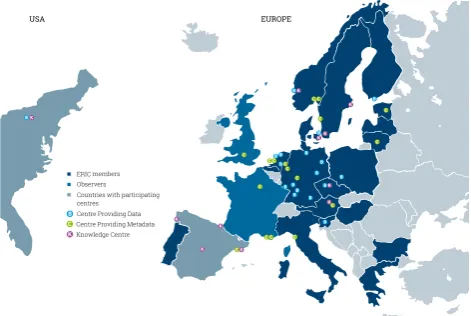
In the preparatory phase 2008–2011 CLARIN was funded by the European Commission. It was established as a Euro-pean Research Infrastructure Consortium (ERIC)2in 2012; the basic funding comes from the member countries. When it was established in 2012 CLARIN had nine members, and in 2017 it has grown to 19 members and two observers. Ad-ditionally, CLARIN has a special agreement with Carnegie Mellon University in the USA. This growth, which is still on-going, shows that the basic idea of CLARIN was well chosen and timely, cf. the map in Figure 1.
An important factor for the success and sustainability of a research infrastructure like CLARIN is its scope and size: since CLARIN is collecting data for languages from all gions and periods that are of interest to the European re-search era, CLARIN is multilingual. A large part of the collected language resources come from the member coun-tries, so the number of members matters for realizing wide coverage. Additionally, CLARIN is open to registering re-sources in all languages, and CLARIN is truly multilingual by providing metadata for at least five resources for each of more than 1,500 languages.
CLARIN has established the Virtual Language Observa-tory (VLO)3, a registry of Language Resources (LRs) based on the CMDI metadata standard (cf. Section 2.). The VLO contains information about all LRs provided by the mem-ber countries, plus information from other registries that
2According to regulations, the consortium needs to have a
ma-jority of European countries, but it is not restricted to Europe.
USA EUROPE
ERIC members Observers Countries with participating
[image:2.595.52.288.73.231.2]centres Centre Providing Data Centre Providing Metadata Knowledge Centre B B B B B B B B B B B B B B B B B B C B C C C C C C C C C C C C C C C C K K K K K K C K K K K K K
Figure 1:Map of CLARIN members, observers, and partic-ipating centres at the start of 2018.
want to be present in the VLO. Recently more than 700,000 records have been added from Europeana,4 the EU digital
platform for cultural heritage, which is of particular inter-est to humanities researchers.5 With more than 1,600,000 entries in the VLO CLARIN supports access to language resources including cultural heritage in many languages.
1.2.
Strategy
After the first 5–6 years, CLARIN is currently shaping its strategy for the next three years, 2018–2020. The strategy builds on the vision given above and further expressed in the Value Proposition6 (Maegaard et al., 2017). The
strat-egy covers four areas: uptake by researchers, technical in-frastructure, knowledge sharing infrastructure and sustain-ability.7
The strategy concerning the latter two points will be ad-dressed in the following subsections. Technical infrastruc-ture will be treated below in Section 2., where also the strong connection to FAIR is described, while responsible data science is addressed in Section 3. and uptake is de-scribed in Section 4..
1.2.1. Knowledge Sharing Infrastructure
CLARIN’s Knowledge Sharing Infrastructure (KSI) is the necessary ‘glue’ between the Technical Infrastructure and the researchers. Several instruments are used to share knowledge. Here we mention only a few of them.
Knowl-edge centresprovide expertise on data and methods to
re-searchers. Knowledge centres may offer expertise and sup-port for certain languages (e.g. the languages of Spain), or a technology or type of data (e.g. treebanks). CLARIN has nine knowledge centres at the time of writing and more are being established.Workshopsare key to share knowl-edge and to develop new ideas. Workshops may be used to support new user communities, to make the needs of
4https://pro.europeana.eu/ 5https://www.clarin.eu/blog/ bridging-europeana-and-clarin-infrastructures 6https://www.clarin.eu/value-proposition 7https://www.clarin.eu/content/ vision-and-strategy
a particular community visible and to discuss known ap-proaches across borders (country borders or discipline bor-ders). Workshops are normally organised by members and financially supported by CLARIN ERIC.
1.2.2. Sustainability
Membership is an essential part of the sustainability strat-egy. Countries and international organizations can join the ERIC as members or observers. They contribute to the gov-ernance of CLARIN and the membership fees form the core of its business model.8 The strategy is to maintain
the current membership and to grow in Europe and be-yond. An important aspect of the strategy is collaboration across borders: CLARIN aims at cross-institutional and cross-sectorial collaboration, e.g., with the GLAM sector (Galleries, Libraries, Archives, Museums) and with the in-dustry. Collaboration with other research infrastructures, be it in the humanities and social sciences area or with eScience, is also pursued in order to foster multidisciplinar-ity and the inherent need for innovation of methodological frameworks. Through cross-border collaboration, as well as through the focus on training and education, on centres of expertise etc. CLARIN will increase its societal impact and will contribute to the development of methodologies for measuring impact of research infrastructures in the so-cial sciences and humanities. Finally, an inherent goal of all these activities is to integrate and contribute to Europe’s Open Science policies (De Smedt et al., 2018).
2.
CLARIN and FAIR
With the wide emergence of digitally available language data (be it digitally native or retrodigitized), the possibil-ities beyond the mere archiving and viewing of such data sets have grown significantly. The idea of transitioning to-wards an ecosystem of registered, updatable and actionable data has been proposed in the context of the so-called Live Archives (Trilsbeek et al., 2008). These insights were guid-ing foundations durguid-ing the establishment of the CLARIN infrastructure (Broeder et al., 2008).
More recently, similar principles have been put forward in the broader data science community, specifically in the con-text of the Research Data Alliance’s Data Fabric working group.9 The most visible embodiment of these principles
are the so-called FAIR principles (Wilkinson et al., 2016) that are now also widely promoted as part of the Open Sci-ence paradigm. In the paragraphs below we describe the data architecture of CLARIN in a nutshell and demonstrate afterwards how it is largely FAIR-compliant.
2.1.
CLARIN Data Architecture
As a distributed infrastructure, CLARIN exists of a net-work of technical centres (nodes). A CLARIN centre typ-ically provides a data repository where language resources are stored and made available for researchers. Additionally, many centres also provide tools (web applications, web ser-vices or stand-alone applications) to process language data.
8
See (OECD, 2017) on business models for research data in-frastructures
9https://www.rd-alliance.org/group/
Figure 2: Schematic overview of what CLARIN technical centres have on offer.
Figure 2 is a schematic description of what type of content a repository incorporates. Figure 3 illustrates how metadata from CLARIN repositories are harvested in order to make items searchable and how described datasets can be pro-cessed with CLARIN tools.
There are two important principles behind the establish-ment of CLARIN centres. The first one is the organic na-ture: CLARIN centres typically evolve from hotspots of know-how, e.g. academic research groups or language data archives. Such fields of specialization could be based on a specific language (e.g. Hungarian), a modality (e.g. speech data), data types (e.g. lexicons) or a processing paradigm (e.g. rule-based morphological analysis). Secondly, there are strict interoperability requirements, in particular for the technical centres. As free as the process of establishing a CLARIN centre can be, a reasonable degree of integra-tion and compatibility is possible only if at the basis there is a clear technical and organisational framework. This is why each CLARIN centre is periodically assessed on var-ious levels, to check if it is following the technical guide-lines and if there is a sound organisational backing for the repository. One should note that these requirements only pertain to the protocol level (e.g., OAI-PMH for metadata exchange), leaving complete freedom to the individual cen-tre to choose its preferred software stack.
Without going into details,10 the main pillars for inter-operability with CLARIN are based on HTTP-accessible data and metadata, persistent identifiers and single sign-on whenever resources are not openly available. In the subse-quent sections we will relate these pillars to the FAIR prin-ciples.
10The full requirements are available at http://hdl.
[image:3.595.304.538.78.298.2]handle.net/11372/DOC-78.
Figure 3: The metadata for both data and tools from CLARIN repositories are harvested and indexed by the Vir-tual Language Observatory. Selected data can then be pro-cessed with relevant CLARIN data analysis tools.
2.2.
Findable
Use and re-use of language resources is only possible when they can be easily found by researchers. FAIR therefore requires persistent identifiers, rich metadata which are in-dexed and searchable and links from the metadata to the data identifiers. As a metadata standard, CLARIN requires CMDI (Goosen et al., 2015).Handlesare used to refer to all metadata records (and to data where this makes sense). In addition, the Virtual Language Observatory (VLO) (Van Uytvanck et al., 2012) provides a powerful search portal for all the collected metadata records, probably the largest catalogue of its kind for language data. Figure 3 depicts how the VLO architecture supports the discovery of data and tools. One can search through all metadata de-scriptions to find a relevant data set. The VLO offers free text search as well as faceted search. An example is given in Figure 4.
Making a searchable catalogue for over a million resources is obviously a daunting challenge. Usability tests have been performed and have triggered a series of improvements to the user interface. Also, issues with harvested metadata are always to be expected; these are being addressed through continuous adaptation and curation of the metadata.
2.3.
Accessible
Figure 4:Screenshot of a VLO search for the keyword “newspaper”, restricting the “language” facet to “Finnish”. Further restrictions can be imposed with other facets, such as “Resource type” for which a menu has been opened.
2.4.
Interoperable
To attain interoperability, FAIR demands a formal, shared and broadly applicable language for knowledge represen-tation, using FAIR vocabularies and links between meta-data and meta-data. CLARIN relies on the CMDI framework as common metadata language, including links to standard-ized OpenSKOS11 vocabularies and standardized ways of linking to datasets and landing pages. There are also rec-ommendations for the use of standard data formats.
2.5.
Re-usable
Researchers need information on how and under which conditions they can re-use existing resources. FAIR states that re-usable data require clear license and prove-nance information and adherence to community standards. CLARIN has clear recommendations on license disclos-ing and user-friendly ways of categorizdisclos-ing these (Arppe et al., 2011). Provenance is an important part of the metadata in CLARIN. While community standards are hard to de-fine, the bottom-up structure of the centres definitely brings
11http://openskos.org
along close ties with such good practices.
3.
CLARIN and Responsible Data Science
In order to serve the research community, the adherence to the principles of Open Science not only demands clar-ity about the data services offered, but also about what is to be expected from the analysis tools offered. In partic-ular researchers that do know how to couple the data they aim to use but that have not developed tools themselves, are in need of guidance and explanation of the various aspects of quality. Given that CLARIN offers support for multiple data science paradigms (e.g., rule-based vs. data-driven), performance expectations need to be carefully managed.3.1.
FACT
A recent expression of these concerns is by the Responsible Data Science consortium (RDS)12which aims to tackle
eth-ical and legal challenges, promote data science techniques, infrastructures and approaches that are responsible in the sense that data and data use should be fair, accurate, confi-dential and transparent (FACT) (Van der Aalst et al., 2017). These aims complement the FAIR principles, especially in a context where the use of data-driven methods typically applied to larger datasets is on the rise.
CLARIN intends to contribute to responsible data science by the design as well as the governance of its infrastruc-ture and to achieve an appropriate and transparent division of responsibilities between data providers, technical cen-tres, and end users. License agreements, which are estab-lished between a data provider and a data centre (reposi-tory), regulate the terms under which some well-described data is made available. These terms include an end-user li-cense agreement which, together with the terms of service at the data centre, may place some restrictions and respon-sibilities on the end user, particularly in the case of privacy concerns. The requirement of provenance data in CLARIN metadata makes data traceable and the use of PIDs makes data citable and their use replicable. Furthermore, CLARIN has started to provide guidance on which tool is recom-mended for which data through a service called the Lan-guage Resource Switchboard (Zinn, 2016).
3.2.
From Big Data to Big Conclusions and
Decisions?
Additional steps are foreseen which relate to the need to document and explain the performance levels that can be expected from the analysis tools, and thereby of the suit-ability of certain tools for specific scenarios of use. This is particularly relevant for the uptake of CLARIN functional-ity in the context of multidisciplinary collaboration where methodological frameworks rooted in multiple scholarly traditions have to be combined. This is not always straight-forward, for example because quite diverse approaches ex-ist towards the annotation of resources, ranging from part-of-speech tagging to the conceptual tagging of content. The step from big data to big conclusions and decisions re-quires a certain level of transparency from the algorithms applied, since black box applications are not likely to be accepted as the basis for conclusions. Merely focussing on the effectiveness of tools on prediction tasks is only rele-vant within the narrow field of NLP. Sustainable scientific and societal impact of the tools offered can only be ex-pected if the validity of analysis results can be assessed and explained to the communities that CLARIN aims to serve (Manovich, 2016; Nguyen et al., 2016). Clearly it may re-quire the renewal of the quality evaluation frameworks pro-posed thus far if the CLARIN contribution to data science is to live up to the emerging standards for responsible data science.
4.
Uptake
CLARIN’s efforts towards uptake reflect and address the vision with two strands of core activities. First, a series of
12http://www.responsibledatascience.org
surveys have been designed to evaluate the comprehensive-ness and usability of CLARIN services and prioritise future development efforts. In parallel, training models have been developed that stimulate the uptake of CLARIN resources, tools and services by researchers from a wide range of dis-ciplines in the humanities and social sciences where in ad-dition to the teaching of how the technologies and services work, an important goal is also to stimulate methodolog-ical and paradigm shifts towards quantitative approaches, interdisciplinary research design, open science policies and transnational collaboration.
4.1.
Surveys
4.1.1. User Base
Language in textual, spoken and multimodal form is a rich source of social and cultural data. CLARIN’s language re-sources are therefore highly relevant for a wide range of dis-ciplines and have a big potential for their reuse and repur-posing. Especially the combination of multiple resources and the analytic tools available for multiple languages make CLARIN an enabler of comparative studies across regions, periods and languages. In addition to supporting research excellence, CLARIN is therefore also an infrastructure that is likely to have societal impact along various dimensions. To be able to cater for the various scenarios of use success-fully, we are monitoring user experience with the infrastruc-ture and identifying obstacles that still need to be addressed through focus groups.
Apart from continued efforts to support existing users, sys-tematic analyses of relevant active research networks are being conducted to increase user engagement, uptake and dissemination for CLARIN.
4.1.2. Resource Tracking
analysed so far, the metadata on the parliament corpora are generally of the best quality (i.e., the only information that was lacking was related to annotation in the case of two out of the 11 corpora in the infrastructure). By contrast, the metadata on the parallel corpora is much poorer: informa-tion on the level of textual alignment is available for 43 cor-pora (52%). For more information on the overviews of the CLARIN key resource ‘families’ see (Fiˇser et al., 2018).
4.2.
Training
It is of strategic importance for CLARIN to offer training opportunities for researchers at all stages and from vari-ous backgrounds. Live events and on-line training materi-als not only demonstrate the functionalities of the available tools but also showcase projects that have successfully used the CLARIN infrastructure, address issues related digitally-enhanced and data-driven research design, contribute to-wards the advancement of the methodological apparatus and, last but not least, actively promote cross-disciplinary and cross-border collaboration. Co-operation with related research infrastructures is part of the strategy for capacity training. The wider aim is to ensure that the knowledge and skills needed to use and maintain the infrastructure are in line with the dynamics in the overall landscape of infras-tructures for research.
5.
Concluding Remarks
CLARIN was first conceived more than 10 years ago and has been steadily expanding, both in terms of members and in terms of disciplines for which services can be of-fered. We have outlined the CLARIN strategy and have shown how from the outset CLARIN has been in line with the more recently formulated principles for FAIR data. Plans for being compliant with the Responsible Data Sci-ence framework are being developed, as well as efforts to reinforce the multidisciplinary potential and uptake of CLARIN.
Acknowledgements
The work reported in this paper has been supported by the member countries and observers in the CLARIN ERIC, and it has received funding from the European Union’s Hori-zon 2020 research and innovation programme under grant agreement No. 676529 for project CLARIN-PLUS, and un-der grant agreement No. 654119 for project PARTHENOS. The authors owe a special merci to Maria Eskevich for her insights and practical support during the writing of this pa-per.
Bibliographical References
Arppe, A., Bruun, S., Koskenniemi, K., Lind´en, K., Ok-sanen, V., and Westerlund, H. (2011). A report in-cluding Model Licensing Templates and Authorization and Authentication Scheme. Technical Report D7S-2.1, CLARIN ERIC, Utrecht, The Netherlands.
Broeder, D., Nathan, D., Str¨omqvist, S., and Van Veenen-daal, R. (2008). Building a federation of language re-source repositories: the DAM-LR Project and its con-tinuation within CLARIN. In Sixth International Con-ference on Language Resources and Evaluation (LREC
2008). ELRA.
De Smedt, K., de Jong, F., Maegaard, B., Fiˇser, D., and Van Uytvanck, D. (2018). Towards an Open Science Infrastructure for the Digital Humanities: The Case of CLARIN. In Proceedings of the Third International Conference on Digital Humanities in the Nordic Coun-tries (DHN2018), Helsinki, Finland.
Fiˇser, D., Lenardiˇc, J., and Erjavec, T. (2018). Meet CLARIN’s Key Resource Families. In Proceedings of the Eleventh International Conference on Language
Re-sources and Evaluation (LREC 2018), Miyazaki, Japan.
ELRA.
Goosen, T., Windhouwer, M., Ohren, O., Herold, A., Eckart, T., ˇDurˇco, M., and Schonefeld, O. (2015). CMDI 1. 2: Improvements in the CLARIN Compo-nent Metadata Infrastructure. In Selected papers from the CLARIN 2014 Conference, October 24–25, Soester-berg, The Netherlands, pages 36–53. Link¨oping Univer-sity Electronic Press.
Hinrichs, E. and Krauwer, S. (2014). The CLARIN Research Infrastructure: Resources and Tools for e-Humanities Scholars. Proceedings of the Ninth Interna-tional Conference on Language Resources and
Evalua-tion (LREC 2014), pages 1525–1531.
Maegaard, B., Van Uytvanck, D., and Krauwer, S. (2017). CLARIN Value Proposition. Public Report CLARIN-CE-2017-1093-P001, CLARIN ERIC, Utrecht, The Netherlands.
Manovich, L. (2016). The science of culture? Social com-puting, digital humanities and cultural analytics.Journal of Cultural Analytics.
Nguyen, D., Doˇgru¨oz, A., Ros´e, C., and de Jong, F. M. G. (2016). Computational sociolinguistics: A survey. Com-putational Linguistics, 42(3):537–593.
OECD. (2017). Business models for sustainable research data repositories. OECD Science, Technology and Inno-vation Policy Papers 47.
Trilsbeek, P., Broeder, D., Van Valkenhoef, T., and Witten-burg, P. (2008). A grid of regional language archives. In
Sixth International Conference on Language Resources
and Evaluation (LREC 2008), pages 1474–1477. ELRA.
Van der Aalst, W. M. P., Bichler, M., and Heinzl, A. (2017). Responsible Data Science. Business & Information
Sys-tems Engineering, 59(5):311–313.
Van Uytvanck, D., Stehouwer, H., and Lampen, L. (2012). Semantic metadata mapping in practice: the virtual lan-guage observatory. In Nicoletta Calzolari (Conference Chair), et al., editors,Proceedings of the Eight Interna-tional Conference on Language Resources and
Evalua-tion (LREC’12), Istanbul, Turkey. ELRA.
Wilkinson, M. D., Dumontier, M., Aalbersberg, I. J., Ap-pleton, G., Axton, M., Baak, A., Blomberg, N., Boiten, J.-W., da Silva Santos, L. B., Bourne, P. E., et al. (2016). The FAIR guiding principles for scientific data manage-ment and stewardship.Scientific Data, 3(160018). Zinn, C. (2016). The CLARIN Language Resource