Towards A Robust Morphological Analyzer for Kunwinjku
William Lane and Steven Bird Charles Darwin University
The Northern Institute
Abstract
Kunwinjku is a polysynthetic language spoken in northern Australia. Members of the commu-nity have expressed interest in co-developing language applications which could assist in the production of written language resources for education and language learning. Modelling Kunwinjku morphology is a step towards ac-complishing these goals. We discuss some of the modeling challenges presented by Kun-winjku verbal morphology, and in polysyn-thetic languages more generally. We show that a model using standard features of theFoma
toolkit can account for much of the verb struc-ture. Our contributions include the first mor-phological analyzer for Kunwinjku, and a dis-cussion of polysynthetic language features and how they affect modelling decisions. Continu-ing challenges include robustness in the face of variation and unseen vocabulary, as well as how to handle complex reduplicative pro-cesses.
1 Introduction
Kunwinjku is an Aboriginal language of the Gun-winyguan language family (ISO gup), spoken by about 2000 speakers in the West Arnhem region of northern Australia. Several Kunwinjku communi-ties have shown interest in leveraging technology to support the production of literacy materials and language learning applications (Bird,2018).
A major focus of our research group is to im-plement language technologies that have positive social impact, such as a morphologically-aware dictionary which lowers the barrier to entry for users who cannot reliably identify or spell cita-tion forms (Hunt et al.,2019;Arppe et al.,2016), or a tool that generates linguistic structures which could help language learners master conjugation and verb structure (Kazantseva et al.,2018).
One thing that these applications have in com-mon is the need to decompose and manipulate text
at the level of morphology. In order to accom-plish this, we must address polysynthesis, mor-phophonemic alternations, incorporation, redupli-cation, and long-distance dependencies. Which aspects of morphosyntax can we model? What are the limitations of computational approaches for modeling polysynthetic languages more gen-erally?
In the sections that follow, we will first give an overview of those features of the language which affect how we approach the modelling task (sec 2). Next, we introduce our data sources and the met-rics we use to evaluate performance (sec 3). This is followed in section 4 by a detailed description of our implementation and how we addressed the linguistic features described in section 2. Finally, we report accuracy and coverage on both a devel-opment data set and a blind test set, provide an error analysis and discussion, and conclude with some thoughts on future directions. To our knowl-edge, this is the first morphological analyzer for Kunwinjku.
2 Features of Kunwinjku Verbs
We model and evaluate the morphosyntax of Kun-winjku verbs according to Evans’ Pan-dialectal Grammar (Evans, 2003). In this section we de-scribe some of these features, and follow-up later with how we account for them in the model.
2.1 Polysynthesis and Agglutination
−12 −11 −10 (−9) (−8) (−7) (−6) (−5) (−4) (−3) (−2) (−1) 0 +1 +2 Tense Subject Object Directional Aspect Misc1 Benefactive Misc2 Gen.inc.nom Bod.par.inc.nom NumeroSpacial Comitative Verb Stem RR TAM
Figure 1: Verbal affix positions in Kunwinjku. Regions where indices share a cell ([−12,−10], [+1,+2]) indicate potentially fused segments. Slot indices in parentheses indicate optionality. Adapted from (Evans,2003, Fig 8.1).
The morphology is described as agglutinative, almost “lego-like” (Evans,2003;Baker and Har-vey, 2003), though with some unusual morpho-phonemic alternations involving glottal stop, long distance dissimilation of peripheral nasals, and complex types of reduplication. Additional com-plexity can be found in the peripheral “fusion zones” spanning slots [−12,−10] and [0, +2].
2.2 Noun Incorporation
Figure 1 shows the optional slots−4 and−3, la-beled for the general incorporated nominal (GIN), and the body part incorporated nominal (BPIN), respectively. The GIN class represents a closed set of nouns which, after losing their gender/class and case inflections, can be injected into the verb to satisfy valency. Consider the incorporable noun kunrerrng“wood”, and the phrasekarrimang“we would go get.” To form the phrase “we would go get wood” using noun incorporation,kunrerrng loses its noun class inflectionkun-, and is placed in slot−4:
(1) a. karri-ma-ng 1pl-get-past
kun-rerrng IV-wood b. karri-rerrng-ma-ng
1pl-GIN.wood-get-past
‘We would go and get wood’ [E.145]
Nouns from the BPIN class perform a similar function, with the characteristic difference of be-ing loosely associated with the human corporal form (an arm, a leg, your shadow, etc). Here we see the nounkunkanj“meat,” loses its noun class inflectionkun-and is placed in the verb slot at−3:
(2) a. bi-ngu-neng
3sg.3Hsg.past-eat-past
kun-kanj IV-meat b. bi-kanj-ngu-neng
3sg.3Hsg.past-BPIN.meat-eat-past ‘He is eating meat’ [E.687]
Additionally, BPIN is anopenclass. 2.3 Valency-affecting prefixes
As can be seen in Figure1, Kunwinjku allows for 15 morph slots to complete a verb form. Transi-tivity of the verb is lexically defined, but there are
three morph slots which signal valency change and affect the resulting semantic interpretation: the benefactive (BEN), comitative (COM), and reflex-ive (RR) (Evans,2003;Ponsonnet,in press).
The following subsections describe the mor-phemes which affect the valency of the verb.
2.3.1 Benefactive
marne-The benefactive prefix indicates that one of the verb objects is the beneficiary of the action of the verb. For example, the English verb for say in Kunwinjku is translated asyime, and is designated by the grammar as intransitive. Consider the case whereyimeis paired with the benefactive marne-prefix:
(3) ben-marne-yime-ng
3sg.3pl.past-BEN-say-PastPerf ‘He told them’ [E.637]
We see that this prefix opens up the intransitive verb, in this caseyime, to the possibility of taking on the 3rd person plural object. That object can be present in the verb itself via the pronominal or an incorporated noun, or it could be located outside of the verb entirely.
2.3.2 Comitative
yi-The comitative slot is located at position−1. Its presence extends verb valency by 1. If the verb root is intransitive, the COM indicates that the ad-ditional object is “with” (accompaniment, not in-strumental) the subject of the verb. For example:
(4) ben-yi-yibme-ng
3sg.3pl-COM-sink-PastPerf
‘He took them down under the water’ [E.433]
If the verb root is transitive, then it conveys the meaning that the new argument accompanies the object of the transitive verb. For example:
(5) nga-kole-yi-kurrme-ng
1sg.3sg-GIN.spear-COM-put.down-PastPerf ‘I left the spear with him’ [E.433]
2.3.3 Reflexive and Reciprocal -rre
(6) bene-marne-kinjwe-rre-nj
3ua.3sg-BEN-be.jealous-RR-PastPerf ‘They were jealous of each other over him.’ [E.430]
In this example, bene- is the 3rd person dual subject (those two) with a 3rd person singular ob-ject. The reflexivity occurring after the verb root directs the action of being jealous back onto the subject, with the indirect object (the 3sg “him”) remaining unaffected.
2.4 Morphophonemic Considerations
Where morphs combine, there are a few mor-phophonemic patterns to account for. The most widespread is that of d-flapping, where morpheme-initial d becomes rr after vowel-final syllables. For example, the inflected form nga-rranginjhas the verb rootdangen, but we see the d has been changed to rr because it is preceded by the syllablengawhich contains a syllable-final vowel. While this rule is fairly regular, Evans’ grammar also recognized cases where the pat-tern doesn’t seem to apply and concludes that “a fuller understanding of stress and prosody will be needed before such examples can be accounted for”. Take the verb “dirri”, “to play” for example:
(7) a. * nga-rrirri-∅
b. * nga-rridi-∅
c. nga-dirri-∅ 1sg-play-nonpast ‘I play’
Another morphophonemic pattern is the dele-tion of morpheme-initial r following apical con-sonants rr, l, andn. In careful speech and writ-ten Kunwinjku, this pattern is not always obliga-tory; Evans argues that it is not evident whether these changes should be treated as “fast-speech phenomena” and therefore not shown in the or-thography. The most consistent example of this alternation that we have seen is that ofr→ ∅krr , which manifests itself in the example ofngarr-re which becomesngarre,we two go.
There are other morphophonemic changes that occur in Kunwinjku speech, but which do not ap-pear to be reflected in the accepted orthography. Evans posits that since the Kunwinjku dialect has a longer tradition of literacy (relative to other di-alects), these changes are not usually reflected in the written medium. Some of the phenomena that
fall into this camp are specific cases of nasal as-similation, andperipheral dissimilation. Since the goal of our morphological analyzer is to recog-nize the inflected forms of written verbs, we avoid giving a more complete description of morpho-phonemic processes which do not impact the stan-dard written form. It is important to note how-ever that these processes may cause variation in how speakers of the language write. A truly ro-bust analyzer intended for applications like spell-checking would need to consider such processes as they manifest themselves in human input.
2.4.1 Reduplication
Kunwinjku has three main types of partial verbal reduplication signalling iterative, inceptive, and extended meaning. Moreover, each type of redu-plication can have more than one consonant (C) and vowel (V) reduplicative pattern, depending on which of the 11 verb form paradigms the verb be-longs to. See Figure2for details.
Computational modeling of partial reduplica-tion in human language using finite state transduc-ers (FSTs) has been addressed in the past (Culy, 1985;Roark et al., 2007;Dras et al.,2012), with the general consensus being that these kinds of partially reduplicative processes explode the state space of the model, and are therefore highly bur-densome to develop. More recent work addresses these challenges using 2-way FSTs (Dolatian and Heinz,2018,2019), and offers a promising future avenue of exploration for our work with Kunwin-jku. We include reduplication in this paper for the sake of completeness (see Figure2), but acknowl-edge that a solution lies beyond the scope of this work.
3 Data and Metrics
Type of reduplication Pattern(s) Unreduplicated Verb Reduplicated Verb Semantic Effect on the verb (V)
Iterative
CVC dadjke = cut dadj-dadjke = cut to pieces
Doing V over and over again CV(C)CV(h) bongu = drink bongu-bongu = keep drinking
CVnV(h) re = go rengeh-re = go repeatedly
Inceptive CV(n)(h) yame = spear (something) yah-yame = try (and fail) to spear (something) Failed attempt to do V durnde = return durnh-durnde = start returning Starting to do V Extended CVC(C)k men djordmen = grow djordoh-djordmen = grow all over the place Doing V all over the place
[image:4.595.71.528.62.135.2]CVC(C)k me wirrkme = scratch wirri-wirrkme = scratch all over
Figure 2: Reduplication in Kunwinjku has three forms, and each form has its own patterns defining how much of the verb is captured and copied. In the case where we’ve used the form Xk Y, we mean that pattern X is the reduplicated segment if found in the context of Y. Figure adapted from (Evans,2003).
To construct our development corpus of in-flected verbs, we extracted all of the Kunwinjku examples from the reference grammar; a total of 567 glossed verbs. We further refined the list to exclude cases of reduplication (cf 2.3.4) which left us with 530 verbs which we used to produce a data set to support the development of the FST.
Additionally, we glossed a small set of 114 verbs randomly sampled from the Kunwinjku translation of the Bible, for the purpose of judging how well the FST generalizes to another domain. The Bible translation was recently completed in 2018, and targets the modern vernacular.
We use accuracy and coverage to measure the effectiveness of the model on the development data set as well as the test set.
4 Implementation
Finite state transducers are viewed as an ideal framework to model morphology (Beesley and Karttunen,2003;Chen and Schwartz,2018; Lach-ler et al., 2018). Our FST was implemented us-ing the Foma toolkit (Hulden, 2009) which is a popular framework for building morphologi-cal analyzers for polysynthetic languages (Chen and Schwartz,2018;Moeller et al., 2018;Littell, 2018). The definition of an FST inFomais com-prised of a lexicon implemented in the.lexc for-mat, and a .foma file for defining rules covering regular morphophonemic changes. The final FST is produced by composing the FSTs defined in both files.
4.1 The .lexc file
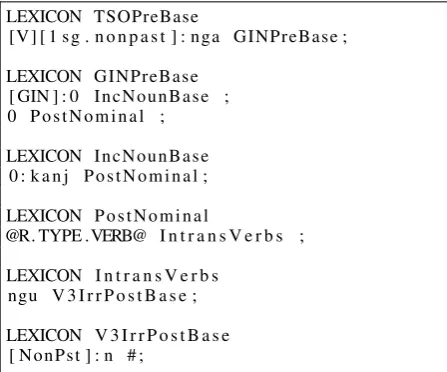
The .lexc file contains definitions of lexicon groups corresponding to morphological units of the language. Lexical entries of the group are listed below the group definition. Each entry in the lexicon is paired with its continuation class which defines legal paths through the FST, enforc-ing valid sequences of morphs. Figure 3 gives a
LEXICON TSOPreBase
[V ] [ 1 s g . n o n p a s t ] : nga GINPreBase ;
LEXICON GINPreBase [ GIN ] : 0 I n c N o u n B a s e ; 0 P o s t N o m i n a l ;
LEXICON I n c N o u n B a s e 0 : k a n j P o s t N o m i n a l ;
LEXICON P o s t N o m i n a l
@R. TYPE .VERB@ I n t r a n s V e r b s ;
LEXICON I n t r a n s V e r b s ngu V 3 I r r P o s t B a s e ;
LEXICON V 3 I r r P o s t B a s e [ N o n P s t ] : n # ;
Figure 3: Lexicon groups are defined in the.lexcfile using the LEXICON keyword. Valid paths through lex-icons are defined on an entry-by-entry basis. Here each lexicon only has one entry, and there is only one path through the graph. The accept state in the graph is sig-naled by the # character.
stripped-down example of this by implementing a .lexc file capable of mapping the inflected Kun-winjku verbngakanjngun, “I am eating meat”, to its analysis:1sg.nonpast-GIN.meat-eat-nonpast.
[image:4.595.304.528.200.386.2]Start
V PreBase
N
PreBase NBase
[image:5.595.74.291.61.194.2]VBase PostBaseV End
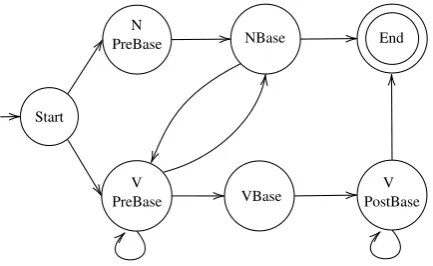
Figure 4: A high-level overview of the morphologi-cal analyzer. Verbal prefix lexicons are represented by
VPreBase, verb root lexicons are represented byVBase, and verbal suffixes are represented byVPostBase.
4.1.1 Noun Incorporation
We handle noun incorporation similarly to Chen and Schwartz (2018): we allow transitions from states in the verbal pre-base lexicons (specifically, the GIN and BPIN slots) to the noun base lexicon (see Figure 4). We use flag diacritics to enforce constraints on word type: if the word begins with verbal morphology and crosses into the noun base via incorporation, it can only be recognized as a valid string if it also ends with verbal post-base morphology.
As described in Figure 3, we define GINPre-Base as a lexicon which points to the IncNoun-Base class, which enumerates the closed class of incorporable nouns. Similarly, we define a lexicon namedBPINPreBase representing the open class of body part nouns which can be incorporated, and which fill the optional position at index−3.
4.1.2 Tense Agreement
The inflected Kunwinjku verb requires agreement between tense in the pronominal prefix and the TAM suffix. To address this we need to dis-criminate between ambiguous paths in the FST based on a feature value that is set at some node in the graph and persists to enforce agree-ment downstream. In Foma, we use flag dia-critics to implement this. Flag diacritics take the form of @FLAGTYPE.FEATURE.VALUE@ whereFLAGTYPEdefines the behavior of the flag, selected from the set of predefined flag types, and FEATURE and VALUE must be defined by the user (Hulden, 2011). We make use of flag types P and R in our implementation of tense agree-ment. P defines the action of settingFEATURE to VALUE and R defines the action of requiring
thatFEATUREequalVALUEin order to remain a valid path.
We define the following tags to enforce tense agreement:
1. @P.TENSE.PAST@
2. @P.TENSE.NONPAST@
3. @R.TENSE.PAST@
4. @R.TENSE.NONPAST@
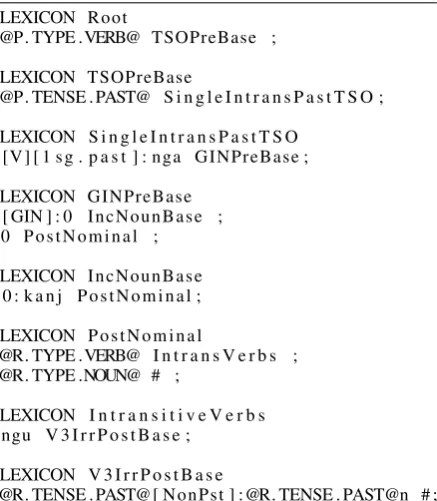
To see how this works in the .lexc format, we update the example in Figure 3 to reflect the enforcement of tense agreement between the pronominal and the tense inflection on the verb using flag diacritics (Figure 5). Notice how @P.TENSE.PAST@is present before the continu-ation class transitions in the new TSOPreBase lex-icon: this effectively labels all paths proceeding from this point as having the attributeTENSEset to a value ofPAST, indicating that this path will agree with any attempt to enforce agreement with a past tense. Indeed, at the bottom of Figure5we see the @R.TENSE.PAST@ diacritic on both the up and down side of the transducer, indicating that in either direction1if we match the morphological entry, the path we’ve taken must also match the TENSEflag feature value in order for the analysis to be valid.
4.1.3 Valency Agreement
As described in 2.3, the valency of the verb is affected by the presence of certain prefixes: the benefactivemarne-, the comitativeyi-and the re-flexiverre-. Our initial belief was that in order to analyze an inflected verb in Kunwinjku, it would be necessary to model these valency changes. We saw no reason to allow the FST to generate anal-yses which seemed to demonstrate valency im-balance in either the direction of over-saturation or under-saturation. For example, the following verbs seem to provide too many or too few argu-ments:
(8) bi-marne-bong-yo-y
3sg.3Hsg.past-BEN-GIN.string-lie-PP
+2 −1 +1 −1 0
‘He had the string lying there for her’ [E.429]
1If you label a continuation class with a flag diacritic, it
LEXICON R o o t
@P. TYPE .VERB@ TSOPreBase ;
LEXICON TSOPreBase
@P. TENSE . PAST@ S i n g l e I n t r a n s P a s t T S O ;
LEXICON S i n g l e I n t r a n s P a s t T S O [V ] [ 1 s g . p a s t ] : nga GINPreBase ;
LEXICON GINPreBase [ GIN ] : 0 I n c N o u n B a s e ; 0 P o s t N o m i n a l ;
LEXICON I n c N o u n B a s e 0 : k a n j P o s t N o m i n a l ;
LEXICON P o s t N o m i n a l
@R. TYPE .VERB@ I n t r a n s V e r b s ;
@R. TYPE .NOUN@ # ;
LEXICON I n t r a n s i t i v e V e r b s ngu V 3 I r r P o s t B a s e ;
LEXICON V 3 I r r P o s t B a s e
[image:6.595.72.291.62.313.2]@R. TENSE . PAST@[ N o n P s t ] :@R. TENSE . PAST@n # ;
Figure 5: Updating our.lexcfile to constrain possible paths through the FST based on the value of the TENSE feature. Shown also is a diacritic enforcement of word type in the PostNominal lexicon.
(9) ∅-djare-ni
3sg.past-want-PastImperf
+1 −2 0
‘He was wanting ’ [E.229]
However, both of the above examples are valid. In these glossed examples, we’ve added a row un-der the morpheme analysis to mark which mor-phemes satisfy valency (+1 if it represents 1 ob-ject, +2 if it represents 2 objects), morphs which increase the valency of the verb (−1 if it demands 1 object, etc), and morphs which have no effect on valency (0). This allows us to do the simple arithmetic to convince ourselves that (9) is over-saturated, while (10) is under-saturated.
In (9), we have a subject (“he”) and two object candidates (“her” and “the string”). The verb root “yo” (“to lie”) is inherently intransitive, and the presence of marne- opens up room for the verb to take an additional argument as the benefactor: “her”. In this instance, the verb appears to be sat-urated, leaving “the string” to act rather as spec-ification of the verb “yo”. As this case shows, ambiguity around when an incorporated nominal is acting as an object rather than providing refer-ential specification impedes the attempt to model valency based on surface form morphology alone.
In (10), the object of the transitive verb forwant is not incorporated, but exists in the wider senten-tial context. This implies that valency cannot be disambiguated without reference to syntactic con-text. Indeed, a syntactic concept can be expected to have syntactic scope, and it is not uncommon for languages containing valence-altering morphs to provide valence-satisfying objects outside of the verb (Haspelmath and M¨uller-Bardey, 2004). In light of this, we decided to take a permissive stance, allowing valence-imbalanced analyses at the level of individual verbs.
4.2 The .Foma File
The .Foma file is the place to encode morphophonological rules in the form of A→BkΓ ∆, ie “A changes to B in the con-text Γ ∆”, where A and B are orthographic symbols representing phonemes which alternate in the given context. These rules define an FST which can then be composed with the lexicon FST defined in the .lexc file, resulting in a final FST representing the complete grammar. Since Kunwinjku is largely agglutinative, with relatively little morphophonemic change to account for. This makes the content of our.Foma file a rela-tively simple composition of three parts: A list of special symbols we define to make our rules more compact, an enumeration of allophonic rules, and finally the composition of the lexicon with the rules to produce the final grammar.
r e a d l e x c kunwok . l e x c d e f i n e L e x i c o n ;
d e f i n e V [ a | e | i | o | u ] ;
d e f i n e C l e a n M o r p h B o u n d a r i e s ” ˆ ” −> 0 ;
d e f i n e D e l e t e P r e c e d i n g V V−> 0 | | ” ˆ ” ” ˜ ” . o . ” ˜ ”−> 0 ;
. . .
d e f i n e F l a p C h a n g e ” ( r r ) ”−> r r | | V ” ˆ ” . o . ” ( r r ) ”−> d ;
d e f i n e Grammar L e x i c o n . o . D e l e t e P r e c e d i n g V . o .
. . o .
. . o .
. . o .
F l a p C h a n g e . o . C l e a n M o r p h B o u n d a r i e s ;
[image:7.595.67.294.62.270.2]r e g e x Grammar ;
Figure 6: An example of our .Foma file. We define phonemic rules which are applied to theLexiconFST by composition, which produces a new and final FST namedGrammar
5 Evaluation
The final FST implements the rules required to produce verbs in Kunwinjku. This includes 157 pronominal entries (including variations reflecting combinations of tense and transitivity), 23 adver-bial/aspective/quantitative modifiers of the verb, 77 general incorporable nouns (a closed class), 31 body part incorporable nouns (an open class), 541 verb roots, and 124 TAM inflection possibil-ities. As mentioned in section 3, we extracted 530 inflected verb forms from the Evans’ gram-mar which we used to optimize coverage and ac-curacy. Accuracy in this context refers to the num-ber of correct analyses out of the set of analysis the FST attempted. We calculate it this way to avoid double-counting information already captured in the coverage metric. Those numbers are shown in Figure8, along with the reported performance over the test set.
6 Discussion
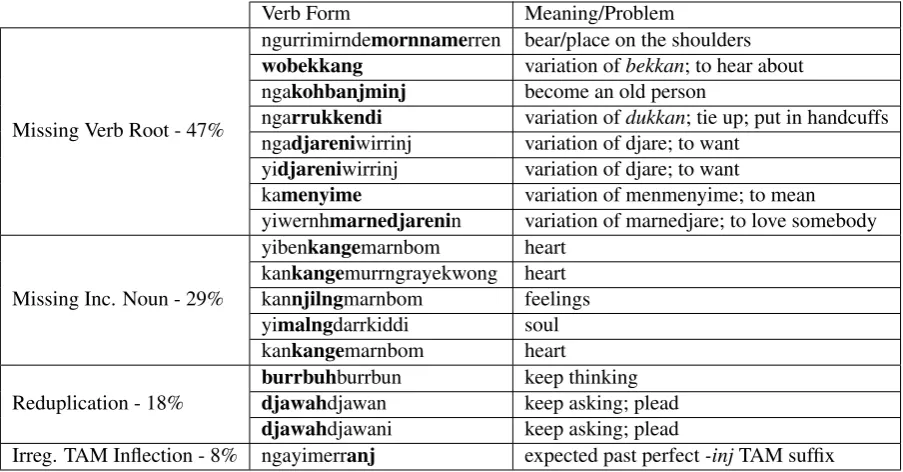
In order to better understand the performance of the FST, we analyzed the coverage and accuracy on the Bible dataset and identified four classes of error: missing verb root, missing incorporated nominal, irregular inflection patterns, and redupli-cation (see Fig7).
The most common error type is missing verb root, which represents 47% of errors. Similarly,
missing incorporated noun, which accounts for another 29%, for a total of 76% of errors due to missing lexical entries. We posit that while it may be possible to infer unseen roots by recognizing the surrounding inflection and stripping it away, the presence of unseen incorporated nouns which attach directly to the verb root have the potential to complicate the matter. However, stemming like this would be sufficient for automatically discov-ering potential verb roots from unannotated text, which can then be verified by language experts prior to adding them to the lexicon.
Reduplication represents 18% of errors. As we discussed in 2.3.4, there are potential solu-tions including 2-way FSTs (Dolatian and Heinz, 2018, 2019), and the possibility that neural ap-proaches to morphological analysis could learn to recognize reduplication through supervised learn-ing (Micher,2017;Moeller et al.,2018;Schwartz et al.,2019). It would be interesting to observe a similar error analysis on a much larger sample size to see if this rate of reduplicative structure holds, and to get an idea for the relative distribution of reduplicative structure in Kunwinjku.
The least common class of error contained a sin-gle instance: Irregular inflection pattern. Here, a path through the FST could not be found because we come across irregular variation of the TAM in-flection. Whether this represents an entire class of error or is caused by simple orthographic variation is unknown: the question requires a larger sample size and consultation with language experts.
7 Conclusion
Kunwinjku is low-resource Australian language for which we would like to develop useful lan-guage learning applications. Being able to model the rich verbal morphology is an important step to-wards that goal. In this work, we identified several areas of Kunwinjku morphology which fit well within the framework of finite state transduction, and some for which a different approach may be better suited to the task. FSTs do well at handling the templatic structure of polysynthetic morphol-ogy. For languages which exhibit high rates of al-lomorphy and morphophonemic change, the abil-ity to compose multiple FSTs into a final grammar has been shown to be quite effective (Chen and Schwartz,2018;Littell,2018).
redupli-Verb Form Meaning/Problem
Missing Verb Root - 47%
ngurrimirndemornnamerren bear/place on the shoulders wobekkang variation ofbekkan; to hear about ngakohbanjminj become an old person
ngarrukkendi variation ofdukkan; tie up; put in handcuffs ngadjareniwirrinj variation of djare; to want
yidjareniwirrinj variation of djare; to want
kamenyime variation of menmenyime; to mean yiwernhmarnedjarenin variation of marnedjare; to love somebody
Missing Inc. Noun - 29%
yibenkangemarnbom heart kankangemurrngrayekwong heart kannjilngmarnbom feelings yimalngdarrkiddi soul kankangemarnbom heart
Reduplication - 18%
burrbuhburrbun keep thinking djawahdjawan keep asking; plead djawahdjawani keep asking; plead
[image:8.595.72.524.62.298.2]Irreg. TAM Inflection - 8% ngayimerranj expected past perfect-injTAM suffix
Figure 7: The inflected verbs from the Bible test set for which the FST had no analysis, sorted into one of the four buckets for error analysis. Thebold substringsare the morphs which the FST could not account for.
Coverage Accuracy Kunwinjku Bible-Test 85.09 97.94 Evans Grammar-Dev 97.17 95.28
Figure 8: Coverage and accuracy of the FST model of verbs in Kunwinjku. The Evans Grammar represents the data we optimised our FST against. The Kunwinjku Bible data is a blind test set.
cation, and being robust in the face of variation in form and orthography.
Additionally, we could have benefitted from a much larger annotated test set. While the Bible set was sufficient to point out the issue of lexicon cov-erage in our FST, more data could help solidify the relative importance of the other much smaller er-ror classes. It could also give us more insight into the distribution of other constructions in Kunwin-jku, which may inform the pedagogical aspect of designing language learning applications in a low-resource setting.
In future work we hope to expand the lexicon of this tool in parallel with developing other ap-proaches to morphosyntactic analysis. Specifi-cally, recent work in bootstrapping recurrent neu-ral models using an FST to generate training ex-amples has showed significant increase in cov-erage and accuracy in other polysynthetic envi-ronments (Micher, 2017; Moeller et al., 2018; Schwartz et al.,2019).
Acknowledgments
We are grateful for the support of the Warddeken Rangers of West Arnhem. We thank Ma¨ıa Pon-sonnet for her valuable insights into Gunwinyguan morphology, syntax and semantics. We also thank Alexandra Marley for contributing her expertise on Kunwinjku morphosyntax. This research has been supported by grants from the Australian Re-search Council and the Indigenous Languages and Arts Program of the Federal Department of Com-munication and the Arts. Finally, we would like to thank the three anonymous reviewers for their constructive feedback.
References
Antti Arppe, Jordan Lachler, Trond Trosterud, Lene Antonsen, and Sjur N Moshagen. 2016. Basic lan-guage resource kits for endangered lanlan-guages: A case study of Plains Cree. Collaboration and Com-puting for Under-Resourced Languages: Towards an Alliance for Digital Language Diversity, pages 1–8.
Brett Baker and Mark Harvey. 2003. Word Structure in Australian Languages.Australian Journal of Lin-guistics, 23:3–33.
Kenneth R Beesley and Lauri Karttunen. 2003. Finite-state morphology: Xerox tools and techniques.
CSLI, Stanford.
endangered languages. InThe Oxford Handbook of
Endangered Languages. Oxford University Press.
Steven Bird and Alex Marley. 2019. Kunwok.org.
https://kunwok.org/. Accessed:
2019-08-30.
Emily Chen and Lane Schwartz. 2018. A morpho-logical analyzer for St. Lawrence Island / Central Siberian Yupik. In Proceedings of the Eleventh In-ternational Conference on Language Resources and
Evaluation, Miyazaki, Japan. European Language
Resources Association.
Christopher Culy. 1985. The complexity of the vocab-ulary of Bambara. InThe Formal Complexity of Nat-ural Language, pages 349–357. Springer.
Hossep Dolatian and Jeffrey Heinz. 2018. Modeling reduplication with 2-way finite-state transducers. In
Proceedings of the Fifteenth Workshop on Computa-tional Research in Phonetics, Phonology, and Mor-phology, pages 66–77, Brussels, Belgium. Associa-tion for ComputaAssocia-tional Linguistics.
Hossep Dolatian and Jeffrey Heinz. 2019. Learn-ing reduplication with 2-way finite-state transducers.
InInternational Conference on Grammatical
Infer-ence, pages 67–80. Proceedings of Machine Learn-ing Research.
Mark Dras, Franc¸ois Lareau, Benjamin B¨orschinger, Robert Dale, Yasaman Motazedi, Owen Rambow, Myfany Turpin, and Morgan Ulinski. 2012. Com-plex predicates in Arrernte. In Proceedings of the
LFG12 Conference, pages 177–197. CSLI
Publica-tions.
Nicholas Evans. 2003. A Pan-dialectal Grammar of Bininj Gun-Wok (Arnhem Land): Mayali, Kunwin-jku and Kune. Canberra: Pacific Linguistics.
Murray Garde, Jill Nganjmirra, and Dan Kennedy. 2019. Bininj Kunwok Dictionary. njamed.com. Accessed: 2019-07-19.
Martin Haspelmath and Thomas M¨uller-Bardey. 2004. Valency change. In Geert Booij, Christian Lehmann, and Joachim Mugdan, editors, Morphol-ogy: A Handbook on Inflection and Word Formation, pages 1130–45. de Gruyter Berlin; New York.
Mans Hulden. 2009. Foma: a finite-state compiler and library. In Proceedings of the 12th Conference of the European Chapter of the Association for Com-putational Linguistics, pages 29–32. Association for Computational Linguistics.
Mans Hulden. 2011. Morphological analysis tutorial: A self-contained tutorial for building morpholog-ical analyzers. https://fomafst.github.
io/morphtut.html. Accessed: 2019-09-30.
Benjamin Hunt, Emily Chen, Sylvia Schreiner, and Lane Schwartz. 2019. Community lexical access
for an endangered polysynthetic language: An elec-tronic dictionary for St. Lawrence Island Yupik. In
Proceedings of the 2019 Conference of the North American Chapter of the Association for Compu-tational Linguistics, pages 122–126, Minneapolis, Minnesota. Association for Computational Linguis-tics.
Anna Kazantseva, Owennatekha Brian Maracle, Ronkwe’tiy´ohstha Josiah Maracle, and Aidan Pine. 2018. Kawenn´on:nis: the wordmaker for Kanyen’k´eha. In Proceedings of the Workshop on Computational Modeling of Polysynthetic
Lan-guages, pages 53–64, Santa Fe, USA. Association
for Computational Linguistics.
Jordan Lachler, Lene Antonsen, Trond Trosterud, Sjur Moshagen, and Antti Arppe. 2018.Modeling North-ern Haida verb morphology. InProceedings of the Eleventh International Conference on Language Re-sources and Evaluation, Miyazaki, Japan. European Language Resources Association.
Patrick Littell. 2018. Finite-state morphology for Kwak’wala: A phonological approach. In Proceed-ings of the Workshop on Computational Modeling of Polysynthetic Languages, pages 21–30, Santa Fe, USA. Association for Computational Linguistics. Jeffrey Micher. 2017. Improving coverage of an
Inuk-titut morphological analyzer using a segmental re-current neural network. InProceedings of the 2nd Workshop on the Use of Computational Methods in
the Study of Endangered Languages, pages 101–
106, Honolulu. Association for Computational Lin-guistics.
Sarah Moeller, Ghazaleh Kazeminejad, Andrew Cow-ell, and Mans Hulden. 2018. A neural morphologi-cal analyzer for Arapaho verbs learned from a finite state transducer. InProceedings of the Workshop on Computational Modeling of Polysynthetic
Lan-guages, pages 12–20, Santa Fe, USA. Association
for Computational Linguistics.
Ma¨ıa Ponsonnet. in press. Comitative applicative con-structions and their “transfer” extensions in Dal-abon and other Gunwinyguan languages (non-Pama-nyungan, Australia). In Myriam Bouveret, editor,
A Contrastive study of Give Constructionalization. John Benjamins Publishing Company, Amsterdam. Brian Roark, Richard Sproat, and Richard William
Sproat. 2007. Computational approaches to
mor-phology and syntax, volume 4. Oxford University
Press.