Parser Features for Sentence Grammaticality Classification
Sze-Meng Jojo Wong
Centre for Language Technology Macquarie University Sydney, NSW, Australia
Mark Dras
Centre for Language Technology Macquarie University Sydney, NSW, Australia
Abstract
Automatically judging sentences for their grammaticality is potentially useful for several purposes — evaluating language technology systems, assessing language competence of second or foreign lan-guage learners, and so on. Previous work has examined parser ‘byproducts’, in par-ticular parse probabilities, to distinguish grammatical sentences from ungrammat-ical ones. The aim of the present paper is to examine whether the primary out-put of a parser, which we characterise via CFG production rules embodied in a parse, contains useful information for sentence grammaticality classification; and also to examine which feature selection metrics are most useful in this task. Our re-sults show that using gold standard pro-duction rules alone can improve over us-ing parse probabilities alone. Combin-ing parser-produced production rules with parse probabilities further produces an im-provement of 1.6% on average in the over-all classification accuracy.
1 Introduction
Automatically judging sentences for their gram-maticality has been a long-standing research prob-lem within the natural language processing com-munity. The ability of distinguishing grammati-cal sentences from ungrammatigrammati-cal ones has many potential applications, which include evaluating language technology systems such as natural lan-guage generation (Mutton et al., 2007) and ma-chine translation (Gamon et al., 2005), as well as assessing language competence of second lan-guage or foreign lanlan-guage learners (Brockett et al., 2006; Gamon et al., 2008; Han et al., 2010).
Various approaches have been proposed in the past to address this typical classification problem.
A number of these existing studies attempt to ex-ploit some form of ‘parser byproduct’ as classifi-cation features for machine learning: for instance, (log) probability of a parse tree, number of par-tial (incomplete) parse trees, parsing duration, and such (Mutton et al., 2007; Sun et al., 2007; Fos-ter et al., 2008; Wagner et al., 2009). The aim of this paper is to examine whether the primary out-put of a parser contains useful information for this classification problem; we characterise this infor-mation by the CFG production rules embodied in a parse. The intuition is that particular production rules might be strongly characteristic of ungram-matical sentences, and that looking at individual rules might provide clues that are aggregated out in measures such as the parse tree probability.
We carry out experiments to test this intuition, using the Penn treebank and an artificially cre-ated ungrammatical version crecre-ated by Foster et al. (2008). This allows a large amount of data to be used for classification, embodying a controlled ungrammaticality that is suitable for preliminary work in this direction; it is for similar reasons that construction of erroneous corpora has become a more prominent line of computational linguistic research lately (Foster and Andersen, 2009; Han et al., 2010; Dickinson, 2010).
and production rules based on both the gold stan-dard and the parser outputs. A number of feature selection metrics are explored to obtain a set of discriminative parse rules for classifying English sentences based on their grammaticality.
The remainder of this paper is structured as fol-lows. We review some related work in Section 2. In Section 3, we detail the experimental settings and the feature selection metrics. Sections 4.1 and 4.2 then present the parsing results and the classi-fication results, respectively; followed by discus-sion in Section 5.
2 Related Work
In this section, we briefly review some of the re-lated studies on judging sentence grammaticality. We also discuss some of the recent work concern-ing the construction of erroneous corpora for the purpose of grammatical error detection.
2.1 Sentence Grammaticality Judgement
In some ways, the present study is an extension of the work presented by Foster et al. (2008). Their intention is to improve the robustness of a prob-abilistic parser which might not be initially de-signed to handle ungrammatical sentences. Re-training on both grammatical and ungrammatical sentences enabled a parser to parse ungrammati-cal sentences at a relatively satisfactory level with-out compromising its initial performance on gram-matical sentences. To attain an optimal parsing accuracy, the parser output of a sentence is cho-sen according to the highest parse probability of the most likely parse tree returned by the three in-duced models of the Charniak and Johnson rerank-ing parser (Charniak and Johnson, 2005) trained across three different corpora — grammatical, un-grammatical, and a combination of both. Their ex-periments show that their parse probability-based classifier which can be considered as an integra-tion of two parsers (one trained on grammatical data and the other trained on some ungrammati-cal data) is able to parse ungrammatiungrammati-cal sentences better than the original parser trained exclusively on a grammatical corpus. The grammatical corpus used by Foster et al. (2008) is the Wall Street Jour-nal (WSJ) treebank, and the ungrammatical ver-sion is one that they generated (see Section 2.2).
In a related work (Wagner et al., 2009), a num-ber of parser outputs are utilised for classifying a sentence as to whether it is grammatical or
un-grammatical. In addition to the widely used part-of-speech n-grams, they made use of two types of parsers, each based on a different grammar — the precision grammar parser (XLE parser) and the probabilistic parser (Charniak and John-son parser). Features extracted from the proba-bilistic parser, which include the differences in log probabilities of parse trees and the structural dif-ferences between parse trees, are better discrim-inants as compared to both the n-gram features and the parser statistics outputs obtained from the precision-grammar-based parser. The overall ac-curacy achieved is within the range of 65-75% by using the combination of all the feature sets.
A similar idea had been used by Mutton et al. (2007), who discovered that parser outputs can be used as metrics for assessing generated sentence fluency. The underlying idea is that a poorer per-formance of the parser on one sentence relative to another might indicate that there is some degree of ungrammaticality or disfluency in the former. Out-puts from multiple parsers, such as log probability of the most likely parse, number of partial parse trees, and number of invalid parses were investi-gated. The combination of multiple parser outputs outperforms individual parser metrics.
Parse probability was also used by Sun et al. (2007) for machine learning based classification. There, the type of feature they term ‘labelled se-quential patterns’ like non-contiguous n-grams, proves more important for sentence grammatical-ity classification with an accuracy rate of over 80%. To provide useful feedback to learners of English as a Second Language (ESL), two English learner corpora are used — Japanese and Chinese. The techniques of phrase-based SMT have been adapted for grammaticality judgement on ESL sentences as well. Brockett et al. (2006) treat er-ror correction as a translation task, and solve it by using the noisy channel model. They made use of the Chinese Learner Error Corpus as a template for training data creation; but also needed large sets of parallel corpora.
2.2 Erroneous Corpora Construction
The thesis work of Foster (2005) involved an extensive analysis of grammar error types across a 20K word corpus consisting of newspaper articles, emails, Internet forum postings, and academic pa-pers. This led to the development of an ungram-matical version of the WSJ treebank according to a model derived from this analysis (Foster, 2007); this also included a procedure for constructing trees for the ungrammatical sentences. Ungram-matical sentences are constructed by introducing errors into the original (grammatical) WSJ sen-tences through the operations of word insertion, substitution, and deletion. Each ungrammatical sentence is then tagged with the gold standard parse tree, a transformation of the original parse tree of its grammatical counterpart with the in-tendedmeaning remained intact. The types of er-rors introduced include missing word, extra word, real-word spelling, agreement, and verb form: ac-cording to Foster, these comprise 72% of the anal-ysed errors. Subsequently, Foster and Anderson (2009) developed an automated error generation tool that can be applied to any text.
Okanohara and Tsujii (2007) attempt to pro-duce grammatically ill-formed sentences termed as pseudo-negative examples which are not rep-resentative of authentic errors but more like ma-chine translation outputs. Han et al. (2010), construct an error-annotated English corpus com-prised of texts written by Korean learners of En-glish and demonstrate that classifiers trained on error-annotated data outperform those that trained exclusively on well-formed data produced by na-tive English speakers. Dickinson (2010), in other recent corpus-based research aiming to address morphological errors found in highly inflecting languages, creates learnlike morphological er-rors from a segmented lexicon.
3 Experimental Setup
We first describe the data used, and then the con-sequent re-training of the parser in the first stage of the experiments. We follow that with a descrip-tion of the feature selecdescrip-tion metrics for the classi-fication experiments in the second stage.
3.1 Grammatical and Ungrammatical Corpora
Given that the goal of the present study is to dis-tinguish between grammatical and ungrammatical sentences, two corpora are needed. For the
gram-matical sentences, we take the WSJ treebank by making the assumption that they are grammati-cally well-formed. On the other hand, the ungram-matical sentences are obtained from noisy (dis-torted) versions of WSJ created by Foster (2007) and used in Foster et al. (2008). As mentioned ear-lier, the grammatically ill-formed WSJ sentences were generated by introducing errors to the ini-tially well-form WSJ sentences through the oper-ations of insertion, deletion, and substitution.
It should be noted that there are two noisy ver-sions of WSJ. The first is a complete parallel of the original WSJ which consists of 24 sections (from Section 0 to Section 23) and the second set is a much smaller one covering only 6 sections (in-cluding Section 0, Section 2-5, and Section 23). The latter is considered noisier data since the sen-tences were generated by applying the error gen-eration procedures to the first set of ungrammat-ical WSJ sentences. Hencefore, we denote the three sets of WSJ treebank as follows: PureWSJ
— the original WSJ; NoisyWSJ— the first set of less noisy WSJ; andNoisierWSJ— the second set of more noisy WSJ.
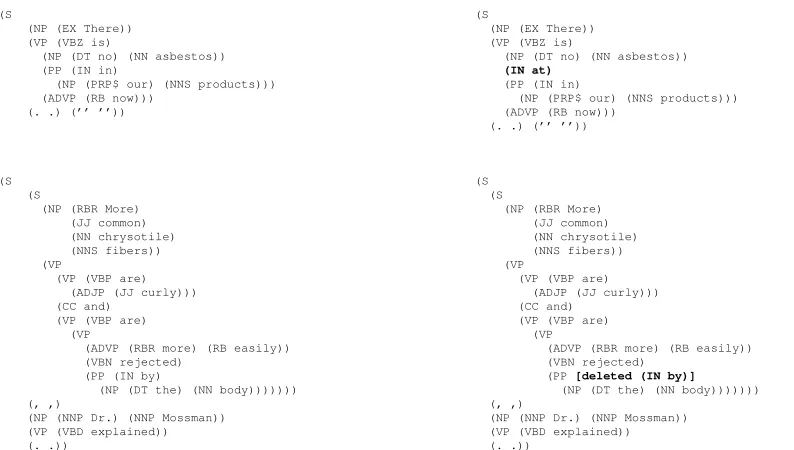
In Figure 1 we give examples of sentences with trees generated by insertion and deletion, and their grammatical counterparts.
3.2 Re-training of Parsers
In order to enable a parser to be able to parse un-grammatical sentences, we re-train a probabilis-tic parser on both grammaprobabilis-tical and ungrammati-cal corpora. This idea is adopted from Foster et al. (2008). By and large, we replicate the exper-iments conducted in Foster et al. (2008) with the exception that the parser used in our study is the Stanford Parser (Klein and Manning, 2003), cho-sen for ease of re-training.
In this first stage, we conduct five experiments to re-train the Stanford Parser to induce a more robust parser capable of parsing both grammati-cal and ungrammatigrammati-cal sentences. In the first three experiments, three models of parser are induced by training on three different sets of corpora — first on the original WSJ (PureWSJ); second on the noisy WSJ (NoisyWSJ); and third on both the orig-inal and noisy WSJ (PureWSJplusNoisyWSJ). We denote these three parser models as PureParser,
(S
(NP (EX There)) (VP (VBZ is)
(NP (DT no) (NN asbestos)) (PP (IN in)
(NP (PRP$ our) (NNS products))) (ADVP (RB now)))
(. .) (’’ ’’))
(S
(NP (EX There)) (VP (VBZ is)
(NP (DT no) (NN asbestos))
(IN at)
(PP (IN in)
(NP (PRP$ our) (NNS products))) (ADVP (RB now)))
(. .) (’’ ’’))
(S (S
(NP (RBR More) (JJ common) (NN chrysotile) (NNS fibers)) (VP
(VP (VBP are) (ADJP (JJ curly))) (CC and)
(VP (VBP are) (VP
(ADVP (RBR more) (RB easily)) (VBN rejected)
(PP (IN by)
(NP (DT the) (NN body))))))) (, ,)
(NP (NNP Dr.) (NNP Mossman)) (VP (VBD explained)) (. .))
(S (S
(NP (RBR More) (JJ common) (NN chrysotile) (NNS fibers)) (VP
(VP (VBP are) (ADJP (JJ curly))) (CC and)
(VP (VBP are) (VP
(ADVP (RBR more) (RB easily)) (VBN rejected)
(PP[deleted (IN by)]
(NP (DT the) (NN body))))))) (, ,)
(NP (NNP Dr.) (NNP Mossman)) (VP (VBD explained)) (. .))
Figure 1: Grammatical (left) and ungrammatical (right) versions of sentences, illustrating insertion errors (top) and deletion errors (bottom)
then evaluated against the three sets of WSJ (i.e.
PureWSJ, NoisyWSJ, and NoisierWSJ) using the labelled f-score measure.
The last two experiments can be viewed as the use of an integrated parser, in which each test sentence is parsed by two types of parser — one trained exclusively on grammatical data (i.e. PureParser) and the other trained on some ungrammatical data (i.e. either NoisyParser or
MixedParser). The best parse is selected by choos-ing the one with the higher parse probability. Hence,PureParseris integrated withNoisyParser
for the fourth experiment and with MixedParser
for the last experiment. (It should be noted that all trainings are performed on Section 2 to Section 21 while all testings are on Section 0.)
3.3 Sentence Classification
This second stage is the core of the present study where we experiment with production rules as fea-tures for sentence grammaticality classification. Apart from the parse probabilities returned to-gether with the parse trees, we extract the indi-vidual production rules (from either the gold stan-dard or the parse trees) and their corresponding rule probabilities (from parse trees) as classifica-tion features. The use of the gold standard is a kind of oracle, to assess the impact of parser inaccuracies. An example with a grammatical-ungrammatical pair is given in Figure 2. We ex-plore various feature selection metrics to obtain a
set of production rules for classifying grammatical and ungrammatical sentences.
Parse probability features For the feature class of parse probabilities, we perform similar proce-dures as in the last two experiments in the first stage. As before, each sentence (be it for train-ing or testtrain-ing) is parsed with two types of parser — PureParser and either NoisyParser or Mixed-Parser. The parse probability returned by each parser type is used as a classification feature. Therefore, there are only two feature values for this feature class — the parse probability from
PureParser and the parse probability from either
NoisyParserorMixedParser. A classifier consist-ing only of these two features is our baseline.
Production rule features We first parse the sen-tences (for both training and testing) by using the best performing parser induced from the five ex-periments in the first stage. Production rules are then extracted automatically from both the gold standard and the parser outputs. Various feature selection metrics are used to select a set of dis-criminative parse rules as classification features.1 The metrics we use are as follows (with r
repre-senting a production rule andca class, i.e.
gram-1
(ROOT [54.390] (S [54.288]
(NP [5.152] (EX [1.061] There)) (VP [44.906](VBZ [0.149] is)
(NP [31.167]
(NP [15.713] (DT [4.930] no) (NN [9.013] asbestos)) (PP [15.047] (IN [1.856] in)
(NP [12.787] (PRP$ [3.179] our) (NNS [4.923] products)))) (ADVP [3.552] (RB [3.224] now)))
(. [0.002] .) (’’ [0.014] ’’)))
(ROOT [62.603] (S [62.500]
(NP [5.152] (EX [1.061] There)) (VP[53.118] (VBZ [0.149] is)
(PP [39.890] (ADVP [20.095]
(NP [14.923] (DT [4.930] no) (NN [9.013] asbestos))
(IN [1.780] at))
(IN [1.564] in)
(NP [12.787] (PRP$ [3.179] our) (NNS [4.923] products))) (ADVP [3.552] (RB [3.224] now)))
(. [0.002] .) (’’ [0.014] ’’)))
Figure 2: Parser outputs for original (left) and insertion-error (right) variants, annotated with log proba-bilities for each production rule
matical or ungrammatical):
• Frequency(FREQ): We take thenmost frequently
occurring parse rules within the grammatical cor-pus and the ungrammatical corcor-pus, where n ∈
{50,100,2500}. Feature values are the relative
frequency of each parse rule within a sentence and also the binary value of their presence or absence.
• Ratio(RATIO): We take the ratio of the number of
occurrences of a parse rule in the grammatical cor-pus to the number of occurrences of that rule in the ungrammatical corpus. We pick the 50 parse rules with the highest ratio and another 50 parse rules with the lowest ratio as features. Feature values are of binary type.
• Mutual information(MI): We calculate the mutual information between a parse rule and each class (i.e grammatical and ungrammatical). The 100 parse rules with the highest mutual information are selected as features with binary-typed values. We adopt the formula from Yang and Pedersen (1997):
M I(r, c) = log Pr (r∧c)
Pr (r) Pr (c) (1)
• Information gain, version 1(IG-FREQ): We pick the 100 and 500 rules with the highest informa-tion gain as features. The formula is again adopted from Yang and Pederson (1997), withm= 2.
IG(r) = −Pm
i=1Pr (ci) log Pr (ci)
+ Pr (r)Pm
i=1Pr (ci|r) log Pr (ci|r)
+ Pr (¯r)Pm
i=1Pr (ci|r¯) log Pr (ci|¯r) (2)
• Information gain, version 2(IG-PROB): In addi-tion, we attempt a different way to calculate the in-formation gain of a parse rule, where the probabil-ity of each parse rulePr(r)is estimated based on
its rule probabilities extracted from the parse trees instead of its occurrence in the corpora. Hence, Pr(r)is the sum of all the parse probabilities of a
parse rule divided by the sum of the parse proba-bility of all the parse trees. All feature values are of binary type. The intuition is that it might not be particular production rules that are character-istic of grammaticality, but their probability: for example, ungrammatical parses might have more unlikely rules. As an illustration, the grammati-cal tree in Figure 2 (left) has log prob 44.906 at the highest VP node, while the ungrammatical tree (right) has log prob 53.118; notwithstanding the contribution of 1.780 from the insertion of the lex-ical item at, there are some unlikely production rules in this subtree of the ungrammatical tree.
• Bi-normal separation(BNS): Forman (2003) sug-gested that this feature selection metric can be competitive with information gain. The metric is defined as below, whereF(x)= cumulative proba-bility function of a normal distribution:
BN S(r, c) =F−1(Pr (r|c))−F−1(Pr (r|¯c)) (3)
Similarly, the 100 and 500 rules with the highest BNS scores are selected as classification features with binary-typed values.
Besides investigating these five feature selec-tion methods individually, we also explore the ef-fects of their combinations as well as the combi-nation with parse probabilities.
Training set The training set is a balanced set of grammatical and ungrammatical sentences. As mentioned in Section 3.1, the grammatical sen-tences are adopted from the PureWSJ, while the ungrammatical sentences are from theNoisyWSJ; both are based on Section 2 to Section 21. There are 79664 sentences in total for training.
Exp Parser PureWSJ NoisyWSJ NoisierWSJ 1 PureParser 85.61 78.42 72.64
2 NoisyParser 84.31 80.32 76.19
3 MixedParser 82.63 78.69 74.25
4 Pure-NoisyParser 85.39 80.43 76.40
5 Pure-MixedParser 85.49 80.04 75.53
Table 1: Parsing results (labelled f-score %) of five experiments on three versions of WSJ Section 0
and the second set is fromPureWSJand Noisier-WSJ; all are based on Section 0. The latter set is used to testify whether the degree of noisiness in the data would have any effects on the classifica-tion performance. There are 3840 sentences in to-tal for testing.
Classifiers A support vector machine (SVM) is used for all the classification tasks. We use the online SVM toolLIBSVM(Version 2.89), imple-mented by Chang and Lin (2001). All the classi-fications are first conducted under the default set-tings where the radial basic function (RBF) kernel is used. The kernel is further tuned to find the best pair of parameters (C, γ) for an optimal
classifi-cation model. 2 In addition to SVM, another ma-chine learner — logistic regression — is also ex-amined to study its effects on classification. Here, we use the logistic regression classifier with ridge regularization from WEKA (Version 3.6.1) (Wit-ten and Frank, 2005).
4 Results
4.1 Parsers
In Table 1, we present the parsing results of the five experiments conducted in the first stage where the intention is to induce a more robust parser that can handle ungrammatical sentences without com-promising its performance on grammatical ones.
The integrated parser in Experiment 4 — Pure Parserintegrated with Noisy Parser— is able to attain a relatively good parsing performance for ungrammatical data while at the same time main-taining its performance for grammatical data. This parser is therefore the one that was used for all the parsing tasks in the second stage.
2
As there is no significant difference between the classi-fication results prior to and after tuning, we only report the prior ones. In addition, no other kernels demonstrated better results than the RBF, so we omit these.
Feature PureWSJ-NoisyWSJ PureWSJ-NoisierWSJ
Parse Prob 65.42 74.19
Table 2: SVM results (accuracy %) with parse probabities as features on both NoisyWSJ and NoisierWSJ
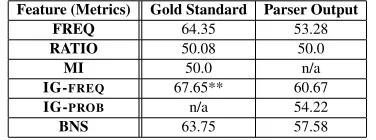
Feature (Metrics) Gold Standard Parser Output FREQ 64.35 53.28
RATIO 50.08 50.0
MI 50.0 n/a
IG-FREQ 67.65** 60.67
IG-PROB n/a 54.22
BNS 63.75 57.58
Table 3: SVM results (%) with parse rules as fea-tures on NoisyWSJ — based on top 100 rules from both gold standard and parser outputs
4.2 Classification 4.2.1 Parse Probabilities
For classification, by using just parse probabili-ties alone as features, we can see that a reasonably good accuracy is achievable (see Table 2). As ex-pected, for more noisy data, their ability to distin-gush grammatical sentences from ungrammatical sentences is even more prominent — comparing the classification accuracy of 65.42% (NoisyWSJ) with 74.19% (NoisierWSJ). This classifier is our baseline for the rest of the sentence grammatical-ity classifications utilising production rules.
4.2.2 Production Rules
As mentioned in Section 3.3, we first examined the production rules extracted from both the gold standard and the parser outputs with five different feature selection metrics. The classification ac-curacies achieved by using the top 100 rules for the testing of the less noisy ungrammatical data —NoisyWSJ— are shown in Table 3.
It appears that standard information gain
(IG-FREQ) outperforms the rest of the selection met-rics and it is the only one that performs better than parse probabilities if the gold standard parse trees were available (with this result being statistically significant with 95% confidence).3 It is, however, worth noting that information gain which utilises rule probabilities (IG-PROB) does not turn out to be a better discriminant as compared to informa-tion gain (IG-FREQ). Bi-normal separation and
frequency are the next potential candidates; but the former is a better choice in the absence of the gold standard. Ratio and mutual information perform no better than chance.
3
Feature (Metrics) n= 200 n= 500 n= 2500
FREQ 54.84 n/a 54.04
MI n/a 50.0 n/a
IG-FREQ n/a 58.72 n/a
BNS n/a 61.93 n/a
Table 4: SVM results (%) with parse rules as fea-tures on NoisyWSJ — based on larger numbers of rules from gold standard
Feature (Metrics) Gold Standard Parser Output IG-FREQ 75.65* 63.44
BNS 71.2 61.51
Table 5: SVM results (%) with parse rules as fea-tures on NoisierWSJ — based on top 100 rules from both gold standard and parser outputs
Table 4 presents results showing the impact of using more production rules as selected by the var-ious metrics; and the results were all poorer than using just 100 rules. In view of this poorer re-sult, we subsequently made use of only the top 100 rules for all the subsequent classifications.
Next, we performed testing on more noisy data — NoisierWSJ — to see whether the degree of noisiness in data would have any effects on the classification. Not surprisingly, the more noisy data appears to be easier to be distingushed from the grammatically well-formed data (see Table 5). Similarly, standard information gain (IG-FREQ) may perform better than parse probabilities if the gold standard were available (although this is only marginally statistically significant at 90% confi-dence.) We only examined two metrics here — IG-FREQ and BNS — as these are the two most
competitive ones.
4.2.3 Combinations of Features
From the tables above, it is observed that using production rules by itself for sentence grammat-icality classification is generally not better than using parse probabilities alone. We therefore at-tempted to combine the various metrics for parse rules as well as with the parse probabilities. Again, we use only IG-FREQand BNS.
Table 6 shows that combining various metrics for production rules does not lead to any sig-nificant improvement in classification accuracy
Features IG-FREQ+BNS IG-FREQ+FREQ BNS+FREQ
NoisyWSJ 64.76 66.38 63.98
Table 6: SVM results (%) with the combinations of metrics as features on NoisyWSJ — based on top 100 rules from gold standard
Features NoisyWSJ NoisierWSJ IG-FREQ(gold standard)
66.59*** 77.58*** + Parse probabilities
IG-FREQ(parser output)
65.6 75.31*** + Parse probabilities
BNS (gold standard)
66.85*** 77.66*** + Parse probabilities
BNS (parser output)
66.02* 75.6*** + Parse probabilities
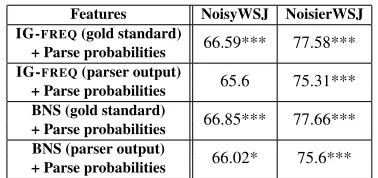
Table 7: SVM results (%) with the combinations of parse rules (IG-FREQand BNS) and parse prob-abilities as features
Feature (Metrics) NoisyWSJ NoisierWSJ IG-FREQ(gold standard) 67.65 75.65
IG-FREQ(parser output) 60.83 63.41
BNS (gold standard) 63.83 71.28
BNS (parser output) 57.97 62.79
Table 8: Logistic regression results (%) with parse rules as features — based on top 100 rules from both gold standard and parser outputs
(i.e. their combinations still do not perform bet-ter than using parse probabilities alone). However, combining parse rules with parse probabilities as shown in Table 7 does demonstrate some mod-est improvement of 1.6% on average in the overall classification accuracy. With either gold standard or parser-derived production rules, combinations on more noisy data (NoisierWSJ) are statistically better than just using parse probabilities alone (all marked with *** are significant at 99% confidence level). This is also true on the less noisy data (NoisyWSJ), but only for gold standard production rules.
4.2.4 Effects of Classifiers
As mentioned in Section 3.3, we also examined the effects of using a different classifier — logis-tic regression. It appears that logislogis-tic regression performs on par with SVM as seen in some of the results for logistic regression presented in Table 8.
5 Discussion
(ROOT [84.000] (S [83.897]
(NP [29.684]
(NP [12.409] (DT [2.450] The) (NN [8.188] turmoil)) (PP [16.908] (IN [1.856] in)
(NP [14.648] (NN [6.372] junk) (NNS [4.550] bonds)))) (VP [51.379] (MD [2.484] may)
(ADVP [36.195] (RB [7.225] last) (PP [25.506] (IN [2.250] for)
(NP [22.367] (NNS [3.946] years) (, [0.000] ,) (NNS [4.558] investors)
(CC [0.162] and) (NNS [5.318] traders)))) (VP [7.861] (VB [4.808] say))) (. [0.002] .)))
(ROOT [92.809] (S [92.686]
(NP [37.595]
(NP [12.467] (DT [2.568] The) (NN [8.058] turmoil)) (PP [16.972] (IN [1.869] in)
(NP [14.666] (NN [6.290] junk) (NNS [4.654] bonds)))
(VBD [1.270] was)) (VP [51.659] (MD [2.518] may)
(VP [35.837] (VB [6.911] last) (PP [25.929] (IN [2.299] for)
(NP [22.908] (NNS [3.981] years) (, [0.000] ,) (NNS [4.578] investors)
(CC [0.163] and) (NNS [5.287] traders)))) (VBZ [4.723] say))
(. [0.002] .)))
Figure 3: Example of rule selected by IG-FREQ
Feature (Metrics) Prod Rule Gram Ungram Information Gain NP→DT DT JJ NN 2 225
(IG-FREQ) VP→TO TO VP 0 89 PP→IN IN S 0 73 PP→NN IN NP 0 70 NP→NP PP VBD 0 54
Bi-normal PP→IN IN NP 105 1858
Separation NP→NP IN PP 6 275
(BNS) VP→VBZ VBZ NP 0 157 NP→DT DT NN 2 531 S→NP VBD VP . 0 242
Ratio NP→NP , NP , VBD 0 48 NP→VBP DT JJ CD 0 15 PP→CD IN NP 0 9 VP→VB VP PRP 0 9 S→CC CC NP VP 0 48
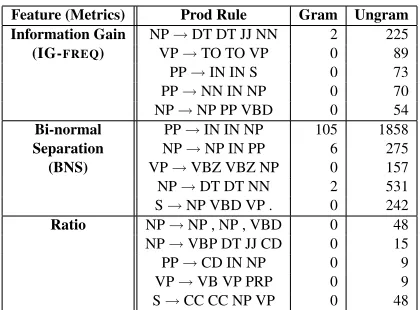
Table 9: Examples of parse rules chosen by vari-ous metrics (IG-FREQ, BNS, and RATIO)
a slightly bigger difference on the noisy data set, with f-scores of 78–80% vs 85–90%.
Analysis of features We admit to some surprise that looking in detail at production rules did not perform better in general. We examined some of the chosen features under each metric, and these do appear to be strongly characteristic of ungram-matical parses; in particular, there are several in-stances where probabilities used in IG-PROB
ap-pear in our inspection to differ quite noticeably between grammatical and ungrammatical alterna-tives. We present the top 5 for each of IG-FREQ, BNS and RATIO in Table 9, along with the num-ber of counts in the grammatical versus ungram-matical training corpora. Figure 3 shows an exam-ple of one of these rules in a corpus instance.
The problem may be due to feature vector spar-sity; looking at other types of cross-sections of parse trees, not only horizontal production rules, (as is done in the parse reranking approach of Charniak and Johnson (2005)), may help with this.
Substitution rules Inspecting the features above, it appears to be the case that substitution cases are hard to detect because the parser is too robust. The way that the Stanford parser
handles cases of substitution, even where there is a significant change of part of speech (e.g. if for
is, an example generated in the ungrammatical corpus), results in a parse that is identical to the original grammatical one: the parser is not troubled at all by the ungrammaticality. Supple-menting production rules and parser probabilities by n-grams is likely to improve this.
Feature selection metrics It was not entirely surprising that mutual information performed poorly: it tends to select rare instances (Manning and Schutze, 1999) and often does poorly in classi-fication tasks (Forman, 2003). Also as per Forman (2003), IG and BNS performed well. Interestingly, IG perform better in every case with rules alone, while BNS performed better in every combination of rules with parse probabilities, which was over-all better than rules alone.
6 Conclusion
The present study has confirmed that parse prob-abilities are good discriminators for judging the grammaticality of sentences. The idea of exploit-ing details of the parses in the form of production rules, combined with the parse probabilities, leads to some modest improvement to the overall classi-fication performance.
Acknowledgments
The authors would like to acknowledge the sup-port of ARC Linkage Grant LP0776267. Much gratitude is due to Jennifer Foster for the erroneous version of WSJ.
References
Chris Brockett, William B. Dolan, and Michael Ga-mon. 2006. Correcting ESL errors using phrasal SMT techniques. InProceedings of the 21st Inter-national Conference on Computational Linguistics and the 44th Annual Meeting of the Association for Computational Linguistics, pages 249–256, Sydney, Australia.
Chih-Chung Chang and Chih-Jen Lin, 2001. LIB-SVM: a library for support vector machines. Software available athttp://www.csie.ntu. edu.tw/˜cjlin/libsvm.
Eugene Charniak and Mark Johnson. 2005. Coarse-to-fine n-best parsing and MaxEnt discriminative reranking. InProceedings of the 43rd Annual Meet-ing on Association for Computational LMeet-inguistics, pages 173–180, Ann Arbor, Michigan.
Markus Dickinson. 2010. Generating learner-like morphological errors in Russian. In Proceedings of the 23rd International Conference on Compu-tational Linguistics (COLING’10), pages 259–267, Beijing, China.
George Forman. 2003. An extensive empirical study of feature selection metrics for text classification. Journal of Machine Learning Research, 3:1289– 1305.
Jennifer Foster and Oistein Andersen. 2009. Gen-ERRate: Generating errors for use in grammatical error detection. InProceedings of the Fourth Work-shop on Innovative Use of NLP for Building Edu-cational Applications, pages 82–90, Boulder, Col-orado.
Jennifer Foster, Joachim Wagner, and Josef van Gen-abith. 2008. Adapting a WSJ-trained parser to grammatically noisy text. In Proceedings of ACL-08: HLT, Short Papers, pages 221–224, Columbus, Ohio.
Jennifer Foster. 2005. Good Reasons for Noting Bad Grammar: Empirical Investigations into the Pars-ing of Ungrammatical Written English. Ph.D. the-sis, Department of Computer Science, Trinity Col-lege, University of Dublin.
Jennifer Foster. 2007. Treebanks gone bad: Parser evaluation and retraining using a treebank of un-grammatical sentences. International Journal of Document Analysis and Recognition, 10(3–4):129– 145.
Michael Gamon, Anthony Aue, and Martine Smets. 2005. Sentence-level MT evaluation without ref-erence translations: Beyond language modeling. In European Association for Machine Translation (EAMT’05), pages 103–111, Budapest, Hungary.
Michael Gamon, Jianfeng Gao, Chris Brockett, and Re Klementiev. 2008. Using contextual speller techniques and language modeling for ESL error correction. In Proceedings of the Third Interna-tional Joint Conference on Natural Language Pro-cessing (IJCNLP’08), pages 449–456, Hyderabad, India.
Na-Rae Han, Joel Tetreault, Soo-Hwa Lee, and Jin-Young Ha. 2010. Using an error-annotated learner corpus to develop an ESL/EFL error correction sys-tem. InProceedings of the Seventh Conference on International Language Resources and Evaluation (LREC’10), pages 763–770, Valletta, Malta.
Dan Klein and Christopher D. Manning. 2003. Ac-curate unlexicalized parsing. InProceedings of the 41st Annual Meeting of the Association for Com-putational Linguistics, pages 423–430, Sapporo, Japan.
Christopher Manning and Hinrich Schutze. 1999. Foundations of Statistical Natural Language Pro-cessing. MIT Press.
Andrew Mutton, Mark Dras, Stephen Wan, and Robert Dale. 2007. GLEU: Automatic evaluation of sentence-level fluency. In Proceedings of the 45th Annual Meeting of the Association of Computational Linguistics, pages 344–351, Prague, Czech Repub-lic.
Daisuke Okanohara and Jun’ichi Tsujii. 2007. A dis-criminative language model with pseudo-negative samples. In Proceedings of the 45th Annual Meet-ing of the Association of Computational LMeet-inguistics, pages 73–80, Prague, Czech Republic.
Guihua Sun, Xiaohua Liu, Gao Cong, Ming Zhou, Zhongyang Xiong, John Lee, and Chin-Yew Lin. 2007. Detecting erroneous sentences using automat-ically mined sequential patterns. InProceedings of the 45th Annual Meeting of the Association of Com-putational Linguistics, pages 81–88, Prague, Czech Republic.
Joachim Wagner, Jennifer Foster, and Josef van Gen-abith. 2009. Judging grammaticality: Experi-ments in sentence classification. CALICO Journal, 26(3):474–490.
Ian H. Witten and Eibe Frank. 2005. Data Mining: Practical Machine Learning Tools and Techniques. Morgan Kaufmann, 2 edition.