I d e n t i f y i n g
t h e C o d i n g S y s t e m a n d L a n g u a g e
o f O n - l i n e D o c u m e n t s o n t h e I n t e r n e t
Gen-itiro KIKUI
N T T I n f o r m a t i o n a n d C o m m u n i c a t i o n S y s t e m s L a b o r a t o r i e s 1 - 2 3 5 6 T a k e , Y o k o s u k a - s h i
K a n a g a w a 2 3 8 - 0 3 , J A P A N kikui~nttnly, i sl. ntt. j p
Abstract
This paper proposes a new algorithm that simultaneously identifies the cod- ing system and language of a code string fetched from the Internet, especially World-Wide Web. The algorithm uses statistic language models to select the correctly decoded string as well as to de- termine the language. T h e proposed al- gorithm covers 9 languages and 11 cod- ing systems used in Eastern Asia and Western Europe. Experimental results show that the level of accuracy of our al- gorithm is over 95% for 640 on-line doc- uments.
1 Introduction
Recent advances in information infrastructure have made an enormous number of on-line docu- ments accessible. A notable example is the explo- sive growth of World-Wide W e b ( W W W ) involv- ing more than 10 million documents.
Accessing and using such a huge number of on- line documents require intelligent document pro- cessing such ~ content-based search, categoriza- tion, information extraction, and machine trans- lation. Most of these processes assume that ~ doc- uments are correctly decoded and the language is known. For documents on the W W W , however, these assumptions do not hold. This is because each language community uses its own coding sys- tem which is optimal for internal communication but is not appropriate for exchanging information with those outside at community.
A fundamental solution is to develop interna- tional standards for an internationalized coding system and language representation. In fact, there is active discussion on the international coding standards(Yergeau et al., 1995)(Nicol, 1995)(Uni- code, 1994), and the language representation on the WWW(Unicode, 1994). However, it will re- quire several years before most of the documents are encoded into a unique well-defined coding sys- tem.
A realistic approach, which also goes together with the above 'fundamental' approach, is to de- velop a more intelligent module t h a t can estimate which coding system and language used for each on-line document on the current W W W .
Automatic identification of the coding system is achieved in communities where a limited number of coding systems are used. For example, (Lunde, 1993) presents an algorithm for Selecting one of three coding systems for Japanese texts (UJIS, SJIS, and JIS) T h e algorithm, however, is not applicable to international domain where a lot of other coding systems are potential candidates.
Automatic language identification has been dis- cussed in the field of document processing. Sev- eral statistic models have been tried including using the n-g~am of characters (Cavnar, 1994), diacritics and special characters (Beesley, 1988), and using the word unigram with heuristics (lien- rich, 1989). Among these methods, the result by (Cavnar, 1994) shows the best accuracy over 95%. (Giguet, 1995) achieved over 99% accuracy by us- ing a rule-based (i.e., non-statistic) method.
These methods, however, cannot handle East- Asian languages, because they presuppose that in- put texts are easily segmented into words, which does not hold true in these languages. Another problem is that it presupposes that the input doc- ument is correctly decoded.
Sibun and Penelope (Penelope and Sibun, 1994) proposed a method of determining the language of a text image. T h e problem tackled by them is similar to ours, in the sense t h a t the input is not a unique character string but a string that po- tentially corresponds to several different character strings. Their method, however, can not directly applied to our problem.
This paper presents an algorithm that identi- fies the coding system and the language of a given text. T h e algorithm is an application of an auto- matic language identification using statistic lan- guage models. It covers 11 coding systems and 13 languages used in East-Asian countries as well as Western-European countries.
The next section describes the problem. Section 3 introduces our algorithm. Se,ction 4 and Section
5 describes an example and the experimental re- suits respectively.
Problems in D e c o d i n g and
Identifying Languages on t h e
W W W
2.1 Brief Explanation of Character Coding Systelns
In a communications network, characters are rep- resented as numbers, or a sequence of numbers. A character coding system specifies the m a p p i n g between characters and numbers. A coding sys- t e m consists of a character set and an encoding S~]te~ne.
A character set is a set of characters collected to represent texts in a certain language community. For example, JIS-X0208-1983 (referred to ms "JIS character set" in this paper) is a character set for encoding texts (mainly) in Japanese. Each char- acter in a character set has a unique identification number. [t should noticed t h a t the same n u m b e r m a y a p p e a r in different character sets.
An encoding sdtema m a p s each element of a character set into a (sequence of) number(s) t h a t is used in communication networks. T h e simplest encoding scheme directly uses the identification n u m b e r of a character set for communication.
Some encoding schemes are designed to encode texts t h a t contain characters from two or more character sets. For example,the encoding scheme for JIS coding s y s t e m (ISO-2022-jp) uses escape sequences to indicate changes of character set in the code string in the following way:
1. "ESC $ B" shows the beginning of J[S char- acter set.
2. "ESC ( B" shows at the beginning of ASCII character set.
2.2 A m b i g u i t y in D e t e r m h l l n g Character Coding S y s t e m
For historical reasons, documents on the cur- rent W W W are encoded in various coding sys- tems. For example, servers in Western-Europe normally use [SO-8859-1 (ISO-LATIN~ 1), whereas most UNIX servers in J a p a n encode text using J a p a n e s e EUC (Extended Unix Code). T h e prob- lem is t h a t different coding systems are applicable to the same code-string.
T h e fundamental solution is to have everyone use a unique coding s y s t e m t h a t can handle all the characters in the world. ISO-2022 is one such cod- ing systems. This system assigns a unique identi- fier to every registered character set in the world and specifies escape sequences for switching one character set to another. Although m o s t of the local coding systems in the world are 'compati- ble' with ISO-2022, m a n y of t h e m lack escape se- quences which are not necessary for choosing the
correct character set in the local domain but are necessary in the international domain.
Therefore, the sender should give or the receiver should infer with w h a t coding s y s t e m the received coded sequence is encoded.
One approach is to transfer the name of the coding s y s t e m with the u p p e r level protocols. For example, the l n t e r n e t mail protocol can transfer the coding system with which the message is en- coded. However, on the W W W , active discussion still continues on the W W W as to how to deliver the coding system.
Another approach is to uncover the coding sys- t e m from the received b y t e code string. If the potential candidates for the code system are lim- ited, the correct coding s y s t e m m a y be inferred by using simple p a t t e r n matching. For example, the byte code contains the p a t t e r n "ESC $ B" then it must be encoded with IS()-2022 and include Japanese characters. IIowever, in international domain, it is difficult or impossible to specify the coding s y s t e m with simple p a t t e r n matching. For example, J a p a n e s e EUC and Korean EUC cannot be discriminated by this simple method, because most of their code values overlap 1.
In s u m m a r y , a more sophisticated method is re- quired to identify the coding s y s t e m from the con- tent of the code string.
2.3 A m b i g u i t y in D e t e r m i n i n g Language
Most text processing systems have language- dependent components such a.s rules or dictionar- ies. Thus, it is crucial to know in what language the target d o c u m e n t is written in order to choose the appropriate s y s t e m or language specific rules and dictionaries.
If we restrict ourselves to H T M L documents, then explicit language lagging, which represents the language of the text body, will be introduced in a future version of H T M L specifications. This, however, does not handle multiple languages in one document. Moreover, there are a lot of non- H T M L documents on the W W W .
If the character set used in the text is known, it might be good clue for identifying the lan- guage because some character sets strongly sug- gest which language(s) was used. For example, if a document consists of characters in the J IS character set, the d o c u m e n t m u s t be written in Japanese. However, this is not always the case. One r e , o n for this is t h a t the character set of a text is sometimes ambiguous due to the. decoding problem described above. Another reason is that some character sets are designed to cover multiple languages (e.g., ISO-8859-1 for several Western- European languages). Sometimes a character set is used in a language t h a t is not the p r i m a r y candi- date suggested by the character set. For example, a document containing only US-ASCII characters,
which suggests the document is in English, may be a German document in ASCII-format (e.g., 6 is written as oe ).
For this reason, it is necessary to identify the language from the content of the given character string.
3 O u r A l g o r i t h m
Our basic idea is to use statistic language models to select the correctly decoded string as well as to determine the language. The idea comes from the observation that a human can distinguish whether or not a text is written in the language s/he can read. If the text is judged to be written not in the language the person can read, then it is written in another language or decoded with an incorrect coding system.
In our algorithm, the human intuition on his familiar language is realized by a statistic-based module which calculates how likely a text to be from a specific language.
3.1 T h e S c o p e o f o u r A l g o r i t h m
The current version of our algorithm can handle the following 11 coding systems and 9 languages.
• coding systems
7 b i t C o d i n g ISO 646 USA (ASCII), JIS Code(ISO-2022-jp), KS C 5601-1992, GB 2312-80, ISO-2022-int
8 b i t C o d i n g ISO-8859-1,
EUC-GB(Simplified Chinese), EUC-KS, EUC-JIS(UJIS), BIG5(Traditional Chi- nese), Shift MS(MS Kanji code)
E n t i t y R e f e r e n c e w i t h A S C I I
entity references(e.g.,
5 is represented as "Ö") for the [SO-8859 characters defined in H T M L (or SGML) specifica- tions.* languages
E u r o p e a n English, French, German, Span- ish, Italian, Portuguese
E a s t A s i a n Chinese, Korean, Japanese
3.2 O u t l i n e o f t h e A l g o r i t h m
Our algorithm consists of the following two major steps.
S t e p 1 This step divides the given code string into East-Asian part (i.e., sub-strings con- sisting of East-Asian characters) and the rest (i.e., European) part.
S t e p 2 This step decodes each part and identifies its language(s).
The following two subsections describe the above two steps in detail.
procedure
extract_ca.string(code-string)
~ Loop 1For each
csys
inca_coding_systems
doif
(ca_string(code-string, csys))
then push(get_ca_string(code-string, csys),
ca_string_list)
endif end
# #
Loop 2For each csys
sort_byjength(ea~string_list )
do(score, lang) +-
identify_language( ea_string )
if
(score > threshold)
then return(lang, ea_strinq)
endifend return nil
Figure 1: Extraction of Eastern-Asian characters.
3.3 D i v i d i n g C o d e - S t r i n g
If the give code string contains escape code se- quences defined in ISO-2022 or its variants, East- Asian character strings are easily extracted be- cause East-Asian characters are explicitly marked by escape sequences in the string.
If the given code string does not contain such escape sequences, the Eastern-Asian part is iden- tified by the procedure shown in Figure 1. The procedure consists of the following two loops.
• Loop 1
If a coding system is determined, it is easy to extract Eastern-Asian characters. For ev- ery coding system that can handle Eastern- Asian characters, the first loop tries to ex- tract Eastern-Asian characters by using the coding system.
The function e a _ s t r i n g takes a code-string and (the name of) a coding system. It ex- tracts Eastern-Asian character-strings, pre- supposing that the given code string has been encoded with the given coding system
(csys).
This function can be realized by simple pat- tern matching. For example, if we presup- pose that the given code-string is encoded with EUC-JIS, then the adjacent two bytes that match [A1H-FEH]{2}, a two byte se- quence whose values ranges from A1 to FE (in hexadecimal representation), correspond to a Japanese (or JIS) character.Table 1 shows examples of regular expression patterns in our system 2
2More information oll Eastern-Asian code values are availM)le in (Lunde, 1993)
Table 1: Patterns for Extracting Eastern-Asian Characters (sample)
Char-set ( C o d i n g ) P a t t e r n GB (EUC-GB) [A1-F~;]{2} KS (EUC-KS) [A1-FE]{2} JIS (EUC-J[S) [A1-FF]{2},
8F[A1-FE]{2}
BIG5 (Bigh) [g 1-FE] [40-7E,A 1-FI';]
If a non-empty string is returned by ea_slring, it is decoded with the presupposed coding system and registered in
ca_string_list.
• Loop 2
T h e second loop tries to identify the lan- guage of each East--Asian character-string in
ca_string_list.
Each Eastern-Asian string is passed to the language identification routine in the descen- dent order of its Length. T h e language iden- tification routine, described in Section 3.4, takes a character string and returns the most likely language and the score of likelihood. If the score is larger than a predetermined threshold, the loop terminates and returns the language and the score.
If the score of every Eastern-Asian string does not exceed the threshold, then the loop re- turns nil, which indicates that no Eastern- Asian characters are involved in the code string.
After the Eastern-Asian part is identified, the remainder is classified into the European part.
3.4 I d e n t i f y i n g t h e L a n g u a g e
T h e language of a text is identitied by the follow- ing three steps.
1. Selecting possible languages for the given coding system
T h e coding system (or the character set(s)) of a text is loosely related to the language of the text. For example, a document encoded with US-ASCII is not written in Korean. We made heuristic rules to map a coding system to possible languages.
2. Calculating the 'likelihood' of the decoded string for each language.
For each language, this step calculates how likely the decoded string is to be from that language by comparing the string with the statistic model of the language.
3. Selecting the language with the highest like- lihood
This step compares likelihood scores, then re- turns the language with the highest likelihood score.
The second step is the most important. Our system uses a unigram model }'or both Western- European languages and East-Asian languages, but the models for Western-European languages and the models for the East-Asian languages have different unigram units.
3.4.1 L i k e l i h o o d S c o r e f o r
W e s t e r n - E u r o p e a n l a n g u a g e s
In order to distinguish Western-European lan- guages, we applied a m e t h o d proposed by Cavnar (Cavnar, 1994). We assign a class name for each word. The class name of a word longer than n characters is the concatenation of "X-" and the last n characters of the word. If the word is not longer than n characters, the class name is the word itself. For example, if n = 4, then class names of "beautiful" and "the" are
X-iful
andthe
respectively.Let
T E X T
be the set of words in a text, then the likelihood of T E X T with regard to language I is given as tile following P(7'EXT", l)=
II
P(c;, 0
w E T E X Twhere P(Cw, l) is the unigram probability of C~ in language l , and (hw is the class name of the word w.
P(C~, l)
is estimated from text corpora in lan- guage I.3.4.2 L i k e l i h o o d S c o r e f o r E a s t - A s i a n l a n g u a g e s
As compared with Western-European lan- guages, East-Asian languages have the following properties:
1. A large number of characters
East-Asian languages use over 3,000 ideo- graphic or combined characters. A charac- ter is normally encoded with two (or more) bytes.
2. No Explicit Word Boundaries
in East-Asian languages, there are no explicit word delimiters (corresponding to spaces in English) in a sentence. We cannot use word- based language models.
For East-Asian languages, we use a character unigram, instead of a word unigram, to model a language. Formally,
r / r • r T
P(.
F xz,
0
1-[
charE'I'EXT
where
P(ehar, l)
is the unigram probability ofchar
in language l .4 E x a m p l e
,.J-IS
Figure 2: Decoded strings
b8c0 b 8 e c b c b l cacc a4ce c a r d c b a l 0a49 6465 6e74 6966 7969 6e67 2074 6865 204c 616e 6775 6167 650a
T h e string is first divided int Asian and Eu- ropean parts. Since there is no escape sequence, which begins with " l b " , the procedure in Section 3.3 is applied.
T h e division procedure first tries to extract Eastern-Asian characters from the given string. T h e first 14 bytes, from b8 to a l , match with ev- ery p a t t e r n in Table 1. This means t h a t all the four coding systems are potential candidates and t h a t they e x t r a c t the same Asian character part.
This p a r t is decoded with each coding system. Result strings are shown in Figure 2.
Next, the statistic-based language identification is applied to each decoded string,
Table 2 shows the score ( = p r o b a b i l i t y ) of each character as regards to the language t h a t pro- duced the highest likelihood (i.e., average score). For example, the second column shows the score of each character as regards to Chinese (zho) when the input code string is decoded with E U C - G B . This implies t h a t Chinese(zho) is the most likely language if we presuppose the original string is encoded with E U C - G B .
Table 2: Likelihood scores of characters of Asian p a r t
char. SCORES(log prob.)[lang]
(JIS) GB[zho] KS[kor] J[S~pn] BIG5[zho] 1 ( ~ ) -11.05 -15.51 -7.25 -12.62 2 ( ~ ) -11.15 -15.51 -7.86 -10.86 3(~I~) -8.47 -7.69 -8.68 -12.42 4(ZU) -11.45 -15.51 -7.71 -15.51 5(¢3) -15.51 -15.51 -3.40 -7.50
Ave. -11.06 -14.39 -6.9 -12.64 zho=Chinese, k o r = K o r e a n , j p n = J apanese
T h e b o t t o m row shows t h a t the highest aver- age score is obtained when the input is decoded with E U C - J [ S and the language is Japanese(jpn). Since this score exceeds the threshold (-10), the Eastern-Asian p a r t is confirmed to be J a p a n e s e string encoded with EUC-JIS.
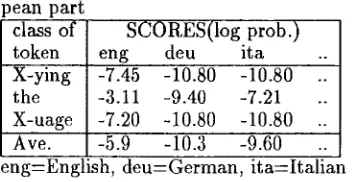
T h e remaining part is decoded into "Identify- ing the Language" and sent to European language
identifier. Table3 gives scores of tokens as regards to three languages.
Table 3: Likelihood scores of characters of Euro- pean part
class of
token ..
X-ying -7.45 -10.80 -10.80 .. the -3.11 -9.40 -7.21 .. X-uage -7.20 -10.80 -10.80 .. Ave. -5.9 -10.3 -9.60 ..
SCORES(log prob.)
eng deu ita
eng=English, d e u = G e r m a n , i t a = I t a l i a n
In this table, English(eng) is the most plausible language for European part with sufficient score.
The final result is easily obtained by combining results of the Asian and the European parts.
5 E v a l u a t i o n a n d D i s c u s s i o n
5.1 D a t a
For evaluation purposes, we collected a set of doc- uments on the W W W . Each document was man- ually assigned a correct language name. If a docu- ment contained more than one Western-European languages, a language t h a t covered more t h a n 80% of the d o c u m e n t was chosen as the correct language. Documents without the correct lan- guage (i.e., documents without the unique main language) were discarded. T h e same process was applied to East-Asian parts of documents.
The remaining documents were divided into 700 training documents and 640 test documents.
5.2 I d e n t i f y i n g W e s t e r n - E u r o p e a n l a n g u a g e s
Table 4 shows the confusion m a t r i x for the Western-European language results. T h e columns correspond to the o u t p u t s from the system, and the rows correspond to the correct answers. T h e value of n is set to 4, which gives the fewest num- ber of errors for the training set.
The error rate is 4.8%. Error occurs when the document is not a normal text (e.g., computer programs, a list of proper names or network ad- dresses, etc. ).
The result shows t h a t our m e t h o d achieved the level of correctness equivalent to the previous methods t h a t presuppose correctly decoded char- acter strings (Cavnar, 1994).
5.3 I d e n t i f y i n g E a s t - A s l a n l a n g u a g e s
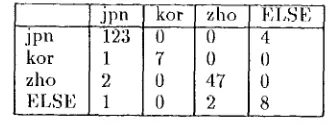
Table 5 shows the confusion m a t r i x for the East- Asian language results. T h e m a t r i x shows t h a t the system performs fairly well also for East-Asian languages.
The error rate is 4.6%. Most errors occur when the document includes only a few East-Asian char- acters. There are m a n y documents which are writ- ten mostly in English but only proper names, es-
[image:5.596.321.501.121.212.2] [image:5.596.89.315.515.632.2]Table 4: Confusion matrix for Western-European languages deu eng esl fra ita por ELSE
deu 51 2
eng 178 1 6
esl 1 23
ffa 90
ita 3 1
por 6
ELSE 1 8 1 70
deu=German, eng=English, esl=Spanish, fra=French ita=ltalian, por= Portuguese
pecially people names and organization names, are written in Asian characters.
Table 5: guages
Confusion matrix for East-Asian lan-
jpn kor zho EI,SE
jpn 123 0 0 4
kor 1 7 0 0
zho 2 0 47 0
ELSE 1 0 2 8
5.4 D i v i d i n g t h e W e s t e r n - E u r o p e a n p a r t a n d t h e E a s t - A s i a n p a r t
As far ~ the above experiments are concerned, there is no confusion between Western-European part and the East-Asian part.
6 C o n c l u s i o n
This paper proposed an algorithm for simultane- ously identifying the coding system and the lan- guage of a given code-string. It handles three East-Asian languages as well as six Western- European languages with a high level of accuracy. The algorithm uses statistic language models to select the correctly decoded string ms well as to determine the language. Since the algorithm uses statistic language models, it is robust and easily extendible to other languages.
The algorithm is implemented in a cross-lingual search engine for WWW pages which has a lan- guage index (i.e., WWW pages are indexed by their languages).
We intend to elaborate the algorithm so that it can identify languages in multi-lingual text, be- cause many documents on the WWW are multi- lingual.
Acknowledgment
The author express his g, atitude to Yoshihiko IIaya,shi and Seiji Suzaki for the comments on an early version of the paper. The comments by anonymous reviewers of Coling 96 helped to im- prove the paper.
R e f e r e n c e s
Beesley, Kenneth R., "Language Identifier: a Computer Program for Automatic Natural Lan- guage Identification of On-line 'l~xt", Language at Crossroads: Proceedings of the 29th Annual Conference of the American rlkanslators Asso- ciation, October 1988, pp 47-54.
Cavnar, William B. and Trenkle, John M., "N- gram Bmsed Text Categorization, Proceedings of the Third Annual Symposium on Document Analysis and Information Retrieval", April
1994, pp 161 -169.
Giguet, Emmanuel, "Multilingual Sentence Cat- egorization according to Language", Proceed- ings of the EACL95 SIGDAT Workshop, Octo- ber 1995.
Henrich, Peter, "Language Identification for the Automatic Grapheme-to-Phoneme Conversion of Foreign Words in a German Text-to-Speech System", t'roceedings of Eurospeech 1989, September 1989, pp 220-223.
Lunde, Ken, "Understanding Japanese Infor- mation Processing", O'Reilly and Associates, [nc, 1993, Japanese translation "Nihongo~Joho- Shori" , April 1995
Nieol, Gavin T., "The Mutiliungual World Wide Web"
httpl//fuzine.mt.cs.cmu.edu/mlm/lycos_ home.html
Sibun, Penelope, and Spitz, A.Lawrence, "Lan- guage Determination: Natural Language Pro- cessing from Scanned Document Images" Pro- ceedings of ANLP 94, October 1994, pp 15-21. Unicode Inc. "The Unicode Standard"
http://www.stonehand.com/unicode/standard.html Yergeau, F., Nicol, G., Adams, G., and Duerst,
[image:6.596.167.428.75.196.2] [image:6.596.93.258.284.346.2]