Enhancing Active Learning for Semantic Role Labeling
via Compressed Dependency Trees
Chenhua Chen, Alexis Palmer, and Caroline Sporleder Computational Linguistics and Phonetics
Saarland University, Saarbr¨ucken, Germany
[email protected], {apalmer, csporled}@coli.uni-sb.de
Abstract
This paper explores new approaches to ac-tive learning (AL) for semantic role label-ing (SRL), focuslabel-ing in particular on com-bining typical informativity-based sam-pling strategies with a novel measure of representativeness based on compressed dependency trees (CDTs). In essence, the compressed representation encodes the target predicate and the key dependents of the verb complex in the sentence. We first present our method for producing CDTs from the output of an existing dependency parser. The compressed trees are used as features for training a supervised SRL sys-tem. Second, we present a study of AL for SRL. We investigate a number of dif-ferent sample selection strategies, and the best results are achieved by incorporating CDTs for example selection based on both informativity and representativeness. We show that our approach can reduce by up to 50% the amount of training data needed to attain a given level of performance.
1 Introduction
The focus of this paper is active learning for se-mantic role labeling, a little-studied intersection of two rather substantial bodies of work.
One aim of active learning (AL) is to reduce the number of labeled training instances required to reach a given performance level using super-vised machine learning techniques. This is accom-plished by allowing the learner to guide the selec-tion of examples to be annotated and added to the training set; at each iteration the learner queries for the example (or set of examples) that will be most informative to its present state. AL is an attrac-tive idea for natural language processing (NLP) because of its potential to dramatically reduce the
need for expensive expert annotation, and it has been successfully applied in various areas of natu-ral language processing (Tang et al., 2002; Settles and Craven, 2008), including named entity recog-nition (Shen et al., 2004),text classification (Yang et al., 2009), image retrieval (Zhou, 2006), part-of-speech tagging (Ringger et al., 2007), mor-pheme glossing (Baldridge and Palmer, 2009), and syntactic parsing (Hwa, 2004; Osborne and Baldridge, 2004).
The problems of scarce annotated data and the expense of annotating new data are at least as rel-evant for semantic role labeling (SRL) as for the above-mentioned areas of NLP. Existing work on automatic SRL usually explores supervised ma-chine learning approaches to mark the semantic roles of predicates automatically by training
clas-sifiers using large annotated corpora.1 Although
such approaches can achieve reasonably good per-formance, annotating a large corpus is still ex-pensive and time consuming. Moreover, the per-formance of trained classifiers may degrade re-markably when they are applied to out-of-domain data (Johansson and Nugues, 2008a). There is very little work on AL for SRL (e.g. Roth and Small (2006)), although much interesting work has been done with semi-supervised and unsu-pervised approaches to the problem (Grenager and Manning, 2006; F¨urstenau and Lapata, 2009; Lang and Lapata, 2010; Titov and Klementiev, 2011, among others).
In this paper we explore the use of compressed dependency trees (CDTs) as features for super-vised semantic role labeling and, most impor-tantly, as a way of measuring how representative an individual instance is of the input data. We then incorporate representativeness as part of the metric used for sample selection in active learning. The
1For recent work on SRL, see, among others: (Das et al.,
2010; Hajiˇc et al., 2009; Surdeanu et al., 2008; Carreras and M`arquez, 2005; Baker et al., 2007).
compressed dependency trees encode the target predicate and the key dependents of the verb com-plex in a sentence. As illustrated in Section 3, the structural relationships defined by the compressed dependency trees well encapsulate key features used in automatic SRL.
For a more complete picture of the potential for AL with respect to SRL, we investigate a set of
strategies designed to select the mostinformative
training examples. We further develop a more ef-fective approach to select training examples
con-cerning both their informativity and
representa-tiveness. We use the compressed dependency trees to measure the similarity of two sentences, and select the training examples with a higher pri-ority which are more informative and representa-tive among the unlabeled sentences in the pool. The experimental results show that our approaches can reduce up to 50% of training examples com-pared to traditional supervised learning solutions.
We begin with a brief description of the seman-tic role labeling task and our supervised learn-ing model. Section 3 presents our method for compressing dependency tree representations, fol-lowed by the active learning model, including def-initions of all sampling strategies investigated in this work (Section 4). Experiments and results are presented and discussed in Section 5 and Sec-tion 6. We end with related work (SecSec-tion 7) and brief conclusions.
2 Semantic Role Labeling
Parsing the semantic argument structure of a sen-tence involves identification and disambiguation of target predicates as well as identification and la-beling of their arguments. Because our focus is on the active learning more so than on the semantic role labeling itself, we address only the argument labeling stage of the process, assuming that predi-cates and argument spans alike have already been identified and correctly labeled.
Broadly speaking, there are two different styles of semantic parsing and semantic role labeling (SRL): those based on FrameNet-style analy-sis (Ruppenhofer et al., 2006) and those using PropBank-style analysis (Palmer et al., 2005). This work takes the PropBank approach, which considers only verbal predicates and is strongly tied to syntactic structure. In (1), for example, the
two arguments of the predicateidolizeare labeled
asArg0andArg1.
(1) [John]Arg0 idolizes [his sister]Arg1.
In this text, we refer to each argument to be
la-beled, together with its target predicate, as an
in-stance; the sentence in (1) contains two instances.
2.1 Supervised Learning Model
The aim of the current work is not to surpass state-of-the-art performance on semantic role labeling. Therefore, although state-of-the-art semantic role labelers are freely available, we chose to imple-ment our own labeler in order to have more con-trol over the underlying machinery. This allows straightforward access to the predicted probability of outputs, which is crucial for the informativity-based selection strategies in Section 4. In addition, compressed dependency trees (Section 3) serve as features for our labeler as well as guiding sample selection in the active learning experiments.
In our study, we applied an L1-regularized2
lo-gistic regression model (Lee et al., 2006) for label-ing instances, uslabel-ing the liblinear package (Lin et al., 2007) to build one classifier per label. There are 6 core and 13 non-core argument labels in PropBank annotations. Thus our SRL system is a suite of binary classifiers, and we then use the one-versus-all method (Duda et al., 2001) to as-sign labels to each instance.
2.2 Data and Features
We used the version of PropBank provided for the CoNLL-2008 SRL shared task (Surdeanu et al., 2008). A test set of 500 randomly selected sen-tences was constructed at the outset of the project; this was used only for evaluation of both super-vised and active learning models. In all AL exper-iments, we simulate the oracle by hiding and then uncovering gold-standard labels.
The CoNLL-2008 data set includes both gold-standard dependency parses and automatic depen-dency parses from the Malt parser (Nivre and Hall, 2005). We use a combination of features taken
directly from the gold-standard parses,3 features
derived from the Malt parses, and features from the output of the Stanford dependency parser (de
2Note that logistic regression is used together with a
regu-larized term to avoid the overfitting problem by penalizing the complexity of the trained model. Generally, the regularized term is defined as a function of the learned parameters over the weights. The L1 regularization, also called lasso penalty, is used to penalize both large and small weights.
3In ongoing work, we replace gold-standard parses with
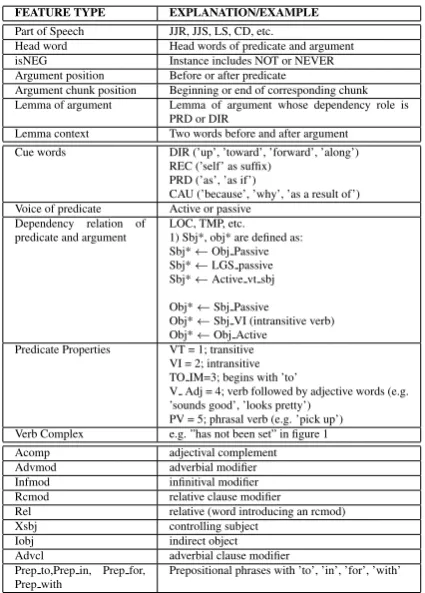
Table 1: Three feature groups: CoNLL basic, CoNLL derived, and from additional parser
FEATURE TYPE EXPLANATION/EXAMPLE
Part of Speech JJR, JJS, LS, CD, etc.
Head word Head words of predicate and argument
isNEG Instance includes NOT or NEVER
Argument position Before or after predicate
Argument chunk position Beginning or end of corresponding chunk Lemma of argument Lemma of argument whose dependency role is
PRD or DIR
Lemma context Two words before and after argument Cue words DIR (’up’, ’toward’, ’forward’, ’along’)
REC (’self’ as suffix) PRD (’as’, ’as if’)
CAU (’because’, ’why’, ’as a result of’) Voice of predicate Active or passive
Dependency relation of
predicate and argument LOC, TMP, etc.1) Sbj*, obj* are defined as: Sbj*←Obj Passive Sbj*←LGS passive Sbj*←Active vt sbj Obj*←Sbj Passive Obj*←Sbj VI (intransitive verb) Obj*←Obj Active
Predicate Properties VT = 1; transitive VI = 2; intransitive TO IM=3; begins with ’to’
V Adj = 4; verb followed by adjective words (e.g. ’sounds good’, ’looks pretty’)
PV = 5; phrasal verb (e.g. ’pick up’) Verb Complex e.g. ”has not been set” in figure 1
Acomp adjectival complement
Advmod adverbial modifier
Infmod infinitival modifier
Rcmod relative clause modifier
Rel relative (word introducing an rcmod)
Xsbj controlling subject
Iobj indirect object
Advcl adverbial clause modifier
Prep to,Prep in, Prep for,
Prep with Prepositional phrases with ’to’, ’in’, ’for’, ’with’
Marneffe et al., 2006). To apply the logistic re-gression model, the features are represented in a binary fashion. The features are described in Ta-ble 1, in three groups separated by douTa-ble lines. The derived features, including a heuristically-identified verb complex and altered dependency labels, are described in more detail in Section 3.
We use cross-validation on the training data to select for each individual classifier the subset of features most relevant for that label. In feature se-lection, features are ranked based on their Fisher score calculated using the training data set (as in Duda et al. (2001)).
3 Dependency Tree Compression
Given a sentence, the task of dependency parsing is to identify the head word and its correspond-ing dependents and to classify their functional re-lationships according to a set of dependency rela-tions (e.g., subject, modifier). Thus, a dependency tree of a sentence encodes the dependency rela-tion between the head words and their dependents. It has been reported that SRL can benefit from phrase-structure and dependency-based syntactic parsing (Hacioglu, 2004; Johansson and Nugues,
Index 1 2 3 4 5 6 7 8
Figure 1: Producing compressed dependency tree
2008b; Pradhan et al., 2005). At the same time, much of the structural and relational information represented in a dependency tree is not relevant for the SRL task.
We use acompressed dependency tree(CDT)
to encode just the relationships between a target predicate and the key dependents of the verb com-plex. The new tree is always rooted in the tar-get predicate, which often means resetting the root from an auxiliary or other finite main verb. We generate the CDT from the output of an existing dependency parser through the process described in a simplified form below, using the example sen-tence in Fig. 1.
1. Fix target predicate (e.g.set) as root of CDT.
2. Identify the verb chain to which the target predicate belongs; this group of tokens will
now be treated as the verb complex. The
verb chain is produced by collecting elements connected by relevant dependency relations
(VC,IM,CONJ), stopping when aROOTnode,
a subordinate clause (SUB), or a verbal OBJ
node is encountered.
3. Collect direct dependents of each word in the new verb complex; set these as dependents of the target predicate in the CDT, transferring the dependency relation to the target
predi-cate. (e.g.dateis a dependent ofhave).
5. Heuristically determine voice of clause and alter some CDT dependency labels(e.g. SBJ PASSIVE becomes OBJ*); these are the
asterisk-marked relations in Table. 1.
For example, in (2):
(2) At the same time, the government did not
want to appear to favor GM by allowing a minority stake that might preclude a full bid by Ford.
the verb complex is {did, n’t, want, appear,
fa-vor}. The subject phrase the government,
orig-inally a dependent of did, becomes a dependent
of the new three-verb predicate{want, appear,
fa-vor}; the negation wordn’tis a dependent of the
target predicatewant.
4 Active Learning
This section provides some background on the ac-tive learning process, as well as detailing the vari-ous sampling strategies we investigate.
4.1 The basic model
In this study we apply a standard active learning model (Settles, 2010; Lewis and Gale, 1994) to the task of semantic role labeling. Algorithm 1
illustrates this model as we use it.4
Algorithm 1Active learning for SRL.
1: Randomly select initial seed of labeled instances; 2: Add initial seed to the training data;
3: Apply logistic regression model to train system of classi-fiers, one for each label;
4: whilenumber of instances in training data is less thanX
do
5: Randomly select pool ofYunlabeled sentences; 6: Select a sentence or sentences from the unlabeled pool
according to a given selection strategy;
7: Ask oracle to label the selected unlabeled sentence; 8: Add instances from selected sentence to training data; 9: Re-train system using the updated training data; 10: Use system to label test data, record accuracy; 11: end while
Much recent work in AL has to do with Step 6 of Algorithm 1, designing and refining selec-tion strategies. The main selecselec-tion criterion used
to date has been informativity, measuring how
much a training example can help to reduce the un-certainty of a statistical model. A less-frequently considered criterion, especially in AL for NLP, is
4Recall that each sentence contains one or more instances.
representativeness, or how well a training exam-ple represents the overall input patterns of the un-labeled data.
While some results from AL are robust across different datasets and even different tasks, it is clear that there is no single approach to AL that is suitable for all situations (Tomanek and Olsson, 2009). Because there is very little previous work on AL for the task of semantic role labeling, we do not assume previous solutions but rather inves-tigate a number of different strategies.
4.2 Informativity
Informativity is exploited in our approaches in terms of uncertainty, which is measured based on how confidently the system labels instances and, by extension, sentences. The lower the confidence on labeling a particular sentence, the more uncer-tainty is assigned to the sentence. At each itera-tion, then, we select from the unlabeled pool the single sentence with the greatest uncertainty. We compare 4 different scoring functions for
measur-ing the system’s certainty (CER) regarding an
un-labeled sentence. These are presented below as
INF1-INF4.
Let srepresent an unlabeled sentence with
in-stancesi = 1ton. Given a set of binary
classi-fiers, one each for labelsy = 1tom, let pi,y be
the probability ofibeing labeled asy. Finally, P
is a pool of unlabeled sentences. At each iteration,
we select the singles ∈ P with the lowest value
forCER.
RAND: Random selection. Random selection
(randomly select an unlabeled sentence s ∈ P)
serves as a strong baseline in active learning.
INF1: Average uncertainty. After labeling each instance in a sentence with the most-likely pre-dicted label, we calculate uncertainty for the sen-tence as the average of the classifiers’ confidence
in assigning the predicted labels. Let T op(i) =
pi,yk, where ∀h 6= k, pi,yk > pi,yh; CER(s) =
(Pnj=1T op(ij))/n.
all instances. Let AV G(i) = (Pmk=1pi,yk)/m,
V AR(i) = Pmk=1(pi,yk −AV G(i))
2/(m −1);
CER(s) =Pnj=1V AR(ij)/n.
INF3: Average top-2 Margin. The intuition be-hind this approach is that the top 2 most confi-dent labels are likely to be more informative than other labels. Therefore, we only select the two
most likely labels to calculate uncertainty.5 Let
M argin(i) = pi,yk1 − pi,yk2, where pi,yk1 >
pi,yk2 ∧ ∀h 6= k1, k2, pi,yk2 > pi,kh;CER(s) = (Pnj=1M argin(ij))/n.
INF4: Most top-2 Margin Instances. Finally,
we further extend the approach ofINF3 by
select-ing the sentence which has the greatest number of instances with a small margin between the top 2 labels (which means that the sentence is more
un-certain than other sentences). Let Q be a set of
instances with the top-2 margin less than a small
threshold (i.e., M argin(i) ≤ 0.1). CER(s) is
defined as the inverse of the number of instances
ofsthat are inQ(i.e. 1/# qualifying instances).
Ties are resolved by random selection.
4.3 Representativeness
A disadvantage of selecting examples based only on informativity is the tendency of the learner to query outliers (Settles, 2010). It has therefore been proposed (Dredze and Crammer, 2008; Settles and Craven, 2008) to temper such selection strategies with a notion of relevance or representativeness. Ours is the first work to use such a combined strat-egy for SRL. We measure the representativeness of unlabeled sentences based on sentence similarity, taking two different approaches: cosine similarity, and a measure based on CDTs.
COS: Cosine Similarity. Given two sentencess
ands0, leti1,i2, . . . ,im, andi01,i02,. . . ,i0nbe their
instances, respectively. The similarity of the two
sentences, denoted assimilarity(s, s0), is defined
as Pm
j=1
Pn
k=1sim(ij, i0k), where sim(ij, i0k) is
the similarity between the instancesij andi0k,
de-fined as the cosine of the two feature vectors.6 For
purposes of comparison, we use the same
formu-lation ofCOSas Settles and Craven (2008).
5Note that in the binary classification case,INF3 is
equiv-alent toINF1.
6Features are extracted from CDTs rather than full
sen-tences, reducing to some extent the appearance of noisy in-formation (e.g. stop words). Whether this can be further re-duced by a modified implementation ofCOSis a question for future work.
Given a pool P of unlabeled sentences, for
ev-ery unlabeled sentences∈P, the
representative-ness of the sentence, denoted asrep(s), is
mea-sured as the sum of the similarity between the sen-tence and all the other sensen-tences in the pool, that
is,rep(s) =Psim(s, s0), wheres0∈P∧s06=s.
COS evaluates the similarity of two sentences
based on the cosine of their instances. This may not be accurate enough because the instances in-clude more information than the relationships be-tween the target predicate and the key dependents of the verb complex in the sentence. Therefore, we exploit the compressed dependency trees as a metric to evaluate the similarity between two sen-tences, as illustrated below:
CDT: Compressed Dependency Trees. For
tar-get predicatep, let (p, ri, ai) be the edges of the
CDT rooted inp, where ai is an argument and ri
is the dependency relationship betweenp andai.
We call two edges similar ifallofp,r, andameet
their respective similarity criteria. Two predicates are considered to be similar if they have the same
value for the PREDICATE PROPERTIES feature as
defined in Table 1 (e.g. both are transitive verbs). Two relations are considered to be similar if they have the same dependency relation label (e.g. SBJ, TMP, MOD, etc.). Finally, two arguments are con-sidered to be similar if they share the same coarse-grained part-of-speech tag.
Given a pool P of unlabeled sentences, for
ev-ery unlabeled sentences∈P, the
representative-ness of the sentence, denoted asrep(s), is defined
asnsimilar, representing the number of edges in
the pool that are similar to the edges of the CDT
fors. Intuitively, the larger the number of similar
CDT edges in the unlabeled pool, the more repre-sentative the sentence is overall of the input data.
4.4 Combining Informativity and Representativeness
The final step in our model is to define a selection
strategy that incorporates both selection criteria.
We define the priority of selecting a sentence as
priority(s) =α×rep(s)−(1−α)×CER(s).
Given a poolP, we select the singles ∈ P with
the highest value forpriority(s). This approach
is very similar to the information density (ID)
ap-proach of Settles and Craven (2008); the key dif-ference is in the balance between the two criteria.
Ours is a linear combination; ID instead
0.62
Figure 2: Combining informativity and representativeness.
resentativeness.
5 Experimental Setup
To evaluate our approach to AL for SRL, we inves-tigate three different questions. First, which infor-mativity strategy is most appropriate for the task? Second, which representativeness measure works best? And third, how shall we weight the trade-off between the two selection criteria?
All of our active learning experiments share some characteristics. First, we randomly select a seed of 50 instances from the labeled training data. The seed set, as well as the test data, are kept con-sistent across all experimental conditions. In each iteration of the training-selection cycle (see Algo-rithm 1), a new unlabeled pool (n=500) is selected, and from that pool a single example is labeled by the oracle and added to the training set. We stop once 500 examples have been labeled.
To evaluate the effectiveness of each strategy, we tested the classifier in each interaction, and measured the accuracy of the predicted labels. The accuracy measure is defined as the number of cor-rect labelings divided by the total number of label-ings in the test data. Results are presented as the average over 20 runs.
To investigate the influence of representative-ness, we run the same experiment with all
cross-combinations of {INF1,INF2,INF3,INF4}
and{COS,CDT}. For weighting the two criteria,
we use both information density (ID) as defined
in Settles and Craven (2008) and ourpriority
met-ric (Section 4.4) withαset at 0.3, 0.5, and 0.7.
6 Results and Discussion
In this section, we analyze and discuss the exper-imental results. The gains achieved by AL can be measured in a number of different ways; first, we plot number of labeled training examples against
system accuracy (Figure 2 and Figure 3). The fig-ures presented here stop at 500 training examples, with averaged accuracies in the range of 80%. For comparison, the fully-supervised system when
trained on20000instances performed at 89.71%.
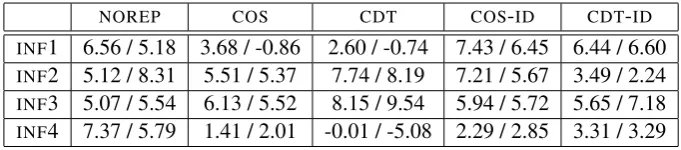
Second, we calculate the percent reduction in er-ror of each strategy compared to the random se-lection baseline (Table 2), following Melville and Mooney (2004). Because most gains from AL happen early in the learning curve, we consider performance at two different points.
6.1 Informativity-based Strategies
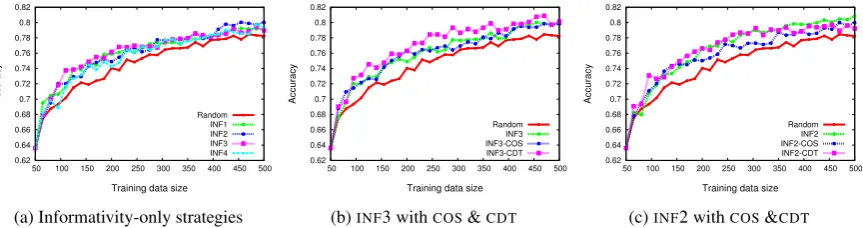
Fig. 2a shows the expected result that the four informativity-based strategies outperform the
ran-dom selection baseline. INF3 performs best
early in the learning curve, but is overtaken by
INF2 at the end of our curve. To reach the
ac-curacy achieved by the four informativity strate-gies at the halfway point (250 training instances),
RANDneeds 100-150 additional instances.
6.2 Informativity plus Representativeness
Fig. 2b shows the result of combining the
informa-tivity (INF3) and representativeness (bothCOSand
CDT). As illustrated in Section 6.1, INF3
out-performs the other informativity-based strategies. However, we see that Fig. 2b shows combining
CDTwithINF3 achieves a better performance than
usingINF3 only (α= 0.3); representativeness
im-proves performance, outperformingRANDby
ap-proximately 250 training instances. For INF3,
COS is a less effective measure of
representative-ness. This may be because the feature vectors for the training instances share too much informa-tion, including stop words and a large number of 0-valued features, to make them easily differenti-ated. As a result, the most representative sentence
0.62
Figure 3: Trade-off between informativity and representativeness.
larity of the sentences. In CDT, we choose only
the structural relation between the predicate and its arguments to measure the similarity between sentences. As a result, the sentences selected
us-ingCDTare more representative than that of using
COS, as confirmed by the result in Fig. 2b.
We also applied the solution of combining in-formativity and representativeness (4.3) to other informativity-based strategies. However, the ad-vantage the combined solution for other strategies
is less obvious than forINF3. For example, Fig. 2c
shows the result of combiningINF2 (α= 0.3) with
bothCOSandCDT. The result shows that the
com-bined solution with CDT performs slightly better
than using INF2 only when the number of
train-ing instances is less than 200. However, when the number of instances is larger than 350, the
solu-tion of usingINF2 only achieves a higher accuracy
than the combined solution. This may be due to a conflict between the two selection criteria. In any event, there is clearly a trade-off between informa-tivity and representativeness, and results are influ-enced by the details of the manner of combining the two.
The results of other INF/REPcombinations are
presented in Table 2, in terms of their reduction in error compared to random selection.
6.3 Weighting the two criteria
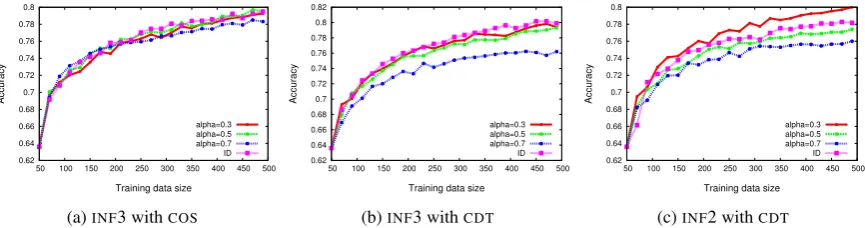
Finally, we set α with different values (i.e., 0.3,
0.5 and 0.7) to investigate how the trade-off be-tween informativity and representativeness may affect the SRL performance. We also compare our solution to the information density solution
pro-posed byet al.(Settles and Craven, 2008) (denoted
asID) multiplies the informativity and
represen-tativeness instead of summing them. Here we
dis-play only the results of INF2 and INF4
combin-ing withCDTin Fig. 3. Other combinations share
a similar pattern with these results and their er-ror reduction percentage can be found in Table. 2. Fig. 3a and Fig. 3b compare the two
representa-tivity measures for INF3, as the best overall
re-sult was achieved by INF3 in combination with
CDT. We see that parameter tuning seems to be
more influential for theCDTmeasure than for the
COSmeasure.
Fig. 3c shows how parameter tuning affects
INF2; α = 0.3 has a higher accuracy than that of
0.5 and 0.7. We can observe that when α = 0.3,
our solution (INF2) has a better performance than
that ofID. However, regarding the combination
ofINF4 and CDT, ID performs better (no graph;
see 2. Note that the INF4 selects the sentences
which has greatest number of instances with a small margin. Then representativeness of the sen-tences within the margin was calculated. In other word, the combination was done step by step not in parallel as the other combination. Therefore, the
combination ofINF4 andCDTaccounts for
infor-mativity prior to representativeness; this may be
whyIDis more successful.
In general, the balance and trade-offs between the two criteria deserve further investigation.
7 Related Work
Much research efforts have been devoted to statistical machine learning methodologies for SRL (Bjkelund et al., 2009; Gildea and Jurafsky, 2002; Shi et al., 2009; Johansson and Nugues, 2008a; Lang and Lapata, 2010; Pradhan et al., 2008; F¨urstenau and Lapata, 2009; Titov and Klementiev, 2011, among others). For
exam-ple, Johansson et al. (Johansson and Nugues,
Table 2: Percentage error reduction overRAND(200 / 500 examples)
NOREP COS CDT COS-ID CDT-ID
INF1 6.56 / 5.18 3.68 / -0.86 2.60 / -0.74 7.43 / 6.45 6.44 / 6.60
INF2 5.12 / 8.31 5.51 / 5.37 7.74 / 8.19 7.21 / 5.67 3.49 / 2.24
INF3 5.07 / 5.54 6.13 / 5.52 8.15 / 9.54 5.94 / 5.72 5.65 / 7.18
INF4 7.37 / 5.79 1.41 / 2.01 -0.01 / -5.08 2.29 / 2.85 3.31 / 3.29
logistic regression due to its desirable property that can result in few nonzero feature weights. This allows us to select the most important fea-tures from an otherwise very large feature set.
Rothet al.(Roth and Small, 2006) proposed a margin based active learning framework for struc-tured output and experiment on SRL task. They defined structured output by constraining the rela-tions among class labels, e.g., one predicate only has one of the labels. The classification prob-lem is defined via constraints among output labels. The most uncertain instances are selected to sat-isfy predefined constraints. Rather than a struc-tured relation between output labels, our work ex-ploits the structure of the sentences themselves via compressed dependency trees.
In the area of sentence similarity measurement, most current work focuses on semantic similar-ity (Haghighi et al., 2005; Tang et al., 2002; Shen and Lapata, 2007). We define similarity between sentences in terms of the nodes and edges in the dependency tree instead of semantic/lexical sim-ilarity of the sentences. We are interested in the structure of a sentence and how it is constructed due to the need of SRL tasks. Wang and Neumann (2007) use a similar sort of compressed depen-dency tree comprised of keywords and collapsed dependency relations to calculate the semantic similarity of sentences for the textual entailment task. Under their approach, dependency relations themselves are collapsed; we keep the specific de-pendency relations and collapse the trees, aiming for structural rather than semantic similarity.
In addition, Filippova et al. (Filippova and
Strube, 2008) proposed to compress a sentence using dependency trees and take the importance of words as weight. They found compressed de-pendency tree can better ensure the grammatical-ity of the sentences to preserve the same lexical meaning as much as possible. In our work, we are more interested in the explicit dependency re-lation of predicate-argument pairs. Our goal is to apply compressed dependency tree to extract
explicit relation between predicate and argument as precise as possible for SRL purpose. There-fore, we construct the compressed tree by identi-fying predicate-argument units and then re-linking them if there exist dependency relation among them. Consequently, most of the nodes in our compressed tree are predicates and arguments.
8 Conclusions
This paper investigates the use of active learn-ing for semantic role labellearn-ing. To improve the learning accuracy and reduce the size of training set, compressed dependency trees are exploited as features. Strategies to select informative un-labeled sentences are proposed. Moreover, the compressed dependency trees are also utilized as a criterion to measure the representativeness of unlabeled sentences. A solution to select unla-beled sentences combining both informativeness and representativeness is developed. The experi-mental results show that our solution can save up to 50% on a small training data set compared to the supervised learning solution.
Possibilities for future work include exploring the use of constraints on label outputs, implemen-tation of entropy-based informativity metrics, and
perhaps combining COS andCDT for measuring
representativeness. Another potentially promising direction is to employ multi-kernel based methods as a structure-oriented similarity measurement.
Acknowledgments
Our thanks to the anonymous reviewers for their valuable commentary and suggestions, and to Ivan Titov for invalu-able, insightful discussions and feedback. This research has been funded by the German Research Foundation (DFG) un-der the MMCI Cluster of Excellence.
References
C. Baker, M. Ellsworth, K. Erk. 2007. SemEval-2007 task 19: Frame semantic structure extraction. In
J. Baldridge, A. Palmer. 2009. How well does ac-tive learning actually work? time-based evaluation of cost-reduction strategies for language
documen-tation. InProc. of EMNLP 2009.
A. Bjkelund, L. Hafdell, P. Nugues, 2009. Multilingual
Semantic Role Labeling, 43–48. 2009.
X. Carreras, L. M`arquez. 2005. Introduction to the CoNLL-2005 shared task: Semantic role labeling. InProc. of CoNLL-2005.
D. Das, N. Schneider, D. Chen, N. A. Smith. 2010.
Probabilistic frame-semantic parsing. In Proc. of
NAACL-HLT 2010.
M.-C. de Marneffe, B. MacCartney, C. D. Manning. 2006. Generating typed dependency parses from
phrase structure parses. InProc. of LREC 2006.
M. Dredze, K. Crammer. 2008. Active learning with
confidence. InProc. of ACL 2008.
R. Duda, P. Hart, D. Stork. 2001. Pattern
classifica-tion, volume 2. Wiley.
K. Filippova, M. Strube. 2008. Dependency tree based
sentence compression. InProc. of INLG 2008.
H. F¨urstenau, M. Lapata. 2009. Semi-supervised
se-mantic role labeling. InProc. of EACL 2009.
D. Gildea, D. Jurafsky. 2002. Automatic labeling of
semantic roles.Computational Linguistics, 28.
T. Grenager, C. Manning. 2006. Unsupervised
discov-ery of a statistical verb lexicon. InProc. of EMNLP
2006.
K. Hacioglu. 2004. Semantic role labeling using
de-pendency trees. InProc. of COLING 2004.
A. D. Haghighi, A. Y. Ng, C. D. Manning. 2005.
Ro-bust textual inference via graph matching. InProc.
of HLT 2005.
J. Hajiˇc, M. Ciaramita, R. Johansson, D. Kawahara, M. A. Mart´ı, L. M`arquez, A. Meyers, J. Nivre, S. Pad´o, J. ˇStˇep´anek, P. Straˇn´ak, M. Surdeanu, N. Xue, Y. Zhang. 2009. The CoNLL 2009 shared task: Syntactic and semantic dependencies in
multi-ple languages. InProceedings of CoNLL 2009.
R. Hwa. 2004. Sample selection for statistical parsing.
Computational Linguistics, 30(3):253–276.
R. Johansson, P. Nugues. 2008a. Dependency-based
semantic role labeling of propbank. In Proc. of
EMNLP 2008.
R. Johansson, P. Nugues. 2008b. The effect of
syntac-tic representation on semansyntac-tic role labeling. InProc.
of COLING 2008.
J. Lang, M. Lapata. 2010. Unsupervised induction of
semantic roles. InProc. of HLT 2010.
S. Lee, H. Lee, P. Abbeel, A. Ng. 2006. Efficient L1
regularized logistic regression. In Proc. of the Ntl.
Conf. on AI, volume 21.
D. D. Lewis, W. A. Gale. 1994. A sequential algorithm
for training text classifiers. InProc. of SIGIR 1994.
C.-J. Lin, R. C. Weng, S. S. Keerthi. 2007. Trust region newton methods for large-scale logistic regression. InProc. of ICML 2007.
P. Melville, R. J. Mooney. 2004. Diverse ensembles
for active learning. InProc. of ICML 2004.
J. Nivre, J. Hall. 2005. Maltparser: A language-independent system for data-driven dependency
parsing. InProc. of the TLT 2005.
M. Osborne, J. Baldridge. 2004. Ensemble-based
ac-tive learning for parse selection. In Proc. of
HLT-NAACL 2004.
M. Palmer, D. Gildea, P. Kingsbury. 2005. The Propo-sition Bank: An Annotated Corpus of Semantic
Roles.Computational Linguistics, 31(1):71–105.
S. Pradhan, W. Ward, K. Hacioglu, J. H. Martin, D. Ju-rafsky. 2005. Semantic role labeling using different
syntactic views. InProc. of ACL 2005.
S. S. Pradhan, W. Ward, J. H. Martin. 2008. Towards
robust semantic role labeling. Computational
Lin-guistics, 34:289–310.
E. Ringger, P. McClanahan, R. Haertel, G. Busby, M. Carmen, J. Carroll, D. Lonsdale. 2007. Ac-tive learning for part-of-speech tagging:
Accelerat-ing corpus annotation. InProc. of the Linguistic
An-notation Workshop.
D. Roth, K. Small. 2006. Active learning with
percep-tron for structured output. In ICML Workshop on
Learning in Structured Output Spaces.
J. Ruppenhofer, M. Ellsworth, M. R. L. Petruck, C. R. Johnson, J. Scheffczyk. 2006. FrameNet II: Ex-tended Theory and Practice.
B. Settles, M. Craven. 2008. An analysis of active learning strategies for sequence labeling tasks. In
Proc. of EMNLP 2008.
B. Settles. 2010. Active learning literature survey. Technical Report Computer Sciences Technical Re-port 1648, University of Wisconsin-Madison, 2010. D. Shen, M. Lapata. 2007. Using semantic roles to
improve question answering. InProc. of
EMNLP-2007.
D. Shen, J. Zhang, J. Su, G. Zhou, C.-L. Tan. 2004. Multi-criteria-based active learning for named entity
recognition. InProc. of ACL 2004.
H. Shi, G. Zhou, P. Qian, X. Li. 2009. Semantic role labeling based on dependency tree with
multi-features. InProc. of IJCBS 2009.
M. Surdeanu, R. Johansson, A. Meyers, L. M`arquez, J. Nivre. 2008. The CoNLL 2008 shared task on joint parsing of syntactic and semantic
dependen-cies. InProc. of CoNLL 2008.
M. Tang, X. Luo, S. Roukos. 2002. Active learning for
statistical natural language parsing. InProc. of ACL
2002.
I. Titov, A. Klementiev. 2011. A bayesian model
for unsupervised semantic parsing. InProc. of ACL
2011.
K. Tomanek, F. Olsson. 2009. A Web Survey on the Use of Active learning to support annotation of text
data. In Proc. of AL-NLP workshop, NAACL HLT
2009.
R. Wang, G. Neumann. 2007. Recognizing textual en-tailment using sentence similarity based on
depen-dency tree skeletons. InProc. of RTE 2007.
B. Yang, J.-T. Sun, T. Wang, Z. Chen. 2009. Effective multi-label active learning for text classification. In
Proc. of KDD 2009.
Z.-H. Zhou. 2006. Learning with unlabeled data and
its application to image retrieval. InProc. of PRICAI