Back to the Roots of Genres: Text Classification by Language Function
Henning Wachsmuth University of Paderborn, s-lab
Paderborn, Germany [email protected]
Kathrin Bujna University of Paderborn
Paderborn, Germany [email protected]
Abstract
The term “genre” covers different aspects of both texts and documents, and it has led to many classification schemes. This makes different approaches to genre iden-tification incomparable and the task itself unclear. We introduce the linguistically motivated text classification tasklanguage function analysis, LFA, which focuses on one well-defined aspect of genres. The aim of LFA is to determine whether a text is predominantly expressive, appellative, or informative. LFA can be used in search and mining applications to efficiently fil-ter documents of infil-terest. Our approach to LFA relies on fast machine learning classi-fiers with features from different research areas. We evaluate this approach on a new corpus with 4,806 product texts from two domains. Within one domain, we correctly classify up to 82% of the texts, but differ-ences in feature distribution limit accuracy on out-of-domain data.
1 Introduction
Text classification has been successfully applied to various natural language processing tasks, among which some of the most popular are topic de-tection, authorship attribution, sentiment analysis, and genre identification. While the first three refer to single aspects of a text, genres cover different properties of both documents and texts, such as their form, function, purpose, and target audience. As a consequence, many different genre classifica-tion schemes exist, which makes most approaches to genre identification badly comparable as a re-cent study showed (Sharoff et al., 2010). Corre-spondingly, the question which features work best in genre identification still remains open. We ar-gue that one major reason behind is a missing
common understanding of genres and that we need to focus on the single aspects of genres in order to overcome this situation.
In this paper, we investigatewhya text was writ-ten. Therefore, we introduce the ambitious task
language function analysis, abbreviated as LFA, i.e., to classify the predominant function of a text as intended by its author. In line with the work of the psychologist Karl B¨uhler (1934), we dis-tinguish three abstract and very general classes, namely, expressive, appellative, and informative
texts. Several search and text mining applications can benefit from applying LFA as a document fil-tering step with respect to both efficiency and ef-fectiveness. A search engine, for instance, might restrict its result list to hits that mainly serve an in-formative purpose. Similarly, LFA can be used in opinion mining to cancel out promotional texts in favor of personal attitudes. While, of course, LFA does not replace genre identification, we think that language functions constitute one root of a com-mon and clear genre concept.
Language functions are well-studied in linguis-tic pragmalinguis-tics, but we analyze whether they also correlate with statistical text characteristics. For this purpose, we built a manually annotated cor-pus with 4,806 product-related texts from two sep-arated domains (music and smartphones) in close collaboration with industry. Each text is tagged aspersonal,commercial, orinformational, which can be seen as an application-specific classifica-tion by language funcclassifica-tion. Also, the texts have been categorized by sentiment polarity.
Our approach to LFA relies on machine learning of lexical and shallow linguistic features from dif-ferent research areas. We evaluate this approach both for classification within one corpus domain and for the transfer to another domain. With re-spect to the in-domain task, our results indicate that a text collection of homogeneous quality and style allows for high accuracy. In particular, we
correctly classify 81.9% of the music texts using a very efficiently computable feature set. This makes our approach suitable for document filter-ing purposes. However, classification of out-of-domain data seems difficult because of the covari-ate shift(Shimodaira, 2000) in feature distribution between domains. Interestingly, though, the best-performing features for this task come from the area of authorship attribution.
1.1 Summary of Contributions
Altogether, the main contributions of this paper are the following:
• We introduce the linguistically motivated text classification task language function analysis, which addresses one well-defined aspect of genres (Section 2).
• We provide a corpus for language function analysis and sentiment analysis with product-related texts that were manually annotated by one of our industrial partners (Section 4). • We analyze the impact of machine learning
features from different research areas on the language function analysis of texts from two domains (Sections 5 and 6).
2 Language Function Analysis
One of the most influential attempts to categorize language functions was introduced by the famous psychologist Karl B¨uhler (1934). In hisOrganon model, which is rooted in Plato’s view of language as a tool, B¨uhler identifies and interrelates three fundamental functions of natural language in com-munication: theexpressionof the speaker, the ap-pealto the receiver, and therepresentationof the object or state of affair being communicated. As illustrated in Figure 1 they all refer to a linguistic sign, which can be understood as the unit of all forms of language.
Based on the three language functions, Katha-rina Reiß (1971) defined a classification of text types, which relates to the intention of the author of a text. In particular, she distinguished between the form-focused expression of the author’s atti-tudes in expressive texts, the aim of making an appeal to the reader inappellative (oroperative) texts, and the content-focused description of ob-jects and facts ininformativetexts. Reiß assigned several concrete text types such as “report” (infor-mative), “novel” (expressive), or “comment”
(in-linguistic sign
speaker receiver
objects or states of affairs
expression representation
appeal
Figure 1: The organon model, formulated by Karl B¨uhler (1934), with its three language functions expression, appeal, and representation.
formative and appellative) to one or more of these classes. While she claimed that a hybrid type is the regular case, she observed that one function is pre-dominant in most texts. We adopt Reiß’ typology to define the language function analysis task.
Definition 1 (Language Function Analysis) Let
C ={expressive, appellative, informative}be the set of abstract language functions and letdbe a text. Then the task of language function analysis, LFA, is to find the mappingd7→ c∈ Csuch that cis the predominant language function ofd.
We argue that LFA can help in many practical problems where document filtering is needed, es-pecially because of its generic nature. For product-related texts, the use of LFA emerges, when we map the abstract functions inC to the following
concrete language function classes of text:
• personal (expressive). Text that aims to ex-press the personal attitude of an individual to-wards a product of interest.
• commercial (appellative). Text that follows commercial purposes with respect to a prod-uct of interest.
• informational (informative).Text that reports on a product of interest in an objective and journalistic manner.
use the classes personal, commercial, and infor-mational for a first evaluation of LFA. Our intu-ition is that, statistically, language functions imply shallow linguistic features, such as certain parts-of-speech or writing style characteristics.
3 Related Work
Classification by intention has been recently ad-dressed in (Kr¨oll and Strohmaier, 2009). The au-thors infer a subset of 145 intentions from the tran-scriptions of speeches based on actions mentioned
withinthe text. Similar problems refer to the anal-ysis of speaker intentions in conversation (Kadoya
et al., 2005) and to the area of textual entailment (Michael, 2009), which is about the information implied by text. In contrast, LFA is about the ques-tion why a text was written and, thus, refers to the authorial intentionbehinda text.1
In that, our work resembles (Santini, 2005) where a linguistic expert system analyzes the gra-dation of four text types that convey the purpose and function of a text. Two of these types fit to the abstract functions introduced in Section 2, namely, the types “explicatory/informational” and “argu-mentative/persuasive”. However, the other types (“descriptive/narrative” and “instructional”) seem quite arbitrary and appear to intersect with the first type. Moreover, a class for the expression of per-sonal views is missing. This might result from the used SPIRIT corpus (Clarke et. al., 2002), which was created for question answering purposes. Be-sides, language functions constitute a general clas-sification scheme that may be concretized for a task at hand, while Santini regards text types only as input to web genre identification.
In terms of the communicative purpose of a text, language functions can be considered as the most abstract view on genres. Indeed, Kessler et al.
(1997) argue that the class of texts that aim at per-suading someone would not be seen as a genre merely because that class is too generic. While the authors simply define a genre to refer to a cer-tain functional trait as well as to some formal prop-erties, several abstract and concrete classification schemes have been proposed for genre identifica-tion. In a pioneer study on genres, Biber (1986) analyzes basic textual dimensions, such as “infor-mative vs. involved”, while Karlgren and Cutting
1While literature theory also addresses the intention of the
reader and the intention of the text itself (Eco, 1990), only authorial intention is relevant for the purpose of this paper.
(1994) try to automatically separate informative from imaginative texts. Stamatatoset. al. (2000) rely on more concrete press-related genres (e.g. “Letter to the editor” or “Spot news”), and Garera and Yarowsky (2009) investigate modern conver-sational genres, such as “Email”.
The two latter show that genres do not only de-scribe the function and purpose of a text, but also its form and target audience and, thus, also rep-resent concepts orthogonal to language functions. Correspondingly, a great deal of genre research in the last decade focused on web genres as sur-veyed in (Stein et al., 2010). Two standard cor-pora for web genre identification, KI-04 (Meyer zu Eissen and Stein, 2004) and SANTINIS (San-tini, 2010), illustrate a common situation in genre research: Their classification schemes partly over-lap, e.g. the class “Help” from KI-04 can be mapped to “FAQ” in SANTINIS, but partly also contain unique and quite specific classes, such as “Search pages” in SANTINIS. Moreover, Sharoff
et. al. (2010) found out that seemingly similar classes (“Portrayal” and “Personal home page”) differ strongly in terms of discriminative features. This supports our argumentation that there is nei-ther a clear common understanding of genres, nor a well-defined genre concept. Additionally, Boese and Howe (2005) recognized that, in the web, gen-res may evolve over time to other gengen-res.
However, language functions still represent one important aspect of genres. Accordingly, genre identification and LFA have similarities with re-spect to both practical applications (e.g. document filtering) and potentially helpful features. Since our focus is on a text itself as opposed to a docu-ment, we follow Webber (2009) who emphasizes the importance of text-internal and linguistic fea-tures, such as particular parts-of-speech. Also, we investigate both character-based and word-based n-grams, which were most successful in the above-mentioned evaluation of genre collections of Sharoffet al.(2010).
lexical and shallow linguistic information (Luyckx and Daelemans, 2008), sometimes using deeper analyses like parsing (Raghavanet al., 2010). We adopt some of these features in Section 5 and 6.
4 The LFA-11 Corpus
To evaluate LFA, we built the LFA-11 corpus with manually annotated German texts from two sepa-rated domains: musicandsmartphones. The pur-pose of the corpus is to provide textual data for the development and evaluation of approaches to LFA and sentiment analysis. The corpus is freely available at http://infexba.upb.de.
The music collection of LFA-11 contains 2,713 promotional texts, professional and user reviews that were taken from a social network platform. Accordingly, these texts are well-written and of homogeneous style. In contrast, a set of 2,093 blog posts from the Spinn3r corpus2 addresses
smart-phones. The Spinn3r project aims at crawling and indexing the whole blogosphere. Hence, the texts in the smartphone collection vary strongly in quality and writing style. While the music texts span 9.4 sentences with 23.0 tokens on average, the blog posts have an average length of 11.8 sen-tences but only 18.6 tokens per sentence.
4.1 Annotations
The corpus consists of UTF-8 encoded XMI files preformatted for the Apache UIMA framework3,
which implements the Unstructured Information
Management Architecture (Ferrucci and Lally,
2004). Each file includes the text together with one of the language function annotationspersonal,
commercial, and informational. Also, the texts have been classified by sentiment polarity as pos-itive, negative, or neutral. Tagging was done by two employees of theDigital Collections Verlags-gesellschaft mbH, a leading supplier of digital as-set management systems.
Figure 2 shows excerpts from three texts of the music collection, one out of each language func-tion class. The excerpts have been translated to English for clarity. While some indicators of lan-guage functions might have been lost due to trans-lation, the examples underline the strong connec-tion of the concrete language funcconnec-tion classes to the abstract functions from Section 2. In order to support a consistent categorization, the following
2Spinn3r corpus, http://www.spinn3r.com 3Apache UIMA, http://uima.apache.org
personal. ... How did Alex recently ask when he saw Kravitz’ latest best-of collection: Is it his own liking, the voting on his website, or the chart position what counts? Good question. However, in our case, there is nothing to argue about: 27 songs, all were number one. The Beatles. Biggest band on the globe. ...
commercial. ... The sitars sound authentically Indian. In combination with the three-part harmonious singing and the jingle-jangle of the Rickenbacker guitars, they create an oriental flair without losing their Beatlesque elegance. If that doesn’t make you smile! ...
informational.... “It’s All Too Much”? No, no, still okay, though an enormous hype was made for decades about the seemingly new Beatles song. The point is that exactly this song “Hey Bulldog” has already been published long time ago, most recently on a reprint of “Yellow Submarine” in the year 1987. ...
Figure 2: Translated excerpts from three texts of the music collection. Note that the translation to English might have affected the indicators of the corresponding language functions.
guidelines were given to the two employees for the language function annotations:
• personal. “Use this annotation if the text
seems not to be of commercial interest, but probably represents the personal view on the product of a private individual.”
• commercial. “Use this annotation if the text is of obvious commercial interest. The text seems to predominantly aim at persuading the reader to buy or like the product.”
• informational.“Use this annotation if the text seems not to be of commercial interest with respect to the product. Instead, it predomi-nantly appears to be informative in a journal-istic manner.”
About 20% of the music texts and 40% of the smartphone texts were tagged twice in order to compute inter-annotator agreement. The resulting values κm = 0.78 (music) and κs = 0.67
(smart-phone) of Cohen’s Kappa (Carletta, 1996) for the language function annotations constitute “substan-tial agreement”. Especiallyκsis far from perfect,
Set personal commercial informational
music collection
Training 521 (38.5%) 127 (9.4%) 707 (52.2%) Validation 419 (61.7%) 72 (10.6%) 188 (27.7%) Test 342 (50.4%) 68 (10.0%) 269 (39.6%) smartphone collection
Training 546 (52.1%) 90 (8.6%) 411 (39.3%) Validation 279 (53.3%) 36 (6.9%) 208 (39.8%) Test 302 (57.7%) 28 (5.4%) 193 (36.9%)
Table 1: Distribution of language function classes in the music and smartphone sets of the corpus.
Set positive neutral negative
music collection
Training 1003 (74.0%) 259 (19.1%) 93 (6.9%) Validation 558 (82.2%) 82 (12.1%) 39 (5.7%) Test 514 (75.7%) 115 (16.9%) 50 (7.4%) smartphone collection
Training 205 (19.6%) 738 (70.5%) 104 (9.9%) Validation 110 (21.0%) 343 (65.6%) 70 (13.4%) Test 84 (16.1%) 359 (68.6%) 80 (15.3%)
Table 2: Distribution of sentiment polarity classes in the music and smartphone sets of the corpus.
4.2 Evaluation Sets
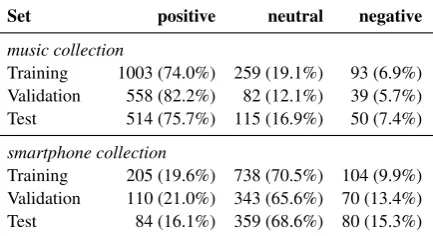
We created splits for each domain with half of the texts in the training set and each one fourth in the validation set and test set, respectively. Table 1 and Table 2 show the class distributions of lan-guage functions and sentiment polarities. The dis-tributions indicate that the training, validation, and test sets differ significantly from each other. Also, Table 1 and 2 give a first hint that the correlation between language functions and sentiment is low. With regard to the distribution of language func-tions, we observe a large imbalance between the three classes. In case of double-annotated texts, we chose the annotations of the employee who cat-egorized more texts ascommercial. Still, this class remains by far the minority class with only about 5% to 10% of the texts in all sets. This, of course, makes the task at hand more difficult.
5 Features
To investigate whether LFA has correlations with other text classification tasks, we experimented with several lexical and shallow linguistic features that relate to some of the research areas mentioned in Section 3. For a concise evaluation, we orga-nized these features into the following six types.
1. Simple genre features. Simple approaches
from genre identification: the frequency of each part-of-speech tag that occurs at least 15 times in the training set, the average word length, and theLixreadability index (Ander-son, 1983).
2. Text type. Features inspired by linguistic ex-pert knowledge from (Santini, 2005), namely, the frequency of time and money entities as well as the frequency of two sets of part-of-speech tags: a) personal and possessive pro-nouns, b) nouns and adjectives.
3. Writing style. A selection of measures used in authorship attribution (Stamatatos, 2009): the frequency of the most common words, part-of-speech trigrams, and character tri-grams as well as the frequency of capital-ized, upper-case, and lower-case words. The same for parentheses, punctuation and quo-tation marks, and the portion of “?” and “!” under all sentence delimiters.
4. Sentiment. Indicators for sentiment, namely, the frequency of 15 common emoticons such as “;-)” and the sentiment polarity of the text.
5. Core trigrams. The frequency of the most
discriminative part-of-speech and character trigrams of each language function class. Similar features performed best in (Sharoffet al., 2010). Here, we use all trigrams that oc-cur over six times as often in one classcas in
any other classc0 6=c.
6. Core vocabularies. The frequency of the
most discriminative words, introduced as a genre feature by Lee and Myaeng (2002). We define such a word to occur at least in 15 training texts of classcand over six times as
often incas in any other classc0 6=c.
6 Experiments
40% 50% 60% 70% 80%
accuracy
1.
(SG )
69.4% 70.0% 74.4% 74.5%
80.7% 81.9%
48.8%
1.-2.
(+TT) (+1.-3.WS) (+1.-4.SE)(+1.-5.CT) (+1.-6.CV) 1.-6.
40% 50% 60% 70% 80%
accuracy
1.
(SG )
64.2% 66.0% 65.0% 65.2% 68.3% 68.8% 63.3%
1.-2.
(+TT)(+1.-3.WS) (+1.-4.SE) (+1.-5.CT) (+1.-6.CV) 1.-6.
Applied to smartphone Applied to music
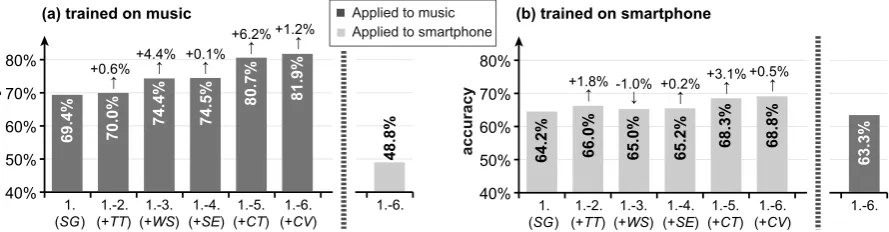
Figure 3: Classification accuracy in the LFA task for a stepwise integration of the six feature types and the transfer to another domain: (a) Training on the music training set, application to the music test set, and transfer to the smartphone test set. (b) Training on the smartphone training set, application to the smartphone test set, and transfer to the music test set.
to check whether LFA based on supervised learn-ing qualifies for document filterlearn-ing purposes.4
6.1 Experimental Set-up
Since commercial texts are largely underrepre-sented in the music and the smartphone collec-tion, the two training sets were balanced with over-sampling. After sentence splitting and tokeniza-tion, we applied the highly efficient TreeTagger
(Schmid, 1995) for part-of-speech tagging and we extracted time and money entities with fast regu-lar expressions. Regarding sentiment poregu-larity, we used the corpus annotations for simplicity.
For the writing style features, we determined the 48 most common words, the 55 most common part-of-speech trigrams, and the 35 most common character trigrams on the training set of each col-lection. Accordingly, we computed the most dis-criminative trigrams for feature type 5. The core vocabularies sum up to 30 words for the music col-lection and to 36 words for the smartphone collec-tion (proper names were discarded). Some of these words are quite specific, e.g. “single” in the music domain (an indicator forcommercial), while oth-ers seem less domain-dependent such as “zumind-est” (“at least”,informational).
Altogether, the six feature types were instanti-ated by 299 music and 373 smartphone features, respectively. On both training sets, we trained one linear multi-class support vector machine (here-after called SVM) using feature type 1 to m for
each m ∈ [1,6]as well as one such SVM using
only typem. For this, we applied theLibSVM
in-tegration inWeka(Hall et. al., 2009; Fan et. al., 2001), where we selected the cost parameters of all
4The Java source code and the feature files used for
eval-uation can be accessed at http://infexba.upb.de.
SVMs on the validation sets. Finally, we analyzed the impact of the resulting classifiers on both test sets. We measured their effectiveness in terms of accuracy, precision, and recall and their efficiency in milliseconds per processed input text.
6.2 Results
Effectiveness of the classifiers. Figure 3a illus-trates classification accuracy on the music test set for a stepwise integration of feature type 1 to 6 into an SVM trained on the music training set. Addi-tionally, the accuracy for the transfer of the SVM with all features to the smartphone domain is de-picted. The simple genre features (SG) already achieved 69.4%. While text type (TT) and senti-ment (SE) contributed only little, the writing style features (WS) and the core trigrams (CT) boosted accuracy by 4.4% and 6.2%, respectively. At last, the core vocabularies (CV) added 1.2 percentage points to the resulting overall accuracy of 81.9% (86.7% on the validation set).
When we applied the SVM with all features to the smartphone test set, its accuracy dropped to 48.8%. To find out whether this dramatic decrease indicates a covariate shift in the feature distribu-tion between the two domains, we retrained the SVM on the smartphone training set. Indeed, its accuracy was re-increased to 68.8%, as shown in Figure 3b. Interestingly, though, the domain trans-fer worked fine in the opposite direction, i.e., the SVM trained on smartphone texts still correctly classified63.3%of the texts in the music test set.
0% 20% 40% 60% 80%
1. Simple
genre feat. 2. Text type 3. Writing style 4. Sentiment 5. Core trigrams 6. Core vocabularies 1.-6. Complete feature set
69.4%
38.4%
62.2%
54.5%
68.9%
58.5%
26.5% 37.7%
68.6%
10.5%
59.6%
10.9%
81.9%
48.8%
applied to music applied to smartphone
accuracy
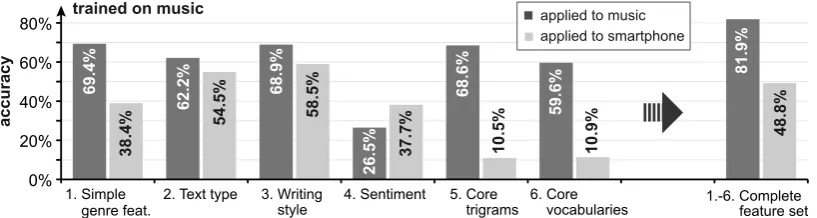
Figure 4: Classification accuracy of each feature type trained on the music training set and applied to both the music test set and the smartphone test set. The accuracy of all features is given on the right.
Domain Class Precision Recall F1
music personal 88.7% 84.8% 86.7% commercial 61.9% 88.2% 72.7% informational 80.8% 76.6% 78.6% smartphone personal 83.5% 68.5% 75.3% commercial 23.2% 46.4% 31.0% informational 63.9% 72.5% 68.0%
Table 3: Precision, recall and F1-score for the
three language function classes on the in-domain test sets using the SVM with all six feature types.
Nevertheless, Figure 3b also conveys that we achieved 13.1% less accuracy in the smartphone domain than in the music domain (68.8% vs. 81.9%). The accuracy of SG, 64.2%, was over five points lower, and only the integration of TT
(+1.8%) andCT(+3.1%) yielded notable improve-ments afterwards. Adding WS even led to a de-crease of one percentage point. However, this does not mean that the writing style features failed, as we see later on, but seems to be only noise from the optimization process of the SVM.
While a kappa value of 0.67 (cf. Section 4) ren-ders high accuracy difficult, in general, one reason for the weak performance on the smartphone test set can be inferred from Table 3. This table lists effectiveness results of the SVMs with all features for each class. On the music test set, we observe a recall of more than 75% for all three classes. Though precision significantly dropped for
com-mercial, given a class imbalance of 1:9
(com-mercial:rest), 61.9% is still over five times better than the expected precision of guessing. In con-trast, the recognition of commercial texts failed on the smartphone test set with an F1-score of only
31.0%. Apparently, the SVM did not determine meaningful features forcommercial, probably be-cause of the small number of commercial texts (cf. Table 1) in combination with the heterogeneity of
the smartphone collection. This, in turn, also af-fected the effectiveness of the other classes.
Effectiveness of the feature types.We measured the effectiveness of each feature type in isolation in order to investigate their impact on LFA. Within music, the simple genre features, the writing style type, and the core trigrams did best, each of them with nearly 70% accuracy as shown in Figure 4. However, there is notonediscriminative type, i.e., the complete feature set clearly outperformed all single types. Under the transfer to the smartphone domain, only the text type and writing style fea-tures reasonably maintained effectiveness. The core vocabularies failed on out-of-domain data, and also the core trigrams did unexpectedly bad, dropping from 68.6% to 10.5%.
With regard to sentiment, our evaluation under-pins the observation from Section 4 that sentiment polarities and language functions hardly correlate: the according features learned on the music train-ing set did not work out on both test sets, and the same holds for the opposite direction in Figure 5. There, we see that feature type 1, 3, and 5 also performed best within the smartphone domain. In particular, the writing style type (64.8%) is only 4% worse than the complete feature set. More-over, while the domain transfer worked well in general, again the most impact was achieved by the text type features with 59.8% accuracy and by the writing style features with 58.9%. This sug-gests that the distribution of these features is only weakly domain-dependent in LFA. With respect to the writing style type, this is an interesting re-sult, as it indicates that the genre-related task LFA significantly benefits from features that are most prominent in the area of authorship attribution.
Efficiency. We measured the run-time of the
0% 20% 40% 60% 80%
1. Simple
genre feat. 2. Text type 3. Writing style 4. Sentiment 5. Core trigrams 6. Core vocabularies 1.-6. Complete feature set
64.2%
53.8% 59.5% 59.8% 64.8% 58.9%
40.2%
26.7%
60.6% 57.3%
46.7% 51.1%
68.8% 63.3%
accuracy
applied to smartphone applied to music
Figure 5: Classification accuracy of each feature type trained on the smartphone training set and applied to both the smartphone test set and the music test set. The accuracy of all features is given on the right.
2 Duo MacBook with 4 GB RAM. Including all
processing steps (sentence splitting, tokenization, part-of-speech tagging, entity recognition, feature extraction, and classification), the average run-time was 37.0 ms per text (σ = 0.6 ms) compared
to 6.2 ms needed for tokenization alone. At least for the homogeneous music domain, where we achieved high accuracy, we thus claim that our ap-proach is suitable for fast document filtering.
7 Conclusion
We presented the text classification task language function analysis, LFA, which addresses why a text was written and which is motivated by Karl B¨uhler’s functions of natural language. We see language functions as one root of a well-defined genre concept and we argue that a common under-standing of such a concept is needed in order to achieve real progress in genre research.
For evaluation of LFA, we provide the LFA-11 corpus with product-related texts from two very different domains that was developed in collabo-ration with industry. Each text in the corpus has been manually classified by its concrete language function. Approaching LFA with machine learn-ing, we achieved promising results within one ho-mogeneous domain. Moreover, we found out that features commonly used in authorship attribution have the most impact on LFA in both evaluated do-mains and that they also qualify for domain trans-fer. This indicates that language functions relate to the writing style of a text. In contrast, the cor-relation with sentiment appeared to be low.
However, in general, both the language function analysis of more heterogeneous texts and the do-main transfer redo-main unsolved. In future work, we hence aim to investigate the use of sentence-level classification and domain adaptation techniques to further improve our approach to LFA.
Acknowledgments
This work was partly funded by the German Fed-eral Ministry of Education and Research (BMBF) under contract number 01IS08007A.
References
Jonathan Anderson. 1983. Lix and Rix: Variations on
a Little-known Readability Index. Journal of
Read-ing, 26(6):490–496.
Douglas Biber. 1986. Spoken and Written Textual Di-mensions in English: Resolving the Contradictory
Findings. Language, 62(2):384–413.
Elizabeth S. Boese and Adele E. Howe. 2005. Ef-fects of Web Document Evolution on Genre
Classi-cation. In Proceedings of the 14th ACM
Interna-tional Conference on Information and Knowledge Management, pages 639–646, Bremen, Germany.
Karl B¨uhler. 1934. Sprachtheorie. Die
Darstellungs-funktion der Sprache. Verlag von Gustav Fischer, Jena, Germany.
Jean Carletta. 1996. Assessing Agreement on
Classi-fication Tasks: The Kappa Statistic. Computational
Linguistics, 22: 249–254.
Charles L. A. Clarke, Gordon V. Cormack, M. Laszlo, Thomas R. Lynam, and Egidio L. Terra. 2002. The Impact of Corpus Size on Question Answering
Per-formance. InProceedings of the 25th Annual
Inter-national ACM SIGIR Conference on Research and Development in Information Retrieval, pages 369– 370, Tampere, Finland.
Umberto Eco. 1990. I Limiti dell’Interpretazione.
Bompiani, Milano, Italy.
Rong-En Fan, Pai-Hsuen Chen, and Chih-Jen Lin. 2001. Working Set Selection Using Second Order Information for Training Support Vector Machines.
Journal of Machine Learning Research, 6:1889– 1918.
Processing in the Corporate Research Environment.
Natural Language Engineering, 10(3–4):327–348.
Nikesh Garera and David Yarowsky. 2009. Modeling Latent Biographic Attributes in Conversational
Gen-res. In Proceedings of the Joint Conference of the
47th Annual Meeting of the Association for Compu-tational Linguistics and the 4th International Joint Conference on Natural Language Processing, pages 710–718, Suntec, Singapore.
Mark Hall, Eibe Frank, Geoffrey Holmes, Bernhard Pfahringer, Peter Reutemann, and Ian H. Witten. 2009. The WEKA Data Mining Software: An
Up-date.SIGKDD Explorations, 11(1).
Yuki Kadoya, Kazuhiro Morita, Masao Fuketa, Masaki Oono, El-Sayed Atlam, Toru Sumitomo, and
Jun-Ichi Aoe. 2005. A Sentence Classification
Technique using Intention Association Expressions.
International Journal of Computer Mathematics, 82(7):777–792.
Jussi Karlgren and Douglass Cutting. 1994. Recog-nizing Text Genres with Simple Metrics using
Dis-criminant Analysis. InProceedings of the 15th
In-ternational Conference on Computational
Linguis-tics, pages 1071–1075, Kyoto, Japan.
Brett Kessler, Geoffrey Numberg and Hinrich Sch¨utze.
1997. Automatic Detection of Text Genre. In
Pro-ceedings of the 35th Annual Meeting of the Asso-ciation for Computational Linguistics and Eighth Conference of the European Chapter of the Associ-ation for ComputAssoci-ational Linguistics, pages 32–38, Madrid, Spain.
Mark Kr¨oll and Markus Strohmaier. 2009. Analyz-ing Human Intentions in Natural Language Text. In
Proceedings of the Fifth International Conference on Knowledge Capture, pages 197–198, Redondo Beach, CA.
Yong-Bae Lee and Sung Hyon Myaeng. 2002.
Text Genre Classification with Genre-Revealing and
Subject-Revealing Deatures. InProceedings of the
25th Annual International ACM SIGIR Conference on Research and Development in Information Re-trieval, pages 145–150, Tampere, Finland.
Loizos Michael. 2009. Reading between the Lines. In
Proceedings of the 21st International Joint Confer-ence on Artifical intelligConfer-ence, pages 1525–1530, San Francisco, CA.
Kim Luyckx and Walter Daelemans. 2008. Author-ship Attribution and Verification with Many Authors
and Limited Data. InProceedings of the 22nd
Inter-national Conference on Computational Linguistics, pages 513–520, Manchester, UK.
Sven Meyer zu Eissen and Benno Stein. 2004. Genre Classification of Web Pages: User Study and
Feasi-bility Analysis. InProceedings of the 27th German
Conference on Artificial Intelligence, pages 256– 269, Ulm, Germany.
Bo Pang and Lillian Lee. 2008. Opinion Mining and
Sentiment Analysis. Foundations and Trends in
In-formation Retrieval, 2(1–2):1–135.
Peter Prettenhofer and Benno Stein. 2010. Cross-Language Text Classification using Structural
Cor-respondence Learning. InProceedings of the 48th
Annual Meeting of the Association of Computational Linguistics, pages 1118-1127, Uppsala, Sweden. Sindhu Raghavan, Adriana Kovashka, and Raymond
Mooney. 2010. Authorship Attribution using
Prob-abilistic Context-Free Grammars. InProceedings of
the ACL 2010 Conference Short Papers, pages 38– 42, Uppsala, Sweden.
Katharina Reiß. 1971.M¨oglichkeiten und Grenzen der
¨Ubersetzungskritik. Max Hueber Verlag, Munich, Germany.
Marina Santini. 2005. Automatic Text Analysis:
Gra-dations of Text Types in Web Pages. InProceedings
of the Tenth ESSLLI Student Session, pages 276– 285, Edinburgh, UK.
Marina Santini. 2010. Cross-testing a Genre
Classica-tion Model for the Web. Genres on the Web:
Com-putational Models and Empirical Studies, Springer. Serge Sharoff, Zhili Wu, and Katja Markert. 2010.
The Web Library of Babel: Evaluating Genre
Col-lections. In Proceedings of the Seventh Language
Resources and Evaluation Conference, LREC 2010, pages 3063–3070, Malta.
Hidetoshi Shimodaira. 2000. Improving Predictive In-ference under Covariate Shift by Weighting the
Log-Likelihood Function. Journal of Statistical
Plan-ning and Inference, 90(2):227–244.
Helmut Schmid. 1995. Improvements in Part-of-Speech Tagging with an Application to German. In
Proceedings of the EACL SIGDAT-Workshop, pages 47–50, Dublin, Ireland.
Efstathios Stamatatos, Nikos Fakotakis, and George K. Kokkinakis. 2000. Text Genre Detection
us-ing Common Word Frequencies. InProceedings of
the 18th International Conference on Computational Linguistics, pages 808–814, Saarbr¨ucken, Germany. Efstathios Stamatatos. 2009. A Survey of Modern
Au-thorship Attribution Methods. Journal of the
Ameri-can Society for Information Science and Technology, 60(3):538–556.
Benno Stein, Sven Meyer zu Eißen, and Nedim Lipka. 2010. Web Genre Analysis: Use Cases, Retrieval
Models, and Implementation Issues. Text, Speech
and Language Technology, 42:167–190.
Bonnie Webber. 2009. Genre Distinctions for
Dis-course in the Penn TreeBank. InProceedings of the