Multilingual Text Entry using Automatic Language Detection
Yo Ehara and Kumiko Tanaka-Ishii
Graduate School of Information Science and Technology, University of Tokyo 13F Akihabara Daibiru, 1-18-13 SotoKanda Chiyoda-ku, Tokyo, Japan
[email protected] [email protected]
Abstract
Computer users increasingly need to pro-duce text written in multiple languages. However, typical computer interfaces re-quire the user to change the text entry soft-ware each time a different language is used. This is cumbersome, especially when lan-guage changes are frequent.
To solve this problem, we propose TypeAny, a novel front-end interface that detects the language of the user’s key entry and au-tomatically dispatches the input to the ap-propriate text entry system. Unlike previ-ously reported methods, TypeAny can han-dle more than two languages, and can easily support any new language even if the avail-able corpus is small.
When evaluating this method, we obtained language detection accuracy of 96.7% when an appropriate language had to be chosen from among three languages. The number of control actions needed to switch languages was decreased over 93% when using Ty-peAny rather than a conventional method.
1 Introduction
Globalization has increased the need to produce multilingual text — i.e., text written in more than one language — for many users. When producing a text in a language other than English, a user has to use text entry software corresponding to the other language which will transform the user’s key stroke sequences into text of the desired language. Such
software is usually called an input method engine (IME) and is available for each widely used lan-guage. When producing a multilingual text on a typical computer interface, though, the user has to switch IMEs every time the language changes in a multilingual text. The control actions to choose an appropriate IME are cumbersome, especially when the language changes frequently within the text.
To solve this problem, we propose a front-end in-terface called TypeAny. This inin-terface detects the language that the user is using to enter text and dy-namically switches IMEs. Our system is situated between the user key entry and various IMEs. Ty-peAny largely frees the user from the need to exe-cute control actions when switching languages.
The production of multilingual text involves three kinds of key entry action:
• actions to enter text
• actions to control an IME1
• actions to switch IMEs
Regarding the first and second types, substantial work has been done in the UI and NLP domain, as summarized in (MacKenzie and Tanaka-Ishii, 2007). There has especially been much work re-garding Chinese and Japanese because in these lan-guages the number of actions of the second type is closely related to the accuracy of conversion from Romanized transcription to characters in each of these languages, and this directly reflects the capa-bility of the language model used.
1
In contrast, this paper addresses the question of how to decrease the need for the third type of action. From the text entry viewpoint, this question has re-ceived much less attention than the need to reduce the number of actions of the second type. As far as we know, this issue has only been directly addressed by Chen et al. (2000), who proposed integrating En-glish entry into a Chinese input system rather than implementing multilingual input.
Reports on ways to detect a change in the lan-guage used are more abundant. (Murthy and Ku-mar, 2006) studied the language identification prob-lem based on small samples in several Indian lan-guages when machine learning techniques are used. Although they report a high accuracy for the method they developed, their system handles switches be-tween two Indian languages only. In contrast, Ty-peAny can handle any number of languages mixed within a text.
(Alex, 2005) addresses a related task, called for-eign inclusion detection (FID). The task is to find foreign (i.e., English) inclusions, such as foreign noun compounds, within monolingual (i.e., Ger-man) texts. Alex reported that the use of FID to build a polyglot TTS synthesizer was also consid-ered (Pfister and Romsdorfer, 2003), (Marcadet et al., 2005). Recently, Alex used FID to improve pars-ing accuracy (Alex et al., 2007). While FID relies on large corpora and lexicons, our model requires only small corpora since it incorporates the transi-tion probabilities of language switching. Also, while FID is specific to alphabetic languages, we made our method language-independent by taking into consid-eration the inclusion problem at the key entry level.
In the following, we introduce the design of Ty-peAny, explain its underlying model, and report on our evaluation of its effectiveness.
2 Design of TypeAny
Figure 1 shows an example of text written in En-glish, Japanese and Russian. The strings shown be-tween the lines indicate the Roman transcription of Japanese and Russian words.
With a conventional computer interface, entering the text shown in Figure 1 would require at least six control actions since there are six switches between languages: from English to Japanese and back, and
Figure 1: Example of Multilingual Text in English, Japanese and Russian
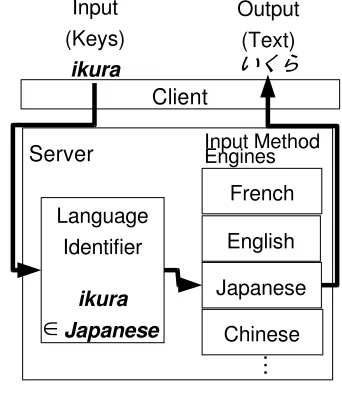
Figure 2: System Structure
twice from English to Russian and back. Note that such IME switches are also required even when the text consists only of European languages. Each Eu-ropean language has its own font and diacritic sys-tem, which are realized by using IMEs.
TypeAny solves the problem of changing IME. It is situated between the user’s key entry and various IMEs as shown in the system architecture diagram of Figure 2. The user’s key entry sequence is input to our client software. The client sends the sequence to the server which has the language identifier mod-ule. This module detects the language of the key sequence and then sends the key sequence to the ap-propriate IME2. The selected IME then converts the key entries into text of the detected language.
In our study, IMEs for European languages are built using simple transliteration: e.g., “[” typed in an English keyboard is transliterated into “¨u” of Ger-man. In contrast, the IMEs for Japanese and Chinese
2
Figure 3: Entry Flow
require a more complicated system because in these languages there are several candidate transcriptions for a key sequence. Fortunately, several existing software resources can be used for this. We use An-thy3 as the IME for Japanese. As for the IME for Chinese, we used a simple word-based pinyin-hanzi conversion system.
TypeAny restarts the language detection every time a certain delimiter appears in the user’s key se-quence. By using delimiters, the system can avoid resorting to a combinatorial search to find the bor-der between languages. Such delimiters naturally occur in natural language texts. For example, in the case of European languages, blank spaces are used to delimit words and it is unlikely that two lan-guages will be mixed within one word. In lanlan-guages such as Chinese and Japanese, blank spaces are typ-ically used to indicate that the entry software should perform conversion, thus guaranteeing that the se-quence between two delimiters will consist of only one language4. Therefore, assuming that a text frag-ment between two delimiters is written in just one language is natural for users. A text fragment be-tween two delimiters is called a token in TypeAny.
An example of the TypeAny procedure to enter
3
http://anthy.sourceforge.jp/ 4
Note that a token can consist of a sequence longer than a word, since many types of conversion software allow the con-version of multiple words at one time.
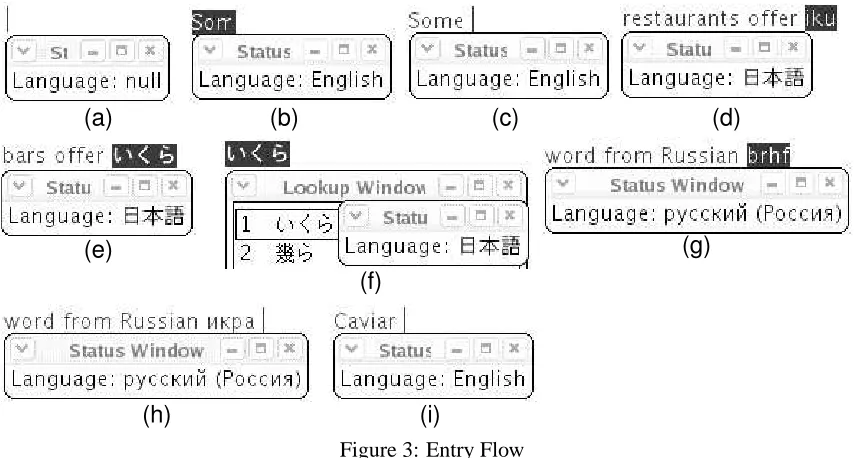
the text from Figure 15 is shown in Figure 3. In each step in Figure 3, the text is entered in the first line, where the token that the user is entering is high-lighted. The language estimated from the token is shown in the locale window shown below (called the Status Window). Each step proceeds as follows.
(a) The initial state.
(b) The user first wants to type a token “Some” in
English. When “Som” is typed, the system identifies that the entry is in English. The user confirms this language by looking at the locale window.
(c) The user finishes entering the token “Some” and
when the user enters a blank space, the token “Some” is confirmed as English text. TypeAny restarts detection for the language of the next token. The tokens up to and including “offer” are entered similarly to “Some”.
(d) The user types in a token “ikura” in Japanese.
The moment “iku” is typed, “iku” is identified as Japanese, as is confirmed by the user through the locale window.
(e) When the user finishes entering the token
“ikura” and types in a blank space, the se-quence is sent to a Japanese IME to be con-verted into “ikura”, so that a Japanese text frag-ment is obtained.
(f) Through conventional kana-kanji conversion,
5
Figure 4: When Detection Fails
the user can select the appropriate conversion of “ikura” among from candidates shown in the Lookup Window and the token is confirmed. TypeAny begins detecting the language of the next token. The tokens between “or” and “Rus-sian” are successfully identified as English in a way similar to procedures (b) and (c).
(g) The key entry “brhf” is the key sequence for the
Russian token whose English transliteration is “ikra”.
(h) Since “brhf” is identified as Russian, “brhf” is
converted into Russian characters.
(i) The following word “Caviar” is detected as
En-glish, as in (b) and (c).
As seen in this example, the user does not need to take any action to switch IMEs to enter tokens of different languages.
Two types of detection failure occur in TypeAny:
Failure A: the language should switch, but the new
language is incorrectly selected.
Failure B: the language should not switch, but
Ty-peAny misjudges that it should.
While conventional methods require a control ac-tion every time the language switches, TypeAny re-quires a control action only to correct such a failure. Therefore, Failure A never increases the number of control actions compared to that of conventional methods. On the other hand, Failure B errors are a concern as such failures might increase the num-ber of control actions to beyond the numnum-ber required by a conventional method. Thus, the effectiveness of introducing TypeAny depends on a trade-off be-tween fewer control actions at language switching points and potentially more control actions due to
Failure B errors. Our evaluation in§4.2 shows that the increase in the number of actions due to Failure
B errors is insignificant.
In the event of failures, the user can see that there is a problem by watching the locale window and
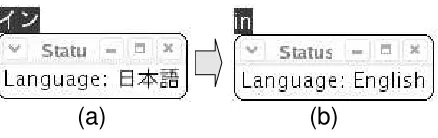
then easily correct the language by pressing the TAB key. For example, while “in” was correctly judged for our example, suppose it is incorrectly detected as Japanese as shown in Figure 4(a). In this case, the user can manually correct the locale by pressing the TAB key once. The locale is then changed from Fig-ure 4(a) (where “in” is identified as Japanese), to (b) where “in” is identified as English.
Note that the language of some tokens will be am-biguous. For example, the word “sushi” can be both English and Japanese because “sushi” has almost be-come an English word: many loan words share this ambiguity. Another case is when diacritic marks are considered: for example, the word “fur” is usually an English word, but some German users may wish to use this word as “f¨ur” without diacritic marks. Such a habit is widely seen among users of Euro-pean languages. Some of this sort of ambiguity is disambiguated by considering the context and by on-line learning, which is incorporated in the detection model as explained next.
3 Language Detection
3.1 Language Detection Model
We modeled the language detection as a hidden Markov model (HMM) process whose states corre-spond to languages and whose outputs correcorre-spond to tokens from a language.
Here, the goal is to estimate the languagesˆlm 1 by maximizingP(l1m, tm1 ), wherel ∈ Ldenotes a lan-guage inL, a set of languages, and tdenotes a to-ken6. By applying a hidden Markov model, the max-imization of P(lm1 , tm1 ) is done as shown in
Equa-In the last transformation of Equation (1), it is assumed that P(tm1 |lm1 ) ≈ Qmi=1P(ti|li) and P(li|li1−1) ≈ P(li|lii−−1k) for the first and the second
terms, respectively. In Equation (1), the first term
6 Lettv
u= (tu, tu+1, . . . , tv)be an ordered list consisting of
corresponds to the output probabilities and the sec-ond term correspsec-onds to the transition probabilities. In a usual HMM process, a system finds the lan-guage sequence (i.e., state sequence)lm1 that maxi-mizes Equation (1) by typically using a Viterbi algo-rithm. In our case, too, the system can estimate the language sequence for a sequence of tokens. How-ever, as discussed earlier, since it is unlikely that a user enters a token consisting of multiple languages, our system is designed only to estimate the language of the latest tokenlm, supposing that the languages
of the previouslm1−1are correct.
In the following two sections, the estimation of each term is explained.
3.2 Output Probabilities
The output probabilitiesP(ti|li)indicate the
proba-bilities of tokens in a monolingual corpus, and their modeling has been substantially investigated in NLP. Note that the estimation of P(ti|li) requires
monolingual corpora. If the corpora are large,
P(ti|li) is estimated from the token frequencies.
However, because large corpora are not always available, especially for minor languages, P(ti|li)
is estimated using key entry sequence probabilities based onn-grams (with maximumnbeingnmax) as
follows:
P(ti|li) =P(c|1ti||li) = |ti|
Y
r=1
P(cr|crr−−1nmax+1, li)(2)
In Equation (2),ti =c1|ti|and|ti|is the length ofti
with respect to the key entry sequence. For exam-ple, in the case ofti=“ikura”,|ti| = 5 andc1=“i”,
c2=“k”, c3=“u” and |ti|=5. Here, each probability
P(cr|crr−−1nmax+1, li)needs to be smoothed.
Values of P(ti|li) are estimated from
monolin-gual corpora. If the corpora are large, P(ti|li) is
estimated from the token frequencies. However, be-cause large corpora are not always available, espe-cially for minor languages,P(ti|li)is estimated
us-ing smoothed character-basedn-grams. Prediction by Partial Matching, or PPM is adopted for this task, since it naturally incorporates online learning and it is effective in various NLP tasks as reported in (Tea-han et al., 2000) and (Tanaka-Ishii, 2006). PPM uses cr−nmax
1 as a corpus for training. PPM is de-signed to predict the nextcrby estimating thenmax
-gram probability P(cr|crr−−1nmax+1) using
backing-off techniques with regard to the current context. Precisely, the probability is estimated as a weighted sum of different(n+ 1)-gram probabilities up to a fixednmax-gram as follows:
P(cr|crr−−1nmax+1) =
nmaxX−1
n=−1
wnpn(cr) (3)
The weights wn are determined through escape probabilities. Depending on how the escape prob-abilities are calculated, there are several PPM vari-ants, which are named PPMA, PPMB, PPMC, and so on. PPMC, the one that we have used, is also known as Witten-Bell smoothing in the NLP field (Manning and Schuetze, 1999). The escape proba-bilities are defined as follows.
wn= (1−en) nYcont
n0=n+1
en0 (−1≤n < ncont)(4)
wncont= (1−en)
Here,ncont is defined as the maximumnthat
satis-fiesXn 6= 0. LetXn be the number ofcrr−−1n,xnbe
the number ofcrr−nandqnbe the number of
differ-ent keycodes followed bycrr−−1nfound incr1−n−1. Using these notations,pn(cr)is defined as
pn(cr) =
xn
Xn (5)
In PPMC, the escape probabilities are calculated as
en= X qn
n+qn (6)
For further details, see (Bell et al., 1990).
3.3 Language Transition Probabilities
Only a small corpus is typically available to esti-mateP(lm|lmm−−1kmax+1), wherekmax is the longest
k-gram in the language sequence to be considered. Thus, the transition probability is estimated on-line, making use of language that will be corrected inter-actively by the user. For this on-line learning, we adopted PPM as well as the output probabilities.
Note that a large kmax may reduce accuracy,
which is intuitively explained as follows. While there is typically a high probability that the subse-quent language will be the same as the current lan-guage, it is unlikely that any language sequence will have long regular patterns. Therefore,kmaxshould
0 20 40 60 80 100
2 3 4 5 6 7 8
Accuracy (%)
Number of languages PPM
ML baseline
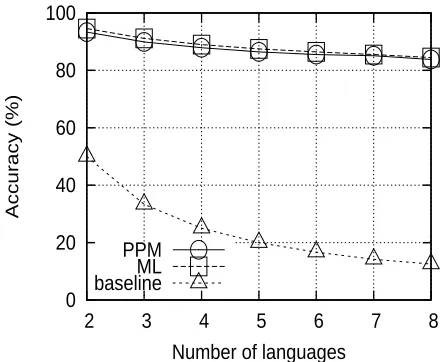
Figure 5: Detection Accuracy Test1
75 80 85 90 95 100
2 3 4 5 6 7 8
Accuracy (%)
Number of languages PPM
ML baseline
Figure 6: Detection Accuracy Test2
4 Evaluation
We evaluated TypeAny with respect to two mea-sures: language detection capability when using arti-ficially generated multilingual corpora, and the num-ber of required control actions when using actual multilingual corpora.
4.1 Language Detection Accuracy
The ideal experiment would be to use actual multi-lingual corpora for many language sets. However, it is still difficult to collect a large amount of multilin-gual corpora with adequate quality for the test data of languages.
Therefore, we measured the language detection accuracies using artificially generated multilingual corpora by mixing monolingual corpora for every combination varying from two to eight languages.
First, the following monolingual corpora were collected: editions of the Mainichi newspaper in 2004 for Japanese, the Peking University corpus for Chinese, and the Leipzig corpora (Biemann et al., 2007) for English, French, German, Estonian, Finnish and Turkish. The text of each of these cor-pora was transformed into a sequence of key entries. Two test sets, Test1 and Test2, were generated by using different mixture rates. In Test1, languages were mixed uniformly and randomly, whereas in Test2 a major language accounted for 90% of the text and the remaining 10% included different lan-guages chosen uniformly and randomly. Test2 is more realistic since a document is usually composed
in one major language.
The output and language transition probabilities were estimated and smoothed using PPMC as de-scribed in§3. Since part of the target of the exper-iment was to clarify the relation between learning size and accuracy, the output probabilities and tran-sition probabilities were not trained on-line while the text was entered using PPMC, thus accuracy was measured by fixing the language model at this initial state. We usednmax = 5for the output probability
andkmax= 1for the transition probability since the
distribution of languages in the corpus was uniform here as we generated it uniformly. (See formula (4) in§3.2).
A 10-fold cross validation was applied to the gen-erated corpora. Each generated corpus was 111 Kbytes in size, consisting of a disjoint 100-Kbyte training part and an 11-Kbyte testing part. The out-put probabilities were trained using the 100-Kbyte training part. The language transition probabilities were trained using about 2000 tokens.
As shown in Figure 5 (Test1), when the mix-ture was uniform, the PPM performance was slightly lower but very close to that of ML. This was because PPM would be theoretically equivalent to ML with infinite learning of language transition probabilities, since languages were uniformly distributed in Test1. These results show that our PPM for transition prob-abilities learns this uniformity in Test1.
As shown in Figure 6, PPM clearly outperformed ML in Test2. This was because ML has no way to learn the transition probability, which was biased with the major language being used 90% of the time. This shows that the introduction of language transi-tion probabilities accounts for higher performance. Interestingly, ML falls below the baseline case when more than three languages were used in Test2, a sit-uation that has rarely been considered in previous studies. This suggests that language detection using only ML requires large corpora for learning to select one appropriate language, and that this requirement can be alleviated by using PPM.
Another finding is that the detection accuracy de-pends on the language set. For example, the accu-racy for language sets consisting of both French and English tended to be lower than for other language sets due to the spelling closeness between these two languages. For example, the accuracy for test data consisting of 90% English, 5% French and 5% Ger-man was 94.4%. This is not surprising since the de-tection was made only within a token (which cor-responds to a word in European languages): natu-rally there were many words whose language was ambiguous within the test set. In contrast, high ac-curacies were obtained for test sets consisting of lan-guages more different in their nature. We obtained 97.5% accuracy for test data consisting of 90% En-glish, 5% Finnish and 5% Turkish; this accuracy was higher than the average for all test sets.
4.2 Number of Control Actions
The second evaluation was done to compare the number of control actions needed to switch lan-guages with TypeAny and with a conventional method. As mentioned in §1, three types of key-board actions are used when entering text. Our work
7E.: English, J.: Japanese and C.: Chinese. 8
http://en.wikitravel.org/ 9
http://en.wikipedia.org/
Table 1: Articles Used in the Decrease Test
article Article 1 Article 2
Foreign tokens 286 55
Total tokens 1725 5100
Inclusion ratio 16.6% 1.1% languages E., J. E., J., C.7
content Introduction
of Japanese phrases for traveling
About tofu (bean curd)
Source Wikitravel8 Wikipedia9
Table 2: Required Number of Control Actions
Article 1 Article 2
Conventional 572 110
Number of switches (100%) (100%)
Ours Failure A 2.8% 3.6%
Failure B 1.6% 2.7%
Total Failures 4.4% 6.3%
Decrease 95.6% 93.6%
only concerns the control action to switch language, though, and the comparison in this section focuses on this type of action.
This evaluation was done using two samples of actual multilingual text collected from the Web. The features of these samples are shown in the top block of Table 1. In both cases, the major language was English.
For each of these articles, the number of con-trol actions required with the conventional method and with TypeAny was measured. The conventional method requires a control action every time the lan-guage switches. For TypeAny, control actions are re-quired only to correct language detection failures. In both cases, the action required to switch languages or correct the language was counted as one action.
transition probabilities were trained on-line using PPMC while the text was entered. Here, bothnmax
andkmaxwere set at 5.
The results are shown in Table 2. First, some de-tection errors occurred for Article 2 because “tofu” was detected as Japanese at the beginning of entry, even though it was used as an English word in the original text. As noted at the end of§2, such loan words can cause errors. However, since our system uses PPM and learns on-line, our system learned that “tofu” had to be English, and such detection errors occurred only at the beginning of the text.
Consequently, there was a substantial decrease in the number of necessary control actions with Ty-peAny, over 93%, for both articles. An especially large decrease was observed for Article 2, even though the text was almost all in English (98.9%). There was only a small increase in the incidence rate of Failure B for Article 2, so the total decrease in the number of required actions was still large, putting to rest the concern discussed in §2. These results demonstrate the effectiveness of our approach.
5 Conclusion
TypeAny is a novel multilingual text input interface in which the languages used for entries are detected automatically. We modeled the language detection as an HMM process whose transition probabilities are estimated by on-line learning through the PPM method.
This system achieved language detection accu-racy of 96.7% in an evaluation where it had to choose the appropriate language from among three languages with the major language accounting for 90% of the sample. In addition, the number of con-trol actions required to switch IMEs was decreased by over 93%. These results show the promise of our system and suggest that it will work well under real-istic circumstances.
An interesting objection might be raised to the conclusions of this study: some users might find it difficult to watch the locale window all the time and prefer the conventional method despite having to work with a large number of key types. We plan to examine and clarify the cognitive load of such users in our future work.
References
B. Alex, A. Dubey, and F. Keller. 2007. Using foreign in-clusion detection to improve parsing performance. In
Proceedings of EMNLP-CoNLL, Prague, Czech, June.
B. Alex. 2005. An unsupervised system for identifying English inclusions in German text. In Proceedings of
the ACL Student Research Workshop, pages 133–138,
Ann Arbor, Michigan, June. Association for Compu-tational Linguistics.
T. C. Bell, J. G. Clear, and I. H. Witten. 1990. Text
Com-pression. Prentice-Hall, New Jersey.
C. Biemann, G. Heyer, U. Quasthoff, and M. Richter. 2007. The Leipzig corpora collection - monolingual corpora of standard size. In Proceedings of Corpus
Linguistics, Birmingham, United Kingdom, July.
Z. Chen and K. Lee. 2000. A new statistical approach to Chinese input. In The 38th Annual Meeting of the
Association for Computer Linguistics, pages 241–247,
Hong Kong, October.
I. S. MacKenzie and K. Tanaka-Ishii. 2007. Text Entry
Systems —Mobility, Accessibility, Universality–.
Mor-gan Kaufmann.
C. D. Manning and H. Schuetze. 1999. Foundations of
Statistical Natural Language Processing. MIT Press.
J.-C. Marcadet, V. Fischer, and C. Waast-Richard. 2005. A transformation-based learning approach to language identification for mixed-lingual text-to-speech synthe-sis. In Interspeech 2005 - ICSLP, pages 2249–2252, Lisbon, Portugal.
K. N. Murthy and G. B. Kumar. 2006. Language identi-fication from small text samples. Journal of
Quantita-tive Linguistics, 13:57–80.
B. Pfister and H. Romsdorfer. 2003. Mixed-lingual anal-ysis for polyglot TTS synthesis. In Eurospeech, pages 2037–2040, Geneva, Switzerland.
K. Tanaka-Ishii. 2006. Word-based text entry techniques using adaptive language models. Journal of Natural
Language Engineering, 13(1):51–74.
W. J. Teahan, Y. Wen, R. MacNab, and I. H. Witten.
2000. A compression-based algorithm for Chinese
word segmentation. In Computational Linguistics,