Modeling Context in Scenario Template Creation
Long Qiu, Min-Yen Kan, Tat-Seng Chua Department of Computer Science National University of Singapore
Singapore, 117590
{qiul,kanmy,chuats}@comp.nus.edu.sg
Abstract
We describe a graph-based approach to Sce-nario Template Creation, which is the task of creating a representation of multiple re-lated events, such as reports of different hur-ricane incidents. We argue that context is valuable to identify important, semantically similar text spans from which template slots could be generalized. To leverage context, we represent the input as a set of graphs where predicate-argument tuples are ver-tices and their contextual relations are edges. A context-sensitive clustering framework is then applied to obtain meaningful tuple clus-ters by examining their intrinsic and extrin-sic similarities. The clustering framework uses Expectation Maximization to guide the clustering process. Experiments show that: 1) our approach generates high quality clus-ters, and 2) information extracted from the clusters is adequate to build high coverage templates.
1 Introduction
Scenario template creation (STC) is the problem of generating a common semantic representation from a set of input articles. For example, given multiple newswire articles on different hurricane incidents, an STC algorithm creates a template that may in-clude slots for the storm’s name, current location, di-rection of travel and magnitude. Slots in such a sce-nario template are often to be filled by salient entities in the scenario instance (e.g., “Hurricane Charley”
or “the coast area”) but some can also be filled by prominent clauses, verbs or adjectives that describe these salient entities. Here, we use the termsalient aspect (SA) to refer to any of such slot fillers that people would regard as important to describe a par-ticular scenario. Figure 1 shows such a manually-built scenario template in which details about im-portant actions, actors, time and locations are coded as slots.
STC is an important task that has tangible bene-fits for many downstream applications. In the Mes-sage Understanding Conference (MUC), manually-generated STs were provided to guide Information Extraction (IE). An ST can also be viewed as reg-ularizing a set of similar articles as a set of at-tribute/value tuples, enabling multi-document sum-marization from filled templates.
Despite these benefits, STC has not received much attention by the community. We believe this is because it is considered a difficult task that re-quires deep NL understanding of the source articles. A problem in applications requiring semantic simi-larity is that the same word in different contexts may have different senses and play different roles. Con-versely, different words in similar contexts may play similar roles. This problem makes approaches that rely on word similarity alone inadequate.
use neighboring or syntactically related words as contextual evidence, we define contexts by semantic relatedness which extends beyond sentence bound-aries. Figure 2 illustrates a case in point with two excerpts from severe storm reports. Here, although the intrinsic similarity of the main verbs “hit” and “land” is low, their contextual similarity is high as both are followed by clauses sharing similar subjects (hurricanes) and the same verbs. Our approach en-codes such contextual information as graphs, map-ping the STC problem into a general graph overlay problem that is solvable by a variant of Expectation Maximization (EM).
Our work also contributes resources for STC re-search. Until now, few scenario templates have been publicly available (as part of MUC), rendering any potential evaluation of automated STC statistically insignificant. As part of our study, we have com-piled a set of input articles with annotations that we are making available to the research community.
Scenario Template: Storm
Storm Name Charley
Storm Action landed
Location Florida’s Gulf coast
Time Friday at 1950GMT
Speed 145 mph
Victim Category 1 13 people
Action died
Victim Category 2 over one million
Action affected
Figure 1: An example scenario template (filled).
2 Related Work
A natural way to automate the process of STC is to cluster similar text spans in the input article set. SAs then emerge through clustering; if a cluster of text spans is large enough, the aspects contained in it will be considered as SAs. Subsequently, these SAs will be generalized into one or more slots in the template, depending on the definition of the text span. As-suming scenarios are mainly defined by actions, the focus should be on finding appropriate clusters for text spans each of which represents an action. Most of the related work (although they may not directly address STC) shares this assumption and performs
Charley landed further south on Florida’s Gulf coast than predicted, ... The hurricane ... has weakened and is moving over South Carolina.
At least 21 others are missing after the storm
hit on Wednesday. .... But Tokage had
weakened by the time it passed over Japan’s capital, Tokyo, where it left little damage be-foremovingout to sea.
Figure 2: Contextual evidence of similarity. Curved lines indicate similar contexts, providing evidence that “land” and “hit” from two articles are semanti-cally similar.
action clustering accordingly. While the target ap-plication varies, most systems that need to group text spans by similarity measures are verb-centric.
In addition to the verb, many systems expand their representation by including named entity tags (Collier, 1998; Yangarber et al., 2000; Sudo et al., 2003; Filatova et al., 2006), as well as restrict-ing matches (usrestrict-ing constraints on subtrees (Sudo et al., 2003; Filatova et al., 2006), predicate argument structures (Collier, 1998; Riloff and Schmelzen-bach, 1998; Yangarber et al., 2000; Harabagiu and Maiorano, 2002) or semantic roles).
Given these representations, systems then cluster similar text spans. To our knowledge, all current systems use a binary notion of similarity, in which pairs of spans are either similar or not. How they de-termine similarity is tightly coupled with their text span representation. One criterion used is pattern overlap: for example, (Collier, 1998; Harabagiu and Lacatusu, 2005) judge text spans to be similar if they have similar verbs and share the same verb argu-ments. Working with tree structures, Sudo et al. and Filatova et al. instead require shared subtrees.
lexical similarity but threshold it to obtain binary judgments. Systems then rank clusters by cluster size and correlation with the relevant article set and equate top clusters as output scenario slots.
3 Context-Sensitive Clustering (CSC) Automating STC requires handling a larger degree of variations than most previous work we have sur-veyed. Note that the actors involved in actions in a scenario generally differ from event to event, which makes most related work on text span similarity cal-culation unsuitable. Also, action participants are not limited to named entities, so our approach needs to process all NPs. As both actions and actors may be realized using different words, a similarity thesaurus is necessary. Our approach to STC uses a thesaurus based on corpus statistics (Lin, 1998) for real-valued similarity calculation. In contrast to previous ap-proaches, we do not threshold word similarity re-sults; we retain their fractional values and incorpo-rate these values holistically. Finally, as the same action can be realized in different constructions, the semantic (not just syntactic) roles of verb arguments must be considered, lest agent and patient roles be confused. For these reasons, we use a semantic role labeler (Pradhan et al., 2004) to provide and delimit the text spans that contain the semantic arguments of a predicate. We term the obtained text spans as
predicate argument tuples (tuples) throughout the paper. The semantic role labeler reportedly achieves an F1 measure equal to 68.7% on identification-classification of predicates and core arguments on a newswire text corpus (LDC, 2002). Within the con-fines of our study, we find it is able to capture most of the tuples of interest.
Our approach explicitly captures contextual ev-idence. We define a tuple’s contexts as other tu-ples in the same article segment where no topic shift occurs. This definition refines the n-surrounding word constraint commonly used in spelling correc-tion (for example, (Hirst and Budanitsky, 2005)), Word Sense Disambiguation ((Preiss, 2001), (Lee and Ng, 2002), for instance), etc. while still en-sures the relatedness between a tuple and its con-texts. Specifically, a tuple is contextually related to other tuples by two quantifiable contextual relations:
argument-similarityandposition-similarity. For our
experiments, we use the leads of newswire articles as they normally summarize the news. We also as-sume a lead qualifies as a single article segment, thus making all of its tuples as potential contexts to each other.
Figure 3: Being similar contexts, “weakened” and “moving” provide contextual evidence that “land” and “hit” are similar.
First, we split the input article leads into sentences and perform semantic role labeling immediately af-terwards. Our system could potentially benefit from additional pre-processing such as co-reference reso-lution. Currently these pre-processing steps have not been properly integrated with the rest of the system, and thus we have not yet measured their impact.
We then transform each leadAiinto a graphGi=
{Vi, Ei}. As shown in Figure 3, vertices Vi = {vi
j}(j = 1, ..., N) are the N predicate argument
tuples extracted from the ith article, and directed
edges Ei = {ei
m,n = (vim, vin)} reflect contextual
relations between tuplevimandvin. Edges only
con-nect tuples from the same article, i.e., within each graph Gi. We differentiate between two types of
edges. One is argument-similarity, where the two tuples have semantically similar arguments. This models tuple cohesiveness, where the edge weight is determined by the similarity score of the most sim-ilar inter-tuple argument pair. The other is position-similarity, represented as the offset of the ending tu-ple with respect to the other, measured in sentences. This edge type is directional to account for simple causality.
an optimal clustering. This process assigns tuples to suitable clusters where they are semantically similar and share similar contexts with other tuples. Algo-rithm 1 outlines this alignment process.
Algorithm 1Graph Alignment(G) /*Gis a set of graph{Gi}*/
T←all tuples inG
C←highly cohesive tuples clusters
other←remaining tuples semantically connected withC C[C.length]←other
repeat /*E step*/
for eachisuch thati < C.lengthdo
for eachjsuch thatj < C.lengthdo
ifi==jthen
continue;
re-estimate parameters[C[i], C[j]] /*distribution
parameters of edges between two clusters*/
tupleReassigned=f alse/*reset*/
/*M step*/
for eachisuch thati < T.lengthdo
aBestLikelihood=T[i].likelihood; /*likelihood of
being in its current cluster*/
for each tuple tcontxt that contextually related with
T[i]do
for each clusterccand, any candidate cluster that
contextually related withtcontxt.clusterdo
P(T[i]∈ccand) =comb(Ps, Pc)
likelihood=log(P(T[i]∈ccand))
iflikelihood > aBestLikelihoodthen aBestLikelihood=likelihood T[i].cluster=ccand
tupleReassigned=true
untiltupleReassigned==f alse/*alignment stable*/
return
During initialization, tuples whose pairwise simi-larity higher than a thresholdτ are merged to form
highly cohesive seed clusters. To compute a con-tinuous similarity Sim(ta, tb) of tuples ta and tb,
we use the similarity measure described in (Qiu et al., 2006), which linearly combines similarities be-tween the semantic roles shared by the two tuples. Some other tuples are related to these seed clus-ters byargument-similarity. These related tuples are temporarily put into a special “other” cluster. The cluster membership of these related tuples, together with those currently in the seed clusters, are to be further adjusted. The “other” cluster is so called be-cause a tuple will end up being assigned to it if it is not found to be similar to any other tuple. Tuples that are neither similar to nor contextually related by
argument-similarityto another tuple are termed sin-gletonsand excluded from being clustered.
We then iteratively (re-)estimate clusters of tuples
across the set of article graphsG. In the E-step of the
EM algorithm, all contextual relations between each pair of clusters are collected as two set of edges. Here we assume argument-similarity and position-similarity are independent and thus we differenti-ate them in the computation. Accordingly, there are two sets: edgesas andedgesps. For simplicity,
we assume independent normal distributions for the strength of each set (inter-tuple argument similarity foredgesasand sentence distance foredgesps). The
edge strength distribution parameters for both sets between each pair of clusters are re-estimated based on current edges inedgesasandedgesps.
In the M-step, we examine each tuple’s fitness for belonging to its cluster and relocate some tuples to new clusters to maximize the likelihood given the latest estimated edge strength distributions. In the following equations, we denote the proposition that
predicate argument tupletabelongs to clustercmas ta∈cm; a typical tuple (the centroid) of the cluster cmastcm; and the cluster oftaascta. The objective
function to maximize is:
Obj(G) = X
Equation 2 takes the harmonic mean of two factors: a contextual factorPcand and a semantic factorPs:
Pc(ta∈cm) =max{P(edges(ta, tb)|
Here the contextual factor Pcmodels how likely ta belongs tocm according to the contextual
infor-mation, i.e., the conditional probability of the con-textual relations betweencm andctb given the
con-textual relations betweentaand one particular
con-texttb, which maximizes this probability.
Accord-ing to Bayes’ theorem, it is computed as shown in Equation 3. In practice, we multiply two conditional probabilities: P(edgeas(ta, tb)|edgesas(cm, ctb))
and P(edgeps(ta, tb)|edgesps(cm, ctb)), assuming
independence betweenedgesasandedgesps.
are dissimilar to each other, we set simdef ault to
a small nonzero value in Equation 4 to prevent the “other” cluster from expelling them based on their low semantic similarity. Tuples’ cluster member-ships are recalculated, and the parameters describ-ing the contextual relations between clusters are re-estimated. New EM iterations are performed as long as one or more tuple relocations occur. Once the EM halts, clusters of equivalent tuples are formed. Among these clusters, some correspond to salient actions that, together with their actors, are all SAs to be generalized into template slots. Cluster size is a good indicator of salience, and each large clus-ter (excluding the “other” clusclus-ter) can be viewed as containing instances of a salient action.
Formulating the clustering process as a variant of iterative EM is well-motivated as we consider the similarity scores as noisy and having missing obser-vations. Calculating semantic similarity is at best inaccurate. Thus it is difficult to cluster tuples cor-rectly based only on their semantic similarity. Also to check whether a tuple shares contexts with a clus-ter of tuples, the clusclus-ter has to be relatively clean. An iterative EM as we have proposed naturally im-prove the cleanness of these tuple clusters gradually as new similarity information comes to light.
4 Evaluation
For STC, we argue that it is crucial to cluster tuples with high recall so that an SA’s various surface forms can be captured and the size of clusters can serve as a salience indicator. Meanwhile, precision should not be sacrificed, as more noise will hamper the downstream generalization process which outputs template slots. We conduct experiments designed to answer two relevant research questions: 1) Cluster Quality: Whether using contexts (in CSC) produces better clustering results than ignor-ing it (in the K-means baseline); and
2) Template Coverage: Whether slots generalized from CSC clusters cover human-defined templates.
4.1 Data Set and Baseline
A straightforward evaluation of a STC system would compare its output against manually-prepared gold standard templates, such as those found in MUC.
Unfortunately, such scenario templates are severely limited and do not provide enough instances for a proper evaluation. To overcome this problem, we have prepared a balanced news corpus, where we have manually selected articles covering 15 scenar-ios. Each scenario is represented by a total of 45 to 50 articles which describe 10 different events.
Our baseline is a standard K-means clusterer. Its input is identical to that of CSC – the tuples tracted from relevant news articles and are not ex-cluded from being clustered by CSC in the initial-ization stage (refer to Section 3) – and employs the same tuple similarity measure (Qiu et al., 2006). The differentiating factor between CSC and K-means is the use of contextual evidence. A standard K-means clusterer requires ak to be specified. For each
sce-nario, we set itsk as the number of clusters
gener-ated by CSC for direct comparison.
We fix the test set for each scenario as ten ran-domly selected news articles, each reporting a dif-ferent instance of the scenario; the development set (which also serves as the training set for determin-ing the EM initialization thresholdτ andsimdef ault
in Equation 4) is a set of ten articles from the “Air-linerCrash” scenario, which are excluded from the test set. Both systems analyze the first 15 sentences of each article, and sentences generate 2 to 3 predi-cate argument tuples on average, resulting in a total of 10×15 ×(2 to 3) = 300 to 450 tuples for each
scenario.
4.2 Cluster Quality
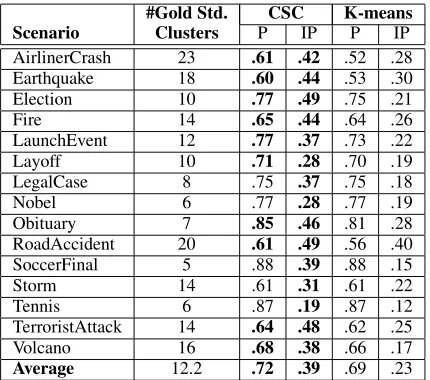
This experiment compares the clustering results of CSC and K-means. We use the standard cluster-ing metrics of purity and inverse purity (Hotho et al., 2003). The first author manually constructed the gold standard clusters for each scenario using a GUI before conducting any experiments. A special clus-ter, corresponding to the “other” cluster in the CSC clusters, was created to hold the singleton tuples for each scenario. Table 1 shows this under the column “#Gold Standard Clusters”.
P scores, the IP scores of CSC are all significantly higher than that of K-means. This suggests clus-ters tend to be split apart more in K-means than in CSC when they have similar purity. One thing worth mentioning here is that the “other” cluster normally is relatively large for each scenario, and thus may skew the results. To remove this effect, we excluded tuples belonging to the CSC “other” cluster from the K-means input, generating one fewer cluster. Run-ning the evaluation again, the resulting P-IP scores again show that CSC outperforms the baseline K-means. We only report the results for all tuples in our paper for simplicity.
#Gold Std. CSC K-means Scenario Clusters P IP P IP AirlinerCrash 23 .61 .42 .52 .28 Earthquake 18 .60 .44 .53 .30 Election 10 .77 .49 .75 .21 Fire 14 .65 .44 .64 .26 LaunchEvent 12 .77 .37 .73 .22 Layoff 10 .71 .28 .70 .19 LegalCase 8 .75 .37 .75 .18
Nobel 6 .77 .28 .77 .19
Obituary 7 .85 .46 .81 .28 RoadAccident 20 .61 .49 .56 .40 SoccerFinal 5 .88 .39 .88 .15
Storm 14 .61 .31 .61 .22
Tennis 6 .87 .19 .87 .12
TerroristAttack 14 .64 .48 .62 .25 Volcano 16 .68 .38 .66 .17 Average 12.2 .72 .39 .69 .23
Table 1: CSC outperforms K-means with respect to the purity (P) and inverse purity (IP) scores.
A close inspection of the results reveals some problematic cases. One issue worth mentioning is that for certain actions both CSC and K-means pro-duce split clusters. In the CSC case, we traced this problem back to the thesaurus, where predicates for one action seem to belong to two or more totally dis-similar semantic categories. The corresponding tu-ples are thus assigned to different clusters as their low semantic similarity forces the tuples to remain separate, despite the shared contexts trying to join them. One example is “blast (off)” and “lift (off)” in the “Launch Event” scenario. The thesaurus shows the two verbs are dissimilar and the corresponding tuples end up being in two split clusters. This can not be solved easily without an improved thesaurus. We are considering adding a prior to model the
op-timal size for clusters, which may help to compact such cases.
4.3 Template Coverage
We also assess how well the resulting, CSC-generated tuple clusters serve in creating good sce-nario template slots. We start from the top largest clusters from each scenario, and decompose each of them into six sets: the predicates, agents, pa-tients, predicate modifiers, agent modifiers and pa-tient modifiers. For each of the first three sets for each cluster, we create a generalized term to repre-sent it using an extended version of a generaliza-tion algorithm (Tseng et al., 2006). These terms are deemed output slots, and are put into the tem-plate with their agent-predicate-patient relations pre-served. The size of the template may increase when more clusters are generalized, as new slots may re-sult.
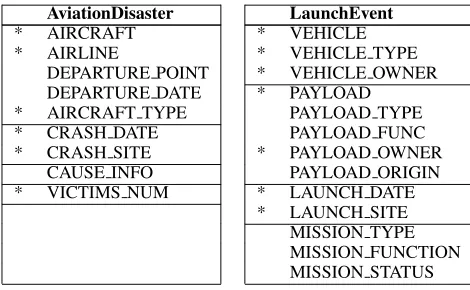
We manually compare the slots that are output from the system with those defined in existing sce-nario templates in MUC. The results here are only indicative and not conclusive, as there are only two MUC7 templates available for comparison:Aviation DisasterandLaunch Event.
Template semantic role general term action crash
cluster 1 agent aircraft
patient —
action kill
cluster 2 agent heavier-than-air-craft
patient people
Figure 4: Automated scenario template of “Avia-tionDisaster”.
Figure 4 shows an excerpt of the automatically generated template “AviationDisaster” (“Airliner-Crash” in our corpus) where the semantic roles in the top two biggest clusters have been generalized. Their modifiers are quite semantically diverse, as shown in Table 2. Thus, generalization (probably after a categorization operation) remains as a chal-lenging problem.
human-semantic role modifier head samples
agent:aircraft A, U.N., The, Swiss, Canadian-built, AN, China, CRJ-200, mil-itary, Iranian, Air, refueling, US, ...
action:crash Siberia, mountain, rain, Tues-day, flight, Sharjah, flames, Sun-day, board, SaturSun-day, 225, Rock-away, approach, United, moun-tain, hillside
patient:people all, 255, 71
Table 2: Sample automatically detected modifier heads of different semantic roles.
AviationDisaster LaunchEvent
* AIRCRAFT * VEHICLE
* AIRLINE * VEHICLE TYPE
DEPARTURE POINT * VEHICLE OWNER DEPARTURE DATE * PAYLOAD * AIRCRAFT TYPE PAYLOAD TYPE
* CRASH DATE PAYLOAD FUNC
* CRASH SITE * PAYLOAD OWNER CAUSE INFO PAYLOAD ORIGIN * VICTIMS NUM * LAUNCH DATE
* LAUNCH SITE MISSION TYPE MISSION FUNCTION MISSION STATUS
Figure 5: MUC-7 template coverage: asterisks marking all the slots that could be automatically generated.
defined scenario templates quite well. The two MUC7 templates are shown as a list of slots in Fig-ure 5, where horizontal lines delimit slots about dif-ferent semantic roles, and asterisks mark all the slots that could be automatically generated by our system once it has an improved generalizer. We can see substantial amount of overlap, indicating that a STC system powered by CSC is able to capture scenarios’ important facts.
5 Conclusion
We have introduced a new context-sensitive ap-proach to the scenario template creation (STC) prob-lem. Our method leverages deep NL processing, us-ing semantic role labeler’s structured semantic tu-ples as input. Despite the use of deeper semantics, we believe that intrinsic semantic similarity by itself
is not sufficient for clustering. We have shown this through examples and argue that an approach that considers contextual similarity is necessary. A key aspect of our work is the incorporation of such con-textual information. Our approach uses a notion of context that combines two aspects: positional simi-larity (when two tuples are adjacent in the text), and argument similarity (when they have similar argu-ments). The set of relevant articles are represented as graphs where contextual evidence is encoded.
By mapping our problem into a graphical formal-ism, we cast the STC clustering problem as one of multiple graph alignment. Such a graph alignment is solved by an adaptation of EM, which handles con-texts and real-valued similarity by treating both as noisy and potentially unreliable observations.
While scenario template creation (STC) is a ficult problem, its evaluation is arguably more dif-ficult due to the dearth of suitable resources. We have compiled and released a corpus of over 700 newswire articles that describe different instances of 15 scenarios, as a suitable input dataset for further STC research. Using this dataset, we have evaluated and analyzed our context-sensitive approach. While our results are indicative, they show that considering contextual evidence improves performance.
Acknowledgments
The authors are grateful to Kathleen R. McKeown and Elena Filatova at Columbia University for their stimulating discussions and comments over different stages of the preparation of this paper.
References
Robin Collier. 1998. Automatic Template Creation for Information Extraction. Ph.D. thesis, University of Sheffield, UK.
A.P. Dempster, N.M. Laird, and D.B. Rubin. 1977. Max-imum likelihood from incomplete data via the EM al-gorithm.JRSSB, 39:1–38.
Elena Filatova, Vasileios Hatzivassiloglou, and Kathleen McKeown. 2006. Automatic creation of domain tem-plates. InProceedings of the COLING/ACL ’06. Sanda M. Harabagiu and V. Finley Lacatusu. 2005.
Sanda M. Harabagiu and S. J. Maiorano. 2002. Multi-document summarization with GISTEXTER. In Pro-ceedings of LREC ’02.
Graeme Hirst and Alexander Budanitsky. 2005. Cor-recting real-word spelling errors by restoring lexical cohesion. Natural Language Engineering, 11(1). Andreas Hotho, Steffen Staab, and Gerd Stumme. 2003.
WordNet improves text document clustering. In Pro-ceedings of the SIGIR 2003 Semantic Web Workshop. LDC. 2002. The aquaint corpus of english news text,
catalog no. LDC2002t31.
Yoong Keok Lee and Hwee Tou Ng. 2002. An empiri-cal evaluation of knowledge sources and learning algo-rithms for word sense disambiguation. InProceedings of EMNLP ’02.
Dekang Lin. 1998. Automatic retrieval and clustering of similar words. InProceedings of COLING/ACL ’98. Sameer Pradhan, Wayne Ward, Kadri Hacioglu, James
Martin, and Dan Jurafsky. 2004. Shallow semantic parsing using support vector machines. In Proceed-ings of HLT/NAACL ’04.
Judita Preiss. 2001. Local versus global context for wsd of nouns. InProceedings of CLUK4.
Long Qiu, Min-Yen Kan, and Tat-Seng Chua. 2006. Paraphrase recognition via dissimilarity significance classification. InProceedings of EMNLP ’06.
Ellen Riloff and M. Schmelzenbach. 1998. An empiri-cal approach to conceptual case frame acquisition. In Proceedings of WVLC ’98.
Kiyoshi Sudo, Satoshi Sekine, and Ralph Grishman. 2003. An improved extraction pattern representation model for automatic IE pattern acquisition. In Pro-ceedings of ACL ’03.
Yuen-Hsien Tseng, Chi-Jen Lin, Hsiu-Han Chen, and Yu-I Lin. 2006. Toward generic title generation for clus-tered documents. InProceedings of AIRS ’06. Roman Yangarber, Ralph Grishman, Pasi Tapanainen,