Using Lexical and Dependency Features to Disambiguate Discourse
Connectives in Hindi
Rohit Jain, Himanshu Sharma, Dipti Misra Sharma
FC Kohli Center on Intelligent Systems (KCIS)International Institute of Information Technology - Hyderabad Telangana, India
[email protected], [email protected], [email protected]
Abstract
Discourse parsing is a challenging task in NLP and plays a crucial role in discourse analysis. To enable discourse analysis for Hindi, Hindi Discourse Relations Bank was created on a subset of Hindi TreeBank. The benefits of a discourse analyzer in auto-mated discourse analysis, question summarization and question answering domains has motivated us to begin work on a discourse analyzer for Hindi. In this paper, we focus on discourse connective identification for Hindi. We explore various available syntactic features for this task. We also explore the use of dependency tree parses present in the Hindi TreeBank and study the impact of the same on the performance of the system. We report that the novel dependency features introduced have a higher impact on precision, in comparison to the syntactic features previously used for this task. In addition, we report a high accuracy of 96% for this task.
Keywords:Discourse analysis, Discourse connective identification, Hindi
1.
Introduction
Units within a piece of text are not meant to be understood independently but understood by linking them with other units in the text. These units may be clauses, sentences or even complete paragraphs. Establishing relations between units present in a text allows the text to be semantically well structured and understandable. Understanding the internal structure of text and the identification of discourse relations is called discourse analysis.
The Hindi Discourse Relation Bank (Prasad et al., 2008b; Oza et al., 2009; Kolachina et al., 2012) was created to en-able discourse analysis and research beyond sentence-level for Hindi. Similar discourse annotation projects for En-glish (Miltsakaki et al., 2004; Prasad et al., 2008a), Chi-nese (Xue, 2005; Zhou and Xue, 2012), Czech (Mladov´a et al., 2008; Pol´akov´a et al., 2013) and Turkish (Zeyrek and Webber, 2008; Zeyrek et al., 2010) have also been carried out.
A fully automated discourse analyzer would thus greatly aid discourse analysis and NLP applications such as text summarization and question answering. The benefits of a fully automated discourse analyzer has led us to work to-wards the same for Hindi.
Given a text, a discourse analyzer would mark the pres-ence discourse relations between two spans of text in a discourse. The presence of discourse relations are often marked by the presence of discourse connectives. Such dis-course relations are called Explicit disdis-course relations, and those whose presence is not marked by discourse connec-tives are called Implicit discourse relations.
Thus the first component towards a complete discourse an-alyzer would be discourse connective identifier. Our work involves identification of discourse connectives which are explicitly realized i.e explicit connectives.
In this paper we experiment with lexical and syntactic fea-tures and study their performance for this task. In addition to these features we attempt to make use of the dependency
tree parses in the Hindi TreeBank (Begum et al., 2008) and interpolated models to further improve performance. We report a high accuracy of 96% for this task and also report significant improvements in performance because of novel dependency features.
The rest of the paper is organized as follows. Section 2. briefly introduces HDRB and describes the task. We dis-cuss related work and our approach in Section 3. Experi-ments and results are presented in Section 4. Finally, we conclude in Section 5.
2.
Corpus and Task description
2.1.
Hindi Discourse Relation Bank
The Hindi Discourse Relation Bank(HDRB) was previ-ously created broadly following the lines of Penn Dis-course TreeBank (PDTB)(Miltsakaki et al., 2004; Prasad et al., 2008a)’s lexically grounded approach along with a modified annotation workflow, additional grammatical categories for explicit connectives, semantically driven Arg1/Arg2 labelling and modified sense hierarchies.(Oza et al., 2009; Kolachina et al., 2012)
HDRB was annotated on a subset of the Hindi TreeBank (Begum et al., 2008) which includes part-of-speech, chunk and dependency parse tree annotations. In comparison, Penn TreeBank (Marcus et al., 1993) has parts-of-speech, chunk and constituent parse tree annotations.
The dependency annotations scheme in Hindi treats a sen-tence as a series of modifier-modified relations. Thus the root of the dependency tree would be the primary modified of the sentence which is generally the main verb of the sentence. The participant relations with the verb are called karakas. There are six basic karaka re-lations namely adhikarana(location), apaadaan(source),
sampradaan(recipient),karana(instrument),karma(theme) andkarta(agent).
rela-tions and 1200 implicit discourse relarela-tions. Out of 125 con-nectives annotated in HDRB, 22 occur as discourse connec-tives more than 90% of the time.
2.2.
Task description
Hindi Discourse Relation Bank(HDRB) contains a total of 125 annotated discourse connectives. Many of these 125 discourse connectives occur in non-discourse context in the corpus. For example:
(1) lG udyog k Ele nI yojnA nhF\ h{ aOr k-Vm ytF m\ kVOtF kA sFDA asr Grl udyog pr pXgA।
There is no new project for small business and cut-offs in the custom duty would have a direct effect on the domestic businesses.
(2) jAn aOr m{rF bA)Ar ge T।
JohnandMary went to the market.
In sentence (1) and is a discourse connective between two clauses whereas in sentence (2)and occurs in a non-discourse context. Our task is thus to differentiate between the discourse and non-discourse usage of a given connec-tive.
3.
Approach
Existing work on discourse connective identifiers for En-glish (Pitler and Nenkova, 2009; Lin et al., 2014; Wang and Lan, 2015) employ a classifier based approach with differ-ences arising in choice of feature sets. We have decided to adopt the same classifier based approach for our task. We thus approach the task as classifying a set of connec-tives as positive or negative, where positive connecconnec-tives are connectives marking the presence of a discourse relation and negative connectives are connectives marking no such presence. The set of possible connectives is obtained using a list of 125 known discourse connectives.
Selection of features is a crucial aspect of classifier based approaches. Since we are to identify positive connectives from free text, our aim while selecting features should be to capture information regarding the connective and its neigh-boring words. We should also aim to capture the position and role of connective in the dependency tree to further im-prove performance. We first discuss the syntactic features we have considered. Later on, we discuss our approaches and features to capture information regarding the position and role of the connective in the dependency tree.
C-String The connective itself would be an important fea-ture to differentiate between positive and negative con-nectives. Since the possible set of connectives has been generated using a fixed set of known discourse connectives, it might seem redundant to include nective string as a feature. However including the con-nective string would allow the model to better under-stand the distribution of features with respect to each connective.
C-Pos The connective’s POS tag will be an indicator of the basic grammatical role of the connective.
C-Chunk The tag of the chunk containing the connective will be an indicator of the larger role played by the connective in the sentence.
C-POS-Neighbour [+/-][1,2] The POS tag of previous word[-] and word occurring after the connective[+] and the distance[1,2] of the same from the connective. These features form the basic description of the syn-tactic neighborhood of the connective.
C-Chunk-Neighbour [+/-][1,2] The chunk tag of previ-ous chunk[-] and chunk occurring after the connec-tive[+] and the distance[1,2] of the same from the con-nective. The motivation behind using these features is the same as discussed before i.e. to capture informa-tion regarding syntactic neighborhood and larger role played in the sentence.
Apart from using features similar to the above mentioned features, Lin et al. (2014) also used two additional fea-tures namely “Path of connective parent to root” and “Com-pressed path of connectives parent to root” in order to cap-ture the syntactic relation between the connective and the syntactic root.
HDRB has dependency tree annotations and thus we at-tempt to capture the semantic relation between connective and root of dependency tree through similar features. How-ever due to a smaller corpus, we believe such simple fea-tures will not necessarily capture the information provided by the dependency annotations. Thus to capture seman-tic information, we introduceDependency Relationfeature. Furthermore, to extract information regarding the position of the connective in the dependency tree we introduce 3 novel features namelyCoordination between clauses,Right Argument LocationandLeft Argument Location.
Dependency Relation Dependency relation of previous chunk, connective chunk and chunk after connective chunk with their respective parents in the dependency tree. Thus rather than capture the semantic relation between chunk in question and root of dependency tree, we limit it to the immediate parent, which in most cases is the verb of the clause the chunk is present in. We attempt to capture the semantic role played by the connective chunk and its neighboring chunks through this feature.
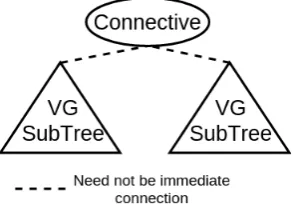
Coordination between clauses This features checks whether the connective has two clauses as its children in the dependency tree. We attempt to capture infor-mation regarding whether the connective in question plays the role of a coordinator between two clauses.
Figure 1: Coordination between clauses
Right Argument Location A discourse relation consists of a discourse connective and two arguments namely Arg1 and Arg2. Arg2 occurs immediately after the connective. This feature labels the location of word immediately after the connective with respect to posi-tion of the connective in the dependency tree. We at-tempt to capture the possibility of Arg2 being present in that position if the connective was playing the role of a discourse connective. For the remainder of this description we refer to the first word of Arg2 i.e. the word immediately after the connective as rightArg. The various position of rightArg as follows:
Last connective occurs at the end of the sentence i.e. no rightArg
Same Node rightArg occurs in the same node as con-nective
Direct Parent rightArg and connective share as im-mediate parent
Conn Parent rightArg is present in the connective’s sub-tree
rightArg Parent connective is present in the rightArg’s sub-tree
Indirect Conn Parent connective’s parent node sub tree contains rightArg
Indirect rightArg Parent rightArg’s parent node sub-tree contains connective
Figure 2: rightArg Locations
Left Argument Location A discourse relation consists of a discourse connective and two arguments namely
Arg1 and Arg1. This feature, similar to right argument location feature, labels the position of the word occur-ring just before the connective. Unlike Arg2, which is always occurs after the connective, there is no such constraint for Arg1. However a simple analysis shows that Arg1 occurs immediately before the connective in 45% of the cases. We attempt to capture the possibility of Arg1 being present in that position if the connective was playing the role of a discourse connective. We re-fer to the last word of Arg1 i.e. the word immediately before the connective to be leftArg. The various posi-tions of leftArg are the same as that of rightArg.
4.
Experiments and Results
We conduct several experiments to arrive at the best fea-ture set for our task. We also experimented with Maximum Entropy (Fan et al., 2008), Naive-Bayes (Zhang, 2004) and Conditional Random Fields (Lafferty et al., 2001) to train the classifier.
We now report the performance of our chosen feature set using Maximum Entropy using ten-fold cross validation. To put this comparison into better perspective, we imple-ment the feature sets chosen by (Pitler and Nenkova, 2009) and (Lin et al., 2014) for Hindi and then compare the per-formance of the respective feature sets to our feature set.
4.1.
Performance of Chosen Feature Set
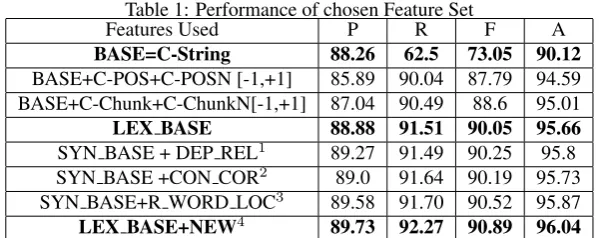
The performance of our feature set is shown in Table 1. The baseline using only C-String feature results in a rea-sonably high f-measure of 73.05%. Using Chunk, C-ChunkN[-] and C-ChunkN[+] features resulted in signif-icant improvements over the baseline(73.05% to 88.6%). Similar performance improvements over the baseline is achieved while using C-POS, C-POSN[-] and C-POSN[+] as features(73.05% to 87.79%). Using both sets of fea-tures further improves performance over baseline(73.05% to 90.05%).Thus using purely lexical features we have achieved an f-measure of 90%. We now study the impact of the de-pendency features and henceforth refer to the performance achieved by lexical features as LEX BASE i.e. lexical baseline.
Using each ofDependency Relation,Coordination between clausesandRight Word Locationindependently, in addition to LEX BASE, resulted in minor improvements of 0.2%, 0.15% and 0.45% respectively. Left Word Location fea-ture did not result in any improvements. A combination of all dependency features has resulted in an improvement of 0.8% across all measurements of performance.
The significance of dependency features can be drawn from the impact on precision. Lexical features resulted in an improvement of 0.6% over baseline precision(88.26%) and the addition of dependency features further improved pre-cision by 0.8%.
Table 1: Performance of chosen Feature Set
Features Used P R F A
BASE=C-String 88.26 62.5 73.05 90.12 BASE+C-POS+C-POSN [-1,+1] 85.89 90.04 87.79 94.59 BASE+C-Chunk+C-ChunkN[-1,+1] 87.04 90.49 88.6 95.01 LEX BASE 88.88 91.51 90.05 95.66 SYN BASE + DEP REL1 89.27 91.49 90.25 95.8
SYN BASE +CON COR2 89.0 91.64 90.19 95.73 SYN BASE+R WORD LOC3 89.58 91.70 90.52 95.87
LEX BASE+NEW4 89.73 92.27 90.89 96.04 1
Dependency relation,2Coordination between clauses,3Right word location,4Dependency features
Table 2: Performance reported by systems for English
System P R F A
Pitler (2009) - - 94.19 96.26
Lin (2014) - - 95.36 97.25
Wang (2015) 95.28 95.00 95.14
-4.2.
Feature Set Comparison
To better understand the efficacy of our feature set, we re-port the performance of feature sets chosen by Pitler(2009) and Lin(2014) for Hindi in Table 3. However since Hindi TreeBank does not contain a constituent parse tree, “Parent category” feature from Pitler’s feature set and “path from node to root” feature from Lin’s feature set could not be implemented.
Table 3: Feature Set Comparision
System P R F A
Pitler (2009) 89.19 88.29 88.56 95.04 Lin (2014) 90.26 87.28 88.59 94.97 Our implementation 89.73 92.27 90.89 96.04
We report an increase of 2.3% in f-measure and 1% in ac-curacy over Pitler’s (2009) feature set and an increase of 2.3% in f-measure and 1.5% in accuracy over Lin’s (2014) feature set.
Carrying out such a feature set comparison across lan-guages has led us to believe that a satisfactory baseline can be achieved using simple lexical features. Language spe-cific features can be then explored depending upon addi-tional information present (constituent parse trees for En-glish and dependency parse trees for Hindi) and language specific differences with regards to what constitutes a dis-course connective.
4.3.
Other Experiments
To study the effect of dependency and lexical features sepa-rately, we experimented with combining models trained on different feature sets using standard linear interpolation:
Pf inal(C) =λ1∗Pf1(C) + (1−λ1)∗Pf2(C) (1)
whereC is the connective in question, Pf1 is the model
trained on lexical features,Pf2is the model trained on
de-pendency features and λ1 is the interpolation weight for
Pf1. λ1 was determined based on performance measured
using ten-fold cross validation.
We also experimented with using connective specific mod-els as was used by Elwell and Baldridge (2008) for dis-course argument classification. Using connective specific models, we attempt to model each category of discourse connective independently to more closely reflect differing behaviors of each connective type. Discourse connectives behave differently according to the grammatical category they belong to. As a result we explore modelling each set independently As a result we trained specific models for each of the six categories of discourse connectives present in HDRB namely coordinating conjunctions, subordinating conjunctions, subordinators, sentential relatives, adverbials and particles. We then combine the connective specific models with a general model trained on all type of con-nectives:
Pf inal(C) =λ2∗Pconn(C) + (1−λ2)∗Pgen(C) (2)
whereCis the connective in question ,Pconnis the connec-tive specific model,Pgenis the general model andλ2is the
interpolation weight for Pconn. λ2was determined based
on performance measured using ten-fold cross validation. We report that both experiments failed to improve over the performance of a single model trained on our chosen fea-ture set.
5.
Conclusions
In this work, we present the first component(discourse con-nective identifier) towards a fully automated discourse an-alyzer for Hindi. We have discussed in detail the perfor-mance of lexical and syntactic features such as String, C-POS, C-Chunk, C-POSN[+,-] and C-ChunkN[+,-] for this task, resulting in a f-measure of 90.9%. In addition to these we introduce 3 novel dependency features resulting in an further improvement of 0.8% across all measurements of performance.
6.
Bibliographical References
Begum, R., Husain, S., Dhwaj, A., Sharma, D. M., Bai, L., and Sangal, R. (2008). Dependency annotation scheme for indian languages. InIJCNLP, pages 721–726. Cite-seer.
Fan, R.-E., Chang, K.-W., Hsieh, C.-J., Wang, X.-R., and Lin, C.-J. (2008). Liblinear: A library for large lin-ear classification. The Journal of Machine Learning Re-search, 9:1871–1874.
Kolachina, S., Prasad, R., Sharma, D. M., and Joshi, A. K. (2012). Evaluation of discourse relation annotation in the hindi discourse relation bank. InLREC, pages 823– 828.
Lafferty, J., McCallum, A., and Pereira, F. C. (2001). Con-ditional random fields: Probabilistic models for segment-ing and labelsegment-ing sequence data.
Lin, Z., Ng, H. T., and Kan, M.-Y. (2014). A pdtb-styled end-to-end discourse parser. Natural Language Engi-neering, 20(02):151–184.
Marcus, M. P., Marcinkiewicz, M. A., and Santorini, B. (1993). Building a large annotated corpus of en-glish: The penn treebank. Computational linguistics, 19(2):313–330.
Miltsakaki, E., Prasad, R., Joshi, A. K., and Webber, B. L. (2004). The penn discourse treebank. InLREC.
Mladov´a, L., Zikanova, S., and Hajicov´a, E. (2008). From sentence to discourse: Building an annotation scheme for discourse based on prague dependency treebank. In
LREC.
Oza, U., Prasad, R., Kolachina, S., Sharma, D. M., and Joshi, A. (2009). The hindi discourse relation bank. In
Proceedings of the third linguistic annotation workshop, pages 158–161. Association for Computational Linguis-tics.
Pitler, E. and Nenkova, A. (2009). Using syntax to dis-ambiguate explicit discourse connectives in text. In Pro-ceedings of the ACL-IJCNLP 2009 Conference Short Pa-pers, pages 13–16. Association for Computational Lin-guistics.
Pol´akov´a, L., M´ırovsk`y, J., Nedoluzhko, A., J´ınov´a, P., Zik´anov´a, ˇS., and Hajiˇcov´a, E. (2013). Introducing the prague discourse treebank 1.0. InProceedings of the 6th international joint conference on natural language pro-cessing, pages 91–99.
Prasad, R., Dinesh, N., Lee, A., Miltsakaki, E., Robaldo, L., Joshi, A. K., and Webber, B. L. (2008a). The penn discourse treebank 2.0. InLREC. Citeseer.
Prasad, R., Husain, S., Sharma, D. M., and Joshi, A. K. (2008b). Towards an annotated corpus of discourse rela-tions in hindi. InIJCNLP, pages 73–80.
Wang, J. and Lan, M. (2015). A refined end-to-end dis-course parser. CoNLL 2015, page 17.
Xue, N. (2005). Annotating discourse connectives in the chinese treebank. In Proceedings of the Workshop on Frontiers in Corpus Annotations II: Pie in the Sky, pages 84–91. Association for Computational Linguistics. Zeyrek, D. and Webber, B. L. (2008). A discourse
re-source for turkish: Annotating discourse connectives in the metu corpus. InIJCNLP, pages 65–72.
Zeyrek, D., Demirs¸ahin, I., Sevdik-C¸ alli, A., Balaban, H. ¨O., Yalc¸inkaya, ˙I., and Turan, ¨U. D. (2010). The annotation scheme of the turkish discourse bank and an evaluation of inconsistent annotations. In Proceedings
of the fourth linguistic annotation workshop, pages 282– 289. Association for Computational Linguistics. Zhang, H. (2004). The optimality of naive bayes. AA,
1(2):3.