AVAB-DBS: Audio-Visual Affect Bursts Database for Synthesis
Kevin El Haddad, H ¨useyin C
¸ akmak, St´ephane Dupont, Thierry Dutoit
TCTS lab - University of Mons31 Boulevard Dolez, 7000, Mons Belgium
{kevin.elhaddad}{huseyin.cakmak}{stephane.dupont}{thierry.dutoit}@umons.ac.be
Abstract
It has been shown that adding expressivity and emotional expressions to an agent’s communication systems would improve the interaction quality between this agent and a human user. In this paper we present a multimodal database of affect bursts, which are very short non-verbal expressions with facial, vocal, and gestural components that are highly synchronized and triggered by an identifiable event. This database contains motion capture and audio data of affect bursts representing disgust, startle and surprise recorded at three different levels of arousal each. This database is to be used for synthesis purposes in order to generate affect bursts of these emotions on a continuous arousal level scale.
Keywords:Affect burst, Multimodal Database, Synthesis
1.
Introduction
It has been mentioned in several recent studies that adding expressivity and emotional expressions to an agent’s com-munication systems would improve the interaction quality between this agent and a human user. Although emotions can be expressed in several and different ways, most of the work aiming at improving an agent’s expressions natural-ness, focus on speech (with or without the corresponding facial expressions) (Jia et al., 2011) or isolated facial ex-pressions (Moosaei et al., 2014). In this work we focus on non-verbal audio-visual expressions. Affect bursts are de-fined in (Krumhuber and Scherer, 2011; Scherer, 1994) as very short non-verbal expressions with facial, vocal, and gestural components that are highly synchronized and trig-gered by an identifiable event.
Emotional expressions are culturally, socially and even in-dividually variable. This means that a particular emotion will be expressed in different ways and modalities at dif-ferent times. From this, comes the difficulty of using a naturalistic database with parametric modeling techniques for synthesis purposes. Indeed, the data recorded for a cer-tain emotional expression in a naturalistic database will be different from one another. Therefore, although being ad-equate for recognition and classification tasks (if the data quantity is enough with respect to the task) this kind of data would most probably not be suitable to create parametric models such as Hidden Markov Models (HMM) (Rabiner and Juang, 1986) or Deep Neural Networks (DNN) (Hin-ton and Osindero, 2006; Anderson, 1995) with the goal of generating descriptors. This difficulty concerns not only modeling a specific emotion expression without taking the arousal level of the emotion into account, but also doing so on continuous arousal scale. Being able to synthesize emo-tion expressions on a continuous arousal level scale, will enable more control over the avatar’s expressiveness. In order to do so, we present an Audio-Visual (AV) database collected for the purpose of synthesizing AV expressions at different levels via statistical parametric modeling, i.e. us-ing HMM in our case. Indeed previous work proved HMM-based systems to be efficient for such applications (Cakmak et al., 2015).
We will first discuss our motivations and how do we intend to use this database in Section 2.. The protocol along with the hardware we used to record the database will be ex-posed in Section 3.. We will present our work on data post-processing, aiming at obtaining suitable data for parametric synthesis (in our case statistical parametric synthesis using HMM) in Section 4.. We will then, in Section 5., give de-tails about the data collected and finally conclude and give our perspectives in Section 8..
2.
Database Use and Motivation
As stated in the introduction, previous work related to this topic have already been proposed in (C¸ akmak et al., 2014) and (Cakmak et al., 2015). In the first, C¸ akmak et. al. present a database recorded for the purpose of AV laugh-ter synthesis using HMM. In the second, AV laughlaugh-ter has been successfully synthesized using HMM-based systems. Also, an audio laughter synthesis system with a controllable arousal level was also presented in (Urbain et al., 2014). The authors in that article report good results obtained us-ing an HMM-based system.
In order to be able to synthesize emotion expressions on different arousal levels, the database presented here con-tains facial expression data along with their corresponding audio affect bursts for three different affect states and at three levels each. The three affect states are disgust, startle and surprise. Those three emotions were chosen because they can be expressed relatively easily on different levels of arousal and in both modalities (vocally and through facial expressions). Having three levels of each affect burst, will allow us to not only attempt to synthesize them but also to obtain intermediate levels via interpolation.
3.
Recording Protocol
The recordings were made from a single male participant who was instructed to act disgust, surprised and scared us-ing both non-verbal sounds and facial expressions simul-taneously. He was asked to produce three levels of each emotional expressions. The experience was repeated sev-eral times. The recordings happened in sevsev-eral sessions and in a quiet room. The participant was asked to clap before each session. The claps are used to synchronize the au-dio and motion capture data (see Section 4.). Indeed, The motion capture and audio data were recorded each on a dif-ferent machine were therefore asynchronous.
Differences between levels were noted both on the facial expression and on the audio sound. Concerning the facial expression, the higher the arousal level, the more accentu-ated the expression was. Concerning the audio, a higher arousal level was usually expressed by a higher amplitude and also by a longer duration of the sound in the “disgust“ case.
The audio data were recorded using a rode podcaster mi-crophone sampled at 44.1 kHz and stored in a 16 bit PCM WAV format.
The motion capture data were collected using Natural-point’s Optitrack system. Infrared sensitive cameras cap-turing data at 100 fps are used in this system with light reflective markers. For our data collection, a 12-camera setup was used with 37 reflective markers. Among those 37 markers, 33 were glued to the participant’s face while 4 were fixed on a headband (see Section 5. for the recorded data characteristics).
Also, a 640x480 grayscale video was recorded for each take and synchronously with the motion capture data using the camera facing the participant which will be used for later data segmentation. This data was stored in an AVI file and recorded also at 100 fps. Thus 11 cameras were used to collect the motion capture data and 1 was used to record the grayscale video. Although the grayscale videos are used for the visual data segmentation in this work, they could provide valuable information on the upper body motion and facial expressions of the participant for later use.
4.
Data Post-Processing
4.1.
Data segmentation
During the recordings, the sessions were stored in separate files. Each session therefore contains several affect burst utterances. In order to serve our purposes and be used in an HMM-based synthesis system, the data in the sessions were segmented. This means that each affect burst event was stored separately in a different file. The audio and mo-tion capture data were segmented with respect to the visual annotations. This is due to the fact that, in this database, it is noted that the facial expressions of all affect bursts began before and ended after or simultaneously with the corre-sponding audio. Annotations based on the audio data alone are also available. These could be used in further study for audio affect bursts synthesis.
Therefore, before the segmentation, session files of both modalities had to be synchronized since they were recorded on different machines.
For each segmented file of each modality, a label file was created. Each label file contains the beginning and ending times of the affect bursts and the preceding and following silences, as well as labels describing the content of the cor-responding data file. This content is the affect burst and its level.
The label files were created in the HTK label format (Young et al., 2006) since we plan on using the HTK software for the HMM-based modeling and synthesis.
4.2.
Synchronization
Synchronizing the data in our case, is important for later modeling and synthesizing. As previously mentioned, each session started with a clap which was capture by the grayscale video and by the microphone. This clap was used to synchronize the data. Indeed, the synchronization was made by aligning the frame at which the hands touch in the video and the onset of the corresponding sound in the audio.
Since the frame rate is 100 fps, the synchronization preci-sion is of 10 ms.
5.
Data Description
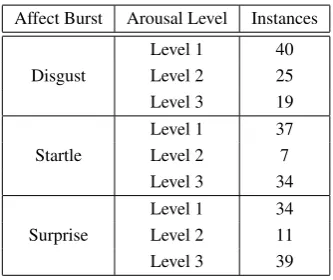
This section gives some details about the data present in our database. Table1 gives the amount of instances col-lected for each affect burst and at each level( level 1 being the lowest arousal level and level 3 being the highest). By instance we mean the utterance of a single affect burst.
Affect Burst Arousal Level Instances
Level 1 40 Disgust Level 2 25 Level 3 19 Level 1 37 Startle Level 2 7
[image:2.595.339.506.422.562.2]Level 3 34 Level 1 34 Surprise Level 2 11 Level 3 39
Table 1: Data instances
Visual: As explained earlier, the Optitrack system uses infrared sensitive cameras along with 33 face markers and 4 headband markers. The system tracks the 33 face markers and converts them into 3D coordinates of each marker per frame. Thus giving us 99 degrees of freedom per frame rep-resenting the facial expression with respect to time. The 4 headband markers have a fixed distance with respect to one another and their positions are not affected by the facial expressions themselves but rather by the head movement these expressions induce. They are thus used to calculate the global head movements: 3D head position coordinates along with 3D Euler angles. This gives us 6 more degrees of freedom making it a total of 105 degrees of freedom rep-resenting the motion capture data.
to quantify this, the mean value of the Root Mean Square (RMS) of the energy computed for each instance of each af-fect burst was computed. For each instance, this was done using a 10 ms wide window, shifted by 10 ms. The mean RMS energy value was then computed per instance. The density distributions of the mean RMS energy per affect bursts type and per arousal level are shown in Fig. 1. For disgust, the mean RMS energy values seem to be higher for higher levels. However this is less obvious in the case of startle and surprise. Indeed, for startle, some of L2 and L3 values seem to be higher than L1 values. But the values computed from the two former seem identical. Concerning surprise, the difference between the L2 and L3 levels val-ues and the L1 ones is more obvious than for startle. Even though the values of the two former levels are not identical, the distinction between them is not obvious either since we can see that L3 contains higher and lower values than L2. Another interesting acoustic aspect of the affect bursts sounds in our database is the fact that some of them are more ”voiced” than others. To show this, the probability of voicing was computed using the Snack library (Sj¨olander, consulted on September 2014) and a 10 ms wide window shifted by 10 ms. The percentage of voicing was then com-puted per instance. This means that for each affect burst instance, of each level, the sum of the voicing probabilities obtained was divided by the length of the total vector. The density distribution of the voicing percentage per instance is given in Fig. 2 per level and per emotion.
From Fig 2, we can conclude that, in this database, the dis-gust sounds are mostly voiced since for all levels, generally, more than 55% of each instance is voiced. The startle ones are all unvoiced since 8% is the highest voicing percentage value. The surprise ones are mostly unvoiced since in gen-eral less than 50% of the signal is voiced for each instance and most of the voicing percentage values are concentrated around 30% for L2 and L3.
6.
PCA for Dimensionality Reduction
The 105 degrees of freedom representing each affect burst per frame seems too much to represent them. Also, from a machine learning point of view, the amount of data rep-resenting each level of each affect burst with respect to the dimensionality of the features (degrees of freedom) is rel-atively large. This may lead to an overfitting the training data by a model. In order to reduce the motion capture features dimensions while also decorrelating the features, a Principal Component Analysis (PCA) is applied.To choose the order to which the dimension will be reduced, we first compute the reconstruction error for all the possi-ble order values. The reconstruction error is the root mean square error (RMSE) between the original matrix of fea-tures from which the reduced feature matrix is created, and the matrix obtained after applying an inverse PCA to the reduced matrix feature.
Fig 3 shows the RMSE evolution with respect to the order to which the dimensions were reduced for each affect and each arousal level.
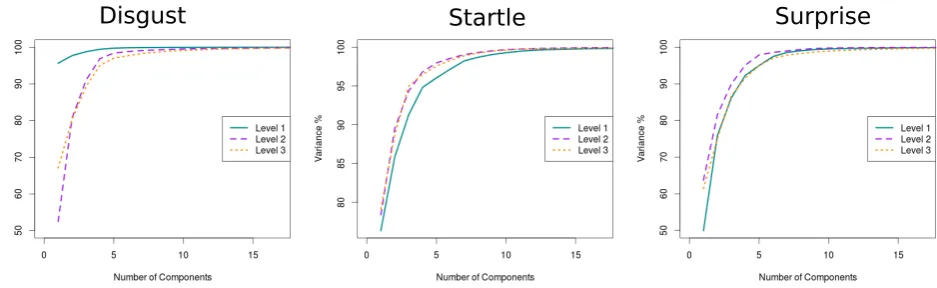
If we considered these graphs alone, we can see that we can achieve a reconstruction error of around 0.05 for all affect bursts and arousal levels with only 20 components. Also, in
[image:3.595.344.501.200.336.2]Fig. 4, the x axes represent the first n components consid-ered while the y axes represent the percentage of the total variance contained in the n components. For all the affects and arousal levels, 5 components are enough to represent over 90% of the components variability and 11 to represent over 99%.
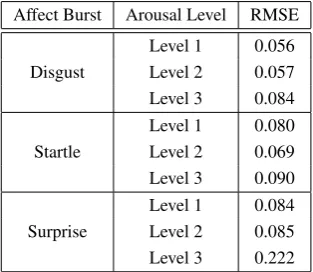
Table 2 represent the RMSE presented in Fig. 3 for each af-fect burst at each arousal level. These RMSE values corre-spond to the order 5 to which the initial features dimensions (allowing 105 degrees of freedom) were reduced.
Affect Burst Arousal Level RMSE
Level 1 0.056 Disgust Level 2 0.057 Level 3 0.084 Level 1 0.080 Startle Level 2 0.069 Level 3 0.090 Level 1 0.084 Surprise Level 2 0.085 Level 3 0.222
Table 2: Root Mean Square Error (RMSE) between the ini-tial features and the reconstructed features after a dimen-sionality reduction via PCA. The initial features were re-duced from a dimensionality of 105 to 5 and then recon-structed by multiplying with the inverse transformation ma-trix.
According to Fig. 4 and Table 2, we can consider that 5 components represent each arousal level for each affect bursts in our database well.
7.
Aknowledgements
This work was partly supported by the Chist-Era project JOKER with contribution from the Belgian Fonds de la Recherche Scientifique (FNRS), contract no. R.50.01.14.F. H. C¸ akmak receives a Ph.D. grant from the Fonds de la Recherche pour l’Industrie et l’Agriculture (F.R.I.A.), Bel-gium.
8.
Conclusion and Perspectives
Figure 1: Density distribution of the Root Mean Square energy computed per affect burst and per level.
Figure 2: Density distribution of the voicing percentage computed per affect burst and per level.
Disgust
Surprise
Fear
Disgust
Startle
Surprise
Figure 3: Root Mean Square Error with respect to the dimensionality reduction order.
Disgust
Surprise
Fear
Disgust
Startle
Surprise
[image:4.595.55.531.387.541.2] [image:4.595.59.528.599.743.2]modality only. This was done to allow a study on the effi-ciency of each segmentation method when used for HMM-based audio synthesis (after training the HMMs with the segmented data) and choose the best one for synthesis.
9.
Bibliographical References
Anderson, J. A. (1995). An introduction to neural net-works. MIT press.
Cakmak, H., El Haddad, K., and Dutoit, T. (2015). Audio-visual laughter synthesis system. In4th Interdisciplinary Workshop on Laughter and Other Non-Verbal Vocalisa-tions in Speech, pages 11–14, Enschede, Netherlands, 14-15 May.
Hinton, G. E. and Osindero, S. (2006). A fast learn-ing algorithm for deep belief nets.Neural Computation, 18:2006.
Jia, J., Zhang, S., Meng, F., Wang, Y., and Cai, L. (2011). Emotional audio-visual speech synthesis based on pad. Audio, Speech, and Language Processing, IEEE Trans-actions on, 19(3):570–582, March.
Krumhuber, E. G. and Scherer, K. R. (2011). Affect bursts: dynamic patterns of facial expression. Emotion, 11(4):825.
Moosaei, M., Gonzales, M., and Riek, L. (2014). Natural-istic pain synthesis for virtual patients. In Timothy Bick-more, et al., editors, Intelligent Virtual Agents, volume 8637 ofLecture Notes in Computer Science, pages 295– 309. Springer International Publishing.
Rabiner, L. R. and Juang, B.-H. (1986). An introduction to hidden markov models. ASSP Magazine, IEEE, 3(1):4– 16.
Scherer, K. R. (1994). Affect bursts.
Sj¨olander, K. (consulted on September, 2014). The Snack Sound Toolkit [computer program webpage].
Tokuda, K., Zen, H., Yamagishi, J., Masuko, T., Sako, S., Black, A., and Nose, T. (2008). The hmm-based speech synthesis system (hts).h ttp://hts. ics. nitech. ac. jp. Urbain, J., Cakmak, H., Charlier, A., Denti, M., Dutoit,
T., and Dupont, S. (2014). Arousal-driven synthesis of laughter. Selected Topics in Signal Processing, IEEE Journal of, 8(2):273–284, April.
Young, S., Evermann, G., Gales, M., Hain, T., Kershaw, D., Liu, X. A., Moore, G., Odell, J., Ollason, D., Povey, D., et al. (2006). The htk book (for htk version 3.4).