A Taxonomy of Spanish Nouns, a Statistical Algorithm to Generate it
and its Implementation in Open Source Code
Rogelio Nazar, Irene Renau
Instituto de Literatura y Ciencias del LenguajePontificia Universidad Cat´olica de Valpara´ıso Av/El Bosque, 1290, Vi˜na del Mar (Chile)
{rogelio.nazar,irene.renau}@pucv.cl
Abstract
In this paper we describe our work in progress in the automatic development of a taxonomy of Spanish nouns, we offer the Perl im-plementation we have so far, and we discuss the different problems that still need to be addressed. We designed a statistically-based taxonomy induction algorithm consisting of a combination of different strategies not involving explicit linguistic knowledge. Being all quantitative, the strategies we present are however of different nature. Some of them are based on the computation of distributional similarity coefficients which identify pairs of sibling words or co-hyponyms, while others are based on asymmetric co-occurrence and identify pairs of parent-child words or hypernym-hyponym relations. A decision making process is then applied to combine the results of the previous steps, and finally connect lexical units to a basic structure containing the most general categories of the language. We evaluate the quality of the taxonomy both manually and also using Spanish Wordnet as a gold-standard. We estimate an average of 89.07% precision and 25.49% recall considering only the results which the algorithm presents with high degree of certainty, or 77.86% precision and 33.72% recall considering all results.
Keywords:corpus statistics, distributional semantics, Spanish, taxonomy induction
1.
Introduction
Influenced by classical logic (Aristotle, on the Categor-ies), modern linguistics since at least structuralist semantics defines a taxonomy of the nouns of a language as the spe-cification of the semantic hierarchy of words in a tree-shape structure, where each link between words establishes their hyponym-hypernym relationships (Lyons, 1977), of-ten called IS-A relations in NLP literature.
A number of properties of such type of structures are well-known, such as the concept of inheritance, i.e., the fact that the “children” nodes inherit the properties of their “par-ent” nodes. From a lexical point of view, words in chil-dren node positions are hyponyms, and words playing the role of parent nodes are hypernyms. Other common prop-erties of taxonomies are asymmetry and transitivity. In some taxonomy X, asymmetry is simply defined as fol-lows: ∀a, b ∈ X,(a → b) ⇒ ¬(b → a), i.e. a can-not simultaneously be the parent and the child of b. And transitivity is analogous to the concept of inheritance, thus ∀a, b, c ∈ X, if(a → b)∧(b → c) ⇒ (a → c). This means that taxonomies are directed acyclic graphs, and that it would be an infringement for a taxonomy to contain cycles. This does not imply, however, that the same word cannot have different hypernymy chains, which is a differ-ent issue. It would be the case, for instance, of polysemous words, as will be shown later in the paper.
Taxonomies can be a useful resource in a number of dif-ferent applications. Having the ability to replace instances of nouns or noun phrases in corpus by their immediate hy-pernym allows one to improve the quality of distributional similarity calculations by means of context normalisation (P´erinet and Hamon, 2014). Another possible application is on correference resolution in discourse analysis (Reca-sens and Hovy, 2009). Bordea et al. (2015) also point out different applications such as e-commerce and online
data-bases among others, and it is easy to foresee other examples such as monolingual or bilingual terminology extraction, named entity categorisation, collocation extraction, etc. In our case, in a separate publication (Nazar and Renau, forth-coming), we apply this taxonomy to a corpus-based study of predicate-argument structures in Spanish. In that study, we differentiate the meanings of verbs by taking into ac-count a combination of syntactic and semantic analysis of predicate-argument structures in the syntagmatic context, and the taxonomy of nouns allows us to discriminate dif-ferent senses or patterns of use of verbs by analysing the semantic class of their arguments (see section 6).
In this paper we describe our work in progress in the de-velopment of the taxonomy, which is already freely avail-able for the research community at the project’s website1.
This version of the taxonomy only contains nouns of gen-eral vocabulary and is limited at the moment to single-word lexical units. The application of this algorithm to the de-velopment of a specialised taxonomy with terminological units –including multiword expressions– is discussed in a separate publication due to its inherent complexity and dif-ferences of approach (Nazar, in preparation). The present paper thus focuses on the description of our statistically-based taxonomy induction algorithm and its implementa-tion as a Perl script running on Linux, applied to general vocabulary words. We also present an example of the ap-plication of this algorithm to a Spanish corpus and we as-sess the the quality of the result in two different ways: pre-cision is estimated through manual evaluation of a sample of the taxonomy by a group of 6 advanced students in lin-guistics, while recall is estimated automatically using
Span-1All materials are available simultaneously in two different servers: hhttp://www.verbario.com/i and
ish WordNet as a gold-standard. At the time of writing, we are replicating experiments in English and French. The article is structured as follows: we first make a short introduction to the state of the art in taxonomy induction (section 2). We describe our methodology (section 3), start-ing from a brief description of the shallow ontology we use, which includes the most general, top nodes of the taxonomy (subsection 3.1). We then describe each algorithm separ-ately (subsections 3.3-3.5), and finally we explain how we integrate the data obtained from the previous strategies in a single output (subsection 3.6). We describe the evaluation of the process (section 4), we make a short explanation of technical details regarding the material we make available for the scientific community (section 5) and we finish with some conclusions and lines of future work (section 6).
2.
Related Work
Automatic taxonomy induction has been a topic in com-putational linguistics since its early beginning. First ef-forts were focused on exploiting machine readable dic-tionaries to extract hypernymy or other types of semantic relations (Chodorow et al., 1985; Guthrie et al., 1990, among many others). Later, with the advent of corpus lin-guistics, similar methods and ideas were extrapolated from lexicographical to textual corpora, mainly by the use of what is now called Hearst’s patterns (Hearst, 1992). I.e., if one finds in a corpus a sequence such asX is a type of Y
or other patterns such asX and other (types of) Y, and ifX andY are nouns or noun phrases, then some authors will assume thatXis a hypernym ofY (Rydin, 2002; Cimiano and V¨olker, 2005; Snow et al., 2006; Pantel and Pennacchi-otti, 2006).
Earlier methods have now been complemented by word-distribution analysis in very large corpora, inspired in Har-ris’ (1954) distributional semantics. First research on dis-tributional similarity and semantic clustering (Grefenstette, 1994; Sch¨utze and Pedersen, 1997; Lin, 1998) was fol-lowed by more complex algorithms for taxonomy induction and population (Ciaramita, 2002; Alfonseca and Manand-har, 2002). In this line, graph-based algorithms seem to represent a new trend (Kozareva and Hovy, 2010; Nazar et al., 2012; Velardi et al., 2013).
The large body of work related to automatic taxonomy in-duction prevents us to make an extended revision in this paper. In general, research is focused either on the exten-sion or adaptation of WordNet (Fellbaum, 1998) including languages other than English, or to the reuse and integra-tion of data from different sources (de Melo and Weikum, 2013; Bansal et al., 2014; Fiˇser and Sagot, 2015).
WordNet has been extensively used in varied NLP tasks, and commonly as a gold-standard in the context of re-search on taxonomy induction (Bordea et al., 2015). To some extent, Wordnet differs from what we are trying to achieve in our project, despite the fact that we too use it for the evaluation of our resource. From a theoretical point of view, Wordnet is a top-down ontology of concepts, or more precisely, synsets, defined as sets of words that have the same sense or refer to the same concept. Maziarz et al. (2013) already pointed out that there exists a sort of tension between synsets and lexical units in Wordnet and
EuroWordnet, regarding the differences between semasi-ological and onomasisemasi-ological perspectives. Unlike Word-Net, our approach is semasiological and aimed at the ana-lysis of the vivid dynamics of the lexicon with data obtained with bottom-up, corpus-based methods. We believe this difference make the two resources hard to compare. From a theoretical perspective, only the semasiological approach seems to be useful for the study of lexical semantics. From a practical perspective, one cannot compare a hand-made resource like WordNet with an automatically generated tax-onomy like ours. Evidently, a generalised problem in all hand-made taxonomies is the fact that they quickly become outdated and require large amounts of human and technical resources. The automatically generated taxonomy, in turn, must deal with problems of recall, structure and polysemy. In spite of these limitations, proposals in automatic meth-ods can contribute to complement or even substitute manual taxonomies and make these resources more adaptable to different languages and purposes. This is even clearer spe-cifically in fully statistically-based taxonomies emerging from corpus data in the line of Bullinaria & Levy (2007) or Strohmaier et al. (2012).
Bordea et al. (2015) offer a recent description of state of the art in taxonomy induction and present the results of dif-ferent teams that participated in the SemEval-2015 Task on Taxonomy Extraction Evaluation. Again, our results are not directly comparable, and the same SemEval organisers admit that there is still much to be done to find an effective way to compare the results of different taxonomy induction algorithms.
More references to related work –most often our own pre-vious work on the subject– are also indicated in the next section as earlier versions of some specific components of the main algorithm have already been published elsewhere.
3.
Methods and Materials
The methodology employed in this research consists of a combination of different statistical algorithms that take into account the distributional behaviour of lexical units in order to build a taxonomy. As stated in previous lines, we imple-ment corpus-based language-independent algorithms, i.e., we disregard the use of linguistic information with the ex-plicit purpose of facilitating the replication of experiments in other languages (see section 6).
As already stated in the introduction, in this section we first make a short description of a hand-made shallow ontology that is used as a basic structure for the most general nodes (subsection 3.1) and then we describe a series of statist-ical techniques to populate such ontology by hypernymy-hyponymy relation discovery (subsections 3.2-3.6). We apply our method on a collection of ca. 45,000 nouns of general vocabulary extracted from corpus and we estimate our taxonomy will double that number shortly.
3.1.
The Starting Point: a Basic Ontology
“Hu-man”, “Food”, “Device”, “Emotion”, “Activity” and so on. As already explained, we use this ontology as an initial basic structure. We are aware that linguistic and cultural differences can have a great impact on how ontologies are structured, but we nonetheless consider that the CPA onto-logy is general enough to be used in a large amount of lan-guages sharing cultural aspects, as at least most European languages do.
The procedure consists first in translating the semantic types to the target language and then populating this ba-sic structure with lexical units, extending it progressively with new branches using the algorithms we describe next. This process involves some degree of manual work, which consists of adding the most general words to the ontology, i.e. the high-frequency nouns with the most general or ab-stract meanings. For instance, we manually paired our node
Recipientewith its equivalent “Container”, one of the se-mantic types in the CPA ontology. In fact, the whole pro-cess could have been conducted automatically applying ma-chine translation to Hank’s semantic types, but being only a few hundred nodes, we decided it would be better to pro-ceed with this step by hand.
After stating the Spanish equivalents of the English se-mantic types, all the hyponyms are added automatically with our algorithms. In the case ofRecipiente, a hyponym such asbotella(‘bottle’) is added, and this one in turn also becomes a hypernym of other nouns such aslicorera (‘de-canter’). The following would be an example of the connec-tion between the CPA Ontology and the nounbotella, taken from corpus and automatically connected withRecipiente2:
→Todo (‘Anything’)
→Entidad (‘Entity’)
→Objeto F´ısico (‘Physical Object’)
→Inanimado (‘Inanimate’)
→Artefacto (‘Artifact’)
→Recipiente (‘Container’)
→botella(‘bottle’)
3.2.
Statistical Analysis of Dictionary Entries
As mentioned in section 2, machine readable dictionaries have been used in the past for the extraction of hypernymy relations. The problem with this method, as reported in the literature, is that it is labour intensive, it must be specific for every particular dictionary, and it is also error prone. A more general methodology, independent of the specific dictionary and language, has been reported in previous work (Nazar and Janssen, 2010; Renau and Nazar, 2012). In these studies, multiple dictionaries were used to calcu-late simple co-occurrence of words in the entries with the words in the definitions. It follows that the most frequent noun in the set of definitions of another noun is likely to be the correct hypernym. E.g., the most frequent noun within all dictionary definitions of the wordmotocicleta (‘motor-cycle’) will most likely beveh´ıculo(‘vehicle’). This obser-vation lead to the development of full networks of hyper-nymic links, identifying hubs or nodes that are repeatedly selected as hypernyms by many other words.
The main drawback of those previous attempts was that
2For clarity’s sake, we capitalize semantic types (concepts in the ontology) and write lexical units in italics.
there was no basic structure to build on, and it is difficult to build a taxonomy from scratch. In the case of the present paper, however, the scenario is different because we in-tegrate the resulting hyponym-hypernym pairings with the CPA Ontology. As a result of the application of this first step, the CPA ontology, which initially contained a set of 250 semantic types, has grown to a total of 2,290 categor-ies, each one representing a parent node populated with hyponyms. This initial tree then continues to be populated by the algorithms subsequently described in this section.
3.3.
Distributional Similarity
Again as explained in section 2., semantic clustering based on paradigmatic relations is among the oldest and most ex-tended techniques in distributional semantics. The underly-ing assumption is that two words that tend to occur in very similar contexts must be semantically similar. Importantly, these words may not be syntagmatically related (they are not seen in presence of each other) but they are used in the same positions, i.e., they are paradigmatically related. Our earlier attempt using this type of distributional similar-ity was aimed at semantic clustering of nouns (Nazar and Renau, 2015a) using bigrams taken from Google Books N-Gram Corpus3. That approach had the problem of being computationally too expensive due to its quadratic com-plexity, which makes it difficult to escalate from small samples of words to a full lexicon. This time, however, and because now we build on the CPA ontology, instead of a clustering procedure now we have framed the task as a categorisation problem, which has helped us achieve better efficiency and accuracy.
If W is the theoretical set of the nouns of a language and C = {c1, ..., c|C|} the set of semantic categories in which every nounwi can be classified, then for each pair
hwi, cji ∈ W xC we obtain a score which will confirm or
disprove the membership of nounwi to category cj, and
this score represents their distributional similarity.
In order to be able to produce a distributional similarity score, words need to be analysed within a particular cor-pus. We used the text of Spanish Wikipedia as a corpus, not because we have a particular interest on it, but because it is large and freely available. In fact, we believe that any other large enough corpus should have the same effect4. We processed this corpus extracting only the text of the pages, with the pages sorted in random order and excluding all metadata and code that make the hierarchical organisation of the content. This resulted in a single block of plain text of ca. 700 million tokens.
In order to improve computational efficiency, we divided the distributional similarity calculation in two steps. Nor-mally, distributional similarity is calculated by building word-vectors, where dimensions are defined as the words that tend to co-occur with any given target word. Instead of doing that directly, as a first step we built category-vectors, where the dimensions are the sum of all dimensions in the vectors of the words contained in such category, thus
3h
https://books.google.com/ngrams/i[last access: 3/4/2016] 4
our setCof semantic categories is redefined here as a set of category-vectors. The efficiency gain is of course ex-plained by the fact that there are always less categories than category members (|C| < |W|), and then the number of comparisons is significantly reduced. Thus, given an input nounwi, we calculate the overlap coefficient (equation 1)
between noun-vectorw~iand every category-vectorc~j ∈C.
O(wi, ~~ cj) = |wi~ ∩cj~|
min(|wi~|,|cj~|) (1)
IfO(w~i, ~cj)> t⇒wi ∈cj(|c~j|= 100andt=.4, both
arbitrary parameters). Forwi, we can expect that this will
be true for more than one category. Thus, we will obtain a new setHidefined as a short list of pre-selected categories
forwi(a list of lengthl, another arbitrary parameter which
in our experiments is equal to 7). Next, ∀cj ∈ Hi, we
now calculate a Jaccard similarity coefficient (equation 2) between word-vectorw~iand each word-vectorc~j,k.
J(wi, ~~ cj,k) = |wi~ ∩cj,k~ |
(|wi~|+|cj,k~ | − |wi~ ∩cj,k~ |) (2)
We assume that if J(w~i, ~cj,k) > t/2 ⇒ w~i ∼ c~j,k, and
after this comparison there will be a proportionpof sim-ilar vs. different cases5 in every category c
j. Then, if
p > t ⇒ wi → cj, i.e., if nounwi proves to be
distri-butionally similar to many members of category cj, then
wiis hyponym ofcj.
3.4.
Co-occurrence Graphs
In the previous subsection we applied distributional ana-lysis to find paradigmatic relations between nouns and used that information to associate nouns with semantic categor-ies. In this section, instead, we present a different, com-plementary approach, based on the study of syntagmatic relations.
This other strategy is based on our observation, already reported in previous work (Nazar et al., 2012; Nazar and Renau, 2012), that words that engage in a hyponym-hypernym relation tend to show a type of asymmetric co-occurrence. That is to say, the presence of a noun in a given sentence can be seen as a predictor of the presence of its hypernym in the same sentence while the opposite is not true. For instance, it is more probable thatmotocicleta
(‘motorcycle’) will co-occur with its hypernym, veh´ıculo
(‘vehicle’), than the other way around.
An intuitive way to visualise these asymmetric relations is using co-occurrence graphs. Figure 1 shows one of these graphs, a case obtained from real data using the same cor-pus mentioned in subsection 3.3. The interpretation is that, given the input wordmotocarro (‘three-wheeler’), repres-ented as a node in the top of the figure, its asymmet-ric co-occurrence with other nouns is drawn as a direc-ted graph. In this case,motocarro tends to co-occur with
furgoneta (‘van’), motocicleta and veh´ıculo. The noun
5It should be noticed that proportionprequires a normalisa-tion procedure because the number of member in each category can be very dissimilar. There are different ways to do this, but in our case we just usedp=
√
s
√
d, wheresis the number of similar
cases anddthe number of different ones.
motocicleta, as already mentioned, also tends to co-occur withveh´ıculo. The nodefurgoneta, in turn, co-occurs with
[image:4.595.356.488.182.318.2]veh´ıculoandcami´on(‘truck’), and the latter also co-occurs withveh´ıculo. It seems that all these co-occurring relations end up in the correct hypernym, as if it would be a case of natural selection. The way we see these graphs is as if, for any given input node, the node with more incoming arrows is selected as the most likely hypernym.
Figure 1: A co-occurrence graph showing the asymmetrical relation betweenmotocarro(‘three-wheeler’) and its hyper-nym,veh´ıculo(‘vehicle’).
The problem we experienced in our previous work using this method is the same we mentioned in subsections 3.2 and 3.3: the fact that we were trying to build the taxonomy from scratch. This has changed since we are using the CPA ontology, because now we can frame the task as a categor-isation problem.
The procedure is to quantify the number of times a noun co-occurs with others in a non reciprocal manner. Formally, any input nounwwill generate a setKof first and second order co-occurring nouns (f(w) = {K1, . . . , K|K|}) and we expect that, as the correct hypernym ofw, there will be a nounh∈K. Thus, we calculate the number of times that any member of setKshows this asymmetric co-occurrence relation with some hypernym candidate h(ki → h),
ex-cluding of course the case whenkiandhare the same
ele-ment, as expressed in equation 3.
f(x) =y+
|K|
X
i=1 (
1 if(ki→x)∧ki6=x
0 otherwise (3)
y=
(
1 if(x∈C)
0 otherwise (4)
3.5.
Analogical Inference
The algorithm described in this subsection is different from the previous ones in that it does not take corpora as input. Instead, it builds a table of correspondences between se-mantic categories and morphological features, which are simply defined as sequences of 3-5 letters at the end of each word. Thus, it takes the output of the previous algorithms as input and then associates, for instance, that terms ending with charecter sequences such as-itisor-osisare consist-ently classified as diseases. This way, it will be able to as-sociate new terms such asdermatitisorendometriosiswith this category.
The idea of associating morphological features with se-mantic classes has been reported in the past (Ciaramita, 2002; Nazar et al., 2012; Bansal et al., 2014), as well as detecting a string overlap (i.e., the fact that hypernyms are sometimes included in their hyponyms, as invirusand ad-enovirus, although this is more often the case in multiword expressions). The main difference here lies in the fact that in this case the association gets registered automatically, as reported in Nazar et al. (2012). Perhaps the best way to understand this difference is in the case of multiword ex-pressions, despite the fact that they are not analysed in this paper. When the association between these features and the semantic classes is automatic, there is no need to find a string overlap between hyponym and hypernym. That is to say, this algorithm will be robust enough to associate ex-pressions such as Maffucci syndrome or Reiter syndrome
with diseases even when there is no string overlap, be-cause the lexical unitsyndromehas been frequently found in terms pertaining to the class of diseases.
3.6.
Integration of Results
The last algorithm is in charge of the task of integrating the results of each of the previous algorithms into a single and coherent taxonomical structure. The integration of results has been solved with a fairly simple voting scheme, which results in a sort of “consensus” taxonomy, far more reliable than the results of each method taken in isolation.
The rule is as follows: if for an input noun wi there are
more than two algorithms that coincide in placingwiunder
the categorycj, then the linkwi → cj is presented with a
high degree of certainty. If, instead, only two algorithms coincide in this, then such link only has a low degree of certainty. Else, the link is ignored.
We see now that this procedure is more simple and effect-ive than our previous integration attempt (Nazar and Renau, 2015b), which we have now abandoned.
4.
Results and Evaluation
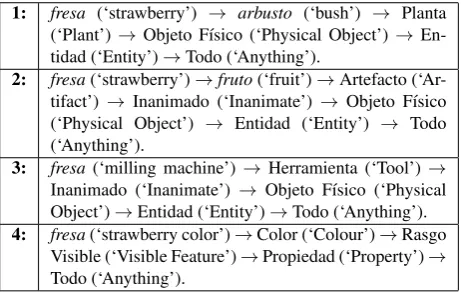
The results of our experiments can be assessed with a qual-itative evaluation by selecting a sample of nouns and in-specting for each of them the obtained ascending hyper-nymy chains until reaching the top node of the ontology. This type of evaluation is useful to check if the different senses of a potentially polysemous word are registered in the taxonomy, and most importantly, if the prototypical senses are attested in the resource. Consider, for illustra-tion, the case of the wordfresa(‘strawberry’), which resul-ted in the chains shown in table 1. In chain 1, the word is
1: fresa (‘strawberry’) → arbusto (‘bush’) → Planta (‘Plant’)→Objeto F´ısico (‘Physical Object’) → En-tidad (‘Entity’)→Todo (‘Anything’).
2: fresa(‘strawberry’)→fruto(‘fruit’)→Artefacto (‘Ar-tifact’) →Inanimado (‘Inanimate’) → Objeto F´ısico (‘Physical Object’) → Entidad (‘Entity’) → Todo (‘Anything’).
3: fresa (‘milling machine’)→Herramienta (‘Tool’)→
Inanimado (‘Inanimate’) → Objeto F´ısico (‘Physical Object’)→Entidad (‘Entity’)→Todo (‘Anything’). 4: fresa(‘strawberry color’)→Color (‘Colour’)→Rasgo
Visible (‘Visible Feature’)→Propiedad (‘Property’)→
[image:5.595.305.536.68.214.2]Todo (‘Anything’).
Table 1: Different taxonomy chains for the Spanish noun
fresa(‘strawberry’)
connected toarbusto(‘bush’), which is in turn linked to the semantic typePlanta(‘Plant’). Strictly speaking, the first connection is incorrect becausefresa, as ‘strawberry’, is not a kind of bush but an herbaceous plant, regardless of the fact that it is true thatarbustois a kind of plant and the rest of the chain is then correct. Chain 2, which definesfresaas a fruit, is correct and identifies the prototypical meaning of the word. Chains 3 and 4 are also correct and identify sec-ondary, metaphorical meanings: a kind of tool and a kind of colour. It is important to point out that, in the case of chain 2,fruto(‘fruit’) is classified as a type of “Food” and not as a type of “Plant Part”, which is another existing node in CPA Ontology. This is because our taxonomy emerges naturally from corpus and does not obey to rigid structures such as those that may appear in a hand-made taxonomy. Being strawberries very popular as a kind of food, they can be considered as such. Ultimately, according to the Diccion-ario de la Real Academia Espa˜nola(DRAE)6, the hyper-nymy chains offresaobtained with this method correspond indeed to the senses listed in the dictionary.
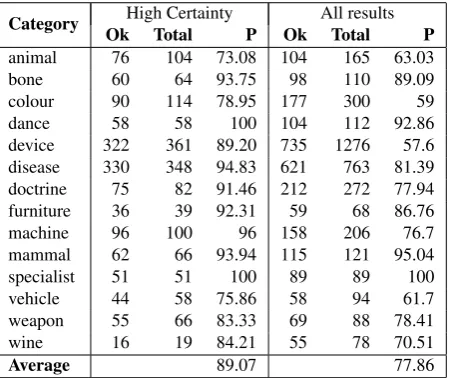
In previous work (Nazar and Renau, 2015b) we conducted this type of evaluation, i.e. generating random samples of nouns and then inspecting the different hypernymy chains produced for each one of them. The problem with this eval-uation procedure is that it is impractical for high volumes of data. For this reason, this time we tried with the inverse approach, which is more in line with the methods described by Bordea et al. (2015). On this occasion we selected a number of semantic categories and then we proceeded to evaluate if the hyponyms placed by the algorithm in such categories were correct. For the evaluation of these results, which we still consider as preliminary, we hired a group of 6 annotators, all advanced students of linguistics. Each stu-dent received a number of categories to evaluate and the in-structions were to accept a hypernymy link only if it could be supported by lexicographical or encyclopedic sources. As explained in subsection 3.6, the results of the taxonomy are classified with two degrees of certainty, high and low, depending on the number of algorithms that agreed to clas-sify a given noun in a given category. Thus, we report fig-ures of precision for each category in different columns in
Category High Certainty All results
Ok Total P Ok Total P
animal 76 104 73.08 104 165 63.03
bone 60 64 93.75 98 110 89.09
colour 90 114 78.95 177 300 59
dance 58 58 100 104 112 92.86
device 322 361 89.20 735 1276 57.6 disease 330 348 94.83 621 763 81.39 doctrine 75 82 91.46 212 272 77.94 furniture 36 39 92.31 59 68 86.76 machine 96 100 96 158 206 76.7 mammal 62 66 93.94 115 121 95.04 specialist 51 51 100 89 89 100 vehicle 44 58 75.86 58 94 61.7 weapon 55 66 83.33 69 88 78.41
wine 16 19 84.21 55 78 70.51
[image:6.595.54.281.68.257.2]Average 89.07 77.86
Table 2: Evaluation of precision of the results of the al-gorithm
Rater High Certainty All results
Ok Total P Ok Total P
E1 144 153 94.12 204 247 82.59 E2 129 153 84.31 168 247 68.02 E3 123 153 80.39 170 247 68.83 E4 128 153 83.66 178 247 72.06 E5 127 153 83.01 181 247 73.28 E6 131 153 85.62 187 247 75.71
Average 85.19 73.41
Table 3: Evaluation of precision with the semantic category “fruits” for the purpose of measuring inter-coder agreement
table 2. For each of them we find three columns: “Ok” for the number of correct cases, “Total” for the total number of cases and “P” for the precision as the ratio between both values. This is how we estimated average precision figures of 89.07% for high certainty results and 77.86% for all res-ults.
In order to calculate inter-coder agreement, we assigned another category to all annotators, the category of fruits, and we instructed them to do the task individually. Table 3 shows the result of all coders analysing this category: an average precision of 85.19% with high certainty and 73.41% in general. A Fleiss’s Kappa coefficient showed rather strong agreement: 0.73 for the six raters.
This evaluation only considered precision. Recall, in turn, is far more difficult to estimate. Again inspired by Bor-dea et al. (2015), on this occasion we attempted to calcu-late recall using Spanish WordNet 1.67as a gold-standard.
There are a number of reasons to believe that this is far from ideal, the main one being that we do not think WordNet is free from errors, omissions and incoherences. Just for il-lustration, if we consider again the case of fresain Span-ish WordNet, we find only two meanings: the fruit and the plant, excluding the other two, the tool and the colour. In the case of the hypernymfruto‘fruit’, we can observefruta
(drupaceous fruits such as apples, peaches, etc.) as
hyper-7hhttp://multiwordnet.fbk.eu/english/home.phpi [last access: 3/4/2016]
Category WN Ours ∩ WN’s R Our R animal 153 117 22 18.8 14.38
bone 69 64 21 32.81 30.43
color 67 96 33 34.38 49.25
dance 39 59 24 40.68 61.54
device 1037 365 158 43.29 15.24
doctrine 14 82 0 0 0
furniture 79 41 8 19.51 10.13 disease 165 348 57 16.38 34.55 machine 96 65 16 24.62 16.67 mammal 315 103 77 74.76 24.44 specialist 289 51 20 39.22 6.92 vehicle 204 62 34 54.84 16.67
weapon 55 66 21 31.82 38.18
wine 13 18 5 27.78 38.46
Average 32.78 25.49
Table 4: Evaluation of recall in results presented with high degree of certainty by the algorithm, using WordNet as gold-standard
nym together withdrupa(‘drupe’) andbaya(‘berry’) as co-hyponyms. We also seepepita/semilla(‘seed’), which is in fact a part of the fruit (a meronym). Furthermore, the selec-tion of the rest of the fruits seems rather arbitrary: we find
calabaza(‘pumpkin’) but not the rest of the cucurbitaceous fruits, such asmel´on‘melon’ orpepino‘cucumber’, which are instead in other categories. Cases like these are frequent in hand-made resources, and this is a problem when using them as gold-standard.
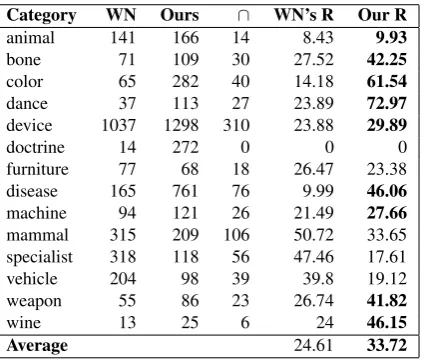
In any case, and conscious that we need to provide at least a basic reference with respect to recall, we conducted an automatic comparison between the hyponyms provided by WordNet and by our algorithm for each of the categor-ies evaluated by the raters. In order to make both re-sources comparable, we excluded multiword expressions from WordNet because our taxonomy now excludes them by design. The result of the comparison is shown in table 4 for the case of result with high degree of certainty and table 5 for the totality of results. Both tables show the number of elements found in WordNet (column “WN”), in our tax-onomy in (column “Ours”), the intersection between both (“∩”) and the relative recall achieved by each of them. We have less recall than WordNet when considering only high certainty results, but the opposite occurs when considering all results. In either case, these results show that our tax-onomy could considerably expand the size of WordNet.
5.
Code and Resources
[image:6.595.302.520.70.246.2]Category WN Ours ∩ WN’s R Our R
animal 141 166 14 8.43 9.93
bone 71 109 30 27.52 42.25
color 65 282 40 14.18 61.54
dance 37 113 27 23.89 72.97
device 1037 1298 310 23.88 29.89
doctrine 14 272 0 0 0
furniture 77 68 18 26.47 23.38 disease 165 761 76 9.99 46.06 machine 94 121 26 21.49 27.66 mammal 315 209 106 50.72 33.65 specialist 318 118 56 47.46 17.61 vehicle 204 98 39 39.8 19.12
weapon 55 86 23 26.74 41.82
wine 13 25 6 24 46.15
[image:7.595.55.266.67.247.2]Average 24.61 33.72
Table 5: Evaluation of recall in all results presented by the algorithm, using WordNet as gold-standard
and reduce file size. Alternatively, a navigable html version of the data is also offered for the less technically advanced user.
6.
Conclusions and Future Work
The work we have presented is an ongoing methodological proposal to create a taxonomy from corpus data, using a set of algorithms which only apply quantitative strategies. As such, we consider that it is relatively easy to replicate the procedure in other languages, and that is one of the lines of research we are conducting at the moment.We are aware that ours is still work in progress and there are many problems to be addressed. We can summarise the following lines of future work:
1)To increase precision making a more detailed error ana-lysis. For the moment, results show that many of the mis-takes are related to the polysemy of the nodes of the tax-onomy and inclusion of other relations such as meronymy. A strategy to depurate our taxonomy is currently being tested (Nazar et al., submitted).
2)To establish a better methodology to calculate recall in-stead of using WordNet as gold-standard. There are dif-ferent aspects to be taken into account. For example, if results show the prototypical meaning of the word, or the most common uses of the word, etc.
3)To increase the number of nouns in the taxonomy until we cover the vast majority of the Spanish language.
4)To replicate the methodology in other languages. At the moment we are working with English and French.
5)To apply the same method to a specialised vocabulary in order to get domain-specific taxonomies, including multi-word expressions.
6)To include more taxonomy induction strategies. There is one algorithm in particular that has already been tested and will be published elsewhere (Nazar & Renau, forthcoming), in which we used a very restricted notion of context such as a fixed position in wordngrams. Consider the case of a sequence such ases un jugador de *(“is a * player”). One can expect that names of games or sports will appear in the position of the asterisk: es un jugador de golf, rugby, tenis. . . (“is a golf/rugby/tennis. . . player”). Of course
there will also be cases such ases un jugador de talento/ /nivel/Estados Unidos/equipo. . . (“is a player of talent / is a level player / is a player from United States / is a team player. . . ”), but the key aspect here is that we do not relate words because they share a singlengram but a very large number of different ones.
We would like to finish this paper referring to a parallel project in which we are applying our taxonomy to the cre-ation of syntagmatic verb patterns which are connected to the different meaning of words, following Hanks’ (2013) Corpus Pattern Analysis. For example, in a sentence such asEl abuelo se muri´o de un infarto(‘Grandfather died of a heart attack’), the verbmorir(‘to die’) has a different mean-ing than in the case of El abuelo se muri´o de verg¨uenza
(‘Grandfather felt very embarrassed’). The main difference between both senses or patterns of use of the verb ‘to die’ in both sentences is indicated by the fact that the direct ob-jects have different semantic types (“Disease” and “Emo-tion”, respectively). Labelling verb arguments with se-mantic types allows us to identify these structures and dis-criminate verb meanings automatically (Nazar and Renau, forthcoming).
7.
Acknowledgements
This research is supported by two grants from the Chilean Government: Conicyt-Fondecyt 11140686, “Inducci´on autom´atica de taxonom´ıas de sustantivos generales y espe-cializados a partir de corpus textuales desde el enfoque de la ling¨u´ıstica cuantitativa” (lead researcher: Rogelio Nazar) and Conicyt-Fondecyt 11140704, “Detecci´on autom´atica del significado de los verbos del castellano por medio de patrones sint´actico-sem´anticos extra´ıdos con estad´ıstica de corpus” (lead researcher: Irene Renau). We would like to thank the anonymous reviewers of the paper for their useful comments and the students who helped us with the evalu-ation.
8.
Bibliographical References
Alfonseca, E. and Manandhar, S. (2002). Extending a lexical ontology by a combination of distributional se-mantics signatures. InLecture Notes in Computer Sci-ence, pages 247–3.
Aristotle. (n.d.).Categories.
Bansal, M., Burkett, D., de Melo, G., and Klein, D. (2014). Structured learning for taxonomy induction with belief propagation. In Proc. of ACL, Baltimore, Maryland, USA, June.
Bordea, G., Buitelaar, P., Faralli, S., and Navigli, R. (2015). Semeval-2015 task 17: Taxonomy extraction evaluation (texeval). InProc. of the 9th International Workshop on Semantic Evaluation (SemEval 2015), pages 902–910, Denver, Colorado, June.
Bullinaria, J. and Levy, J. (2007). Extracting se-mantic representations from word co-occurrence statist-ics: A computational study. Behavior Research Meth-ods, 39(3):510–526.
Ciaramita, M. (2002). Boosting automatic lexical acquis-ition with morphological information. In Proc. of the ACL-02 Workshop on Unsupervised Lexical Acquisition - Volume 9, ULA ’02, pages 17–25, Stroudsburg, PA, USA.
Cimiano, P. and V¨olker, J. (2005). Text2onto: A frame-work for ontology learning and data-driven change dis-covery. InProc. of the 10th International Conference on Natural Language Processing and Information Systems, NLDB’05, pages 227–238, Berlin, Heidelberg. Springer-Verlag.
de Melo, G. and Weikum, G. (2013). Taxonomic data in-tegration from multilingual wikipedia editions. Know-ledge and Information Systems, 39(1):1–39.
Fellbaum, C. (1998). WordNet: An Electronic Lexical Database. Bradford Books.
Fiˇser, D. and Sagot, B. (2015). Constructing a poor man’s wordnet in a resource-rich world. Language Resources and Evaluation, 49(3):601–635.
Grefenstette, G. (1994). Explorations in Automatic Thesaurus Discovery. Kluwer Academic Publishers, Norwell, MA, USA.
Guthrie, L., Slator, B., Wilks, Y., and Bruce, R. (1990). Is there content in empty heads? In Proc. of the 13th International Conference on Computational Linguistics, COLING’90 (Helsinki, Finland), pages 138–143. Hanks, P. (In process). CPA ontology.
http://www.pdev.org.uk/#onto. [last access: 1/3/2016]. Harris, Z. (1954). Distributional structure. Word,
10(23):146–162.
Hearst, M. A. (1992). Automatic acquisition of hyponyms from large text corpora. InProc. of the 14th Conference on Computational Linguistics - Volume 2, COLING ’92, pages 539–545, Stroudsburg, PA, USA.
Jezek, E. and Hanks, P. (2010). What lexical sets tell us about conceptual categories. Lexis: E-Journal in English Lexicology, (4):7–22.
Kilgarriff, A. and Renau, I. (2013). esTenTen, a vast web corpus of peninsular and american spanish. Procedia -Social and Behavioral Sciences, 95:12 – 19. 5th Interna-tional Conference on Corpus Linguistics (CILC2013). Kozareva, Z. and Hovy, E. (2010). A semi-supervised
method to learn and construct taxonomies using the web. In Proceedings of the 2010 Conference on Empirical Methods in Natural Language Processing, EMNLP ’10, pages 1110–1118, Stroudsburg, PA, USA. ACL. Lin, D. (1998). Automatic retrieval and clustering of
sim-ilar words. InProc. of the 17th International Conference on Computational Linguistics - Volume 2, COLING ’98, pages 768–774, Stroudsburg, PA, USA.
Lyons, J. (1977). Semantics, volume 2. Cambridge Uni-versity Press.
Maziarz, M., Piasecki, M., and Szpakowicz, S. (2013). The chicken-and-egg problem in wordnet design: syn-onymy, synsets and constitutive relations. Language Re-sources and Evaluation, 47(3):769–796.
Nazar, R. and Janssen, M. (2010). Combining resources: Taxonomy extraction from multiple dictionaries. In
Proc. of the International Conference on Language
Re-sources and Evaluation, LREC, 17-23 May 2010, Val-letta, Malta.
Nazar, R. and Renau, I. (2012). A co-occurrence taxonomy from a general language corpus. InProc. of EURALEX 2012, pages 367–375, Oslo, Norway.
Nazar, R. and Renau, I. (2015a). Agrupaci´on sem´antica de sustantivos basada en similitud distribucional: im-plicaciones lexicogr´aficas. InLing¨u´ıstica y diccionarios, pages 273–288. Universidade da Coru˜na, A Coru˜na. Nazar, R. and Renau, I. (2015b). Ontology population
us-ing corpus statistics. InJOWO@IJCAI, volume 1517 of
CEUR Workshop Proc.CEUR-WS.org.
Nazar, R. and Renau, I. (forthcoming). A quantitative ana-lysis of the semantics of verb-argument structures. In
Collocations and other lexical combinations in Spanish, pages 92–108. OSU Press, Ohio.
Nazar, R., Vivaldi, J., and Wanner, L. (2012). Co-occurrence graphs applied to taxonomy extraction in sci-entific and technical corpora. Procesamiento del Len-guaje Natural, 49:67–74.
Nazar, R., Renau, I., Ferraro, G., and Mar´ın, R. (submit-ted). Self-depurating ontologies.
Nazar, R. (in preparation). Taxonomy induction and ter-minology extraction help each other. Journal paper. Pantel, P. and Pennacchiotti, M. (2006). Espresso:
Lever-aging generic patterns for automatically harvesting se-mantic relations. InProc. of the 21st International Con-ference on Computational Linguistics and the 44th An-nual Meeting of ACL, ACL-44, pages 113–120, Strouds-burg, PA, USA.
P´erinet, A. and Hamon, T., (2014). Distributional Context Generalisation and Normalisation as a Mean to Reduce Data Sparsity: Evaluation of Medical Corpora, pages 128–135. Springer International Publishing, Cham. Recasens, M. and Hovy, E., (2009). A Deeper Look
into Features for Coreference Resolution, pages 29–42. Springer Berlin Heidelberg, Berlin, Heidelberg.
Renau, I. and Nazar, R. (2012). Hypernymy relations from definiens-definiendum co-occurrence in multiple dictionary definitions. Procesamiento del Lenguaje Nat-ural, 49:83–90.
Rydin, S. (2002). Building a hyponymy lexicon with hier-archical structure. InProc. of the ACL-02 Workshop on Unsupervised Lexical Acquisition - Volume 9, ULA ’02, pages 26–33, Stroudsburg, PA, USA.
Sch¨utze, H. and Pedersen, J. O. (1997). A cooccurrence-based thesaurus and two applications to information re-trieval. Inf. Process. Manage., 33(3):307–318, May. Snow, R., Jurafsky, D., and Ng, A. Y. (2006). Semantic
taxonomy induction from heterogenous evidence. In
Proc. of the 21st International Conference on Compu-tational Linguistics, Sydney, Australia.
Strohmaier, M., Helic, D., Benz, D., K¨orner, C., and Kern, R. (2012). Evaluation of folksonomy induction algorithms.ACM Trans. Intell. Syst. Technol., 3(4):74:1– 74:22, September.