The Effect of Syntactic Representation on Semantic Role Labeling
Richard Johansson and Pierre Nugues Lund University, Sweden
{richard, pierre}@cs.lth.se
Abstract
Almost all automatic semantic role label-ing (SRL) systems rely on a preliminary parsing step that derives a syntactic struc-ture from the sentence being analyzed. This makes the choice of syntactic repre-sentation an essential design decision. In this paper, we study the influence of syn-tactic representation on the performance of SRL systems. Specifically, we com-pare constituent-based and dependency-based representations for SRL of English in the FrameNet paradigm.
Contrary to previous claims, our results demonstrate that the systems based on de-pendencies perform roughly as well as those based on constituents: For the ar-gument classification task, dependency-based systems perform slightly higher on average, while the opposite holds for the argument identification task. This is re-markable because dependency parsers are still in their infancy while constituent pars-ing is more mature. Furthermore, the re-sults show that dependency-based seman-tic role classifiers rely less on lexicalized features, which makes them more robust to domain changes and makes them learn more efficiently with respect to the amount of training data.
1 Introduction
The role-semantic paradigm has a long and rich history in linguistics, and the NLP community has recently devoted much attention to develop-ing accurate and robust methods for performdevelop-ing
c
2008. Licensed under the Creative Commons Attribution-Noncommercial-Share Alike 3.0 Unported
li-cense (http://creativecommons.org/licenses/by-nc-sa/3.0/). Some rights reserved.
role-semantic analysis automatically (Gildea and Jurafsky, 2002; Litkowski, 2004; Carreras and Màrquez, 2005; Baker et al., 2007). It is widely conjectured that an increased SRL accuracy will lead to improvements in certain NLP applica-tions, especially template-filling systems. SRL has also been used in prototypes of more advanced semantics-based applications such as textual en-tailment recognition.
It has previously been shown that SRL systems need a syntactic structure as input (Gildea and Palmer, 2002; Punyakanok et al., 2008). An im-portant consideration is then what information this input should represent. By habit, most systems for automatic role-semantic analysis have used Penn-style constituents (Marcus et al., 1993) produced by Collins’ (1997) or Charniak’s (2000) parsers. The influence of the syntactic formalism on SRL has only been considered in a few previous arti-cles. For instance, Gildea and Hockenmaier (2003) reported that a CCG-based parser gives improved results over the Collins parser.
Dependency syntax has only received little at-tention for the SRL task, despite a surge of inter-est in dependency parsing during the last few years (Buchholz and Marsi, 2006). Early examples of dependency-based SRL systems, which used gold-standard dependency treebanks, include Žabokrt-ský et al. (2002) and Hacioglu (2004). Two stud-ies that compared the respective performances of constituent-based and dependency-based SRL sys-tems (Pradhan et al., 2005; Swanson and Gor-don, 2006), both using automatic parsers, reported that the constituent-based systems outperformed the dependency-based ones by a very wide mar-gin. However, the figures reported in these studies can be misleading since the comparison involved a 10-year-old rule-based dependency parser versus a state-of-the-art statistical constituent parser. The recent progress in statistical dependency parsing gives grounds for a new evaluation.
In addition, there are a number of linguistic mo-tivations why dependency syntax could be bene-ficial in an SRL context. First, complex linguis-tic phenomena such as wh-word extraction and topicalization can be transparently represented by allowing nonprojective dependency links. These links also justify why dependency syntax is of-ten considered superior for free-word-order lan-guages; it is even very questionable whether the traditional constituent-based SRL strategies are vi-able for such languages. Second, grammatical function such as subject and object is an integral concept in dependency syntax. This concept is in-tuitive when reasoning about the link between syn-tax and semantics, and it has been used earlier in semantic interpreters such as Absity (Hirst, 1983). However, except from a few tentative experiments (Toutanova et al., 2005), grammatical function is not explicitly used by current automatic SRL sys-tems, but instead emulated from constituent trees by features like the constituent position and the governing category. More generally, these lin-guistic reasons have made a number of linguists argue that dependency structures are more suit-able for explaining the syntax-semantics interface (Mel’ˇcuk, 1988; Hudson, 1984).
In this work, we provide a new evaluation of the influence of the syntactic representation on se-mantic role labeling in English. Contrary to previ-ously reported results, we show that dependency-based systems are on a par with constituent-dependency-based systems or perform nearly as well. Furthermore, we show that semantic role classifiers using a de-pendency parser learn faster than their constituent-based counterparts and therefore need less train-ing data to achieve similar performances. Finally, dependency-based role classifiers are more robust to vocabulary change and outperform constituent-based systems when using out-of-domain test sets.
2 Statistical Dependency Parsing for English
Except for small-scale efforts, there is no depen-dency treebank of significant size for English. Sta-tistical dependency parsers of English must there-fore rely on dependency structures automatically converted from a constituent corpus such as the Penn Treebank (Marcus et al., 1993).
Typical approaches to conversion of constituent structures into dependencies are based on hand-constructed head percolation rules, an idea that has
its roots in lexicalized constituent parsing (Mager-man, 1994; Collins, 1997). The head rules cre-ated by Yamada and Matsumoto (2003) have been used in almost all recent work on statistical depen-dency parsing of English (Nivre and Scholz, 2004; McDonald et al., 2005).
Recently, Johansson and Nugues (2007) ex-tended the head percolation strategy to incorporate long-distance links such aswh-movement and top-icalization, and used the full set of grammatical function tags from Penn in addition to a number of inferred tags (in total 57 function tags). A depen-dency parser based on this syntax was used in the best-performing system in the SemEval-2007 task on Frame-semantic Structure Extraction (Baker et al., 2007), and the conversion method (in two dif-ferent forms) was used for the English data in the CoNLL Shared Tasks of 2007 and 2008.
3 Automatic Semantic Role Labeling with Constituents and Dependencies
To study the influence of syntactic representation on SRL performance, we developed a framework that could be easily parametrized to process either constituent or dependency input1. This section
de-scribes its implementation. As the role-semantic paradigm, we used FrameNet (Baker et al., 1998).
3.1 Systems
We built SRL systems based on six different parsers. All parsers were trained on the Penn Tree-bank, either directly for the constituent parsers or through the LTH constituent-to-dependency con-verter (Johansson and Nugues, 2007). Our systems are identified as follows:
LTH. A dependency-based system using the LTH
parser (Johansson and Nugues, 2008).
Malt. A dependency-based system using
MaltParser (Nivre et al., 2007).
MST. A dependency-based system using
MSTParser (McDonald et al., 2005).
C&J. A constituent-based system using the
reranking parser (the May 2006 version) by Charniak and Johnson (2005).
Charniak. A constituent-based system using
Charniak’s parser (Charniak, 2000).
Collins. A constituent-based system using
Collins’ parser (Collins, 1997).
1Our implementation is available for download at
MaltParser is an incremental greedy classifier-based parser classifier-based on SVMs, while the LTH parser and MSTParser use exact edge-factored search with a linear model trained using online margin-based structure learning. MaltParser and MST-Parser have achieved state-of-the-art results for a wide range of languages in the 2006 and 2007 CoNLL Shared Tasks on dependency parsing, and the LTH parser obtained the best result in the 2008 CoNLL Shared Task on joint syntactic and seman-tic parsing. Charniak’s and Collins’ parsers are widely used constituent parsers for English, and the C&J parser is the best-performing freely avail-able constituent parser at the time of writing ac-cording to published figures. Charniak’s parser and the C&J parser come with a built-in part-of-speech tagger; all other systems used the Stanford tagger (Toutanova et al., 2003).
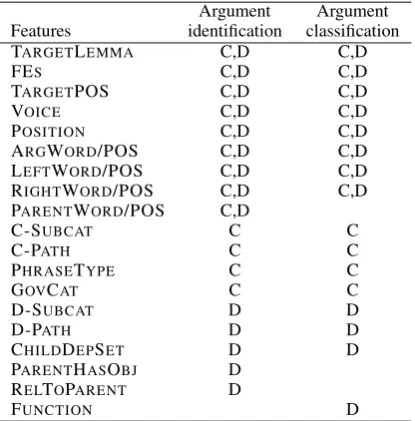
Following Gildea and Jurafsky (2002), the SRL problem is traditionally divided into two subtasks: identifying the arguments and labeling them with semantic roles. Although state-of-the-art SRL sys-tems use sophisticated statistical models to per-form these two tasks jointly (e.g. Toutanova et al., 2005, Johansson and Nugues, 2008), we im-plemented them as two independent support vector classifiers to be able to analyze the impact of syn-tactic representation on each task separately. The features used by the classifiers are traditional, al-though the features for the dependency-based clas-sifiers needed some adaptation. Table 1 enumer-ates the features, which are described in more de-tail in Appendix A. The differences in the fea-ture sets reflect the structural differences between constituent and dependency trees: The constituent-only features are based on phrase tags and the dependency-only features on grammatical func-tions labels.
3.2 Dependency-based Argument Identification
The argument identification step consists of find-ing the arguments for a given predicate. For constituent-based SRL, this problem is formulated as selecting a subset of the constituents in a parse tree. This is then implemented in practice as a binary classifier that determines whether or not a given constituent is an argument. We approached the problem similarly in the dependency frame-work, applying the classifier on dependency nodes rather than constituents. In both cases, the
identi-Argument Argument Features identification classification TARGETLEMMA C,D C,D
FES C,D C,D
TARGETPOS C,D C,D
VOICE C,D C,D
POSITION C,D C,D
ARGWORD/POS C,D C,D
LEFTWORD/POS C,D C,D
RIGHTWORD/POS C,D C,D
PARENTWORD/POS C,D
C-SUBCAT C C
C-PATH C C
PHRASETYPE C C
GOVCAT C C
D-SUBCAT D D
D-PATH D D
CHILDDEPSET D D
PARENTHASOBJ D RELTOPARENT D
FUNCTION D
Table 1: Classifier features. The features used by the constituent-based and the dependency-based systems are marked C and D, respectively.
fication step was preceded by a pruning stage that heuristically removes parse tree nodes unlikely to represent arguments (Xue and Palmer, 2004).
To score the performance of the argument iden-tifier, traditional evaluation procedures treat the identification as a bracketing problem, meaning that the entities scored by the evaluation procedure are labeled snippets of text; however, it is ques-tionable whether this is the proper way to evalu-ate a task whose purpose is to find semantic re-lations between logical entities. We believe that the same criticisms that have been leveled at the PARSEVAL metric for constituent structures are equally valid for the bracket-based evaluation of SRL systems. The inappropriateness of the tra-ditional metric has led to a number of alternative metrics (Litkowski, 2004; Baker et al., 2007).
predi-cate, then the branch containing the predicate is removed. Also, FrameNet allows arguments to co-incide with the predicate; in this case, the yield is just the predicate node.
Algorithm 1Span creation from argument
depen-dency nodes.
inputPredicate nodep, argument nodea ifadoes not dominatep
Y ← {n;adominatesn} else ifp=a
Y ← {p} else
c←the child ofathat dominatesp
Y ← {n;adominatesn} \ {n;cdominatesn} end if
S ←partition ofY into contiguous subsets
return{(min-indexs,max-indexs);s∈S}
that we have been relying on the ideas
ROOT−FRAG
VC
SBJ VC CLR
PMOD NMOD
NMOD
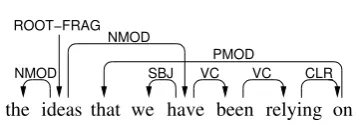
Figure 1: Example of a dependency tree containing a predicaterelyingwith three arguments:the ideas, we, andon . . . that.
To illustrate Algorithm 1, consider Figure 1. In this sentence, the predicaterelyinghas three argu-ments: the ideas,we, andon . . . that. The simplest of them iswe, which does not dominate its predi-cate and which is not discontinuous. A more com-plex case is the discontinuous argument headed by on, where the yield {on,that} is partitioned into two subsets that result in two separate spans. Fi-nally, the dependency node ideas dominates the predicate. In this case, the algorithm removes the subtree headed byhave, so the remaining yield is
{the,ideas}.
4 Experiments
We carried out a number of experiments to com-pare the influence of the syntactic representation on different aspects of SRL performance. We used the FrameNet example corpus and running-text corpus, from which we randomly sampled a training and test set. The training set consisted of 134,697 predicates and 271,560 arguments, and
the test set of 14,952 predicates and 30,173 argu-ments. This does not include null-instantiated ar-guments, which were removed from the training and test sets.
4.1 Argument Identification
Before evaluating the full automatic argument identification systems, we studied the effect of the span creation from dependency nodes (Algo-rithm 1). To do this, we measured the upper-bound recall of argument identification using the con-ventional span-based evaluation metric. We com-pared the quality of pruned spans (Algorithm 1) tounpruned spans (a baseline method that brack-ets the full subtree). Table 2 shows the re-sults of this experiment. The figures show that proper span creation is essential when the tradi-tional metrics are used: For all dependency-based systems, the upper-bound recall increases signif-icantly. However, the dependency-based systems generally have lower figures for the upper-bound recall than constituent-based ones.
System Pruned Unpruned
LTH 83.9 82.1
Malt 82.1 78.3
MST 80.4 77.1
C&J 85.3
Charniak 83.4
Collins 81.8
Table 2: Upper-bound recall for argument identifi-cation.
that a reranker could be used to improve the de-pendency parsers as well.
System P R F1
LTH 79.7 77.3 78.5 Malt 77.4 73.8 75.6 MST 73.9 71.9 72.9 C&J 81.4 77.3 79.2 Charniak 79.8 75.0 77.3 Collins 78.4 72.9 75.6
Table 3: Argument identification performance.
Differences between parsers using the same syn-tactic formalism are also considerable, which sug-gests that the attachment accuracy is probably the most important parameter when choosing a parser for this task.
4.2 Argument Classification
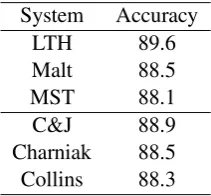
To evaluate the argument classification accuracies, we provided the systems with gold-standard argu-ments, which were then automatically classified. Table 4 shows the results.
System Accuracy
LTH 89.6
Malt 88.5
MST 88.1
C&J 88.9 Charniak 88.5 Collins 88.3
Table 4: Semantic role classification accuracy.
Here, the situation is different: the best dependency-based system make 6.3% fewer errors than the best constituent-based one, a statistically significant difference at the 99.9% level according to a McNemar test. Again, there are no clear differ-ences that can be attributed to syntactic formalism. However, this result is positive, because it shows clearly that SRL can be used in situations where only dependency parsers are available.
On the other hand, it may seem paradoxical that the rich set of grammatical functions used by the dependency-based systems did not lead to a clearer difference between the groups, despite the linguistic intuition that this feature should be use-ful for argument classification. Especially for for the second- and third-best systems (Malt and MST versus Charniak and Collins), the performance fig-ures are almost identical. However, all systems
use lexical features of the argument, and given enough training data, one may say that the gram-matical function is implicitly encoded in these fea-tures. This suggests that lexical features are more important for constituent-based systems than for dependency-based ones.
4.3 Robustness of SRL Classifiers
In this section, we test the hypothesis that the SRL systems based on dependency syntax rely less heavily on lexical features. We also investigate two parameters that are influenced by lexicaliza-tion: domain sensitivity and the amount of training data required by classifiers.
Tests of Unlexicalized Models
To test the hypothesis about the reliance on lex-icalization, we carried out a series of experiments where we set aside the lexical features of the argu-ment. Table 5 shows the results.
As expected, there is a sharp drop in perfor-mance for all systems, but the results are very clear: When no argument lexical features are avail-able, the dependency-based systems have a supe-rior performance. The difference between MST and C&J constitutes an error reduction of 6.9% and is statistically significant at the 99.9% level.
System Accuracy
LTH 83.0
Malt 81.9
MST 81.7
C&J 80.3 Charniak 80.0 Collins 79.8
Table 5: Accuracy for unlexicalized role classi-fiers. Dependency-based systems make at least 6.9% fewer errors.
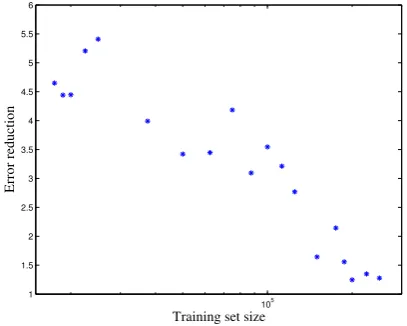
Training Set Size
reduc-tion was 5.4% with a training set of 25,000 in-stances. When the training set size increases, the difference between the groups decreases. The plot is consistent with our hypothesis that the gram-matical function features used by the dependency-based systems make generalization easier for sta-tistical classifiers. We interpret the flatter learning curves for constituent-based systems as a conse-quence of lexicalization – these systems need more training data to use lexical information to capture grammatical function information implicitly.
105 1
1.5 2 2.5 3 3.5 4 4.5 5 5.5 6
Training set size
Error reduction
Figure 2: Error reduction of average dependency-based systems as a function of training set size.
Out-of-domain Test Sets
We finally conducted an evaluation of the se-mantic role classification accuracies on an out-of-domain test set: the FrameNet-annotated Nuclear Threat Initiative texts from SemEval task (Baker et al., 2007). Table 6 shows the results. This cor-pus contained 9,039 predicates and 15,343 argu-ments. The writing style is very different from the FrameNet training data, and the annotated data contain several instances of predicates and frames unseen in the training set. We thus see that all sys-tems suffer severely from domain sensitivity, but we also see that the dependency-based systems are more resilient – the difference between MST and C&J is statistically significant at the 97.5% level and corresponds to an error reduction of 2%. The experiment reconfirms previous results (Carreras and Màrquez, 2005) that the argument classifica-tion part of SRL systems is sensitive to domain changes, and Pradhan et al. (2008) argued that an important reason for this is that the lexical fea-tures are heavily domain-dependent. Our results
are consistent with this hypothesis, and suggest that the inclusion of grammatical function features is an effective way to mitigate this sensitivity.
System Accuracy
LTH 71.1
Malt 70.1
MST 70.1
C&J 69.5 Charniak 69.3 Collins 69.3
Table 6: Classification accuracy on the NTI texts. Dependency-based systems make 2% fewer errors.
5 Discussion
We have described a set of experiments that in-vestigate the relation between syntactic represen-tation and semantic role labeling performance, specifically focusing on a comparison between constituent- and dependency-based SRL systems.
A first conclusion is that our dependency-based systems perform more or less as well as the more mature constituent-based systems: For the argu-ment classification task, dependency-based sys-tems are slightly better on average, while the constituent-based systems perform slightly higher in argument identification.
This result contrasts with previously published comparisons, which used less accurate depen-dency parsers, and shows that semantic analyz-ers can be implemented for languages where con-stituent parsers are not available. While traditional constituent-based SRL techniques have so far been applied to languages characterized by simple mor-phology and rigid word order, such as English and Chinese, we think that dependency-based SRL can be particularly useful for languages with a free word order.
Structure Extraction and the 2008 CoNLL Shared Task are examples of steps in the right direction.
Our second main result is that for argument classification, dependency-based systems rely less heavily on lexicalization, and we suggest that this is because they use features based on grammatical function labels. These features make the learning curve steeper when training the classifier, and im-prove robustness to domain changes.
A Features Used by the Classifiers
The following subsections itemize the features used by the systems. All examples are given with respect to the sentenceshe gave the horse an apple. The constituent and dependency trees are shown in Figure 3. For this sentence, the predicate is gave, which has the FrameNet frame GIVING. It
has three arguments: she, which has the DONOR
role;the horse, the RECIPIENT; andan apple, the
THEME.
NP NP NP
VP S
gave the horse an apple she
gave the horse an apple she
SBJ ROOT−S
NMOD NMOD
IOBJ OBJ
Figure 3: Examples of parse trees.
A.1 Common Features
The following features are used by both the constituent-based and the dependency-based se-mantic analyzers. Head-finding rules (Johansson and Nugues, 2007) were applied when heads of constituents were needed.
TARGETLEMMA. The lemma of the target word itself, e.g. give.
FES. For a given frame, the set of available frame
elements listed in FrameNet. For instance, for givein the GIVINGframe, we have 12 frame
elements: DONOR, RECIPIENT, THEME, . . .
TARGETPOS. Part-of-speech tag for the target
word.
VOICE. For verbs, this feature is Active or
Pas-sive. For other types of words, it is not de-fined.
POSITION. Position of the head word of the
argu-ment with respect to the target word: Before, After, or On.
ARGWORD and ARGPOS. Lexical form and
part-of-speech tag of the head word of the ar-gument.
LEFTWORD and LEFTPOS. Form and
part-of-speech tag of the leftmost dependent of the argument head.
RIGHTWORD and RIGHTPOS. Form and
part-of-speech tag of the rightmost dependent of the argument head.
PARENTWORD and PARENTPOS. Form and
part-of-speech tag of the parent node of the target.
A.2 Features Used by the Constituent-based Analyzer Only
C-SUBCAT. Subcategorization frame:
corre-sponds to the phrase-structure rule used to ex-pand the phrase around the target. Forgivein the example, this feature isVP→VB NP NP.
C-PATH. A string representation of the path
through the constituent tree from the target word to the argument constituent. For in-stance, the path fromgavetosheis↑VP-↑S
-↓NP.
PHRASETYPE. Phrase type of the argument
con-stituent, e.g.NPforshe.
GOVCAT. Governing category: this feature is
ei-therSorVP, and is found by starting at the
ar-gument constituent and moving upwards until either aVPor a sentence node (S,SINV, or SQ) is found. For instance, forshe, this
fea-ture is S, while forthe horse, it is VP. This
can be thought of as a very primitive way of distinguishing subjects and objects.
A.3 Features Used by the Dependency-based Analyzer Only
D-SUBCAT. Subcategorization frame: the grammatical functions of the dependents concatenated. For gave, this feature is
SBJ+IOBJ+OBJ.
D-PATH. A string representation of the path
CHILDDEPSET. The set of grammatical
func-tions of the direct dependents of the target node. For instance, for give, this is { SBJ, IOBJ,OBJ}.
PARENTHASOBJ. Binary feature that is set to
true if the parent of the target has an object. RELTOPARENT. Dependency relation between
the target node and its parent.
FUNCTION. The grammatical function of the
ar-gument node. For direct dependents of the target, this feature is identical to the D-PATH.
References
Baker, Collin F., Charles J. Fillmore, and John B. Lowe. 1998. The Berkeley FrameNet Project. InProceedings of COLING/ACL-1998.
Baker, Collin, Michael Ellsworth, and Katrin Erk. 2007. Se-mEval task 19: Frame semantic structure extraction. In
Proceedings of SemEval-2007.
Buchholz, Sabine and Erwin Marsi. 2006. CoNLL-X shared task on multilingual dependency parsing. InProceedings of the CoNLL-X.
Carreras, Xavier and Lluís Màrquez. 2005. Introduction to the CoNLL-2005 shared task: Semantic role labeling. In
Proceedings of CoNLL-2005.
Charniak, Eugene and Mark Johnson. 2005. Coarse-to-fine n-best parsing and MaxEnt discriminative reranking. In
Proceedings of ACL.
Charniak, Eugene. 2000. A maximum-entropy-inspired parser. InProceedings of NAACL-2000.
Collins, Michael. 1997. Three generative, lexicalised models for statistical parsing. InProceedings of ACL/EACL-1997.
Gildea, Daniel and Julia Hockenmaier. 2003. Identifying semantic roles using combinatory categorial grammar. In
Proceedings of EMNLP-2003.
Gildea, Daniel and Daniel Jurafsky. 2002. Automatic labeling of semantic roles. Computational Linguistics,
28(3):245–288.
Gildea, Daniel and Martha Palmer. 2002. The necessity of syntactic parsing for predicate argument recognition. In
Proceedings of the ACL-2002.
Hacioglu, Kadri. 2004. Semantic role labeling using depen-dency trees. InProceedings of COLING-2004.
Hirst, Graeme. 1983. A foundation for semantic interpreta-tion. InProceedings of the ACL-1983.
Hudson, Richard. 1984. Word Grammar. Blackwell.
Johansson, Richard and Pierre Nugues. 2007. Extended constituent-to-dependency conversion for English. In Pro-ceedings of NODALIDA 2007.
Johansson, Richard and Pierre Nugues. 2008. Dependency-based syntactic–semantic analysis with PropBank and NomBank. InProceedings of CoNLL–2008.
Litkowski, Ken. 2004. Senseval-3 task: Automatic labeling of semantic roles. InProceedings of Senseval-3.
Magerman, David M. 1994. Natural language parsing as sta-tistical pattern recognition. Ph.D. thesis, Stanford Univer-sity.
Marcus, Mitchell P., Beatrice Santorini, and Mary Ann Marcinkiewicz. 1993. Building a large annotated corpus of English: the Penn Treebank. Computational Linguis-tics, 19(2):313–330.
McDonald, Ryan, Koby Crammer, and Fernando Pereira. 2005. Online large-margin training of dependency parsers. InProceedings of ACL-2005.
Mel’ˇcuk, Igor A. 1988. Dependency Syntax: Theory and Practice. State University Press of New York.
Nivre, Joakim and Mario Scholz. 2004. Deterministic depen-dency parsing of English text. InProceedings of COLING-2004.
Nivre, Joakim, Johan Hall, Jens Nilsson, Atanas Chanev, Gül¸sen Eryi˘git, Sandra Kübler, Svetoslav Marinov, and Er-win Marsi. 2007. MaltParser: A language-independent system for data-driven dependency parsing. Natural Lan-guage Engineering, 13(2):95–135.
Pradhan, Sameer, Wayne Ward, Kadri Hacioglu, James Mar-tin, and Daniel Jurafsky. 2005. Semantic role labeling using different syntactic views. InProceedings of ACL-2005.
Pradhan, Sameer, Wayne Ward, and James H. Martin. 2008. Towards robust semantic role labeling. Computational Linguistics, 34(2):289–310.
Punyakanok, Vasin, Dan Roth, and Wen-tau Yih. 2008. The importance of syntactic parsing and inference in semantic role labeling.Computational Linguistics, 34(2):257–287.
Swanson, Reid and Andrew S. Gordon. 2006. A comparison of alternative parse tree paths for labeling semantic roles. InProceedings of COLING/ACL-2006.
Toutanova, Kristina, Dan Klein, Christopher Manning, and Yoram Singer. 2003. Feature-rich part-of-speech tagging with a cyclic dependency network. InProceedings of HLT-NAACL-2003.
Toutanova, Kristina, Aria Haghighi, and Christopher D. Man-ning. 2005. Joint learning improves semantic role label-ing. InProceedings of ACL-2005.
Žabokrtský, Zdenˇek, Petr Sgall, and Sašo Džeroski. 2002. A machine learning approach to automatic functor assign-ment in the Prague dependency treebank. InProceedings of LREC-2002.
Xue, Nianwen and Martha Palmer. 2004. Calibrating features for semantic role labeling. In Proceedings of EMNLP-2004.