Exploiting Graph Structure for Accelerating the Calculation of Shortest
Paths in Wordnets
Holger Wunsch
Collaborative Research Center 441 “Linguistic Data Structures” University of T¨ubingen, Germany
Abstract
This paper presents an approach for sub-stantially reducing the time needed to cal-culate the shortest paths between all con-cepts in a wordnet. The algorithm exploits the unique “star-like” topology of word-nets to cut down on time-expensive calcu-lations performed by algorithms to solve the all-pairs shortest path problem in gen-eral graphs. The algorithm was applied to two wordnets of two different languages: Princeton WordNet (Fellbaum, 1998) for English, and GermaNet (Kunze and Lem-nitzer, 2002), the German language word-net. For both wordnets, the time needed for finding all shortest paths was brought down from several days to a matter of minutes.
1 Introduction
Significant effort has been devoted in linguistic re-search to the problem of determining the semantic distance1between two concepts. Many of the ap-proaches that were developed to provide a solution for the task use wordnets as their basic knowledge resource. Budanitsky and Hirst (2006) present an extensive number of approaches for determining lexical semantic relatedness based on the Prince-ton WordNet (Fellbaum, 1998). A large number of these solutions have in common that at some point in the calculation, the length of the shortest path that connects the two concepts in question has
c
°2008. Licensed under the Creative Commons
Attribution-Noncommercial-Share Alike 3.0 Unported
li-cense (http://creativecommons.org/licenses/by-nc-sa/3.0/). Some rights reserved.
1see Budanitsky and Hirst (2006) for a critical discussion of the term “semantic distance”.
to be taken into account. The length of the short-est path between two concepts is thus a vital piece of information in virtually any approach for deter-mining their semantic distance.
From a computer science perspective, a word-net is a directed graph. The nodes in the graph correspond to the concepts that are stored in the wordnet. Two nodes are connected by an edge if there exists a semantic relation between the two concepts that correspond to the nodes. The edges are directed, reflecting the directedness of seman-tic relations in wordnets, such as the relation of hypernymy. The problem of finding the shortest path between two nodes in a graph has been well studied in computer science. Sedgewick (1990) presents two algorithms:
• Dijkstra’s algorithm finds the shortest path
between two concepts in quadratic time, and is extensible to find the shortest paths be-tween all concepts in cubic time.
• The Floyd-Warshall algorithm, which is very easy to implement, solves the all-pairs short-est path problem in cubic time as well. The Floyd-Warshall algorithm served as the base-line algorithm for this paper.
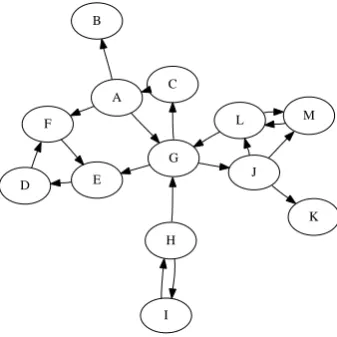
Both algorithms operate on general directed graphs. The structure of a directed graph is sketched in figure 1. Given two nodes, there exist multiple different paths that connect the two nodes. In figure 1, in order to get from L to D, one could take the path L–G–E–D, but also L–G–C–A–F–E– D, and several other paths. An algorithm that looks for the shortest path must deal with this situation and basically be able to consider all alternatives.
Computing of the length of all shortest paths with the Floyd-Warshall algorithm takes about 120
hours for GermaNet, using a compiler-optimized C implementation on a machine equipped with two AMD Opteron processors. GermaNet, which contains 53,312 synsets2 in its current release 5, is of moderate size, compared to the Princeton WordNet, which contains more than twice as many synsets. The execution time of 120 hours is accept-able if the wordnet does not change, and the short-est paths are calculated once and then kept for later use. However, when the task involves the modifi-cation of the wordnet itself and the repeated recal-culation of all shortest paths, this is unacceptable. In such cases the execution time will most likely prohibit research involving such techniques.
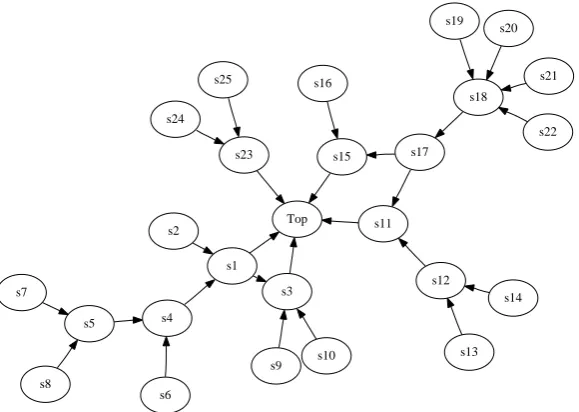
It has been shown that there is no faster way for solving the all-pairs shortest paths problem in gen-eral graphs. However, the structure of wordnets is somewhat different to that of a general directed graph. It can best be described to be similar to that of a star, as depicted in figure 2. In the middle, there is a unique top node that dominates all other nodes3. In the center area around the top node, the synsets represent general concepts. Closer to the fringe, the synsets become more and more spe-cific. A typical configuration in this region would
2A synset is a set of words that are synonymous. Through-out this paper, we will use the term synset synonymously to
nodes in a graph, since the relevant relations (which are
rep-resented by edges in the graph) hold between synsets. 3In most wordnets such as Princeton WordNet or Ger-maNet, there is usually no unique top node. Instead, there is a set of most general concepts, called unique beginners. In the example in figure 2, the unique beginners would be the synsets s1, s3, s11, s15, and s23. The algorithm presented here requires the wordnet to be a connected graph, therefore we stipulate an explicit artificial top node.
our baseline. The Floyd-Warshall algorithm uses a dynamic programming approach. The basic idea is to find all shortest paths by first computing and storing the paths lengths between nodes that are close to each other, and then moving on to longer paths by combining the results of the shorter paths. The Floyd-Warshall algorithm uses a matrix that contains for each pair of nodes the length of the shortest path that connects the two nodes. The ma-trix is initialized by setting the length of the short-est path between any two adjacent nodes to 14. All other fields are set to∞ (which indicates that no path has been found (yet)). Then the algorithm checks for any pair of nodesxandywhether there exists a nodezsuch that the path fromxtoythat runs alongzis shorter than the path betweenxand
ythat has been found so far.
Floyd-Warshall Algorithm
N: set of nodes
p: matrix that contains the lengths of the short-est path between any nodexandy∈N.
Initialization Step for allx, y∈N do
5: ifneighbors(x, y)then
pxy := 1
else
pxy :=∞
end if
10: end for
[image:2.595.97.266.73.242.2]Top
s1 s3 s4
s5
s6 s2
s9 s10 s11
s12
s13 s14
s22 s18
s17 s15
s23 s25
s24
s16
s20 s19
s21
s7
[image:3.595.156.446.73.279.2]s8
Figure 2: Schematic star-like structure of a wordnet.
Shortest Path Calculation for allz∈N do
for allx, y∈N do
pxy :=min(pxy, pxz+pzy) 15: end for
end for
Since the shortest of all possible paths must be found, the Floyd-Warshall algorithm has to check for any node z if the path x–z–y is the shortest. Returning to the example in figure 2, the shortest path betweenx = s1 andy= s16 is s1–Top–s15– s16. The Floyd-Warshall algorithm also considers the other possible paths, such as s1–s3–Top–s15– s16 or s1–Top–s11–s17–s15–s16, which are even-tually discarded because they turn out to be not the shortest connection.
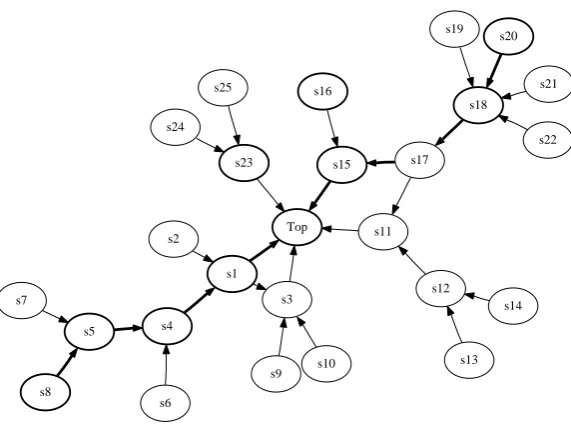
Now consider a path such as the one illustrated in figure 3, which is the shortest undirected path between the synsets s8 and s205. In order to find this shortest path, the Floyd-Warshall algorithm would check all possible combinations of nodes
x–z–y in order to find a potential shorter alterna-tive. To the human reader it is obvious that this is an unnecessary amount of work: there is only one path that leads from s8 to s1, because the part of the wordnet rooted in s4 is in fact a tree, and paths connecting two nodes in trees are always unique. The same is true for the structure rooted in s18.
5Since the edges in the graph correspond to the hypernymy relations in the wordnet, they all point towards the top node. In order to get from s8 to s20, one must first follow the path up to the top node along the hypernymy axis, and then down to s20 in the opposite direction. Therefore, paths are undirected.
Moreover, there is a unique link from s4 to s1, and from s18 to s17. The synsets s1 and s17 are part of the core structure of the wordnet with higher den-sity. Here, between s1 and s17 there do exist more than one paths which must all be considered by the path finding algorithm.
The complexity of the Floyd-Warshall algorithm results from the necessity of considering all possi-ble paths through a general graph in order to find the shortest one. Wordnets are graphs – but, as explained above, they have a very special struc-ture: There is a core graph consisting of a limited number of synsets, but the majority of all synsets is arranged in tree structures that are attached to the core graph, which gives wordnets the star-like structure described earlier.
This structure, which is specific to wordnets, can be exploited such that expensive calculations are only performed where necessary – in the core graph of the wordnet – while specialized cheaper calculations are used in the outer parts.
3 Structure-Adapted Shortest Path Search
Figure 3: A path through the wordnet.
all nodes in the wordnet are classified whether they are part of the core graph or a peripheral tree struc-ture. The second stage is the shortest path search proper, which uses the information about the struc-ture of the wordnet that was acquired in the first stage.
3.1 Stage 1: Node classification
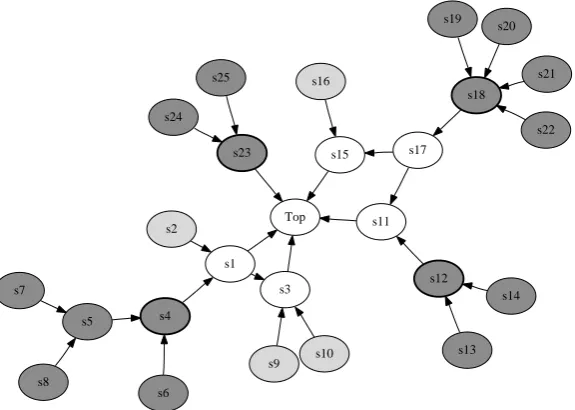
In the first stage, the algorithm determines whether a node belongs to the graph proper which consti-tutes the core network, or to a tree structure in the periphery. The algorithm classifies nodes in four classes, which are illustrated in figure 4.
1. Inner nodes: Inner nodes belong to the graph in the center of the network. A node is an in-ner node if it has more than one parent node, or if one of its children is an inner node. In figure 4, inner nodes have a white back-ground.
2. Root nodes: A root node, as suggested by its name, is the root node of a tree. Root nodes have a unique parent node, which must be an inner node. In figure 4, root nodes have a dark gray background, and thick borders.
3. Tree nodes: Tree nodes are part of a tree, i.e. they have one unique parent node. This parent node must either be a root node, or a tree node as well. In figure 4, tree nodes have a dark gray background (and thin borders).
4. Leaf nodes: Leaf nodes have a unique parent node, which must be an inner node. They do not have any child nodes. As such, leaf nodes are actually a special case of a root node. But for performance reasons, they will be handled separately from root nodes. In figure 4, leaf nodes have a light gray background.
Two remarks are in order. The tree structures referred to in this classification rely on a well de-fined parent-child relation. The hypernymy rela-tion, which is the only relation between synsets we consider in this paper, is a directed relation that satisfies this property: if synsetxis a hypernym of synsety, thenxis a parent node ofy.
The difference between the terms tree node and
leaf node may seem a little arbitrary –
consider-ing for example s8, which is a tree node, and s9, which is a leaf node. Both nodes do not have child nodes. However, from a performance perspective, it is advantageous to treat leaf nodes and tree nodes differently in the algorithm, which is why two dif-ferent nodes types are assumed.
3.2 Stage 2: Shortest Path Search
Top
s1 s3 s4
s5
s6 s2
s9 s10 s11
s12
s13 s14
s22 s18
s17 s15
s23 s25
s24
s16
s20 s19
s21
s7
[image:5.595.157.445.74.279.2]s8
Figure 4: Node classes. White: inner nodes; dark gray: tree nodes; dark gray with thick border: root nodes; light gray: leaf nodes.
graph and runs along s1-Top-s15-s176. The third part of the path is s18-s20. Again, the correspond-ing synsets are members of a tree whose root is s18.
The important point is that for any part of a path that runs though a tree, this is the only possible path through the tree. A general algorithm for find-ing the shortest path out of a set of multiple pos-sible paths is not necessary here. This way, it is possible to restrict the application of general but time-expensive algorithms to the area of the word-net where this is needed – the core of the word-network, while elsewhere it is sufficient to just determine the length of a path through a tree, a task which can be solved very efficiently.
Returning to our example, the algorithm splits the calculation of the shortest path between s8 and s20 as follows: Both s8 and s20 are part of a tree, as determined in step 1. The root of the tree that s8 is a member of is s4. The length of the path between s2 and s4 is 2. s4’s parent node is s1. Root nodes have a unique parent node by defini-tion. Therefore we know that only s1 can be the next node on the path, and its distance is 1, since s4 and s1 are neighbors. So, the length of the path up to s1 is 3. In the same fashion, the length of the other part of the path that is located in a tree, the path between s20 and s17, can be computed.
6there are actually two possible paths of the same length (8) – the other possible path would be the one that runs along synset s11.
The length of this part is 2. Now there remains the part between node s1 and s17. This part of the path runs through the core graph. Here, a general algorithm for finding shortest paths, such as the Floyd-Warshall algorithm, must be used to com-pute the path’s length. The length of the shortest possible path within this region turns out to be 3. Now the lengths of all parts of the path have been determined – and the total length of the shortest path is just the sum of the three parts, which is 8.
4 Implementation
This section will present pseudo-code for the two stages of structure-adapted shortest path search.
4.1 Stage 1: Node classification
Stage 1 explores a wordnet and classifies every node whether it is an inner node, or a root, tree, or leaf node. The procedure starts out by classifying as leaf nodes all nodes that are childless and that have one unique parent node. Note however that the definition of a leaf node requires that its parent node be an inner node. This constraint can not be checked at this point, since information about in-ner nodes is not yet available. Therefore the check is postponed until later.
Next, any node that has more than one parent node is classified as an inner node. The transitive closure of all of this node’s parent nodes is classi-fied as inner nodes as well.
classi-Node Classification Algorithm7
N: set of nodes
Node classes: inner, leaf, root, tree, undefined
Classify leaf nodes for alln∈N do
5: if|children(n)|= 0∧ |parents(n)|= 1then
assign class(n,leaf)
end if end for
Classify inner nodes
10: for alln∈N do
if|parents(n)|>1then ifclass(n)6=inner then
assign class(n,inner)
{All parent nodes of inner nodes are inner nodes as well}
15: for allm∈parents∗(n)do
assign class(m,inner)
end for end if end if
20: end for
Classify root and tree nodes for alln∈N do
ifclass(n) =undefined then
ifclass(parents(n)[0]) =inner then
25: assign class(n,root)
7Notes on the notation:parents(
n)andchildren(n)are
functions that return a list of all parent or child nodes of the node n. parents(n)[0] returns the first node in the list of
parent nodes ofn. parents∗(n)is the transitive closure of
all parent nodes ofn. |parents(n)|is the number of parent
nodes ofn.
4.2 Stage 2: Finding Shortest Paths
The actual calculation of shortest paths takes place in stage 2. In order to calculate the shortest paths between two nodes x andy, two main cases are considered.
4.2.1 xandydo not belong to the same tree
xandydo not belong to the same tree if the root nodes of the trees thatxandyare members of are different: root(x)6=root(y).
The path fromxtoyis then split into three parts:
• lxix: the length of the subpath fromx to the first inner nodeixon the path.
• lyiy: the length of the subpath from yto the
first inner nodeiyon the path.
• lixiy: the length of the subpath fromix toiy,
which runs through the core.
The following cases are considered by the algo-rithm:
1. xis an inner node:ix=x, andlxix = 0.
2. xis a tree node: lxix is the length of the path
fromxto the root node of the treerx, plus 1 to get fromrxtoix:lxix :=lxrx + 1.
3. xis a leaf node or a root node: lxix is 1.
4. yis an inner node:iy =y, andlyiy = 0.
5. yis a tree node:lyiy is the length of the path fromy to the root node of the treery, plus 1
to get fromrytoiy:lyiy :=lyry+ 1.
The length of the path lixiy (the path running
through the core graph) is calculated using the Floyd-Warshall algorithm, that is lixiy = pixiy
(see the description of the Floyd-Warshall algo-rithm above).
The total length of the shortest path is then
lxy :=lxix +lixiy+lyiy.
4.2.2 xandybelong to the same tree
This is a special case that is treated differently from all other cases. Letz be the lowest node in the tree that dominates bothxandy(wherezmay be equal toxory). Thenlxy =lxz+lyz.
Shortest Paths Algorithm
Input:
Two nodesx, y∈N.
Path matrix p for nodes in the core graph as calculated by Floyd-Warshall
Output:
5: The length of the shortest path betweenxand
y,lxy.
if((class(x) =root∨class(x) =tree)∧
(class(y) =root ∨class(y) =tree))∧
root(x) =root(y)then
First case:xandybelong to the same tree
Letz ∈Sbe the lowest common subsumer ofxandy.
lxy :=lxz+lyz
10: return lxy
else
Second case: xandydo not belong to the same tree
ix:=x;
iy :=y;
15: ifclass(x) =treethen
rx :=root(x)
lxix :=lxrx+ 1
else ifclass(x) = root ∨class(x) = leaf
then
lxix := 1
20: else
lxix := 0
end if
ifclass(y) =treethen
ry :=root(y) 25: lyiy :=lyry+ 1
else ifclass(y) =root ∨class(y) =leaf
then
lyiy := 1
else
lyiy := 0 30: end if
lxy :=lxix +lixiy+lyiy
end if
5 Experiments and Results
5.1 The Data
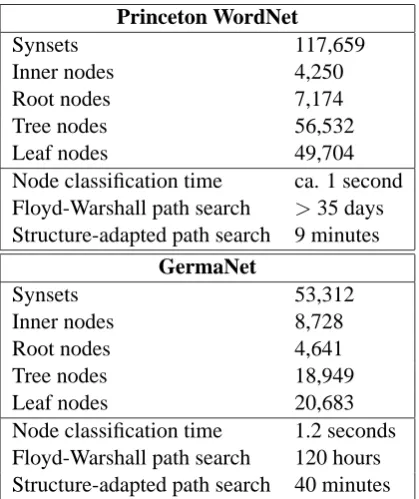
In order to assess the performance of structure adapted path search, we experimented with two different wordnets. For English, we looked at Princeton WordNet (Fellbaum, 1998) in its current release 3, which contains 117,659 synsets. Only 4,250 of these synsets belong to the core network. The remaining 113,410 nodes are members of pe-ripheral tree structures, which amounts to 96 % of all nodes.
Furthermore, we applied the approach to GermaNet (Kunze and Lemnitzer, 2002) for Ger-man. The architecture of GermaNet is modelled after Princeton WordNet and is largely compati-ble. GermaNet, in its current release 5.0, contains 53,312 synsets. Out of these, 8,728 synsets are members of the core of the network (i.e. the part of the network that is a graph proper). The remain-ing 44,273 synsets are part of peripheral tree struc-tures (or leaf nodes). Hence, 83% of the synsets in GermaNet are part of substructures that do not require a general algorithm for calculating shortest paths.
The topology of GermaNet is thus slightly dif-ferent than that of WordNet. The fact that more nodes belong to the core graph indicates that GermaNet’s density with respect to the hypernymy relation is higher than the density of WordNet on the level of the more abstract concepts.
5.2 Application of the Algorithm
We conducted our experiments on a machine equipped with two AMD Opteron 250 processors running at 2.4 GHz and 8 GB of main memory.
For the path-finding stage, we implemented two C programs. Both operate on the same input. Both programs were compiled using gcc’s-O3 option for maximum optimization.
Node classification time 1.2 seconds Floyd-Warshall path search 120 hours Structure-adapted path search 40 minutes
Table 1: Structure-adapted path search – Summary of results
slower the more nodes have been processed, this value is likely to be even higher. GermaNet con-tains only half of the synsets, and the Floyd-Warshall algorithm completed in 120 hours8. The result, a matrix of 53,312×53,312 elements, con-taining the lengths of the shortest paths between all nodes, was written to a binary file whose size was roughly 3 GB.
In the second program, we implemented the structure-adapted shortest path search approach. For calculating shortest paths in the core graph area of the network, we used the same implemen-tation of the Floyd-Warshall algorithm as in the first program. With the same input data and the same machine, we were able to bring the execution time down to 40 minutes for GermaNet, and only 9 minutes for WordNet. This includes creating the output file, which had the same binary format as the one generated by the first program. The dif-ference in processing time between WordNet and GermaNet stems from the smaller core graph in WordNet, which allows for even more nodes to be excluded from the time consuming Floyd-Warshall calculation. The results of the experiments are summarized in table 1.
8The complexity of the Floyd-Warshall algorithm is cubic, therefore twice as many synsets result in a processing effort that is eight times higher.
The benefits of structure adaptation diminish with increasing density of the network as more and more nodes become part of the core graph. In this case, the execution time will approach that of the Floyd-Warshall algorithm. It is also obvious that the approach does not generalize to arbitrary graphs. As long as the structure of graphs is sim-ilar to the star-like structure of wordnets, we ex-pect the approach to be beneficial in applications involving such graphs as well.
References
Budanitsky, A. and Hirst, G. (2006). Evaluating WordNet-based Measures of Lexical Semantic Relatedness. In Computational Linguistics, vol-ume 32. Association for Computational Lin-guistics.
Fellbaum, C. (1998). WordNet: An Electronic
Lex-ical Database. MIT Press, Cambridge, MA.
Kunze, C. and Lemnitzer, L. (2002). GermaNet – Representation, Visualization, Application. In
Proceedings of LREC, pages 1485–1491.