Automatic Learning of Language Model Structure
Kevin Duh and Katrin Kirchhoff Department of Electrical Engineering University of Washington, Seattle, USA
{duh,katrin}@ee.washington.edu
Abstract
Statistical language modeling remains a challeng-ing task, in particular for morphologically rich lan-guages. Recently, new approaches based on factored language models have been developed to address this problem. These models provide principled ways of including additional conditioning variables other than the preceding words, such as morphological or syntactic features. However, the number of possible choices for model parameters creates a large space of models that cannot be searched exhaustively. This paper presents an entirely data-driven model selec-tion procedure based on genetic search, which is shown to outperform both knowledge-based and ran-dom selection procedures on two different language modeling tasks (Arabic and Turkish).
1 Introduction
In spite of novel algorithmic developments and the increased availability of large text corpora, statistical language modeling remains a diffi-cult problem, particularly for languages with rich morphology. Such languages typically ex-hibit a large number of word types in relation to word tokens in a given text, which leads to high perplexity and a large number of un-seen word contexts. As a result, probability es-timates are often unreliable, even when using standard smoothing and parameter reduction techniques. Recently, a new language model-ing approach, called factored language models (FLMs), has been developed. FLMs are a gen-eralization of standard language models in that they allow a larger set of conditioning variables for predicting the current word. In addition to the preceding words, any number of additional variables can be included (e.g. morphological, syntactic, or semantic word features). Since such features are typically shared across mul-tiple words, they can be used to obtained bet-ter smoothed probability estimates when train-ing data is sparse. However, the space of pos-sible models is extremely large, due to many
different ways of choosing subsets of condition-ing word features, backoff procedures, and dis-counting methods. Usually, this space cannot be searched exhaustively, and optimizing mod-els by a knowledge-inspired manual search pro-cedure often leads to suboptimal results since only a small portion of the search space can be explored. In this paper we investigate the possibility of determining the structure of fac-tored language models (i.e. the set of condition-ing variables, the backoff procedure and the dis-counting parameters) by a data-driven search procedure, viz. Genetic Algorithms (GAs). We apply this technique to two different tasks (lan-guage modeling for Arabic and Turkish) and show that GAs lead to better models than ei-ther knowledge-inspired manual search or ran-dom search. The remainder of this paper is structured as follows: Section 2 describes the details of the factored language modeling ap-proach. The application of GAs to the problem of determining language model structure is ex-plained in Section 3. The corpora used in the present study are described in Section 4 and ex-periments and results are presented in Section 5. Section 6 compares the present study to related work and Section 7 concludes.
2 Factored Language Models
A standard statistical language model com-putes the probability of a word sequence W = w1, w2, ..., wT as a product of conditional
prob-abilities of each wordwigiven its history, which
is typically approximated by just one or two pre-ceding words (leading to bigrams, and trigrams, respectively). Thus, a trigram language model is described by
p(w1, ..., wT)≈ T Y
i=3
p(wi|wi−1, wi−2) (1)
word contexts may be observed infrequently or not at all, leading to unreliable probabil-ity estimates under maximum likelihood estima-tion. Several techniques have been developed to address this problem, in particular smooth-ing techniques (Chen and Goodman, 1998) and class-based language models (Brown and oth-ers, 1992). In spite of such parameter reduc-tion techniques, language modeling remains a difficult task, in particular for morphologically rich languages, e.g. Turkish, Russian, or Arabic. Such languages have a large number of word types in relation to the number of word tokens in a given text, as has been demonstrated in a number of previous studies (Geutner, 1995; Kiecza et al., 1999; Hakkani-T¨ur et al., 2002; Kirchhoff et al., 2003). This in turn results in a high perplexity and in a large number of out-of-vocabulary (OOV) words when applying a trained language model to a new unseen text.
2.1 Factored Word Representations A recently developed approach that addresses this problem is that ofFactored Language Mod-els (FLMs) (Kirchhoff et al., 2002; Bilmes and Kirchhoff, 2003), whose basic idea is to decom-pose words into sets of features (or factors) in-stead of viewing them as unanalyzable wholes. Probabilistic language models can then be con-structed over (sub)sets of word features instead of, or in addition to, the word variables them-selves. For instance, words can be decomposed into stems/lexemes and POS tags indicating their morphological features, as shown below:
Word: Stock prices are rising Stem: Stock price be rise
Tag: Nsg N3pl V3pl Vpart
Such a representation serves to express lexical and syntactic generalizations, which would oth-erwise remain obscured. It is comparable to class-based representations employed in stan-dard class-based language models; however, in FLMs several simultaneous class assignments are allowed instead of a single one. In general, we assume that a word is equivalent to a fixed number (K) of factors, i.e.W ≡f1:K. The task
then is to produce a statistical model over the resulting representation - using a trigram ap-proximation, the resulting probability model is as follows:
p(f11:K, f 1:K
2 , ..., f 1:K T )≈
T Y
t=3
p(ft1:K|f
1:K t−1, f
1:K t−2)
(2)
Thus, each word is dependent not only on a sin-gle stream of temporally ordered word variables, but also on additional parallel (i.e. simultane-ously occurring) features. This factored repre-sentation can be used in two different ways to improve over standard LMs: by using a product model or a backoff model. In a product model, Equation 2 can be simplified by finding con-ditional independence assumptions among sub-sets of conditioning factors and computing the desired probability as a product of individual models over those subsets. In this paper we only consider the second option, viz. using the factors in a backoff procedure when the word n-gram is not observed in the training data. For instance, a word trigram that is found in an unseen test set may not have any counts in the training set, but its corresponding factors (e.g. stems and morphological tags) may have been observed since they also occur in other words.
2.2 Generalized parallel backoff
Backoff is a common smoothing technique in language modeling. It is applied whenever the count for a given n-gram in the training data falls below a certain threshold τ. In that case, the maximum-likelihood estimate of the n-gram probability is replaced with a probabil-ity derived from the probabilprobabil-ity of the lower-order (n−1)-gram and a backoff weight. N-grams whose counts are above the threshold re-tain their maximum-likelihood estimates, dis-counted by a factor that re-distributes proba-bility mass to the lower-order distribution:
pBO(wt|wt−1, wt−2) (3)
=
dcpM L(wt|wt−1, wt−2) ifc > τ3 α(wt−1, wt−2)pBO(wt|wt−1) otherwise
where c is the count of (wt, wt−1, wt−2), pM L
denotes the maximum-likelihood estimate and dc is a discounting factor that is applied to the
t
W Wt1
− Wt−2Wt−3
t
W 1 t
W
− Wt−2
t
W Wt1
−
t
W
(a)
F F1F2F3
F
F F1F2 F F1F3 F F2F3
F F1 F F2 F F3
[image:3.612.80.293.79.209.2](b)
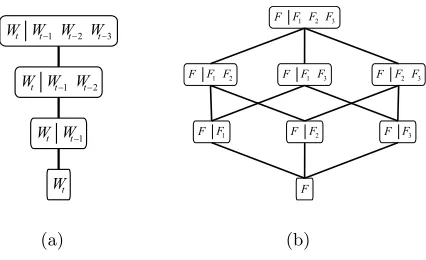
Figure 1: Standard backoff path for a 4-gram lan-guage model over words (left) and backoff graph for 4-gram over factors (right).
However, if variables occur in parallel, i.e. do not form a temporal sequence, it is not imme-diately obvious in which order they should be dropped. In this case, several backoff paths are possible, which can be summarized in a backoff graph(Figure 1(b)). In principle, there are sev-eral different ways of choosing among different paths in this graph:
1. Choose a fixed, predetermined backoff path based on linguistic knowledge, e.g. always drop syntactic before morphological variables. 2. Choose the path at run-time based on statis-tical criteria.
3. Choose multiple paths and combine their probability estimates.
The last option, referred to as parallel backoff, is implemented via a new, generalized backoff function (here shown for a 4-gram):
pGBO(f|f1, f2, f3) (4)
=
dcpM L(f|f1, f2, f3) ifc > τ4
α(f1, f2, f3)g(f, f1, f2, f3) otherwise
where c is the count of (f, f1, f2, f3), pM L(f|f1, f2, f3) is the maximum
likeli-hood distribution, τ4 is the count threshold, and α(f1, f2, f3) is the normalization factor. The function g(f, f1, f2, f3) determines the backoff strategy. In a typical backoff proce-dure g(f, f1, f2, f3) equals pBO(f|f1, f2). In
generalized parallel backoff, however, g can be any non-negative function of f, f1, f2, f3. In our implementation of FLMs (Kirchhoff et al., 2003) we consider several different g functions, including the mean, weighted mean, product, and maximum of the smoothed probability distributions over all subsets of the conditioning
factors. In addition to different choices for g, different discounting parameters can be chosen at different levels in the backoff graph. For instance, at the topmost node, Kneser-Ney discounting might be chosen whereas at a lower node Good-Turing might be applied. FLMs have been implemented as an add-on to the widely-used SRILM toolkit1
and have been used successfully for the purpose of morpheme-based language modeling (Bilmes and Kirchhoff, 2003), multi-speaker language modeling (Ji and Bilmes, 2004), and speech recognition (Kirchhoff et al., 2003).
3 Learning FLM Structure
In order to use an FLM, three types of para-meters need to be specified: the initial con-ditioning factors, the backoff graph, and the smoothing options. The goal of structure learn-ing is to find the parameter combinations that create FLMs that achieve a low perplexity on unseen test data. The resulting model space is extremely large: given a factored word rep-resentation with a total of k factors, there are
Pk n=1
k n
possible subsets of initial condition-ing factors. For a set ofmconditioning factors, there are up tom! backoff paths, each with its own smoothing options. Unlessmis very small, exhaustive search is infeasible. Moreover, non-linear interactions between parameters make it difficult to guide the search into a particular direction, and parameter sets that work well for one corpus cannot necessarily be expected to perform well on another. We therefore need an automatic way of identifying the best model structure. In the following section, we describe the application of genetic-based search to this problem.
3.1 Genetic Algorithms
Genetic Algorithms (GAs) (Holland, 1975) are a class of evolution-inspired search/optimization techniques. They perform particularly well in problems with complex, poorly understood search spaces. The fundamental idea of GAs is to encode problem solutions as (usually binary) strings (genes), and to evolve and test successive populations of solutions through the use of ge-netic operators applied to the encoded strings. Solutions are evaluated according to a fitness function which represents the desired optimiza-tion criterion. The individual steps are as
fol-1We would like to thank Jeff Bilmes for providing and
lows:
Initialize: Randomly generate a set (popula-tion) of strings.
While fitness improves by a certain threshold: Evaluate fitness: calculate each string’s fitness Apply operators: apply the genetic operators
to create a new population.
The genetic operators include the probabilis-tic selection of strings for the next genera-tion, crossover (exchanging subparts of differ-ent strings to create new strings), and muta-tion (randomly altering individual elements in strings). Although GAs provide no guarantee of finding the optimal solution, they often find good solutions quickly. By maintaining a pop-ulation of solutions rather than a single solu-tion, GA search is robust against premature convergence to local optima. Furthermore, solu-tions are optimized based on a task-specific fit-ness function, and the probabilistic nature of ge-netic operators helps direct the search towards promising regions of the search space.
3.2 Structure Search Using GA
In order to use GAs for searching over FLM structures (i.e. combinations of conditioning variables, backoff paths, and discounting op-tions), we need to find an appropriate encoding of the problem.
Conditioning factors
The initial set of conditioning factors F are encoded as binary strings. For instance, a trigram for a word representation with three factors (A,B,C) has six conditioning variables:
{A−1, B−1, C−1, A−2, B−2, C−2} which can be represented as a 6-bit binary string, with a bit set to 1 indicating presence and 0 indicating ab-sence of a factor inF. The string 10011 would correspond toF ={A−1, B−2, C−2}.
Backoff graph
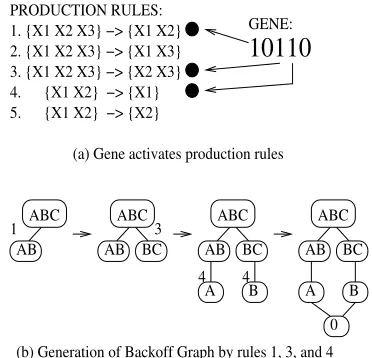
The encoding of the backoff graph is more dif-ficult because of the large number of possible paths. A direct approach encoding every edge as a bit would result in overly long strings, ren-dering the search inefficient. Our solution is to encode a binary string in terms of graph gram-mar rules (similar to (Kitano, 1990)), which can be used to describe common regularities in backoff graphs. For instance, a node with m factors can only back off to children nodes with m−1 factors. For m = 3, the choices for pro-ceeding to the next-lower level in the backoff
1. {X1 X2 X3} −> {X1 X2} 2. {X1 X2 X3} −> {X1 X3} 3. {X1 X2 X3} −> {X2 X3} 4. {X1 X2} −> {X1} 5. {X1 X2} −> {X2} PRODUCTION RULES:
AB ABC
AB ABC
BC AB ABC
BC
A B AB
ABC
BC
A B
0 1
4 4
10110
3
(b) Generation of Backoff Graph by rules 1, 3, and 4 (a) Gene activates production rules
[image:4.612.333.519.71.250.2]GENE:
Figure 2: Generation of Backoff Graph from pro-duction rules selected by the gene 10110.
graph can thus be described by the following grammar rules:
RULE 1: {x1, x2, x3} → {x1, x2}
RULE 2: {x1, x2, x3} → {x1, x3}
RULE 3: {x1, x2, x3} → {x2, x3}
Here xi corresponds to the factor at the ith
position in the parent node. Rule 1 indicates a backoff that drops the third factor, Rule 2 drops the second factor, etc. The choice of rules used to generate the backoff graph is en-coded in a binary string, with 1 indicating the use and 0 indicating the non-use of a rule, as shown schematically in Figure 2. The presence of two different rules at the same level in the backoff graph corresponds to parallel backoff; the absence of any rule (strings consisting only of 0 bits) implies that the corresponding backoff graph level is skipped and two conditioning vari-ables are dropped simultaneously. This allows us to encode a graph using few bits but does not represent all possible graphs. We cannot selec-tively apply different rules to different nodes at the same level – this would essentially require a context-sensitive grammar, which would in turn increase the length of the encoded strings. This is a fundamental tradeoff between the most general representation and an encoding that is tractable. Our experimental results described below confirm, however, that sufficiently good results can be obtained in spite of the above limitation.
Smoothing options
discount-ing method while second indicates the minimum count required for the n-gram to be included in the FLM. The integer string consists of succes-sive concatenated tuples, each representing the smoothing option at a node in the graph. The GA operators are applied to concatenations of all three substrings describing the set of factors, backoff graph, and smoothing options, such that all parameters are optimized jointly.
4 Data
We tested our language modeling algorithms on two different data sets from two different lan-guages, Arabic and Turkish.
The Arabic data set was drawn from the CallHome Egyptian Conversational Arabic (ECA) corpus (LDC, 1996). The training, development, and evaluation sets contain approximately 170K, 32K, and 18K words, respectively. The corpus was collected for the purpose of speech recognizer development for conversational Arabic, which is mostly dialectal and does not have a written standard. No additional text material beyond transcriptions is available in this case; it is therefore im-portant to use language models that perform well in sparse data conditions. The factored representation was constructed using linguistic information from the corpus lexicon, in combi-nation with automatic morphological analysis tools. It includes, in addition to the word, the stem, a morphological tag, the root, and the pattern. The latter two are components which when combined form the stem. An example of this factored word representation is shown below:
Word:il+dOr/Morph:noun+masc-sg+article/ Stem:dOr/Root:dwr/Pattern:CCC
For our Turkish experiments we used a mor-phologically annotated corpus of Turkish (Hakkani-T¨ur et al., 2000). The annotation was performed by applying a morphological analyzer, followed by automatic morphological disambiguation as described in (Hakkani-T¨ur et al., 2002). The morphological tags consist of the initial root, followed by a sequence of inflectional groups delimited by derivation boundaries (ˆDB). A sample annotation (for the word yararlanmak, consisting of the root yarar plus three inflectional groups) is shown below:
yararmanlak:
yarar+Noun+A3sg+Pnon+Nom
ˆDB+Verb+Acquire+Pos
ˆDB+Noun+Inf+A3sg+Pnon+Nom
We removed segmentation marks (for titles and paragraph boundaries) from the corpus but included punctuation. Words may have different numbers of inflectional groups, but the FLM representation requires the same number of factors for each word; we therefore had to map the original morphological tags to a fixed-length factored representation. This was done using linguistic knowledge: according to (Oflazer, 1999), the final inflectional group in each dependent word has a special status since it determines inflectional markings on head words following the dependent word. The final inflectional group was therefore analyzed into separate factors indicating the number (N), case (C), part-of-speech (P) and all other information (O). Additional factors for the word are the root (R) and all remaining information in the original tag not subsumed by the other factors (G). The word itself is used as another factor (W). Thus, the above example would be factorized as follows:
W:yararlanmak/R:yarar/P:NounInf-N:A3sg/ C:Nom/O:Pnon/G:NounA3sgPnonNom+Verb +Acquire+Pos
Other factorizations are certainly possible; however, our primary goal is not to find the best possible encoding for our data but to demonstrate the effectiveness of the FLM approach, which is largely independent of the choice of factors. For our experiments we used subsets of 400K words for training, 102K words for development and 90K words for evaluation.
5 Experiments and Results
found in previous runs. This method consis-tently improved the performance of normal GA search and we used it as the basis for the results reported below. Due to the large number of
fac-N Word Hand Rand GA ∆ (%)
Dev Set
2 593.8 555.0 556.4 539.2 -2.9 3 534.9 533.5 497.1 444.5 -10.6 4 534.8 549.7 566.5 522.2 -5.0
Eval Set
[image:6.612.318.535.71.168.2]2 609.8 558.7 525.5 487.8 -7.2 3 545.4 583.5 509.8 452.7 -11.2 4 543.9 559.8 574.6 527.6 -5.8
Table 1: Perplexity for Turkish language models. N = n-gram order, Word = word-based models, Hand = manual search, Rand = random search, GA = genetic search.
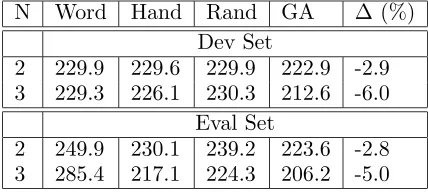
tors in the Turkish word representation, models were only optimized for conditioning variables and backoff paths, but not for smoothing op-tions. Table 1 compares the best perplexity re-sults for standard word-based models and for FLMs obtained using manual search (Hand), random search (Rand), and GA search (GA). The last column shows the relative change in perplexity for the GA compared to the better of the manual or random search models. For tests on both the development set and evalu-ation set, GA search gave the lowest perplex-ity. In the case of Arabic, the GA search was
N Word Hand Rand GA ∆ (%)
Dev Set
2 229.9 229.6 229.9 222.9 -2.9 3 229.3 226.1 230.3 212.6 -6.0
Eval Set
[image:6.612.77.292.133.254.2]2 249.9 230.1 239.2 223.6 -2.8 3 285.4 217.1 224.3 206.2 -5.0
Table 2: Perplexity for Arabic language models (w/o unknown words).
performed over conditioning factors, the back-off graph, and smoothing options. The results in Table 2 were obtained by training and test-ing without consideration of out-of-vocabulary (OOV) words. Our ultimate goal is to use these language models in a speech recognizer with a fixed vocabulary, which cannot recognize OOV words but requires a low perplexity for other
N Word Hand Rand GA ∆ (%)
Dev Set
2 236.0 195.5 198.5 193.3 -1.1 3 237.0 199.0 202.0 188.1 -5.5
Eval Set
[image:6.612.77.291.507.603.2]2 235.2 234.1 247.7 233.4 -0.7 3 253.9 229.2 219.0 212.2 -3.1
Table 3: Perplexity for Arabic language models (with unknown words).
word combinations. In a second experiment, we trained the same FLMs from Table 2 with OOV words included as the unknown word to-ken. Table 3 shows the results. Again, we see that the GA outperforms other search methods. The best language models all used parallel back-off and different smoothing options at different backoff graph nodes. The Arabic models made use of all conditioning variables (Word, Stem, Root, Pattern, and Morph) whereas the Turkish models used only the W, P, C, and R variables (see above Section 4).
6 Related Work
Various previous studies have investigated the feasibility of using units other than words for language modeling (e.g. (Geutner, 1995; C¸ arki et al., 2000; Kiecza et al., 1999)). However, in all of these studies words were decomposed into linear sequences of morphs or morph-like units, using either linguistic knowledge or data-driven techniques. Standard language models were then trained on the decomposed represen-tations. The resulting models essentially ex-press statistical relationships between morphs, such as stems and affixes. For this reason, a context larger than that provided by a trigram is typically required, which quickly leads to data-sparsity. In contrast to these approaches, factored language models encode morphological knowledge not by altering the linear segmenta-tion of words but by encoding words as parallel bundles of features.
of these studies assume a fixed path through the graph, which is usually obtained by an ordering from more specific probability distri-butions to more general distridistri-butions. Some schemes also allow two or more paths to be combined by weighted interpolation. FLMs, by contrast, allow different paths to be chosen at run-time, they support a wider range of combi-nation methods for probability estimates from different paths, and they offer a choice of dif-ferent discounting options at every node in the backoff graph. Most importantly, however, the present study is to our knowledge the first to describe an entirely data-driven procedure for identifying the best combination of parameter choices. The success of this method will facili-tate the rapid development of FLMs for differ-ent tasks in the future.
7 Conclusions
We have presented a data-driven approach to the selection of parameters determining the structure and performance of factored language models, a class of models which generalizes standard language models by including addi-tional conditioning variables in a principled way. In addition to reductions in perplexity ob-tained by FLMs vs. standard language models, the data-driven model section method further improved perplexity and outperformed both knowledge-based manual search and random search.
Acknowledgments
We would like to thank Sonia Parandekar for the ini-tial version of the GA code. This material is based upon work supported by the NSF and the CIA un-der NSF Grant No. IIS-0326276. Any opinions, find-ings, and conclusions expressed in this material are those of the authors and do not necessarily reflect the views of these agencies.
References
Jeff A. Bilmes and Katrin Kirchhoff. 2003. Factored language models and generalized parallel backoff. InProceedings of HLT/NACCL, pages 4–6. P.F. Brown et al. 1992. Class-based n-gram models
of natural language. Computational Linguistics, 18(4):467–479.
K. C¸ arki, P. Geutner, and T. Schultz. 2000. Turkish LVCSR: towards better speech recognition for ag-glutinative languages. InProceedings of ICASSP. S. F. Chen and J. Goodman. 1998. An empirical study of smoothing techniques for language mod-eling. Technical Report Tr-10-98, Center for
Re-search in Computing Technology, Harvard Uni-versity.
P. Dupont and R. Rosenfeld. 1997. Lattice based language models. Technical Report CMU-CS-97-173, Department of Computer Science, CMU. P. Geutner. 1995. Using morphology towards better
large-vocabulary speech recognition systems. In Proceedings of ICASSP, pages 445–448.
D. Gildea. 2001. Statistical Language Understand-ing UsUnderstand-ing Frame Semantics. Ph.D. thesis, Uni-versity of California, Berkeley.
D. Hakkani-T¨ur, K. Oflazer, and G¨okhan T¨ur. 2000. Statistical morphological disambiguation for ag-glutinative languages. In Proceedings of COL-ING.
D. Hakkani-T¨ur, K. Oflazer, and G¨okhan T¨ur. 2002. Statistical morphological disambiguation for ag-glutinative languages. Journal of Computers and Humanities, 36(4).
J.H. Holland. 1975. Adaptation in Natural and Ar-tificial Systems. University of Michigan Press. Gand Ji and Jeff Bilmes. 2004. Multi-speaker
lan-guage modeling. InProceedings of HLT/NAACL, pages 137–140.
D. Kiecza, T. Schultz, and A. Waibel. 1999. Data-driven determination of appropriate dictionary units for Korean LVCSR. In Proceedings of ICASSP, pages 323–327.
K. Kirchhoff et al. 2002. Novel speech recognition models for Arabic. Technical report, Johns Hop-kins University.
K. Kirchhoff et al. 2003. Novel approaches to Ara-bic speech recognition: Report from 2002 Johns-Hopkins summer workshop. In Proceedings of ICASSP, pages I–344–I–347.
Hiroaki Kitano. 1990. Designing neural networks using genetic algorithms with graph generation system. Complex Systems, pages 461–476. LDC. 1996.
http://www.ldc.upenn.edu/Catalog/-LDC99L22.html.
K. Oflazer. 1999. Dependency parsing with an ex-tended finite state approach. InProceedings of the 37th ACL.
W. Wang. 2003. Factorization of language
models through backing off lattices.
Com-putation and Language E-print Archive,
oai:arXiv.org/cs/0305041.