A framework for representing lexical resources
Fabrice Issac LDI
Universit´e Paris 13
Abstract
Our goal is to propose a description model for the lexicon. We describe a software framework for representing the lexicon and its variations called Proteus. Various examples show the different possibilities offered by this tool. We conclude with a demonstration of the use of lexical re-sources in complex, real examples. 1 Introduction
Natural language processing relies as well on methods, algorithms, or formal models as on lin-guistic resources. Processing textual data involves a classic sequence of steps : it begins with the nor-malisation of data and ends with their lexical, syn-tactic and semantic analysis. Lexical resources are the first to be used and must be of excellent qual-ity.
Traditionally, a lexical resource is represented as a list of inflected forms that are projected on a text. However, this type of resource can not take into account linguistic phenomena, as each unit of information is independent. This results in a number of problems regarding the improvement or review of the resource. On the other hand some languages such as Arabic, because of the potential large lexicon, lends itself less easily to this kind of manipulation.
Our goal is to propose a model for the descrip-tion of the lexicon. After presenting the existing theory and software tools, we introduce a software framework calledProteus, capable of represent-ing the lexicon and its variations. The different possibilities offered by this tool will be illustrated through various examples. We conclude with a
demonstration of the use of lexical resources in different languages.
2 Context
Whatever the writing system of a language (logo-graphic, syllabic or alphabetic), it seems that the word is a central concept. Nonetheless, the very definition of a word is subject to variation depend-ing on the language studied. For some Asian lan-guages such as Mandarin or Vietnamese, the no-tion of word delimiter does not exist ; for others, such as French or English, the space is a good in-dicator. Likewise, for some languages, preposi-tions are included in words, while for others they form a separate unit.
Languages can be classified according to their morphological mechanisms and their complexity ; for instance, the morphological systems of French or English are relatively simple compared to that of Arabic or Greek.
There are two main branches of morphology, inflectional or grammatical morphology and lexi-cal morphology. The first one deals with context-related variations, as the rules of agreement in gender and number or the conjugation of verbs. The second one concerns word formation, gener-ally involving the association of a lexeme to pre-fixes or sufpre-fixes.
3 Tagging
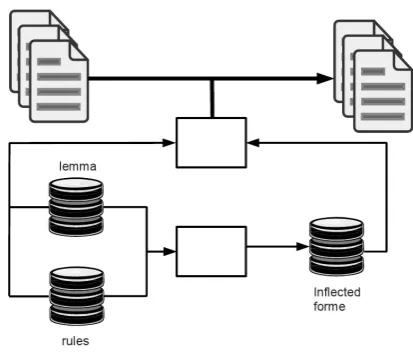
or-Figure 1: tagging schema
der to merge multiple tokens. Token merging ap-plies to polylexical units, syntactic or para-textual structures.
We distinguish two main types of resources that can be projected on raw texts in order to enrich them. The first of these resources is a set of inflected forms associated with a num-ber of information units (in the example below, the lemma and the morphosyntactic annotation of each form) :
abyssal abyssal A--ms abysses abysse N-mp
The projection of this type of resources in tex-tual corpora is quite simple. After identifying a token, the program only needs to check if the to-ken is included in the resource and add the infor-mation units associated with it.
The second type of resources contains a set of rules and a set of canonical forms (usually the lemma but not necessarily). These sets are used jointly, to produce all the inflected forms or to analyse the tokens. Analysis consists in determin-ing, for a given inflected form, which rule was used, on which canonical form, in order to gener-ate it. Then the information to be associgener-ated with the inflected form is related to the rule found.
Diagram 1 presents the place of different re-sources in the tagging process.
4 Tools and resources
Several concepts are related to the use of lexical resources ; here we provide some examples of tools, theoretical as well as computational.
• resources in the form of a frozen list: Mor-phalou (Romary et al., 2004), Morfetik (Bu-vet et al., 2007), Lexique3 (New, 2006) ;
• lexical representation formalisms:
DATR (Evans and Gazdar, 1996) ;
• inflections’ parsers: Flemm (Namer, 2000) ;
• complete software platforms: Nooj
(Sil-berztein, 2005), Unitex (Paumier, 2002) ;
• lexicon acquisition: lefff (Sagot et al., 2006).
4.1 Frozen resources
If this kind of resource is directly used in the tagging process, it raises many maintenance is-sues. Moreover, in the case of languages with rich morphology, the number of elements becomes too large. These lists are most often the result of flection engines that use canonical forms and in-flection rules to generate the inflected forms.
4.2 Hierarchical lexical representation formalisms
The goal of this type of formalisms is to represent the most general information at the top-level of a hierarchy. There is an inheritance mechanism to transmit, specify, and if necessary, delete informa-tion along the structure. It is possible to group un-der one tag a set of morphological phenomena and their exceptions. Multiple inheritance allows a node to inherit from several different hierarchies.
4.3 Inflections’ parsers
4.4 Software platforms
Unitex / Intex / NooJ are complete environments for performing linguistic analysis on documents. They are able to project dictionaries on texts and to query them. They offer a set of tools for man-aging dictionaries, both lexical and inflectional. NooJ is the successor of Intex ; among the new features, is the redesign of the architecture of the dictionaries. It proposes handling simple and compound words in a single way. The method is a mix of manipulation of characters and use of mor-phological grammars.
The inflexion mechanism is based on classic character handling operators as well as on word manipulation operators. Here is the list of some operators:
<B>delete last character
<D>duplicate last character
<L>go left
<R>go right
<N>go to the end of next word form
<P>go to the end of previous word form
<S>delete next character
5 Representation and structuring of inflections: the Proteus model
We introduce a framework capable to represent and structure inflections efficiently, not only in terms of resource creation, but in terms of linguis-tic consistency too. At the inflection level we pro-pose a simple multilingual mechanism for simple and compound forms. It is used both to generate simple forms and to analyse them. Regarding the lexicon, the model allows for clusters.
We distinguish three levels:
• the inflection level: determine how to
pro-duce a derived form from a base form ; the atomic processing unit here is the character (i.e. local transformation).
• the conjugation level: determine how to or-ganise family rules effectively in order to avoid redundancy ; the atomic processing unit here is the transformation rule.
• the word level: once the derived form is produced, determine which operation is
re-quired to validate the form against non-morphological rules ; the processing unit here is the token (i.e.global transformation). The model was developed to meet the following objectives:
1. A verbatim description of a language does not allow for the analysis of unknown words even if their inflection is regular. We must therefore develop a mechanism that we can use for both analysis and generation. Then we will be able to analyse not only known words but also neologisms.
2. In a lexical database, where, for French, the number of elements reaches one million, the presence of an error is always possible, even inevitable. We must therefore consider an ef-fective maintenance procedure : a dictionary of lemmas linked to a dictionary of inflec-tions and not a read-only resource containing all inflected forms.
3. The concept of word is so complex that we cannot limit a resource to simple words. The model must integrate the management of both simple and compound words. The only limit we set is syntax: the management of id-ioms, even if it is fundamental, requires the implementation of other tools.
4. The concept of inflection varies depending on the language. We must build a system ca-pable of dealing with all types of affixation (prefixation, suffixation or infixation). The treatment of Arabic is from this point of view a good indicator since it uses all three types of affixation.
5. An inflection rule, applied to a canonical form, is never completely autonomous ; it is part of a group. For instance, we group to-gether all the inflections of a verb type, for all tenses.
7. The proposed model is based on a set of sim-ple tools, it is able to easily integrate third-party applications and allows use of dictio-naries built in another environment.
5.1 Inflection description
Letf be the inflexion function andf−1its inverse function, then
f(canonicalf orm, code) =inf lectedf orm
f−1(inf lectedf orm, code) =canonicalf orm
By simplifying the model to the extreme, we use of a rule that generates an inflected form from its lemma. The form is represented as a list of car-acters : (i) it shifts charcar-acters from the list to a stack or vice versa (ii) and deletes or inserts char-acters in the list. By default, the operations apply to characters placed at the end of the list of char-acters or, depending on the operator, at the top of the stack. Most operators allow for the applica-tion of the inverse funcapplica-tion for the analysis of an inflection. Due to the operator based construction, the function has the following property:
letc1, c2be valid code andxa character string, then
f(f(x, c1), c2) =f(x, c1•c2)
We now present the different operators. They must be sufficiently numerous, to offer the nec-essary expressive power to represent any kind of inflection, but small enough, not to make the task of creating the rule too difficult.
P (Push) : move a character from the list to the stack
D (Dump) : moves the character of the stack to the list
E (Erase) : deletes a character from the list /x/ : adds the character x at the end of the list
To simplify code writing, it is possible to indicate the number of repetitions of an operator. Here is an example of code that generates an inflected form from its lemma.
Step Mot Pile Code restant 1 c´eder 3PE/`e/3D/ais/
2 c´e der E/`e/3D/ais/
3 c der /`e/3D/ais/
4 c`e der 3D/ais/
5 c`eder /ais/
6 c`ederais Steps:
1→2 : stack of three characters 2→3 : deleting of a character
3→4 : adding the character `e
4→5 : dumping three characters from the stack 5→6 : addition of three charactersais
This code can inflect french verbs likec´eder(as
r´ev´eler,esp´erer, . . . ). However, this kind of code does not allow reversing the operation,i.e.find the lemma from the inflection : the E (erase) operator, unlike other operators, is not reversible. Therefore we add another operator to erase this function or remove the characters to delete.
\x\ : erase given character from the list (this rule cannot be applied if the character is not present)
The code of the previous example becomes
3P\´e\/`e/3D/ais/.
Since consonant duplication is a common phe-nomenon, we introduce a specific operator :
C (Clone) : duplicates the last character of the list.
The code C/ing/ generates the present par-ticiple of words such asrun,sitorstop
The management of prefixes requires the addi-tion of operators:
](fill stack) : transfers all the characters from the list to the stack
Operator]can prepare an addition at the begin-ning of a word since all characters are put in the stack. We are now able to describe the inflexion of the form: move → unmovable. The
transfor-mation ”remove the character ’e’ at the end of a word, add ’un’ at the beginning and ’able’ end of a word” is coded\e\]/un/[/able/. The same code can analyse verb constructions that end with the charactere.
Processing compound words requires the addi-tion, or rather the transformaaddi-tion, of an operator. The difficulty here is to distinguish the different components of an expression with respect to one or more separators (traditionally in French space, hyphen or apostrophe).
P|x| (Push): moves the character of the list to the
stack to meet the character x
Changing the stacking operator allows us to ac-cess directly an element of an expression or a compound word. Please note that access to dif-ferent elements of an expression is achieved by stacking and unstacking successively. The code
2P|-|/s/[allows to form the plural of expres-sions such asbrother-in-law: only the third word from the end is pluralized (brothers-in-law). To preserve the analysis function of the model, it would be necessary to add, symmetrically, a con-ditional popping operator (e.g. D|x|). However, compound words analysis is far more complex, and such an operator could not bring the solution.
5.2 Management of inflexion
We have defined an XML DTD to manage the in-flections expressed in code.
<flex id="n-y-p" type="final"> <name>Np</name>
<info>Noun plural with a terminal y</info> <code>\y\/ies/</code> <\flex>
The above definition associatesn-y-pidentifier with the code\y\/ies/. A typical inflexion is characterised by:
• an identifier (attributeid) is used by the de-scription language ;
• a status (optional attributetype) ;
• a name (optional element <name>) which corresponds to the tag associated to the in-flected form ;
• information (optional element <info>) about the inflection ;
• a Proteus inflection code (element<code>).
However it is often necessary to combine sev-eral transformations : masculine/feminine and singular/plural for nouns and adjectives, persons and tenses for verbs. Take for example the con-jugation of a French verb in the first group in the present tense. The prototypical inflection may be given as follows:
<flex id="v1ip" type="term"> <name>Vp</name>
<info>verbes
indicatif pr´esent</info> <flex id="p1ns">
<name>1s</name> <code>/e/</code> </flex>
<flex id="p2ns"> <name>2s</name> <code>/es/</code> </flex>
<flex id="p3ns"> <name>3s</name> <code>/e/</code> </flex>
<flex id="p1np"> <name>1p</name> <code>/ons/</code> </flex>
<flex id="p2np"> <name>2p</name> <code>/ez/</code> </flex>
<flex id="p3np"> <name>3p</name> <code>/ent/</code> </flex>
</flex>
a generic definition that can take into account ex-ceptions, and can be apllied to any tense or mood.
identifier name code
It is also possible to group inflections with a new element (<op>with the attributetype).
<flex id="vig1-1" type="nonterm">
To the previous definitions we need to modify the code in order to add a prefix operation:remove the ’er’ at the end of the lemma. So we added the possibility of code concatenation to a previously defined group. In the example bellow the pos
attribute determines if the code to be added is a prefix (p) or a suffix (s). Thevalueattribute in-dicates the identifier of the structure upon which the operation is applied.
<flex id="v1" type="final">
In some cases, modification has to be per-formed on a particular inflection. This is done via the application of amaskwhich operates on a group of inflections and changes, possibly selec-tively, codes of inflexion. A mask is a set of rules applied on code. A regular expression on the iden-tifier (ervalueattribute) performs the selection. We use Proteus code to modify Proteus code. This
mise en abymeseems inconsistent, since Proteus has been designed to apply on a language element. But it seemed inappropriate to introduce a new syntax.
The definition below allows to add the letter e
to a form in order to maintain its pronunciation [ÿ].
<mask id="m-ge">
<info>add e after a g</info> <item ervalue="v1ip\.p1np">
The previous definition transforms code as
\er\/ons/ in\er\/eons/,\re\/ais/ in
\re\/eais/, . . . The mask is used in combina-tion with the attributemaskin a inflection defini-tion, as in theconcattribute.
<flex id="v1" type="final">
You can build a complex inflection by using a base and applying masks successively. The inflec-tion of the French verbneiger(to snow) can be ex-pressed using two masks. First a mask to take into account the pronunciation of the [ÿ] and a second one, the weather verb mask, which is only used in the third singular person.
5.3 Applications
The examples bellow show the different capabili-ties of the model.
5.3.1 Neologisms in French
The formation of French inflections should not create significant problems. For the most com-mon languages, simple forms are less than 1 mil-lion. Therefore, most systems use this set of in-flected forms and supply modules to guess un-known words, only when they arise. This experi-ment is used to validate the model and to analyse unknown forms.
The example below shows how we analyse an unknown form.
attested form. The set of rules provides a poten-tial analysis of the unknown word. Note that the rules used allow to determine the part of speech. In the example, the analysed word can be a plural noun or an adjective.
5.3.2 Arabic verbs
Arabic is a Semitic language ; it uses a semitic root to derive all the words used. For example from the root
I.J»
(which refers to the writing) it is possible to produce verb (write), noun (desk) or adjective (written).With these lemmas it is possible to agglutinate prefixes and suffixes. The rules are very regular in morphology but also very productive. We build all inflexion from the semitic root. So we have the schema: root → radical → inflected form. We
then define inflexion for prefix/suffix (identifier
pass1term), a mask for the radical (identifier
pass1radical) and a definition which com-bine both.
<mask id="pass1radical"> <info>add radical past</info> <item ervalue=".">
]/2P\/´\/D\/´\/D/[+ </item>
</mask>
<flex id="pass1" type="nonterm"> <name>Vis</name>
<info>passe</info>
<op type="mask" value="pass1term"> <item value="pass1radical"/> </op>
</flex>
The problem encounter with arab text is the possible non use of all vowels. In fact they are rarely used, generally in pedagogical or religious text. This mean that the context is fundamental to interpret a text, a vowel is added only to re-move an ambiguity. However we decide to de-scribe language fully vowelled and to manage this specificity in an earlier stage.
The objective is to provide a resource used dur-ing an lexical analysis. This can be done in two ways1:
1We used here a transliteration version of arab writing to be more clear.
5.3.3 Old French
We are developping (author reference) an Old French resource, as exhaustive as possible. One difficulty is to consider the various alterna-tives, dialectal or chronological. This proto-morphologicalproblem complicates the develop-ment of the dictionary nomenclature. We solved this problem by introducing an arbitrary ”lan-guage Phantom” and by adding one level to the composition of the nomenclature, in the form of a label named hyperlemma. All derivations are from this entity using Proteus rules. All variants are generated from this item by application of suc-cessive masks.
The example below shows the successive masks applied on the inflection rules to account for the variations of the imperfect tense. Each mask is namedmodifxxxand corresponds to the modifica-tion of the Proteus rule for each centuryxxx.
<flex id="vg1i-5" type="final"> <name>Vii</name>
<info>first group imparfait</info> <op type="mask" value="v1ii">
<item value="modifXI"/> <item value="modifXII"/> <item value="modifXIII"/> <item value="modifXIIIa"/> <item value="vrber"/> </op>
</flex>
6 Implementation
This framework is not only a theoretical tool ; it is designed to be implemented in a tagging software as an autonomous module. Based on abstract de-scriptions (Proteus code and XML language), it allows the resource creator to focus on linguistic aspects. It is simple enough to be easily expressed in any computational language.
The platform described here is developed in Python, which allows a very compact coding and can be used for both generation and analysis.
7 Conclusion
handled in the same way as simple words. The proposed model also allows simple word identi-fication in both analysis and resource generation functionality. We have presented three examples of the use of the model, each introducing a speci-ficity: French, Old French and Arabic. In the near future we expect to begin work on the Korean, Polish and Greek.
The best way to improve the framework is to create real, i.e. exhaustive linguistic resources. The development of the framework can be con-sidered from several ways.
The Proteus code and the XML language de-scription need stability. In our opinion, addition of operations to take into account some language specificities would complicate the model without adding any significant improvement. These modi-fications will take place during the third stage, the word level, where post-treatments are applied. For instance, the tonic accent in Greek can move along the last three syllables of a word and affects the use of the diaeresis mark in diphthongs.
As far as the analysis functionnality is con-cerned, we are considering to develop specific heuristics for each language in order to guide the choice of rules.
References
Buvet, Pierre-Andr´e, Emmanuel Cartier, Fabrice Issac, and Salah Mejri. 2007. Dictionnaires ´electroniques et ´etiquetage syntactico-s´emantique. In Hathout, Nabil and Philippe Muller, editors, Actes des 14e journ´ees sur le Traitement Automatique des
Langues Naturelles, pages 239–248, Toulouse. IRIT
Press.
Evans, Roger and Gerald Gazdar. 1996. Datr: A lan-guage for lexical knowledge representation. Com-putational Linguistics, 22(2):167–216.
Namer, F. 2000. Flemm : Un analyseur flexionnel du franc¸ais `a base de r`egles. Revue Traitement Au-tomatique des Langues, 41(2).
New, Boris. 2006. Lexique 3 : Une nouvelle base de donn´ees lexicales. In Mertens, P., C. Fairon, A. Dis-ter, and P. Watrin, editors, Verbum ex machina. Actes de la 13e conf´erence sur le Traitement
au-tomatique des langues naturelles, Cahiers du
Cen-tal 2,2, Louvain-la-Neuve. Presses universitaires de Louvain.
Paumier, S´ebastien, 2002. Manuel d’utilisation du logiciel Unitex. Universit´e de Marne-la-Vall´ee.
Romary, Laurent, Susanne Salmon-Alt, and Gil Fran-copoulo. 2004. Standards going concrete : from lmf to morphalou. In Zock, Michael, editor, COL-ING 2004 Enhancing and using electronic
dictio-naries, pages 22–28, Geneva, Switzerland, August
29th. COLING.
Sagot, Benoˆıt, Lionel Cl´ement, ´Eric Villemonte de la Clergerie, and Pierre Boullier. 2006. The lefff 2 syntactic lexicon for french: architecture, acquisi-tion, use. InLREC’06, Gˆenes.