Towards Generating Procedural Texts: an exploration of their rhetorical and
argumentative structure
Farida Aouladomar, Patrick Saint-Dizier
IRIT-CNRS
118, route de Narbonne
31062 Toulouse Cedex France
[email protected], [email protected]
Abstract
Instructional texts consist of sequences of instruc-tions designed in order to reach an objective. The author or the generator of instructional texts must follow a number of principles to guarantee that the text is of any use. Similarly, a user must follow step by step the instructions in order to reach the results expected. In this paper, we explore facets of instructional texts: general prototypical structures, rhetorical structure and natural argumentation. Our study is based on an extensive corpus study with the aim of generating such texts.
1
Introduction
Instructional texts, also equivalently called procedural texts, consist of a sequence of instructions, designed with some ac-curacy in order to reach an objective (e.g. assemble a com-puter). Procedural texts explain how to realize a certain goal by means of actions which are at least partially temporally organized.
Procedural texts often exhibit a quite complex rational and ’irrational’ structure, outlining different ways to realize some-thing, with arguments, advices, conditions, hypothesis, pref-erences, evaluations, user stimulations, etc. They also often contain a number of recommendations, warnings, and com-ments of various sorts.
Another feature is that procedural texts tend to minimize the distance between language and action. Plans to realize a goal are made as immediate and explicit as necessary, the ob-jective being to reduce the inferences that the user will have to make before acting, and therefore potential errors or mis-understandings.
In our perspective, procedural texts range from appar-ently simple cooking receipes to large maintenance manuals (whose paper versions are measured in tons e.g. for aircraft maintenance). They also include documents as diverse as teaching texts, medical notices, social behavior recommen-dations, directions for use, assembly notices, do-it-yourself notices, itinerary guides, advice texts, savoir-faire guides etc. Procedural texts obey more or less to a number of structural criteria, which may depend on the author’s writing abilities and on traditions associated with a given domain. There is obviously a big contrast between maintenance manuals and
people magazines which both contains such texts. Procedu-ral texts can be regulatory, proceduProcedu-ral, programmatory, pre-scriptive, injunctive, or may introduce advices (for social of psychological behavior) [1].
The study we present in this paper has three main goals:
First, to be able to accurately respond in natural
lan-guage to
(procedural) questions. Procedural question answering systems are much of interest both to large public via the web, and to more technical staff for example to query large textual databases dedicated to various types of procedures [6].
Next, to be able to select the best text (assuming a single text is selected as a response) w.r.t. the user profile when there are several responses (a frequent phenomenon on the Web),
Finally, and for the long term, to be able to merge proce-dural texts or fragments of proceproce-dural texts to construct an optimal text, in terms of level of detail, illustration, etc. Integrating texts is obviouly a long-term challenge.
This paper basically relates the structure of procedural texts as they are in French. English translations of examples are just glosses, they are given when space constraints permit. We believe that besides language realization variants, most of the characteristics we present here are language neutral. This study is based on an extensive corpus study, within a language production perspective. This approach allows us to integrate logical, linguistic (e.g. [17], [5]) and philosophical views of argumentation.
In this paper we first introduce some elements of a general typology of procedural texts, outlining the number of com-ponents, rational and irrational, that compose them. We then give the most important structural elements, and the rhetorical structure that characterizes the relations between elements. Finally, we focus on argumentation, a major dimension of procedural texts and we briefly present the forms of argu-ments which are the most important, and under what con-straints they can be generated.
2
State of the art
2.1
General typology
ap-proaches here, outlining elements of interest for our objec-tives.
Under the heading of procedural texts, there is a quite large diversity of texts. J.M. Adam [1] notices the variability of judgments in procedural text categorization. Texts can, for example, be grouped into families according to their main objectives and style. We have, for example:
regulatory texts [16] that characterize expected be-haviours,
procedural texts [13] defined as rather liear sets of in-structions,
’programmatory’ texts [11] which include receipes, mu-sical scores and architectory plan, identifie how knowl-edge from an expert is transferred via these texts to users who are expected to follow strictly the instructions which are given.
instructional-prescriptive texts [21], where a quite de-tailed analysis of temporal and event structures is carried out,
injunctive texts, where [2] show the form and style used in short notices that relate e.g. fire instructions, security measures, etc.,
advice texts [14], which include advice texts of various sorts, such as those found in large public magazines.
receipe texts [18], which is a domain quite well-studied, for example in language generation.
Despite their goals, all these forms share common struc-tures: specification of goals, description of lists of pre-requisites to reach the goal, and description of sequences of instructions. They also share common stylistic forms, e.g. preferences for imperative forms, and a number of ty-pographic elements such as enumerations.
2.2
Informational content
Two works will be used as the starting point of the develop-ment of the discursive structure of procedural texts that we have elaborated (see section 3.). G.R. Bieger [7] propose a taxonomy of the contents of instructions in 9 points: in-ventory (objects and concepts used), description (of objects and concepts), operational (information that suggest the agent how to realize an action), spatial (spatial data about the ac-tions), contextual, covariance (of actions, which evolve in conjunction), temporal, qualificative (manners, limits of an information), emphatic (redirects attention to another action). One of the main works in Computational Linguistics is due to [12]. She isolated 9 main structures or operations, called
semantic elements from corpus analysis:
1. sequential operations: a necessary action that the agent must realize,
2. object attribute: description meant to help understand the action to realize,
3. material conditions: environment in which an action must be carried out,
4. effects: consequences of the realization of a group of operations on the world,
5. influences: explain why and how and operation must be realized,
6. co-temporal operations: expresses synchronization of operations,
7. options: optional operations,
8. preventions: describes actions to be avoided,
9. possible operations: possible operations to do in the fu-ture.
She also identified 7 rhetorical relations (sequence, c-condition, elaboration, goal, result, manner, concurrence) which present those semantic elements. She positionned her work on automatic text generation : how to select the infor-mation and how to present it into a coherent text.
2.3
Argumentation
Procedural texts are specific forms of discourse, satisfying constraints of economy of means, accuracy, etc. They are in general based on a specific discursive logic, made up of presuppositions, causes and consequences, goals, inductions, warnings, anaphoric networks, etc., and more psychological elements (e.g. to stimulate a user). The goal is to optimize a logical sequencing of instructions and make the user feel safe and confident with respect to the goal(s) he wants to achieve (e.g. clean an oil filter, learn how to organize a customer
meeting).
Procedural texts, from this point of view, can be analyzed not only just as sequences of mere instructions, but as effi-cient, one-way (i.e. no contradiction, no negotiation) argu-mentative discourses, designed to help a user to reach a goal, making the best decisions (see e.g. [3], [4]). This type of dis-course contains a number of facets, which are all associated in a way to argumentation. Given a certain goal, it is also of much interest to compare or contrast the means used by different authors, possibly for different audiences.
In most types of procedural texts, in particular social be-havior, communication, etc. procedural discourse has two dimensions: an explicative component, constructed around rational and objective elements, and a seduction component whose goal is (1) to encourage the user, (2) to help him re-vise his opinions, (3) to enrich the goals and the purposes, by outlining certain properties or qualities or consequences of a certain action or prevention.
Producing explanations is a rather synthetic activity whose goal is to use the elements introduced by knowledge ex-plicitation mechanisms to induce generalizations, subsump-tions, deducsubsump-tions, relations between objects or activities and the goals to reach. This is particularly visible in the lexical choices made and in the choice of some constructions, includ-ing typographic; procedural discourse is basically interactive: it communicates, teaches, justifies, explains, warns, forbids, stimulates, evaluates.
3
A Discursive analysis of procedural texts
The complexity of procedural texts leads us to proceed very gradually in the study of their structure before being able to produce even simple such texts. At an intermediate level, re-sponding in natural language to
questions, using un-derspecified templates is an interesting step which can be evaluated.
We collected a corpus of procedural texts from which we extracted the main structure via the design of a grammar. The corpus contains several types of procedural texts: re-ceipes, maintenance manuals, medical notices, assembly, ad-vice texts, etc. The grammar was enriched as the analysis progresses. Finally a second corpus was gathered to conduct a manual evaluation of the grammar. An annotation tool based on the grammar and on related marks has been developped in order to automatically evaluate on larger samples. The struc-tures reported below essentially correspond to (1) the organi-zation of the informational contents: how tasks are planned, according to goals and subgoals, and (2) to the argumentative strategies used (planning, progression of tasks, warnings, ad-vices, evaluations, etc.). General principles of argumentative discourse are given e.g. in [9].
In what follows, parentheses express optionality, + it-eration, the comma is just a separator with no temporal connotation a priori, / is an or and the operator
indicates a preferred precedence. Each symbol corresponds to an XML-tag, allowing us to annotate procedural texts,.
The top node is termed objective:
objective title, (summary), (warning)+, (pre-requisites), (picture)+
instruction sequences.
summary title+
Summary describes the global organization of the procedure, it may be useful when procedures are complex (summary can be a set of hyper-links, often pointing to titles).
warning text , (picture)+, (pre-requisites).
pre-requisites list of objects, instruction sequences.
Pre-requisites describe all kinds of equipments needed to realize the action (e.g. the different constituents of a receipe) and preparatory actions. It may also include presuppositions on the user profile and abilities.
picture describes a sequence of charts and/or schemas
of various sorts. They often interact with instructions by e.g. making them more clear.
Instruction sequences is structured as follows:
instruction sequences instseq
discursive con-nector
instruction sequences / instseq.
instseq is then of one of four main types below:
instseq (goal), imperative linear sequence / (goal), optional sequence / (goal), alternative sequence / (goal), imperative co-temporal sequence.
Goal may contain, besides the target itself motivations,
manners, references etc.
Each type of instruction sequence is defined as follows:
imperative linear sequence instruction
(tempo-ral mark), imperative linear sequence/ instruction. (e.g. inspect carefully if the filter is clean and then open the valve)
optional sequence conditional expression, imper-ative linear sequence. (e.g. if you prefer a stronger flavor, add curry powder and cream.)
alternative sequence (conditional expression), (argument) imperative linear sequence, (alternative-opposition mark)
instseq / (conditional expression, instseq)+. (e.g. if you can locate the COM1 port, then ... otherwise, or if you wish to be more cautious or cannot locate it, dismount ....).
imperative co-temporal sequence imperative linear sequence
co-temporal mark,
imperative co-temporal sequence / instruction.
A co-temporal sequence relates instructions which must be realized at the same time.
Finally, Instruction is the lower level and has the following structure, with recursion on objective:
instruction (iterative expression), action, (ref-erence)+, (goal)+, (manner)+, (motivation), (limit), (picture)+, (warning) / objective.
Instructions can be complex since they may contain their own goals, warnings and pictures. If an instruction is complex it is analyzed as an objective.
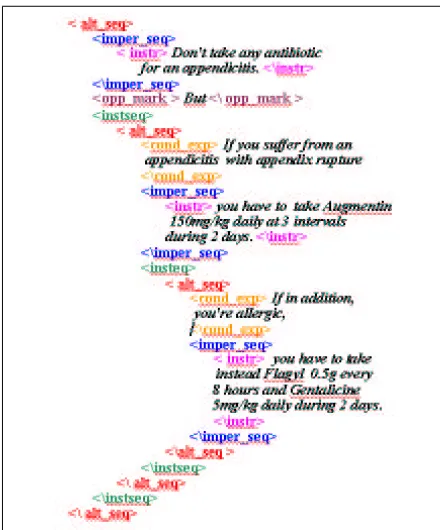
As an illustration, the annotation of an alternative sequence which is analysed as ”embedded conditions” is given, page 4.
3.1
Rhetorical structures
Rhetorical structures play several roles in our approach. They first give a semantics to the discursive structure syntax given above. They also contribute to enhancing the production of well-designed responses [12]. They are also useful, as shall be seen below, to allow for the integration of procedural texts dealing with similar objectives or goals, but this is an ex-tremely difficult task. Finally, they are used to answer ques-tions with a higher accuracy by clearly identifying e.g. in-struments (for the instrumental how), risks (via the warnings) and equipment needed (via the prerequisites).
The RST [15] is a descriptive theory that specifies 23 pos-sible relations showing how two portions of a text are linked. Previous work on procedural texts [12], [20], [19], used lim-ited RST relations and suggested additional relations that fit procedural texts, which we use for our own analysis (limit, al-ternative, concurrence). We identified 16 rhetorical relations among which we introduced 6 new relations from our corpora analysis:
Option: is considered when an action depends on the
Figure 1: An example of an annotated alternative se-quence
compulsory and the other depends on the subject will or on the situation itself (steam the fish for 10 minutes and
put it 5 minutes in the oven if you want it to turn brown).
Reference: holds between an action and a segment
which provides the localisation (in the text or in related texts via hyperlink) of the detailed procedure, (remove
the reductor (see page 18)); This relation occurs also
be-tween the summary (which contains the subgoals of the global objective) and the related instruction sequences.
Prevention: is usually a relation between an action and
its warnings. Satellites include expressions such as: be careful not to ..., and ’don’t’ expressions (cut the wood
planks, don’t draw any line!).
Prerequisites: occur between an action or an objective
and a list of of entities and instruments or a set of ac-tions without which the action or the objective cannot be realized (changing a car wheel : to change a wheel is
not difficult, with the proviso of having in one’s car the good tools : wheel brace, jack, clean rag, torch (if dark), warning triangle).
Concurrence: occurs between two rival co-temporal
ac-tions (to choose the best computer, run the program A on
Mac, at the same time run the program B on PC. If Mac detects the component before the PC, then use Mac, oth-erwise use PC).
Development: allows for the identification of the
pro-cedure and sub-propro-cedures in a text. It usually links the titles or the goals to the instruction sequences.
The chart below summarizes, for the rhetorical relations we use, the elements in our grammar which are involved.
Rhetorical kernel-sattelite relations or multi-kernel pairs
Sequence Instruction-imperative linear sequence Instruction sequence - instseq Result Goal-imperative linear sequence
Goal-optional sequence Goal-alternative sequence
Goal-imperative co-temporal sequence Instruction-imperative linear sequence Goal-action
Purpose Imperative linear sequence - goal Optional sequence - goal Alternative sequence- goal
Imperative co-temporal sequence - goal Action - goal
Evaluation Goal-imperative linear sequence Goal-optional sequence Goal-alternative sequence
Goal-imperative co-temporal sequence Goal-action
Limit Action - limit
Alternative Imperative linear sequenc - instruction sequence Instruction sequence - instseq
Means Action - manner
Reference Action - reference
Summary - Instruction Sequences Prerequisites Title-prerequisites
Option Optional expression-imperative linear sequence Instruction sequence - instseq
Prevention Title-warning Action - warning
Condition Imperative linear sequence -optional expression Imperative linear sequence -conditional expression Instruction sequence - instseq Concurrence Imperative linear sequence
-imperative co-temporal sequence Co-occurrence Imperative linear sequence
-imperative co-temporal sequence Motivation Action - motivation
Development Goal - imperative linear sequence Goal - optional sequence Goal - alternative sequence
Goal - imperative co-temporal sequence Goal - action
Title - instruction sequences Summary - instruction sequences
4
Argumentation in procedural texts
Argumentation is found in the expression of procedural text objectives, in the expression of disjunction, alternatives, warnings, and within instructions.
’Objective or goal’ arguments: are the most usual
ones. They usually introduce a set of instructions or more locally an instruction. Their target is the ”goal” symbol of the grammar. They basically introduce causality between a goal and the set of instructions that realize it. The abstract schemas are the following: (1) purpose infinitive verb, (2) causal connector-deverbal and (3) titles.
– purpose connectors : pour, afin de, etc. (to, in order
to) (e.g. to remove the bearings, for lubrification of
the universal joint shafts).
– titles : infinitive verbs or deverbals (e.g. engine dis-mount).
Prevention arguments: embedded either in a ’positive’
or a ’negative’ formulation. Their role is basically to ex-plain and to justify. Negative formulation is easy to iden-tify: there are prototypical expressions that introduce the arguments. Negative formulation follows the abstract schemas : (1) negative causal connector-infinitive risk verbs; (2) causal connector-modal +VP(negative polar-ity, infinitive); (3) negative causal mark-risk verb class VP; (4) causal connector-VP(with negation); (5) causal connector-prevention verb.
– negative causal connectors: sous peine de, sinon,
car sinon, sans quoi, etc. (otherwise, under the risk of) (e.g. sous peine d’attaquer la teinte du bois).
– risk verb class: risquer, causer, nuire, commettre
etc. (e.g. pour ne pas commettre d’erreur).
– prevention verbs: ´eviter, pr´evenir, etc. (e.g. afin d’´eviter que la carte se d´echausse lorsqu’on la visse au chˆassis, gloss: in order to prevent the card from skipping off its rack).
– causal connector and negation: de facon `a ne pas,
pour ne pas, pour que ... ne ...pas etc. (in order not to) (e.g. pour ne pas le rendre brillant, gloss: in
order not to make it too bright).
– modal VP: pouvoir, pouvoir-ˆetre (e.g. car il peut ˆetre us´e pr´ematur´ement par la d´efaillance d’un autre, gloss: because it may be prematurely worn due to the failure of another component).
Positive formulation marks are the same as for the first category of arguments described above. We have the following abstract schemas: (1) purpose mark-infinitive verb; (2) causal subordination mark-subordinate propo-sition, (3) causal mark-proposition:
– purpose marks: afin de, pour (so as to, for). – causal marks: car, c’est pourquoi etc. (e.g. car
ceux-ci sont les plus d´elicats).
– causal subordination marks: afin que, pour que, etc.
(so that, for).
– the verbs encountered are usually of conservative
type : conserver, maintenir, etc.
To discriminate arguments using purpose marks from those of the first class, we can use a reformulation crite-rion. Positive prevention arguments can be reformulated
to a negative form using negative causal connectors or verbal inferences (e.g. afin que la semence adh`ere bien
au sol car sinon la semence n’adh`erera pas au sol
(gloss: in order for the crop to adhere to the ground / otherwise the crop will not adhere to the ground)).
Performing arguments: These arguments are less imperative than the others, they are rather advices, evaluations. The corresponding abstract schemas are: (1) causal connector-performing NP; (2) causal connector-performing verb; (3) causal connector-modal-performing verb; (4) connector-modal-performing proposition.
– performing verbs: e.g. permettre, am´eliorer, etc.
(allow, improve).
– performing NP: e.g. Pour une meilleure finition; pour des raisons de performances.
– performing proposition: e.g. Have small bills. It’s easier to tip and to pay your fare that way.
Threatening arguments: These arguments have a strong impact on the user’s intention to realize the in-struction provided, the inin-struction is made compulsory by using this kind of argument. This is the injuctive form. It follows the following schema: (1) otherwise connector-consequence proposition; (2) otherwise nega-tive expression-consequence proposition
– otherwise connectors: sinon.
– otherwise negative expression: si ... ne ...pas... (e.g. si vous ne le faites pas, nous le p´erimerons automa-tiquement apr`es trois semaines en ligne, if you do
not do it, we will revoke it immediately).
Besides these four main types of arguments, we found some forms of stimulation-evaluation (what you only have to do now...), and evaluation.
5
Injunctive forms
Let us now say a few words about interesting syntactic and morphological characteristics. First, we found no sign of au-thor positioning: there is no use of personal pronoun like ’I’ or ’We’. However, the author’s enunciation is made visible in French by the use of imperative and infinitive verbal forms. The most important form is certainly the injunctive discourse. It characterizes certain modalities of discourse: orders, pre-ventions, warnings, avoidances, advices. These all have a strong volitive and deontic dimension.
Injunctive discourse shows how the author of an procedural text imposes his point of view to the user. The goal is that the user knows how to execute it in a way as explicit and less ambiguous as possible. The user is assumed to have the required competences to realize it.
infinitive: Mettre la poudre dans le verre (put the powder in the glass).
imperative: Enlevez la bague sup´erieure du bol d’articulation `a l’aide d’un burin (gloss: remove upper bushing from socket using a chisel).
modal verbs: Vous devez enduire la face int´erieure du
pivot de pˆate d’´etanch´eit´e SILICOMET (gloss: you must coat internal face of pivot with SILICOMET sealing compound).
preference expresssion : ”il est conseill´e de ...”, ”nous
vous recommandons de ...”, ”il est pr´ef´erable de ...” (it
is advised to, we recommend that).
negative infinitive form: Ne pas utiliser de facon
pro-long´ee sans avis m´edical do not use on the long term
without medical advice.
In everyday life, we encounter many injunctions posted in public areas. In French, these injunctions follow in general these regular structural schemas:
deverbal-infinitive (e.g. d´efense d’afficher (gloss: stick
no bills).
courtesy formula-negative infinitive (e.g. pri`ere de ne
pas fumer (gloss: no smoking (please)).
6
Conclusion
In this paper, we briefly shown the variety of structures, ra-tional and somewhat irrara-tional that organize procedural texts. We conducted this research with the main goal of generating responses in a cooperative way to
and
ques-tions. The long-term goals are to select the best text w.r.t. a user profile, and then to be able to integrate texts on the same topic to get a better text.
This preliminary step is now stabilized, and we designed an annotation tool, based on the grammar and related marks, to implement and evaluate our results. However, to get a more accurate view of the diversity of argumentation in this type of text, we need to also consider more subtle language forms such as: modalisators, tonality, opinion marks, evalua-tion marks, illocuevalua-tionary force in injuncevalua-tions, etc.
References
[1] Adam, J.M., Types de Textes ou genres de Discours ?
Comment Classer les Textes qui Disent De et Comment Faire, Langages, 141, pp. 10-27, 2001.
[2] Adam, J.M., Types de Sequences Textuelles Elementaires, Pratiques n56, Metz, 1987.
[3] Amgoud, L., Parsons, S., Maudet, N., Arguments,
Dia-logue, and Negotiation, in: 14th European Conference on
Artificial Intelligence, Berlin, 2001.
[4] Amgoud, L., Bonnefon, J.F., Prade, H., An Argumentation-based Approach to Multiple Criteria Decision, in 8th European Conference on Symbolic and
Quantitative Approaches to Reasoning with Uncertainty, ECSQARU’2005, Barcelona, 2005.
[5] Anscombre, J.C., Ducrot, O., Interrogation et
Argumen-tation, in Langue francaise, no 52, L’interrogation, 5 - 22,
1981.
[6] Aouladomar, F., Towards Answering Procedural
Ques-tions, Workshop KRAQ05, IJCAI05, Edinburgh, 2005.
[7] Bieger, G.R., Glock, M.D., The Information Content of
Picture-text Instructions, Journal of Experimental
Educa-tion, 53, 68-76, 1984-85.
[8] Ellahad, M., Using Argumentation in Text generation, Journal of Pragmatics, vol. 24 (1995).
[9] Eggs, E., Grammaire du Discours Argumentatif. Le
Top-ique, le G´en´erTop-ique, le Figur´e Editions Kim´e, Paris, 1994.
[10] Fellbaum, C., WordNet An Electronic Lexical Database, The MIT Press, 1998.
[11] Greimas, A., La Soupe au Pistou ou la Conservation
d’un Objet de Valeur, in Du sens II, Seuil, Paris, 1983.
[12] Kosseim, L., Lapalme, G., Choosing Rhetorical
Struc-tures to Plan Instructional Texts, Computational
Intelli-gence, Blackwell, Boston, 2000.
[13] Longacre, R., Discourse Typology in Relation to
Lan-guage Typology, Sture Allen ´ed., Text Processing,
Pro-ceeding of Nobel Symposium 51, Stockholm, Almquist and Wiksell, 457-486, 1982.
[14] L¨uger, H.H., Pressesprache, Tubingen, Niemeyer, 1995.
[15] Mann, W., Thompson, S., Rhetorical Structure Theory:
Towards a Functional Theory of Text Organisation, TEXT
8 (3) pp. 243-281, 1988.
[16] Mortara Garavelli, B., Tipologia dei Testi, in G. Hodus et al.: lexicon der romanistischen Linguistik, vol. IV, Tub-ingen, Niemeyer, 1988.
[17] Moschler, J., Argumentation et Conversation, El´ements
pour une Analyse Pragmatique du Discours, Hatier
-Cr´edif, 1985.
[18] Qamar, H., Quand Dire c’est: Ecrire-Comment-faire.
Un Autre Type de Texte: le RECETTAL, these soutenue
l’Universite Lumiere, Lyon II, 1996.
[19] R¨osner, D., Stede, M., Customizing RST for the
Auto-matic Production of Technical Manuals, in R. Dale, E.
Hovy, D. Rosner and O. Stock eds., Aspects of Automated Natural Language Generation, Lecture Notes in Artificial Intelligence, pp. 199-214, Springler-Verlag, 1992.
[20] Vander Linden, K., Speaking of Actions Choosing
Rhetorical Status and Grammatical Form in Instructional Text Generation Thesis, University of Colorado, 1993.
[21] Werlich, E., Typologie der Texte, Heidelberg, Quelle and Meyer, 1975.
[22] Zuckerman, I., McConachy, R., Korb, K., Using
Argu-mentation Strategies in Automated Argument Generation,