Proceedings of the ACL Workshop on Feature Engineering for Machine Learning in NLP, pages 24–31,
Using Semantic and Syntactic Graphs for Call Classification
Dilek Hakkani-T¨ur Gokhan Tur
AT&T Labs – Research Florham Park, NJ, 07932
dtur,gtur @research.att.com
Ananlada Chotimongkol
Carnegie Mellon University Pittsburgh, PA 15213
Abstract
In this paper, we introduce a new data representation format for language pro-cessing, the syntactic and semantic graphs (SSGs), and show its use for call classifi-cation in spoken dialog systems. For each sentence or utterance, these graphs in-clude lexical information (words), syntac-tic information (such as the part of speech tags of the words and the syntactic parse of the utterance), and semantic information (such as the named entities and seman-tic role labels). In our experiments, we used written language as the training data while computing SSGs and tested on spo-ken language. In spite of this mismatch, we have shown that this is a very promis-ing approach for classifypromis-ing complex ex-amples, and by using SSGs it is possible to reduce the call classification error rate by 4.74% relative.
1 Introduction
Goal-oriented spoken dialog systems aim to iden-tify intents of humans, expressed in natural lan-guage, and take actions accordingly to satisfy their requests. The intent of each speaker is identified using a natural language understanding component. This step can be seen as a multi-label, multi-class call classification problem for customer care appli-cations (Gorin et al., 1997; Chu-Carroll and Carpen-ter, 1999; Gupta et al., To appear, among others).
As an example, consider the utterance I would like to know my account balance, from a financial do-main customer care application. Assuming that the utterance is recognized correctly by the automatic speech recognizer (ASR), the corresponding intent (call-type) would be Request(Balance) and the ac-tion would be telling the balance to the user after prompting for the account number or routing this call to the billing department.
Typically these application specific call-types are pre-designed and large amounts of utterances man-ually labeled with call-types are used for training call classification systems. For classification,
gen-erally word -grams are used as features: In the
How May I Help You? (HMIHY) call routing
sys-tem, selected word -grams, namelysalient phrases,
which are salient to certain call-types play an im-portant role (Gorin et al., 1997). For instance, for the above example, the salient phrase “account bal-ance” is strongly associated with the call-type Re-quest(Balance). Instead of using salient phrases, one can leave the decision of determining useful features (word -grams) to a classification algorithm used as
described in (Di Fabbrizio et al., 2002) and (Gupta et al., To appear). An alternative would be using a vector space model for classification where call-types and utterances are represented as vectors
in-cluding word -grams (Chu-Carroll and Carpenter,
1999).
Call classification is similar to text categorization, except the following:
The utterances are much shorter than typical documents used for text categorization (such as broadcast news or newspaper articles).
0 <bos> 1 WORD:I 2 WORD:paid 3 WORD:six 4 WORD:dollars 5 <eos> 6
Figure 1: An example utterance represented as a single path FSM.
Since it deals with spontaneous speech, the ut-terances frequently include disfluencies or are ungrammatical, and
ASR output is very noisy, typically one out of every four words is misrecognized (Riccardi and Hakkani-T¨ur, 2003).
Even though the shortness of the utterances may imply the easiness of the call classification task, un-fortunately this is not the case. The call classifi-cation error rates typically range between 15% to 30% depending on the application (Gupta et al., To appear). This is mainly due to the data sparseness problem because of the nature of the input. Even for simple call-types like Request(Balance), there are many ways of uttering the same intent. For instance, in one of the applications we used in our experi-ments, as a response to the greeting prompt, there are 2,697 unique utterances out of 3,547 utterances for that call-type. Some examples include:
I would like to know my account balance
How much do I owe you
How much is my bill
What is my current bill
account balance
You can help me by telling me what my phone bill is
...
Given this data sparseness, current classification ap-proaches require an extensive amount of labeled data in order to train a call classification system with a reasonable performance. In this paper, we present methods for extending the classifier’s feature set by generalizing word sequences using syntactic and se-mantic information represented in compact graphs, called syntactic and semantic graphs (SSGs). For each sentence or utterance, these graphs include lexical information (words), syntactic information (such as the part of speech tags of the words and the syntactic parse of the utterance), and semantic in-formation (such as the named entities and semantic role labels). The generalization is expected to help
reduce the data sparseness problem by applying var-ious groupings on word sequences. Furthermore, the classifier is provided with additional syntactic and semantic information which might be useful for the call classification task.
In the following section, we describe the syntac-tic and semansyntac-tic graphs. In Section 3, we describe our approach for call classification using SSGs. In Section 4, we present the computation of syntactic and semantic information for SSGs. In the last Sec-tion, we present our experiments and results using a spoken dialog system AT&T VoiceToneR
Spoken Dialog System (Gupta et al., To appear).
2 Semantic and Syntactic Graphs
Consider the typical case, where only lexical infor-mation, i.e. word -grams are used for call
classifi-cation. This is equivalent to representing the words in an utterance as a directed acyclic graph where the words are the labels of the transitions and then extracting the transition -grams from it. Figure 1
shows the graph for the example sentenceI paid six dollars, where bos and eos denote the
begin-ning and end of the sentence, respectively.
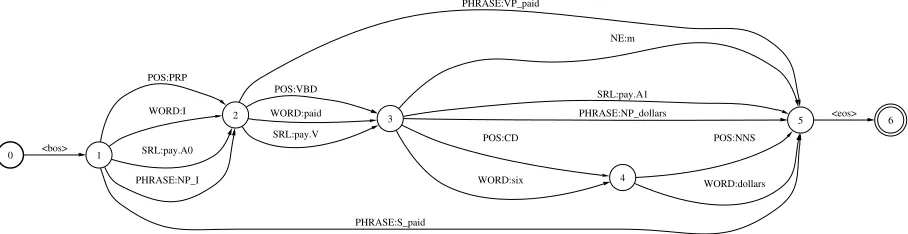
Syntactic and semantic graphs are also directed acyclic graphs, formed by adding transitions encod-ing syntactic and semantic categories of words or word sequences to the word graph. The first addi-tional information is the part of speech tags of the words. In the graph, as a parallel transition for each word of the utterance, the part of speech category of the word is added, as shown in Figure 2 for the example sentence. Note that, the word is prefixed
by the token WORD: and the part-of-speech tag is
prefixed by the token POS:, in order to distinguish between different types of transitions in the graph.
There-0 <bos> 1
2 POS:PRP
WORD:I
SRL:pay.A0
PHRASE:NP_I
5
PHRASE:S_paid
PHRASE:VP_paid
3 POS:VBD
WORD:paid
SRL:pay.V
6 <eos> NE:m
SRL:pay.A1 PHRASE:NP_dollars
4 POS:CD
WORD:six
POS:NNS
[image:3.612.80.534.73.190.2]WORD:dollars
Figure 2: The SSG for the utteranceI paid six dollars, where words (WORD:), part-of-speech tags (POS:), syntactic parse (PHRASE:), named entities (NE:) and semantic roles (SRL:) are included.
Σ:Σ
0 1 2 3
Σ:ε
ε:ε
Σ:ε ε:ε Σ:Σ Σ:Σ
Figure 3: The FST used to extract unigram, bigram and trigrams. represents the alphabet, represents the
epsilon transition.
fore,six dollarsis also represented by the transition labeledPHRASE:NP dollars. As an alternative, one may drop the head word of the phrase from the rep-resentation, or insert an epsilon transition parallel to the transitions of the modifiers of the head word to
eliminate them from some -grams.
Generic named entity tags, such as person, lo-cation and organization names and task-dependent named entity tags, such as drug names in a medical domain, are also incorporated into the graph, where applicable. For instance, for the example sentence,
six dollarsis a monetary amount, so the arcNE:mis inserted parallel to that sequence.
As another source of semantic information, se-mantic role labels of the utterance components are incorporated to the SSGs. The semantic role labels represent the predicate/argument structure of each sentence: Given a predicate, the goal is to identify all of its arguments and their semantic roles. For example, in the example sentence the predicate is
pay, the agent of this predicate is Iand the amount is six dollars. In the graph, the labels of the tran-sitions for semantic roles are prefixed by the token
SRL: and the corresponding predicate. For
exam-ple, the sequence six dollars is the amount of the predicate pay, and this is shown by the transition
with labelSRL:pay.A1 following the PropBank
no-tation (Kingsbury et al., 2002)1.
In this work, we were only able to incorporate part-of-speech tags, syntactic parses, named entity tags and semantic role labels in the syntactic and se-mantic graphs. Insertion of further information such as supertags (Bangalore and Joshi, 1999) or word stems can also be beneficial for further processing.
3 Using SSGs for Call Classification
In this paper we propose extracting all -grams from
the SSGs to use them for call classification. The
-grams in an utterance SSG can be extracted by con-verting it to a finite state transducer (FST),. Each
transition of has the labels of the arcs on the SSG
as input and output symbols2. Composing this FST
with another FST, , representing all the possible
-grams, forms the FST, , which includes all
-grams in the SSG:
1A1orArg1indicates the object of the predicate, in this case
the amount.
2Instead of the standard notation where “:” is used to
Then, extracting the -grams in the SSG is
equiva-lent to enumerating all paths of . For ,
is shown in Figure 3. The alphabet contains all
the symbols in.
We expect the SSGs to help call classification be-cause of the following reasons:
First of all, the additional information is ex-pected to provide some generalization, by al-lowing new -grams to be encoded in the
utter-ance graph since SSGs provide syntactic and semantic groupings. For example, the words
a and the both have the part-of-speech tag
category DT (determiner), or all the numbers
are mapped to a cardinal number (CD), like
the six in the example sentence. So the
bi-gramsWORD:six WORD:dollarsandPOS:CD
WORD:dollarswill both be in the SSG. Simi-larly the sentencesI paid six dollarsandI paid seventy five dollars and sixty five centswill both
have the trigramWORD:I WORD:paid NE:min
their SSGs.
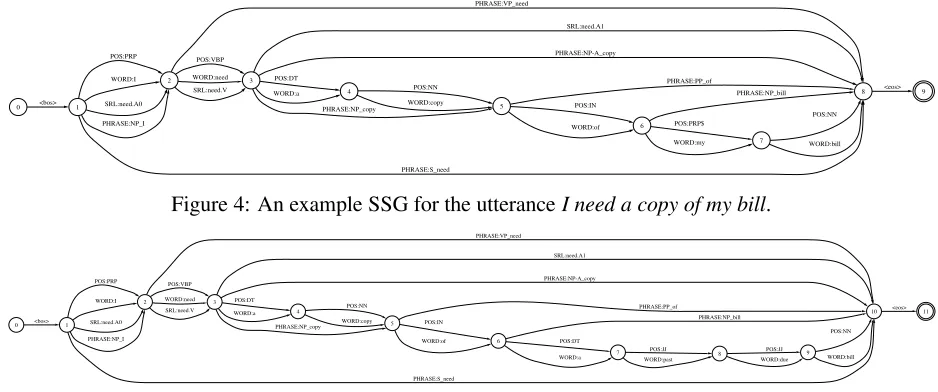
The head words of the syntactic phrases and predicate of the arguments are included in the SSGs. This enables the classifier to handle long distance dependencies better than using other simpler methods, such as extracting all gappy
-grams. For example, consider the following
two utterances: I need a copy of my bill and
I need a copy of a past due bill. As shown
in Figures 4 and 5, the -gram WORD:copy
WORD:of PHRASE:NP bill appears for both utterances, since both subsequencesmy billand
a past due bill are nothing but noun phrases with the head wordbill.
Another motivation is that, when using simply the word -grams in an utterance, the
classi-fier is only given lexical information. Now the classifier is provided with more and different information using these extra syntactic and se-mantic features. For example, a named entity of type monetary amount may be strongly as-sociated with some call-type.
Furthermore, there is a close relationship be-tween the call-types and semantic roles. For example, if the predicate is order this is most probably the call-type Order(Item) in a retail
domain application. The simple -gram
ap-proach would consider all the appearances of
the unigramorderas equal. However consider
the utteranceI’d like to check an orderof a dif-ferent call-type, where theorder is not a pred-icate but an object. Word -gram features will
fail to capture this distinction.
Once the SSG of an utterance is formed, all the
-grams are extracted as features, and the decision
of which one to select/use is left to the classifier.
4 Computation of the SSGs
In this section, the tools used to compute the in-formation in SSGs are described and their perfor-mances on manually transcribed spoken dialog ut-terances are presented. All of these components may be improved independently, for the specific applica-tion domain.
4.1 Part-of-Speech Tagger
Part-of-speech tagging has been very well studied in the literature for many languages, and the ap-proaches vary from rule-based to HMM-based and classifier-based (Church, 1988; Brill, 1995, among others) tagging. In our framework, we employ a simple HMM-based tagger, where the most prob-able tag sequence,
, given the words, , is
out-put (Weischedel et al., 1993):
"!$#&%' )( * +-,
/.
10 "!2#&%' )( * +-,
.
0
+3,
0
Since we do not have enough data which is manually tagged with part-of-speech tags for our applications, we used Penn Treebank (Marcus et al., 1994) as our training set. Penn Treebank includes data from Wall Street Journal, Brown, ATIS, and Switchboard cor-pora. The final two sets are the most useful for our domain, since they are also from spoken language and include disfluencies. As a test set, we manu-ally labeled 2,000 words of user utterances from an AT&T VoiceTone spoken dialog system application, and we achieved an accuracy of 94.95% on manu-ally transcribed utterances. When we examined the errors, we have seen that the frequent word please
0 <bos> 1
2 POS:PRP
WORD:I
SRL:need.A0
PHRASE:NP_I
8
PHRASE:S_need
PHRASE:VP_need
3 POS:VBP WORD:need
SRL:need.V <eos> 9
SRL:need.A1
PHRASE:NP-A_copy
4 POS:DT WORD:a
5 PHRASE:NP_copy
POS:NN WORD:copy
PHRASE:PP_of
6 POS:IN
WORD:of
PHRASE:NP_bill
7 POS:PRP$ WORD:my
POS:NN
[image:5.612.70.539.65.261.2]WORD:bill
Figure 4: An example SSG for the utteranceI need a copy of my bill.
0 <bos> 1
2 POS:PRP
WORD:I
SRL:need.A0 PHRASE:NP_I
10
PHRASE:S_need PHRASE:VP_need
3 POS:VBP WORD:need
SRL:need.V <eos> 11
SRL:need.A1
PHRASE:NP-A_copy
4 POS:DT WORD:a
5 PHRASE:NP_copy
POS:NN WORD:copy
PHRASE:PP_of
6 POS:IN WORD:of
PHRASE:NP_bill
7 POS:DT
WORD:a 8
POS:JJ WORD:past
9 POS:JJ WORD:due
POS:NN
WORD:bill
Figure 5: An example SSG for the utteranceI need a copy of a past due bill.
training data (van Halteren et al., 2001), we achieve a very reasonable performance, considering these er-rors.
4.2 Syntactic Parser
For syntactic parsing, we use the Collins’ parser (Collins, 1999), which is reported to give over 88% labeled recall and precision on Wall Street Journal portion of the Penn Treebank.
We use Buchholz’s chunklink script to extract
information from the parse trees3. Since we do not
have any data from our domain, we do not have a performance figure for this task for our domain.
4.3 Named Entity Extractor
For named entity extraction, we tried using a sim-ple HMM-based approach, a simplified version of BBN’s name finder (Bikel et al., 1999), and a classifier-based tagger using Boostexter (Schapire and Singer, 2000). In the simple HMM-based ap-proach, which is the same as the part-of-speech tag-ging, the goal is to find the tag sequence,
, which maximizes
+-, /.
10 for the word sequence, . The
tags in this case are named entity categories (such
as P and p for Person names, O and o for
Orga-nization names, etc. where upper-case indicates
the first word in the named entity) or NA if the
word is not a part of a named entity. In the sim-plified version of BBN’s name finder, the states of
3http://ilk.kub.nl/
4 sabine/chunklink/chunklink 2-2-2000 for conll.pl
the model were word/tag combinations, where the tag 56 for word 78 is the named entity category of
each word. Transition probabilities consisted of tri-gram probabilities
+-, 79;:<56
.
7=?>A@B:<5C?>A@EDF7=?>GH:<5C?>GH0
over these combined tokens. In the final version, we extended this model with an unknown words model (Hakkani-T¨ur et al., 1999). In the classifier-based approach, we used simple features such as the current word and surrounding 4 words, binary tags indicating if the word considered contains any dig-its or is formed from digdig-its, and features checking capitalization (Carreras et al., 2003).
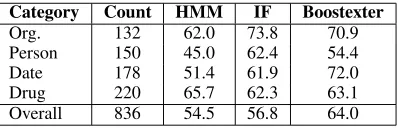
To test these approaches, we have used data from an AT&T VoiceTone spoken dialog system applica-tion for a pharmaceutical domain, where some of the named entity categories were person, organiza-tion, drug name, prescription number, and date. The training and test sets contained around 11,000 and 5,000 utterances, respectively. Table 1 summarizes the overall F-measure results as well as F-measure for the most frequent named entity categories. Over-all, the classifier based approach resulted in the best performance, so it is also used for the call classifica-tion experiments.
4.4 Semantic Role Labeling
Category Count HMM IF Boostexter
Org. 132 62.0 73.8 70.9 Person 150 45.0 62.4 54.4 Date 178 51.4 61.9 72.0 Drug 220 65.7 62.3 63.1 Overall 836 54.5 56.8 64.0
Table 1: F-Measure results for named entity extrac-tion with various approaches. HMM is the sim-ple HMM-based approach, IF is the simplified ver-sion of BBN’s name finder with an unknown words model.
work, we use the semantic roles and annotations from the PropBank corpus (Kingsbury et al., 2002), where the arguments are given mnemonic names, such as Arg0, Arg1, Arg-LOC, etc. For example, for the sentence I have bought myself a blue jacket from your summer catalog for twenty five dollars last week, the agent (buyer, or Arg0) isI, the predicate isbuy, the thing bought (Arg1) isa blue jacket, the seller or source (Arg2) isfrom your summer catalog, the price paid (Arg3) istwenty five dollars, the bene-factive (Arg4) is myself, and the date (ArgM-TMP) islast week4.
Semantic role labeling can be viewed as a
multi-class multi-classification problem. Given a word (or
phrase) and its features, the goal is to output the most probable semantic label. For semantic role la-beling, we have used the exact same feature set that Hacioglu et al. (2004) have used, since their sys-tem performed the best among others in the CoNLL-2004 shared task (Carreras and M`arquez, CoNLL-2004). We have used Boostexter (Schapire and Singer, 2000) as the classifier. The features include token-level features (such as the current (head) word, its part-of-speech tag, base phrase type and position, etc.), predicate-level features (such as the predicate’s lemma, frequency, part-of-speech tag, etc.) and argument-level features which capture the relation-ship between the token (head word/phrase) and the predicate (such as the syntactic path between the to-ken and the predicate, their distance, toto-ken position relative to the predicate, etc.).
In order to evaluate the performance of semantic role labeling, we have manually annotated 285 utter-ances from an AT&T VoiceTone spoken dialog
sys-4See http://www.cis.upenn.edu/
4 dgildea/Verbs for more details
tem application for a retail domain. The utterances include 645 predicates (2.3 predicates/utterance). First we have computed recall and precision rates for evaluating the predicate identification performance. The precision is found to be 93.04% and recall is 91.16%. More than 90% of false alarms for pred-icate extraction are due to the word please, which is very frequent in customer care domain and erro-neously tagged as explained above. Most of the false rejections are due to disfluencies and ungrammatical utterances. For example in the utteranceI’d like to order place an order, the predicate placeis tagged as a noun erroneously, probably because of the pre-ceding verborder. Then we have evaluated the argu-ment labeling performance. We have used a stricter measure than the CoNLL-2004 shared task. The la-beling is correct if both the boundary and the role of all the arguments of a predicate are correct. In our test set, we have found out that our SRL tool cor-rectly tags all arguments of 57.4% of the predicates.
5 Call Classification Experiments and Results
In order to evaluate our approach, we carried out call classification experiments using human-machine di-alogs collected by the spoken dialog system used for customer care. We have only considered utter-ances which are responses to the greeting prompt
How may I help you?in order not to deal with confir-mation and clarification utterances. We first describe this data, and then give the results obtained by the se-mantic classifier. We have performed our tests using the Boostexter tool, an implementation of the Boost-ing algorithm, which iteratively selects the most dis-criminative features for a given task (Schapire and Singer, 2000).
[image:6.612.86.285.62.126.2]5.1 Data
Table 2 summarizes the characteristics of our appli-cation including the amount of training and test data, total number of call-types, average utterance length, and call-type perplexity. Perplexity is computed us-ing the prior distribution over all the call-types in the training data.
5.2 Results
Training Data Size 3,725 utterances
Test Data Size 1,954 utterances
Number of Call-Types 79
Call-Type Perplexity 28.86
[image:7.612.316.536.61.148.2]Average Utterance Length 12.08 words
Table 2: Characteristics of the data used in the ex-periments.
Baseline Using SSG Increase
Unigram 2,303 6,875 2.99 times
Bigram 15,621 112,653 7.21 times
Trigram 34,185 705,673 20.64 times
Total 52,109 825,201 15.84 times
Table 3: A comparison of number of features.
described above. When -grams are extracted from
these SSGs, instead of the word graphs (Baseline), there is a huge increase in the number of features given to the classifier, as seen in Table 3. The clas-sifier has now 15 times more features to work with. Although one can apply a feature selection approach before classification as frequently done in the ma-chine learning community, we left the burden of an-alyzing 825,201 features to the classifier.
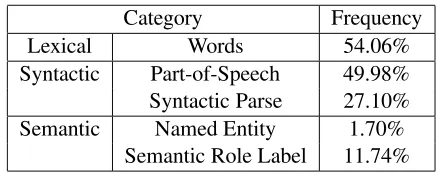
Table 4 presents the percentage of the features se-lected by Boostexter using SSGs for each informa-tion category. As expected the lexical informainforma-tion is the most frequently used, and 54.06% of the selected features have at least one word in its -gram. The
to-tal is more than 100%, since some features contain more than one category, as in the bigram feature
ex-ample: POS:DT WORD:bill. This shows the use of
other information sources as well as words.
Table 5 presents our results for call classification. As the evaluation metric, we use the top class error rate (TCER), which is the ratio of utterances, where the top scoring type is not one of the true call-types assigned to each utterance by the human la-belers. The baseline TCER on the test set using only
word -grams is 23.80%. When we extract features
from the SSGs, we see a 2.14% relative decrease in the error rate down to 23.29%. When we analyze these results, we have seen that:
For “easy to classify” utterances, the classifier already assigns a high score to the true call-type
Category Frequency
Lexical Words 54.06%
Syntactic Part-of-Speech 49.98%
Syntactic Parse 27.10%
Semantic Named Entity 1.70%
[image:7.612.79.294.62.134.2]Semantic Role Label 11.74%
Table 4: The percentage of the features selected by the classifier for each information category
Baseline SSGs Decrease
All utterances 23.80% 23.29% 2.14%
Low confidence
utterances 68.77% 62.16% 9.61%
All utterances
(Cascaded) 23.80% 22.67% 4.74%
Table 5: Call classification error rates using words and SSGs.
using just word -grams.
The syntactic and semantic features extracted from the SSGs are not 100% accurate, as pre-sented earlier. So, although many of these fea-tures have been useful, there is certain amount of noise introduced in the call classification training data.
The particular classifier we use, namely Boost-ing, is known to handle large feature spaces poorer than some others, such as SVMs. This is especially important with 15 times more fea-tures.
Due to this analysis, we have focused on a sub-set of utterances, namely utterances with low confi-dence scores, i.e. cases where the score given to the top scoring call-type by the baseline model is be-low a certain threshold. In this subset we had 333 utterances, which is about 17% of the test set. As expected the error rates are much higher than the overall and we get much larger improvement in per-formance when we use SSGs. The baseline for this set is 68.77%, and using extra features, this reduces to 62.16% which is a 9.61% relative reduction in the error rate.
That is, first the baseline word -gram based
clas-sifier is used to classify all the utterances, then if this model fails to commit on a call-type, we per-form extra feature extraction using SSGs, and use the classification model trained with SSGs. This cas-caded approach reduced the overall error rate of all utterances from 23.80% to 22.67%, which is 4.74% relative reduction in error rate.
6 Conclusions
In this paper, we have introduced syntactic and se-mantic graphs (SSGs) for speech and language pro-cessing. We have described their use for the task of call classification. We have presented results show-ing 4.74% improvement, usshow-ing utterances collected from AT&T VoiceTone spoken dialog system. SSGs can also be useful for text classification and other similar language processing applications. Our fu-ture work includes feafu-ture selection prior to classifi-cation and developing methods that are more robust to ASR errors while computing the SSGs. We also plan to improve the syntactic and semantic process-ing components by adaptprocess-ing the models with some amount of labeled in-domain spoken dialog data.
References
Srinivas Bangalore and Aravind K. Joshi. 1999. Su-pertagging: An approach to almost parsing. Compu-tational Linguistics, 25(2), June.
Daniel M. Bikel, Richard Schwartz, and Ralph M. Weischedel. 1999. An algorithm that learns what’s in a name. Machine Learning Journal Special Issue on Natural Language Learning, 34(1-3):211–231. Eric Brill. 1995. Transformation-based error-driven
learning and natural language processing: A case study in part of speech tagging. Computational Lin-guistics, 21(4):543–565, December.
Xavier Carreras and Llu´ıs M`arquez. 2004. Introduction to the CoNLL-2004 shared task: Semantic role label-ing. In Proceedings of the Conference on Computa-tional Natural Language Learning (CoNLL), Boston, MA, May.
Xavier Carreras, Llu´ıs M`arquez, and Llu´ıs Padr´o. 2003. A simple named entity extractor using AdaBoost. In Proceedings of the Conference on Computational Natural Language Learning (CoNLL), Edmonton, Canada.
Jennifer Chu-Carroll and Bob Carpenter. 1999. Vector-based natural language call routing. Computational Linguistics, 25(3):361–388.
Kenneth W. Church. 1988. A stochastic parts program and noun phrase parser for unrestricted text. InSecond Conference on Applied Natural Language Processing (ANLP), pages 136–143, Austin, Texas.
Michael Collins. 1999. Head-Driven Statistical Models for Natural Language Parsing. Ph.D. thesis, Univer-sity of Pennsylvania, Computer and Information Sci-ence, Philadelphia, PA.
Giuseppe Di Fabbrizio , Dawn Dutton, Narendra Gupta, Barbara Hollister, Mazin Rahim, Giuseppe Riccardi, Robert Schapire, and Juergen Schroeter. 2002. AT&T help desk. InProceedings of the International Confer-ence on Spoken Language Processing (ICSLP), Den-ver, CO, September.
Allen L. Gorin, Giuseppe Riccardi, and Jerry H. Wright. 1997. How May I Help You? . Speech Communica-tion, 23:113–127.
Narendra Gupta, Gokhan Tur, Dilek Hakkani-T¨ur, Srini-vas Bangalore, Giuseppe Riccardi, and Mazin Rahim. To appear. The AT&T spoken language understand-ing system. IEEE Transactions on Speech and Audio Processing.
Kadri Hacioglu, Sameer Pradhan, Wayne Ward, James H. Martin, and Dan Jurafsky. 2004. Semantic role label-ing by tagglabel-ing syntactic chunks. In Proceedings of the Conference on Computational Natural Language Learning (CoNLL), Boston, MA, May.
Dilek Hakkani-T¨ur, Gokhan Tur, Andreas Stolcke, and Elizabeth Shriberg. 1999. Combining words and prosody for information extraction from speech. In
Proceedings of the EUROSPEECH’99,I)JLK European
Conference on Speech Communication and Technol-ogy, Budapest, Hungary, September.
Paul Kingsbury, Mitch Marcus, and Martha Palmer. 2002. Adding semantic annotation to the Penn Tree-Bank. InProceedings of the Human Language Tech-nology Conference (HLT), San Diego, CA, March. Mitchell P. Marcus, Beatrice Santorini, and Mary Ann
Marcinkiewicz. 1994. Building a large annotated cor-pus of English: The Penn Treebank. Computational Linguistics, 19(2):313–330.
Giuseppe Riccardi and Dilek Hakkani-T¨ur. 2003. Ac-tive and unsupervised learning for automatic speech recognition. InProceedings of the European Confer-ence on Speech Communication and Technology (EU-ROSPEECH), Geneva, Switzerland, September. Robert E. Schapire and Yoram Singer. 2000.
Boostex-ter: A boosting-based system for text categorization.
Machine Learning, 39(2-3):135–168.
Hans van Halteren, Jakub Zavrel, and Walter Daele-mans. 2001. Improving accuracy in word class tag-ging through combination of machine learning sys-tems.Computational Linguistics, 27(2):199–230. Ralph Weischedel, Richard Schwartz, Jeff Palmucci,