Proceedings of the 27th International Conference on Computational Linguistics, pages 1683–1693 1683
A New Concept of Deep Reinforcement Learning based Augmented
General Sequence Tagging System
Yu Wang
Samsung Research America
Abhishek Patel
Samsung Research America
Hongxia Jin
Samsung Research America
Abstract
In this paper, a new deep reinforcement learning based augmented general sequence tagging system is proposed. The new system contains two parts: a deep neural network (DNN) based sequence tagging model and a deep reinforcement learning (DRL) based augmented tagger. The augmented tagger helps improve system performance by modeling the data with minority tags. The new system is evaluated on SLU and NLU sequence tagging tasks using ATIS and CoNLL-2003 benchmark datasets, to demonstrate the new system’s outstanding performance on general tagging tasks. Evaluated by F1 scores, it shows that the new system outperforms the current state-of-the-art model on ATIS dataset by 1.9%and that on CoNLL-2003 dataset by 1.4%.
1 Introduction
Sequence tagging/labeling is one of the general techniques required for implementing different natu-ral/spoken language understanding (NLU/SLU) tasks, such as: Named-entity recognition (NER), Part-of-speech (POS) Tagging in NLU, or Slot filling in SLU. Though the purpose of the tasks and their sequence labels are different, most of the state-of-the-art results for these tasks are generated using neu-ral network based architectures. For example, Ma et al. demonstrates that their BLSTM-CNN-CRF model (Ma and Hovy, 2016) can achieve state-of-the-art performance for the NER task (without using extra features) on CoNLL-2003 dataset; Liu et al. gives an attention-based bi-directional LSTM model (Liu and Lane, 2016) for the slot-filling task, which also gives the best performance on the popular ATIS dataset (Hemphill et al., 1990) for SLU tasks (This result is obtained by intial paper submission, a bet-ter result is published labet-ter by Yu et al. (Wang et al., 2018)). The details of these related works will be given in next background section. The solution for general sequence tagging tasks (like NER/Slot filling) should mainly contain two properties: the first one is that the model can handle the language sequence in a word/token level manner,i.e., it can read in the sequence word by word and outputs their correspond-ing labels; the second property is that the model should capture the contextual information/constraints which helps understand the word/token’s tags, either as named-entity or simply slot tags. In(Lample et al., 2016; Ma and Hovy, 2016), the authors use a conditional random filed (CRF) to assist their basic bidirectional LSTM model to capture the contextual constraints in NER task. Similarly, Liu et al. uses an attention based mechanism to take advantages of the weighted collective information from the hidden states of all words in an utterance.
Due to the imbalance of data distribution under different labels, normally the evaluations for different models will be based on their precision and recall, or simply the F1 scores. It can be observed that, though the neural network based models are becoming more and more complicated, it becomes harder to make further improvement on these tagging tasks by using more advanced network structures. The main reasons are from two aspects:
1. Though the tagging models are designed to be more and more complicated, they also becomes more likely to be over-fitting by using more layers, hidden nodes or advance recurrent neural network structures
This work is licensed under a Creative Commons Attribution 4.0 International License. License details: http://creativecommons.org/licenses/by/4.0/
(like bidirectional LSTM). A model’s performance may easily reach a bottom-neck by simply tuning hyper-parameters or changing network structures.
2. Considering the fact that the numbers of words/tokens under some wrongly labeled tags may be quite small, it may not give us more improvement if we still use the same group of training data by simply changing the model. Normally a model will focus on finding the pattern of the data under majority tags instead of minority. Sometimes, even a new model can improve the performance on minority tags’ classes, at the cost of degrading the model’s performance on the majority tags with more training data, which is a common issue resulting from the imbalanced data distribution under different tags (He and Garcia, 2009; Chawla et al., 2004).
Weighted sampling is one general solution to resolve the imbalanced data issue by giving more weights to minority tags and fewer to the majority ones (He and Garcia, 2009; Sun et al., 2009). The tech-nique, however, gives the issue of distorting the original tagging distribution, which may adversely affect model’s performance on majority tags. Similar approach, like adaptive synthetic sampling (He et al., 2008), also suffers from the same problem.
This gives us the dilemma on dealing with imbalanced tagged data (either for slot filling or NER task): On the one hand, it is a non-trivial task to re-organizing/sampling the data under different tags without any distortion of information; on the other hand, the improvement by changing models has an upper bound which is mainly decided by the data pattern itself instead of the model structure. Due to these two reasons, in this paper, a new concept of augmented tagging system based on deep reinforcement learning is proposed to furture improve the performances of sequence labeling tasks without sacrificing their original data distributions. This novel system will use a deep reinforcement learning based compensatory model to capture the wrong labeled tags and learn their correct labels, hence it can improve the whole model system performance without affecting the original correctly labeled tags. Detailed experiments will be further conducted on two sequence labeling tasks in the domain of SLU/NLU, as NER and slot filling, using public datasets.
The paper is organized as following: In section 2, a brief overview of two common NLP/SLU tagging tasks,i.e. NER and Slot filling, are given. Their current state-of-the-art models will also be explained briefly. Section 3 gives a background of deep reinforcement learning (DRL) first, then illustrates our DRL based augmented general tagging system (DAT) in detail. In section 4, two different tagging tasks on different datasets are given, One is a slot filling task performed on the ATIS benchmark dataset. The other is a named-entity recognition (NER) task, tested on the CoNLL-2003 benchmark dataset. Both experiments will compare our new algorithm with their current best-performed models with state-of-the-art results.
2 Background
In this section, a brief background overview on the models for two sequence labeling tasks will be given. Their state-of-the-art neural network structures will also be discussed for further comparison purpose.
2.1 Slot filling in SLU
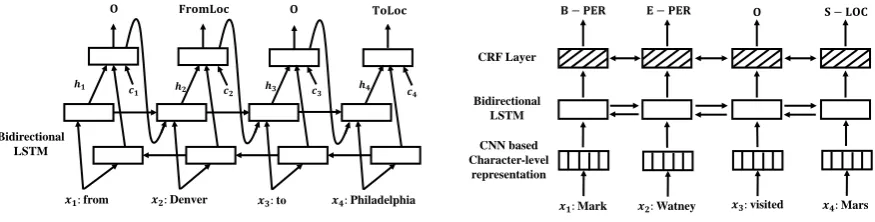
𝒙𝟏:from 𝒙𝟐:Denver 𝒙𝟑:to 𝒙𝟒:Philadelphia
𝐎 𝐅𝐫𝐨𝐦𝐋𝐨𝐜 𝐎 𝐓𝐨𝐋𝐨𝐜
𝒄𝟏 𝒄𝟐 𝒄𝟑 𝒄𝟒
Bidirectional LSTM
[image:3.595.77.515.74.185.2]𝒉𝟏 𝒉𝟐 𝒉𝟑 𝒉𝟒
Figure 1: Attention based Bidirectional LSTM for Slot Filling
Bidirectional LSTM CRF Layer
CNN based Character-level
representation
𝐁 − 𝐏𝐄𝐑 𝐄 − 𝐏𝐄𝐑 𝐎 𝐒 − 𝐋𝐎𝐂
𝒙𝟏:Mark 𝒙𝟐:Watney 𝒙𝟑:visited 𝒙𝟒:Mars
Figure 2: BLSTM-CNN-CRF Structure for Named-entity Recognition
As shown in the figure, a contextual vectorci(·)is defined using the attention of hidden stateshj:
ci= L
X
j=1
αi,jhj (1)
whereαi,jis the attention coefficient defined as:
αi,j =
eei,j
PL
k=1eei,k
ei,k =φ(si−1, hk)
(2)
whereφ(·)is a feed-forward neural network andsi−1is the decoder hidden state.
This model consists of tw0 main properties:
1. It uses the Bi-direction LSTM (BLSTM) structure to capture the long-term dependencies in both directions.
2. The attention vectorci gives additional contextual information, for which cannot be captured by the
hidden states in BLSTM.
The model gives the state-of-the-art slot filling performance on ATIS dataset. In this paper, we will also use this model as a baseline for comparison purpose. Also, this attention based model is chosen as the DNN part of our new system,i.e.fdnn, to generate the filtered input data to the deep reinforcement
learning based augmented tagger (DAT) sub-model of the system.
2.2 Named-entity recognition in NLU
Another very common NLU sequence labeling task is named-entity recognition (NER), which seeks to locate and classify entities into some pre-defined named labels. In this section, a brief overview about the neural network based NER model as in (Ma and Hovy, 2016) will be given. The model gives the state-of-the-art performance on CoNLL-2003 dataset (without lexicon features).
The structure contains a convolutional neural network for generating character-level representations, which is used as an input to a bidirectional LSTM network followed by a conditional random field layer. The conditional random field layer is designed to capture the strong dependency across the labels, which can be formulated as:
s(X, y) =
n
X
i=0
Ayi,yi+1+
n
X
i=0
Pi,yi
p(y|X) = e
s(X,y)
P
˜ y∈Yxe
s(X,˜y)
(3)
wheres(X, y)is the score defined a predicted labeling sequenceygivenX. Ayi,yj represents transition
score from the tag yi to tag yj, andPi,yi is the probability of the yi output tag of the i
Table 1: Comparison between Minority Tags and Majority Tags on ATIS and CoNLL-2003
ATIS CoNLL-2003
Training Data Test Data Training Data Test Data
#of tag types
#of tokens
%of wrongly labeled data #of tag types
#of tokens
%of wrongly labeled data
Minority Tags 119 6,323 92% 2 2,312 78%
(<1%of total#of data)
Majority Tags 8 38,707 8% 7 202,255 22%
(≥1%of total#of data)
Total 127 45,030 100% 9 204,567 100%
generated by the bidirectional LSTM.YX represents all possible tag sequences for an input sentence
X, and p(y|X) is the predicted output y’s tagging probability giving an input words sequence X =
{x1, x2,· · ·, xn}.
The model shown above gives the state-of-the-art result on the English NER task with an F1 score of 91.2 on CoNLL-2003 dataset (without extra features).
Though decent experimental results are obtained by using deep learning models on the slot filling and NER tagging tasks, the potentials of these models are still limited by the imbalanced data distribution, since most of the tokens don’t have any entity names (labeled as ’O’). The model can easily cover the majority tags but not the minority ones. Table 1 gives a summary of minority tags (each tag has less than 1%of entire data) and majority tags on ATIS and CoNLL-2003 datasets, and their corresponding occurrence ratio among the wrongly labeled data in test dataset.
In Table 1, it shows that about 92%of the wrongly labeled data are from minority tags in ATIS dataset and 78%in CoNLL03 dataset. This gives us an indication that, in order to further improve the model performance, the new model needs to figure out how to better label the minority tags and wrongly labeled tags without sacrificing the model performance on majority tags.
3 Deep Reinforcement Learning
In this section, a novel deep reinforcement learning (DRL) based augmented tagging system is proposed to address the issue as described earlier. The system contains two parts: one is the original deep neural network(NN) based tagger (fdnn) as in section 2.1 for slot filling and section 2.2 for NER, the second
part is a deep reinforcement learning (DRL) based augmented tagger (fdat), which can be trained to learn
the correct tags that are labeled wrongly by the deep learning based tagger, such that it can compensate the weakness of the original single tagger.
3.1 Reinforcement Learning and Deep Q Network (DQN)
Reinforcement learning (RL) is a bit different from the supervised learning and unsupervised learning algorithm. Formulated as a markov decision process (MDP) , an RL based model mainly contains several key elements: state (st), action (at), rewards (rt) and policy (π). In a given a state of a stochastic
environment, an agent is seeking its best action to perform in order to maximize its expected rewards to be obtained, by following some policy. The main target of a RL based model is to seek the best policy, hence the corresponding action, for an agent to perform. There are mainly three types of reinforcement learning algorithms: value-based, policy gradient and actor-critic. In our scenario, due to the necessity to define rewards at each state and small discrete action space, a value-based model design usingQ-learning is proposed for our problem. Its optimal action-value functionQπ, which is also the maximum expected reward obtained by selecting the best policyπ, is defined as:
Qπ(st, at) = max
π E[Rt|at, st, π] (4)
One well-known issue of applying reinforcement learning in real problems is that, in order to compute this optimal action-value function Qπ, it is necessary to store all of the Qvalues for each state action
pair (st, at) in a table, which is not very practical if the state or action space is large. This problem is
Word Sequence
Pre-trained Deep NN based Tagger𝒇𝒅𝒏𝒏
DRL based Augmented Tagger (DAT) 𝒇𝒅𝒂𝒕 States
𝒚𝒑𝒓𝒆𝒅𝒊𝒄𝒕
action𝒂𝒕
𝒙𝒕𝒓𝒂𝒊𝒏
𝒙𝒕𝒓𝒂𝒊𝒏
𝑷𝒑𝒓𝒆𝒅𝒊𝒄𝒕= [𝒑𝟏, 𝒑𝟐, … , 𝒑𝒘]
One hot labels 𝒐𝒍∗
Ground Truth 𝒚𝒕𝒓𝒂𝒊𝒏
[image:5.595.315.513.75.209.2]𝒔𝒕= (𝒗𝒊, 𝒍𝒊)
Figure 3: Training Model of DRL based Augmented Tag-ger
Pre-trained Deep NN based Tagger𝒇𝒅𝒏𝒏
DRL based Augmented Tagger (DAT) 𝒇𝒅𝒂𝒕
States
𝒚𝒑𝒓𝒆𝒅𝒊𝒄𝒕
action𝒂𝒕
𝒙𝒕𝒆𝒔𝒕
𝒔𝒕= (𝒗𝒊, 𝒍𝒊)
Filter 𝒚𝒑𝒓𝒆𝒅𝒊𝒄𝒕_𝒅𝒏𝒏
𝒚𝒑𝒓𝒆𝒅𝒊𝒄𝒕_𝒅𝒂𝒕
> 𝑇𝑟
≤ 𝑇𝑟 𝒙𝒅𝒂𝒕= 𝒙𝒕𝒆𝒔𝒕\𝒑𝒓𝒆𝒅𝒊𝒄𝒕_𝒅𝒏𝒏
[image:5.595.75.296.87.189.2]Combine 𝒚𝒓𝒆𝒔𝒖𝒍𝒕
Figure 4: Inference Model of DRL based Augmented Tag-ger
by training a deep neural network based estimatorQ(st, at|θt)to estimateQπ(st, at)at timet. However,
these types of estimators tend to be unstable since the convergence cannot be fully guaranteed. Recently, the deepQnetwork (DQN) (Mnih et al., 2013; Mnih et al., 2015) demonstrates much better convergence performance on large state space, by taking advantage of a novel training technique called “experience replay”. In this paper, we will use DQN as our selected deep reinforcement learning structure to satisfy the model requirement due to large state space.
In DQN structure, the optimal action-value functionQπ(st, at)is estimated by a neural network based
estimatorQ(st, at|θt),i.e.
Q(st, at|θt)∼Qπ(st, at) (5)
whereθt is the neural network parameter, and the statest serves as the input of the network. In next
section we will describe how to use the techniques in DQN to build our augmented tagger from a system perspective. Also, the states, actions and rewards of the DRL based tagger are also going to be carefully designed next.
3.2 DRL based Augmented Tagger (DAT) System
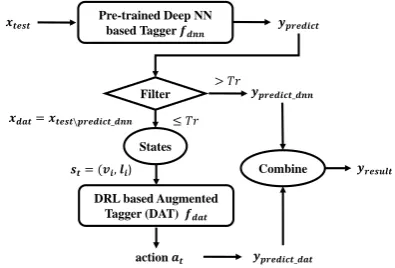
The design of DRL based augmented tagging (DAT) system is as given in Figure 3 and Figure 4. Due to the differences of using augmented tagger in training and inference, we discuss these two parts separately.
3.2.1 Training DAT System
In order to train the entire tagging system, one may need to first pre-train a deep NN based taggerfdnn,
this tagger will follow the design as discussed in section 2.1 for slot filling task or section 2.2 for the NER task. Oncefdnnis fully trained, the output labels offdnnusing training inputxtrain are stored as
ypredict with a probability distributionPypredict = [p1, p2,· · · , pw], wherewis the total number of tags
in the entire training dataset. Following is the DRL based design of our new DAT structure:
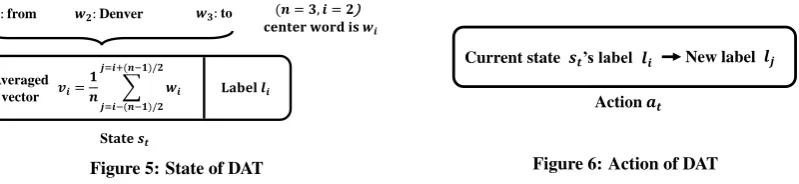
States (st):The DAT model’s statestis shown in Figure 5. The state is defined by each word/tokenwi
in sentences, it mainly contains two parts: the first part contains the word level information represented by an n-gram (nis odd) averaged vector vi, and the other part is a given label li of wi. During the
generation of training states,liuses all possible tags for the word/tokenwi. vi is defined as the average
of the vector of word sequences fromwi−(n−1)/2towi+(n−1)/2, wherewjis the center of this sequence:
vi =
1
n
j=i+(n−1)/2
X
j=i−(n−1)/2
wj (6)
S𝐭𝐚𝐭𝐞 𝒔𝒕
𝐋𝐚𝐛𝐞𝐥 𝒍𝒊
𝒗𝒊=
𝟏 𝒏
𝒋=𝒊−(𝒏−𝟏)/𝟐 𝒋=𝒊+(𝒏−𝟏)/𝟐
𝒘𝒊
𝒘𝟏:from 𝒘𝟐:Denver 𝒘𝟑:to (𝒏 = 𝟑, 𝒊 = 𝟐)
𝐜𝐞𝐧𝐭𝐞𝐫 𝐰𝐨𝐫𝐝 𝐢𝐬 𝒘𝒊
Averaged vector
Figure 5: State of DAT
Action𝒂𝒕
[image:6.595.98.498.75.167.2]Current state 𝒔𝒕’s label 𝒍𝒊 New label𝒍𝒋
Figure 6: Action of DAT
Actions (at): The DAT model’s actionatat time steptis defined as in Figure 6. The action gives a
transition signal such that the state will change from its current labelli to its next label lj by keep the
same n-gram vectorvi. Simply speaking, the action setAcontains all possible labels/tags for the word
vectorwior its correspond n-gram substitutevi,i.e.A={l1,· · ·, lk}. At each time stept, the actionat
with highest predicted action-reward value is chosen as:
at= arg max a
Q(st, a|a∈A, θt) (7)
Then the state will transit from its current label to the label directed by actionat.
Rewards (rt): The reward defined at a state st containing an n-gram vector vi (with a center
word/token wi) will use the one-hot representation ol∗
i of wi’s true labell ∗
i, the one hot vector oli of
the labelliin current statest, and the predicted probabilitypi for the wordwiusingfdnnas:
rt=tanh(log( ||ol∗
i −pi||2 ||oli−ol∗i||2+
)) (8)
wheretanh(·)is used to normalize the reward to be within -1 and 1,|| · ||2is theL2norm, andis a very small value added to avoid zero denominator.
The insight behind our reward design is using the ratio of the distance from fdnnpredicted label to
w0istrue label and that from current state’s label to its true label. Based on our definition, a higher reward will be assigned to a state in which its label is more closer to the true label compared with the fdnn’s
predicted one. The reward function is one of the key factors for further improvement using our new augmented tagger.
Remarks: It is worth noticing that pi should be generated byfdnn using the same word sequence as preparingvi. Similarly,li∗is the true label ofwiin the same sentence of preparingpiandvi.
Training: The training algorithm for DAT is as shown in Algorithm 1. The loss function is defined based on the difference of two estimated expected rewards at statestusing an unsupervised approach as:
Lst = ( ˆQ(st, at|θt)−Q(st, at|θt))
2
= (rt+γmax at+1
Q(st+1, at+1|θt)−Q(st, at|θt))2 (9)
whereQ(st, at|θt)is the predicted expected reward using(st, at)generated by the neural network-based
estimator in DAT directly, andQˆ(st, at|θt)is an estimation ofQ(st, at|θt)using the current state reward
rtand its neighbors’ estimationsQ(st+1, at+1|θt)as in (9).
One training technique we borrowed from (Mnih et al., 2013) is the experience replay used in DQN. It improves the convergence issue in neural network-estimator basedQ-learning by storing the statest
visited before, action performedat, state’s rewardrtand the next statest+1after performing the action
atin an experience tuple (st,rt,at,st+1). This tuple is then pushed into the experience replay memory
queueM. The size ofM is pre-defined based on experiment.
Whenever an action is performed then a new state is arrived, the past experience tuple will be pushed into the replay memory queueM ifM is not full, otherwiseM will pop out the first tuple and push in the latest one as First-in First-out (FIFO). At each training iteration, a random tuple is selected fromM
Algorithm 1DAT Training using Experience Replay
1: Epochs:N
2: Batch Size:K
3: Initialize a replay memoryM with sizeµ
4: forn=1→Ndo
5: Time step in state space: t←0
6: Randomly select an initial statest= (vi, li),l∗i ←true label ofvi 7: whileli!=l∗i do
8: Q(st, at|θt)←DAT(st) 9: at=arg maxaQ(st, a|θt)
10: Perform actionat, generating next statest+1 11: Push tuple(st, rt, at, st+1)into replay memoryM
12: forb=1→Kdo
13: Randomly select a tuplemfromM
14: st←m(0),rt←m(1),st+1←m(3)
15: Q(st, at|θt)←DAT(st) 16: Q(st+1, at+1|θt)←DAT(st+1)
17: Obtainpifromfdnnandoli in statest,oli∗from the ground truth in training data
18: rt←tanh(log( ||ol∗
i −pi||2 ||oli−ol∗i||2+
))
19: UpdateQˆ(st, at|θt)in (9)
20: Update the network by minimizing lossLstin (9)
21: end for
22: t←t+ 1 23: end while
24: end for
Remarks: 1. It is worth noticing that it is necessary to use reinforcement learning (RL) in our problem, since RL based model can learn the long-term dependency much better than the “conventional” deep learning approach. In our case, since we split a sentence into multiple word level vectors and select them randomly during training, not only we need to consider what the states current label is, but also how this state/word level vector is affected by its connected state in the network, such that it wont have any difficulty to find the correct label from its current wrong label.
2. In our model, we use a cascaded multiple model structure to boost the system performance. The concept of using information from multiple models (with the same or different structures) to achieve better performance has been widely used in deep learning ((Dean et al., 2012; Ngiam et al., 2011; Wang et al., 2018)), system identification ((Narendra et al., 2014; Narendra et al., 2015b; Murray-Smith and Johansen, 1997; Narendra et al., 2015c; Wang, 2017a; Wang, 2017b)) and also reinforcement learning field ((Narendra et al., 2015a; Wang and Jin, 2018; Narendra et al., 2016)) recently . Instead of using collective information, in this paper, we takes advantage of two models (DNN-based and DRL-based) to compensate each other, such that minor tags can be taken care of and learned.
3.2.2 Model Inference
As shown in Figure 4, the inference part of the DAT model is a bit different from training the DAT. Since during the training procedure, the entire training dataset (xtrain,ytrain) is used to train both DNN and
DAT models. Comparatively, during inference, only partial of test data with “unsatisfied performance” will be collected and further evaluated by DAT. This is mainly because that we use DAT as an augmented tagger to compensate the minority cases when the original DNN based taggerfdnn does not perform
well. For the majority test dataxpredict dnn, on whichfdnn can perform very well, we still usefdnn to
generate their tagsypredict dnn. In order to filter those data with “unsatisfied performance”, a threshold
minority cases and further used as the inference input of DAT,i.e. xdat =xtest\predict dnn. The outputs
of DAT are the actions that will transfer the states from their current labelslito the target labell∗i, which
gives the output of minority cases,i.e.ypredict dat.
Remarks: The choice ofTrwill slightly affect the performance of DAT as different percentage of data will be filtered. A general recommendedTr is to use a similar percentage of data under minority tags in training data as shown in section 2.2. For example, we use aTrto filter around 14%(=6,323/45,030) percent of test data in ATIS for DAT since the training tokens under minority tags in ATIS are roughly around this ratio, as shown in Table 1.
4 Experiment
4.1 Data Sets
In our experiment, we will evaluate our deep reinforcement learning based augmented tagging system on two sequence labeling tasks: Slot filling task and NER task.
Slot Filling: For Slot filling task, we use the public ATIS dataset which follows the same format as in (Liu and Lane, 2015; Mesnil et al., 2015; Xu and Sarikaya, 2013; Liu and Lane, 2016). The training set contains 4,978 utterances/sequences, and the test dataset contains 893 utterances. There are totally 127 slot tags.
NER: For NER task, we use the public CoNLL-2003 dataset as in (Lample et al., 2016; Chiu and Nichols, 2016; Ma and Hovy, 2016; Xu et al., 2017; Huang et al., 2015). The training set contains 14,987 sentences, and the test dataset contains 3,684 sentences. The dataset contains four different types of named entities: PERSON, LOCATION, ORGANIZATION, and MISC. By using the BIO2 tagging scheme, the total number of different labels is 9. There are a total of 204,567 tokens in training set, and 46,666 tokens in test set.
4.2 Training Setup
Slot Filling: For slot filling task, the pre-trained DNN modelfdnn has the same set-up as in (Liu and
Lane, 2016), by using an attention based bi-directional LSTM. The number of states in LSTM cell is 128. The randomly initialized word embedding size is also 128.The batch size is 16 and the dropout rate for non-recurrent connection is 0.5.
NER:For NER task, the pre-trained DNN modelfdnnfollows the BLSTM-CNNS-CRF structure as in
(Ma and Hovy, 2016), which gives the current state-of-the-art result on CoNLL-2003 dataset. The word embedding is chosen as the GloVe 100-dimensional embedding (Pennington et al., 2014). The CNN’s window size is chosen as 3 and the number of filters is 30. The number of states in LSTM cell is 200. The batch size is 10 and the dropout rate is 0.5.
The DAT modelfdatused for Slot fill and NER tasks are almost the same except the batch size. The
network structure chosen to estimate the action-value functionQis an LSTM structure with 100 states. The averaged word vector in a reinforcement learning state is chosen as a trigram,i.e.n=3. The discount factorγin (9) is selected as 0.5, 0.7 and 0.9 for difference experiments. The minibatch size isK = 16 for slot filling task andK = 10for NER in order to keep the same training batch size asfdnnin different
tasks, and the replay memory size is pre-defined asµ= 5,000. The thresholds for both experiment are set asTr= 0.95.
4.3 Performance on ATIS dataset
Our first experiment is performed on ATIS dataset and compared with other existing approaches, by evaluating their slot fillingF1scores. A detailed comparison is given in Table 2.
By using the same DNN based model forfdnnas in (Liu and Lane, 2016), our new model surpassed the
Table 2: Performance of Different Models on ATIS Dataset
Model F1 Score
Recursive NN (Guo et al., 2014) 93.96%
RNN with Label Sampling (Liu and Lane, 2015) 94.89%
Hybrid RNN (Mesnil et al., 2015) 95.06%
RNN-EM (Peng and Yao, 2015) 95.25%
CNN CRF (Xu and Sarikaya, 2013) 95.35%
Encoder-labeler Deep LSTM (Kurata et al., 2016) 95.66% Attention Encoder-Decoder NN (Liu and Lane, 2016) 95.87% Attention BiRNN (Liu and Lane, 2016) 95.98%
DRL based Augmented Tagging System (γ= 0.5) 96.85%
DRL based Augmented Tagging System (γ= 0.7) 97.23%
DRL based Augmented Tagging System (γ= 0.9) 97.86%
Table 3: Performance of Different Models on CoNLL-2003 Dataset
Model F1 Score
NN+SLL+LM2(Collobert et al., 2011) 88.67%
NN+SLL+LM2+Gazetter∗(Collobert et al., 2011) 89.59%
BI-LSTM-CRF∗(Huang et al., 2015) 90.10%
ID-CNN-CRF (Strubell et al., 2017) 90.54%
FOFE (Xu et al., 2017) 90.71%
BLSTM-CNN+emb (Chiu and Nichols, 2016) 90.91%
BLSTM-CRF(Lample et al., 2016) 90.94%
BLSTM-CNN-CRFs (Ma and Hovy, 2016) 91.21%
BLSTM-CNN+emb+lex∗(Chiu and Nichols, 2016) 91.62%
DRL based Augmented Tagging System (γ= 0.5) 91.92%
DRL based Augmented Tagging System (γ= 0.7) 92.23%
[image:9.595.76.521.240.328.2]DRL based Augmented Tagging System (γ= 0.9) 92.67%
Table 4: Change on Tags’ Distribution of Wrongly Labeled Data on ATIS and CoNLL-2003 Test Datasets
ATIS Test Dataset CoNLL-2003 Test Dataset
%of wrongly labeled data %of wrongly labeled data %of wrongly labeled data %of wrongly labeled data
usingfdnn usingfdnn+fdat usingfdnn usingfdnn+fdat
Minority Tags 92% 56% 78% 48%
(<1%of total#of data)
Majority Tags 8% 44% 22% 52%
(≥1%of total#of data)
Total 100% 100% 100% 100%
4.4 Performance on CoNLL-2003 dataset
Our second experiment is conducted on the CoNLL-2003 dataset and compared with current existing neural network-based approaches for the NER tasks. The metric is also using their F1 scores, and the result is as shown in Table 3 (The results are collected before initial submission, some better results are released during final submission (Peters et al., 2018), despite our model’s performance is still better).
The methods marked using∗are using extra features like lexicons and etc. It can be observed that our DAT system’s result outperforms the state-of-the-art results in (Ma and Hovy, 2016) (without lexicon features) and (Chiu and Nichols, 2016) (lexicon features) by 1%and 1.4%using γ = 0.9 separately. Similar to the SLU task, a larger discount factorγalso boosts our system’s performance.
4.5 Change on Result Distribution
Another observation from our experiment’s result is that the tags’ distribution of wrongly labeled data changed. Table 4 gives a summary about these changes on ATIS and CoNLL-2003 two test dataset.
It can be observed that the percentage of wrongly labeled data with minority tags decreases for both ATIS and CoNLL-2003 datasets by adding the DAT model fdat to the DNN based model fdnn. It
indicates that the DAT modelfdatcan help improve the performance of general sequence tagging model
by correctly labeling data with minority tags, which is also the weakness of a single DNN based model
fdnn.
5 Conclusion
In this paper, a new DRL based augmented general tagging system is designed. The system use two sequence labeling models: one is a “conventional” DNN based tagger, and the other is a novel DRL based augmented tagger, i.e. DAT. By filtering DNN’s output and picking out the “unsatisfied data”, DAT can further improve sequence labeling tasks’ performance by correctly relabeling the data below the threshold Tr, especially for those under minority tags. The experiment results on two sequence
References
Nitesh V Chawla, Nathalie Japkowicz, and Aleksander Kotcz. 2004. Special issue on learning from imbalanced data sets. ACM Sigkdd Explorations Newsletter, 6(1):1–6.
Jason PC Chiu and Eric Nichols. 2016. Named entity recognition with bidirectional lstm-cnns. Transactions of
the Association for Computational Linguistics, 4:357–370.
Ronan Collobert, Jason Weston, L´eon Bottou, Michael Karlen, Koray Kavukcuoglu, and Pavel Kuksa. 2011.
Natural language processing (almost) from scratch. Journal of Machine Learning Research, 12(Aug):2493–
2537.
Jeffrey Dean, Greg Corrado, Rajat Monga, Kai Chen, Matthieu Devin, Mark Mao, Andrew Senior, Paul Tucker,
Ke Yang, Quoc V Le, et al. 2012. Large scale distributed deep networks. InAdvances in neural information
processing systems, pages 1223–1231.
Daniel Guo, Gokhan Tur, Wen-tau Yih, and Geoffrey Zweig. 2014. Joint semantic utterance classification and slot filling with recursive neural networks. InSpoken Language Technology Workshop (SLT), 2014 IEEE, pages 554–559. IEEE.
Haibo He and Edwardo A Garcia. 2009. Learning from imbalanced data. IEEE Transactions on knowledge and
data engineering, 21(9):1263–1284.
Haibo He, Yang Bai, Edwardo A Garcia, and Shutao Li. 2008. Adasyn: Adaptive synthetic sampling approach
for imbalanced learning. In Neural Networks, 2008. IJCNN 2008.(IEEE World Congress on Computational
Intelligence). IEEE International Joint Conference on, pages 1322–1328. IEEE.
Charles T Hemphill, John J Godfrey, George R Doddington, et al. 1990. The atis spoken language systems pilot
corpus. InProceedings of the DARPA speech and natural language workshop, pages 96–101.
Zhiheng Huang, Wei Xu, and Kai Yu. 2015. Bidirectional lstm-crf models for sequence tagging. arXiv preprint
arXiv:1508.01991.
Gakuto Kurata, Bing Xiang, Bowen Zhou, and Mo Yu. 2016. Leveraging sentencelevel information with encoder lstm for natural language understanding. arXiv preprint.
Guillaume Lample, Miguel Ballesteros, Sandeep Subramanian, Kazuya Kawakami, and Chris Dyer. 2016. Neural architectures for named entity recognition. arXiv preprint arXiv:1603.01360.
Bing Liu and Ian Lane. 2015. Recurrent neural network structured output prediction for spoken language
under-standing. InProc. NIPS Workshop on Machine Learning for Spoken Language Understanding and Interactions.
Bing Liu and Ian Lane. 2016. Attention-based recurrent neural network models for joint intent detection and slot filling. arXiv preprint arXiv:1609.01454.
Xuezhe Ma and Eduard Hovy. 2016. End-to-end sequence labeling via bi-directional lstm-cnns-crf. arXiv preprint
arXiv:1603.01354.
Gr´egoire Mesnil, Yann Dauphin, Kaisheng Yao, Yoshua Bengio, Li Deng, Dilek Hakkani-Tur, Xiaodong He, Larry Heck, Gokhan Tur, Dong Yu, et al. 2015. Using recurrent neural networks for slot filling in spoken language
understanding. IEEE/ACM Transactions on Audio, Speech and Language Processing (TASLP), 23(3):530–539.
Volodymyr Mnih, Koray Kavukcuoglu, David Silver, Alex Graves, Ioannis Antonoglou, Daan Wierstra, and Martin Riedmiller. 2013. Playing atari with deep reinforcement learning. arXiv preprint arXiv:1312.5602.
Volodymyr Mnih, Koray Kavukcuoglu, David Silver, Andrei A Rusu, Joel Veness, Marc G Bellemare, Alex Graves, Martin Riedmiller, Andreas K Fidjeland, Georg Ostrovski, et al. 2015. Human-level control through deep reinforcement learning. Nature, 518(7540):529.
Roderick Murray-Smith and T Johansen. 1997. Multiple model approaches to nonlinear modelling and control.
CRC press.
Kumpati S Narendra, Yu Wang, and Wei Chen. 2014. Stability, robustness, and performance issues in second level
adaptation. InAmerican Control Conference (ACC), 2014, pages 2377–2382. IEEE.
Kumpati S Narendra, Yu Wang, and Wei Chen. 2015b. Extension of second level adaptation using multiple models
to siso systems. InAmerican Control Conference (ACC), 2015, pages 171–176. IEEE.
Kumpati S Narendra, Yu Wang, and Wei Chen. 2015c. The rationale for second level adaptation. arXiv preprint
arXiv:1510.04989.
Kumpati S Narendra, Yu Wang, and Snehasis Mukhopadhay. 2016. Fast reinforcement learning using multiple
models. InDecision and Control (CDC), 2016 IEEE 55th Conference on, pages 7183–7188. IEEE.
Jiquan Ngiam, Aditya Khosla, Mingyu Kim, Juhan Nam, Honglak Lee, and Andrew Y Ng. 2011. Multimodal
deep learning. In Proceedings of the 28th international conference on machine learning (ICML-11), pages
689–696.
Baolin Peng and Kaisheng Yao. 2015. Recurrent neural networks with external memory for language
understand-ing. arXiv preprint arXiv:1506.00195.
Jeffrey Pennington, Richard Socher, and Christopher Manning. 2014. Glove: Global vectors for word
represen-tation. InProceedings of the 2014 conference on empirical methods in natural language processing (EMNLP),
pages 1532–1543.
Matthew Peters, Mark Neumann, Mohit Iyyer, Matt Gardner, Christopher Clark, Kenton Lee, and Luke
Zettle-moyer. 2018. Deep contextualized word representations. InProceedings of the 2018 Conference of the North
American Chapter of the Association for Computational Linguistics: Human Language Technologies, Volume 1
(Long Papers), volume 1, pages 2227–2237.
Warren B Powell. 2007. Approximate Dynamic Programming: Solving the curses of dimensionality, volume 703.
John Wiley & Sons.
Emma Strubell, Patrick Verga, David Belanger, and Andrew McCallum. 2017. Fast and accurate sequence labeling with iterated dilated convolutions. arXiv preprint arXiv:1702.02098.
Yanmin Sun, Andrew KC Wong, and Mohamed S Kamel. 2009. Classification of imbalanced data: A review.
International Journal of Pattern Recognition and Artificial Intelligence, 23(04):687–719.
Yu Wang and Hongxia Jin. 2018. A boosting-based deep neural networks algorithm for reinforcement learning.
InProceedings of the 2018 American Control Conference.
Yu Wang, Yilin Shen, and Hongxia Jin. 2018. A bi-model based rnn semantic frame parsing model for intent de-tection and slot filling. InProceedings of the 2018 Conference of the North American Chapter of the Association
for Computational Linguistics: Human Language Technologies, Volume 2, volume 2, pages 309–314.
Yu Wang. 2017a. Adaptive control and learning using multiple models. Ph.D. thesis, Yale University.
Yu Wang. 2017b. A new concept using lstm neural networks for dynamic system identification. InAmerican
Control Conference (ACC), 2017, pages 5324–5329. IEEE.
Puyang Xu and Ruhi Sarikaya. 2013. Convolutional neural network based triangular crf for joint intent detection
and slot filling. InAutomatic Speech Recognition and Understanding (ASRU), 2013 IEEE Workshop on, pages
78–83. IEEE.
Mingbin Xu, Hui Jiang, and Sedtawut Watcharawittayakul. 2017. A local detection approach for named entity recognition and mention detection. InProceedings of the 55th Annual Meeting of the Association for