R. Dale et al. (Eds.): IJCNLP 2005, LNAI 3651, pp. 498–506, 2005. © Springer-Verlag Berlin Heidelberg 2005
Web Knowledge Bases
Zhushuo Zhang, Yaqian Zhou, Xuanjing Huang, and Lide Wu
Department of Computer Science and Engineering, Fudan University, Shanghai, China, 200433
{zs_zhang, zhouyaqian, xjhuang, ldwu}@fudan.edu.cn
Abstract. This paper presents a definition question answering approach, which is capable of mining textual definitions from large collections of documents. In order to automatically identify definition sentences from a large collection of documents, we utilize the existing definitions in the Web knowledge bases in-stead of hand-crafted rules or annotated corpus. Effective methods are adopted to make full use of Web knowledge bases, and they promise high quality response to definition questions. We applied our system in the TREC 2004 definition question-answering task and achieved an encouraging performance with the F-measure score of 0.404, which was ranked second among all the submitted runs.
1 Introduction
When people want to learn an unknown concept from a large collection of documents, the most commonly used tools are the search engines. They submit a query to a search engine system, and the search engine returns a number of pages related to the query terms. Usually, the pages returned are ranked mainly based on keywords matching rather than their relevance to the query terms. The users have to read a lot of returned pages to organize the information they wanted by themselves. This procedure is time-consuming, and the information acquired is not concentrative. The research of Ques-tion Answering (QA) intends to resolve this problem by answering user’s quesQues-tions with exact answers.
Questions like “Who is Colin Powell?” or “What is mold?” are definition questions [3]. Their relatively frequent occurrences in logs of Web search engines [2] indicate that they are an important type of question. The Text REtrieval Conference (TREC) provides an entire evaluation for definition question answering from TREC2003. A typical definition QA system extracts definition nuggets that contain the most descrip-tive information about the question target (the concept for which information is being sought is called the target term, or simply, the target) from multiple documents.
Until recently, definition questions remained a largely unexplored area of question answering. Standard factoid question answering technology, designed to extract single answers, cannot be directly applied to this task. The solution to this interesting re-search challenge will involve the techniques in related fields such as information extraction, multi-document summarization, and answer fusion.
find definitional sentences. Sasha et al. [12] proposed to combine data-driven statisti-cal method and machine learned rules to generate definitions. Cui et al. [7] used soft patterns, which were generated by unsupervised learning. Such methods require hu-man labor to construct patterns or to annotate corpus more or less.
Prager et al. [8] try to solve this problem through existing technology. They de-compose a definition question into a series of factoid questions. The answers to the factoid questions are merged to form the answer to the original question. However, the performance of their system on the TREC definition QA task is unsatisfactory. They need a more proper framework to determine how to generate these follow-up questions [8].
Some systems [1] [7] [9] statistically rank the candidate answers based on the ex-ternal knowledge. They all adopt a centroid-based ranking method. For each question, they form one centroid (i.e., vector of words and frequencies) of the information in the external knowledge, and then calculate the similarity between the candidate an-swer and this centroid. The ones that have large similarity are extracted as the anan-swers to this question.
Among the abundant information on the Web, Web knowledge bases (KBs) are one kind of most useful resource to acquire information. Dictionary definitions often supply knowledge that can be exploited directly. The information from them can model the interests of a typical user more reliably than other information. So we go further in identifying and selecting definition sentences from document collection using Web knowledge bases.
Our work differs from the above in that we make use of the Web knowledge bases in a novel and effective way. Instead of using centroid-based ranking, we try to find out more effective methods in ranking the candidate sentences. We consider the rela-tionship and the difference between the definitions from different knowledge sources. In our first algorithm, we calculate the similarity scores between the candidate sen-tence and the definitions from different knowledge bases respectively, and merge these scores to generate the weight of this candidate sentence. In another algorithm, we first summarize the definitions from different KBs in order to eliminate the redun-dant information, and then use this summary to rank the candidate sentences. We have applied our approaches to the TREC 2004 definition question-answering task. The results reveal that these procedures can make better use of the knowledge in the Web KBs, and the extracted sentences contain the most descriptive information about the question target.
The remainder of the paper is organized as follows. In Section 2, we describe the system architecture. Then in Section 3 we give the details of our definition extraction methods. The evaluation of our system and the concluding remarks are given in Sec-tion 4 and SecSec-tion 5 respectively.
2 System Architecture
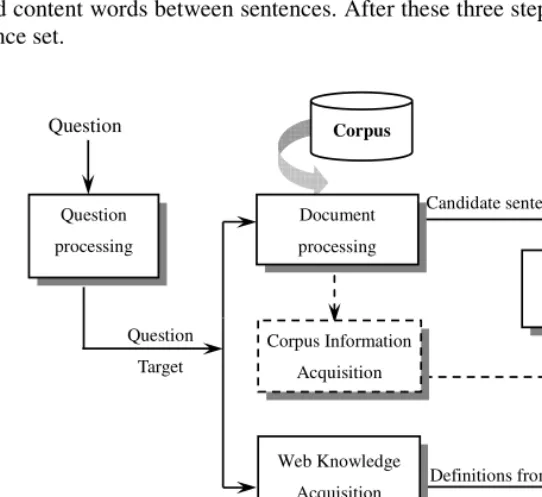
Firstly, a definition question is input, and the question processing module identifies the question target from this question. The so called target or target term is a term for which information is being sought (e.g., the target of the question “What is Hale Bopp comet?” is “Hale Bopp comet”.) The target term is the input for document processing module and knowledge acquisition module.
Secondly, the document processing module generates the candidate sentence set according to this target term. This module has three steps, document retrieval, rele-vant sentence extraction and redundancy removal. In the first step, the documents that relevant to the target are retrieved from the corpus. In the second step, the sentences that relevant to the target are extracted from these documents. We first cut the docu-ments into sentences, and delete the irrelevant sentences by a few heuristic rules. In the third step, the redundant sentences are deleted by calculating the percentage of shared content words between sentences. After these three steps, we get the candidate sentence set.
Definition
Extraction Question
processing
Web Knowledge
Acquisition
Answer
Question
Target
Candidate sentence set
Definitions from Web KB
World Wide Web
Question Corpus
Corpus Information
Acquisition Document
processing
Fig. 1. System architecture
Thirdly, the Web knowledge acquisition module acquires the definitions of the tar-get term from the Web knowledge base. If we can find definitions from these sources (the Web KBs we used will be described in Section 3.1), we use them to rank the candidate sentences set.
At last, the definition extraction module extracts the definition from the candidate sentence set based on the knowledge which is got from the Web knowledge base.
candidate sentence set. We rank candidate sentences based on this centroid. The sen-tences that have high similarity with this centroid are extracted as the answers to the question. The assumption is that words co-occurring frequently with the target in the corpus are more important ones for answering the question.
The system architecture is illustrated in Fig.1.
In this paper, we focus on how to make use of the Web KBs in extracting definition sentences, so we will describe the detail of the definition extraction module below.
3 Definition Extraction Based on Web Knowledge Bases
3.1 Web Knowledge Base
There are lots of specific websites on the Web, such as online biography dictionaries or online cyclopaedias. We can get biography of a person, the profile of an organiza-tion or the definiorganiza-tion of a generic term from them. We call this kind of website Web knowledge base (KB). The definitions from them often supply knowledge that can be exploited directly. So we answer definition questions by utilizing the existing defini-tions in the Web knowledge bases. The results of our system reveal that the Web knowledge bases are quite helpful to answering definition questions.
Usually, different knowledge bases may pay attention to different kind of concept, and they may have different kind of entries. For example, the biography dictionary (www.s9.com) is a dictionary that covers widely on biography of people, and other KBs may pay attention to other kinds of concept. We choose several authoritative KBs that cover different kinds of concept to achieve our goal.
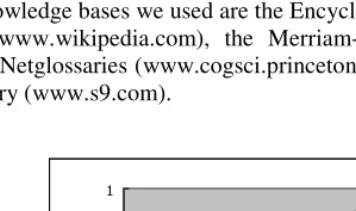
The Web knowledge bases we used are the Encyclopedia(www.encyclopedia.com), the Wikipedia(www.wikipedia.com), the Merriam-Webster dictionary (www.mw. com), the WordNetglossaries (www.cogsci.princeton.edu/cgi-bin/webwn) and a biog-raphies dictionary (www.s9.com).
0 0. 2 0. 4 0. 6 0. 8 1
TREC2003 TREC2004
pe
rc
en
t
ency wi ki mw wn s9 al l
Fig. 2. The Web KBs’ coverage of TREC data
“mw”, “wn” and “s9” stand for the five online KBs we have used. Each column repre-sents the percent of the target terms that can be found in the corresponding online knowledge base. The column marked “all” represents the percent of the target terms that can be found in at least one of these five online knowledge bases.
It is easy to see that a high coverage can be got by using these Web knowledge bases. In the Section 3.2 and Section 3.3 we will show how to use these KBs, and in Section 4 we can see that it boosts the performance of the system significantly.
3.2 Definition Extraction Based on GDS
As mentioned above, we may get most of the submitted target terms’ definitions by utilizing multiple Web KBs. One target may find its definitions in more than one knowledge base. Are all of them useful? The experimental data tells that, the different definitions belonging to one target differ from each other in some degree. They are short or long, concise or detailed.
Considering the above factor, we try to utilize all of the definitions from different Web KBs to accomplish our task. For one target term, the definitions from all Web knowledge bases compose its “general definition set”, which is abbreviated to GDS. Each element of this set is a definition from one Web knowledge base, so the number of the elements in this set is the same as the number of the Web KBs we used. When we cannot find its entry in a certain Web KB, its corresponding element will be an empty string.
For each target, its candidate sentence set is expressed as SA = {A1, A2,…, Am},
where Ak (k=1..m) is a candidate sentence in the set and m is the total number of the
candidate sentences.
GDS is expressed as SGD = {D1, D2 ,..., Dn}, where Dk (k=1..n) is the definition of
the target from the kth knowledge base, and n is the number of the knowledge bases. Dk may be an empty string when the target has no definition in the knowledge base k.
In this algorithm, we rank the candidate sentences set SA = {A1, A2,…, Am} using
SGD.
Let Sij be the similarity of Ai and Dj. The similarity is the tf.idf score, where the
candidate sentence Ai and the definition Dj are all treated as a bag of words. The tf.idf
function we used is described in [5].
For each candidate sentence Ai in the set SA, we calculate its score based on the
GDS as follows:
The weights wjare fixed based on experiment, considering the authoritativeness of the knowledge base from which Dj comes. The sentences of set SA are ranked based
on this score, and the top ones are chosen as the definition of the target term.
3.3 Definition Extraction Based on EDS
one concise definition. We extract the essential information from the “general defini-tion set” to form the “essential definidefini-tion set”, which is abbreviated to EDS.
EDS is expressed as SED = {d1, d2 ,…, dl}, where each element dk (k=1..l) is an
es-sential definition sentence about the target, and l is the number of the essential defini-tion sentences. We hope that each element can tell one important aspect of the target term, and the whole “essential definition set” may contain as much information as GDS but no redundant information.
We try to use an automatic text summary technique [11] to get EDS. This tech-nique is based on sentence’s weight and similarity between sentences. Firstly, calcu-late the weights of all sentences and similarities between any two sentences, and then extract sentence based on these weights. After one sentence has been extracted, calcu-late the new weights of the remained sentences based on their similarities. Iterate the above procedure until the extracted sentences reach the required length. More detail of this technique can be found in [11]. In this section we will try to use the “essential definition set” to extract definitions from the candidate sentence set.
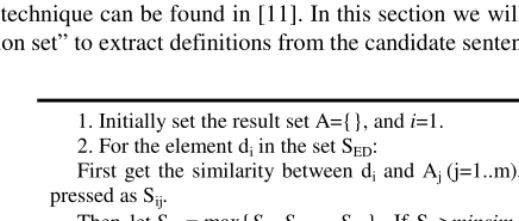
1. Initially set the result set A={}, and i=1. 2. For the element di in the set SED:
First get the similarity between di and Aj (j=1..m), which is
ex-pressed as Sij.
Then letSik =max{Si1,Si2,...,Sim}. If Sik>minsim, then add Ak
to the set A and delete Ak from the set SA .
3. If m L A length
k
k) max_
( 1
>
∑
′=
or i equals to l, the algorithm ends;
otherwise, i = i +1, go to step2.
Fig. 3. Definition extraction using EDS
The algorithm was showed in Fig.3. The candidate sentence set is also expressed as SA = {A1, A2,…, Am}, where Ak (k=1..m) is a candidate sentence in the set and m is
the total number of the candidate sentences. The similarity Sij is calculated as the
same as in Section 3.2. L
( )
Ak represents the length of string Ak in character and m ’is the number of elements in set A. The parameters max_length and minsim were em-pirically set based on TREC’s definition question set. The last result is set A, where A={A1, A2,…, Am’}.
4 Evaluation
In order to get comparable evaluation, we apply our approach to TREC2004 defini-tion QA task. We can see that our approach is an effective one compared with peer systems in this competitive evaluation.
4.1 Evaluation Criterion
The TREC evaluation criterion [3] is summarized here for the purpose of discussing the evaluation results.
For an individual definition question, there is a list of essential nuggets and accept-able nuggets provided by TREC. These given nuggets are used to score the definition generated by the system.
An individual definition question will be scored using nugget recall (R) and an ap-proximation to nugget precision (P) based on length. In particular,
R = # essential nuggets returned in response/# essential nuggets P is defined as: if length < allowance, P = 1
else P=1-[(length-allowance)/length]
where allowance = 100*(# essential+acceptable nuggets returned) length = total # non-white-space characters in answer strings The F measure is:
where
β
value is fixed three in TREC 2004, and we also use three to get comparable result.The score of a system is the arithmetic mean of F-measure scores of all the defini-tion quesdefini-tions output by the system.
4.2 Effectiveness of Web Knowledge Bases
To compare the effectiveness of the Web knowledge bases, we experimented on the TREC 2004 definition question set. The result can be seen in Table1.
Table 1 shows the F-measure scores of our two algorithms and the baseline method. It also shows the median of the scores of all participating systems in TREC 2004. The baseline method is: for an input question, form the candidate sentence set by using the approach described in Section 2. Then put the sentence of this set into the answer set one by one until all the sentences in the candidate sentence set are consid-ered or the answer length is greater than a pre-fixed length (we set the length 3000 characters in our experiment).
We can see that our two algorithms all outperform the median and the baseline method which does not use Web knowledge bases. In conclusion, the Web knowledge bases are effective resources to definition question answering.
Table 1. The F- measure score of the baseline method, the median system in TREC2004, and our two methods on TREC 2004 data set
4.3 Definition Extraction Based on GDS vs. Based on EDS
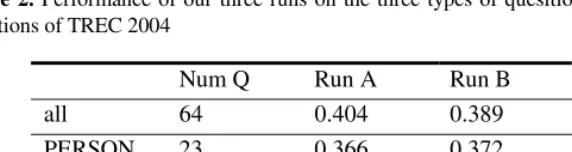
As we have mentioned, we have tried two algorithms in the definition extraction mod-ule, which are based on GDS and EDS respectively. The performance of these algo-rithms is shown in Table 2.
Table 2. Performance of our three runs on the three types of quesitions and on the whole 64 questions of TREC 2004
Num Q Run A Run B Run C
all 64 0.404 0.389 0.367
PERSON 23 0.366 0.372 0.404
ORG 25 0.413 0.389 0.326
THING 16 0.446 0.415 0.379
We have submitted three runs in TREC2004, which were generated by using dif-ferent algorithm in the definition extraction module. Run A and run B were generated by using GDS with slightly different weights in formula (1), and run C was generated by using EDS. All the 64 questions are divided into three classes based on the entity types of the targets, which are person, organization and other thing. Table 2 shows the three runs’ F-measure scores on these three types and their overall score on the whole 64 questions.
Two algorithms’ F-measure scores are all among the best of total 63 runs. Run C’s score on the “PERSON”, 0.404 is the highest of our three runs on this type. Run A does better on the types named “ORG” and “THING”. We can say that these two algorithms contribute to different kinds of target terms. Dividing definition questions into different subclass and processing them with different methods could be a proper direction.
Considering the score on all the 64 questions, the former algorithm is slightly higher than the latter one. However, the result of the latter one is also encouraging. Since the “essential definition set” contain the important information and less redun-dancy, it has the potential to get the answers, which are not only concise but also have wide coverage about the target. We believe it is an appropriate way to extract the high quality definitions. A preliminary analysis shows that the major problem is how to improve the quality and the coverage of the essential definition set. We believe that the performance could be boosted through improving this technique.
In conclusion, we can say that our methods can make better use of the external knowledge in answering definition question.
5 Conclusions
Since definitional patterns can not only filter out those statistically highly-ranked sentences that are not definitional, but also bring those definition sentences that are written in certain styles for definitions but are not statistically significant into the answer set. [6] In the future work, we will employ some pattern matching methods to reinforce our existing method.
Acknowledgements
This research was partly supported by NSF (Beijing, China) under contract of 60435020, and Key Project of Science and Technology Committee of Shanghai under contract of 035115028.
References
1. Abdessamad Echihabi, Ulf Hermjakob, Eduard Hovy: Multiple-Engine Question Answer-ing in TextMap. In ProceedAnswer-ings of the Twelfth Text REtreival Conference. NIST, Gath-ersburg, MD (2003) 772–781
2. Ellen M. Voorhees: Overview of the TREC 2001 question answering track. In Proceedings of the Tenth Text REtreival Conference. NIST, Gathersburg, MD (2001) 42–51
3. Ellen M. Voorhees: Overview of the TREC 2003 Question Answering Track. In Proceed-ings of the Twelfth Text REtreival Conference. NIST, Gathersburg, MD (2003) 54–68 4. Ellen M. Voorhees: Evaluating answers to definition questions. In Proceedings of the 2003
Human Language Technology Conference of the North American Chapter of the Associa-tion for ComputaAssocia-tional Linguistics (2003) Volume 2: 109–111
5. G.Salton, C. Buckley: Term weighting approaches in automatic text retrieval. Information Processing and Management (1988) 24(5): 513–523
6. Hang Cui, Min-Yen Kan, Tat-Seng Chua, Jing Xiao: A comparative Study o Sentence Re-trieval for Definitional Question Answering. In Proceedings of the 27th Annual Interna-tional ACM SIGIR Conference (2004)
7. Hang Cui, Keya Li, Renxu Sun, Tat-Seng Chua, Min-Yen kan: National University of Singapore the TREC-13 Question Answering Main Task. In Proceedings of the Thirteenth Text REtreival Conference. NIST, Gathersburg, MD (2004)
8. J. M. Prager, Jennifer Chu-Carroll, Krzysztof Czuba, Christopher Welty, Abraham It-tycheiach, Ruchi Mahindru: IBM’s PIQUANT in TREC2003. In Proceedings of the Twelfth Text REtreival Conference. NIST, Gathersburg, MD (2003) 283–292
9. Jinxi Xu, Ana Licuanan, Ralph Weischedel: TREC2003 QA at BBN: Answering defini-tional Questions. In Proceedings of the Twelfth Text REtreival Conference. NIST, Gath-ersburg, MD (2003) 98~106
10. Milen Kouylekov, Bernardo Magnini, Matteo Negri, Hristo Tanev: ITC-irst at TREC-2003: the DIOGENE QA system. In Proceedings of the Twelfth Text REtreival Confer-ence. NIST, Gathersburg, MD (2003) 349–357
11. Qi Zhang, Xuanjing Huang, Lide Wu: A New Method for Calculating Similarity between Sentences and Application on Automatic Text Summarization. In Proceedings of the first National Conference on Information Retrieval and Content Security (2004)