Open Access
Research
Development and characterization of positively selected
brain-adapted SIV
Peter J Gaskill, Debbie D Watry, Tricia H Burdo and Howard S Fox*
Address: Department of Neuropharmacology, The Scripps Research Institute, 10550 N. Torrey Pines Road, La Jolla, CA, 92037, USA Email: Peter J Gaskill - [email protected]; Debbie D Watry - [email protected]; Tricia H Burdo - [email protected];
Howard S Fox* - [email protected] * Corresponding author
Abstract
HIV is found in the brains of most infected individuals but only 30% develop neurological disease. Both viral and host factors are thought to contribute to the motor and cognitive disorders resulting from HIV infection. Here, using the SIV/rhesus monkey system, we characterize the salient characteristics of the virus from the brain of animals with neuropathological disorders. Nine unique molecular clones of SIV were derived from virus released by microglia cultured from the brains of two macaques with SIV encephalitis. Sequence analysis revealed a remarkably high level of similarity between their env and nef genes as well as their 3' LTR. As this genotype was found in the brains of two separate animals, and it encoded a set of distinct amino acid changes from the infecting virus, it demonstrates the convergent evolution of the virus to a unique brain-adapted genotype. This genotype was distinct from other macrophage-tropic and neurovirulent strains of SIV. Functional characterization of virus derived from representative clones showed a robust in vitro infection of 174xCEM cells, primary macrophages and primary microglia. The infectious phenotype of this virus is distinct from that shown by other strains of SIV, potentially reflecting the method by which the virus successfully infiltrates and infects the CNS. Positive in vivo selection of a brain-adapted strain of SIV resulted in a near-homogeneous strain of virus with distinct properties that may give clues to the viral basis of neuroAIDS.
Introduction
As the Acquired Immune Deficiency Syndrome (AIDS) pandemic continues to grow, the number of people affected by the neurological complications of human immunodeficiency virus (HIV) infection expands. Neuro-logical complications, known collectively as neuroAIDS, affect approximately 30% of those infected with HIV [1]. Although our knowledge of the process by which HIV causes brain disease is constantly expanding, we still have only a limited understanding of the underlying patho-genic mechanism leading to disease in the central nervous system (CNS). It has been shown that an increase in the
population of brain macrophages is a significant patho-logical correlate of neuropatho-logical disease [2], and that most strains of HIV isolated from the brains of individuals with neurological disease are macrophage tropic and utilize the CCR5 co-receptor [3,4]. Macrophages and microglia, related cells of monocytic lineage, are the only cell types consistently infected in the brains of HIV-infected individ-uals [5]. Damage to neurons is thus indirect, resulting from effects of viral proteins or products of infected mac-rophages. The ability of HIV to infect macrophages and microglia in vitro is predictive of its neuroinvasiveness [6] and infected monocytes/macrophages are thought to
Published: 12 May 2005
Virology Journal 2005, 2:44 doi:10.1186/1743-422X-2-44
Received: 10 March 2005 Accepted: 12 May 2005
This article is available from: http://www.virologyj.com/content/2/1/44
© 2005 Gaskill et al; licensee BioMed Central Ltd.
carry HIV into the brain as per the Trojan horse hypothesis [7,8].
Simian immunodeficiency virus (SIV) is closely related to HIV [9,10] and SIV infection of macaques can generate a neuroAIDS-like syndrome that mirrors neuroAIDS in humans, demonstrating the neuropathological hallmarks of neuroAIDS found in HIV-infected humans along with cognitive, motor, and neurophysiological impairments [11-15]. The similarities between HIV- and SIV-induced neurological disease in humans and macaques, in light of the ethical and practical limitations of performing neuro-logical research in humans, make the rhesus macaque an excellent model for the study of neuroAIDS.
There are a variety of strains and molecular clones of SIV that have been used to study aspects of AIDS pathogene-sis, many of which are derived from the SIVmac251 strain [16]. Of the molecular clones, the most commonly used is SIVmac239, derived from the SIVmac251 strain by animal passage and tissue culture proviral DNA cloning [17]. SIVmac239 is highly pathogenic in vivo and displays a very high infectious capacity for T cells, but not macrophages, in vitro [17]. Unlike T-cell-tropic strains of HIV, which uti-lize the CXCR4 but not the CCR5 co-receptor, the T-cell tropism of SIVmac239 may be based on its inefficient use of the relatively low cell-surface CD4 density on rhesus macrophages, rather than co-receptor specificity [18]. Yet this may not fully explain SIVmac239's lack of productive macrophage infection, since many studies have found efficient entry, but post-reverse transcriptional blocks in the SIVmac239 life cycle in macrophages [19-21].
Other studies have examined the molecular aspects of virus recovered ex vivo from macrophages late in infection, revealing specific nucleotide/amino acid changes in viral genes and their products, which are associated with high levels of infection of macrophages in vitro [22-25]. In stud-ying SIV cellular tropism, another commonly used clone is SIVmac316, isolated from proviral DNA in lung macro-phages of a macaque that died rapidly after infection with SIVmac239 [24]. Tropism studies with this clone and oth-ers like it essentially examine viral revertants, examining changes in the viral sequence in the context of the back-bone of SIVmac239 [26].
We have taken an independent approach to examine viral properties of SIV in the CNS. Using the SIVmac251 stock, we performed a serial passage of cell-associated virus iso-lated from the CNS of infected monkeys, followed by pro-duction of a cell-free stock of virus from in vitro infected microglia [27,28]. In this manner, we utilized a forward selection of neuroinvasive variants that exist in, or arose from, the SIVmac251 stock. In this study we discuss the development and analysis of SIV clones derived from
virus released by cultured microglia that were isolated from the brains of monkeys infected with microglia-pas-saged viral stock. Sequencing and characterization of viral tropism and infectious phenotype were then undertaken to analyze genomic and functional characteristics com-mon to these brain-derived viruses.
Results
Molecular Cloning of Microglia-Derived SIV
A total of 43 clones of the 3' region of SIV were isolated from viral RNA found in the supernatant of microglia cul-tures derived from the brains of SIVmac182-infected macaques 225 and 321. Of these clones, 24 clones were from animal 225, and 19 clones from animal 321. A por-tion of gp41 was sequenced in each clone to insure the identity of the clones and to determine if any of the clones contained premature truncations due to stop codons in the gp41 region, a common finding in macrophage-tropic SIVmac239-derived clones. Sequence analysis confirmed that all of the clones were SIV, and that none had trunca-tions in the gp41 region.
Infectivity and Cytopathogenicity
Each of these 43 clones containing the 3' region of SIV was ligated to the 5' region of SIVmac239, and transfected into 174xCEM cells, a common indicator cell line for SIV infec-tion. Cultures were observed daily for syncytia formation and monitored for infectious virus formation by p27Gag analysis of culture supernatants. Of the 43 viruses, 19 (13 from macaque 225 and 6 from macaque 321) induced syncytia formation in the cultures and/or tested positive for p27Gag production in the culture supernatant.
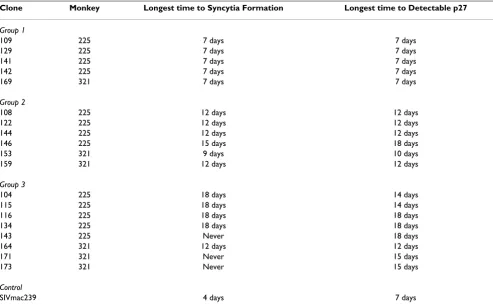
In vitro parameters of cytopathogenicity were then tested, using cells transfected with SIVmac239 as a positive con-trol. SIVmac239 led to a very robust infection in 174xCEM cells, rapidly producing high levels of p27Gag (1.5 ng/ml) and syncytia. Pronounced cytopathic effects ensued, and the cells in the SIVmac239-transfected cultures were all dead by day 11 post-transfection. The microglia-derived molecular clones could be divided into three groups. A first group of five clones: 109, 129, 141, 142, and 169, produced the most consistent and robust infections, with all clones in this group generating syncytia, consistently high levels of p27Gag (above 1.5 ng/ml) and high levels of cell death by day 15 (Table 2).
This group of clones 3 was considered least pathogenic of the three in vitro because they did not cause any detectable cell death and were unable to consistently generate syncy-tia and detectable p27Gag levels by day 18 experiments, although all of them did generate syncytia and high levels of p27Gag in at least one experiment, with the exception of 171 and 173, which did not generate syncytia despite p27Gag production.
Sequence Analysis
The nine clones judged the most pathogenic in vitro were chosen for complete sequence analysis. These clones included all five from the most pathogenic group; 109, 129, 141, 142 and 169, as well as clones 108, 122, 153 and 159 from the second group. Clones from the second group were picked because they generated the highest
lev-els of p27Gag in that group. Of the clones chosen, 108, 109, 122, 129, 141, and 142 were isolated from macaque 225 and clones 153, 159 and 169 were isolated from macaque 321. We fully sequenced the env and nef genes as well as the 3' LTR of each of these molecular clones. These sequences were used to develop a consensus sequence for all nine of the molecularly derived clones to be used for further analysis.
The nine clones showed a remarkable degree of similarity in the three gene products analyzed, with more differences in the TM portion of Env and in Nef than in the SU por-tion of Env. The nine clones differed from the consensus sequence by zero to six amino acids of 1,144 in amino acids in all three genes sequenced (Table 3). Comparison with other common molecular clones of SIV that were also derived from the SIVmac251 stock showed marked differences from the consensus sequence of the brain-adapted viruses in these regions (Table 3). The detail of these differences can be found in Table 4, showing that the brain-adapted genotype lacks the commonly seen truncation in gp41, and possesses 18 unique amino acids across Env and Nef.
Additional sequence analysis was performed on the gp41 cytoplasmic tail regions of SIVmac251, SIVmac182 and cDNA derived from the supernatant of microglia from macaques 225 and 321. These reactions were performed on the cytoplasmic tail because of the variable sequence and frequent truncations found in this region and used a different set of primers than previous sequencing reac-tions in order to serve as independent confirmation of the observed amino acid changes. The brain-adapted viruses developed a unique sequence in this area, with 4 synony-mous and 14 non-synonysynony-mous changes in the gp41 cyto-plasmic tail regions of both 225 and 321 cDNA when compared with the original progenitor strain SIVmac251. There were also two synonymous and five non-synony-mous changes found when comparing 225 and 321 cDNA with that of their immediate progenitor, SIVmac182. The synonymous and non-synonymous changes from both SIVmac251 and SIVmac182 were identical in uncloned PCR products from both 225 and 321 microglia superna-tants, and the resulting amino acid changes in gp41 can be seen in Table 5.
Macrophage Infection
It has previously been shown that a majority of viruses isolated from the brains of individuals with neurological disease are macrophage tropic, and the ability to infect macrophages is thought to be key in the induction of neu-rological disease. Because the molecularly cloned viruses were all isolated from the brains of rhesus macaques that suffered from encephalitis, we hypothesized that these viruses were macrophage tropic. To test this hypothesis,
Table 1: Sequence of oligonucleotide primers used for reverse transcription, PCR, and sequencing of SIV.
Primer Sequence
Reverse Transcription
SIVGSP TGCTAGGGATTTTTCCTGCYTCGGTTT
Nested PCR
6516 CTCGCTTGCTAACTGCA CTTCTAATCATATCTA
Sph2 GCATGCTATAACACATGCTATTGTAAAAAGTGTT
10505 AAGCAGAAAGGGTCCTAACAGACCAGGGTCTTCA
Molecular Clone Sequencing
For 1 AACTCAGTGCCTACCAGATAA
For 2 TGGCATGGTAGGGATAATAGGA
For 3 ATAAAAGAGGGGTCTTTGTGCT
For 4 AACTGCAGAACCTTGCTATCG
For 5 GTTTGATCCAACTCTAGCCTACAC
For 6 ATGACAGGGTTAAAAAGAGACAAGA
For 7 GAATTGGTTTCTAAATTGGGTAGA
For 8 GAGGCACAAATTCAACAAGAGAAG
For 9 CATACAGAAAACAAAATATGGATGA
For 10 TCCTGGTCCTGAGGTGTAATCCTG
Rev 1 CGCAAGAGTCTCTGTCGCAGAT
Rev 2 AGAGGGTGGGGAAGAGAACACTG
Rev 3 ACTTCTCGATGGCAGTGACC
Rev 4 CCAGACATAATGGAGACTGGTAA
Rev 5 AGAGTACCAAGTTTCATTGTACTC
Rev 6 AGGCAAATAAACATTTTTGCCTAC
Rev 7 GAGCGAAATGCAGTGATATTTATACATCAAG
Population PCR and Sequencing
8877For ATAGCTGGGATGTGTTTGGC
8534For GCTGGGATAGTGCAGCAACAGCAAC
8406For CTACTGGTGGCACCTCAAG
9452Rev CGAGTATCCATCTTCCAC
9625Rev CCTACCAAGTCATCATCTTCCTCA
9880Rev ATCCTCCTGTGCCTCATCTG
Table 2: In vitro syncytia formation and viral antigen production. The molecular clones, derived from microglia of the indicated monkey, were tested by transfection and subsequent growth in 174xCEM cells.
Clone Monkey Longest time to Syncytia Formation Longest time to Detectable p27
Group 1
109 225 7 days 7 days
129 225 7 days 7 days
141 225 7 days 7 days
142 225 7 days 7 days
169 321 7 days 7 days
Group 2
108 225 12 days 12 days
122 225 12 days 12 days
144 225 12 days 12 days
146 225 15 days 18 days
153 321 9 days 10 days
159 321 12 days 12 days
Group 3
104 225 18 days 14 days
115 225 18 days 14 days
116 225 18 days 18 days
134 225 18 days 18 days
143 225 Never 18 days
164 321 12 days 12 days
171 321 Never 15 days
173 321 Never 15 days
Control
SIVmac239 4 days 7 days
Table 3: Comparison of encoded amino acids (AA) from clones described here (top) with other SIV molecular clones (bottom). The number (#) and percent (%) changes (∆) in the indicated regions of Env and Nef are given.
Clone Monkey Derived From #AA ∆ in gp120 #AA ∆ in gp41 #AA ∆ in Nef ∆ consensus in Env & Nef
108 225 Viral RNA from Microglia supernatant 0 1 0 0.08%
109 225 Viral RNA from Microglia supernatant 1 0 0 0.08%
122 225 Viral RNA from Microglia supernatant 0 0 0 0.00%
129 225 Viral RNA from Microglia supernatant 1 1 0 0.17%
141 225 Viral RNA from Microglia supernatant 1 2 1 0.35%
142 225 Viral RNA from Microglia supernatant 1 0 1 0.17%
153 321 Viral RNA from Microglia supernatant 1 3 2 0.52%
159 321 Viral RNA from Microglia supernatant 0 2 2 0.35%
169 321 Viral RNA from Microglia supernatant 0 2 1 0.26%
SIVmac1A11 251-79 Proviral DNA from Tissue culture cells 28 8* 18 4.72%
SIVmac32H (pJ5) 32H Proviral DNA from Tissue culture cells 24 14 19 4.98%
SIVmac316 316-85 Proviral DNA from Tissue culture cells 19 8* N/A 3.07%**
SIV/17E-Fr 17E Proviral DNA from Brain & Macrophages 22 11* 20 4.63%
SIVmac239 239-82 Proviral DNA from Tissue culture cells 18 14 15 4.11%
[image:4.612.56.554.498.693.2]we isolated macrophages from rhesus macaque PBMC and inoculated them with six of the molecularly cloned viruses. Three of the viruses that were fully sequenced, clones 108, 122 and 142, were dropped from this analysis because their sequences were greater than 99% similar to another clone being used for these infections. In order to generate more uniform results between experiments, all inoculations were performed using spinoculation. Spin-oculation effectively eliminates potential differences in viral infection resulting from viral attachment to the cell, because it moves viruses directly onto their cellular targets [29,30].
Viruses derived from all six of the molecular clones repli-cated well in macrophages, and while the levels of p27Gag produced fluctuated between infections, the pattern of p27Gag production between the six viruses was remarka-bly consistent between experiments with the exception of the p27Gag production by clone 153, which induced strong p27Gag production on day 4 of this experiment, had reduced levels on day 10, and had inconsistent p27Gag production in subsequent experiments. Clones
109, 129, and 169 consistently produced the highest lev-els of p27Gag (Figure 1). Although strong p27Gag pro-duction was induced by clone153 on day 4 of this experiment, p27Gag levels were much reduced by day 10, and p27Gag production with this clone was inconsistent in subsequent experiments. As controls, the T-cell-tropic clones SIVmac239 and the molecular clone SIVmac251 were used and neither of these clones was able to produce detectable p27Gag after ten days, whereas the SIVmac251stock (the progenitor strain for SIVmac239, the SIVmac251 molecular clone and our microglia serial passage) successfully infected macrophages but produced relatively low levels of p27Gag (data not shown). Based on these results and the genetic similarity of the brain-adapted clones, subsequent experiments focused only on clones 129 and 169 as representatives of this particular genotype of SIV.
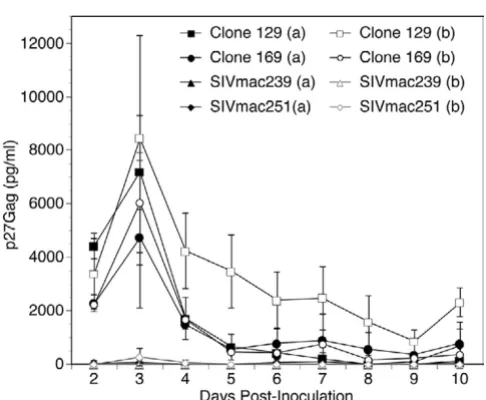
[image:5.612.54.555.110.224.2]Both the 129 and 169 molecular clones produced a simi-lar infectious phenotype following spinoculation, pro-ducing p27Gag levels that peaked early after infection and then slowly declined (Figure 2). This particular infection
Table 4: Predicted amino acid residue at the indicated location in the SU region of Env. Bold indicates unique amino acids in clones 129 and 169.
Env – gp120 67 79 127 132 134 135 144 153 176 178 309 382 385 475 511
SIVmac239 V N I S T S M A K D M G D G D
SIVmac316 M N I S T S M A E D M R D G D
SIV17E-Cl M N I S T S M A N D I R N G D
SIV17E/Fr M N I S T S M A N D I R D G D
SIVmac32H L E L P A - M T K D M R D G D
SIVmac1A11 L E S A P - M V K D I G D G N
Clone 129 L D S S T P V V K G I R D R N
Clone 169 L D S S T P V V K G I R D R N
*sequence not available, – no amino acid residue.
Table 5: Predicted amino acid residue at the indicated location in the TM region of Env. Bold indicates unique amino acids in clones 129 and 169.
Env – gp41 573 631 676 713 734 737 741 751 752 760 764 767 785 802 821 850 855
SIVmac239 K K D M Q I P R D S W E S L T G T
SIVmac316 T K D V Q I P G D S W Stop - - - -
-SIV17E-Cl K K N V Q * * * * * * * * * * * *
SIV17E/Fr K K D M Q I P G D S Stop - - -
-SIVmac251 K N D M Q I P G D S W E S L T G T
SIVmac32H K D D M Q I P G D S W E S L T G T
SIVmac1A11 K K D M Stop - - -
-Clone 129 K D D M Q T Q G D R W E N F A R T
Clone 169 K D D M Q T Q G G R W E N F A R A
[image:5.612.59.555.298.423.2]phenotype, an early peak in p27 levels, was seen in all infections with either of these two viruses, although SIVmac129 consistently produced higher peak p27 levels than SIVmac169.
Microglia Infection
Along with perivascular macrophages, microglia are the most commonly infected cells in the brain [31]. In order to determine if the molecularly cloned viruses were able to infect microglia, these cells were isolated from the brains of 3 animals (uninfected with SIV, but treated with meth-amphetamine for other studies). The microglia were spin-oculated with virus prepared from clones129, 169, or SIVmac239. The molecular clone of SIVmac251 was also used to infect microglia from two of the three animals.
Viruses from both clones 129 and 169 were able to pro-ductively infect microglia, producing very high levels of p27Gag within the first 5 days, and then slowly declining out to day ten (Figure 3). While the peak levels of p27Gag production were reached more slowly in microglia than in macrophages, taking between 4 and 6 days rather than 3 or 4, the pattern of infection was similar to that seen in macrophage infections with these viruses. SIVmac239 was
[image:6.612.312.553.83.298.2]Viral replication in macrophages of six brain-adapted clones on days four (left) and ten (right) days post-inoculation
Figure 1
Viral replication in macrophages of six brain-adapted clones on days four (left) and ten (right) days post-inoculation. Cul-tures were inoculated with virus produced from the indi-cated clones. Culture media was replaced one day before collection at the indicated day and a 24-hour supernatant was then analyzed by ELISA to determine p27Gag levels.
Daily SIV production in macrophage cultures
Figure 2
Daily SIV production in macrophage cultures. Macrophages from two different rhesus monkeys (a – 359, b – 420) were inoculated with virus produced from the indicated clones. Culture media was replaced each day and the removed supernatant was analyzed by ELISA to determine 24-hour p27Gag levels. This figure is representative of the infectious phenotype for these viruses in this cell type seen in four sep-arate experiments.
[image:6.612.55.296.88.282.2]Daily SIV production in microglia cultures
Figure 3
[image:6.612.54.297.410.610.2]unable to infect microglia, failing to produce detectable levels of p27Gag in any of the infections. The SIVmac251 molecular clone was only able to infect microglia at a very low level, producing detectable p27Gag only sporadically during the course of infection (Figure 3).
Spread in Macrophage Infection
[image:7.612.314.554.87.329.2]Because macrophage tropism is a common characteristic of viruses found in the brains of individuals with neu-roAIDS, the spread of virus between macrophages may carry important implications for understanding disease progression in the CNS. To assess spread of infection through macrophages, we enumerated the number of infected cells in cultures of primary macrophages inocu-lated with the viruses prepared from molecular clones 129 and 169, in comparison to the parental SIVmac251stock. In order to account for donor-related differences in mac-rophage infection, we examined infection of monocyte-derived macrophages in fourteen experiments, utilizing cells from four different macaques. The percentages of infected macrophages varied between experiments (most likely due to host-cell differences or the variability inher-ent in working with primary cells), but each viral clone produced infection within 48 hours of inoculation. Viruses generated from clones 129 and 169 both pro-duced separate, unique infection patterns in all animals (Figure 4). In particular, clone 129 followed a similar infection pattern found by measuring supernatant p27Gag (shown in Figure 2), showing the highest percent of infected cells early on (17.1% by day 4). In contrast, clone 169 manifested the highest percent of infected cells later (8.2% on day 6) (Figure 4). The SIVmac251stock showed a very low level of infection, with 3% or less cells infected each day.
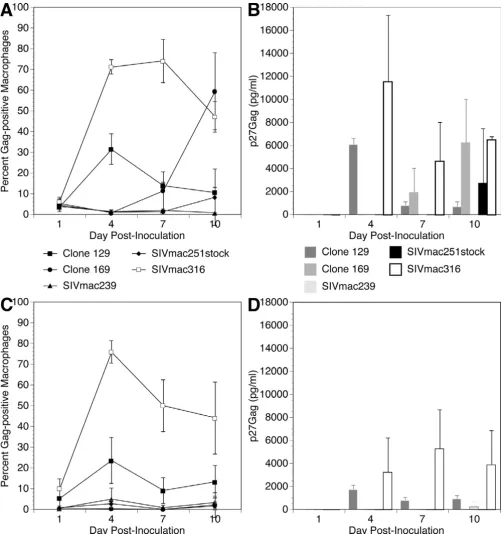
To further examine the behavior of this brain-adapted phenotype in terms of viral spread, we performed a sec-ond macrophage infection over a 10-day time course, again using clones 129 and 169 as well as the SIVmac239 and SIVmac316 viruses, and the parental SIVmac251stock. Due to the limited number of macro-phages derived from each animal, infections were only analyzed by staining and p27Gag analysis on days 1, 4, 7 and 10 post-infection. Since macrophages isolated from different rhesus macaques vary in their in vitro susceptibil-ity to infection, in order to account for this variation, macrophages from macaques with different susceptibili-ties were used for each experiment. Although the percent-ages of infected cells (Figure 5A, 5C) and p27Gag levels (Figure 5B, 5D) varied between animals, the general infec-tion pattern, with one notable excepinfec-tion, was remarkably similar.
Macrophages from donor monkey 408 showed no signif-icant infection by any virus on day one post-inoculation,
with all chambers showing a percentage (<3%) of infected cells and no detectable p27Gag levels in the supernatant (Figures 5A,B). Day four post-inoculation was much dif-ferent, showing increases in percent of cells infected and p27Gag levels in chambers infected with SIVmac316 (71% of cells infected with p27Gag levels of 11.5 ng/ml) and clone 129 (30% and 6.1 ng/ml). Chambers inocu-lated with clone 169, SIVmac239 and SIVmac251stock had an extremely low infected cell percentage (<1%) and no detectable p27Gag levels in the supernatant. On day seven post-inoculation, the SIVmac316-infected cell per-centage remained constant (66.6%) while p27Gag levels dropped (4.6 ng/ml). The percentage of infected cells in chambers infected with clone 129 dropped more than two-fold (12.8%) and supernatant p27Gag levels in the supernatant also dropped (0.8 ng/ml). No change was seen in SIVmac239 and SIVmac251stock infections. Sur-prisingly, the infected cell percentage in cultures inocu-lated with clone 169 greatly increased (14.6%), as did p27Gag levels in the supernatant (1.9 ng/ml). These
Infected cell percentage in macrophage culture
Figure 4
trends all continued on day 10, with a greater than 3-fold increase in infected cell percentage (58.4%) and
superna-tant p27Gag levels (6.2 ng/ml). SIVmac316-infected chambers had reduced infected cell percentage (42.8%),
[image:8.612.54.557.85.619.2]Spread and production of five different isolates of SIV in primary macrophages
Figure 5
though p27Gag levels in the supernatant increased (6.5 ng/ml). Chambers infected with clone 129 showed both reduced infected cell percentage (8.1%) and slightly reduced p27Gag levels in the supernatant (0.7 ng/ml). There was no change in the chambers infected with SIVmac239. Chambers inoculated with the SIVmac251stock showed increased infected cell percent-age (5.5%) and a large increase in p27Gag levels in the supernatant (2.7 ng/ml) at this last time point.
Somewhat similar infection trends were seen on infection of macrophages from macaque 411 (Figure 5C,D). On day one post-inoculation, infected cell percentages in chambers inoculated with SIVmac316 (10.1%) and clone 129 (4.1%) were both higher than those seen in the 408 infections, but neither infection generated detectable p27Gag levels in the supernatant. Inoculation with SIVmac316 and clone 129 then followed the same general pattern found in the 408 infections above, with increases in infected cell percentage and p27Gag levels in the super-natant on day 4, followed by a decline on days 7 and 10. Supernatant p27Gag levels were in general lower than those found from the macrophages from macaque 408. However, in contrast to the results found in the other monkey's macrophages, here clone 169 did not lead to detectable infected cells or p27Gag levels in the supernatant at any point in the infection. Furthermore a low infected cell percentage was seen in SIVmac251stock and SIVmac239 infected chambers on days 4 and 10 respectively, but neither of these cultures had detectable p27Gag levels at any point during the infection.
Discussion
To improve understanding of the viral factors that allow certain strains of HIV/SIV to induce brain disease, we ana-lyzed molecular clones generated from SIVmac251stock through serial passage in infected microglia in vivo. After the final passage, several brain-adapted molecular clones were isolated from two macaques, 225 and 321, both of whom died with SIVE. Sequence analysis of the env and
nef genes of these viral clones showed remarkable
genotypic homology, as the all the brain-adapted clones differed from their consensus sequence by less than 0.55%.
Separate examination of the cytoplasmic tail of gp41 from uncloned viral sequence derived from the same microglia supernatant used to isolate the brain-adapted clones pro-vided independent verification of these similarities. The uniqueness of this genotype is seen in comparison with other common SIVs like SIVmac239, SIVmac316 and SIVmac17E-Fr, as the brain-adapted genotype differs from the env and nef gene sequences of the other virus by three to five percent (Tables 3,4,5). Furthermore, uncloned viral sequence derived from both 225 and 321 microglia
showed a large number of identical non-synonymous mutations in the gp41 cytoplasmic tail when compared with both SIVmac251 and SIVmac182.
Because of the way they were derived, the sequential dif-ferences from other SIVmac251 derived viruses and the exceptional homology between the separately isolated viral clones, the amino acid changes in these clones likely represent positive selection for adaptations beneficial towards survival and infection in the brain and CNS. The large number of identical non-synonymous mutations from the original SIVmac251 strain supports this idea, as non-synonymous mutations are only maintained if they are beneficial adaptations. When these brain-adapted clones are examined in light of their separate derivation from two different animals and the relative frequency of mutations during viral infection of macaques, the extraor-dinary homogeneity and uniqueness of the sequence of these brain-adapted clones, along with the identical and numerous non-synonymous mutations found in virus from both animals, strongly indicates that this genotype developed as a result of viral adaptation to the unique environment found in the CNS.
Numerous studies using SIV have linked brain infection to macrophage tropism [32-34], and indeed, virus from all of the brain-derived clones were macrophage tropic. Rep-resentative clones derived from each macaque (clone 129 from macaque 225, and clone 169 from macaque 321), were further characterized, and found not only to be infec-tious in primary macaque macrophages, but also in pri-mary macaque CD4+ T-cells and pripri-mary macaque microglia. In addition to characterizing the tropism of the brain-adapted clones, the macrophage and microglia infection experiments also demonstrated a distinct, repro-ducible infectious phenotype associated with this viral genotype.
changes that contribute to this characteristic is not surpris-ing in clones derived from the brain. Indeed, the brain-adapted clones from this study were found to contain numerous changes in Env, including the G382R and R751G changes mentioned above (see Table 3).
Macrophage tropism alone is not sufficient for induction of neurological illness [26], and many studies cite specific genes thought to be important in the induction of CNS disease. Mankowski and colleagues demonstrated the pri-macy of the envelope gene in neurovirulence in the devel-opment of SIV/17E-Fr, and examination of this clone by Flaherty and colleagues found macrophage tropism asso-ciated changes V67M, P334R and G382R in the envelope, along with several unique amino acid changes [23,26]. These and other studies demonstrate that while there is a group of amino acid changes associated with the macro-phage tropic aspect of brain adaptation, it is an additional set of amino acid changes that allow a virus to successfully adapt to the environment of the brain. The brain-adapted clones described in this paper are a perfect example of this, with several macrophage tropism associated changes in the envelope, along with a group of entirely unique amino acid changes; seven in gp120 and seven in gp41.
However, other studies of brain adaptation in SIV find that specific Nef sequences are also important for infection and replication of virus in the brain, implying that similar neuroadaptive changes may also occur in the nef gene [26,36,37]. Barber and colleagues have noted five amino acid changes in Nef between SIVmac239 and SIV/ 17E-Fr, including two, P12S and E150K, that mediate dis-tinct Nef/kinase associations and may be important in neuroadaptation [38]. Also a study of four pigtailed macaques infected with SHIV containing nef from an SIV background demonstrated that the majority of nef genes amplified from an animal with neurologic disease encoded two amino acid changes, T110A and A185T [39]. The brain-adapted genotype described in this paper does not contain any of the Nef changes seen in SIV/17E-Fr but it does contain the T110A residue, along with four other amino acid changes unique to this genotype among the viruses examined.
It is clear from the number of common changes found in various brain derived SIV clones that certain amino acid residues in Env and Nef are important to the adaptation of SIV to the CNS environment, including, but not limited to, those changes contributing to macrophage tropism. As with many derivatives of SIVmac251, the brain-adapted viruses described here do match the amino acids for sev-eral of the reversions noted in SIVmac239 described above, notably G382R and R751G in Env and T110A in Nef. The brain-adapted genotype described here also con-tains some amino acid differences from SIVmac251 and
SIVmac239 that match other neurovirulent viruses like SIV17E/Fr, although it lacks the commonly seen trunca-tion in the cytoplasmic region of gp41 and contains sev-eral amino acid changes that are unique to this group of viruses.
Unlike the macrophage-tropic and neurovirulent variants of SIVmac239 described above, the brain-adapted viruses isolated in this study were selected, or evolved from, a stock which could infect macrophages naturally in the course of infection, which was then preserved and selected for by subsequent passage through the brains of other ani-mals. We had previously reported that analysis of brain proviral DNA for a portion of gp120 revealed selection of homogeneous sequences over the course of microglia pas-sage [27]. Here, we have expanded these studies to the entire Env as well as Nef, examination of viral RNA, and characterization of infectious phenotypes in macrophage and microglia. Unlike many other studies with SIV, the changes found in the brain-adapted genotype described in this paper are an example of forward selection, rather than reversions that function largely in the context of the back-bone of the non-macrophage-tropic non-brain-derived strain SIVmac239.
It is interesting to note that three of the amino acid changes found in gp41 of the brain-adapted clones are not found in the same region of their immediate progenitor, SIVmac182, therefore they developed during the course of infection in each animal. The presence of identical amino acid changes in viruses derived from two separate animals indicates that the genotype described by these clones results from convergent evolution rather than random mutation, and therefore the particular changes found in the genomes of these clones may be important to the nat-ural adaptation of the virus to the brain.
phe-notype has only been shown to be distinct among the five viruses tested in these experiments and may also be an experimental artifact due to spinoculation or another aspect of our infection protocol, so the relevance of this particular phenotype to SIV remains uncertain.
Based on the data presented above; the method of isola-tion, the uniqueness of the Env and Nef sequences and their derivation through forward evolution in the brain and unique phenotype and tropism, it is clear that the genotype represented by the clones described in this study represents a new, brain-adapted genotype of SIV with a unique phenotype of infection. Further study of this gen-otype and its unique phengen-otype, both alone and in com-parison with other brain-adapted strains of SIV, will hopefully generate greater understanding for the viral basis of brain disease and dementia, providing new targets and avenues of research in order to more effectively com-bat this disease.
Methods & Materials
Cell isolation and culture
All cell culture media and components were obtained from Invitrogen (Carlsbad, California), fetal calf serum (FCS) from Hyclone (Logan, Utah) and recombinant human macrophage colony-stimulating factor (M-CSF) from Peprotech (Rocky Hill, New Jersey). 174xCEM cells were obtained from the NIH AIDS and Reference Reagent Program (Germantown, Maryland), and grown in RPMI-1640 containing 10% FCS, 10 mM Hepes, and 100 U/mL penicillin, 100 µg/mL streptomycin and 250 ng/mL fung-izone (added as an antibiotic cocktail called PSF).
Monocyte-derived macrophages were prepared from rhe-sus peripheral blood mononuclear cells (PBMC). PBMC were isolated by Histopaque 1077 (Sigma-Aldrich, St. Louis, Missouri) gradient centrifugation, and cultured at 2 × 10⁶ cells/ml in complete macrophage media (RPMI-1640, 10% FCS, 5% autologous monkey serum, 10 mM HEPES, 10 ng/ml M-CSF, 1% PSF). Cultures were incu-bated briefly with PBS and then washed with serum-free RPMI-1640 on days 1, 3, and 5 post-isolation to remove non-adherent cells. After washing on day 5 post-isolation, cells were washed one additional time with PBS and then incubated in Versene (Invitrogen) on ice, agitating every 1–2 minutes. Cells were then shaken loose, enumerated in a Coulter Z2 counter (Beckmann-Coulter, Fullerton, California) and resuspended in complete macrophage media. Purity was ascertained by FACS analysis.
To prepare microglia, the meninges, surface vessels, and choroid plexi were removed from brains taken from sterile phosphate buffered saline-perfused rhesus monkeys. Then brain tissue was homogenized with a Tenbroeck tis-sue homogenizer, and microglia purified by collagenase/
DNase digestion and Percoll gradient centrifugation as described [28]. Cells were enumerated in a Coulter Z2 counter, resuspended in complete microglia media (RPMI-1640, 10% FCS, 20 mM HEPES, 50 ng/ml M-CSF), and plated in 48-well plates at a concentration of 7.5 × 10⁵ cells/well. Purity was ascertained by FACS analysis. Non-adherent cells are removed by washing 1, 3 and 5 days after isolation, and microglia used for experiments on day 6 post-isolation.
Animal infection
Two rhesus macaques were infected intravenously with cell-free stock of SIVmac182, obtained by 3 generations of in vivo serial passage of SIVmac251 (44, 47). Both of these animals developed neuroAIDS with SIV encephalitis. Macaque 225 had a natural, rapid course of disease, requiring sacrifice at 80 days post-viral inoculation. Mon-key 321 was treated with an anti-CD8 antibody at the time of infection [40] and also had a rapid course of disease, requiring sacrifice at 108 days post-viral inoculation. Following sacrifice, microglia from both animals were cul-tured as described above and cell-free supernatant was drawn from these cultures on days 8 through 12 post-iso-lation.
Molecular cloning
Nucleic acids were isolated from the supernatants of cul-tured microglia, isolated from macaques 225 and 321, using a QIAamp Viral RNA mini kit (QIAGEN, Valencia, California) and were used to generate viral cDNA using the primer SIV GSP (see Table 1 for all primer sequences). Nested PCR were then used to amplify the cDNA, using the primers 10505 and 6516 for the first round of ampli-fication, and primers 10505 and Sph2 for the second round of amplification. The PCR product was analyzed by gel electrophoresis to insure it was the proper size and then excised using the crystal violet gel excision system (Invitrogen). Approximately 10 ng of cDNA was cloned into the TOPO-XL vector (Invitrogen) and transformed into Max Efficiency STBL2 cells (Stratagene, La Jolla, Cali-fornia). Plasmid DNA was then isolated, restriction mapped, and initially sequenced using primer For8, corre-sponding to a region of the gp41 gene.
174xCEM Transfection and Infections
been subcloned into the Litmus38 vector (New England BioLabs, Beverly, Massachusetts). This process was also used to combine the 3' regions of SIVmac239, and the molecular clone SIVmac251, both originally obtained from the NIH AIDS Research and Reference Reagent Pro-gram, with the 5' region of SIVmac239.
The ligation products were transfected into 174xCEM cells by DEAE-Dextran. Transfections were observed for syncy-tia for 18 days and supernatant was taken from each cul-ture periodically for use in p27Gag ELISA (SIV Core Antigen Assay, Beckmann-Coulter) to test for the presence of infectious virus. Clones were monitored microscopi-cally for the speed of syncytia formation and speed of cell death in culture, and the media was assayed by ELISA for p27Gag level in order to characterize the robustness of infection. All transfections were each performed inde-pendently at least twice, with an extra transfection being performed on clones with inconsistent results in the first two transfections.
Viral stocks were produced in 174xCEM cells using either transfection, as above, or infection, for the uncloned SIVmac251 stock and a viral stock of the SIVmac239/ 316EM*/nef-open molecular clone. SIVmac239/316/ Macropahge Variant is a macrophage tropic derivative of SIVmac239 (this clone is hereafter referred to as SIVmac316, kindly provided by Dr. R. Desrosiers, New England Primate Research Center, Southborough, Massa-chusetts). Following infection or transfection, when syn-cytia become prevalent throughout the infected culture, cells were washed and resuspended in fresh growth media every twenty-four hours, with the cell-free supernatant aliquoted and stored at -80°C. Each stock was run in trip-licate p27Gag ELISA for quantification.
Sequence Analysis
The 3' regions of nineteen molecular clones were com-pletely and bi-directionally sequenced using a battery of primers designed to cover the full length of that fragment of the genome. The group of primers used included M13 Forward and M13 Reverse as well as ten SIV-specific for-ward primers and seven SIV-specific reverse primers, listed on Table 1. All sequencing reactions on the molecular clones were performed at the TSRI Nucleic Acids Core Facility.
Additional sequencing reactions were performed on uncloned cDNA prepared from cell-free viral RNA isolated from SIVmac251 stock, SIVmac182, and from cultured microglia from macaques 225 and 321. RNA was con-verted to cDNA using the First Strand cDNA synthesis kit (Marligen Biosciences, Ijamsville, MD) and amplified by using the primers 8534For, 8406For, 9880Rev and 10203Rev, followed by purification of the PCR product
and sequence analysis with 8777For, 9452Rev and 9625Rev in order to sequence the gp41 cytoplasmic tail region (bases 8750–9499). All direct sequencing reactions of PCR products were performed by Retrogen (San Diego, California).
Macrophage and Microglia Infection
Macrophages were purified as above, and plated in 48-well plates at 7.5 × 10⁴ per well. The macrophages were grown in these plates for one day and then inoculated in triplicate with 4 ng (p27Gag) of the virus stock in com-plete macrophage media. Infection was facilitated by spin-oculation (30). Briefly, virus was added to each well and plates were centrifuged at 1,200 × g for 2 hours at 25°C. Plates were then incubated at 37°C for 22 hours, washed twice with Hanks Balanced Salt Solution (Invitrogen), and fed with complete media. Every 24 hours, supernatant was removed and stored at -80°C, while cells were fed with fresh complete macrophage media.
Microglia were infected following the above spinocula-tion protocol. Following spinoculaspinocula-tion media was col-lected and replaced with fresh complete microglia media daily, similar to the collection protocol followed in mac-rophage infections.
Macrophage chamber slide culture infection and analysis PBMCs were isolated and enumerated as described above, and monocytes purified using the MiniMacs magnetic separation system (Miltenyi Biotech, Cologne, Germany) using paramagnetic anti-CD11b beads. The cells were then enumerated and resuspended in complete macrophage media and plated onto 8-well chamber slides (Fisher Scientific, Pittsburgh, Pennsylvania) at 105 cells per well.
Media was changed on day 3 post-isolation, and on day 6 removed and replaced with the viral inoculum containing 6 ng (p27Gag) of virus stock diluted in complete macro-phage media, performed in triplicate. Slides were incu-bated for 24 hours at 37°C, after which the supernatant was gently aspirated, cells washed, and fed with complete macrophage media. Day one post-inoculation and every three days following, one set of slides (corresponding to 3 wells for each infecting virus and one uninfected well for each virus) was processed for staining and the supernatant from each chamber was carefully aspirated and stored at -80°C.
for 1 hour with a 1:100 dilution of FA2 (mouse anti-p27Gag antibody, originally obtained from the NIH AIDS Research and Reference Reagent Program) in 5% BSA in PBS. Following this incubation, chambers were washed once with 1% BSA in PBS, and incubated for 1 hour with a 1:500 dilution of rhodamine-conjugated goat-anti-mouse antibody (Molecular Probes, Eugene, Oregon) in 5% BSA in PBS. Cells were then washed once with PBS and incubated for 3 minutes with 4,6-diamidino-2-phe-nylindole dihydrochloride hydrate (DAPI, Sigma-Aldrich) diluted to 10 ug/mL in PBS. All of these reactions were performed at room temperature in the dark. Cells were then gently washed once with PBS, chamber divisions were removed and coverslips were attached using Vectash-ield mounting medium (Vector Labs, Burlingame, California) and sealed with nail polish. Slides were stored in the dark at 4°C.
One day after staining, each set of slides was assessed by computer-assisted fluorescence microscopy using the Axiovision program (Carl Zeiss, AG, Germany). Three 10x fields were assessed from each chamber using rhodamine and DAPI filters, generating nine fields per virus per day examined. Three fields taken of an uninfected control well were used to control for background fluorescence. All observation and focusing was performed under DAPI flu-orescence to avoid experimenter bias. The images were
analyzed using OpenLab (Improvision, Lexington, MA) to elucidate the total number of cells and infected cells in each field. The total number of cells per field was deter-mined by counting the DAPI-stained nuclei, while the number of infected cells in each field was determined using Boolean operations to overlay the FA2-Rhodamine stained viral gag with those nuclei. The number of posi-tive-staining cells in the control wells was used to account for background fluorescence.
Competing interests
The author(s) declare that they have no competing interests.
Acknowledgements
This work was support by NIH grants R01 MH59468, R01 NS045534, and P30 MH62261. PJG was supported by NIH training grant T32 AI07606. 174xCEM cells, p239SpSp5, p239SpE' nef Open, and SIVmac251 phage were provided by NIH AIDS Research and Reference Reagent Program. This is manuscript #16804-NP from The Scripps Research Institute.
References
1. Petito CK, Cho ES, Lemann W, Navia BA, Price RW: Neuropathol-ogy of acquired immunodeficiency syndrome (AIDS): an autopsy review.J Neuropathol Exp Neurol 1986, 45:635-646. 2. Glass JD, Fedor H, Wesselingh SL, McArthur JC:
[image:13.612.55.554.100.204.2]Immunocyto-chemical quantitation of human immunodeficiency virus in the brain: correlations with dementia. Ann Neurol 1995, 38:755-762.
Table 6: Predicted amino acid residue at the indicated location in Nef. Bold indicates unique amino acids in clones 129 and 169.
Nef 7 12 39 43 49 53 75 93 110 112 119 150 201 206
SIVmac239 M P Y P G R E E T S M E S P
SIV/17E-Fr M S Y P G L K Q T S I K S P
SIVmac251 R P S L G L E E T S M E S P
SIVmac32H R P S L G L E E T S M E S P
SIVmac1A11 M P S L G L E E T S M E S P
Clone 129 R P S L D R E E A T M E A S
Clone 169 R P S L D R E E A T M E A S
Table 7: Predicted amino acid residues in the gp41 cytoplasmic tail that differ in the indicated viruses. Residues found only in the microglia-passage derived SIVmac182 stock, and/or in the resulting virus released from monkey 225 and 321 microglia, are in bold; italics further indicated residues found in the microglia virus but not SIVmac182. For amino acid 747, a mixed sequence was present in SIVmac182 capable of encoding either amino acid listed. Population-based sequencing was performed on the SIVmac251, SIVmac182, 225 microglia, and 321 microglia viral stocks. SIVmac239 is provided for reference.
695 737 741 747 748 751 758 760 785 794 802 808 821 831 837 850 858
SIVmac239 (clone) V I P E S R G S S V L T T H V G R
SIVmac251 (stock) V I P E S G S S S A L A T Q G G G
SIVmac182 (stock) I I Q G/E G G G R S V F T T Q G R R
225 microglia I T Q G G G G R N V F T A Q G R R
[image:13.612.55.553.291.374.2]3. Smit TK, Wang B, Ng T, Osborne R, Brew B, Saksena NK: Varied tropism of HIV-1 isolates derived from different regions of adult brain cortex discriminate between patients with and without AIDS dementia complex (ADC): evidence for neu-rotropic HIV variants.Virology 2001, 279:509-526.
4. Gabuzda D, Wang J: Chemokine receptors and mechanisms of cell death in HIV neuropathogenesis.J Neurovirol 2000, 6 Suppl 1:S24-32.
5. Bissel SJ, Wiley CA: Human immunodeficiency virus infection of the brain: pitfalls in evaluating infected/affected cell populations.Brain Pathol 2004, 14:97-108.
6. Gorry PR, Bristol G, Zack JA, Ritola K, Swanstrom R, Birch CJ, Bell JE, Bannert N, Crawford K, Wang H, Schols D, De Clercq E, Kunst-man K, Wolinsky SM, Gabuzda D: Macrophage tropism of human immunodeficiency virus type 1 isolates from brain and lym-phoid tissues predicts neurotropism independent of core-ceptor specificity.J Virol 2001, 75:10073-10089.
7. Peluso R, Haase A, Stowring L, Edwards M, Ventura P: A Trojan Horse mechanism for the spread of visna virus in monocytes.
Virology 1985, 147:231-236.
8. Williams K, Alvarez X, Lackner AA: Central nervous system perivascular cells are immunoregulatory cells that connect the CNS with the peripheral immune system. Glia 2001, 36:156-164.
9. Desrosiers RC: The simian immunodeficiency viruses.Annu Rev Immunol 1990, 8:557-578.
10. Kestler H, Kodama T, Ringler D, Marthas M, Pedersen N, Lackner A, Regier D, Sehgal P, Daniel M, King N, et al.: Induction of AIDS in rhesus monkeys by molecularly cloned simian immunodefi-ciency virus.Science 1990, 248:1109-1112.
11. Clements JE, Anderson MG, Zink MC, Joag SV, Narayan O: The SIV model of AIDS encephalopathy. Role of neurotropic viruses in diseases.Res Publ Assoc Res Nerv Ment Dis 1994, 72:147-157. 12. Horn TFW, Huitron-Resendiz S, Weed MR, Henriksen SJ, Fox HS:
Early physiological abnormalities after simian immunodefi-ciency virus infection. Proc Natl Acad Sci U S A 1998, 95:15072-15077.
13. Murray EA, Rausch DM, Lendvay J, Sharer LR, Eiden LE: Cognitive and motor impairments associated with SIV infection in rhe-sus monkeys.Science 1992, 255:1246-1249.
14. Sharer LR, Baskin GB, Cho ES, Murphey-Corb M, Blumberg BM, Epstein LG: Comparison of simian immunodeficiency virus and human immunodeficiency virus encephalitides in the immature host.Ann Neurol 1988, 23:S108-12.
15. Weed MR, Gold LH, Polis I, Koob GF, Fox HS, Taffe MA: Impaired performance on a rhesus monkey neuropsychological test-ing battery followtest-ing simian immunodeficiency virus infection.AIDS Res Hum Retroviruses 2004, 20:77-89.
16. Daniel MD, Letvin NL, King NW, Kannagi M, Sehgal PK, Hunt RD, Kanki PJ, Essex M, Desrosiers RC: Isolation of T-cell tropic HTLV-III-like retrovirus from macaques. Science 1985, 228:1201-1204.
17. Naidu YM, Kestler HW, Li Y, Butler CV, Silva DP, Schmidt DK, Troup CD, Sehgal PK, Sonigo P, Daniel MD, et al.: Characterization of infectious molecular clones of simian immunodeficiency virus (SIVmac) and human immunodeficiency virus type 2: persistent infection of rhesus monkeys with molecularly cloned SIVmac.J Virol 1988, 62:4691-4696.
18. Bannert N, Schenten D, Craig S, Sodroski J: The level of CD4 expression limits infection of primary rhesus monkey mac-rophages by a T-tropic simian immunodeficiency virus and macrophagetropic human immunodeficiency viruses [In Process Citation].J Virol 2000, 74:10984-10993.
19. Kim SS, You XJ, Harmon ME, Overbaugh J, Fan H: Use of helper-free replication-defective simian immunodeficiency virus-based vectors to study macrophage and T tropism: evidence for distinct levels of restriction in primary macrophages and a T-cell line.J Virol 2001, 75:2288-2300.
20. Kirchhoff F, Pohlmann S, Hamacher M, Means RE, Kraus T, Uberla K, Di Marzio P: Simian immunodeficiency virus variants with dif-ferential T-cell and macrophage tropism use CCR5 and an unidentified cofactor expressed in CEMx174 cells for effi-cient entry.J Virol 1997, 71:6509-6516.
21. Mori K, Ringler DJ, Desrosiers RC: Restricted replication of sim-ian immunodeficiency virus strain 239 in macrophages is
determined by env but is not due to restricted entry.J Virol
1993, 67:2807-2814.
22. Banapour B, Marthas ML, Ramos RA, Lohman BL, Unger RE, Gardner MB, Pedersen NC, Luciw PA: Identification of viral determinants of macrophage tropism for simian immunodeficiency virus SIVmac.J Virol 1991, 65:5798-5805.
23. Flaherty MT, Hauer DA, Mankowski JL, Zink MC, Clements JE: Molecular and biological characterization of a neurovirulent molecular clone of simian immunodeficiency virus. J Virol
1997, 71:5790-5798.
24. Mori K, Ringler DJ, Kodama T, Desrosiers RC: Complex determi-nants of macrophage tropism in env of simian immunodefi-ciency virus.J Virol 1992, 66:2067-2075.
25. Overbaugh J, Rudensey LM, Papenhausen MD, Benveniste RE, Morton WR: Variation in simian immunodeficiency virus env is con-fined to V1 and V4 during progression to simian AIDS.J Virol
1991, 65:7025-7031.
26. Mankowski JL, Flaherty MT, Spelman JP, Hauer DA, Didier PJ, Ame-dee AM, Murphey-Corb M, Kirstein LM, Munoz A, Clements JE, Zink MC: Pathogenesis of simian immunodeficiency virus encephalitis: viral determinants of neurovirulence. J Virol
1997, 71:6055-6060.
27. Lane TE, Buchmeier MJ, Watry DD, Jakubowski DB, Fox HS: Serial passage of microglial SIV results in selection of homogene-ous env quasispecies in the brain.Virology 1995, 212:458-465. 28. Watry D, Lane TE, Streb M, Fox HS: Transfer of neuropathogenic
simian immunodeficiency virus with naturally infected microglia.Am J Pathol 1995, 146:914-923.
29. O'Doherty U, Swiggard WJ, Malim MH: Human immunodefi-ciency virus type 1 spinoculation enhances infection through virus binding.J Virol 2000, 74:10074-10080.
30. Saphire AC, Bobardt MD, Gallay PA: Cyclophilin a plays distinct roles in human immunodeficiency virus type 1 entry and postentry events, as revealed by spinoculation.J Virol 2002, 76:4671-4677.
31. Cosenza MA, Zhao ML, Si Q, Lee SC: Human brain parenchymal microglia express CD14 and CD45 and are productively infected by HIV-1 in HIV-1 encephalitis. Brain Pathol 2002, 12:442-455.
32. Sharma DP, Zink MC, Anderson M, Adams R, Clements JE, Joag SV, Narayan O: Derivation of neurotropic simian immunodefi-ciency virus from exclusively lymphocytetropic parental virus: pathogenesis of infection in macaques. J Virol 1992, 66:3550-3556.
33. Stephens EB, Galbreath D, Liu ZQ, Sahni M, Li Z, Lamb-Wharton R, Foresman L, Joag SV, Narayan O: Significance of macrophage tropism of SIV in the macaque model of HIV disease.J Leukoc Biol 1997, 62:12-19.
34. Anderson MG, Hauer D, Sharma DP, Joag SV, Narayan O, Zink MC, Clements JE: Analysis of envelope changes acquired by SIVmac239 during neuroadaption in rhesus macaques. Virol-ogy 1993, 195:616-626.
35. Kodama T, Mori K, Kawahara T, Ringler DJ, Desrosiers RC: Analysis of simian immunodeficiency virus sequence variation in tis-sues of rhesus macaques with simian AIDS. J Virol 1993, 67:6522-6534.
36. Overholser ED, Coleman GD, Bennett JL, Casaday RJ, Zink MC, Bar-ber SA, Clements JE: Expression of simian immunodeficiency virus (SIV) nef in astrocytes during acute and terminal infection and requirement of nef for optimal replication of neurovirulent SIV in vitro.J Virol 2003, 77:6855-6866.
37. Thompson KA, Kent SJ, Gahan ME, Purcell DF, McLean CA, Preiss S, Dale CJ, Wesselingh SL: Decreased neurotropism of nef long terminal repeat (nef/LTR)-deleted simian immunodeficiency virus.J Neurovirol 2003, 9:442-451.
38. Barber SA, Maughan MF, Roos JW, Clements JE: Two amino acid substitutions in the SIV Nef protein mediate associations with distinct cellular kinases.Virology 2000, 276:329-338. 39. Singh DK, McCormick C, Pacyniak E, Lawrence K, Dalton SB, Pinson
DM, Sun F, Berman NE, Calvert M, Gunderson RS, Wong SW, Stephens EB: A simian human immunodeficiency virus with a nonfunctional Vpu (deltavpuSHIV(KU-1bMC33)) isolated from a macaque with neuroAIDS has selected for mutations in env and nef that contributed to its pathogenic phenotype.
Publish with BioMed Central and every scientist can read your work free of charge
"BioMed Central will be the most significant development for disseminating the results of biomedical researc h in our lifetime."
Sir Paul Nurse, Cancer Research UK
Your research papers will be:
available free of charge to the entire biomedical community
peer reviewed and published immediately upon acceptance
cited in PubMed and archived on PubMed Central
yours — you keep the copyright
Submit your manuscript here:
http://www.biomedcentral.com/info/publishing_adv.asp
BioMedcentral 40. Schmitz JE, Simon MA, Kuroda MJ, Lifton MA, Ollert MW, Vogel CW,
Racz P, Tenner-Racz K, Scallon BJ, Dalesandro M, Ghrayeb J, Rieber EP, Sasseville VG, Reimann KA: A nonhuman primate model for the selective elimination of CD8+ lymphocytes using a mouse-human chimeric monoclonal antibody. Am J Pathol