Acquisition of Lexical Information
from a Large Textual Italian Corpus
Nicoletta C A L Z O L A R I - Remo BINDI
Istituto di Linguistica Computazionale del C N R , Pisa Dipartimento di Linguistica, Universita" di Pisa
Via deIla t'aggiola 32 56100 PISA - I T A L Y
e-mNl: G L O T T O L O @ I C N U C E V M . B I T N E T
1. l.troduction: L D B requirements
T h e creation and development of a large Lexical Database ( L D B ) which, until now, mainly reuses the data found in standard Machine Readable Dictionaries, has been going on in Pisa for a n u m b e r o f years (see Calzolari 1984, 1988, Calzolari, Picchi 1988). We are well aware that, in order to build a more powel-ful I.DB (or even a Le.'dcal Knowledge Base) to be used in different ComputationM l.inguistics (CL) applications, types of information other than those usually found in machine readable dictionaries are urgently needed. Different sources of information must therefore be exploited if we wemt to overcome the 'qchcal bottleneck ~" of Natural l..anguage Processing ( N I P ) .
In a trend which is becoming increasingly relevant both m c1 proper and in Literao" and Iinguistic Computing, we feel that very interesting data ibr our LI)Bs c:m be found b.v processing large textuM corpora, where the actual usage of the language can be truly investigated. Many research projects are nowadays collecting large amounts of textuM data, thus providing more and more material to be analyzed for descriptions based on measurable evidence of how language is actually used. We uhhnately aim at integrating lexical data extracted from the an',dysis of large textual corpora into the I,DB we are implementing. These data refer, typically, to:
i) complementation relations introduced by prepositions (e.g. dividere < divide > subcategorizes for a PP headed by the preposition in < in > ha one sense, and by the preposition fra
< a m o n g > in another sense);
ii) lexically conditioned modification relations (tena macchina potente < powerful car > , un farmaco potente < p o t e n t medicine> and not /brte < strong > , while un cajfe" forte < strong coffee >,
una moneta forte < strong currency > and not po- tente < powerful > );
iii) lefically significant collocations (premiere ut~a decisione < to take a decision > and not fare z~na decisione < to make > , prestare attenzione < to pay attention > and not dare < to give > );
iv) fixed phrases and idioms I (donna itz carriera, dottorato di ricerca, a propo~ito di);
v) compounds ( tarola calda, ~ave scuo/a).
All these types of data are a major issue of practical relevance, and particularly problematic, in many N I P applications in different areas. They should therefore be d v c n very lm'ge coverage in any useful LDB, and, moreover, should also be annotated, in a computerk,'ed lexicon, for the pe~inent t)equency information obtained fiom the processed corpus, and obviously updated fl"om time to time. As a matter of fact, dictionaries now tend to encode all the theoreticcd possibilities on a same level, but "if e ; ' e ~ possibility in the diction:m, must be given equal weight, parsing is very diificult" (Church 1988, p.3): they should provide infornaation on what is more likely to occur, e.g. relative likelihood of alternate pm-ts of speech for a word or of ahernate word-senses, both out of context and it" possible taking into account contextu~d factors.
Statistical anMyses of linguistic data were very popular in the "50s and '60s, mainly, even though not only, for literary types of analyses and for studies on the lexicon (Guiraud 1959, Muller 1964, Moskovich 1977). Stochastic approaches to linguistic analyses have been strongly reevaluated in the past few years, either for syntactic analysis (Gm'side et al. 1987, Church 1988), or for N L P applications (Brown et al. 1988), or for semantic analysis (Zemik 1989, Smadja 1989). Quantitative (not statistical) evidence on e.g. word-sense occurrences in a large corpus have been taken into account for lexicographic descriptions (Cobuild 1%7).
T h e claim of this paper is that the above types o f linguistic information (i-v), to be made available for o u r LDB, can be partially extracted by processing and analyzing very large text corpora, with quantitativc/st,~zistic methods.
2. The Italian Reference Corpus
T h e corpus (see Zarnpolli 1988) on which we are n o w conducting our analysis is being produced by the ILC and an Italian publishing house (see Bindi et al. 1989). The project was begun in 1988. The corpus n o w contains about 12 milfion words, and the first goal is to reach 20 million words by the end of "90. When completed, the corpus will be balanced among journals, novels, manuals, scientific texts, 'grey' literature, etc. The corpus is presently unproportioned, because we first processed and inserted up to about 8 million words from journals, newspapers, mag~ines, etc., while we are nt)w inserting data fi'om novels and from the scientific and technical literature.
T h e present study is conducted on the first section o f the corpus, but we obviously intend to extend the mlMysis to the other sections as soon as they become available.
We describe two types of quantitative anMyses whose aim is to extract information on:
a) the strength ofassocialion between two words; b) fixed phrases or idioms.
3. The strength o f association within word-pairs As regards the first point we have used the m e t h o d o f measuring thc association ratio between two words as described by Church and llanks (1989). T h e value of the association ratio reflects the strength of the bond between the two words taken into account. The method is very simple. The association ratio between any two words x and y appearing together in a window of five words in the corpus is based on the concept of "mutuM information" defined as:
I (x,y) = log~
P (x) P (y)
where P is the probability. We refer to Church and Hank,.~ (1989, pp. 77-78) for a detailed explanation o f the f o m m l a and of how the association ratio slightly differs from it, given that we are more
interested here in the linguistic m~d lexicographic evaluation of the numerical results deriving from its application.
In addition to this we have introduced the measurement of the so~called dispersion, in order to obtain - linked to the association ratio - quanti~ tative information on the distribution of the second word of the word-pair in the selected window. We wanted in fact to complete the simple frequency notion for a word-pair with that of frequency stability or dispersion, i.e. to add to the frequency a measure of how it is distributed over the different positions of the window. In this way we evaluate the uniformity of repartition of frequency of the second word over the considered span. We have used the formula described in detail in Bortolini et al. (1971, pp. 23-31), even though used here for different purposes.
We gj've some ex,'unples in Table 1, where fix,y) is the frequency of occurrence of words x and y together and in this order in a window of 5 words, gap is equal to the number of words between x and y (if gap = 0 then x and y are immediately adjacent), f(x) and f(y) are the frequencies of occu;rence of x and y independently in the corpus, ass.ratio is the result of application of the formula to x at~d y, dispersion calculates how tile second word is distributed within the considered window.
This last information is very useflfl not only to evidence words belongi'ng to fixed phrases, but especially while trying to evidence syntactic relationships. If the dispersion is 0 or ncm" to !), all or most of tile occurrences of tile second word are concentrated in the sameposition. This means that the position and distance of the two words is always the same, and it is theretbre a strong measure for evidencing "fixed phrases" or "compounds" with no variation inside. When viceversa its value approaches 1, y is almost equally distributed in the four positions o f the considered span. Thus, the combination of a not very lfigh (but above a certain level) ass.ratio with dispersion values near to 1 is more typical o f syntactic types of collocations, giving e.g. information on prepositional government.
We wish to highlight here some of the results achieved by the application of these statistical measures to the Italian corpus, and mainly to evaluate their linguistic relevance.
Table 1.
f(x,y) gap = 0 gap = 1 gap = 2 gap = 3
Stall Uniti 2047 2042 0
punto vista 832 0 831
opinione pubblica 272 272 0
presto a 33 14 9
spendere per 36 8 8
e" arnbizioso 20 5 5
~x)
0 5 5850
0 1 4396
0 0 657
6 4 85
9 11 183
5 5 115476
f(y) ass.ratio dispersion
2159 10.34 0.003 1974 9.58 0.002 1315 11.30 0.000
F r o m the present corpus of 8,032,667 occurrences (tokens) and 178,811 different word- forms (types), we obtained 26,473,263 word-pairs (tokens) in a window of 5 words (and not 32,000,000, as the window is not extended beyond any strong punctuation mark) and 8,716,446 different word-pairs (types). After discarding all the pairs with f(x,y) < 4, because they were too rare and of no linguistic relevance, 787,878 word-pairs were obtained, which were eventually reduced to 322,718 after eliminating those with association ratio < 3 (the pairs seem to be linguistically irrelevant below this level).
We must also recall that the data to which we have applied our measures are articles from many different types of newspapers, journals, etc. - i.e. m a n y short texts - , so that there is no bias towards clustering tendencies of words such as could appear in longer texts, like entire novels.
If we order the word-pairs by decreasing value of the association ratio, and examine the types of word combinations appearing in the different positions o f the file, we observe a different typology of word combinations according to the different levels:
i) at the top; ii) in the center;
iii) towards the lower interesting values, which for Italian seems to be a little higher than for English, i.e. around 35;
iv) below this significant value, until reaching the few negative values.
For example at the top, i.e. with very high values (ranging from 22.93 to about 15), we find the following categories of word-pairs:
- proper nouns, titles, etc. (e.g. Oci Ciornie 20.6,
Cvrano Bergerac 20.1, Montgomery Clift 20.1, Ursula Andress 19.9);
foreign (usually English) compound words or fixed phrases (value added 19.8, pax Christi 17.7, teen ager 17.7, drug administration 17.3);
Italian compounds of words belonging to specialized languages, which almost never occur in e v e ~ d a y language (bismuto colloidale 20.1, tornografia assiale 19.8, marmitte catalitiche 19.6, nitrato amrnonio 19.5, accoppiatore acu_~tico 17.5);
- co-occurring technical words, which again appear very rarely ( laringiti traeheiti 20.3, idrologia climatologia 20.2, capperi cetriolini 19.6, prefetti questori 18.5, antisettiche antispasmodiche 17.8);
- fixed phrases or idioms whose component words are not frequent in ordinary language (volente nolente 20.6, specchietto allodole 18.8, bla bla 18.00, batter ciglio 17.2, cartoni animati 16.5, spron battuto 15.5);
modification relations between low" frequency Adjectives and Nouns (sostantivi plurali 19.9, fbr- bicine affilate 18.4, gradazione alco[ica 18.1, giub~ botti antiproiettile 17.4, salmone affumicato 17.1);
-. modification relations between Noun and Noun of a PP, both of tow frequency (cartina tornasole
18.3, filetti alici 17.7, siepi bosso 15.9, spicchio aglio
15.5).
These word-pairs share the following properties: both the words are of very low frequency, and almost always appear only together in the same context.
The characteristics of the different types of combinations appearing within the other ranges of the association ratio value, i.e. from ii) to iv) above (for example, at the value levels when more specific grammatical/syntactic information appears), are very different and present quite interesting properties.
Thus, we have observed how the measure of the association ratio gives quantitative/statistical evidence to a number of lexical, syntactic and semantic relationships between word-pairs. These relationships are essential for codification in an LDB, and cannot be actfieved with the same "objectiveness", and certainly not to the same extent, by other means such as e.g. le~cographers' intuition.
iMnong the syntactic relationships, particularly relevant is the data which regards the prepositions marking the different arguments of verbs, adjectives and nouns, together with their relative frequency. This is very important hfformation to be inserted in the LDB (especially of Italian), provided we have no dictionary source for this type of complementation as for example the L o n ~ n a n dictionary for Emglish. Other syntactic data concern the type of sentential complementation, mainly for the verbs.
We notice, for example, that in M1 their iIfflections the verb rischiare < to risk > and the noun rischio only subcategorize for the preposition di < o f > ; the same holds for the adjective capace < able > . Tiffs infom~ation is sinll?ly a confirmation of their only possible prepositional complementizer. The verb pensare < to think > is found with a, che, come, di < to, that, how, o f > , i.e. with all its theoretictd possibilities of prepositional and sentential government, while parlare < to speak > is more frequently associated only with con, di < with, about > , and not with a < to > , which should be found in principle. DM- dere is mostly associated with con, da, bl < with, from, i n > , and not with Ira < a m o n g > . These quantitative data can be associated to the different subcategorization frames and can be helpful for cornplementation rules, to decide on ambiguous attachments of PPs.
the three types of subcategorization. These may in fact correspond to different word-senses.
Vmy useful data of both syntactic and lexical/semantic relevance concern the so-called support verbs (see Gross 1982) for Nouns (usually deverbal or Action nouns) or for Adjectives. WE observe for example:
compiere accertamenti /0.8 fare, afjTdamento 8.1
a y e r e (lcee.~so 5 . 3
condwre:'e/fetmare analisi 8.3/7.3 avuto accoglienza 8.0 prendere decisione 9.7 rendere accettabile 8.9 re:~dere accessibile 9.4
This sort of intonnation on support verbs is of cssential importance for language generation (see Mel'cuk, Polguere 1988), and cannot be predicted in may other way, but can only be given either by observation or by introspection. The automatic collection of these data is thu:s an impovtm:t shortcut towards their extensive coverage in a I,DB. Their se.mantics cm~ be rather easih' inferred by the type of support verb (there is a iinite list of them) and given by rule.
Purely semantic data mainly regard typical collocations, e.g. between Adjective and Noun (see below), or between Verb a n d :\dverb, or between
\:art) a n d Lvpical Subjects and :or Objects (flondare
cohmia /I.4, abbas:are co{esterolo ]1.3, di~toggere attet~.Tiotze 10.9, attirare aztet;2iotze /0.7, pre.~tare attenzione 10.5,
sparo"
co"po 10.6).Interesting dma are also found concerning the semantic field of ccrtain wo,ds, and obvioush.' words bel,mging to a fixed phrase. For co- occurrences of ?',ouns bclongina, to the same semantic field an exmnple is:
abbig/iamemo acces.~ori 9.6
chili acce.ssori 9.4
her.u? aeces.~ori 9.3
:carpe accessori 9.0
Examples of fixed and o r idiomatic phrases ::re:
battuta arresto 11.7 (t)attuta d'arresto) pohnone acetate II.6 (pohnone d'acciaio) primo acchito 10.1 (di primo acchito) As this m e t h o d is only used to work on couples of words, it is clear that we do not generally obtain the whole phrase. It is for this reason that we have developed, especially for this type of data, other quantitative tools which are described in section 4,
whose results will supplcmcnt those providcd by this method.
A n u m b e r of different observations can be made for the word-pairs, according to whether they are
sorted on the right or the left word. If we examine the left contexts (i.e. if' words arc ordered on tt,e right), we arc more likely to gather information on e.g. the Nouns which are typically modified by" a given tbllowing Adjective (sotriso accattivat2te ]13; luce accecante 10.8; h¢ce accesa 8.7, radio aceeaa 9.7, co/ori aecesi 10.0, toni accesi 1/.2, forno acce:o 10.7, ji~oco acceso 8.5). If vice-versa we examine the right contexts, it is easier to collect data on the Nouns which are typically modified by a given preceding Adjective (costante aumee~to 7.6. co.~lante contalto 6.4, costante miglioramemo 7.9, co.~tan[e riferitnenlo 7.4, costante tet~peratura 8.1).
In the left contexts again we find together data which regard which Adjectives m'e typical pre- modifiers of a given Noun (forte aecel2zo 8.6, inconfimdibile aecento 12.0," difficile accesso 5.3, facile accesso 5.7, libero accesso 7.5," buena acco- glienza 8.7; amice amore 4.& 1)uo:2 amo;e 3.,1. elerrzo amore 7.0, grande amo,,'e 5.2. im?ro~q%o amore 5..5, u#imo amore ,f.4, vecchio amore 3.7. ;'ere amore 3.7), or which types of Nouns arc the governors of PPs with a given Noun as head (co,> troI/o armamenti 8.9, limitazione armamet?ri /1.,?. riduzione armamenti 9.t, settore atw:a.,?ze~m ~ 0.9).
When analyzhag the left contexts, we also find high association ratios for certain types :~!" gammatieal structures such as: comD.,ur~d \e.,bs (with essere < to be > or re'ere ," to have ;> as k'ft word), rcfle.,dve or intransitive propomina! -orbs (with tile par'icle .vi on tile left), reciprt~ca:! verb.,. {with the particles ci, ri), etc. A!t ',hose types of data are obviously iml,Onant for the c:cazio> <:~.~' ::n e×haustive LDB.
As a final remark we can add that it would ce:ainlv be useihl to make the same ca!cul:,,tic,::s on a tagged (for POS) corpus, in order to ob~ait: relevant inf0nnation for the Iemmas; however, we rnust observe that different word-forms c,f the same ~. O I Y l b l l i d [ (.3 ! ILtl len-ana often present very different ~ '- " ' properties, both at the grammatical syntactic level and at the lexieal'.,,cmantic level. \Vh~;n compacting m, lommtic.n f0r a sin~c lcmma we must therefore be carclhl not to lose data wlfich are relevant to particular inflected forms. This kind of information is again particularly' importmu tbr practical NI~P applications.
4. Fixed phrases and idioms
Mairdy for the detection of "stereotypes" in texts we have implemented and are now refining other quantitative/statistical tools not limited to couples
of words.
In order to collect data concerning specifically
fixed phrases or multi-word units, we first calculated the frequency of occunence in the corpus of all identical couples, triples, and so on,
up to seven-word syntagqns.
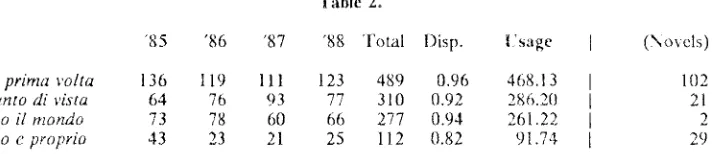
Table 2.
'85 "86 '87 '88 Total l)isp. 17sage
per la prima volta 136 119 111 123 489 0.96 468.13 dal punto di vista 64 76 93 77 310 0.92 286.20 in gusto il mondo 73 78 60 66 277 0.94 26l .22 un vero e proprio 43 23 21 25 112 0.82 9[.74
(Novels)
102 21
2
29
Dispersion. It is therefore equal to Frequency when the word is uniformly distributed in the different years (and genres), m:d is equal to 0 when Dispersion is 0, i.e. if all occurrences were concentrated in a sin~e year (or genre). L'sage is as nearer to Frequency as much the distribution is uniform, and decreases proportionally while I)ispersion is decreasing..
In this case dispersion and usage werc first calculated on the sections of the corpus which refer to the 4 3'cars of publication of the journals (from 1985 to 1988), in c, rder to point out, :-~_mong others, the appearance (or disappearance) of phrases, compounds, and stereotypes in gcneral. We then compared a svbset of all the prcss data with a subset of novels of analogous size, and again calculated dispersion mid usage in order to evidence eventual difference of distributkm of these fixed phrases between t'ress and novels.
'[he data (of the two types) were then so~cd in different ways: by alphabetical order of the n- :uples. by frcque::cy o i occurrence of the n-tuples, by dispcr.qou, by :.:sage. l:rom each ordering we anther data ~hiei: can be used in a variety of ways or can evidence different b p e s of phenomena. ,-~n cx~implc at :he bcginniug of the filc of the quad:u:'!cs e'.dcrcd b\ ~:'..,:-ge (in decreasing order) is I\mnd in Table 2 (\~ith iigurcs ior dispcrsion and usage c,::i\ cop.coming press data, i.e. the first four columns: the ,:elu,/v.n for Novels, o f the s~m:e size :is each )-era" cc, lumn. has been inserted in the table from the second comparison just for curiosity).
Fhc d a t a i.e. :dI the n-tuples of different lengths, were aiso :nerged in a single file, to evidence the precise length of each W e n phrase. For exa_mple, veto e proyrio is in a ,'rex high position for its frequency in the set of tripies, but the fact that un veto e/~roprio is also in a very high position in the set of quadruples memas that this is the size of the 'true fixed phrase'. Other observations on the
linguistic results evidenced by this method will be made in the presentation.
5. Final remarks
In the next months we intend to experiment with other statistical formulas (e.g. those used by Smadja and Choueka) on the corpus (which will 'also contain the novels and other types o f texts).
The first stage of the research consists in a careful linguistic analysis of the results obtained by the
different statisticN tools we are now implementing and applying. By this analysis performed
according to different parameters, both from the slatistical and linguistic, lexicographic viewpoints - we a~im at achieving a twofold objective. On the one side we mm at setting up the beginning of a sound methodology to semi-automatize the extraction of at least part of the relevant syntactic:semantic relationships flom the corpus: on the other :side we hope we shall be able to build a model of the "actuat" modification and complementation relations (out of the theoretical a-priori possibilities), ">f the "actual" lcxical collocations, of the "actual" stcre(~types in the Italian language.
One of the claims of this pro];:ct i's ttmt the linguistic information embodi,ed in all these quite different types of lexicaI collocations - c, nc,: they have been supplied in a ~ystemati,: vc'tv by a computational lexicon which is also ar?p,.ot~:tted" !br frequency can be helpful t,.)r !c:,:ic,d disambiguation in analysis and cmciaI fbr lexical selection in generation. Our method should be seen as a strategy to obtain in a semi-automatic way, and for a large portion of the lexicen, a fi~rmali.,:ation of many of the types of lexical relations coded, ior example, in the _MeI'cuk lexicon. "Il-,is should be an enhancement both for a rnore concr<e and objective lexicography (the results will be in fact evaluated in the next months in a true lexicographic environment), and tbr a more comprehensive :rod q]ata-based" li::g:dstics.
Acknmvledgment
We wish to th:mk our Referees for useful comments :rod suggestions, and A. Zampo!li for helpful discussions.
References
Bindi, R., M . . M e n a c h i n i , P. Orsolini, (lq8%, "Italian Reference Corpus", lI.C-'lI.N-3, Pisa. Bortolini, U., C. Tagliavini, A. Zampolli, (t971),
Lessico di Frequenza della LiINua ltalia~Ta Contemporanea, Garzanti, Nlilano.
Brown, P., Cocke, J., Della Pietra, S., Della Pietra, V., Jelinek, F., Mercer, R., Roossin, P., (1988),
"A statisticN approach to language translation", Proceedings oJ" the 27th b2ternational Cotference on Computafio~zal Linguistics, Budapest. Calzolari, N., (1984), "Detecting patterns in a
International Conference on Computational Linguistics, Stanford (CA), 170-173.
Calz.olm-i, N., (1988), ':Fhe dictionary and the thesaurus can be combined", in M. Evens (ed.),
Relational Models of the Lexicon, Studies in
Natural I,anguage Processing, Cambridge
University Press, Cambridge, 75-96.
Calzolari, N., (1989), '%exical Databases ,and Textual Corpora: perspectives of integration for
a Lexical Knowledge Base", Proceedings of the
/st International Lexical Acquisition Workshop,
1)etroit, Michigan.
Calzolari, N., E. Picchi, (1988), "Acquisition of
semantic intbrmation from ml on-line
dictionary", Proceedings of the I2th
International Conference on Computational l.inguistics, Budapest, I Iungary, 87-92.
Choueka, Y., (1988), "I.ooking for needles in a
haystack", Proceedings of the RIAO, 609-623.
Church, K., (1988), "e\ stochastic parts program and noun phrase parser tbr unrestricted text",
Proceedings of the 2nd A CL Conference on Applied Yatural Langucc¢e Processing.
Church K., P. Ihmks, (1989), "%Vord association norms, mutual intbrrnation and lexicography",
Proceedings of the 27th Annual Meeting of the Association for Computational Linguistics,
Vancouver, British Columbia, 76-83.
Cobuild, (1987), Collins Cobuild English Language
Dictionary, Collins, Glasgow.
Garside, R., Leech, G., Sampson, G., (1987), The
Computational Analysis of English - a corpus based approach, Lonmnan, l.ondon.
Gross, M., (1982), "On the notion of support verb", semhmr at the Simon Fraser University, B.C. Canada.
Guiraud, P., (1959), Problemes et methodes de la
statistique linguistique, D.Reidel, I)ordrecht.
Ilindlc, D., (1989), "Acquiring disambiguation rules
from text", Proceedings of the 27th Annual
Meeting of the Association for Computational Linguistics, Vancouver, British Columbia,
118-125.
Mel'cuk, I., Polgmere, A., (1988), "A formal Icxicon
in Memfing-Text theory", Computational
Linguistics, 13(3-4).
Muller, Ch., (1964), Essai de Statistique Lexica/e,
Klincksiek, Paris.
Muller, Ch., (1965), "Frequencc, dispersion et usage: apropos des dictionnaires de fiequence",
Cahiers de, Lexicologie, I1, 32-42.
Moskovitch, W.A., (1977), "Polyscmy in natural and artificial (phmned) languages", S,~///.,
Journal of Linguistic Cak'u/us, Skriptor, 1, 5-2g.
Smadja, J., (1989), "Macrocoding the lexicon with
co-occurrence knowledge", Proceeding.s" q: z/:e
]qrst International l.exical :1 cqui.ritio:z Workshop, Detroit, Michigan.
Webster, M., M. Marcus, (1989), ":\uto:natic acquisition of the lexical semantics of verbs
from sentence frames", Proceedings O~ dw 2 ~':/t
Annual Meeting o/" the Association _/br Computational l.i:~guistics, Vmacouver, lh-i~ish Columbia, 177-184.
Zarnpolli, A., (1988), "Progetto Strategic, .Uetodi
e strumenti per l:lndustria delle Li~zgue ::ella collaborazione internaAonale", I LC- C N R, Pica.
Zemik, U., (1989), "Paradigms in lexical
acquisition", Proceedinsds o J" the ['ir.~t
International Lexica/ .,i cquifftion I Vorks/',o/),