Scheduling In Flexible Manufacturing System By
Considering Two Objectives
A. Prashanth1, B. Satish kumar 2, Dr. G.Janardhana raju3
1. M.Tech student, Department of Mechanical Engineering S R Engineering College. 2. Associate professor, Department of Mechanical Engineering S R Engineering College.
3. Dean-Engineering, Nalla Narasimha Reddy Engineering College. [email protected]
ABSTRACT
Flexible manufacturing system (FMS) is a highly integrated manufacturing system Flexibility in manufacturing system is one of the most important issues of present scenario, to fulfill the desired customer’s requirement & high quality of product that enforced to adopting the flexible manufacturing system for various modern manufacturing enterprises. It has flexibility to react in case of changes, whether predicted or unpredicted. I considered FMS in this work has 16 CNC machine tools for processing 43 varieties of products for minimizing of total penalty costs and maximizing of total Reward, the problem has a multi‐objective nature. This research focus on evaluate and discuss the performance of the different approaches (SPT,CS,MCS,EDD) to find the optimum sequence In This research we have made an attempt has been modified in order to determine the optimum sequence for minimizing of total penalty costs and maximizing of total reward for multi objective optimization. The result has been compared with different approaches shortest processing time (SPT), cuckoo search (CS), Modified cuckoos search (MCS), Earlier due dates (EDD).It was found that the shortest processing time (SPT) approach was superior for the research problem.
Keywords: Flexible manufacturing system , Scheduling optimization,Multi object optimization, Minimization of total penalty cost & Maximization of total bonus
1. INTRODUCTION
A flexible manufacturing system (FMS) is a production system. It consist of a Numerically Controlled (NC) machine, a Material handling system (MHS), and a computer controlled system for integrating the NC machine and the MHS. FMS has capable of producing a variety of part types and handling flexible routing of parts instead of running parts in a straight line through machines, FMS gives great advantages through its flexibility such as dealing with machine and tool breakdowns, changes in schedule, product mix, and alternative routes. Flexible manufacturing is of increasing importance in advancing factory automation that keeps a manufacturer in a competitive edge. While FMS offers many strategic and operational benefits over conventional manufacturing systems, its efficient management requires solutions to complex product planning problems with multiple objectives and constraints.
Many problems faced during the life cycle of an FMS. These problems are classified into design, planning, scheduling and control problems. In particular, task of scheduling and the control problem during the operation are important owing to the dynamic nature of the FMS such as flexible parts, tools and routings of automated guided vehicle (AGV). Scheduling of operations is one of
the most critical issues in the planning and managing of manufacturing processes. The increased use of flexible manufacturing systems (FMS) that effectively provides a customer with diversified products has created a significant set of operational challenges. The design of these kinds of systems is characterized by massive alternatives of positions and paths of components, while in practice there is always the attempt to minimize the total penalty cost, dealing with a lot of alternatives in respect to positioning of components and path planning.
2. LITERATURE REVIEW
Many research has been done in this area from the last three decades. Different heuristic algorithms have been developed to generate optimum schedule and part‐releasing policies. Most of these algorithms has enumerative procedures, mathematical programming and approximation techniques,
Tiwari and Vidyarthi [2] presented a genetic algorithm based heuristic to solve the machine loading problem of a random type FMS. The proposed GA based heuristic determines the part type sequence and the operation machine allocation that determine the optimal solution to the problem. Toker, Kondakci and Erkíp [3] proposed an approximation algorithm for the n jobs and m machines resource constraint job shop problem. Sankar et al. [4] applied multi‐objective genetic algorithm FMS for 16 machines and 43 jobs. The results were better than conventional optimization approaches.
Chen and pak [5] presented two heuristic algorithms for solving scheduling problem with the aim of minimizing the total cost of tardiness in a statically loaded FMS.
Hoitomt et al. [6] explored the use of the Lagrangian relaxation technique to schedule job shops characterized by multiple non‐identical machine types, generic procedure constraints and simple routing considerations.
Yu and Greene [7] use a simulation study to examine the effects of machine selection rules and scheduling rules for a flexible multi‐stage pull system.
Jerald et al. [8] proposed a combined objective scheduling optimization solution for FMS. Saravanan and Noorul had modified the same problem in scatter‐search approach of flexible manufacturing systems, but this work is only for 43 parts and few generations.
Udhayakumar and Kumanan [9] have generated an active schedules and optimal sequence of job and tool that can meet minimum make span schedule for the flexible manufacturing system.
Sridhar and rajendran [10] proposed a GA for part family grouping and scheduling parts with in part families in a flow line based manufacturing cell. In this work, various approaches ( SPT,/CS,MCS/,EDD ) are proposed to minimize the penalty cost and maximize the Reward bonus for the optimum sequence. The procedures are applied to relatively large‐size problems of up to 43 part varieties passing
through 16 different CNC machine centers, and the results are found to be closer to the global optimum sequence.
3. 3 THE MAIN CONTRIBUTION OF THE PAPER
The following are the novel aspects in this paper: • Two new objective functions are
considered separately for minimizing penalty cost and maximizing Reward by finding the optimum sequence. So the optimization model used in this paper is truly an improved one.
• This paper has considered to find the optimum sequence by using evolutionary approaches (SPT,CS,MCS,EDD) used for solving the problem to minimize the total penalty cost and maximize the total Reward
4. PROBLEM DESCRIPTIONS
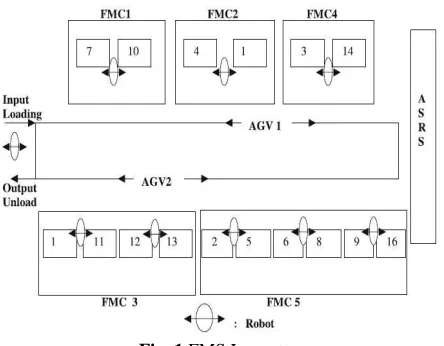
The FMS considered in this work. There are five flexible machining cells (FMCs), each with two to six computer numerical machines (CNCs), an independent and a self sufficient tool magazine, one automatic tool changer (ATC) and one automatic pallet changer (APC). Each cell is supported by one to three dedicated robots for intra cell movement of materials between operations. There is a loading station from which parts are released in batches for manufacturing in the FMS. There is an unloading station where the finished parts are collected and conveyed to the final storage area. One automatic storage and retrieval system (AS/RS) is used to store the work in progress. The five FMCs are connected by two identical automated guided vehicles (AGVs). These AGVs perform the inter cell movements between the FMCs, the movement of finished product from any of the FMCs to the unloading station and the movement of semi‐finished products between the
Fig. 1 FMS Layout
The assumptions made in this work are as follows: • There are 43 varieties of products for a
particular combination of tools in the tool Magazines using 16 machines in 5 FMCs. • The type/variety has a particular
processing sequence batch size, deadline and penalty Cost for not meeting the deadline and Reward if product completes before due date .
• Each processing step has a processing time with a specific machine in a required batch size, deadline and penalty cost and Reward.
• There is no constraint on the availability of pallets, fixtures, AGVs, robots, automated storage and retrieval system, cutting tools, and part programs as and when they are
needed at the required places.
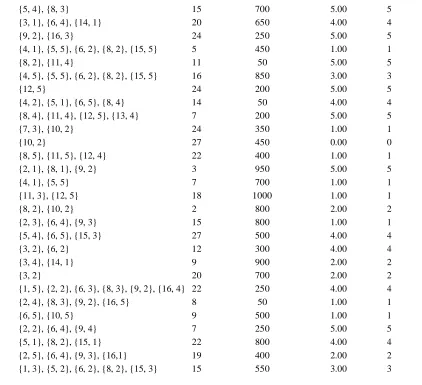
• A random product mix generated as shown in the Table 1 reflect the current market demand.
Part
No.
Processing sequence – {Machine No., Processing time (min)}
Deadline (days)
Batch size (Nos)
Penalty Rewards cost (INR/unit/day) (INR/unit/day)
1 {6, 1}, {7, 1}, {8, 1}, {10, 2} 17 150 1.00 1
2 {2, 1}, {6, 1}, {8, 1}, {9, 2}, {14, 4}, {16, 2} 17 200 1.00 1
3 {8, 1}, {11, 3}, {13, 4} 14 800 1.00 1
4 {9, 4} 26 700 2.00 2
5 {4, 5}, {5, 3}, {15, 4} 11 150 1.00 1
6 {6, 5}, {14, 1} 16 700 1.00 1
7 {3, 5}, {6, 3}, {16, 5} 26 250 2.00 2
8 {5, 4}, {6, 5}, {8, 1} 26 850 2.00 2
9 {4, 1}, {5, 5}, {8, 1}, {11, 1} 1 100 0.00 0
10 {2, 2}, {9, 1}, {16, 4} 20 150 2.00 2
11 {8, 4}, {12, 2} 1 250 1.00 1
12 {6, 2}, {8, 4}, {10, 1} 19 1000 3.00 3
13 {6, 1}, {7, 5}, {10, 4} 25 700 4.00 4
14 {4, 2}, {5, 3}, {6, 2}, {15, 2} 22 1000 4.00 4
15 {5, 4}, {8, 3} 15 700 5.00 5
17 {3, 1}, {6, 4}, {14, 1} 20 650 4.00 4
18 {9, 2}, {16, 3} 24 250 5.00 5
19 {4, 1}, {5, 5}, {6, 2}, {8, 2}, {15, 5} 5 450 1.00 1
20 {8, 2}, {11, 4} 11 50 5.00 5
21 {4, 5}, {5, 5}, {6, 2}, {8, 2}, {15, 5} 16 850 3.00 3
22 {12, 5} 24 200 5.00 5
23 {4, 2}, {5, 1}, {6, 5}, {8, 4} 14 50 4.00 4
24 {8, 4}, {11, 4}, {12, 5}, {13, 4} 7 200 5.00 5
25 {7, 3}, {10, 2} 24 350 1.00 1
26 {10, 2} 27 450 0.00 0
27 {8, 5}, {11, 5}, {12, 4} 22 400 1.00 1
28 {2, 1}, {8, 1}, {9, 2} 3 950 5.00 5
29 {4, 1}, {5, 5} 7 700 1.00 1
30 {11, 3}, {12, 5} 18 1000 1.00 1
31 {8, 2}, {10, 2} 2 800 2.00 2
32 {2, 3}, {6, 4}, {9, 3} 15 800 1.00 1
33 {5, 4}, {6, 5}, {15, 3} 27 500 4.00 4
34 {3, 2}, {6, 2} 12 300 4.00 4
35 {3, 4}, {14, 1} 9 900 2.00 2
36 {3, 2} 20 700 2.00 2
37 {1, 5}, {2, 2}, {6, 3}, {8, 3}, {9, 2}, {16, 4} 22 250 4.00 4
38 {2, 4}, {8, 3}, {9, 2}, {16, 5} 8 50 1.00 1
39 {6, 5}, {10, 5} 9 500 1.00 1
40 {2, 2}, {6, 4}, {9, 4} 7 250 5.00 5
41 {5, 1}, {8, 2}, {15, 1} 22 800 4.00 4
42 {2, 5}, {6, 4}, {9, 3}, {16,1} 19 400 2.00 2
[image:4.612.104.526.110.495.2]43 {1, 3}, {5, 2}, {6, 2}, {8, 2}, {15, 3} 15 550 3.00 3
Table 1 Machining sequence, time, deadline, batch size, and penalty details 5. RESULTS AND DISCUSSIONS The optimization sequence is obtained for 43 jobs, using combined objective optimization method. A comparison between the approaches namely SPT, CS, MCS and EDD has been presented in Table 2. In this work we have taken the scheduling problem with 43 parts and multi objective optimization approach is implemented. The result of different relating to the problem of 43 jobs is meticulously compared. Table 2 shows the results obtained by the proposed approaches (SPT, CS,MCS,EDD). It performs better in terms of objective functions and computational effort. The optimum sequence is obtained from the shortest processing time (SPT) approach that gives minimum total penalty cost and maximum total Reward. Algorithm SPT CS MCS EDD Penalty cost 81400 118400 181150 225800
Bonus 1058. 614 337 314
20,23,38,1,9,26 8,14,28,31,3,42 19,21,28,31,32,24 9,11,32,29,19,25 22,10,34,18,36, 26,33,22, 20,5, 30,3,39,11,14,15 30,41,39,36,40, 11,25,5,16,2,40, 24,2,4,18,7,18 41,12,13,17,16,33 5,21,35,3,24,15
17,6,29,35,37,15 35,40,37,15,17 40,34,22,27,37,42 31,12,43,10,17 39,42,27,33,3,43 39,6,2,34,1,29 6,29,7,27,25,10 37,14,28,38,42 19,13,12,32,30,8 27,16,36,30,25 20,2,23,1,5,38 18,23,26,13,4,7 14,21 32,13,3,11,10,9 9,26 8,16,27,34
Table 2 Comparison between various approaches
6. CONCLUSION
In the current business scenario and competitive environment among various manufacturing enterprises in order to achieve higher productivity, lower total penalty cost & high total bonus of the product as per market demand. In this work the optimum sequence is obtained based on the shortest processing time (SPT) approach. This method is implemented successfully for solving the scheduling optimization problem of FMS. FMS schedule is obtained for 43 jobs and 16 machines. The best sequence is obtained from shortest processing time (SPT) is analyzed for two objectives, i.e. minimizing total penalty cost and maximizing total reward. Future work will use some other algorithms to find the optimum results
REFERENCES
[1]
Guo, Z.X., Wong, W.K., Leung, S.Y.S., Fan, J.T., Chan, S.F. (2008). A genetic-algorithm-based optimization model for scheduling flexible assembly lines, The International Journal of Advanced Manufacturing Technology, Vol. 36, No. 1-2, 156-168, doi: 10.1007/s00170-006-0818-6.[2]
Kumar, A.V.S.S., Veeranna, V., Prasad, B.D., Sarma, B.D. (2010). Optimization of FMS scheduling using non- traditional techniques, International Journal of Engineering Science and Technology, Vol. 2, No. 12, 7289-7296.[3]
Jerald, J., Asokan, P., Prabaharan, G., Saravanan, R. (2004). Scheduling optimization of flexible manufacturing systems using particle swarm optimization algorithm, The International Journal of Advanced Manufacturing Technology, Vol. 25, No. 9-10, 964-971, doi: 10.1007/s00170-003-1933-2.[4]
Saravana Sankar, S. Ponnanbalam, S.G. Rajendran, C. (2003). A multiobjective genetic algorithm for scheduling a flexible manufacturing system, The International Journal of Advanced Manufacturing Technology, Vol. 22, No. 3-4, 229-236, doi: 10.1007/s00170-002-1464-2.[5]
Burnwal, S., Deb, S. (2013). Scheduling optimization of flexible manufacturing systemusing cuckoo search-based approach, The International Journal of Advanced Manufacturing Technology, Vol. 64, No. 5-8, 951-959, doi: 10. 1007/s00170-012-4061-z.
[6]
Udhayakumar, P., Kumanan, S. (2010).Sequencing and scheduling of job and tool in a flexible manufacturing system using ant colony optimization algorithm, The International Journal of Advanced Manufacturing Technology, Vol. 50, No. 9-12, 1075-1084, doi: 10.1007/s00170-010-2583-9.