Available online at www.ijrat.org
623
Hacker Detection In Wireless Sensor
Network
1T.Narendra Babu,2
I.Sai Durga Pravallika,
3Boypati.Rani Himaja,
4G.kusumanjali,
5A.V.Kavya sree
Assoc.Prof,CSE,Tirumala Engineering College,Nararaopet,India B.Tech Students , Tirumala Engineering College , Narasaraopet , India.
[email protected],[email protected] [email protected]@gmail.com
Abstract :Wireless sensor network (WSN) consists of sensor nodes. Deployed in the open area, and characterized by constrained resources, WSN suffers from several attacks, intrusion and security vulnerabilities. Intrusion detection system (IDS) is one of the essential security mechanism against attacks in WSN. In this paper we present a comparative evaluation of the most performant detection techniques in IDS for WSNs, the analyzes and comparisons of the approaches are represented technically, followed by a brief. Attacks in WSN also are presented and classified into several criteria. To implement and measure the performance of detection techniques we prepare our dataset, based on KDD'99, into five steps, after normalizing our dataset, we determined normal class and 4 types of attacks, and used the most relevant attributes for the classification process. We propose applying CfsSubsetEval with BestFirst approach as an attribute selection algorithm for removing the redundant attributes. The experimental results show that the random forest methods provide high detection rate and reduce false alarm rate. Finally, a set of principles is concluded, which have to be satisfied in future research for implementing IDS in WSNs. To help researchers in the selection of IDS for WSNs, several recommendations are provided with future directions for this research.
1. INTRODUCTION
Wireless sensor networks are composed of several sensors deployed in areas where the aim is to collect data and forward it for the analysis. It has become an increasingly interesting field of research in solving such challenging real-world problem, as environmental monitoring [1], military applications, geographical sensing and home automation. The properties of WSN show that sensor node is completely restricted by resources, including memory, energy, computing, communication and bandwidth. [2]. Therefore, the deployment of these kinds of networks with their resource restrictions makes their security issue essential, and vulnerable to various security threats. Key management and authentication have been used to protect WSNs from different attacks, encryption and authentication are the first security measures as the first line of defense for protecting WSN [3]. But cryptography based on secret key management are not enough to protect the WSN, because even in the presence of this first line of several attacks may extract sensitive information, and use them for malicious reason. However, Detection-based approaches are then proposed to protect WSNs from intrusion and attacks, as a second line defense, after the failure of the cryptographic techniques [4], Intrusion detection system (IDS) observes and analyzes the events generated in the network system to identify maximum security problems. IDSs are used to monitor the network to detect anything unusual. [5]. This concept was originally proposed by Anderson [6]. There are two principal approaches for detection, intrusion: Misuse detection based on rules, these rules will look for signatures on the network and then system operations try to catch known attack that should be considered as Misuse [7] [8]. Anomaly detection [9], which based on the normal behavior of a system, it compares normal activities against observed events to identify
significant deviations. The main scope of this paper is to improve that random forest technique is an efficient anomaly detection technique for IDS in WSN, with a comparative evaluation study for the most recent and performants anomaly detection technique used in IDS for WSN. In Section 2 we present a classification of existing attacks in WSN by several criteria. Section 3 introduces a survey of ids in WSN, and analyzes four recent anomaly intrusion detection techniques using in IDS for WSN: (K-means, Naives Bayesian, SVM, Random Forest), showing their principles, advantages and drawbacks. Simulation environment and results are presented in section 4, we simulated last techniques on KDD dataset using Weka tool, and results are based on matrices of confusion, detection rate, time of execution and memory consumption. At the end of the paper a conclusion is introduced, and a set of recommendations are suggested to boosting the performance of intrusion detection in WSN for future researches.
2. ATTACKS CLASSIFICATION IN WSN
An attack is a set of techniques, used to cause damage to a network by exploiting flaws in it. Attacks know several possible classification, the most used are grouped into the following categories:
A. According To The Origin Or Source Attacks:
Available online at www.ijrat.org
624 are the most serious threats that can disturb the WSN
[10][11].
B. Based On The Nature Of Attacks:
We can distinguish between passive and active attacks, the passive attack is limited to listening and analyzes exchanged traffic. This kind of attacks is difficult to detect and easier to realize, because the attacker does not make any modification on exchanged information.
The aims of the attacker can be the knowledge of the significant nodes in the network (cluster head node), or knowledge of confidential information by analyzing routing information. In the active attacks, an attacker tries to modify or remove the messages transmitted on the network, inject his
own traffic or replay of old messages to disturbing the operation of the network. [12].
C. Classification By Attacks Techniques:
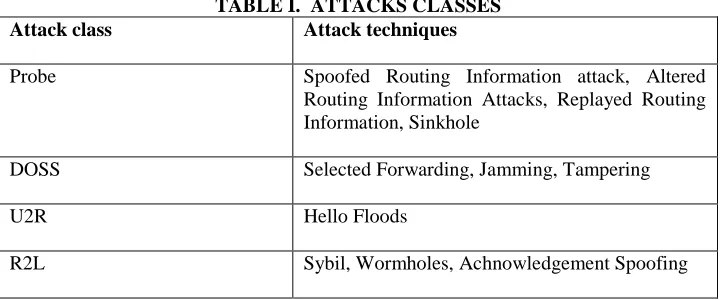
The spoofed, altered, or replayed routing information attack, and sinkhole attack: need to make a probe step before starting to attack, thereforeattack we can classified these attack as probe attacks. Selected forwarding, jamming, tampering: which uses illegitimate data forwarding to make attack, is known as a dos attacks? Hello floods caused by internal attacks, is classified as U2R attack. Sybil, wormholes, hello floods, and acknowledgment spoofing make the attack through the weakness of the system then they would be classified as R2L attack. In the table below we present the following main types of attacks, sorted by four principals
attack classes.
TABLE I. ATTACKS CLASSES
Attack class Attack techniques
Probe Spoofed Routing Information attack, Altered
Routing Information Attacks, Replayed Routing Information, Sinkhole
DOSS Selected Forwarding, Jamming, Tampering
U2R Hello Floods
R2L Sybil, Wormholes, Achnowledgement Spoofing
3. RELATED WORK
It has become clear that we cannot achieve the satisfactory level of security in WSN only by using cryptographic techniques, as these techniques fall prey to insider attacks. The attacker can compromise and retrieve the cryptographic material of a number of nodes [15]. In order to counter this threat some additional techniques such as intrusion detection system (IDS) has to be deployed. Any kind of unauthorized or unapproved activities are called intrusions. An IDS is a collection of the resources, methods and tools to help identify, evaluate, and report intrusions [16]. WSN led researchers develop strategies about providing stable networking and communications, and also about how to secure these strategies with limited resources.
In [17], a hierarchical framework for intrusion detection as well as data processing is proposed. Throughout the experiments on the proposed framework, they stressed the significance of one hop clustering. The authors believed that their hierarchical framework was useful for securing industrial applications of WSNs with regard to two lines of defense. Krontiris et al. [18] proposed a distributed IDS for
Available online at www.ijrat.org
625
TABLE II. IDS REQUIREMENT FOR WSN
Constraints and challenges of WSN Requirement of IDS
• No infrastructure in WSNs to support operations such as communications, routing, real time traffic analysis, encryption, etc.
• Nodes are prone to physical capture, tampering or hijacking which compromises network operations.
• Compromised nodes may provide misleading routing information to the rest of the WSN leaving the network un-operational (blackhole, wormhole, sinkhole attacks).
• Wireless communication is susceptible to eavesdropping, which would reveal important data to adversaries and/or to jamming/interfering, which would cause DoS in the WSN.
• There is no trusted authority; decisions have to be concluded in a collaborative manner.
• Not introduce new weaknesses to the system,
• Need little system resources and should not degrade overall system performance by introducing overheads,
• Run continuously and remain transparent to the system and the users,
• Use standards to be cooperative and open,
• Be reliable and minimize false positives and false negatives in the detection phase.
There are two basic approaches in IDS according to the used detection techniques [21]:
Misuse detection technique: compares the observed behavior with known attack patterns (signatures). Action patterns that may pose a security threat have to be defined and stored in the system. The advantage of this technique is that it can accurately and efficiently detect instances of known attacks, but it lacks an ability to detect an unknown type of attack.
Anomaly detection: The detection is based on monitoring changes in behavior, rather than searching for some known attack signatures. Before the anomaly detection based system is deployed, it usually must be taught to recognize normal system activity (usually by automated training). The system then watches for activities that differ from the learned behavior by a statistically significant amount. The main disadvantage of this type of system is high false positive rate. The system also assumes that there are no intruders during the learning phase.
Anomaly may be caused by security threats, or faulty sensor nodes in the network or unusual phenomena in the monitoring zone [22]. Isolated node failures can bring down the whole network, which is malicious to reliability of WSN. Researches in this field are yet absent to present the latest progress of developing anomaly detection in WSN. However, our paper expects acting as a guideline of selecting efficient and appropriate anomaly detection techniques, not just based on analyzing, comparing, and evaluating those particular approaches, but also according to the results of simulation, which shows the classification rate, confusion matrix, consumption of memory, and time to build every approach.
4. RSTUDY ANALYSIS AND EVALUATION OF
ANOMALY DETECTION TECHNIQUES IN WSN
A.Support Vector Machine Classifier
Support Vector Machines (SVMs) are supervised learning algorithms [24], which have been applied increasingly to anomaly detection in the last decade. One of the primary benefits of SVMs is that they learn very effectively from high dimensional data [25]. In WSN SVM is used to investigate spatial and temporal correlations of data for detecting suspect
behavior of a node. Many researchers have tried to find possible methods to apply SVM classification for large data sets. Sequential Minimal Optimization (SMO) is a fast method to train SVM [26], which breaks the large Quadratic Programming (QP) problem into a series of smallest possible QP problems. In [27] Kim et all applied SVMs to host based anomaly detection of masquerades. One-class quarter-sphere SVM, as a representative algorithm of SVM, is also suited to distribute anomaly detection [28]. First, the local quarter-sphere is computed at each common sensor node. Second, the cluster heads collects these locally computed radii to work out a global radius. Detection is then launched at each common sensor node with the global normal profile.
B.Random Forest Classifier :
Random forests are based on collection learning method for classification, that operate by constructing a multitude of decision trees, at training time and outputting the class, that is the mode of the classes output by individual trees. Random tree, on the other hand, involves construction of multiple decision trees randomly [30]. Each tree is constructed using the following algorithm:
Step1: Let the number of training cases be N, and the number of variables in the classifier be M.
Step2: We are told the number m of input variables to be used to determine the decision at a node of the tree; m should be much less than M.
Step3: Choose a training set for this tree by choosing n times with replacement from all N available training cases (i.e. take a bootstrap sample). Use the rest of the cases to estimate the error of the tree, by predicting their classes.
Step4: For each node of the tree, randomly choose m variables on which to base the decision at that node. Calculate the best split based on these m variables in the training set.
Available online at www.ijrat.org
626 classifier for the proposed intrusion detection framework. RF
gives better performance in designing IDS that is efficient and effective for network intrusion detection. the advantages and
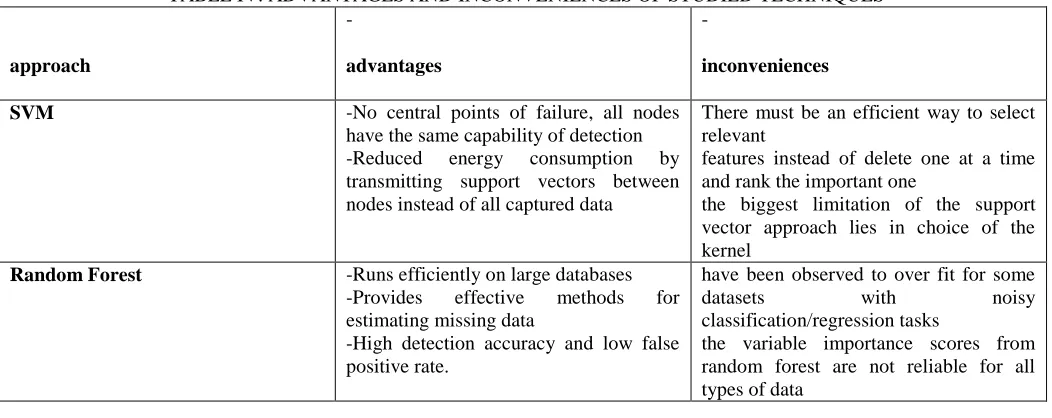
inconveniences of the studied techniques are presented in the following table:
TABLE IV. ADVANTAGES AND INCONVENIENCES OF STUDIED TECHNIQUES
approach
-
advantages
-
inconveniences
SVM -No central points of failure, all nodes
have the same capability of detection -Reduced energy consumption by transmitting support vectors between nodes instead of all captured data
There must be an efficient way to select relevant
features instead of delete one at a time and rank the important one
the biggest limitation of the support vector approach lies in choice of the kernel
Random Forest -Runs efficiently on large databases
-Provides effective methods for estimating missing data
-High detection accuracy and low false positive rate.
have been observed to over fit for some
datasets with noisy
classification/regression tasks
the variable importance scores from random forest are not reliable for all types of data
5. EXPERIMENT RESULTS
A series of experiments were conducted to simulate and evaluate each approach, to define the efficient detection technique for ids in WSN. We used several critical evaluation
metrics: Confusion matrix, general classification rate, time to build model, memory consumption. We prepared our data set, based on the standard KDDCup’99 intrusion detection dataset [32], into following five step, using Weka tool :
Fig. 1. Preparing dataset steps
Step1: in this step we structured all records on Attribute-Relation File Format (ARFF), which is an input file format used by the machine learning tool WEKA [33].
Step2: In this step we classed all types of attacks, on four principal categories. As shown the table [2].
Step 3: the main aims of this step is defining the number of records treated for each class as presented in table below, we used 70% in training stage and 30% in the test stage for each class
.
TABLE V. NUMBER OF RECORDS
Class Instances Number
Normal 10233
Dos 41748
Probe 441
R2L 96
Available online at www.ijrat.org
627
Step4: In general, a characteristic is good if it is relevant to the concept of class but not redundant to one of the other functions. Reduction of the attributes is a process of choosing a subset of the original attributes which feature space is reduced optimally at an endpoint.
In our experiment, Weka tool is used for reduction function.
CfsSubsetEval with BestFirst approach is applied to the set
of training data to obtain the relevant features for the classification process. Each subset was analyzed using correlation analysis to identify important features. The best known Measuring correlation is the linear correlation coefficient. For a pair of variables (x, y), the linear correlation coefficient r (x, y) is given by the expression below
The main principle of CfsSubsetEval method is evaluating the value of a subset of attributes by considering the individual predictive ability of each element as well as the degree of redundancy between them. It generates subsets of features that are highly correlated with the class while having a low cross correlation [34]. The results are presented in the table below:
Step5: In this step we implemented each technique on our dataset, using Weka tool. Below the result obtained based on confusion matrix, detection rate, time of execution and memory consumption.
A. Confusion Matrix:
In order to assess these techniques we take the confusion matrix, illustrated below:
TABLE VII. CONFUSION MATRIX APPROACHES
Generally each column of a matrix representsthe number of occurrences of an estimated class, while each row represents
Available online at www.ijrat.org
628
According to results, it is clear that memory is enough to compile each approach on Mica2 node or Telosb node, but for increasing the lifetime of the node, and taken on consideration the main aims of these techniques, detecting the different attacks (classification rate),we can say that Random forest technique is the efficient technique for detecting intrusion in wireless sensor network, with a higher rate classification (99.9544 %), reasonable required memory (11,62 KB), and building time(78,67 s). Indeed, the superiority of Random Forest intrusion detection technique, SVM, Naïve Bayes and K-means respectively, can be clearly deduced, in this order, according to confusion matrix, classification rate, memory, complexity, building time and memory consumption we can classify these techniques, from the higher to lower performant technique. Classification based on suitable feature selection is one of the main factors which reach the performance of IDS, especially in WSN.
6. CONCLUSION
The key challenge of evolving intrusion detection system in WSN is to identify attacks with high accuracy, and satisfied the required constraints and challenges, to prolong the lifetime of the entire network. This aims could be attained from several ways. Firstly paying much more attention to detection techniques used for attacks detection is characterized by efficiency and ability. Secondly, reconstructing detection mechanism with a distributed manner, to reducing the communication overhead. This paper has compared and evaluated the newest anomaly detection intrusion techniques used in wireless sensor network, to improve the efficient technique for IDS in WSN. According to the results, it is highly recommended to use the data mining techniques to detect effectively the intrusions and attacks in WSN. The decision of choosing efficient IDS is a compromise between technique employed and performance metrics. However, many issues are still open and need further research efforts such as hierarchical clustering patterns, using machine learning in resource management problem of wireless sensor networks, developing a classifier that is
trained well with network patterns, selecting and preprocessing an appropriate dataset. In addition, taking smart strategies into account such as compressing the input dataset, narrowing the scale of attributes set and simplifying the procedure of analysis and decision could make lots of progress for IDS to satisfy the requirement constraint of WSN without losing the security and reliability.
REFERENCES
[1] Akyildiz,I.F.,Su,W.,Sankarasubramaniam,Y.,Cayirci ,E.,2002.Wirelesssensor networks: asurvey. Comput Networks 38,393–422.
[2] Lopez J, Zhou J. Overview of wireless sensor network security. In: Wireless sensor network security. IOS Press, incorporated; May 2008. p. 1– 21.
[3] Perrig A, et al. SPINS: security protocols for sensor networks .Presented at the 17th ACM international conference on mobile computing and networks, 2001.
[4] Xiao Y, Rayi VK, Sun B, Du X, Hu F, Galloway M. A survey of key management schemes in wireless sensor networks. Comput Commun 2007;P: 30-23,14–41.
[5] Jaiganesh, V., Mangayarkarasi, S., & Sumathi, P.(2013). Intrusion Detection Systems: A Survey and Analysis of Classification Techniques. International Journal of Advanced Research in Computer and communication Engineering ,Vol. 2, Issue 4, April 2013
[6] Anderson JP. Computer security threat monitoring and surveillance. Fort Washing- ton, Pennsylvania: James P Anderson Co; April 1980.
[7] Kuperman, Benjamin A. "CERIAS Tech Report 2004-26 A CATEGORIZATION OF COMPUTER SECURITY MONITORING SYSTEMS AND THE
IMPACT ON THE DESIGN OF AUDIT
Available online at www.ijrat.org
629 [8] Govindarajan, M. "Hybrid Intrusion Detection Using
Ensemble of Classification Methods." International Journal of Computer Network & Information Security 6.2 (2014).
[9] Hu J. Host-based anomaly IDS. In: Springer handbook of information and com- munication security. Springer Verlag; 2010. Sensor Networks: A Survey; IEEE Communication Surveys; 2008.
[12] David Boyle, Thomas Newe. “Securing Wireless Sensor Networks: Security Architectures”, Journal of networks, Volume 3, No. 1, 2008.
[13] Rouba El Kaissi, Ayman Kayssi, Ali Chehab and Zaher Dawy, (2005)” DAWWSEN: A Defense Mechanism against Wormhole ttack In Wireless Sensor Network”,Proceedings of the Second International Conference on Innovations in Information Technology (IIT‟05).
[14] A. D. Wood and J. A. Stankovic,(2002) “Denial of service in sensor networks”,Computer, 35(10):54– 62, 2002.
[15] Ioannis Krontiris, Tassos Dimitriou, Thanassis Giannetsos, and Marios Mpasoukos. Intrusion detection of sinkhole attacks in wireless sensor networks. In Miroslaw Kutylowski, Jacek Cichon, and Przemyslaw Kubiak, editors, ALGOSENSORS, volume 4837 of Lecture Notes in Computer Science, pages 150–161. Springer, 2007.
[16] Richard Heady, George Lugar, Mark Servilla, and Arthur Maccabe. The architecture of a network level intrusion detection system. Technical report, University of New Mexico, Albuquerque, NM, August 1990.
[17] S. Shin, T. Kwon, G.Y. Jo, Y. Park, H. Rhy, “An experimental study of hierarchical intrusion detection for wireless industrial sensor networks”, IEEE Trans. Ind. Informat., volume 6, number 4, pages 744-757, 2010.
[18] I. Krontiris, T. Dimitriou and F.C. Freiling, “Towards Intrusion Detection in Wireless Sensor Networks”, Proc. 13th European Wireless Conference, 2007
[19] I. Onat and A. Miri, “An Intrusion Detection System for Wireless Sensor Networks”, IEEE International Conference on Wireless and Mobile Computing, Networking and Communications, 2005.
[20] S. Rajasegarar, C. Leckie, M. Palaniswami, J.C. Bezdek, “Distributed Anomaly Detection in Wireless Sensor Networks”, 10th IEEE Singapore International Conference on Communication systems, 2006.
[21] A. Patcha and J.M. Park, “An overview of anomaly detection techniques: Existing solutions and latest technological trends”, Elsevier J. Computer Networks, volume 51, number 12, pages 3448-3470, 2007.
[22] Rajasegarar S, et al. Anomaly detection in wireless sensor networks. IEEE Wireless Communications 2008;15:34–40.
[23] Y.EL Mourabit, A. Toumanari, H.Zougagh, “A Mobile Agent Approach for IDS in Mobile Ad Hoc Network”, International Journal of Computer Science Issues, Vol. 11, Issue 1, No 1, January 2014 [24] M. Burgess. Computer immunology. In LISA ’98:
Proceedings of the 12th USENIX conference on System administration, pages 283–298, Berkeley, CA, USA, 1998. USENIX Association.
[25] B.E Boser, I.M. Guyon and V.N. Vapnik. A training algorithm for optimal margin classifiers. In COLT ’92:Proceedings of the fifth annual workshop on Computational learning theory, pages 144–152, New York, NY, USA, 1992. ACM. ISBN 0-89791-497-X. [26] J.Platt, “Fast training of support vector machine
using sequential minimal optimization,” Advances in Kernel Methods: support vector machine, MIT Press, Cambridge, MA, 1998.
[27] H-S. Kim and S-D. Cha. 2004. Efficient masquerade detection using svm based on common command frequency in sliding windows.IEICE Transactions On Information And Systems Volume, E87-D, 2446–2452.
[28] S. Rajasegarar, C. Leckie, M. Palaniswami and J.C. Bezdek, “Quarter Sphere Based Distributed Anomaly Detection in Wireless Sensor Networks”, IEEE ICC ’07, Glasgow, U.K., June 2007.
[29] Bill C.P. Lau a, Eden W.M. Maa, Tommy W.S. Chow, “Probabilistic fault detector for Wireless Sensor Network”, Expert Systems with Applications 41 (2014) 3703–3711.
[30] Hastie, T., et al., The elements of statistical learning: data mining, inference and prediction. The Mathematical Intelligencer, 2005. 27(2): p. 83-85. [31] Abebe Tesfahun, D. Lalitha Bhaskari, “Intrusion
Detection using Random Forests Classifier with SMOTE and Feature Reduction”, 2013 International Conference on Cloud & Ubiquitous Computing & Emerging Technologies.