Extracting Word Sequence Correspondences
with Support Vector Machines
Kengo SATO and Hiroaki SAITO Department of Information and Computer Science
Keio University
3–14–1, Hiyoshi, Kohoku, Yokohama 223–8522, Japan
{satoken,hxs}@nak.ics.keio.ac.jp
Abstract
This paper proposes a learning and extracting method of word sequence correspondences from non-aligned parallel corpora with Support Vector Machines, which have high ability of the generaliza-tion, rarely cause over-fit for training samples and can learn dependencies of features by using a kernel function. Our method uses features for the trans-lation model which use the transtrans-lation dictionary, the number of words, part-of-speech, constituent words and neighbor words. Experiment results in which Japanese and English parallel corpora are used archived 81.1 % precision rate and 69.0 % re-call rate of the extracted word sequence correspon-dences. This demonstrates that our method could reduce the cost for making translation dictionaries.
1 Introduction
Translation dictionaries used in multilingual natu-ral language processing such as machine transla-tion have been made manually, but a great deal of labor is required for this work and it is difficult to keep the description of the dictionaries consis-tent. Therefore, researches of extracting transla-tion pairs from parallel corpora automatically be-come active recently (Gale and Church, 1991; Kaji and Aizono, 1996; Tanaka and Iwasaki, 1996; Kita-mura and Matsumoto, 1996; Fung, 1997; Melamed, 1997; Sato and Nakanishi, 1998).
This paper proposes a learning and extract-ing method of bilextract-ingual word sequence correspon-dences from non-aligned parallel corpora with Sup-port Vector Machines (SVMs) (Vapnik, 1999). SVMs are ones of large margin classifiers (Smola et al., 2000) which are based on the strategy where margins between separating boundary and vectors of which elements express the features of train-ing samples is maximized. Therefore, SVMs have higer ability of the generalization than other learn-ing models such as the decision trees and rarely
cause over-fit for training samples. In addition, by using kernel functions, they can learn non-linear separating boundary and dependencies between the features. Therefore, SVMs have been recently used for the natural language processing such as text categorization (Joachims, 1998; Taira and Haruno, 1999), chunk identification (Kudo and Matsumoto, 2000b), dependency structure analysis (Kudo and Matsumoto, 2000a).
The method proposed in this paper does not re-quire aligned parallel corpora which do not exist too many at present. Therefore, without limiting appli-cable domains, word sequence correspondences can been extracted.
2 Support Vector Machines
SVMs are binary classifiers which linearly separate d dimension vectors to two classes. Each vector rep-resents the sample which has d features. It is distin-guished whether given sample ~x = (x1,x2, . . . ,xd)
belongs toX1orX2by equation (1) :
f (~x)=sign(g(~x))=
(
1 ~x∈ X1
−1 ~x∈ X2 (1)
where g(~x) is the hyperplain which separates two classes in which w and b are decided by optimiza-~ tion.
g(~x)=w~ ·~x+b (2)
Let supervise signals for the training samples be expressed as
yi =
(
1 ~xi∈ X1 −1 ~xi∈ X2
whereX1is a set of positive samples andX2is a set of negative samples.
PSfrag replacements
X
1X
22/||w~||
~
w·~x+b=0
~
w·~x+b=1
~
w·~x+b=−1
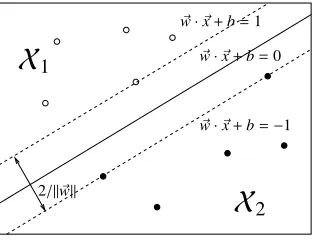
Figure 1: A separating hyperplain
satisfy equation (1). Therefore, give the following constraints :
[image:2.595.107.263.71.193.2]∀i, yi(w~ ·x~i+b)−1≥0 (3)
Figure 1 shows that the hyperplain which sepa-rates the samples. In this figure, solid line shows separating hyperplainw~ ·~x+b = 0 and two dotted lines show hyperplains expressed byw~·~x+b=±1. The constraints (3) mean that any vectors must not exist inside two dotted lines. The vectors on dotted lines are called support vectors and the distance be-tween dotted lines is called a margin, which equals to 2/||w||~ .
The learning algorithm for SVMs could optimize ~
w and b which maximize the margin 2/||w||~ or min-imize||w||~ 2/2 subject to constraints (3). According to Lagrange’s theory, the optimization problem is transformed to minimizing the Lagrangian L :
L= 1
2||w||~ 2+
n
X
i=1
λi yi(w~·~xi+b−1) (4)
whereλi ≥ 0 (i = 1, . . . ,n) are the Lagrange
mul-tipliers. By differentiating with respect tow and b,~ the following relations are obtained,
∂L ∂~w =w~−
n
X
i=1
λiyi~x=0 (5)
∂L ∂b =
n
X
i=1
λiyi =0 (6)
and substituting equations (5) (6) into equation (4) to obtain
D=−1 2
n
X
i=1
n
X
j=1
λiλjyiyj~xi·x~j+ n
X
i=1
λi (7)
Consequently, the optimization problem is trans-formed to maximizing the object function D subject to Pn
i=1λiyi = 0 and λi ≥ 0. For the optimal
pa-rameters λ∗
= arg maxλD, each training sample x~i
whereλ∗
i >0 is corresponding to support vector.
~
w can be obtained from equation (5) and b can be obtained from
b=yi−w~ ·x~i
where ~xi is an arbitrary support vector. From
equa-tion (2) (5), the optimal hyperplain can be expressed as the following equation with optimal parameters λ∗:
g(~x)= n
X
i=1 λ∗
iyi~xi·~x+b (8)
The training samples could be allowed in some degree to enter the inside of the margin by changing equation (3) to :
∀i, yi(w~ ·x~i+b)−1+ξi≥0 (9)
whereξi ≥0 are called slack variables. At this time,
the maximal margin problem is enhanced as mini-mizing ||w~||2/2+CPn
i=1ξi, where C expresses the weight of errors. As a result, the problem is to max-imize the object function D subject toPn
i=1λiyi =0
and 0≤λi≤C.
For the training samples which cannot be sepa-rated linearly, they might be sepasepa-rated linearly in higher dimension by mapping them using a non-linear function:
φ: Rd 7→Rd0
A linear separating in Rd0 forφ(~x) is same as a non-linear separating in Rdfor~x. Letφsatisfy
K(~x, ~x0)=φ(~x)·φ(x~0) (10)
where K(~x, ~x0) is called kernel function. As a result, the object function is rewritten to
D=−1 2
n
X
i=1
n
X
j=1
λiλjyiyjK(x~i, ~xj)+ n
X
i=1
λi (11)
and the optimal hyperplain is rewritten to
g(~x)= n
X
i=1 λ∗
Note thatφ does not appear in equation (11) (12). Therefore, we need not calculateφin higher dimen-sion.
The well-known kernel functions are the polyno-mial kernel function (13) and the Gaussian kernel function (14).
K(~x, ~x0)=(~x·~x0+1)p (13)
K(~x, ~x0)=exp −
||~x−x~0||2 2δ2
(14)
A non-linear separating using one of these kernel functions is corresponding to separating with con-sideration of the dependencies between the features in Rd.
3 Extracting Word Sequence Correspondences with SVMs
3.1 Outline
The method proposed in this paper can obtain word sequence correspondences (translation pairs) in the parallel corpora which include Japanese and En-glish sentences. It consists of the following three steps:
1. Make training samples which include positive samples as translation pairs and negative sam-ples as non-translation pairs from the train-ing corpora manually, and learn a translation model from these with SVMs.
2. Make a set of candidates of translation pairs which are pairs of phrases obtained by pars-ing both Japanese sentences and English sen-tences.
3. Extract translation pairs from the candidates by inputting them to the translation model made in step 1.
3.2 Features for the Translation Model
To apply SVMs for extracting translation pairs, the candidates of the translation pairs must be converted into feature vectors. In our method, they are com-posed of the following features:
1. Features which use an existing translation dic-tionary.
(a) Bilingual word pairs in the translation dictionary which are included in the can-didates of the translation pairs.
(b) Bilingual word pairs in the translation dictionary which are co-occurred in the context in which the candidates appear.
2. Features which use the number of words.
(a) The number of words in Japanese phrases.
(b) The number of words in English phrases.
3. Features which use the part-of-speech.
(a) The ratios of appearance of noun, verb, adjective and adverb in Japanese phrases.
(b) The ratios of appearance of noun, verb, adjective and adverb in English phrases.
4. Features which use constituent words.
(a) Constituent words in Japanese phrases. (b) Constituent words in English phrases.
5. Features which use neighbor words.
(a) Neighbor words which appear in Japanese phrases just before or after.
(b) Neighbor words which appear in English phrases just before or after.
Two types of the features which use an existing translation dictionary are used because the improve-ment of accuracy can be expected by effectively us-ing existus-ing knowledge in the features. For features (1a), words included in a candidate of the trans-lation pair are looked up with the transtrans-lation dic-tionary and the bilingual word pairs in the candi-date become features. They are based on the idea that a translation pair would include many bilingual word pairs. Each bilingual word pair included in the dictionary is allocated to the dimension of the feature vectors. If a bilingual word pair appears in the candidate of translation pair, the value of the corresponding dimension of the vector is set to 1, and otherwise it is set to 0. For features (1b), all pairs of words which co-occurred with a candidate of the translation pair are looked up with the trans-lation dictionary and the bilingual word pairs in the dictionary become features. They are based on the idea that the context of the words which appear in neighborhood looks like each other for the trans-lation pairs although expressed in the two different languages (Kaji and Aizono, 1996). The candidates are converted into the feature vectors just like (1a).
of the phrases of both languages in the translation pair. The number of constituent words of each lan-guage is used for the feature vector.
Features (3a) (3b) are based on the idea that there is a correlation in the ratio of content words (noun, verb, adjective and adverb) which appear in the phrases of both languages in a translation pair. The ratios of the numbers of noun, verb, adjective and adverb to the number of words of the phrases of each language are used for the feature vector.
For features (4a) (4b), each content word (noun, verb, adjective and adverb) is allocated to the di-mension of the feature vectors for each language. If a word appears in the candidate of translation pair, the value of the corresponding dimension of the vec-tor is set to 1, and otherwise it is set to 0.
For features (5a) (5b), each content words (noun, verb, adjective and adverb) is allocated to the di-mension of the feature vectors for each language. If a word appears in the candidate of translation pair just before or after, the value of the corresponding dimension of the vector is set to 1, and otherwise it is set to 0.
3.3 Learning the Translation Model
Training samples which include positive samples as the translation pairs and negative samples as the non-translation pairs are made from the training corpora manually, and are converted into the fea-ture vectors by the method described in section 3.2. For supervise signals yi, each positive sample is
as-signed to +1 and each negative sample is assigned to−1. The translation model is learned from them by SVMs described in section 2. As a result, the optimal parametersλ∗for SVMs are obtained.
3.4 Making the Candidate of the Translation Pairs
A set of candidates of translation pairs is made from the combinations of phrases which are obtained by parsing both Japanese and English sentences. How to make the combinations does not require sen-tence alignments between both languages. Because the set grows too big for all the combinations, the phrases used for the combinations are limited in up-per bound of the number of constituent words and only noun phrases and verb phrases.
3.5 Extracting the Translation Pairs
The candidates of the translation pairs are converted into the feature vectors with the method described in section 3.2. By inputting them to equation (8)
with the optimal parametersλ∗obtained in section 3.3, +1 or −1 could be obtained as the output for each vector. If the output is+1, the candidate corre-sponding to the input vector is the translation pair, otherwise it is not the translation pair.
4 Experiments
To confirm the effectiveness of the method de-scribed in section 3, we did the experiments where the English Business Letter Example Collection published from Nihon Keizai Shimbun Inc. are used as parallel corpora, which include Japanese and En-glish sentences which are examples of business let-ters, and are marked up at translation pairs.
As both training and test corpora, 1,000 sentences were used. The translation pairs which are already marked up in the corpora were corrected to the form described in section 3.4 to be used as the positive samples. Japanese sentences were parsed by KNP 1 and English sentences were parsed by Apple Pie Parser 2. The negative samples of the same number as the positive samples were randomly chosen from combinations of phrases which were made by pars-ing and of which the numbers of constituent words were below 8 words. As a result, 2,000 samples (1,000 positives and 1,000 negatives) for both train-ing and test were prepared.
The obtained samples must be converted into the feature vectors by the method described in section 3.2. For features (1a) (1b), 94,511 bilingual word pairs included in EDICT3were prepared. For fea-tures (4a) (4b) (5a) (5b), 1,009 Japanese words and 890 English words which appeared in the training corpora above 3 times were used. Therefore, the number of dimensions for the feature vectors was 94,511×2+1×2+4×2+1,009+890+1,009+890=
192,830.
S V Mlight 4was used for the learner and the clas-sifier of SVMs. For the kernel function, the squared polynomial kernel (p = 2 in equation (13)) was used, and the error weight C was set to 0.01.
The translation model was learned by the train-ing samples and the translation pairs were extracted from the test samples by the method described in section 3.
1http://www-lab25.kuee.kyoto-u.ac.jp/
nl-resource/knp.html
2http://www.cs.nyu.edu/cs/projects/proteus/
app/
3http://www.csse.monash.edu.au/˜jwb/edict.
html
0 20 40 60 80 100
0 2 4 6 8 10 12 14 16 18 20
rate (%)
[image:5.595.75.289.72.230.2]the number of the training samples (x1.0e02) Precision Recall
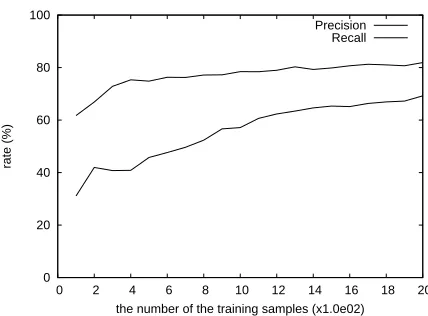
Figure 2: Transition in the precision rate and the recall rate when the number of the training samples are increased
Table 1 shows the precision rate and the recall rate of the extracted translation pairs, and table 2 shows examples of the extracted translation pairs.
Table 1: Precision and recall rate Outputs Corrects Precision Recall
851 690 81.1 % 69.0 %
5 Discussion
Figure 2 shows the transition in the precision rate and the recall rate when the number of the training samples are increased from 100 to 2,000 by every 100 samples. The recall rate rose according to the number of the training samples, and reaching the level-off in the precision rate since 1,300. There-fore, it suggests that the recall rate can be improved without lowering the precision rate too much by in-creasing the number of the training samples.
Figure 3 shows that the transition in the precision rate and the recall rate when the number of the bilgual word pairs in the translation dictionary are in-creased from 0 to 90,000 by every 5,000 pairs. The precision rate rose almost linearly according to the number of the pairs, and reaching the level-offin the recall rate since 30,000. Therefore, it suggests that the precision rate can be improved without lowering the recall rate too much by increasing the number of the bilingual word pairs in the translation dictionary.
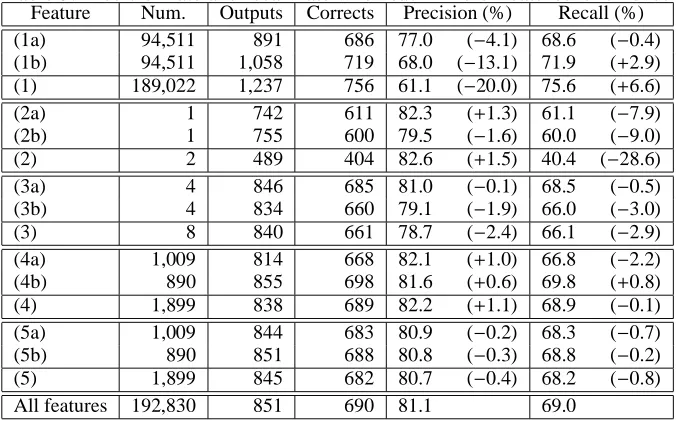
Table 3 shows the precision rate and the recall rate when each kind of features described in section 3.2 was removed. The values in parentheses in the columns of the precision rate and the recall rate are
0 20 40 60 80 100
0 10 20 30 40 50 60 70 80 90 100
rate (%)
the size of dictionary (x1.0e03) Precision
[image:5.595.318.535.72.230.2]Recall
Figure 3: Transition in the precision rate and the recall rate when the number of the bilingual word pairs in the translation dictionary are increased
differences with the values when all the features are used. The fall of the precision rate when the features which use the translation dictionary (1a) (1b) were removed and the fall of the recall rate when the fea-tures which use the number of words (2a) (2b) were removed were especially large.
It is clear that feature (1a) (1b) could restrict the translation model most strongly in all features. Therefore, if feature (1a) (1b) were removed, it causes a good translation model not to be able to be learned only by the features of the remainder because of the weak constraints, wrong outputs in-creased, and the precision rate has fallen.
Only features (2a) (2b) surely appear in all sam-ples although some other features appeared in the training samples may not appear in the test samples. So, in the test samples, the importance of features (2a) (2b) are increased on the coverage of the sam-ples relatively. Therefore, if features (2a) (2b) were removed, it causes the recall rate to fall because of the low coverage of the samples.
6 Related Works
Table 2: Examples of translation pairs extracted by our method
Japanese English
chairman of a special program committee
officially retired as
!"
would like to say an official farewell 30#
$!%'& ()
my thirty years of experience
*+,
-. /
%
sharpen up on my golf
Table 3: Precision rate and recall rate when each kind of features is removed
Feature Num. Outputs Corrects Precision (%) Recall (%)
(1a) 94,511 891 686 77.0 (−4.1) 68.6 (−0.4)
(1b) 94,511 1,058 719 68.0 (−13.1) 71.9 (+2.9)
(1) 189,022 1,237 756 61.1 (−20.0) 75.6 (+6.6)
(2a) 1 742 611 82.3 (+1.3) 61.1 (−7.9)
(2b) 1 755 600 79.5 (−1.6) 60.0 (−9.0)
(2) 2 489 404 82.6 (+1.5) 40.4 (−28.6)
(3a) 4 846 685 81.0 (−0.1) 68.5 (−0.5)
(3b) 4 834 660 79.1 (−1.9) 66.0 (−3.0)
(3) 8 840 661 78.7 (−2.4) 66.1 (−2.9)
(4a) 1,009 814 668 82.1 (+1.0) 66.8 (−2.2)
(4b) 890 855 698 81.6 (+0.6) 69.8 (+0.8)
(4) 1,899 838 689 82.2 (+1.1) 68.9 (−0.1)
(5a) 1,009 844 683 80.9 (−0.2) 68.3 (−0.7)
(5b) 890 851 688 80.8 (−0.3) 68.8 (−0.2)
(5) 1,899 845 682 80.7 (−0.4) 68.2 (−0.8)
All features 192,830 851 690 81.1 69.0
correspondence level of the word pairs. (Melamed, 1997) has proposed the Competitive Linking Algo-rithm for linking the word pairs and a method which calculates the optimized correspondence level of the word pairs by hill climbing.
These methods could archive high accuracy be-cause of the assumption of the sentence alignments for parallel corpora, but they have the problem with narrow applicable domains because there are not too many parallel corpora with sentence alignments at present. However, because our method does not require sentence alignments, it can be applied for wider applicable domains.
Like our method, researches which are not based on the assumption of the sentence alignments for parallel corpora have been done (Kaji and Aizono, 1996; Tanaka and Iwasaki, 1996; Fung, 1997). They are based on the idea that the context of the words which appear in neighborhood looks like each other for the translation pairs although expressed in two different languages. (Kaji and Aizono, 1996) has proposed the correspondence level calculated by the size of intersection between co-occurrence sets with the word included in an
ex-isting translation dictionary. (Tanaka and Iwasaki, 1996) has proposed a method for obtaining the bilingual word pairs by optimizing the matrix of the translation probabilities so that the distance of the matrices of the probabilities of co-occurrences of words which appeared in each language might be-come small. (Fung, 1997) has calculated the vectors in which the weighted mutual information between the word in the corpora and the word included in an existing translation dictionary was an element, and has used these inner products as the correspondence level of word pairs.
[image:6.595.136.474.189.400.2]it needs the positive and negative samples for the training data. However, the methods introduced above must learn a new model again for new cor-pora.
(Sato and Nakanishi, 1998) has proposed a method for learning a probabilistic translation model with Maximum Entropy (ME) modeling which was the same approach of the statistical ma-chine learning as SVMs, in which co-occurrence information and morphological information were used as features and has archived 58.25 % accuracy with 4,119 features. ME modeling might be similar to SVMs on using features for learning a model, but feature selection for ME modeling is more difficult because ME modeling is easier to cause over-fit for training samples than SVMs. In addition, ME mod-eling cannot learn dependencies between features, but SVMs can learn them automatically using a ker-nel function. Therefore, SVMs could learn more complex and effective model than ME modeling.
7 Conclusion
In this paper, we proposed a learning and ex-tracting method of bilingual word sequence corre-spondences from non-aligned parallel corpora with SVMs. Our method used features for the transla-tion model which use the translatransla-tion dictransla-tionary, the number of words, the part-of-speech, constituent words and neighbor words. Experiment results in which Japanese and English parallel corpora are used archived 81.1 % precision rate and 69.0 % recall rate of the extracted translation pairs. This demonstrates that our method could reduce the cost for making translation dictionaries.
Acknowledgments
We would like to thank Nihon Keizai Shimbun Inc. for giving us the research application permission of the English Business Letter Example Collection.
References
Pascale Fung. 1997. Finding terminology translation from non-parallel corpora. In Proceeding of the 5th
Workshop on Very Large Corpora, pages 192–202.
William A. Gale and Kenneth W. Church. 1991. Identi-fying word correspondances in parallel texts. In
Pro-ceedings of the 2nd Speech and Natural Language Workshop, pages 152–157.
Thorsten Joachims. 1998. Text categorization with sup-port vector machines: Learning with many relevant features. In the 10th European Conference on
Ma-chine Learning, pages 137–142.
Hiroyuki Kaji and Toshiko Aizono. 1996. Extracting word correspondences from bilingual corpora based on word co-occurrence information. In Proceedings
of the 16th International Conference on Computa-tional Linguistics, pages 23–28.
Martin Kay and Martin R¨oschesen. 1993.
Text-translation alignment. Computational Linguistics,
19(1):121–142.
Mihoko Kitamura and Yuji Matsumoto. 1996. Auto-matic extraction of word sequence correspondences in parallel corpora. In Proceeding of the 4th Workshop
on Very Large Corpora, pages 78–89.
Taku Kudo and Yuji Matsumoto. 2000a. Japanese de-pendency structure analysis based on support vector machines. In Proceedings of the 2000 Joint SIGDAT
Conference on Emprical Methods in Natural Lan-guage Processing and Very Large Corpora, pages 18–
25, Hong Kong, October.
Taku Kudo and Yuji Matsumoto. 2000b. Use of support vector learning for chunk identification. In
Proceed-ings of the 4th Conference on Computational Natural Language Learning and the 2nd Learning Language in Logic Workshop, pages 142–144, Lisbon,
Septem-ber.
I. Dan Melamed. 1997. A word-to-word model of trans-lation equivalence. In Proceedings of the 35th Annual
Meeting of the Association for Computational Lin-guistics, pages 490–497.
Kengo Sato and Masakazu Nakanishi. 1998. Maximum entropy model learning of the translation rules. In
Proceedings of the 36th Annual Meeting of the Asso-ciation for Computational Linguistics and the 17th In-ternational Conference on Computational Linguistics,
pages 1171–1175, August.
Alexander J. Smola, Peter J. Bartlett, bernha Sch¨olkopf, and Dale Schuurmans, editors. 2000. Advances in
Large Margin Classifiers. MIT Press.
Hirotoshi Taira and Masahiko Haruno. 1999. Feature selection in svm text categorization. In Proceedings
of the 16th National Conference of the American As-socitation of Artificial Intelligence, pages 480–486,
Florida, July.
Kumiko Tanaka and Hideya Iwasaki. 1996. Extraction of lexical translatins from non-aligned corpora. In
Proceedings of the 16th International Conference on Computational Linguistics, pages 580–585.
Vladimir Naumovich Vapnik. 1999. The Nature of
Sta-tistical Learning Theory (Statistics for Engineering and Information Seience). Springer-Verlag Telos, 2nd